Nemeth-Kellner Lymphoma Is a Valid Experimental
Model in Testing Chemical Agents for
Anti-Lymphoproliferative Activity
*
Maxim D. Lootsik1#, Maksym M. Lutsyk2, Rostyslav S. Stoika1
1Institute of Cell Biology, National Academy of Sciences of Ukraine, Lviv, Ukraine; 2Department of Histology, Cytology and
Em-bryology, Danylo Halytsky National Medical University, Lviv, Ukraine. Email: #[email protected]
Received August 6th, 2013; revised September 6th, 2013; accepted September 13th, 2013
Copyright © 2013 Maxim D. Lootsik et al. This is an open access article distributed under the Creative Commons Attribution Li-cense, which permits unrestricted use, distribution, and reproduction in any medium, provided the original work is properly cited.
ABSTRACT
Scheme of detection and investigation of antitumor activity of chemical substances by use of experimental murine Ne-meth-Kellner lymphoma (NK/Ly) are described. It includes monitoring of growth of NK/Ly ascites by everyday weighting of animals in course of intraperitoneal application of tested substance in 24 or 48 hours after inoculation of 107 tumor
cells. The inhibitory effect became distinct on the 6th - 8th day of experiment, and 3 types of response were observed: 1)
complete suppression of ascites development, corresponding to high antitumor activity of tested substance; 2) partial suppression of ascites growth (weak antitumor activity); 3) insignificant effect on ascites growth (lack of activity, at least towards hematoblastoses). As compared with leukemia L1210 or P388 lymphoma NK/Ly provides more distinct daily increment of body weight due to tumor growth. Clinical pattern of tumor development was supported by cyto-morphological investigations of tumor cells which included: 1) cells count in ascites; 2) measuring cell dimensions and ratio of enlarged cells in a population (diameter over 17 µm in case of NK/Ly); 3) quantitative evaluation of tumor cells damage by smears count after staining with azure-eosin, bromophenol blue and hematoxylin. In case of complete sup-pression of ascites growth the cytological investigation was conducted by delayed application of tested agent to animals with the developed ascites. After treatment with vinblastine or doxorubicin NK/Ly cells represent a convenient object for fractionation of cell population, as demonstrated by separation of giant and small tumor cell subpopulations.
Keywords: Nemeth-Kellner Lymphoma; Antitumor Substances; Screening
1. Introduction
Nemeth-Kellner lymphoma (NK/Ly) was developed in 1961 at National Oncological Institute in Budapest (Hungary) by an intraperitoneal inoculation of leukemia cells from spleen of an old inbred mice with spontaneous leucosis to a newborn mouse and subsequent transplanta-tion of developed tumor as ascites, thereafter as solid tumor [1,2]. Defined initially as lympholeukosis, after transformation tumor displayed properties of lympho- sarcoma [3]. During 1960-1990 the usefulness of this tumor model in screening antitumor substances was proved and confirmed by numerous investigations [4-9]. However, nowadays it is rarely used in experimental on- cology. Our long-term work with mentioned tumor mod-
el demonstrated its convenience in testing antitumor ac-tivity of different chemical substances. The versatile ap-proach consists of registering the dynamics of ascites growth at the initial stage and characterizing cytomor- phological changes of tumor cells under the influence of tested substance.
Besides we used lymphoma ascitic cells for fractiona- tion of cell populations. Here we demonstrated separa- tion of heterogeneous population of NK/Ly cells which is developed during treatment with doxorubicin into pure subpopulations of “giant” and “small” cells for further investigation of their properties.
The aim of present communication is to demonstrate the validity of NK/Ly model for detection and charac- terization of antitumor activity of chemical substances in
in vivo experiments as well as its usefulness for studies
of tumor cell biology and as a source of large amount of *The authors have no conflicts of interest to report. The authors alone
are responsible for the content and writing of this article.
L1210 cells, as described in [3,10]. Samples of ascites for transplantation were taken on the 7th - 8th day of
tu-mor growth. Experiments were performed on C57 black mice, 3 - 5 animals in control and experimental groups were processed simultaneously. Requirements of the European Convention on protection of vertebrate animals (November 13, 1987) and The Law of Ukraine, on pro-tection of animals from cruel behaviour” (March 28, 2006) were kept.
The following substances were used for experimental treatment of lymphoma: Vinblastine sulphate (“Gedeon Richter”, Hungary), Doxorubicin (“Arterium”, Ukraine), sapogenin-like substance, sanguinarine + chelerythrine (sanguerythrine) alkaloids from the Greater celandine were home prepared, as described [11,12]. Tested sub-stances were dissolved and stored as stock solutions in 50% alcohol at rate of 1 dose in 5 or 10 µl (applied doses are indicated in the figures). Just before application, stock solution was diluted with sterile distilled water or saline and injected intraperitoneally. Treatment was started in 24 or 48 hours after inoculation of tumor cells, as recommended for detection of antitumor activity [10]. Ascites growth was monitored by everyday weighting of animals during 30 days. Change in body mass was expressed in percents relatively to initial value, accepted as 100%, in order to adopt data for statistical analysis.
Cytological analysis included measurement of cell
diameter performed by using AxioVision release 2007 program (Karl Zeiss) on images of native cells in hemo- cytometric chamber taken with Canon A590 digital cam- era. A plot of distribution of cells according to dimen- sions was constructed on the basis of obtained data. A ratio of damaged cells in a population was determined by counting images of smears stained with azure-eosin (Romanovsky-Giemsa method), bromophenol blue for evaluating cell protein content [13,14], and hematoxylin for characterizing structure of nucleus and chromatin. As damaged, cells which differed from standard image of NK/Ly cell in the early stage of tumor growth (shape, dimension, intensity of staining, nuclei fragmentation, presence of cytoplasm vesicles) were defined. No less than 300 cells were counted on the images from each smear.
supernatant was centrifuged at 1500 g for 5 min, and sediment was retained for isolation of small cells. Su-pernatant was clarified by centrifugation at 2000 g for 10 min, and clear supernatant (cell free ascitic fluid) was collected and used as a medium for processing cell frac-tions. Giant cells were purified by suspending in cell free ascitic fluid and centrifugation for 1 min at 150 g. This procedure was repeated three times. Small sized cells were purified by centrifugation of cell suspension in as-citic fluid and collecting cells which sediment between 150 g for 3 min and 1000 g for 5 min. The purity of cell subpopulations was checked in the hemocytometric cham- ber.
2.3. Statistical Analysis
All statistical calculations were performed using Micro-softt Office Excel 2003 program. Significance of differ-ence between groups of data was determined by using Student’s t criterion, and significance was defined as p < 0.05.
3. Results
3.1. Effect of Tested Substances upon Growth of NK/Ly Ascites
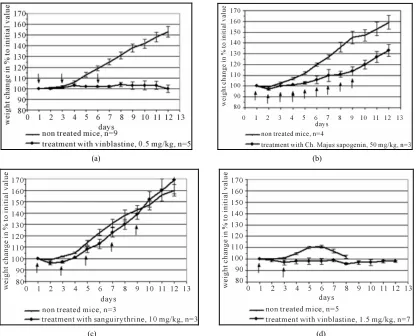
Three types of response in plots of body mass dynamics during treatment of animals with tested agents were ob- served (Figure 1). Routinely used antitumor drugs vin-
blastine and doxorubicin completely inhibited the devel- opment of ascites (Figure 1(a)), and thus may be ac-
cepted as standard in evaluation of potential antitumor drugs. The sample of sapogenin-like substance isolated from seeds of Greater celandine exhibited partial inhibi- tion effect towards NK/Ly ascites growth (Figure1(b)).
Similar effect was observed in application of purified antibodies developed by immunization of rabbits with microvesicles obtained from aged ascites. Mixture of sanguinarine and chelerythrine alkaloids isolated from Greater celandine showed no significant inhibition of NK/Ly ascites growth (Figure 1(c)), although in vitro
(a) (b)
[image:3.595.91.507.94.430.2]
(c) (d)
Figure 1. Principal types of development of NK/Ly ascites ((a)-(c)) under treatment with different substances and comparison with L1210 leukemia (d). (a) Complete suppression of ascites development at treatment with vinblastine or doxorubicin ap-plied intraperitoneally (i/p) as indicated by arrows (single dose 0.5 mg/kg). (b) Partial suppression of ascites growth at treat-ment with sapogenin-like substance isolated from Greater celandine, applied i/p as indicated by arrows (single dose 50 mg/kg). (c) Non-significant effect on ascites growth at treatment with sanguerythrine isolated from greater celandine, applied i/p as indicated by arrows (single dose 1.5 mg/kg). (d) Complete suppression of L1210 ascites growth at treatment with vin-blastine, applied i/p as indicated by arrows (single dose 2.5 mg/kg). In all graphs the scale is the same for comparison of body mass dynamics during development of NK/Ly and L1210 ascites.
MT-4 and SEM-T [15].
It should be noted that daily increment of body mass due to the development of NK/Ly ascites was expressed much more distinctly as compared with L1210 leukemia (Figure 1(d)).
After obtaining information about antitumor activity of tested agent (10 - 12 days) further investigation was con-tinued for studying animal survival. Accumulated ascites was periodically evacuated in control and treated animals at the same day for analysis of its characteristics (volume, total cell number and cytological pattern). In cases of complete suppression of development of NK/Ly ascites high probability of recovery or considerable prolongation of life of experimental animals was expected. Recovery is assumed when mouse survive for 90 days with no visi- ble signs of tumor [10]. In our studies death in about 60 days was usually caused by development of solid tumor
nodes in loci of injection. In contrary, suppression of L1210 leukemia ascites development was rarely followed by the recovery due to the appearance of endotoxicosis, which is a characteristic feature of this tumor strain, and which can be retarded but not totally eliminated even in suppression of ascites growth.
3.2. Effect of Tested Substances on Cytological Pattern of NK/Ly Cells
The results of monitoring tumor growth agreed with as-cites characteristics (volume of asas-cites, total number of cells, and quantitative cytomorphological evaluation of cell damage). In block of ascites production by strong antitumor agents these investigation can be performed in special experiments with delayed application of tested substance to well developed ascites, i.e. on the 7th - 9th
score of cell damage based on the evaluation of cell pro-tein content was much lower than one at staining with azure-eosin. The reason of that might be more intensive staining of many “giant” cells due to normal or increased intracellular protein content. Thus these cells were not registered as damaged, while according to the results of azure-eosin staining they differed significantly from typ-ical parental cells and were classified as damaged. He-matoxylin staining was shown to be of low informative validity, and its score was in close resemblance to the results of Romanovsky-Gimsa staining.
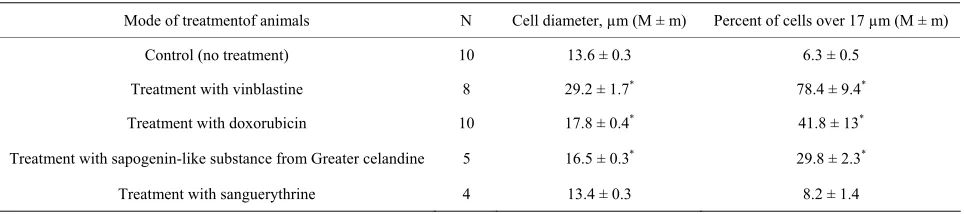
The level of cell alterations based on measuring cell dimensions and changes in their morphology correlated with the cytotoxic efficacy of tested agent.
Highly active antitumor substances of potential prac-tical significance induced highly significant (p < 0.001) changes in studied cytological indices versus control,
induced a more uniform subpopulation of “giant” cells. A significant difference in size of “giant” cells and the rest of the parental and other “small” cells permits separating these subpopulations by using low speed differential centrifugation. Light microscopy image of separated “giant” and “small” cells subpopulations is presented on
Figure2. Fractionof “giant” cells is rather uniform in
[image:4.595.58.540.456.563.2]size, while fraction of “small” cells is heterogeneous and contains small parental and degraded NK/Ly cells as well as mononuclears. Investigation of “giant” cells can be of interest in sense of their tumorogenic properties, as it has been shown that these polyploid cells can revert to pseu-dodiploid condition and cause a relapse of tumor growth [16-18]. Besides, fraction of “small” cells can be used for isolation of lymphocytes and further investigation of their cytotoxicity towards NK/Ly cells in vivo. We have
Table 1. Effect of tested substances on dimensional characteristics of NK/Ly cells.
Mode of treatmentof animals N Cell diameter, µm (M ± m) Percent of cells over 17 µm (M ± m)
Control (no treatment) 10 13.6 ± 0.3 6.3 ± 0.5
Treatment with vinblastine 8 29.2 ± 1.7* 78.4 ± 9.4*
Treatment with doxorubicin 10 17.8 ± 0.4* 41.8 ± 13*
Treatment with sapogenin-like substance from Greater celandine 5 16.5 ± 0.3* 29.8 ± 2.3*
Treatment with sanguerythrine 4 13.4 ± 0.3 8.2 ± 1.4
[image:4.595.59.540.604.725.2]*p < 0.01 vs. control.
Table 2. Cytological idexes of NK/Ly cells damage in treatment with tested substances.
% of damaged cells in population after staining with
Mode of treatment of animals N
Azure-eosin Bromophenol blue Hematoxylin
Control (no treatment) 8 26.8 ± 3.9 18.5 ± 1.5 13.2 ± 1.2
Treatment with vinblastine 8 80.2 ± 3.2** 51.9 ± 4.5** 71.3 ± 4.3**
Treatment with doxorubicin 5 83.8 ± 4.5** 27.4 ± 1.7** 78.5 ± 5.0**
Treatment with sapogenin-like substance from Greater celandine 4 70.2 ± 4.8* 27.3 ± 2.3* 63.0 ± 5.1*
Treatment with sanguerythrine 3 35.6 ± 4.4 23.0 ± 2.5 18.3 ± 2.3
[image:5.595.93.510.96.275.2]
(a) (b) (c)
Figure 2. Separation of “giant” and “small” cell subpopulations from NK/Ly ascites developed after treatment with doxoru-bicin. (a) Initial ascites, mean diameter of cells 15.3 ± 0.4 µm, ratio of cells over 17 µm 34.1%; (b) Subpopulation of giant cells, mean diameter of cells 33 ± 0.5 µm, ratio of cells over 17 µm 100%; (c) Subpopulation of small cells, mean diameter of cells 8.3 ± 0.1 µm, amount of cells over 17 µm 0%, cells below 12 µm 95.2%. Images are taken in the hemocytometric unit, square side corresponds to 50 µm and is used as a scale.
detected a massive infiltration of the abdominal cavity fluid with lymphocytes after reinoculation of tumor cells to mice, which have recovered after the first inoculation of NK/Ly cells and treatment with vinblastine or doxoru-bicin.
4. Discussion
The scheme is proposed on testing antitumor activity that permits answering a question if the tested substance ex- hibits antitumor activity in vivo or not. Obtaining positive
answer (Figure 1(a)) predicts the expediency of further
studies in a complex preclinical investigation of the po- tential antitumor agent (therapeutic effect, scheme of application, toxicity and side effects, drug technology etc.). Negative result (Figure 1(c)) may be interpreted as
absence of activity towards lymphoproliferative malig- nancies, and, thus, testing on tumors of another origin is reasonable. The results of investigation of substance ac- tivity on a panel of tumor cell lines can be used as a guide in choosing the type of tumor target. Besides, the used lymphoma NK/Ly permits revealing substances with moderate antitumor activity (Figure 1(b)), which is not
possible at employment of L1210 leukaemia.
There are several advantages of NK/Ly model, in par- ticular much better expressed increment of body mass due to tumor growth comparing that in L1210 leukemia.
In this property NK/Ly lymphoma resembles Ehrlich carcinoma which was also used in monitoring tumor growth [19,20]. Now we modified this approach by in- troducing relative values of weight expressed in percent of the initial weight value accepted as 100% in order to subject the data obtained in individual animals to statis-
tical analysis.
A complete suppression of growth of NK/Ly ascites in early stages of tumor development permits expecting with high probability of a recovery or considerable prolon- gation of life in the treated animals. In L1210 leukaemia it is not possible due to the development of endotoxicosis, a characteristic feature of this murine tumor strain, and in suppression of ascites growth it can be retarded but not stopped.
Here is reasonable to mention the data of Prihozhina and Vendrov [21] who revealed the karyotype identity of NK/Ly lymphoma, S-180 and S-37 sarcomas with Ehr- lich carcinoma according to chromosome number and set of chromosomal markers. This was interpreted as substi-tution of the former three tumor strains with Ehrlich car-cinoma and, consequently, to regard these tumors as the sub-strains of Ehrlich carcinoma. We suggest that it may be also another interpretation of those results in sense that identity of karyotypes of mentioned tumors indicates on a possibility of obtaining similar, yet not identical, results in testing activity of the antitumor agents. This thesis can be supported by comparison of sensitivity of NK/Ly lymphoma and Ehrlich carcinoma to a number of chemotherapeutic drugs [10]. Besides resemblance in response to many drugs Ehrlich carcinoma is more sensi-tive to 5-fluorouracile, cis-platine, hydroxyurea, and less sensitive to cytarabine then NK/Ly lymphoma.
Segek Gyogyszeres Keselese (Drug Treatment of Tumor Diseases),” Akademiai Kiado, Budapest, 1975, pp. 21-25. [4] A. Kurnatowski and R. Willighagen, “Cytochemistry of
the NK/Ly Lymphoma,” Nature, Vol. 193, No. 4886, 1963, pp. 91-92.
[5] E. Schauenstein, H. Zollner, M. Ernet and H. Esterbauer, “Experiments on the Therapeutic Effect of 4-Hydroxy- pen-Tenal. Inhibition of the Growth of Solid Nemeth- Kellner-Lymphoma,” Zeitschrift fur Krebsforschung und Klinische Onkologie, Vol. 76, No. 2, 1971, pp. 140-144. [6] L. Kopper, A. Jeney, K. Lapis and M. Torok, “Studies of
the Growth of an Ascitic Tumour. II A System to Study Tumour-Age Dependent Effect of Antitumour Agents,” European Journal of Cancer, Vol. 14, No. 1, 1978, pp. 75-82.
[7] L. Fiszer-Maliszewska, W. Peczyńska-Czoch, J. Wieczo- rek, M. Mordarski, R. Balicki and P. Nantka-Namirski, “Antineoplastic Activity of New Linear Hydrazine De- rivatives,” Archivum Immunologiae et Therapiae Experi- mentalis, Vol. 35, No. 2, 1987, pp. 225-235.
[8] Z. Machoń, J. Wieczorek and M. Mordarski, “Isothia- zolo-Pyrimidines—New Group of Anticancer Agents,” Archivum Immunologiae et Therapiae Experimentalis, Vol. 35, No. 5, 1987, pp. 599-607.
[9] G. G. Bratus’, O. P. Naumenko, E. P. Nastenko and O. I. Novichenko, “Morpho-Functional Characteristic of LY- MPH-OMA NK/Ly Cells Treated with Concanavalin A and Neura-Minidase of Vibrio cholerae,” Tsitologiya (Cytology), Vol. 32, No. 1, 1990, pp. 67-75.
[10] Z. P. Sofyina, A. B. Syrkin, A. Goldin and I. Klein, “Ex-perimental Evaluation of Antitumor Substances in USSR and USA,” Medicine, Moscow, 1980, pp. 76-77. [11] M. Lootsik, N. Boiko, M. Lutsyk and R. Stoika, “Purifi-
cation of Sapogenin from Seeds of Greater Celandine (Chelidonium majus L.) and Investigation of Its Influence towards Experimental Lymphoma NK/Ly,” Proceedings of Shevchenko Scientific Society, Section of Chemistry and Biochemistry, Vol. 28, 2011, pp. 150-159.
[12] M. D. Lootsik, M. M. Lutsyk and R. S. Stoika, “Sapoge- nins Isolated from the Greater Celandine (Chelidonium majus) Seeds Potentiate a Therapeutic Effect of Vinblas- tine towards Murine NK/Ly Lymphoma,” Studia Biolo- gica, Vol. 6, No. 3, 2012, pp. 29-38.
[13] P. Skehan, R. Storeng, D. Scudiero, A. Monks, J. Mc- Mahon, D. Vishca, J. Warren, H. Bokesch, S. Xenney and
, Vol. 177, No. 3, 2008, pp. 168-181. http://dx.doi.org/10.1016/j.toxlet.2008.01.009
[16] D. N. Wheatley, “Regrowth of Tumor Cells from Suppo- sedly Terminal Giant Cells,” Oncology News, Vol. 1, No. 3, 2006, p. 3.
[17] J. Erenpreisa, K. Salmina, A. Huna, E. A. Kosmacek, M. S. Cragg, F. Ianzini and A. P. Anisimov, “Polyploid Tum- or Cells Elicit Paradiploid Progeny through Deploidizing Divisions and Regulated Autophagic Degradation,” Cell Biology International, Vol. 35, No. 7, 2011, pp. 687-695. http://dx.doi.org/10.1042/CBI20100762
[18] P. E. Puig, M. N. Guilly, A. Bouchot, N. Droin, D. Cath- elin, F. Bouyer, L. Favier, F. Ghiringhelli, G. Kroemer, E. Solary, F. Martin and B. Chauffert, “Tumor Cells Can Escape DNA-Damaging Cisplatin through DNA Endore- duplication and Reversible Polyploidy,” Cell Biology In- ternational, Vol. 32, No. 9, 2008, pp. 1031-1043. http://dx.doi.org/10.1016/j.cellbi.2008.04.021
[19] J.-Y. Lin, K.-Y. Tserng, Ch. Chen, L.-T. Lin and T.-Ch. Tung, “Abrin and Ricin: New Anti-Tumor Sustances,” Nature, Vol. 227, No. 5255, 1970, pp. 292-293.
http://dx.doi.org/10.1038/227292a0
[20] M. D. Lutsik, “The Antitumour Activity of Phytohemag- glutinin from Viscum album L.,” Reports of Academy of Sciences of Ukrainian SSR, Series B, No. 6, 1975, pp. 543-545.