Munich Personal RePEc Archive
Economic analysis of resilience: a
framework for local policy response
based on new case studies
Regibeau, Pierre and Rockett, Katharine
Imperial College, London, CRAI, University of Essex, UK
1 October 2011
Online at
https://mpra.ub.uni-muenchen.de/38549/
1
Economic Analysis of Resilience: A Framework for Local Policy Response Based on New Case Studies
Pierre Régibeau* and Katharine Rockett**
April, 2012
Key Words: Resilience, Sustainability, EcoCulture, Governance, Insurance, Methodology
JEL Classification: Q56, R11,R58, Y01
*Imperial College, London and CRA International.
** University of Essex. Corresponding author: [email protected]
We would like to thank J. Hernandez for excellent research assistance, A. Bouet, W.
2
Abstract
A recent set of case studies on resilience of ecocultures forms the basis for our review
of and comment on the resilience literature. We note the diversity of definitions of
resilience and the confusion this creates in implementing resilience studies. We
develop a synthesis view that establishes a framework for defining resilience in an
implementable way. This framework emphasises the importance of defining the
source of and magnitude of shocks. Next, we outline measurement issues, including a
variety of performance measures that can be used to gauge resilience. We argue that
self-determination and local ownership of resources is supported in the cases, and
review the effectiveness of the informal insurance arrangements observed in the
cases. We close with the variables suggested by the case studies to include in a
3 I. Introduction
The purpose of this paper is to present a basis for policy discussions of resilience at the local level. We draw on data from a recent and new set of case studies of
resilience of “ecocultures”, broadly defined as the system by which a culture is linked with its environment (Pretty, 2011) to study the effects of a wide variety of shocks ranging from petrol price shocks to environmental change due to global warming to population depletion due to emigration. We unite our findings into a framework for study that should be sufficiently broad to apply to resilience discussion beyond ecocultures.
The paper starts with a definition of what is meant by “resilience” and how it relates to the concept of” sustainability”, which also is discussed in the case studies and is linked to resilience in many ways. We find a lack of clarity on the concept in the case studies that reflects an enormous spread of definitions used in the literature. This lack of a common vocabulary not only leads to a lack of comparability across the case studies, but also to difficulties implementing resilience policy locally: if actors cannot be sure of what they are discussing, communication becomes difficult and local policy poorly directed. We note that the core difference between resilience and sustainability is that resilience refers to the recovery of a system from shocks, whereas sustainability refers to maintaining current opportunities into the long run future. Although a sustainable system must be resilient to some degree the analysis of resilience is not completely subsumed in the analysis of sustainability, as it investigates a number of different dimensions, such as the speed of recovery of the system or the depth of the dip in performance of the system after a shock. These aspects are not essential to the broader study of sustainability. As a first element in our framework, we propose a definition of resilience that unifies a variety of approaches whilst providing some clarity on the concept.
4 literature. A selection of measures will be discussed including purely “economic” measures, such as gross national product, broader measures of well being such as the human development index, and more recent and subjective measures such as happiness. In the face of this lack of agreement in the literature, local agreement on the measure of resilience needs to be a cornerstone of any resilience policy before it is implemented locally: if actors are not implicitly using the same measure of performance in their definitions, policy support may not be well coordinated. The choice of measure, in turn, needs to be rooted in the determinants of local welfare. The measure is, then, the second element of the framework.
A further issue when measuring resilience is that we must state the type of shock – mild or severe, specific or broad-based -- to which we want our system to be resilient. A social system may be resilient to one type of shock but not to another, similar to the way a society may perform well on some measures and not others. Indeed, a feature of the case studies is that one observes that the policies followed by the ecocultures often are well designed to create resilience to certain threats, but actually make the culture less resilient to other threats: a “perverse resilience”, as it is termed in one of the case studies (Clifton, 2011). Hence, societies may face trade-offs in resilience policies where policy choice must be weighed by an evaluation of the likelihood and severity of certain types of threat. While this suggests that we need some method of aggregating threats to yield an idea of what we wish our region to be resilient to, this does not imply that we must use a method that simply takes the most likely threat. Indeed, precautionary methods such as real options analysis may be more desirable. Indeed, all aggregation methods that we review are imperfect, but some method must be chosen before undertaking any public consultation so that appropriate information is gathered to feed into the analytical method. The choice and measurement of shock is, then, our third element.
5 with our conclusions on a framework for analysis and pressure points where local governments can play a key role in promoting resilience.
I. Definition of Resilience
The definition of resilience has received considerable attention in the economics literature. We will start here with a rough definition that we can translate into measures. We will then contrast the definition to that of sustainability and move on to discuss some of the subtleties of the definition. These subtleties are important, as they can determine whether we consider any particular system resilient or not. We close with a framework that can be used as a basis for discussion in defining resilience as a prelude to policy consultation.
a. Resilience, and Sustainability: The Role of Shocks
As a first cut, resilience can be defined as the ability of an economy, society, organisation or individual to recover effectively from an unexpected shock. This rough definition of resilience raises two related questions: what it means to “recover” and what we mean by an effective recovery. An example might help illustrate how the two issues are linked as well as how they can be put into practice. Suppose that we only care about economic performance and that we take GDP per capita as our sole measure of this performance. The term “recovery” can then be made more precise. It might mean to go back to the same level of GDP per capita as before the adverse shock, or to reach the same growth rate in GDP per capita as before, or to reach the level of GDP per capita that would have prevailed at the same time had the shock not occurred. Any one of these, or other GDP levels, including even those lower than before the shock might be deemed a “recovery”. Once we know how to measure
6 This example raises a series of issues. First, resilience is quite distinct from sustainability, which has its own extensive literature. While resilience relates to recovery of a system from a shock, sustainability relates to the long term trajectory -- or opportunity set -- of a social system. Resilience requires definition of a shock to be applied, whereas sustainability does not. The cases that motivate this study include
examples that illustrate the distinction between “locally sustainable” but “globally
non-resilient” systems. The Puruvesi seine fishing community investigated by Mustonen, 2011, describes a system that is sustainable in the sense that it does not deplete its resources beyond the level at which they renew (so that its capital stocks, including natural capital, are not depleted). Further, the society is able to maintain consumption based on these resources potentially indefinitely when taken on its own terms. In this sense, it illustrates a locally sustainable system. On the other hand the case also shows that the same system is not resilient to the shock of changing outside opportunities, especially for youth. Indeed, emigration appears to be a major threat endangering the culture, as the study reports that there are no young seine fishermen at all in the community. Extinction is, then, a real threat when the shock of exposure occurs despite the sustainability of the system when not subjected to this shock.
b. Discounting: Resilience and Weight on the Short Term
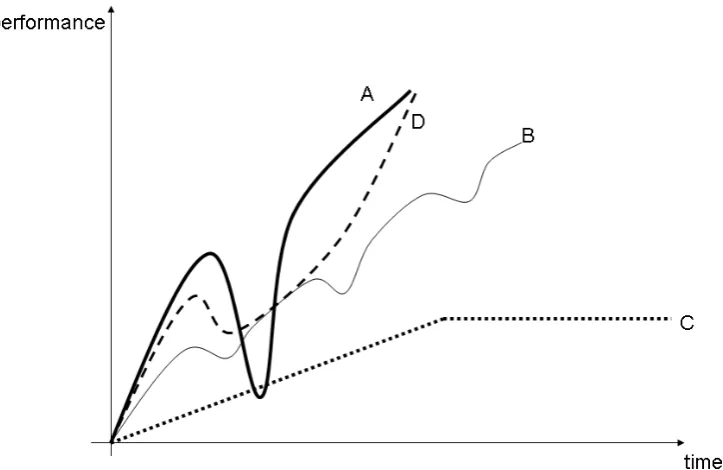
Our evaluation of resilience depends on the term of our analysis. Referring to our GDP example and postulating a set of growth trajectories illustrated in the figure, below, we have systems A and D which are differently resilient, but neither is necessarily more resilient than the other: our answer depends on whether resilience is defined as the depth of the dip in performance or the total discounted cost incurred during the dip. Further, A and D have the same long run performance so that in the long term there is little difference between the two. B is subject to more frequent dips (perhaps because it is susceptible to a greater variety of shocks but is more resilient to
each one) so that it is, again, “differently” resilient. B also has lower long run
7 For policy purposes, we need some basis for discussion to decide whether A, B, C or D would be the optimal policy or design for our system.
Figure 1
We need to have a guide on how much weight to allocate to the shorter or longer term in order to make such a policy choice. When we review the variety of definitions of resilience in the literature, however, we note that some focus purely on the long term viability of a system while others include some weight on shorter term viability. For example, extinction as opposed to short term fluctuations is the focus of the definition of Holling, 1973. Indeed, in this sense, the definition is more in line with what appears as sustainability in the economics literature and would single out trajectory C
as perhaps the least “resilient” despite its short term stability. On the other hand,
Perrings’, 2006, definition of resilience as “the ability of the system to withstand either market or environmental shocks without losing the capacity to allocate
8 To resolve this, we note that under any positive weight given to current generations, we are potentially concerned with both long and short term performance. Indeed, if the time to recovery is infinite, then the system is neither sustainable nor resilient from the point of view of the actors taking the decision today. This just states the implicit current state of play in policy: for example, all current policy suggestions on human population control as a means towards sustainable or resilient ecological systems takes current human well-being and human rights into account as a matter of law. This does not filter through into all the literature on the definition of resilience, however, nor does it filter through to a precise weight to apply in economic analysis to shorter versus longer term policy. Indeed, economic analysis does not provide the tools to specify a single “right” discount rate. Instead, the precise weight must be the subject of discussions that establish a framework for resilience policy and can only be the fruit of open consultation. We are left, then, with little direction from the literature but with implicit weight given to current generations’ well being in practice.
What is needed is an explicit time frame given to policy so that all participants are on the same page in developing policy responses.
Holling and others draw a distinction between stability and resilience, where stability refers to (short term) fluctuations of a system such as the system’s population, whereas resilience refers to the (long term) persistence of the ecosystem itself to retain its functional characteristics. Hence, a resilient system can still fluctuate greatly in the short term where we have low stability in the face of long term resilience. Common and Perrings, 1992, translate this distinction into economic modelling, suggesting that stability refers to fluctuations in variables and resilience refers to constant parameters of a system. Our view is that this distinction is not crucial to economic modelling. If we accept the Common and Perrings interpretation then this distinction is actually just a modelling choice: it is up to the modeller to determine what will be parameterised and what will be left as variable in any
economic study. The choice is determined by the focus of the study: what is left variable usually is the focus of the model and the behaviour of that variable is the reason for conducting the modelling exercise. If we are interested in the characteristics or function of a system, as we might be in a resilience study à la
9 functioning would be the focus of our modelling (and would appropriately be left as variable rather than parameterised). Hence, stability and resilience are not distinct
concepts in Hollings’ sense in economic modelling and need not be made. What is distinct is whether one focuses on the short or the long term or on both, as we discussed above. Economics itself is agnostic about the focus, potentially allowing for a weight to be placed on either term and potentially allowing any aspect of a system to be a variable of interest. The role of government is clear, however, in that it is the facilitator of the process that determines the time frame to be used in resilience policy based on local preferences and social welfare.
c. Performance versus Structural Evaluation
Our example, above, of GDP measurement is an interpretation of resilience based on an output or performance measure rather than on the structural features of the system
underlying that measure. We defined “recovery” in a way that leaves our measure of systemic “health” (GDP per capita in the example) at its original level but allows the
underlying system to look rather different after the shock: while the performance measure may have recovered to earlier levels, that performance may be derived from an evolved social system. This performance view is consistent with the idea of introducing important changes to societies to improve the stability of their livelihoods via projects to diversify food sourcing methods or energy production.
On the other hand, Walker et al, 2004, have defined resilience as “the capacity of a system to absorb disturbance and reorganize while undergoing change, so as to retain
essentially the same function, structure, identity and feedbacks.” Hence, this definition encompasses the stability of a structure, rather than focus purely on the performance outcomes of that structure.
10 Hayashi, 2011, view (ecoculture) resilience as persistence of cultural properties that represent the combined works of man and nature. These three studies view resilience as the maintenance of a co-evolving system of humans and their environment, although both take a performance measure, the well-being of the humans, as one
outcome of interest. Qingwen and Li, 2011, and aspects of Clifton, 2011, examine more narrowly ecological resilience, and focus on the importance of knowledge as a means of adaptation to shock rather than on resilience per se. Finally, Mustonen, 2011, focuses on a particular technology (seine fishing), a structural characteristic. A common thread is that resilience refers to maintenance of some variable, but this may be a performance measure or the structure of a system or sub-system or even a mix of both. Hence, we need to decide for policy discussion whether resilience will refer to a performance or a structural outcome or whether positive weight will be placed on both.
The case study of Uttarakhand (Vihar and Doon, 2011) points to an interesting subtlety of this choice. Two valleys faced with climate change are contrasted, one of which has moved away from agriculture into other income sources, modified agricultural practices significantly, and exploited transport routes to integrate into the rest of Indian society to effect a large scale transformation in the livelihood of the valley. The other valley has kept its traditional crops and agrarian focus but draws on government support to maintain this structure with acceptable levels of consumption. Which of these valleys has been more resilient? In this case, the authors point out that one would not want to identify societies that adapt significantly to change as non-resilient. In other words, we should not interpret the definition of resilience as implying that the system itself should remain unchanged. Surely the ability of a system to change itself without unnecessary upheavals in the face of external shock must be part of any sensible notion of resilience. One would like a definition of resilience to include those societies that are plastic, as long as the change occurs in an orderly and incremental fashion1. On the other hand, if we define the function of the society as being anything other than simply maintaining the well-being of the
1
11 populous, then one of these two valleys may have lost its “function” by essentially extinguishing its previous ecoculture. Any weight placed on structure, often
introduced via an attempt to capture the “function” of a society, may tend to make a
rigid response look more resilient than a large adaptation.
The authors of this case study discuss well-being measures of the populations of the two valleys, pointing out that the valley with the rigid response also is the valley with the lower levels of well-being (measured by a variety of performance outcomes including satisfaction levels as well as development measures). Indeed, economic modelling, based as it is on a utilitarian philosophy, usually takes performance measures as the outcome of interest. In this sense, economics takes performance as
“trumping” any functional or structural characteristic. Taking a performance measure
as the basis for evaluation automatically incorporates adaptability into an economic study of resilience although some outcomes of interest, such as distributional issues, could be incorporated into performance but generally are not. The argument to place full weight on performance measures, whatever those are, is, then, that any weight given to structural measures rules out large adaptations that may be desirable responses to certain types of shock.
An alternative method of incorporating adaptability into the analysis is presented by Perrings, 1998, who suggests that a system is resilient if it maintains its basic organisation in the face of exogenous shocks without undergoing “catastrophic,
12 The study of Greenland by Hayashi, 2011, and the study of Bangladesh by Bunting et al, 2011, identify a role for governmental bodies in the introduction of new features that allow the society to adapt in the face of environmental change. In other words, one primary role for government is to identify changes and ensure that they do not occur in a catastrophic manner. The interventions in the cases take the form of introducing new techniques of earning livelihood (techniques of hunting new species in the case of Greenland and techniques in agriculture and aquaculture in the case of Bangladesh). Clifton, 2011, identifies the government’s role in sedentarisation of the Bajau, intended as a way of integrating these basically nomadic people into the mainstream of Indonesian society, but instead resulting in significant social exclusion.
Which performance measure is more appropriate depends in part on the question policy wishes to answer with the resilience study. We answer the question of “If we wish to maintain performance under stress, in what way and by how much will
society need to change?” or “If we subject the society to stress, what will the cumulative cost be before the society reaches a new state of stability in both
performance and structure?” then a cost of adjustment outcome would be appropriate. If we wish to answer “If we subject a given societal structure to stress, by how much
will performance suffer?” then we would take the performance of our measure of
well-being as our focus.
d. A Synthesis
In sum, we are faced with a variety of points that need to be specified in order to develop resilience policy: we need to define a term of analysis, outcome measures that we target, and a measure of the nature of change. One way to achieve this could be to require that any definition of resilience comprise three elements: what one cares about (i.e. what is worth preserving or returning to), the type of shock with respect to which resilience is assessed, and a metric telling us how effectively the system maintains or returns to what one cares about after a shock is experienced. For example, one might care about infant mortality, study resilience with respect to tsunamis, and measure the performance of the system in terms of the loss of well-being (e.g. extra infant
13 incorporate the idea that the nature of change – catastrophic or gradual – affects whether we consider a system resilient or not.
A distinction of this approach is that we place considerable emphasis on identifying the source(s) of the shock(s). Identifying the source of the shock is surprisingly rare in applied work on resilience. It is our focus because we wish to take a management perspective on the ecoculture, rather than an ex post perspective: if we wish to be able to manage the system so as to generate resilience, we need to know which measures to undertake. Since the appropriate measures tend to be specific to the type of shock, we need to be able to prioritise. We return to methods of prioritising later in the paper. For the moment, we merely signal the importance of the source of the shock as part of the definitional framework.
Further, notice that the integrity of the system itself will play no role in our assessment of resilience, although the cost of change does. Indeed, this approach implies that we should only care about retaining the “function, structure, identity and feedbacks” of the system if these have (performance) value in themselves. In other words, the list of what one cares about as outcome measures defines the list of elements we must return to: the precise elements are not integral to the definition itself and will change depending on the priorities and preferences of the region itself. The definition is a priori agnostic about how flexible or rigid we are in defining what
we are to return to compared to the original “base” structure we evaluate. As such, it
hopefully captures a broad spectrum of interpretations of what “resilience” can mean.
Applying this approach to a particular definition of resilience, consider the intriguing economic study of regional resilience conducted by Musson, 2011. She defines
regional resilience for her study to mean “maintaining or enhancing the attractiveness
14 cost of alternative policies, and the type of shock to be faced colour the responses. Indeed, the responses are difficult to compare and analyse partly due to this. A similar lack of clarity dogs the case studies that are the data for this paper. What we attempt is a template to ensure clarity of implementation so that more can be gleaned from these resilience analyses.
II. Multiple Equilibria, Threshold Effects and Path Dependence
If we push our definition further to consider how to implement mathematically a definition of “resilience”, we find two additional concerns: those of threshold effects and path dependence. Even if we do not wish to construct a mathematical model, policy discussion surrounding resilience will need to address these concerns in order to obtain desirable consequences from policy interventions.
Most economic modelling is equilibrium modelling. Equilibrium is, roughly speaking, the behaviour that a system “tends towards” if there are no shocks. If a system has a stable equilibrium, then it will tend to move back towards the same behaviour even after a shock. Hence, stability could be interpreted as a general mathematical implementation of the concept of “resilience”, which can be translated directly into formal economic modelling.
15 hand, a sufficiently large shock can push a system from one equilibrium to the other, making the system return not to the original equilibrium but to a new state2.
If we stick to a narrow interpretation of “resilience as stability of the original equilibrium”, we have several problems. First, a move in response to stress from the less desirable to the more desirable equilibrium could be seen as a lack of resilience. Such an approach would not make much sense if we wish to allow for improved performance as an outcome for a resilient society. This suggests that resilience should not be defined in terms of a specific equilibrium but in terms of some measure of performance that can be compared across equilibria, where behaviour can differ considerably between the equilibria. This allows upwards movements in performance to be distinguished from downward movements, with resilience policy aiming at more restriction of downward movement. This is consistent with the general approach implicitly taken by the case studies in this project: the authors and the members of the societies studied do not seem to be concerned that their lives are improving too much. Rather, they are concerned solely with reductions in well-being.
Multiple equilibria can also mean that a system might be highly resilient to small shocks but very non-resilient to large shocks. This could be the case if a system exhibited threshold effects (so that small shocks had little effect on the equilibrium but large shocks caused the equilibrium to change). Both of these features are common in economic models of the effects of environmental change3 as well as policy discussions of climate change. For example, the effects for Europe of a cessation of the Gulf Stream accompanying a global temperature increase could be dramatically different from the effects of a change in global temperature without a Gulf Stream effect. As part of the specification of the source of the shock on a system that we discussed above, we should then add that any specification of resilience must include the magnitude of the shock since policies may be specific to magnitudes as
2
This is similar to the Walker et al, 2004, concept of the “latitude” of a system: the degree to which it can be perturbed and still return to the original state. The difference between latitude and our point about stability is our emphasis that the original state is not necessarily the desirable one: our view is
that the concern about “latitude” is not symmetric: policy wishes to restrict downward and not upward movements.
3
16 well. We will return specifically to the distinction between resilience to large versus small shocks when we discuss insurance, below.
As Bruneau et al, 2003, point out, a further important issue with multiple equilibria is the speed and path of adjustment of a system from one equilibrium to another, not just the change in equilibrium itself. In other words, the adjustment process itself may have desirable or undesirable features, regardless of the final performance level at the equilibria. The first concern echoes Perrings’, 1998, concerns outlined above, that the features of this adjustment path can affect the type of policy change we recommend, as the transition period from one equilibrium to another might need to be supported with policies to ease the adverse performance consequences of change. A second and more novel concern about adjustment is that the equilibrium of a system may be path-dependent, where decisions from the past may limit the features of the equilibrium one can have in the future. In other words, the transition process itself can affect the nature of the equilibrium that is finally attained, making the final state sensitive to inter-rim decisions4. Hence, any policy decision on how to intervene needs to evaluate the short term conditions that can shape long term outcomes: even if one takes a very long term perspective on resilience, then, one cannot ignore short term behaviour in any sense.
Summarising, then, a resilience study needs to be sensitive to the presence of multiple equilibria. While focussing on performance measures can overcome certain problems with multiple equilibria, threshold effects may imply that distinct analyses for large and small shocks must be conducted. Finally, path dependence can imply that short term analysis must form part of the study, as the short term behaviour and policies can limit long term attainable states.
III. Measuring Resilience: Defining Goals and Sources of Shocks
If we take the performance perspective discussed above in order to measure resilience we need some standard of performance (or “health”) to which we wish our system to
4
17 return after a shock. The case studies in this project illustrate the possibility of using single-dimensional economic measures (such as income or consumption, as in Sedlmayer and Boehm, 2011, or Accorigi, 2011) or environmental measures (as in Qingwen and Li, 2011). Such an approach could be misleading, however, as societal performance may be highly multidimensional.
Many multi-dimensional indices have been proposed. For example, the Human Development Index, used by the United Nations Development Programme as a measure of well-being, includes measurements of real income, lifespan and education5. The HDI index is relatively well correlated with subjective well-being for a broad variety of countries6, where subjective well-being has been measured in a variety of ways. Reviewing a large number of papers, Blanchflower and Oswald, 2011, broadly suggest that subjective well-being defined as “happiness” can be measured as a function of age, gender, income, education, marital status, diet, other personal characteristics, regional characteristics, and country characteristics. Hence, happiness is a composite measure reflecting a large number of societal features. High levels of measured happiness also correlate relatively well with low societal inequality, high social capital and strong friendship networks, low unemployment and inflation, high levels of democracy and democratic participation, high levels of trust, strong welfare states and public spending and low pollution7.
Blanchflower and Oswald point out, however, that no clear causal link has been established between societal correlates and happiness. In other words, while happiness seems to be related to whether one eats a diet rich in fruit and vegetables, it is not clear that forcing us all to become vegetarians would actually cause our measured happiness to rise. Hence, the point here is two fold. First, the performance measure we choose will determine how systems appear to fare in terms of resilience. Second, since societal characteristics relate to well-being as correlations and not causations, it is not clear how we should “engineer society” in order to obtain higher resilience
5
(See http://hdr.undp.org/en/statistics/hdi/ for more detail).
6
There is rough positive correlation between the human development index and some measures of subjective well-being. See Johnson, 2010 (figure 2). Some discussion complementary to
Blanchflower and Oswald, 2011, on the measurement of subjective well-being also is available in this paper.
7
18 based on such a measure. Indeed, for policy purposes the choice of an index such as happiness may not be very useful: if we cannot control it by clear policy levers, then its use in a study will not yield any useful policy recommendations.
Bruneau et al, 2003, comment that the measure of resilience can potentially be multi-dimensional, where they consider reduced probability of failure of a system, reduced consequences of failures -- should they occur -- and reduced time to recover from failure as three dimensions. In practice, then, we might measure “resilience” by an index that weighs each aspect of resilience and combines them into an overall aggregate. We might, for example, measure performance and structural change and the degree of both as well as some concept of the dislocation that has occurred along the adjustment path. Each receives a weight, determined by preferences of the region, and as diagnosed by the policy-maker. Alternatively, we might care about only a single aspect, such as social wellbeing, but that aspect might not be the same in all societies or in all time periods. For example, while health concerns were the sole motivating force behind the Clean Air Act in the United States in the early 1970s, current debate on this legislation takes into account other considerations. In other words, some dimensions might receive a weight of zero, but this weight may change over time as policy revisions occur and societal preferences change. Clearly, the choice of weights can also affect whether a society appears resilient or not.
Note that local resilience policy may have substantial externalities to other regions. This means that the choice of preference of one region may constrain the choices available to another. Where such externalities exist, coordinated choice across regions is appropriate in both the choice of goals and weights. To return to the case of clean air, externalities can be far more significant than in the case of land contamination. Hence, the degree of externalities determines the degree of regional control over resilience policy, and will tend to vary with the type of variable resilience
policy is addressing. There is no “one size fits all” recommendation on where
resilience policy should be seated.
19 There may be a presumption that, because it reduces a community’s ecological
footprint, moving from “modern” to more traditional or organic methods also increases “resilience”. This might or might not be true depending on the mechanism
through which organic food promotes resilience. For example, one could argue that, by reducing dependence on chemical products that are imported, organic farming makes the community more resilient to unexpected shocks in international transport prices, changes in exchange rates, or even politically motivated embargoes. On the other hand it might be that organic farming is actually more vulnerable to sudden infestations of pests that are, for example, new to a region. Hence while organic farming could perform well in the face of oil price shocks, it could perform poorly in the face of the appearance of a new species due to climate change. The point is that to the extent that a policy is specific to certain types of threat, any given policy has the
potential drawback of creating “perverse resilience” in the sense of creating a society
that is very stable in one sense, which could be an advantage in response to certain threats but a disadvantage when faced with other circumstances. Clifton’s 2011 study of the Bajau proposes the term “perverse resilience”, in fact, when referring to the
society’s focus on subsistence in the face of a need to undertake marine management for the longer term in order to sustain the sea’s ability to support their way of life.
In order to perform social engineering for -- or to simply evaluate -- resilience, we need some way of combining these mechanisms into a global evaluation of a policy that may affect resilience with respect to different types of shocks and through several mechanisms at once. This is necessary because policy-makers face the daunting task of deciding on which way we need to organise our society before knowing exactly which threats we will face in the future. An index of the threats likely to face a community, weighted by their probabilities would be one approach to this.
20 for these techniques to be implemented in a full or desirable way. Given how broad the concept of resilience is, how complex it is to evaluate, and the likely lack of agreement on measures and goals of resilience analyses one could be sceptical about whether any quantitative evaluation of resilience relying on these techniques would be conducted in general in any more than a cynical way8. Recalling the Musson, 2011, study cited above, qualitative techniques may be more enlightening but only if the framing of the resilience issue is sufficiently well-defined.
On a more positive and perhaps constructive note, a point that is not emphasised in
Accorigi’s review is the role of real options analysis in such quantitative evaluations
as a way of incorporating policy responses to small probability but catastrophic events9. As small probability catastrophic events may be of particular concern in resilience work, any quantitative analysis would be well-advised to exploit such techniques. As has been pointed out in the literature, real options analysis has the qualitative effect of introducing precautionary concerns into policy evaluation.
IV. Governance
Suppose that, using Accorigi’s techniques for organising public debate and defining preferences, we have decided on the question we wish to ask of our resilience study, the resultant definition of resilience and the consequent performance standards we wish to use to judge the system, and we have identified the likely sources of shocks and the term of analysis. What sort of policy levers will we likely need to use to manage resilience of a society? Can economic theory combined with the case studies give us a hint of the aspects of society that might generate resilience or reduce resilience? These aspects would form input to the construction of a model and a policy response for resilience. To use the terminology of the literature, while Walker
et al, 2004, specify adaptability and transferability as “precursors” of resilience, can economic analysis help us to be more specific about the sources of these precursors? How would the contribution of economics compare to and add to the discussion from other social sciences?
8
Accorigi et al (2009) chapters 2-4 particularly go through stakeholder analysis, methods of achieving participation at the local level, and methods of building scenarios. Chapter 5 goes through evaluation techniques, including computable general equilibrium and cost benefit analysis.
9
21 The economic approach to resilience would share many common themes with the analysis of specialists from other fields. In particular, any microeconomic analysis of resilience would put significant emphasis on the issue of governance. Hence the economic and social institutions of the affected communities – whether formal or informal – are of the utmost importance in assessing their resilience.
Within the broad area of governance, there are several dimensions that affect resilience particularly and have been themes in the economics literature. First, as a general principle, there will be a trade-off between centralisation and decentralisation:
22 made earlier, these suggest that connections between regions in resilience decision-making and policy need to be shock-specific and multi-level.
Second, there would be a similar trade-off between rigid social/economic institutions, which are good in ensuring commitment to certain fixed goals or values, and more flexible ones that might be better at adaptation to unusual or unanticipated circumstances. Indeed, one of the issues mentioned in the three northern case studies that underlie this paper (Hayashi, Mustonen et al, and Mustonen, all 2011) as well as the Bhaghirathi valley case study (Vihar and Doon, 2011) is that the threat facing each of these communities is the unpredictability and novelty of weather patterns created by climate change. The system in place to respond to threats in each case is an oral tradition rooted in experience-based knowledge, which equips these communities well to uphold their values in the face of threats that have been encountered before, but does less well in equipping the group to face novel challenges. The method of incorporating a wider set of tools into the knowledge base is weak, creating lack of flexibility of response, even though the existing system is both well-tailored and sufficiently flexible to create resilience to historical threats.
Again, no “one size fits all” recommendation emerges: depending on the type of
threat a relatively rigid and “closed” system or a rather flexible and “open” one is appropriate. A multi-level response is then indicated.
a. Local Ownership and Property Rights
Interestingly, the case studies underlying this paper emphasise a particular
23 resource. Both the Coase Theorem and Principal-Agent theory do recommend government intervention in some circumstances, so that we can use both theories to diagnose why and when government intervention could be needed.
First, consider local ownership – in other words decentralisation of the decisions on how to manage local resources -- as a mechanism to achieve resilience, or more generally to achieve some target in desired resource management. In a case where use of a resource by one party can degrade or deplete the resource available to other parties, or where the resource is a public good, the resource tends to be subject to over-use when it is not wholly owned by a private party. For example, if a fishery can be exploited by multiple parties, each of whom extracts from the fishery so as to only take into account its own private benefits, then that fishery is likely to be depleted: each party will not tend to take into account the damage its own fishing does to the stocks of fish available to others, including the future beneficiaries of the fishery. Returning to the cases, the lack of a sense of ownership by the Bajau led them to share their marine environment fully with commercial fishing boats. Over-fishing has resulted, as the commercial boats do not take fully into account the costs their harvest
imposes on the Bajau’s ability to harvest using their traditional techniques and the Bajau do not take fully into account their own harvest’s effects on the commercial
take. Indeed, without clear allocation of ownership or even a clear concept of ownership among the Bajau, it is not obvious how such externalities could be taken into account by the parties: no basis for discussion exists between the parties at present.
24 also creates the ability to manage both resource use and access so as to attain that maximum value. In this sense, decentralising management and ownership to the local group can work well to ensure that the resource is not exhausted and is also managed to maximise its livelihood benefits.
How this ownership right is used is, however, crucial to whether or not full value is extracted. Suppose that we gave full ownership to the Bajau who, as was stated in the case in this project, have little sense of what property rights mean. It is not at all clear that they would enforce any exclusion of others with or without compensation, nor is it clear that they have sufficient knowledge of the usual institutions for enforcing property rights to be able to enforce them in any realistic manner. In other words, ownership rights would only be useful to the Bajau if they enforced those rights in the presence of continued threats from commercial fleets. If the Bajau are unlikely to enforce their rights, then giving them ownership as a way of ensuring wise management of the resource might not be very useful.
A further issue is that the case states that the interests of the Bajau are oriented towards current extraction of fish for subsistence, in the face of a rising population. In other words, while the Bajau live in family groups that would normally allow current generations to understand and take into account fully the needs of future generations, it appears that population pressures are resulting in a poor representation
of future generations’ interests in the preferences of today’s Bajau. Hence, a relevant
constituency in the decision process of how to manage the resources appears poorly represented under the current organisation. Further, scientific marine management
techniques that could help to ensure similar opportunities as today’s population enjoy
in marine exploitation appear not to be accessible for the Bajau. In this sense, even if
they did put primacy on future generations’ needs, it is not clear that they have the skills necessary to do this. Under these conditions – lack of skills and lack of weight
placed on future generations’ needs, it is not clear that the fishery will be maintained
25 The Bajau face a further problem in potential negotiations over the use of marine resources, even assuming that there were no problem with the concept of ownership: they organise in insular groups that do not coordinate well across groups. To the extent that commercial fishing is concentrated in a relatively small set of hands – or at least is able to organise its interests -- while the Bajau are a dispersed and uncoordinated set of independent family groups, the bargaining that the Bajau conduct would likely be ineffective. This is because each individual family group would have an incentive to “let others do the negotiating” so as to reap the benefits of negotiations without necessarily being the party to exert the effort to learn enough to conduct the negotiations. Further, each individual group would be unlikely to represent the interests of the entire Bajau community. Both of these problems with a dispersed set of interests could cause bargaining inefficiencies that would reduce the value that the Bajau could extract from local ownership.
Moving on to other cases, the Mustonen et al’s 2011 study of the Puruvesi fishermen states that this group has very clear ideas of ownership, so at least this concern would not be the same as in the case of the Bajau. The case suggests, however, that this group also does not seem to have been very effective at negotiating their way to resource use that preserves their cultural and livelihood value. A problem here could be that the fishermen in question may not be very skilled or informed negotiators compared to other groups that wish to have access to the same resources for their own purposes. In order for ownership to work to create efficiency, bargaining and negotiations have to be efficient as well. If information about the use to which the resource will be put by all parties is not available or understood by the different parties, for example if information on pollution consequences of certain activities is not available to local groups, then bargaining may not occur efficiently. Again, ownership does not work on its own to ensure that local groups extract full value from the resource in such a case, as the bargaining that should lead to extracting full value happens subject to incomplete or asymmetric information that can allow parties to misrepresent their own interests so as to skew the bargaining results in their favour.
26 lack of information or lack of understanding, the local group may be unable to organise so as to bargain effectively, and in any case the interests of future generations may not be guaranteed under decentralisation. Finally, even if the society in question has a clear sense of ownership and institutions to enforce ownership rights, the Coase Theorem only holds when negotiations can be conducted with low transactions costs. If property rights are too dispersed, large negotiation costs can result whenever resource use issues arise since many parties need to be assembled to access resource rights. Hence, how much decentralisation occurs depends in part on how much can be achieved whilst still allowing low enough negotiation costs that efficient resource exploitation is possible in a Coasian manner10.
Addressing these problems, Cullen-Unsworth and Wallace’s 2011 study of the Australian aborigines in Queensland suggests a role for government in creating a structure for ensuring that ownership is exploited so as to generate value efficiently. In the Queensland case, informed representatives work with the local group to ensure that the group speaks with a single voice in negotiations, and has the information and skills necessary to be effective negotiators. Resources are provided so that ownership rights can be enforced via the court system, with the advisors to the tribe as guides through this process. Negotiations occur at the tribal level so that few points of contact exist for outsiders, minimising transaction costs. In this sense, the Queensland case maps out a system that addresses the issues above of (1) understanding and enforcement of property rights, (2) informed and skilled (low cost) bargaining, (3) the need for the local group to speak with a unified voice, and (4) the scientific support needed to manage the resource for current and future generations. Hence, if one wants ownership rights to transfer value to local groups, a comprehensive support system as in this case may be necessary for such a system to work. It is clear from the case that such a complete system requires time and significant resources to establish, and also requires the trust of local groups. These are demanding conditions to transfer to the other cases in this study: even if the system functions very efficiently once implemented, the cost, time, and skill
10Indeed, much recent literature has developed on the “anticommons” –
27 necessary to establish it creates a significant ex ante opportunity cost to this type of endeavor.
The Coase theorem suggests that when a system is created, perhaps on the model of the Queensland case, to ensure efficient bargaining it does not matter whether the local groups hold full ownership of the resource or whether some external private body does. In other words, once all parties have a fully informed and effective “seat” at the bargaining table, while who owns the resource matters to how the value is split it does not matter to how much value is created in total. Hence, ownership of the waters on which the Puruvesi or the Bajau do their fishing could be held by a commercial interest, and the land on which the aborigines live could be held by a private entity -- full value should still result, but the proportion of this value going to the local group could change. Unfortunately, economic analysis does not give a definitive answer on the optimality of the various possible distributions. Indeed, one could argue that an alternative solution to generating value from resources is to have some support for local groups in bargaining, but otherwise not to transfer ownership to the local groups.
If the value of the resource were purely monetary, then this argument could perhaps hold true. However, maintenance of the cultural heritage of the local group is one of the sources of value in all the cases that form the data for this paper. If this value were purely a benefit to the local group, then the Coase theorem suggests that as long as bargaining is efficient, this value would still be maximised regardless of who owns the resource. On the other hand, these cultural values are, in themselves, a resource is available to many people beyond the local group that creates them. This “public
good” aspect of cultural rights suggests that ownership by a private entity other than
the local group would likely not result in maximising the cultural value of the resource since the cultural heritage value would remain a public good whoever owns the resources that generate them. Hence, cultural heritage as a public good is an argument that suggests local ownership with support is a better solution to
maximising the value “broadly understood” from the resources than ownership by
28
b. Agency Issues
It should be emphasised that the solution proposed in the Queensland case is emphatically not a fully centralised solution. A common objection to full centralisation is that decentralised decisions tend be able to incorporate special circumstances that are known only at the local level. In other words, knowledge tends to be dispersed and difficult to pull together in complete form for any central authority. A benefit of decentralisation is precisely that local information can be taken into account more efficiently than it might be under fully centralised (for example, government) management.
29 the local group does not have full information on the policies or implications of the policies undertaken by the manager. In such a “principal-agent” relationship there is a trade-off between control, which would ensure exploitation aimed at the local group’s preferences albeit perhaps inefficiently exercised due to lack of expertise, and delegation, which ensures that those exploiting the resource have the required technical and commercial expertise to optimise exploitation but may do so to other purposes.
The usual solution to the principal-agent problem lies in either transfer of responsibility for management to the owner, or in aligning the incentives of the manager and the owner by means of a contract or judicious choice of manager. The contracts that aim to align incentives can get quite sophisticated, which creates another hurdle for local groups, as designing complex contracts can be an expensive proposition. Moreover, contracts only help alleviate the principal agent problem if they can be enforced. This presumes that some measure of the agent’s performance can be adequately monitored and that conflicts would be resolved quickly and fairly by the local judiciary. As effective monitoring might require a formal training not available within the local ranks and the “governance structure” of the local judiciary might itself be inadequate to enforcement, delegation is likely to be less attractive. Perhaps this is why the case studies generally support both local ownership and local management of resources rather than management by any remote body. Rather, taking the Queensland case (Cullen-Unsworth and Wallace, 2011) as an example, the participation of remote bodies is primarily in terms of legal and informational support and advice rather than active decision making on how the resource is managed. Indeed, in his treatment of the trade-offs between centralised and decentralised management of resources using a combination of economic approaches, Farrell, 1987, recommends that centralised economic institutions such as government control and intervention, and decentralised institutions such as bargaining and ownership rights,
be viewed both as complementary and as “checks and balances” on each other.
Of course, local ownership and management of a resource also implies that the local
group’s fortunes will be tied to some degree to that resource’s value. In other words,
30 may not preserve the local group as a viable entity. Some form of diversification of livelihood, as emphasised by the North Greenland case (Hayashi, 2011) or the Bangladeshi case (Bunting et al, 2011), may be necessary to insure against such fluctuations in livelihood. Without some form of insurance against lean years or diversification of livelihood to provide a smooth consumption stream – plus some form of support in terms of how to manage the local resource so as to generate a livelihood that is likely to be resilient -- local ownership may not go far enough to ensure viable local cultures. We treat insurance issues specifically in the next section.
These are significant caveats, and often mean that self-determination is not enough on its own. In particular, if the local group lacks the tools, including the information, to manage their own resources fully, then other groups need to be brought in for assistance to the extent that decision making is delegated. This risks degradation of the resource unless the local group can monitor the actions of the manager and impose penalties if the resources are not managed properly. Independent monitoring is a possible solution for this problem, coupled with a system of awarding damages to the local group if their resources are not managed properly. Either those damages can be revealed via the courts or they can be taken into account by a bond, payable by the manager to the owners upon detection of mis-management.
31 conflicting interests as we find in some of the other cases (such as the Bajau case), where a stronger centralised intervention might be necessary. Finally, the resource demands to create and maintain such a system are substantial and may be beyond what other governments are willing to commit.
V. Risk and Insurance
To fully understand a community’s response to a specific unexpected shock,
economists would look at a number of dimensions that are commonly studied in other social sciences. For example, levels of trust and concepts of fairness are likely to be
important determinant of the community’s response, especially when more formal
lines of authority and command are adversely affected by the shock. Similarly, social networks and other mechanisms through which the community deals with issues of risk and insurance would be examined. Finally, the ability of savings to absorb shocks would normally also is an area of interest. These threads have recently been combined into studies of risk sharing that bear upon resilience, as resilience could be
conceived as the degree of “insurance” of a community against threats.
a. Savings and Insurance
A standard way of “insuring” against fluctuations in income is saving. Precautionary savings as a method of cushioning shocks is a standard strategy of individuals and households11. Insurance extends beyond savings, however, to a large number of methods of pooling risks via formal and informal insurance, including government-provided insurance as well as family or other social network support12. The effectiveness and design of these as means to assist regions to recover from disasters has been investigated extensively13. Insurance mechanisms deal with shocks by providing for savings and resources that can be transferred to areas or individuals that
11
For example, see Kimball and Weil, 2009, and references therein.
12
For example, see the discussion of the effectiveness of foreign aid in mitigating disasters in Bourgignon and Sundberg (2007).
13
32 need them in order to facilitate recovery, but do not necessarily prevent the effect of the shock in the first place. Of course, incentives that are priced can be added to those insurance arrangements in order to induce local agents to take steps to reduce the effects of shocks or their likelihood.
It is interesting to note that certain local insurance (or, more generally “smoothing”)
mechanisms are present in in our data at the expense of savings as another mechanism. For example, several of the case studies such as the agri-food case study by Sedlmayer and Boehm, 2011, and the energy provision study by Accorigi, 2011 emphasise systems that are currently quite costly and so may reduce the savings that would normally be expected to serve as a means of absorbing shocks. For example, an (implicit) alternative solution to the peak oil problems, which is emphasised in some of the case studies such as Accorigi, 2011, is to continue to use oil as the cheapest current alternative, but to build up a fund to use in the future to cushion the effect of peak oil prices. Hence, “insurance” of one type is bought by sacrificing
“insurance” of another type.
Indeed, one could think of both of these studies as emphasising the importance of diversification of sourcing (of food in the case of Sedlmayer and Boehm and of energy in the case of Accorigi). There is considerable emphasis on diversification of the sources of livelihoods as a means of coping with new and unpredictable challenges in the case studies. This is found in the Bunting et al (2011) case study of Bangladesh, the Greenland study of Hayashi (2011) and in the contrast between the two valleys studied in Vihar and Doon (2011). In all these cases, the basic nature of
33 like self-insurance for a community albeit at the cost of fewer specialisation economies.
The issue of the cost of achieving resilience runs through this project. As a result, while we have discussed some of the governance, social networks, and insurance mechanisms that underlie resilience to a variety of shocks, we cannot assume that greater resilience is always desirable. Consider the example of unexpectedly heavy snowfall in England. The authors’ own experience in recent years is that the UK and
its economy are not very resilient to this type of shock….but what should be done
about it? Is it worth investing more in snow removal equipment to deal with what remains a rare occurrence? One reason why snow is very disruptive is that many workers travel significant distances to work. So, in the name of increased resilience, should we move to a society based on small self-sufficient communities? Clearly, such a drastic change involves significant costs even in the longer term and would not
be feasible in the short or medium run. Because of this “cost side” of resilience, one
should be quite careful in drawing lessons for desirable policy, transferring lessons from one country to the other, or over time. While the case studies often mention the investment needed to achieve resilience for an ecoculture, the magnitude of this expense would need to be balanced against any benefits derived from resilience in order to judge accurately whether such a resilience policy would be socially desirable to pursue when weighed against other potential investments.
Stabilizing mechanisms or “insurance mechanisms” have been the subject of a great deal of economic research on both developed and developing economies. The mechanisms that have been catalogued in the literature are large, involving intertemporal mechanisms that even a single individual or family can practice (such as pecuniary or non-pecuniary savings, including storing food across seasons), diversifying crops held within a single family or across a community14, purchases or sale of assets (like livestock or land)15, borrowing/lending16, gifts/transfers from networks17, pulling children out of school or increasing family size, diversifying earning stream to both agricultural and non-agricultural sources (including migrant
14
For example, see Walker, Singh and Jodha (1983).
15
For example, see Rosenzweig and Wolpin (1993)
16
For example, see Jodha (1978) , Bell, Srinivasan and Udry (1997), and Kochar (1997)
17
34 income, for example)18. Many of these mechanisms are difficult to separate out into distinct groups. For example, Banerjee and DuFlo, 2007, note that since savings
cannot be held in bank accounts or other secure facilities for many of the world’s population, lending is the natural way to “save”. In addition, such lending serves to
smooth consumption of others and so helps to provide some kind of insurance to them. Second, while some of these institutions, such as diversifying income streams outside of agriculture, have insurance implications, they also serve to use the
individual’s time efficiently and fully throughout the year. Finally, intermediaries sometimes play a role in these arrangements, such as lending and borrowing arrangements, but the nature of the intermediation and at what scale the intermediation begins and bilateral or small multilateral arrangements end is somewhat fuzzy.
We see a wide variety of insurance institutions represented in the case studies in this project. For example, we see food source diversification strategies in Sedlmayer and Boehm, 2011; energy source diversification strategies in Accorigi, 2011; changes in cropping pattern or crop mix as well as shifts among pastoral, agricultural activities, and other sources of livelihood such as remittances or participation in the tourism industry in Vihar and Doon, 2011; adopting flexible and diversified methods and aims of hunting activities in Hayashi, 2011; credit and catch networks, sharing of boats and other tools, as well as reciprocal gift exchange within clusters and trading alliances with other land-based communities in Clifton, 2011.
Whatever the mechanism, insurance against income fluctuations appears to be provided to a surprising level in many communities, including our data. Indeed, it has been observed that, despite wide fluctuations in income, consumption in developing countries remains comparatively stable. While Banerjee and Duflo (2007) comment, based on empirical and observational studies using a wide variety of countries, that insurance arrangements appear to be neither complete nor efficient, despite the welfare benefits that this could generate, Townsend’s (1994) work suggests that almost full global insurance against certain types of shock may be obtained at the village level. Hence, we may not be “far away” from the optimum even if we are not
18