ìm\
I ' * -; : ι
lili i
¡ Ü l l i ! S
¡β|
ϊ
This document was prepared under the sponsorship of the Commission the European Communities
'ÄlSÄlI«
Jmà
Neither the Commission of the European Communities, its contractors nor any person acting on their behalf:
make any warranty or representation, express or implied, with respect to the accuracy, completeness, or usefulness of the information contained in this document, or that the use of any information, apparatus, method
11»
mm,
rights; oror process disclosed in this document may not infringe privately owned
to the use of, or for damages resulting apparatus, method or process disclosed assume any liability with respect
from the use of any information,
in this document.
Ill .
mm
li r
alti
m
'TAI
T*Wu\\&
iåiÉÉÉi i i i l í
mm
M m
s report is on sale at the addresses listed on cover page 4 at the price of B.Fr. 60.—lil
European Communities D.G. XIII - C.I.D. 29, rue Aldringen
L u x e m b o u r g « M j September 1973
SM
This document was reproduced on the basis of the best available copy.
and G. VALENTINI (CEC, Brussels) and M. Z I F F E R E R O (CNEN, Roma)
Commission of the European Communities
Directorate General for Industrial, Technological and Scientific Affairs, Brussels (Belgium)
Luxembourg, August 1973 - 50 Pages - B.Fr. 60.—
The report is meant to be an inventory of the most important problems which will be encountered during the processing of Fast breeder reactor fuels using aqueous reprocessing technique. I t has been the objective to analyze the origin of the different problems and establish their importance in comparison with the actual practice in processing light water reactor fuels.
As a basis for the analysis and comparison, light water reactor fuels with a burn-up of 30 000 Mwd/ton and fast breeder core fuel of 80 000 Mwd/ton burn-up have been chosen. The reactor Na(l on which information and
EUR 5010 e
REPROCESSING OF FAST B R E E D E R REACTOR F U E L USING AQUEOUS REPROCESSING TECHNOLOGY by G. CALLERI (Eurex, Saluggia), E. DETILLEUX (Eurochemic, Mol), R. DE B E U K E L A E R and A. DE CONINCK (BelgoNucléaire, Bruxelles), J. VAN CAENEGHEM and G. VALENTINI (CEC, Brussels) and M. Z I F F E R E R O (CNEN, Roma)
Commission of the European Communities
Directorate General for Industrial, Technological and Scientific Affairs, Brussels (Belgium)
Luxembourg, August 1973 - 50 Pages - B.Fr. 60.—
The report is meant to be an inventory of the most important problems which will be encountered during the processing of Fast breeder reactor fuels using aqueous reprocessing technique. It has been the objective to analyze the origin of the different problems and establish their importance in comparison with the actual practice in processing light water reactor fuels.
As a basis for the analysis and comparison, light water reactor fuels with a burn-up of 30 000 Mwd/ton and fast breeder core fuel of 80 000 Mwd/ton burn-up have been chosen. The reactor Na(l on which information and
EUR 5010 e
REPROCESSING OF FAST B R E E D E R REACTOR FUEL USING AQUEOUS REPROCESSING TECHNOLOGY by G. CALLERI (Eurex, Saluggia), E. D E T I L L E U X (Eurochemic, Mol), R. DE B E U K E L A E R and A. DE CONINCK (BelgoNucléaire, Bruxelles), J. VAN CAENEGHEM and G. VALENTINI (CEC, Brussels) and M. Z I F F E R E R O (CNEN, Roma)
Commission of the European Communities
Directorate General for Industrial, Technological and Scientific Affairs, Brussels (Belgium)
Luxembourg, August 1973 - 50 Pages - B.Fr. 60.—
The report is meant to be an inventory of the most important problems which will be encountered during the processing of Fast breeder reactor fuels using aqueous reprocessing technique. It has been the objective to analyze the origin of the different problems and establish their importance in comparison with the actual practice i n processing light water reactor fuels.
calculated provisional data were readily available to the authors has been used as a specific example.
The annexes to the report contain detailed figures on fuel characteristics used in the study.
calculated provisional data were readily available to the authors has been used as a specific example.
The annexes to the report contain detailed figures on fuel characteristics used in the study.
calculated provisional data were readily available to the authors has been used as a specific example.
COMMISSION OF THE EUROPEAN COMMUNITIES
REPROCESSING OF FAST BREEDER REACTOR FUEL
USING AQUEOUS REPROCESSING TECHNOLOGY
by
G. CALLERI (Eurex, Saluggia)
E. DETILLEUX (Eurochemic, Mol)
R. DE BEUKELAER, A. DE CONINCK (BelgoNucléaire, Bruxelles)
J. VAN CAENEGHEM, G. VALENTINI (CEC, Brussels*)
and
M. ZIFFERERO (CNEN, Roma)
1973
*) Directorate General for
A B S T R A C T
The report is meant to be an inventory of the most important problems which will be encountered during the processing of Fast breeder reactor fuels using aqueous reprocessing technique. It has been the objective to analyze the origin of the different problems and establish their importance in comparison with the actual practice in processing light water reactor fuels.
As a basis for the analysis and comparison, light water reactor fuels with a burn-up of 30 000 Mwd/ton and fast breeder core fuel of 80 000 Mwd/ton burn-up have been chosen. The reactor Na(l on which information and calculated provisional data were readily available to the authors has been used as a specific example.
The annexes to the report contain detailed figures on fuel characteristics used in the study.
KEYWORDS
for the reprocessing on an industrial scale of metallic and oxide type power reactor fuels.
Fast breeder fuels of the oxide type will appear under the same general form as the thermal oxide fuels. The high burn-up foreseen for fast breeder fuels will result in caracteristice
of the irradiated fuel which are much more extreme than those
encountered with thermal fuels.
An analysis of the different steps in the reprocessing process is necessary in order to evaluate the consequences of the more extreme caracteristics.
The present report is meant to be an inventory of the most important problems which will be encountered during the processing of Fast breeder reactor fuels using aqueous
reprocess-ing technique. It has been the objective to analyze the origin of the different problems and establish their importance in comparison with the actual practice in processing light water reactor fuels. The report reflects the situation of different aspects of the problems as they veri .seen in 1970.
As a basis for the analysis and comparison, light water reactor fuels with a burn-up ofV30.000 Mwd/ton and fast breeder core fuel of 80.000 Mwd/ton burn-up have been chosen. The
reactor Na-1 on which information and calculated provisional data were readily available to the authors has been used as a specific example (Ref. - annexes I, II & III).
The annexes to the present report contain detailed figures
on fuel characteristics used in the study.
CHARACTERISTICS OF IRRADIATED FAST BREEDER REACTOR FUEL
At this moment the sodium cooled type F.B.R. is certainly
the most advanced in development.
The core fuels for this reactor type will consist of nixed
plutonium dioxide-uranium dioxide clad in stainless steel.Although
this type of fuels has disadvantages as far as breeding ratio is
4
-concerned, they are prefered at this stage because of the
experience gained with oxide fuels and stainless steel cladding in light water reactor fuels. Other compounds such as carbides or nitrides as well as other cladding materials may eventually replace the stainless steel clad oxide fuels in second generation reactors.
The core fuel of the first generation fast breeder will contain of the order of 20% plutonium dioxide. The blanket fuel will be natural or depleted uranium oxide.
The very high investment in fissile material (see table l) for fast breeder reactors results in high charges for the fuel inventory. As a result of these high inventory charges, the
economics of the fuel cycle call for minimum out of reactor time.
TADLE 1
Pu CONTENT OF UNLOADED Nal FUEL
* Discharge rate
Zone 1 2 3 4 5 6
============
1/3 1/3 1/3 1/3 1/3 1/6
1================:
Pu content at discharge
18,9 %
22,2 %
2,9 %
1,8 %
1,6 %
0,7 %
t = = = = = = = = = = = = = = = =
Total quantities.» of Pu
515,5 kg 620,7 kg 73,9 kg 45,9 kg 92,6 kg
43,9
kgTot. 1392,5 kg
L===== = = = === = === = = ===) * fraction of fuel loading discharged every 8 months
Minimization of the out of reactor time will affect in the first place the cooling time and will require the handling of short cooled fuels throughout the different processing
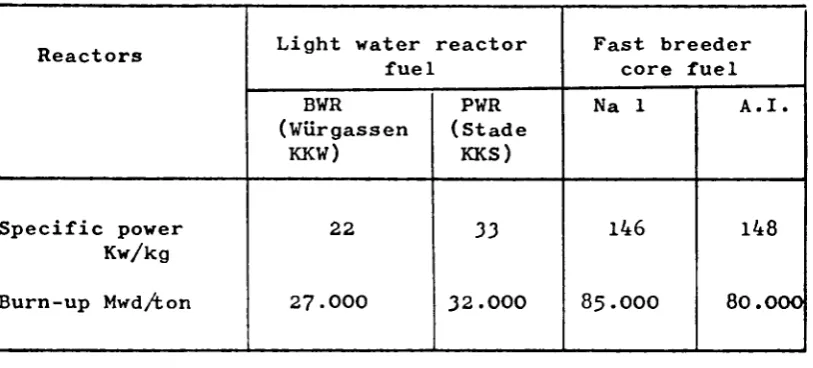
High specific power and high burn-up of F.B. Reactor fuel (table 2) result in very high levels of fission product activity in the discharged fuels.
TABLE
COMPARISON OF BASIC FUEL CHARACTERISTICS
Reactors
Specific power Kw/kg
Burn-up MwdAon
Light water reactor fuel
BWR (Würgassen
KKW)
22
27-000
PWR (Stade
KKS)
33
32.000
Fast breeder core fuel Na 1
146
85.OOO
A.I.
148
8O.OOO
(A.I.: Atomics International Fast breeder project)
In first approximation the short lived fission product content of the irradiated fuel when discharged is directly
proportional to the specific power,while the long lived fission product content is directly proportional to the burn-up.
Consequently it can be said that for fuel characteristics as cited in the table above, fast breeder core fuels will contain,
at the moment of discharge from the reactor, roughly 5 times more
short lived fission product activity per ton than light water reactor fuels. This higher fission product content results in a very important heat generation in these fuels (see annex III and table 3)· The heat generation becomes a problem of primary
importance when the handling of short cooled fuels is considered.
At this moment it is the tendency of those engaged in fast
breeder development to consider total cooling times before
reprocessing ranging between 30 and 60 days. Consequently, the
different operations leading to the recovery of the fissile material
[image:9.595.96.503.230.414.2]- 6
IRRADIATED FUEL TRANSPORT
Decay heat generation is the main fuel parameter of concern in the fuel transport operation as it has a determin-ing influence on the transport cask characteristics and cask loading. The decay heat release is for an important part dependent on the short lived fission product content which in turn is directly related to the specific power and the cooling time.
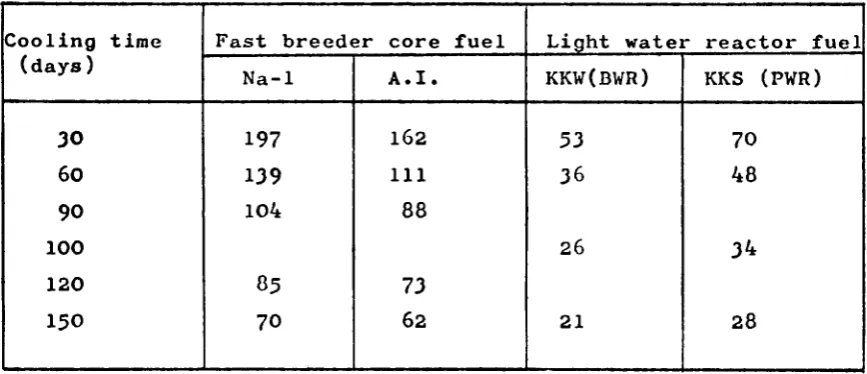
[image:10.595.93.527.476.663.2]Table 3 compares calculated heat generation data for the fuel of two light water reactors under construction and for the core fuel of two fast breeder reactor projects. The basic fuel characteristics for this comparison are given in Table 2.
TABLE
COMPARISON OF THE DECAY HEAT GENERATION FOR FUELS OF LIGHT WATER AND FAST BREEDER REACTORS W/kg fuel
Cooling time (days)
30 60 90 100 120 150
Fast breeder core fuel Na-1
197 139 104
85 70
A.I.
162 111 88
73 62
Light water reactor fuel KKW(BWR)
52
36
26
21
KKS (PWR)
70 48
34
28
From the above table it can be seen that the transport of 30 or 60 days cooled fast breeder core fuels will have to cope with a heat generation rate which is more than five times greater than the heat generation which is encountered during
as tests for the transport cask.
The regulations worked out by the International Atomic Energy Agency "Regulations for the Safe Transport of Radioactive Materials" are of application in the different
European countries, in addition to the general transport regulations in each of these countries.
At present the packaging and transport of short cooled fast breeder core fuel is being studied in relation with the various fast breeder projects. The most advanced study is probably the shipping cask design of Oak Ridge National
Laboratory (ref. 1 ) . The overall characteristics of this cask could be summarized as follows :
- exceptionally rugged containment system
- energy absorbing members to protect the cask from high impact loads
- steel as the biological shield - sodium as primary coolant
- arrangement of multiple fuel elements in close array inside a single fuel cavity.
Although this design study is not complete and additional work is required the author concludes that the available test data indicate that the approach is feasable.
In this study only rough indication is given of shielding to fuel weight ratio as function of the total cask capacity. In the case of twenty days cooled fuel the ratio of shielding
weight to fuel weight would vary from 100 down to 40 for cask-loads from 6 to 36 A.I. subassemblies respectively. An increase
in cooling time from 20 to 90 days would reduce the shielding to fuel weight ratio from 40 to 28 in the case of 36 A.I. subassem-blies .
It is further made clear that the total system weight
- 8
FUEL CLEANING
The fuel assemblies discharged from sodium cooled reactors will be stored under sodium for partial cooling before being
transported to the reprocessing installation. The transport of short cooled fuel from the reactor to the reprocessing
installation is envisaged to be done in sodium cooled containers.
Before entering the aqueous processing scheme, sodium adhering to the assemblies will have to be removed. Longer fuel cooling times at the reactor site could allow the transport to be done in water cooled containers but this would not eliminate the assembly cleaning operation, which would than have to be
executed at the reactor.
Various cleaning methods for reactor parts (including fuel assemblies) have been envisaged and experimented. A number of these methods such as water cleaning (ref.2;3)j steam clean-ing (ref. 4;5 ; 6 ; 7 ï 8) and wet gas cleanclean-ing are based on the reaction of sodium with water. The chemical reaction is exothermic and produces hydrogen which can react explosively with oxygen under certain concentration conditions and must therefore be closely controlled.
- Water cleaning which is the most straight forward method but presents favorable conditions for the explosive hydrogen oxygen reaction to occur. The chemical reaction of sodium
with water is very rapid and cannot be controlled.
This fuel cleaning method has been experimented at S.R.E. During such a cleaning operation an explosion occured and dammaged the fuel assembly (ref. 9)«
- Steam cleaning assures a rapid and complete reaction but necessitates a temperature of tie assembly above 100°C to avoid condensation. It allows a certain control of the
the humidity or vapour The equipment to be cleaned does not need to be heated like it is the case for steam cleaning.Next to these advantages it should be pointed out that the major drawback of this cleaning method is the possibility of incomplete reaction, specially in case of complicated
geometries and for this reason the method will probably have to be used in combination with water cleaning or steam
cleaning.
- Distillation of sodium has been experimented and
has given goodyresults. The equipment to be cleaned has to be heated in a vacuum chamber. The major difficulty of such a cleaning method is the evacuation of the decay heat, problem which is not solved at this moment.
- Sodium evaporation under argon gas flow at temperatures over 400°C has given goo^results on simple geometries, but the problems for fuel assembly cleaning have not been solved yet.
- Dissolution of sodium in different media is being evaluated in connection with the following reactors t
SRE Mineral oil PFFBR ΑΙ-Si alloy RAPSODIE Pb-Sb alloy DFR Lead
From available information it can be said that although various methods of cleaning of reactor parts are possible it seems that for fuel assembly cleaning at this state of the
10
-FUEL STORAGE
On arrival at the reprocessing installation,reactor fuel has to be unloaded and stored for some time. Several media such as sodium, gas or water can be envisaged for both the unloading and storage.
The unloading medium will mainly depend on the cask cooling medium used. Sodium cooled transport casks will have to be unloaded under inert gas cover in a shielded cell. The
unloaded fuel elements with adhering sodium will need to be stored under sodium awaiting fuel cleaning. Water or gas cooled
transport casks could be handled in a way similar to the way thermal reactor fuel is handled, making use of water as shielding medium.
As existing reprocessing plants will have to handle the first fast breeder funis, water pool storage can be
expected to be the prefered system for reasons of simplicity. This presupposes that the physical state of the fuel assemblies is compatible with water and that the necessary heat dissipation is provided for short cooled fuels.
The calculated heat generation for assemblies from the different reactor zones is given in table 4 hereafter
TABLE Ί
HEAT RELEASE PER FUEL ASSEMBLY (REACTOR NA-l) KW/ASSEMBLY
^**>*^ C o o l i n g ^ V t i m e R e a c t o r z o n e s S .
Zone 1 + 3 Zone 2 + 4 Zone 5 Zone 6
3 0
1 7 , 5 1 3 , 6 3
3 , 9 6 1,89
60
1 2 , 3 1 9 , 3 9 2 , 7 6 1,37
90
9 , 2 0 7 , 1 7 2 , 0 4 1,04
120
7 , 5 2 5 , 8 6 1,68 0 , 8 7
1 5 0
6 , 2 2 4 , 8 5 1,38 0 , 7 3
180
5 , 3 1 4 , 1 4 1,17 0 , 6 5
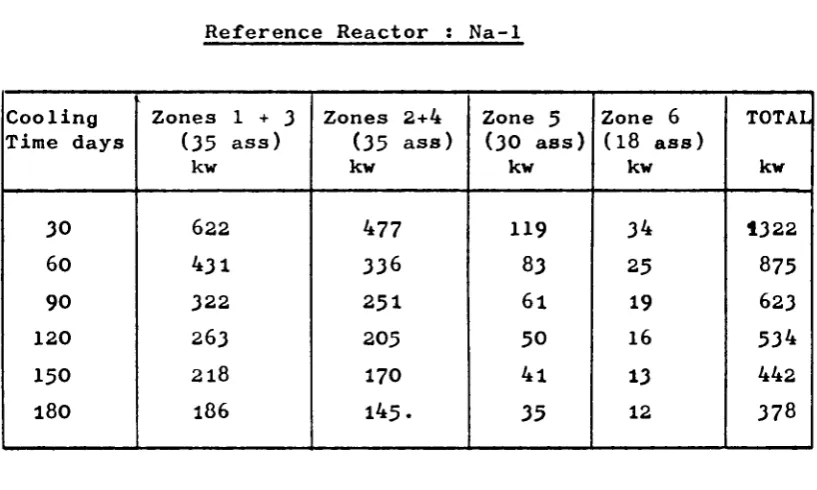
A fuel discharge from the Reactor Na-1 would be composed
Of
:
35 assemblies from zone 2 + 4 (core + axial blanket) 30 assemblies from zone 5 (radiad blanket)
18 assemblies from zone 6 (radial blanket).
[image:15.595.97.506.282.527.2]This would lead to a total heat release of all the assemblies discharged in one discharge operation as indicated in table 5·
TABLE 5
HEAT RELEASE OF DISCHARGED FUEL AS A FUNCTION OF COOLING TIME
Reference Reactor : Na-1
Cooling Time days
30 60 90 120 150 180
Zones 1 + 3 (35 ass)
kw
622 431 322 263 218 I86
Zones 2+4 (35 ass) kw
477 336 251 205 170
145-Zone 5 (30 ass)
kw
119 83 61 50 41 35
Zone 6 (18 ass)
kw
34 25 19 16 13 12
TOTAL
kw
1322 875 623 534 442 378
MECHANICAL PROCESSING
The practice in the head-end part of L.W.R. fuel
processing has evolved from chemical decladding and dissolution to the now generally accepted chop-leach process.
Chemical decladding produces rather important volumes of liquid radioactive wastes, which have to be stored safely awaiting further treatment for final storage and disposal.
Y¿
Other processes based on the dissolution of cladding materials in molten metals and alloys such as Zn and Sb-Cu are under study and evaluation. Interesting results have been obtained with these methods but at this state, these processes have not been tried any further than on bench scale. Apart from the potential advantages of these systems a number of operational problems, mainly on the separation of the fuel and the molten metal phase remain to be solved.
The practice of the chopping process for L.W.R. fuels consists of removing the fuel element end-pieces and cutting through the whole fuel bundle as such, at distances of about 5 cm. The pieces of the fuel pins are collected in a basket which serves as charging basket for the dissolver.
As the burn-up of to-days L.W.R. fuel is rather low (20.000 to 25.OOO Mwd/ton) and the cooling time relatively long (150 days or more) there is no cooling problem during the mechanical processing phase and the operation is conducted in a normal shielded cell. In the case of F.B.R. fuels, specially short cooled fuels (30 to 60 days), the mechanical processing could be more complicated as a result of the decay heat generated in the fuel.
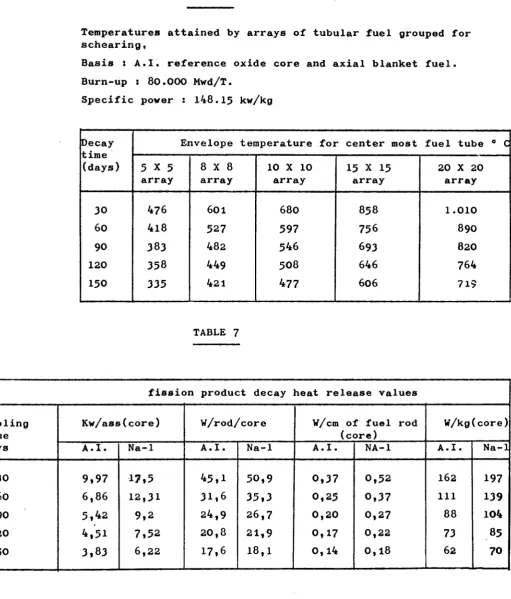
A report of Dr. Watson & C° from Oak Ridge (Ref. 10) (table 6) indicates the temperature attained by the centermost tube of different arrays of fuel pins at different cooling times for A.I. reference fuel. The calculated heat generation of the Na-1 reference fuel is somewhat higher than the corresponding figures for the A.I. reference fuel (table 3 and 7)·
TABLE 6 (reference 10)
Temperatures attained by arrays of tubular fuel grouped for
schearing,
Basis : A.I. reference oxide core and axial blanket fuel.
Burn-up : 80.000 Mwd/T.
Specific power : 148.15 kw/kg
Decay time (days) 30 60 90 120 150
Envelope temperature for center most
5 X 5 array 476 418 383 358 335
8 X 8 array 601 527 482 449 421
10 X 10 array 680 597 546 508 477
15 X 15 array 858 756 693 646 606
fuel tube ° C
20 X 20 array 1.010 890 820 764 719
TABLE 7
fission product decay heat release values
Cooling time days 30 60 90 120 150 Kw/ass(core) A.I. 9,97 6,86 5,42 4,51 3,83 Na-1 17,5 12,31 9,2 7,52 6,22 W/rod/core A.I. 45,1 31,6 24,9 20,8 17,6 Na-1 50,9 35,3 26,7 21,9 18,1
[image:17.595.42.554.96.696.2]- 14
Carbide cutting tools can operate up to temperatures of 600°C, so that the problem of cutting such assemblies will be centered mainly on the behaviour of the caldding material at these high temperatures. Forced cooling of the assemblies could be used to limit the temperature of the cladding, but this will introduce operational complication and have a repercussion on the volatile fission product collection and retention.
Apart from longer decay times, which seem to be economically unacceptable, the other alternative to forced cooling is
disassembly of the fuel assemblies and regrouping of the single core and blanket fuel pins into smaller bundels for cutting.
Several fuel assembly concepts for fast reactors have been worked out to permit disassembly. For other types such as S.N.R. and Na-1, disassembly cannot be envisaged. It could however be argued that the fuel from prototype fast reactors will not need to be reprocessed shortly after discharge from the reactor and that long cooling times will eliminate the heat generation problem.
The high burn-up of fast breeder core fuels (80.000 to
100.ΌΟ0 Mwd/ton) may result in such embrittlement of the cladding material, that fuel pins will tend to break during the cutting operation. Such breakage could lead to small cladding fragments which could constitute a problem in the operation of the cutting machine.
Another aspect of short cooled F.B.R. fuel, which differs in an important way from L.W.R. fuel, is its volatile fission product content and the liberation of these products during the cutting operation. Short cooled (30 to 60 days cooled) F.B.R.
Λ ο Λ O tr "I *ì *ì
core fuel will contain important quantities of I ; Kr ; Xe 3
An important part of the original content of these gaseous fission products is estimated to be set free when opening the fuel cladding, the remainder being liberated in the successive processing steps, mainly during dissolution of the fuel. The cell atmosphere in which these fission products are set free has to be treated for the removal of the activity or stored for decay before it can be released through the chimney. Hence it will be important to minimize the volume of air or gas to be treated for gaseous F.P. retention.
A peculiar aspect of the F.B.R. fuel is the presence of sodium bonding between fuel pellets and cladding material, and the possible sodium in-leakage in ruptured fuel pins. The presence of sodium inside the fuel pins could make it necessary to use an inert atmosphere inside the mechanical processing cell or at least in a part of the equipment. The use of an inert gas might lead to the recycling of the gas over a F.P. retention treatment and a cooling system. This could then result in less stringent requirements for the iodine retention yields as there would be practically no release of this gas to the atmosphere.
In actual practice for L.W.R. fuels the cut fuel fragments are collected in stainless steel baskets which serve as charging baskets for a batch dissolver. In case of fast breeder core fuel the collected fuel fragments will need to be cooled due to the high heat generation, or will have to be charged in a
continuous way to the dissolver unit.
From the above considerations on heat generation it would seem preferable to disassemble the fuel assemblies and to regroup the fuel pins into smaller bundels for chopping rather than to use forced cooling on complete assemblies and eventually cool the fuel fragments.
FUEL DISSOLUTION AND FEED PREPARATION
16
-It had been shown that PuO does not dissolve in nitric acid as does UO . Consequently, a dissolution scheme using
Hydrofluoric acid as a catalyst in the nitric acid was developed.
From later results it seems however that solid solutions of PuO„ in U0„ dissolve like pure U0„ but mixtures of PuO„ in
2 2 2 2 UO need HF as catalyst to assure the dissolution of PuO . It
has further more been found that irradiation of the fuol up to 99.000 Mwd/ton has no adverse effect on the dissolution rate of
solid solutions of UO - 20 % PuO . As for mixtures of UO
-2 -2 -2
0,5 % P u0 „ , irradiation results in an increase in dissolution
2
rate which was attributed to the formation of solid solutions during irradiation. The question whether a fuel mixture of UO -PuO can become a real solid solution during irradiation is not
¿à
answered yet, but this could come in the next few years. 131
The high I content of the fuel makes it necessafy to obtain very high decontammation factors of the process off-gasses for this isotope. The technical difficulties for achiev-ing this have led to envisage a fission gas release treatment whereby iodine, tritum, xenon and krypton are released from the fuel in such a way that they undergo a minimum dilution. Such fusion gas release treatment can be an oxidation of the fuel material by which UO -PuO is transformed into U O.-PuO . The
¿à ¿» J Ö 2*
change in crystallographic structure of the uranium compound permits the release of trapped fission gasses. It is not yet clear wether during such an oxidation of the fuel material, the
dissolution caracteristics of PuO are altered. Á
Several continuous or semi-continuous dissolver and
Fast breeder fuels irradiated to a burn-up as high as
1U0.000 Mwd/ton will contain important quantities 01 fission
products such as Mo, Zr, Ph, Rh, Nd, K U (see Annex lv). Some of these elements will not dissolve in nitric acid, while others have limited solubility in this medium. Calculations show that in the core fuel the quantity of fission products likely to form precipitates during dissolution of the fuel, reaches the ten kgr per ton level. Valuable elements such as Rd & Rh could be recovered the precipitate after clarification of the dissolver solution. Fuel treatment before dissolution could alter the chemical form and dissolution rate of these
elements.
Attention should also be paid to iodine present in the dissolution solution, and iodine removal from the solution by such methods as oxidation and air-sparging may be necessary as part of the feed preparation step.
The presence of Macro amounts of Pu in the dissolver solution will require important quantities of reagents to be added to the solution to assure Pu valence ajustment. The reagent used up to now for the small quantities of Pu present in L.W.R. fuels was NaNO . Research work on the use of HNO for Pu
ajust-A. 2
ment has led to introduction of No gas in the solution producing in situ the reduction reagent HNO (Ref. 11).
¿t
The high plutonium content of F.B.R. core fuel ( 20 %)
will result in geometric restrictions of the processing equipment for criticality safety. The dissolver unit, specially the batch type, is very critical in this respect as the equipment has to be safe for an heterogeneous as well as for an homogeneous configuration.
18
-handling and treatment of the fisson product solutions. The use of soluble poisons would permit much higher concentrations of plutonium in the dissolver solution and the extraction feed solution but it does not solve the problem in the following processing steps where plutonium is extracted into an organic solvent.
EXTRACTION AND SEPARATION PROCESS
Uranium and plutonium extraction from nitric acid
solutions is a well proven process for the processing of thermal reactor fuels. It is generally accepted, that a similar extrac-tion process will be used for fast breeder fuel processing at least in the early period, as the basic separations to be
performed are the same as for thermal reactor fuels. The applica-tion of T.B.P. extracapplica-tion to fast breeder fuels requires however careful consideration of the characteristics of these fuels as some of these characteristics may require adaptation of the standard Purex flowsheet conditions.
The Pu/U ratio in F.B. core fuel is of the order of 1/4. Even when considering the mixing of core and breeder pins in the same proportion as they are discharged from the reactor, the average of Pu/U ratio in the dissolution solution will be around I/20, which is still five to ten times higher than the Pu/U ratio in light water reactor fuels. Most of the data on extraction of Pu and U have been obtained from solutions with Pu concentrations
in the range 0,1 % to 1 % of the uranium concentration, it is
therefore feld that more extraction data will be needed on solutions containing macro concentrations of Pu.
of a large excess of reductant,the quantities of reagent to be introduced in the solution may become excessive. In situ electrochemical reduction or reduction with hydrogen in the presence of platinium seem to be valuable alternatives.
Solutions containing high Plutonium concentration show increased tendency to form Plutonium polymers that can not be extracted. The tendency to form polymers increases with decreas-ing acidity of the solution. This phenomenon will have to be understood well before flowsheet conditions can be established.
The high radiation level of the fast breeder core fuel will result in appreciable degradation of the solvent. The degradation products of T.B.P., dibutyl and monbutylphosphate have not only a negative effect on the decontamination factor but they contribute also to form insoluble organo-metallic
compounds with certain elements such as Zr. These compounds tend to accumulate at the interphase in the extraction equipment. This last effect is all the more important as the fission
products concentration is high. The accumulated insoluble organo-metallic compounds also act as substrate on which other solid impurities collect. Such unpurity accumulation could seriously disturb the operation of the extraction equipment and adds to the solvent radiation damage.
The higher Plutonium content of the fuels will result in a higher Plutonium loading of the solvent and this in turn will contribute to the solvent radiation damage.
Iodine present in the extraction feed solution accumulates in the solvent, where it contributes in an important way to the solvent radiation damage. The chemical and radiation effects of such accumulation will affect the solvent behaviour and the solvent regeneration.
20
available and will probably replace the usual mixer settlers and pulse collumns in those parts where important solvent
degradation is to be feared. Short contact time of the aqueous and organic phases will limit the radiation dose absorbed by the solvent as well as the formation of degradation products. The high concentration of fission products in core fuel solution will still tend to form the solid organo-metallic compounds so
that the centrifugal contactors could have to handle a certain amount of solids, which may constitute one of the problems in their utilisation.
The increased fission product content of the extraction feed solutions will reqtiire a good knowledge of fission product behaviour and their possible inter influence in the extraction process.
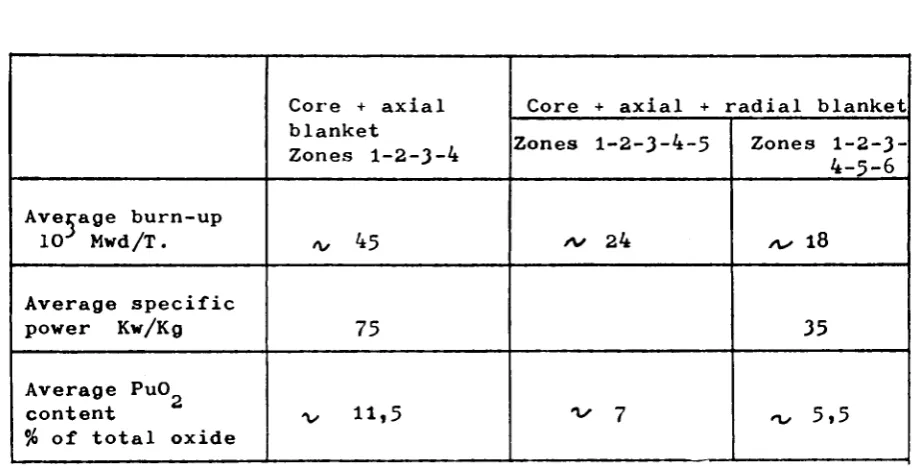
The specific extraction and separation problems resulting from high burn-up and short cooling as well as those resulting from the high plutonium content of the core fuel could be over-come by mixing the high burn-up, high plutonium content core fuel with the low burn-up, low Pu content blanket fuel. The principle of mixing core and blanket fuel pins supposes however that the fuel elements are disassembled into single pins and
TABLE 8
AVERAGE BURN-UP SPECIFIC POWER AND Pu CONTENT OF MIXTURES OF FUEL PINS AS THEY ARE DISCHARGED FROM Na-1
Average burn-up IO3 Mwd/T.
Average specific power Kw/Kg
Average PuO content
% of total oxide
Core + axial blanket
Zones 1-2-3-4
/v 45
75
ν 11,5
Core + axial + radial blanket Zones 1-2-3-4-5
/v 24
ν 7
Zones 1-2-3-4-5-6
/w 18
35
rw 5,5
The final plutonium purification requires the handling of considerable quantities of plutonium and the criticality problems involved in this part of the reprocessing process are at their highest. The amounts of plutonium to be handled appear to be around 50 kg/ton of mixed core and blanket fuel.
Losses of plutonium experienced in light water reactor fuel
reprocessing have frequently been in the order of 2%. For a small
plutonium through-put these losses may seem acceptable. In the case of plutonium concentrations in the fuel of some 5% such losses
represent about 1 Kg of plutonium per ton of fuel processed. Most of the lost plutonium appears in the waste streams. Apart from the loss of financial value the accumulation of important quantities of
22
The usual anion resin system and the more recent amine extraction system have been developed to handle the small quantities of plutonium resulting from thermal reactor fuel processing. The application of these processes in handling great quantities of plutonium from fast breeder fuels will require adaptation and
adjustment.
The high o^ activity of F.B.R. plutonium and the associated
neutron generation through (^ ;' t\ ) reaction on oxygen could lead
to remote fabrication of the fuels. Such remote fabrication may further result in less stringent requirements for fission product decontamination and affect in this way the whole reprocessing.process
GASEOUS EFFLUENTS
The gaseous fission product content in fast breeder core fuel is much higher than in the light water reactor fuel as a result of higher burn-up, higher specific power and shorter cool-ing time.
131
The isotopes of primary importance are I (t Vi 8,05 d)
X e1 3 3 (t Vi = 5,3 d) Kr 5 (t # = 10.8 y) and II (t % = 12,3 y) ·
The concentration of these isotopes in the core fuel can be expressed as follows : (ref. 13)
85
Kr : 0,3 Ci/Mwd burn-up H : 0,025 Ci/Mwd burn-up
133
Xe : 1.200 Ci/Mw specific power )
) after 30 days cooling
I : 2.200 Ci/Mw specific power ) time
- IODINE
131
A compariaon of the calculated I content in light water reactor fuels and fast breeder reactor core fuels given
Durn-up: Mwd/ton
Specific power : Kn/Kg
Cooling time : days ,131 I ac tivity Ci/Ton
1 ' t
L.W.R. fuels
25.OOO
15
30
3.3.104
150
1,0
F.B.R. Na-1 Core fuels
80.000
150
30
\
3,3.io5
60
2.1θ4 90
1,6.10^
Mixed core + axial blanket Zones 1 + 2 + 3 + 4
45.OOO
75
30
1,6.IO5 60
4 1,10
90
8.102
Mixed core + axial + radial blanket
Zones 1 + 2 + 3 + 4 + 5-rG
18.000
35
30
4 8.10*
60
3 5. K T
90
4. io2
co
[image:27.842.16.818.128.448.2]24
In the case of fast breeder fuels, cooling times as short as 30 and 60 days are envisaged, this allows only a very limited
131
reduction of the I content which is for the F.B.R. core fuels 10 times higher than in light water reactor fuels at the moment of discharge of the fuel. The overall Iodine decontamination
factor to be obtained is dependent on the allowed continuous release limit which is in turn dependent on the stack dilution factor.
As an example under conditions of an average dilution factor of 7.IO m /sec (case of Eurochemic) a release of 0,1 Ci/day of I would not result in a breathing air concentration above the MPC
(population) corrected by the factor I/7OO for intake by the milk — 13 3
pathway (1,4.10 Ci/m ) .
131
On the basis of a release of 0,1 Ci I /day the decontamina-tion factor to be obtained has been derived for L.W.R. fuels, F.B.R. core fuels and mixtures of F.B.R. core and blanket fuel (Table 10).
TABLE 10
DECONTAMINATION FACTORS FOR I1 3 1 TO BE OBTAINED FOR LWR FUEL AND
FBR FUEL
13 1
release of 0,1 Ci I /day
Plant capacity
Cooling time
L.W.R. fuels F.B.R. core
fuel F.B.R. core + axial blanket Zones 1+2+3+4 F.B.R. mixed
core & Blanket fuel (Reactor Na-1)
Zones 1+2+3+4 +5+6
1 ton/day
30 d.
3.3.105
3,3-IO6
1,6.10
8.105
60 d.
2.105
1.105
5.IO
90 d
4 1,6.10
8.103
4.103
150 d
10
5 Tpns/day
30 d
1,6.10
1,6.107
8.106
4.106
60 d
1.10
5.IO5
2,5.105
90 d
4 8.10
4. IO4
4 2.10
150 d
From published information it can be concluded that 131 2 3
decontamination factors for I of 10 to 10 have been achieved in presently operating reprocessing plants.
The ipdine removal methods in use are mainly : scrubbers using sodium hydroxide with or without sodiumthiosulfate addition to the scrub solution and silver reactors in which Iodibe is fixed on a packing coated with Silver Nitrate. Adsorbtion on activated
charcoal and molecular sieves has been extensively studied and is still being tested to clarify the efficiency in the presence of other gases such as oxygen and oxides of nitrogen.
131
From Tabic 10 it is clear that I release limits can be rather easily met for 15O days cooled light water reactor fuels
even in the case of processing plants of 5 to 10 tons/day throughput. In the case of short cooled (30 or 60 days) F.B.R. fuels the iodine content is so high that decontamination factors in the order of 10 and 10 would have to be readied for core fuels. We can expect that the higher iodine content is the off-gas and a less diluted form of the off-gas stream will result in an increased overall efficiency of the removal methods. Nevertheless the required decontamination factors will only be achieved through improvement and combination of existing methods or the development of new
methods. It is to be noted that processing mixed core and blanket fuels would result in lower average iodine release over short periods and would distribute more evenly the release of the total iodine contained in a batch of discharged Fast Breeder fuel.
It should also be considered that gaseous fission products in general and iodine in particular are released from the fuel at different stages of the processing line.
The pressure in the fuel tubes and the temperature at which short cooled fast breeder fuels will have to be handled indicates that an important part of the gases will be released when the fuel
26
A second part of the iodine content will be released during
fuel dissolution and will follow the dissolution offgas which will
have to be treated for iodine removal. The dissolution offgas
contains important quantities of Nitrogen oxides which are recombined
to/form nitric acid. In the process part of the Iodine is also
returned to the solution. After recombination of nitric acid the
offgas stream contains still small quantities of nitrogen oxides
as well as the excess oxygen or air from the acid recombinatbn. The
presence of nitrogen oxides and the dilution obtained by the excess
air or oxygen do not simplify the Iodine retention.
In order to assure maximum decontamination it would be
advantageous to release all or as much as possible of the fission
gases in one and the same step, preferably before dissolution of
the fuel as this would avoid to mix the fission gases with nitrogen
oxides from the dissolution offgas. These considerations lead to
a réévaluation of the existing head end treatments and possibly to
the incorporation of a fission gas release treatment before dissolu
tion ofthe fuel.
NOBLES GASES
85 133
The noble gas fission products Kr and Xe have up to now
been released to the atmosphere as the environmental concentration
resulting from stack dilution remains well below the permissible
concentration. In the case of fast breeder core fuels the concen
Ο Λ o o
tration of Kr and Xe " are much higher than in light water reactor
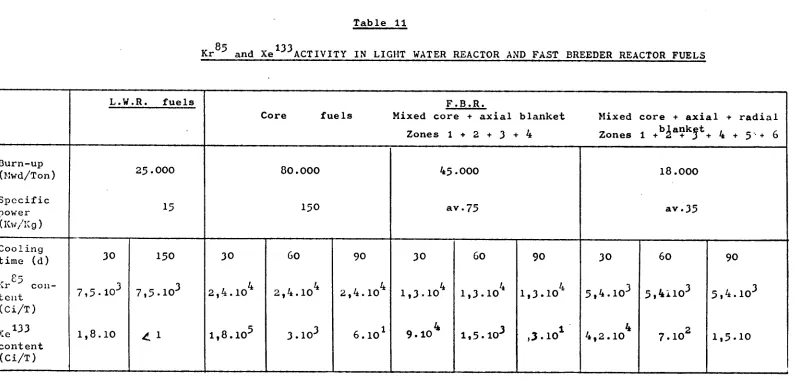
fuels. A comparison of these concentrations is given in Table 11.
sc
85
6 1 Considering an atmospheric dilution factor of 1.10 m /sec
the calculation shows that the release of the total content of Kr 133
and X e of 60 days cooled fuel, processed at a rate of 5 T/day is
Burnup (Mwd/Ton)
Specific power
(Kw/Kg)
Cooling time (d)
kr con tent
(Ci/T)
y1 3 3
λ e
content (Ci/T)
L.W
30
7,5.103
1,8.10
.R. fuels
25.000
15
150
7.5.103
4 ι
F.B.R.
Core fuels Mixed core + axial blanket
80.000
150
30
2,4.10
1,8.105
60
4
2,4.10
3.IO3
Zones 1 + 2 + 3 + 4
90
4 2,4.10
6.101
45.OOO
av.75
30
4 1,3.10
4
9.1060
4 1,3.10
1.5.103
90
4 1,3-10
,3.1ο1
Mixed core + axial + radial Zones 1 +b¿a?k5t+ 4 + 5 + 6
18.000
av. 35
30
5.4.103
4 4,2.10
60
5,4il03
7.IO2
90
5,4.103
[image:31.842.28.823.83.475.2]ENVIRONMENTAL X e1 3 3 AND Kr8 5 CONCENTRATIONS RESULTING FROM PROCESSING OF DIFFERENT TYPES OF FUELS UNDER
CONDITIONS OF TOTAL RELEASE
Basis : figures of table 11
6 _3
atmospheric dilution factor 7.10 m /secKr Ci/m
v 133
Xe . Ci/m
Plant capacity
1 T/day
5 T/day
1 T/day
5 T/day
LWR fuels cooling time
150 d
1,3.1o"8
8 6,5.10
¿ i o "1 1
< io"11
F.B.R. C O O I J 30 d Β 4.10 2.10~' 3.10"' 1,5.10"6
Core fue m g time
60 d 4.108 7 2.10 9 5.10 8 2,5.10 1 90 d 4.108 7 2.10 1.1o10
5 . 1 o -
1 0F.B.R. Co , Zones 1
Cool 30 d
2.IO"8
7 1.10
1 , 5 . 1 o '
76,5.1o"
7re + axia
+ 2 + 3 + ing time
60 d
8 2.10 7 1.10 ' 9 2,510 8 1,2.10 1 blanket 4 90 d 2.IO" 7 1.10 '
5 . 1 o -
1 1,~io
2,5.10
Mixed Core &. tota Cooling time
30 d 60 d
9 9.IO 7
8 5.IO 8 7.IO 3,5.10"7 9 9.10 7
8 5.IO
1.1o-
87 5,10
1 blanket fuel 90 d
9 9.IO y
8 5.IO
2,5.10
10
WASTES
Low activity effluents
The radioactive waste solutions produced during the aqueous
processing of irradiated fuel constitute an important volume of
liquids. As the fission products have to be stored, be it under
liquid or solid form, there is a distinct interest in concentrat
ing the waste solutions. The concentration step6produce highly
active concentrate to be stored and low active effluent which can be
released to the environment. The concentrate retains practically
all of the fission product elements except Tritium. Tritium appears
as Tritiated water in the aqueous solutions throughout the process.
It distributes during the waste concentration steps over the low
activity effluent and the concentrate. The low activity effluent,
after eventual further treatment to decrease its activity content,
is released to the environment.
In actual practice with L.W.R. fuels of up to 20.000 Mwd/Ton
burnup, the low activity effluent volume represents approximately
95% of the total waste volume, so that finally about 95% of all
tritium generated is released to the environment as triated water.
As a result of the rather long halflife of Tritium (12,3 year) its
content in irradiated fuel is directly proportional to the burnup
of the fuel and is not influenced by cooling. A thermal fission
4 3 235
yield of*, 1,10 H atoms per fission for U " and a fast fission
4 3 239
yield of ν 2,5 10 Η atoms per fission for Pu , are cited in the
literature (ref.l4). Tritium formation in the fuel takes also place
through an (n ;e¿ ) reaction with Li I Li, (n>V ) H Li being
present in the fuel as an impurity (ref. 14; 15)«
In the case of thermal neutron irradiation the Tritium
production through n;t{ reaction with Li is quoted to be approximately
twice as high as through fission. The Tritium content of L.W.R.fuels
with 20.000 Mwd/Ton burnup is considered to be around 700 Ci/Ton
(ref. 14).
Other sources evaluate the Tritium content of L.W.R. fuels
at ^»300 Ci/Ton (ref. 15), neglecting the Tritium generation through
activation of Li as the concentration of the Li impurity in the
30
For F.B.R. fuel irradiated to 100.000 Mwd/Ton the Tritium content is calculated to be around 3.300 Ci/Ton. In this case practically all of the Tritium is generated through fission, as the cross section for the (n;o¿ ) reaction with Li impurities is rather low for fast neutrons.
Considering that fuel discharged from a F.B.R. (example Na-l) is approximately l/5 core fuel and 4/5 blanket fuel, the average
Tritium content can be estimated to be around 600 to 700 Ci/Ton. This content of Tritium is very much comparable to the Tritium
content of 700 Ci/Ton for L.W.R. fuels irradiated to 20.000 Mwd/Ton.
The quantities of Tritium indicated above are to be released to the environment or to be stored.
In case of release to the environment two possibilities are to be considered :
- release to surface waters in which case the dilution at the
release point has to reduce the concentration of Tritium below the MPC for the population (3-10 " Ci/ml) such a dilution would
require an important water flow to handle the Tritium release from a fuel processing plant handling one ton/day core fuel or 5 tons/day mixed core and blanket fuel.
- dispersion into the atmosphere is another method for Tritium release which has been put forward. It consists of evaporating the Tritium containing water and evacuating it through the stack. This method takes advantage of the greater dis ersion coefficient, obtained through stack release at a certain height.
Lately consideration has been given in the American litterature to the storage of Tritium. This method of Tritium
handling could be of interest when the fuel is subjected to a fission gas release treatment. The gaseous fission products could then be collected in a relatively small volume from which Tritium could be separated.
Such release concept for the gaseous wastes implies the liberation and collection of gaseous fission products from the fuel before dissolution. For the aqueous wastes it would require the thorough decontamination of the low level wastes to be released or the recycling of distillates and possibly other low level wastes as make up water for fresh reagent solutions.
High level wastes
The concentration factor which can be reached in the
concentration step of the fission product solutions is limited by the content of dissolved salts and activity of fission products. Considering that dissolved salts content is low and does not limit the concentration factor, the maximum activity of the concentrate is usually limited to around 5-000 Ci/l for reasons of decay heat evacuation during storage of the concentrates.
The long lived fission product (T }6 ^ 1 year) content of irradiated fuel is directly proportional to the burn-up. Considering
239
that the fast fission yield of Pu ' and the thermal fission yield 235
of U are not so much different on the whole, the fast breeder core fuel of 80.000 Mwd/Ton would have a 4 times higher long lived fission product content. Mixed core and blanket fuel (1/5 core -4/5 blanket) will have approximately the same average content of long lived fission product as light water reactor fuels irradiated to 20.000 Mwd/Ton.
32
The activity of the specific nuclides as well as the total activity of the fuel as function of the cooling time is presented in annex IV. The data indicate clearly that the volume reduction of fission product solutions resulting from processing of short cooled fuel will be limited by the activity contained and the decay heat generated.
Economic studies on waste disposal have indicated the advantage of liquid storage for a period of three to five years before application of solidifaction treatment and final disposal. The economic advantage of interim storage stems from reduction of activity and heat output which allows a greater volume of liquid waste to be incorporated per unit volume of solidified product
(f.i. glass).
The interim storage being an economic advantage for fission product solutions from L.W.R. fuel that were cooled for about I50 days before processing, the advantage will even be greater for less cooled fast breeder fuels. Depending on the effective cooling time before processing it will have to be examined what could be gained by reconcentrating the wastes after a first decay storage.
A unique aspect of fast breeder core fuel is its high content of noble metal fission products. The calculated content fission products for 80.000 Mwd/Ton irradiated core fuel (annex IV) shows that kilogram per ton quantities of Rhodium and Paladium are present. It is to be expected that the recuperation of these
Conclusion
The aqueous fuel reprocessing technique is at this stage the most probable choice for the processing of the fast breeder fuel because of experience gained with this technique in the processing of oxide fuel from thermal reactors.
The process will however need to be adapted to the characteris tics of the fuel and at some stages of the process new process steps may even be needed.
Three characteristics of the fast breeder core fuel are at the basis of the arising major problems : the plutonium contenti the burn up and cooling time; the presence of sodium on the fuel elements.
The high plutonium content of the fast breeder ι core fuels results in increased criticality risks, which will lead to geometry limitations and operational restrictions in reprocessing.
The burn up and cooling time of the fuel before processing are the important parameters determining the heat generation and the gaseous fission product content of the fuel. The processing of short cooled fuels ( 30 to 60 days) as proposed to day will require adaptation of existing techniques or new solutions for a number of problems such as : heat evacuation during transport storage and mechanical processing, gaseous fission product release and off gas treatment.
The presence of adhering sodium on the fuel elements will require the introduction of a sodium removal step before the fuel elements can be transfered to an aqueous cooling medium
All of the above mentioned major problems are examined and studied at the various laboratories and organisations concerned with these problems.
The fuel cycle cost for fast breeder reactors will depend to a great extend on the solutions developped for the various problems, and only when satisfactory solutions will exist, will it be possible to evaluate with some precision the cost of fast breeder fuel
34
-REFERENCES
,-th
1. Proceeding of the 16 conference on remote systems technology, 1969. "Shipping-cask design considerations for breeder reactor fuel".
2. A.P.D.A.
Review of information received to date on methods of removing sodium from components. D.E. Bloomfield May l4, 1959·
3· I.G.D. Memo 04l U.K.A.E.A. - Industrial group.
The removal of sodium and sodium potassium alloy from irradiated fast reactor fuel elements.
4. ACNP - 64503
"Large fast reactor design study" - Jan. 1964. 5. CEND - 200
Liquid metal fast breeder reactor design study - 1964. 6. CEA - R - 2554
Etudes préliminaires conduisant à un concept de réacteur à neutrons rapides de 1.000 Mwe (1964)
7. EFAPP
Power reactor development company - Technical information and hazards summary - Report vol. 3«
8. NAA - SR - S 700
Final summary of safeguards report for the Hallam Nuclear power facility - 196I.
9. SRE - NAA - SR 5348
Design modifications to the SRE during i960 - Feb. I96I.
10. Proceedings of the 16th conference on remote systems tecnnology 1969. Head-end processing of spent LMFBR fuel.(by C D . Watson) 11. L'oxydo-réduction du Plutonium dans le traitement des
combus-tibles irradiés. Par A. Chesné. 12. IN - 1091
First Zirconium alloyd fuel reprocessing campaign using soluble nuclear poison.
13· General survey of reprocessing of thermal reactor fuels by Ferguson & Blanco. American nuclear Society - Washington D.C. November I968.
14. ANL 7375
Chem. Eng. Div. Semi-annual report January - June 1967·
ANNEXE
CHARACTERISTICS OF THE FAST BREEDER REACTOR
36
I. Characteristics of the reference fuel.
II. Characteristics of the reference fast breeder reactor fuel assembly.
III. Comparison AX fuel - Nal fuel.
IV. Decay heat of the reference fast breeder reactor fuel.
Annexe
CHARACTERISTICS OF THE REFERENCE FUEL.
For the study of the reprocessing of fast breeder reactor fuel element,
the core fuel of a 1.000 MWe power reactor has been taken as referenoe.
The comparison of different fast breeder power reactor projects and the
progress in the development work actually undertaken permit to define the
characteristics of the reference fuel as follows
ι
- Bum-up
- Specific power
- Nature of the fuel
- I n i t i a l Pu oontent (Pu/U + Pu)
- I n i t i a l composition of the Pu
- Pu content after irradiation
- Composition of the Pu after irradiation
- Residence time- Charge factor
85.000 MWD/t 146 kW/kg
pellets (UO - PuO )
18.1
W/o
6V20/5/2 W/o
I8.9 W/o
6Ο.5/3Ο.65/6.35/2.5 W/o
7J50 days
38
Annexe II.
CHARACTERISTICS OF THE REFERENCE FAST BREEDER REACTOR FUEL ASSEMBLY.
The reference fast breeder reactor fuel assembly is the core assembly of the Na-1 1,000 MWe fast breeder reactor.
This assembly Includes the core fuel and the axial blanket fuel. It consists of 331 fuel pins fixed at support bars. Spacer grids are foreseen every mm.
The fuel pins are enveloped in a hexagonal elosed wrapper.
- Number of fuel pins/assembly 331 - Weight of the assembly 3I5 kg
. weight of core fuel (zone 1) 85,5 kg . weight of axial blanket fuel (zone 3) 73.8 kg . weight of the' canning/assembly 52.3 kg . weight of the wrapper IO3.5 kg - Weight of one fuel pin (core and axial 639 g
blanket)
The Na-1 reactor is subdivized in six different zones :
zone zone zone zone zone zone
1
2
3
4
5
6
core core
, axial blanket axial blanket radial blanket ! radial blanket.
1
zone 3
I
zone 1
I
1 zone 3
zone k
zone 2
zone 4
in
4>
§
Zones of the Na-1 reactor,
VO
§
Ν
/
8
J3-k
->e
8
hf
The specific power of the different zones is
- zone 2 : 115 kW/kg - zone 3 s 6.5 kW/kg - zone 4 : 3.3 kW/kg - zone 5 : 10.3 kW/kg - zone 6 ι 3.75 kW/kg
40
Annexe III
COMPARISON OF THE REFERENCE FUEL CHARACTERISTICS FOR ATOMICS
INTERNATIONAL F.B.R. OXIDE FUEL AND Na1 F.B.R. OXIDE FUEL
Assembly
length
wrapper
material wrapper
thickness wrapper
hexagone size
Fuel rod
total length
fuel hight core
material
blanket
gas plenum
diameter (O.D.)
thickness of tube
material
0>.ides
quantity/assembly
quantiÎy/rod
Burnup (core fuel)
Irradiation time (core blanket)
core
blanket
total
core
blanket
total
and axial
A.X*
538O mm
hexagonal
AISI 304
3,3 mm
135 mm
366O mm
1220 mm
2 χ 305 mm
I755 mm
6,35 mm
0,38 mm
AISI 304
60,8 kg
30,4 kg
91,2 kg
28O gr
140 gr
420 gr
80.000 MWD/T
540 D
Na 1**
790 mm
hexagonal
4 mm
178,5 mm
2672 mm
955 mm
2 χ 400 mm
800 mm
6,7 mm
0,35 mm
AISI 304
85,5 kg
73,7 kg
159,1 kg
258,3 gr
223, gr
481,3 gr
85.OOO MWD/T
584 D
Specific power (core fuel) 148,15 kw/kg 146 kw/kg
* A.X : Atomics International Reference Oxide Fuel, NAASRMEMO12604 (jan. 1968).
Annere IV.
DECAY HEAT OF THE REFERENCE FAST BREEDER REACTOR FUEL (Nal)
AS A FUNCTION OF THE COOLING TIME.
The decay heat of the reference fuel has been estimated following the
results of K. Shure (Aft).
The mean decay heat for mixtures of fuel (c.. C
1# ...) (ft) are calcu
lated for mixtures of fuel quantities proportional to the decharged
quantities from each zone :
zone 1 : 1/3 per period («■ 730 days)
zone 2 : 1/3 per period
zone 3
'-
1/3 per period
"
zone 4 : 1/3 per period
"
zone 5 : 1/3 per period
zone 6 : 1/6 per period.( = 1,8C0 days)
(ft) C. , mixture of fuel contained in the core 1 pins,
C ] £ mixture of fuel contained in the core 2 pins,
C. mixture of fuel from zones 1 to 4,
C.x
mixture of fuel from zones 1 to
6,
C^
^ mixture of fuel from zones 5 iuid 6.
5 + 5
(Aft)
Note BN n° 3 0 8 . 0 9 / l 7 7 / n i / 0 6 5 .
K. Shure,
F i s s i o n Product
Decay
Energy, B e t t i s Technical
Review,
DECAY HEAT OF THE REFERENCE FAST BREEDER REACTOR FUEL (Na-1).
per kg (U02 - Pu02)
Reference fuel (core fuel zone 1)
Axial blanket fuel (zone 3)
Core fuel (zone 2)
Axial blanket fuel (zone 4)
Radial blanket fuel (zone 5)
Radial blanket fuel (zone 6)
Fuel mixture C-
ÄFuel mixture C.
fiUnit
W/kg W/kg W/kg W/kg W/kg W/kg W/kg W/kgDecay time - days
10
320
14.2
251.8
7,2
22,2
8.6
153,2
79.9
20
247
IO.9
I94.3
5-6
17.1
6.7
118.2
61.6
30
197
8.8
155.2
4.5
13.6
5.4
94.4
49.2
60
139
6.2
109,2
3.1
9.5
3.9
66.5
34.7
90
104
4.6
81.6
2.3
7
3
49.7
25.9
120
85
3,8
66.7
1.9
5.8
2.5
40.7
21,2
I50
70
3 . I
Fuel mixture C_
.
5 + 6
Fuel mixture C,
1 + 3
Fuel mixture C„
,,
2 + 4
Unit
W/kg
W/kg
W/kg
Decay time - days o
10
15.14
I78
I39.5
20
11.7
137.5
107
30
9.34
110
85.6
60
6.59
77.4
60.2
90
4.92
57.7
45
120
4.08
47.2
36.8
I5O
3.35
39
30,5
180
2,91
33.3
26
DECAY HEAT OF THE REFERENCE FAST BREEDER REACTOR FUEL PER ASSEMBLY AND FUEL PIN.
Assembly zone 1 + 3 Assembly zone 2 + 4 Assembly zone 5 Assembly zone 6 Fuel pin zone 1 + 3 Fuel pin zone 1 Fuel pin zone 3 Fuel pin zone 2 + 4 Fuel pin zone 2 Fuel pin zone 4 fuel pin zone 5 fuel pin zone 6
Unit kW/ass. kW/ass. kW/ass. kW/ass. W/pin W/zone W/zone W/pin W/zone W/zone W/pin W/pin
Decay time - days
10 28,39 22.22 6 . 4 8 2 . 9 9 8 5 . 8 8 2 . 6 3.2 6 6 . 8 1 6 5 . 2
1.61 71.2 4 9 . 1
20 2 1 . 9 I7.O7
4 . 9 8 2.34 6 6 . 2 6 3 . 7 2 . 5 51.54 5 0 . 3
1,24 5 4 . 7 38.4
30 I 7 . 5 1 3 , 6 3
3.96 1.88 5 2 . 8 5 0 . 9 1.9 41.19 4 0 . 2
0.99 4 3 . 5 3 0 . 9
60 12,31 9.59 2.76 1.37 36.7 3 5 . 3 1.4 29.O 2 8 . 3 0,70 3 0 . 3 22.4
90 9,2 7 . I 7 2.04 1.04 2 7 . 7 2 6 . 7 1.0 2 1 . 7 2 1 . 2 0.50 22.4 1 7 . 1
120 7.52 5.86 1,68 O.87 22.74 2 1 . 9
0.84 1 7 . 7 3 1 7 . 3
O.43 1 8 . 5 1 4 . 3
150 6.22 4 . 8 5 1.38 0.73 18.79 1 8 . 1
0.69 14.65 1 4 . 3
0.35 15.2 11.9
180 5 . 3 1 4.14 1,17 O.65 I 6 . I 9 15.6
0.59 1 2 . 5 12.2 0 . 3 1 2 . 8 1 0 . 7
. . . ....
Annexe V
FISSION PRODUCT CONTENT OF THE IRRADIATED REFERENCE FUEL
-FAST BREEDER REACTOR Na 1
The fission product content of the reference fuel has been determined following the calculations of D. Gupta*
* D. Gupta, F. Heller, R. Schröder „ _ The amounts of Fission Products Nuclides Produced in Pu '
Fuelled Fast Reactor and the Delated Heat Generation after Shut-Down,
KFK 722, November 1968.