Activity test and mechanism study of an
environmentally friendly wheat seed coating agent
Defang Zeng, Huifang Zhao
School of Resource and Environmental Engineering, Wuhan University of Technology, Wuhan, China; [email protected]
Received 26 May 2013; revised 17 June 2013; accepted 25 June 2013
Copyright © 2013 Defang Zeng, Huifang Zhao. This is an open access article distributed under the Creative Commons Attribution License, which permits unrestricted use, distribution, and reproduction in any medium, provided the original work is properly cited.
ABSTRACT
This novel environmentally friendly wheat seed coating agent which has been made with natural polymer as the primary material could increase yield by about 9% compared with the conven- tionally virulent wheat seed coating agent. In the premise of this production, the content of ma- londialdehyde (MDA) and peroxidase (POD) was determined. The results show that, after treated by the self-made wheat seed coating agent, the contents of the MDA were less than traditional group and the blank control group and POD con- tents were higher than traditional group and blank control group, this provides a good foun- dation on the further research of self-control wheat seed coating agent.
Keywords: Wheat Seed Coating Agent; Increase Wheat Yield; Environmentally Friendly; MDA; POD
1. INTRODUCTION
China is a large agricultural nation, so how to improve the food production has always been the center of our topic, but environmental pollution problems by the pesti- cide have been with us [1-6]. With the development of the seed coating technology, more and more seeds were treated with seeds coating agent before sowed. It can im- prove the quality of seed germs and save seeds at the same time. Wheat seeds coating agent contains many trace elements such as Mn, Zn, B and so on, it can effectively prevent the crop nutrient deficiency, increase production, promote germinate and stimulate plant growth.
Although the traditional wheat seed coating agent also could improve the crop production, however, the effec- tive components in the traditional contain a lot of poi- sonous and harmful ingredients, such as thiram, carbofu- ran, three silicone and so on. So the pollution and harm
to our environment from this also cannot be ignored. How to improve crop production and reduce the pollu- tion caused by pesticides at the same time has become an urgent problem to be solved [7-11].
This study was started from the premise and the pur- pose that this pesticide could reduce the pollution of the environment and improve the wheat yield. A kind of novel wheat seed coating agent was developed in which a natural polymer polysaccharide as the main composi- tion, adds wheat essential trace elements and auxiliary agents. It indicated that it arrived the basic requirements that it must be environment friendly and pollution-free, and it also can improve the wheat yield 8% - 10% or so compared with the traditional pesticide, so it is a kind of novel wheat seed coating agent which was worthy of promotion.
2. MATERIALS AND REAGENTS
Traditional wheat seed coating agents were zhengda No. 18 (which were obtained from Zhongzhou Agricul- tural Seed Company in Henan, P.R. China), polysaccha- ride (PO, made in lab), biological bacteriostatic agent (BT, made in lab), Rhizoctonia cerealis (agriculture sci- ence and technology academy test site in Henan), deion- ized water for laboratory, violet natural pigment (German Food Additives, Ltd., Shantou, Guangdong, China), sand, agar medium (WeiDa chemical Co., Ltd. in Guangzhou ), cane sugar (Nan Ning cane sugar crop in Guangxi), po- tatos (Hong’an, Hubei), Wheat seeds (Yufeng, wheat seeds company, Henan, China).
3. EXPERIMENT PROCESS
3.1. The Test on Germination Potential and Germinate Rate
the self-made wheat seed coating agent (marked 17 #) according to 1:50 proportion, some others were treated with the traditional pesticide (zhengda No. 18) according to the specifications, Mix well, put them in room tem- perature 20 minutes or so, divided into four groups and each group take 100 seeds, germination bed for double wet filter paper, and then put them in the constant tem- perature and humidity incubator culture with temperature for (25 ± l)˚C, and humidity for 70%, the phenomenon, seed germination potential, germination rate, germination index must be recorded (seed germination potential was recorded on the 4th day, seed germination rate recorded on the 7th day). Then twenty of the wheat seed germs were chosen in each group randomly and the height and root length would be measured, each make four repeat, experimental data for its average. The computation for- mula is as follows:
Gf Germination potential % 100%Gt
Germination rate %
Gs 100% Gt
Germination index %
Gn Gd
where Gf is the number of germinated seeds on the 4th day, Gs is the number of germinated seeds on the 7th day, Gt is the total number of seeds, Gn is the daily germina- tion numbers, Gd is the corresponding germination days.
3.2. Determine the Content of MDA in the Wheat Germs
Malondialdehyde (MDA) is the product of cell memb- rane lipid peroxidation, which can increase the degree of cell membrane damage. The quantity of MDA can reflect the antioxidant ability is strong or weak in the plant cell organization indirectly and it also can be in a certain ex- tent represent the degree of peroxidation, so the content of MDA is a very important index in the study of plant senescence physiological and resistance physiological [12-18]. From the above three groups of wheat seedings, take 4 plants growing similar wheat seedings, shredded the wheat seedling leaves and take 1 g in a beaker, then add 10% trichloroacetic acid 2 ml and small amounts of quartz sand in it. Grinding the seedings to slurry, cen- trifugal about 10 minutes. Absorb supernatant 2 ml, add 2 ml 0.6% sulfur generation barbituric acid solution, mix well before in a boiling water bath reaction 15 min, cen- trifugal about 10 minutes after the rapid cooling, take supernatant fluid and determine the absorbance under the wavelength of 532 nm, 600 nm and 450 nm respectively, then calculate the content of MDA. The computation for- mula is as follows:
532 600
450
The content of MDA 6.45 D D
0.56 D
3.3. Determine the Content of POD in the Wheat Germs
The activity of peroxidase (POD) was measured by guaiacol colorimetric method: 1) enzyme liquid extrac- tion. Take 0.5 g sheared wheat seedling leaves, add 2 ml phosphate buffer which pH = 7 in the mortar and grind into slurry. All of the slurry was poured into a centrifuge tube, centrifugal 10 min under 3000 rpm, and then trans- fer supernatant fluid into volumetric flask with the vol- ume 25 ml. Precipitation was washed with 5 ml phos- phate buffer two times, supernatant fluid join volumetric flask of constant volume to scale, low temperature pres- ervation standby; 2) the enzyme determination: add in 2.9 ml 0.05 mol·l−1 phosphate buffer, 1.0 ml 2% H
2O2,
1.0 ml 0.05 mol·l−1 guaiacol and 0.1 ml enzyme solution
in order. With heating boiling 5 minutes of enzyme solu- tion for comparison, pour enzyme solution into reaction system, then put it into water bath with the temperature 30˚C immediately with 3 minutes, and then dilution it 1 times quickly. Record the absorbance in 470 nm wave- length every 1 minutes, marked A470, a total of five times, A470 changed 0.01 in per minute was called one enzyme activity unit (U).
470nm
A
The activity of POD = D 0.01 T
where D for dilution multiple extraction is the total enz- yme solution for reaction system in enzyme liquid ratio; T for the reaction time.
3.4. Antibacterial Experiment on Wheat Seed Coating Agents
The antibacterial experiment included two aspects: the fungus vaccinations and the colony diameter measure- ment. Make a culture medium with sugar, potatoes, AG- AR and other materials for fungus to growth, then the blight fungus was vaccinated in the culture medium, and then add to the wheat seed coating agent which made in lab and traditional pesticide separately, all the vessels are treated under the high pressure, the antibacterial effect was determined through the colony diameter. After the cultivation of 72 hours, remove the petri dish and ob- served the phenomenon with microscope. Then measure the colony diameter vernier calipers with cross measur- ing method 2 times (take the average), repeat 4 times and take the average, the bacteriostatic rate calculation for- mula is as follows:
Fc Ft Fungistic rate % 100%Fc
where Fc is the presence of fungi on the control, Ft is the presence of fungi on the treated Petri dishes.
3.5. Field Trials
The wheat seeds were coated with the wheat seed coating agent make in lab (17 #) and the traditional (zhengda No. 18) respectively and sowed in wheat test- ing field for year-on-year test. Sowing in June and har- vesting in October, the wheats were treated with the same field management during the time. The wheat ger- mination rate and germination index were determined in wheat growth period and wheat plant height was deter- mined after they were sown 30 days. When the wheats were harvested, the different index was recorded.
All the data were processed by excel and SPSS.
4. RESULTS AND DISCUSSION
4.1. The Effects of Different Kinds of Seed Coating Agent on Wheat Growth
It can be seen from Table 1 that, the wheats coated
with17 # germination potential was 90%, it was 7% higher than the traditional and 12% higher than blank CK, the germination rate were increased by 9% and 17% re- spectively, germination index increased by 3 and 8 re- spectively. By measuring the first ten days of plant height and average root length, the height coated with17 # was 10.3 cm, it was 0.3 cm higher than the traditional and 1.7 cm higher than CK, the average root length was 3.7 cm, it was also increased. In the experiment it can be ob- served that the wheat coated with 17 # was stronger and the roots of the wheat seeding growth robust compared with the traditional pesticide and blank CK. It can be seen from above that the novel wheat seed coating agent can promote the wheat germination potential and the wheat germination rate effectively and can continuous control the growth of wheat and the control effect is su- perior to the traditional.
4.2. The Effects of Different Kinds of Seed Coating Agent on MDA Content
The content of MDA represents the degree of memb- rane lipid peroxidation to some extent. Its content can in- directly reflect the plant cell organization of antioxidant
ability, the content of MDA lower, the plant antioxidant ability stronger. It can be seen from the Figure 1 that
through the measurement of MDA content in the third day, the fifth day, the seventh day respectively, the MDA content in wheat germ coated by 17 # was lower than any other two. In addition, MDA content in these three days with the same kind of seed coating agent was analyzed respectively, MDA content in the wheat seedling coated with 17 # were increased by 0.8 and 0.9 respectively, while zhengda No. 18 increase by 0.9 and 1.2 respec- tively and CK was increased of 1.3 and 1.2 respectively. These date show that 17 # can prevent the increase of MDA better in wheat germs. To sum up, 17 # could re- duce the content of MDA in wheat germ effectively, and can restrain the MDA increases continuously in the later, so 17 # could increase the wheat antioxidant ability and improve the ability of the wheat disease resistance, fi- nally the overall yield of wheats have been promoted.
4.3. The Effects of Different Kinds of Seed Coating Agent on POD Content
Peroxidase plays an important role on plant growth and development. Peroxidase content will increased in plant when plant suffer from adversity conditions, this shows that in wheat germs, the peroxidase content higher, the plant resistance stronger. The content of POD was de- termined on the third day, the fifth day and the seventh day respectively, the result (Figure 2) show that the POD
content in the wheat germs coated with 17 # was the highest. From what has been discussed above, the wheat coated with 17 # was better than the other, the POD con- tent in embryo are higher than the traditional and the blank group, this helps wheat better against the bad en- vironment and increase the wheat resistance which is conducive to the growth of wheat and the increase of wheat production.
4.4. The Effects of Different Kinds of Seed Coating Agent on Bacteriostatic Rate
Sheath blight, gibberellic disease and powdery mildew were chosen in this study, it can be seen from the Figure 3 that the antibacterial effect of this novel wheat seed
coating agent to these three kinds of diseases is very small, the antibacterial rate is 90%, 88% and 88% re-
Table 1. The effects of different kinds of seed coating agent on wheat growth.
Main index 17 # Zhengda No. 18 CK
Germination potential/% 90 ± 1.41a 83 ± 1.83b 78 ± 2.16c
Germination rate/% 99 ± 0.82a 90 ± 2.87b 82 ± 2.71c
Germination index 26 ± 0.92a 23 ± 1.74b 18 ± 1.41c
Average height on tenth day/cm 10.3 ± 0.50a 9.5 ± 0.36b 8.6 ± 0.42c
[image:3.595.54.538.656.736.2]0 1 2 3 4 5 6 7
on the third day on the fifth day on the seventh day
MDA
c
o
nt
en
t
(
mo
l/
m
g
p
rot
)
[image:4.595.60.285.87.238.2]17# zhengda No.18 CK
Figure 1. The effects of different kinds of seed coating agent on MDA content.
0 5 10 15 20 25 30 35 40
on the third day on the fifth day on the seventh day
PO
D
co
nt
en
t(
U
/m
gp
ro
t)
17#
zhengdaN0.18
[image:4.595.312.540.89.231.2]CK
Figure 2. The effects of different kinds of seed coating agent
on POD content.
pectively. But generally speaking, antibacterial rate of 17 # is always better than the traditional and CK. In conclu- sion: the novel wheat seed coating agent 17 # has a very good antibacterial effect compared with the traditional. The traditional pesticide is usually contain many kinds of poison chemical materials which could kill the pests and bacteria, while This novel wheat seed coating agent has been made with natural polymer as the primary material, so it can protect the wheat seeds from the violated effec- tively and it’s very friendly to our environment.
4.5. The Results of Experiments in the Field
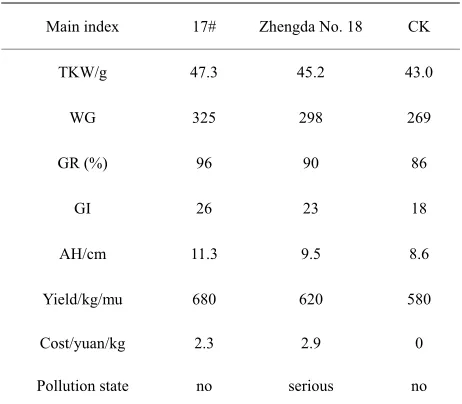
Where the TKW is thousand kernel weight, WG is the total number of wheat grain of ten wheats, GR is germi- nation rate, GI is germination index, AH is the seedling average plant height after sowed 30 days.
From Table 2 we can see that the cost dropped about
21% compared with the traditional, the 17 # of germina- tion rate was 6% higher than the traditional and 10% higher than the blank; Germination index was increased three compared with the traditional and improved by
0 10 20 30 40 50 60 70 80 90 100
Sheath blight gibberellic disease powdery mildew
b
a
ct
er
io
st
a
tic
r
a
te
(
%
)
17# zhengdaNo.18 CK
Figure 3. The effects of different kinds of seed coating agent
[image:4.595.60.287.280.432.2]on bacteriostatic rate.
Table 2. The results of experiments in the field.
Main index 17# Zhengda No. 18 CK
TKW/g 47.3 45.2 43.0
WG 325 298 269
GR (%) 96 90 86
GI 26 23 18
AH/cm 11.3 9.5 8.6
Yield/kg/mu 680 620 580
Cost/yuan/kg 2.3 2.9 0
Pollution state no serious no
eight compared with the blank; After sowed 30 days, the seedling average plant height was measured, the result show that average height coated with 17 # was more than 1.8 cm higher than the traditional and about 2.7 cm higher than the blank. Wheat grain has also improved. The Wheat yield increased by about 9.7% compared with the traditional and increased by about 17.2% compared with the blank. From the above we can also know that the traditional pesticide could bring environmental pollu- tion seriously, while the 17 # made in lab belong to a kind of environmental friendly seed coating agent with a wide range of application value.
5. DISCUSSION
The main component of 17 # is a natural polymer polysaccharide, it has obvious physiological regulating function on the plants, its specific regulating function is embodied in the following respects:
[image:4.595.308.539.285.487.2]ively. Peroxidase widely exists in plant tissue which can protect plants from poisoning. It plays an important role on the resistance of the plant. The activity of enzymes could be improved and the enzyme peak that could be advanced after the wheat seeds were coated, especially the activity of peroxidase improved obviously. On the other hand, the natural polymer polysaccharide can con- trol endogenous hormone level and it can improve the seedling radical scavenging related enzyme activity and the content of radical scavenger, so it reduce the mem- brane lipid peroxidation of wheat seedlings effectively, thus promoted the root growth and seedling strong growth. The wheats treated with this novel seed coating agent can improve seedling peroxidase activity and reduce the con- tent of MDA at the same time, It can promote the me- tabolism of the wheats and increased the seed germina- tion rate and germination index through the role of the enzyme.
It could induce wheat produce resistance and increase wheat production. After the wheat seeds were inducted by chitosan, it can produce a new synthetic substances in wheat germ cell rapidly such as antitoxin and other ma- terials which can stable the cell membrane structure and promote wheat normal physiological metabolism under the harsh environment condition. Moreover, this kind of natural polymer polysaccharide formed a layer of film which protect the seed itself from the soil harmful organ- isms violations, it can also improve the microcirculation around the seeds and make it more conducive to the growth of seedlings, so the wheat yield was increased ef- fectively.
To sum up, the natural polymer polysaccharide in the seeds coating agent could affect enzyme levels in wheat germ: it could reduce the malondialdehyde content and increase peroxidase content, so it enhances the resistance of wheat finally. Moreover, it increases the ability of the wheat to absorb nutrients and can induce wheat to pro- duce resistance for the bad environment. At the end, it makes the wheats have strong adaptability and promote the wheat production significantly.
6. CONCLUSION
This study is about the determination of wheat seed- ling germination rate and enzyme activity parameters af- ter the wheats were coated with different kinds of wheat seed coating agent. The results show that the 17 # made in lab can improve the wheat germination rate effectively, it can promote the growth of wheat root system, increase the content of wheat seedling POD effectively and re- duce the content of MDA at the same time. Moreover, it can improve the wheat germ resistance ability signifi- cantly, so it could ensure the wheat seedling strong growth. Field test further shows that it costs lower than the traditional and can improve the wheat production by
about 9%. The most important is that it is an environ- mentally friendly wheat seed coating agent which de- served to be widely applied in agriculture.
REFERENCES
[1] Brooker, N.L., Lagalle, C.D., Zlatanic, A., Javni, I. and Petrovic, Z. (2007) Soy polyol formulations as novel seed treatments for the management of soil-borne diseases of soybean. Communications in Agricultural and Applied Biological Sciences, 72, 35-43.
[2] Bautista-Banos, S., Hernandez-Lopez, M., Bosquez-Mo- lina, E. and Wilson, C.L. (2003) Effects of chitosan and plant extracts on growth of Colletotrichum gloeospori- oides, anthracnose levels and quality of papaya fruit.
Crop Protection, 22, 1087-1092.
[3] Ait Barka, E., Eullaffroy, P., Clement, C. and Vernet, G. (2004) Chitosan improves development, and protects Vi- tis vinifera L. against Botrytis cinerea. Plant Cell Reports, 22, 608-614. doi:10.1007/s00299-003-0733-3
[4] Enayat, A.O., Hanan F.A. and Somaia A.N. (2012) Chi- tosan induced hepatonephro toxicity in mice with special reference to gender effect in glycolytic enzymes activi- ties. Regulatory Toxicology and Pharmacology, 62, 29-
40. doi:10.1016/j.yrtph.2011.11.010
[5] Li, Y.Y., Guo, X.L., Lin, P.F., et al. (2010) Preparation
and functional properties of blend films of gliadins and chitosan. Carbohydrate Polymers, 81, 484-490.
doi:10.1016/j.carbpol.2010.03.005
[6] Guo, Z., Chen, R., Xing, R., Liu, S., Yu, H., Wang, P., et al. (2006) Novel derivatives of chitosan and their anti- fungal activities in vitro. Carbo-Hydrate Research, 341,
351-354. doi:10.1016/j.carres.2005.11.002
[7] Meng, X.H., Yang, L.G., John, F., et al. (2010) Effects of
chitosan and oligochitosan on growth of two fungal pa- thogens and physiological properties in pear fruit. Car- bohydrate Polymers, 81, 70-75.
doi:10.1016/j.carbpol.2010.01.057
[8] Rinaudo, M. (2006) Chitin and chitosan: Properties and applications. Progress in Polymer Science, 31, 603-632. doi:10.1016/j.progpolymsci.2006.06.001
[9] Seyed, M.O., Masoud, R., Seyed, H.R., et al. (2010) De- velopment and evaluation of a novel biodegradable film made from chitosan and cinnamon essential oil with low affinity toward water. Food Chemistry, 122, 161-166.
doi:10.1016/j.foodchem.2010.02.033
[10] Wang, Y.Q., Wang, X.L., Shan, Y.H., et al. (2010) Mem-
brane-potential alteration during K+ uptake of different
salt-tolerant wheat varieties. Agricultural Sciences in China, 9, 974-979. doi:10.1016/S1671-2927(09)60179-6
[11] Ma, P.P. and He, L.Q. (2001) Progress of chitosan in sup- pression of plant diseases. Natural Product Research and Development, 13, 82-86.
[12] Zhao, X.M., She, X.P., Du, Y.G., et al. (2007) Induction
of antiviral resistance and stimulary efect by oligochito- san in tobacco. Journal of Pesticide Biochemistry and Physiology, 87, 78-84.
bioactive coatings based on chitosan for artichoke seed protection. Crop Protection, 29, 853-859.
doi:10.1016/j.cropro.2010.03.002
[14] Chatterjee, S., Chatterjee, B.P. and Guha, A.K. (2008) En- hancement of growth and chitosan production by Rhizo- pus oryzae in whey medium by plant growth hormones. International Journal of Biological Macromolecules, 42,
120-126. doi:10.1016/j.ijbiomac.2007.10.006
[15] Li, J. and Zivanovic, S. (2010) Characterization and com- parison of chitosan/PVP and chitosan/PEO blend films.
Carbo-Hydrate Polymers, 79, 786-791. doi:10.1016/j.carbpol.2009.09.028
[16] Sanpui, P., Murugadoss, A., Durga Prasad, P.V., Ghosh,
S.S. and Chattopadhyay, A. (2008) The antibacterial pro- perties of a novel chitosan-Ag-nanoparticle composite.
International Journal of Food Microbiology, 124, 142-
146. doi:10.1016/j.ijfoodmicro.2008.03.004
[17] Xia, W.S., Liu, P., Zhang, J.L. and Chen, J. (2011) Bio- logical activities of chitosan and Chitooligos accharides. Food Hydrocolloids, 25,170-179.
doi:10.1016/j.foodhyd.2010.03.003
[18] Xie, H.L. and Xu, G.M. (2008) Suspension property of gemini surfactant in seed coating agent. Journal of Dis- persion Science and Technology, 29, 496-501.