Munich Personal RePEc Archive
Saving behavior in low- and
middle-income developing countries
Reinhart, Carmen and Ogaki, Masao and Ostry, Jonathan
University of Maryland, College Park, Department of Economics
January 1995
Online at
https://mpra.ub.uni-muenchen.de/13757/
IMF
WORKINGPAPER
O 1995 International Monetary Fund
Thii is a Wking Paper and the authw(s) wMJd &me
any commEntJ on the p a n t wxc. Citatbm Jhwkl mkr a Working Pqxr 06 he International M o n e w Fund. mm cioning the aufhw(s), and the date of isauanoe. 'lhc &M
ex+ arc those of the author(s) and do not n c u s a d y
rc-nt those of the Fund.
WP/95/3
INTERNATIONAL MONETARY FIMD
Research
DepartmentSaving Behavior in Low- and
Middle-Income
Developing
Countries:
A
ConmarisanPrepared
by
Masao Ogaki, JonathanD.
Ostry, andCarmen
M.
Reinhartl
J
Author
f
zedfor
distribution
by
Peter
Wickham
January 1995Abstract
The impact
o f
changesin
real interest rates on saving and growth isa central issue
in
development economics.According
toone familiar view,
afinancial liberalization
programwhich
increasesreal
interest ratesshould
encourage saving, therebyboosting
investment andgrowth.
While
suchliberalizations
have
indeed typically succeededin raising
realinterest rates,
their
impacton
privatesaving
has
been mixed.This
paper uses macroeconomic data
for
a sampleof
countrieswith
diverseincome levels
t o estimate a modelin which
the intsrtemparal elasticity of substitution varieswith
the level of wealth. The estimated parametersare
then
used ta calculate,in
the contextof
a simple endogenous growth model, the responsivenessof
saving to real interest x a t e changes forcountries
atdiffering
stagesof development.
3EL
Class1
f
icationNumbers:
E21,F41,
F 4 3 , 011, 016, 057I
J
Ogaki: Departmentof
Economics,Ohlo
S t a t eUniversity; Ostry
andReinhart: Research Department, International Monetary
Fund.
Any viewsexpxessed
in
this papex are those of the authors and should not beattributed to the institutions
with
which
theyare
affiliated.
The
authorswish
tothank
seminar participants atthe
IMF andOhio
StateUniversity,
aswell
as Sergio Rebelo, Michael Sarel,Miguel
Savastano, andPeter
Wickham
for
helpful comments and suggestions, and Jared Romeyf o x
excellent
research
-
Ti
-
Contents
Summary
I .
Introduction31. S t y l i z e d Facts
111. Analytical Framework
IT.
Estimation Strategy andEmpirical Results
1.
Data issues2. Empirical methodology and estimation results
a. The
f i r s t
step: estimating the intratemporale l a s t i c i t y
of
substitutionb. The second s t e p : estimating the intertemporal
parameters
V . Saving and the Rate
of
Interest1. A simple model of endogenous growth 2 . Results
V I
.
Canclus ionsText
Tables1.
Food as aPercent of
T o t a lPersonal Expenditure for
S e l e c t a d Countries, 19902 . Personal Saving Rates for S e l e c t e d Countries
3 . Canonical Cointegrating Regression Results
4 . The intertemporal Parameters: Generalized Method of
Moments Results
5.
The
Intertemporal Elasticity. of Substitution: Low-and L o w e r Middle-fncoms Countries
6.
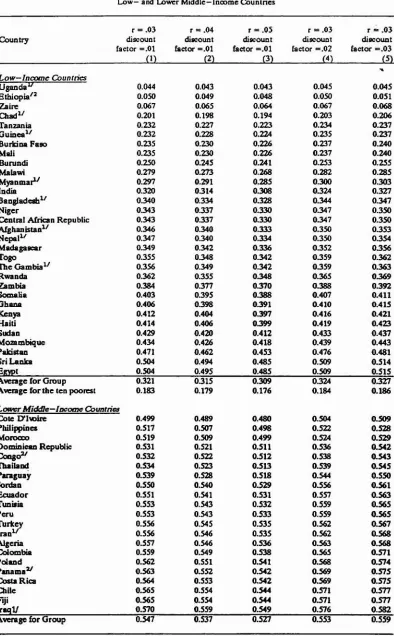
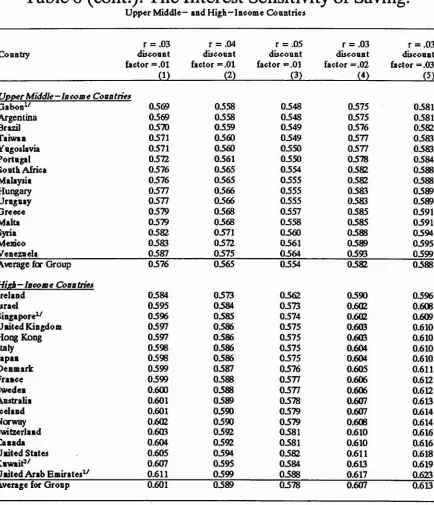
The Interest Sensitivity of Saving: Low- andLower
Middle-Income Countries
Chart
1.
The
Intertemporal Elasticity ofSubstitution
u
iii
The
responsiveness of- saving to changesin
seal i n t e r e s t rates is akey
parameterin the
evaluation of the effectsof
anumber o f
exogenousand
policy-induced shocks in
developing countries. Financial sector reforms havetypically
resulted in increases inreal
interest xatesin
developing countries, but the response of saving--andthe
e f f e c t s on investment andgrowth--have been much less clear-cut.
In
addition, the effects on the externalcurrent
account balance of fiscal policychanges
that alterdomestic interest rates depend
on
the
responsiveness ofprivate
saving to movements in r e a l rates of return.Finally,
temporary tenasof
trade shocksor
trade liberalizatians that are not credible contribute to movements inccmsumption rates of interest (which measure the true cost of consuming today relative to consuming tomorrow)
in
developing countries ,the
effectsof
which on
the
current account dependcritically on
the
e l a s t i c i t yof
saving w i t h respect: to thereal
i n t e r e s t rate.Empirical evidence suggests t h a t the intertemporal elasticEty
of
substitution in consumption
(on
which the interest rate elasticity of saving depends) variesconsiderably
acrossdeveloping
countries.This
paperargues
that a main reason for t h i s variation
may
be
acountry's
levelof
development. Specifically, because
of
therole of
subsistence consumptionin
household expenditure, low-income developing countries w i l l typicallye x h i b i t a n e g l i g i b l e response
of
saving to movementsin
real interest r a t e s . As the p e r c a p i t a income level r i s e s , the fraction of the budget left aftersubsistence needs have been met increases. As only this fraction of the budget is sensitive to movements
in raal
interest rates, the model implies anonlinear
relationship between the Intertemporal e l a s t i c i t yof
substitutionand the
level
of development.The
interest rate e l a s t i c i t yof
saving shouldtherefore
be
much higherin middle-income
than
in
low-income countries(where it will be close to
zero),
but
it w i l lbe only slightly
higherin
high-income
than
in
middle-income
countries, where subsistence p l a y s littlerole
in
the expenditure patterns of most households.These notions f i n d support in the data. Using macroeconomic data from
a sample of countries w i t h diverse income levels, the paper concludes that a
model in
trhich the
intertemporal e l a s t i c i t y of substitutionis an
increasing
function
of
the
gap between permanentincome
andthe
subsistence consumpttonlevel cannot be rejected. The model implies v e r y
different
responsesof
private savfng to (exogenous and policy-induced) raal interest rate
shocks,
I.
I n t r o d u c t i o nThe
impact of changesin
real i n t e r e s t rates on saving, investment,and economic growth, is a central issue
in
development economics. According ro onefamiliar
view (see, for example, McKimon (1973) andShaw (1973)),
an
increase in real interest rates in developing countriesshould
encourage
saving and expand the supplyof
creditavailable
todomestic investors, thereby enabling the economy to grow more quickly.
Indeed, a
number
of liberalization p'rograms supported by the international financial institutions over the years havehad
as their explicit objectiveto increase i n t e r e s t rates from levels t h a t in many cases
were
substantially negativein
weal terms.While
increasesin real
interest rateshave
oftenbeen
the outcome o fsuch
liberalization
e p i s o d e s (see,for
example,Calbis (1993)), their impact
on
domestic saving and investmenthas
beenunclear. L/
There
is l i t t l e consensusin
t h e empirical literatureon
the
interaction between saving and the real rate of interest ( s e e , for
instance, Savastano
(1994)
andSchmidt-Hebbel,
e t al. (1992) for areview
a £ this literature). Some researchers have been unable to d e t e c t much of
an effect of changes in real interest rates on domestic saving in
developing counrries
.
For example, Giovannini ( 1 9 8 5 ) finds that inonly
five
of the eighteendeveloping
countriesin
h i s sample are consumptionand saving sensitive to changes
in
the real i n t e r e s t rate.He
cancludest h a t f o r
the
majority of cases,"the
responseof
consumption growth to t h ereal rate of
i n t e r e s t is insignificantly differentfrom
zeroh' [page215)
and t h a tone
should therefore expect " n e g l i g i b l e responses of aggregatesaving to the real rate of interest [in developing countries]" (page
197).
Rossi (1988) a l s o finds t h a t "increasesin
the real r a t eof
return are n o tlikely to
e l i c i t substantial increasesin
savtngs, especiallyin
low-incomedeveloping countries" (page 104).
In
a model with asingle
consumptiongood, O s t r y and Reinhart ( 1 9 9 2 ) confirm these
findings;
but when a disaggregated commodity struc'turc that allows for traded and nontradedgoods is assumed, these authors f i n d higher and statistically significant
estimates of t h e intertemporal e l a s t i c i t y of substitution. However,
regional differences emerge, with
Asian
countries showing a greaterresponsiveness to real interest rate changes. 2J
The finding
of
a zero or near-zero interest rase sensitivity of savingin a
number
of developing countries has led researchers to consider a number of alternativehypotheses
that could help to explain t h i sresult.
One suchhypothesis is that consumption
in
developing eauntriesmay
bemore
r e l a t e d to subsistence consideratians--particularlyin
the case of low-income4/
For
a v i e wrunning
contrary
t othe
McKinnon-Shaw hypothesis,
seeBuffie
(1982)
and van Wijnbergen(1983).
For an analysis of the Uruguayanexperience with
financial
liberalization, see de Melo and Tybout (1986).2/
Ostry andReinhart 11992)
attributed thesedifferences
to t h e presencecountries--than to intertemporal consumption smoothing.
J
I
If
householdsmust:
first achieve a subsistence consumption level, letting intertemporalconsiderations g u i d e their decisions
only
f o rthat
p o r t i o n of their budgetleft
after subsistence has been satisfied,then
the intertemporal elasticity of substitution and the interest-rate sensitivity of private saving w i l l beclose to zero for countries at or near subsistence consumption Levels, and
rising
thereafter.A second reason why the intertemporal elasticity of substitution
may
be smaller
for
low-income countries concerns the relativeshare
of
n e c e s s i t i e s
in
t h e budgetsof
relatively poorhouseholds. If
necessities(for
example, food) are less substitutablethrough
time than other goods,then the intertemporal e l a s t i c i t y of substitution will be lower
for
households with a larger proportion of necessities in their budgets than for householdswhere such
goods areless
important. The implication wouldbe
that
for
relatively poor countrieswhere
budget shares of food arerelatively
high, the interest-rate e l a s t i c i t y ofsaving
wouldbe
relativelylow. 2J
It is indeed noteworthy that food consumption accounts for a markedly
lower share of total expenditure
in
high incomathan in low income
countries. As
shown in
Table 1,
food consumption accounts f o r less thantwenty percent of t o t a l expenditure in most industrial countries and for only 8 percent of t o t a l consumption in the United S t a t e s .
For
middle-incomecountries such as Mexico and Thailand,
the
share is often 3 0 - 4 0 percent,while for t h e poorer countries the share of food approaches 60-70 percent ( s e e Mitchell and lngco (1993)).
Empirical
supportfor
thesehypotheses
isfound
inAtkeson
andOgaki
(1993).
Specifically, using a panel of data on Indian households,they find
t h a t the intertemporal e l a s t i c t t y of substitution of the richestsix households in their data s e t is approximately 1.6 times that of the
poorest six households.
Thus,
fromtheir
results, the e f f e c t so f
the
l e v e lof
wealthon
theintertemporal
elasticityof
substitution would indeedappear to be economically significant.
h/ For
models t h a t stressthe
role played by
subsistence considerationsin
eonsumption/saving d e c i s i a n s , see Rebelo (1992) and Easterly (1994).On the b a s i s of a similar argument, Rebelo (3992) argues that
financial
liberalization in
low-income developing countries is unlikely toproduce large e f f e c t s
on
saving and economic growth. F o r a discussion ofthe
effectsof financial
market deregulationi n
developing countries, seeGalbis (1993). For an analysis that highlights
stylized
facts concerningthe differences in saving behavior between l o w - and middle-income developing countries, see two recent World Bank
volumes
(World Bank (1993, 1 9 9 4 ) ) ,dealing respectively w i t h the performance
of
the
economiesof
East Asia andTable 1.
Food
as
a
Percent of Total Personal
Expenditure for Selected Countries
Country
Percent
Law-Income Countntnes
HondurasIndia
Sierra
Leone
SriLanka
Sudan
Average
for
Qrmp
Lower
Middle-Inmmc
Caunr'es
Colombia
Ecuador
Fiji Jamaim Jordan Philippints Thailand
Average for Group
Up- Middle-
I n m e
Coun
Greece
Malaysia
Mexico
South
Amca
Venezuela
Average
for
aroup
High
-Income
Caunmtnes AustraliaCanada
Belgium
Sweden
United
Kingdom
United State Average
for Orwp
Note:
For chsifiation
of
cconomfm
byIncome
I&
see
World
Bank
(1 W b )There a r e , however, additional reasons
why
saving may be l e s sresponsive to changes
in
real interest rates in low-income than in middle-incame countries. Rossi (19881, for example, argued that low-income
developing countries are characterized
by
pervasiveliquidity
constraintswhich
imply
that consumption growthin
such countries is morelikely
tof o l l o w
income
growth than changesin
expected ratesof
return.J
l
Theempirical evidence appears t o point to the presence of liquidity
constraints in many developing countries; however, Haque and Montiel (1989) highlight t h a t the severity of these constraints varies considerably across
countries.
More
recently, Vaidyanathan (1993) showedthat the
incidence of liquidity constraints among households i sinversely
r e l a t e d t o the degree ofeconomic development
which
wouldimply--following
Rossi (1988)--that savingin poorer countries should be less responsive to interest rate changes. 2J
Lastly,
i t could beargued
that failure t o d e t e c t a systematicrelationship bemeen
saving and
real interest rates across countriesand across time may a l s o be due to considerable variation in
the
economic signzficance and information content ofthe
real rates n f return themselves.Lack of sophistication and depth in domestic financial markets or direct
regulation may result
in
nominal interest rates that do not adequately reflect expectations about the underlying economic fundamentals. This problem m a y be particularly severe for some o f the poorer countries.In
addition, lack of information
on
inflation expectations is a problem that, as the literature on the peso problem has shown, may be especially relevantfor
high-inflation
countries and/or episodes,While a number of hypotheses have been put forward to suggest t h a t
saving behavior in developing countries is a f f e c t e d by the Level of
development, there
has
so far been little systematic empirical investigationof
this
issue atthe
macroeconomic level i n the l i t e r a t u r e .Yet
from apolicy perspective, the issue is of
central
importance, since for example,the e f f e c t s on--inter
alia
investment and growth--of a number of p o l t c yactions frequently undertaken by developing countries--including financial
liberalizarion, reducing capital controls, and the transmission of fiscal
and commercial policy
changes
to thecurrent
account--willall be governed
l
J
Deaton ( 1 9 8 9 )has
a l s o emphasized the importance of liquidityconstraints in explaining consumption/saving behavior in developing
countries.
2
J Vaidyanathan (1993)
also
foundthat
financial liberalization
in
developing
countries reducedthe
severity of borrowing constraints.Although no direct t e s t s were undertaken,
the
implicationwould be
that
financial liberalization, by
reducingthe
fractionof
households f o rwhich
liquidity constraints are
binding,
should increase the interest-ratesensitivity
of
privatesaving.
For a direct test of t h i s hypothesis, seeto some degree by t h e responsiveness o f saving to i n t e r e s t rate
changes.
l
J
With this in mind, the purpose of this paper is to q u a n t i f y empirically
t h e response of c o n s ~ p t i o n / s a v i n g t o
changes in
thereal
rate of i n t e r e s t .W e proceed
in t w o
s t e p s . First, we use macraecanomic data f o r a sample ofcountries with diverse income levels to estimate a
model
t h a tallows
theintertemporal elasticity of substitution to vary with the level of wealth. W e then use
the
estimated parametexs to calculate,in
the context of asimple endogenous
growth
model, t h e elasticityof saving
with
respect to changes in the real rate of interest.The remainder of the paper is organized as follows. Section
I1
presents some s t y l i z e d facts on saving behavior and income levels and
focuses
on
the differences between low- and middle-income developing countries. Section 111 describesthe
analytical
framework,while
SectionIV
discusses t h eempirical
methodology and summarizes theestimation results. The response of saving to changes
in
real interest rates is examinedin
the context of a simphe endogenous growth model in Section V. The implications for policy and future research are taken upin
the
final
section.11. Stylized Facts
A model, such as the one developed
in
this paper,
t h a t emphasizes the role of subsistence consumption, has t w o main p r e d i c t i o n s about savingbehavior, First, saving rates should increase with the level
of
wealth atthe
initial stages of development, with the largest increasesin
the savingI;/
In addition to policy-induced shocks, the transmission of a temporaryterms of trade disturbance, through its effect on the consumption r a t e of
i n t e r e s t , depends
crucially on
the sensitivity ofsaving to
intertemporal relative prices (see, f o r example, Svensson andRazin
(1983)
andOstry
(1988)).
In
the area of commercial policies, noncredibleliberalizarions will also generate changes in consumption rates of
i n t e r e s t as
households
may view the reductionin
import p r i c e s (associated w i t h tariff reductions) as a temporary phenomenon ( s e e ,for
axample,Razin
and Svensson (19831, Calvo (1987, 1988,
1989)'
Edwards and O s t r y ( 1 9 9 0 ) and O s t r y (1991a,b)). The extent to which such noncredible liberalizations willinduce a consumptian boom (and a current account deterioration) therefore depends
on
t h e intertemporal e l a s t i c i t y of substitution in consumption.The
finding that:this
parameteris
Lowin
anumber of
countriesmay
help torationalize the empirical
findings
of Ostry and Rose(1992)
that
tariffshave little systematic effects an saving and current account behavior.
Finally,
the transmission of f i s c a l p o l i c y changes (which engender movementsin domestic interest rates) to
the
current accountwill be governed
in partby
the
responsiveness of private saving to real Interest rates ( s e e , f o rrate occurring as a country moves f r o m
low-
to middle-income levels. lJ
Second,
saving should become more responsive t o changesin
real
interest rates as countries become r i c h e r . The first prediction follows d i r e c t l yfrom
tlfie role of subsistence consumptionin t h e
low-income developing countries, andthe
fact that the share of subsistencein
t o t a lconsumption declines
with
income.2/
The second p r e d i c t i o n may a l s obe r e l a t e d to subsistence considerations, since intertemporal incentives should
only
a f f e c tthat
portion a £ the budget left over after subsistencehas been achieved, t h a t i s , discretionary income.
With regard to saving rates, a model t h a t stresses the role of
liquidity constraints offers a different p r e d i c t i o n ;
if
poor consumers c a m o r borrow but face an uncertainincome
stream,the
demand f o rprecautionary saving rises ( s e e , f o r instance, Deaton (1989)).
Hence, it may be the poorest lfquidity-constrained consumers t h a t save
more. However, as w i t h
the
subsistence model, the responsiveness ofsaving to changes in interest rates rises with the level of wealth as
liquidity constraints become less binding.
Among countries in various income groups,
the
patterns of savingrates that emerge are broadly consistent w i t h
the
predictions of thesubsistence model. As Table 2
highlights
for selected countries, private saving is, on average, considerably lowerfor
the
poorestdeveloping countries,
where
the saving rate is about onehalf
t h a t ofthe high-income group.
4J
Xn f a c t , such differences also appear withinregions. According to the World Bank {1994a), median gross domestic saving as a percentage of GDP
(1987-91
average) was 5.6 percent forthe low income African countries and 19.0 percent f o r the middle-income African countries (the average was 7.7 percent).
As predicted, t h e
relationship
between thelevel of
income and thesaving r a t e appears to be nonlinear
for
the countries in our sample ( s e eRebelo (1992)); the largest increases
in
the saving rates occur in thetransition from low- to lower middle-income, where the average personal
saving rate rises by 5.5 percent (Table 2 ) . The average f o r the upper middle-income countries is s t i l l 2 . 8 percent above t h a t of the lower
middle-income group,
but
there appears to be relatively littledifference
(0.5
percent) betweenthe
average saving ratesin
the
hfgh-income and upper middle-income countries
in our
sample.- -.
1/
In fact, in such models ( s e e Rebelo (1992) and Sarel (1994)), t h esavLng rate need n o t increase
in
the transition from middle tohigh
incomelevels.
2J S e e , f o r example Barro (1990) and Rebelo (1992).
This
precautionary motive, without explicitly modelling l i q u i d i t yconstraints, is empirically investigated
in
Ghosh and O s t r y(1994).
Table
2.
Personal Saving
Rates
for
Selected Countries
(lW-I1)9J a * e n g n . ~ ~ e ~ n ~ d )
-
GNPpr&&Mdult b M d % # a 8ia 1915
s
19CO-:7 -#! P-tdGDPT V i 6395 -Ilf
Ehrkwa R& W6 111
8882 135
h h d r g m r 9168 4 3
TOP %SF9 14.0
! h d i a 1144.4 62
Ghana 1161.1 6.1
H& 1210.4 4 5
1 197.9 1 8 2
S w m h 1311.0 8.1
N- l W J 95
P 8 k a u 1m 230
Lm5*
1m9 753m.o 143
S r i h h 2156.1 1 98
Rdik m79 322
-8- 3576 127
-
217RI 1111El* ZZMD 15.0
p b i i p p e 8 ' 2- 162
~d
24724 209M i mReplib B11.1 118
Tbrihd m1.4 pa
3LI&tl 146
3773.4 145
Peru 3B65 244
k*
3531 6 21.43%25
m
U t h 4lM.O I 2 7
PdradY 43W.6 2&S
CWe 4ST7F87d 1 2 8
Still, there appear to be sharp differences in savings rates t h a t
cannot be accounted
for
by the
subsistence model.For
example,saving
rates in L a t i n
America
are
well below
those observedin many
Asiancountries, despite similar income levels.
J
l
As pointed out in WarldBank
(19931, gross domestic saving as a percentage of GDP was n e a r l y 40 percent f o x the high-performing (middle-income) Asian economiesin
1990;
it is argued that these relativelyhigh
saving rates werean
engine of growth in many of these countries, since t h e y financed higher rates of investment as well.The role o f
real
interest ratesin saving
behavior ismore
difficultt o gauge. One
problem--which
is particularly importantin Africa,
isthat
financial
markets remain t h i n and governments s e t interest s a t e s , frequently at non-market levels. As pointed o u tin
a recent WorldBank
study on Africa (World Bank ( 1 9 9 4 a ) ) , "most countries
[in Africa] have
few banks, and
...
there is l i t t l e scope for 'true' market-determination o f interest rates" (page114).
This
feature of credit marketsin low-
income countries may i t s e l f make saving less responsive to interest rates
Nevertheless, there is some evidence t h a t financial savings increased
as a resulr o f the increase in real interest rates associated with
l i b e r a l i z a t i o n of financial markets, b o t h in Africa and elsewhere among
developing countries.
For
example, among the Asian countries, the increasein
real interest rates in Taiwan Province ofChina
in1949
contributed to a sharp increasein
savings. Similar results were achievedby
Indonesia and Korea, and more recently, by Argentina,Chile,
Mexico, and Pakistan(see Uorld Bank (1993) and the references therein). There is also some
evidence t h a t r e f o r m programs
in
Africa have succeededin
raising domesticsavings, For example, as documented in World Bank (1994a), median gross
domestic saving
climbed
3 . 3 percentage p o i n t sfor
the six African countriesw i t h a large improvement in macroeconomic p o l i c i e s (whlch consisted
of
f i v e m a i nindicators,
oneof which
was interestrate
policy),
compared to ad e c l i n e
of
3 . 3 percentage pointsfor
countriesw i t h
p o l i c y deterioration.In
general,moving
real fnterestrates
fromsharply
negative to mildlypositive
levels
seems to be a posicive factorin
mobilizing domesticsavings, although there is no particular evidence
that
the effectivenessof such policies rises with the level of development, as
the
subsistencemodel would suggest.
An
investigationof this
issue is undertakenin
thefollowing three sections.
U
Income distribution within a country is often argued to exertan
independent influence an saving behavior, but w e are unaware of any
111.
Analvtical
FrameworkWe begin by describing the maximization problem faced by a
representative household in a given country. Since our ultimate purpose is to examine cross-country differences in saving behavior, we do n o t
assume that representative hauseholds
in
different countries haveidentical preferences. As in Ostry
and
Reinhaxt (19921, we adopt a two-goodframework that distinguishes between traded and nontraded goods. As argued
in
that
paper, it is important to estimate the intertemporal elasticity ofsubsritution
with
a two-good model in order to avoid biaswhen
the relativep r i c e
of
traded and nontraded goods (thereal
exchange rate) variesconsiderably through t i m e , as we will discuss later. W e allow
for
cross- country variation in both the intratemporal e l a s t i c i t y of substitutionbetween traded and nontraded goods and t h e intertemporal elasticity of
substitution.
The
assumptionis
that
the latter varies systematically withthe level
of
wealth, We beginby
describing,in
equations(1)-(7)
below, the optimization problem at the n a t i o n a l level.Consider
then
an economy withan infinitely-lived
representativehousehold whose objective is to choose a c o n s ~ t i o n stream t h a t maximizes:
subject t a the series
of
budget constraints:and the transversality condition:
where Q is the expectations operacor conditional on information available
at time 0 ; Bt denotes the real level of debt carried from period t to period
t+l w i t h Bdl given; (
1 ) -
=r
is thereal
interest rate (in termsof the numeraire)
on
the
debt soR;
is the associated world real discountfactor; m (n) denotes consumption of importables (nontradables) and p (q)
denoted the r e l a t i v e p r i c e of
m
(n)
in termsof
the numeraire;p
is thesubjective discount factor; and E
(PI
denotes the intratemporal(intertemporal) elasticity of substitution.
I
J
An intratemporalelasticity oaf subsritution greater (less) t h a n one implies gross
substitutability ( c o m p l e m e n t a r i q ) between traded and nontraded goods;
a value of
unity
corresponds to the logarithmic utility case. Theintertemporal elasticity
of
substitution reflectsthe
sensitivityof
consumption (and therefore saving) t o changes in intertemporal p r i c e s ( i . e . the consumption rates of i n t e r e s t ) ,
with
higher values indicatinggreater sensitivity.
The problem of the representative
consumer in
agiven
country is to choosean
optimal sequenceI%,
r+, Btlthat
maximizes(1)
subject to ( 2 )and ( 3 ) . The first order necessary conditions
for
an optimum are:Equation (4) is the intertemporal
Euler
equation a s s o c i a t e d with importables consumptionin
two consecutive p e r i o d s ; it states that the marginal utilitycost
of
givfng upone unit of
at s h e t should be equated to the expected u t i l i t y gain from consuming one more unit of m at t+l. Equation ( 5 ) is theanalogous condition relating the marginal rate of substitution between
consumption
of
goodn
at t and t+l torhe relevant
intertemporalrelative
p r i c e . Finally, equation ( 6 ) is the nonstochastic fLrst order conditionequating
the
intratemporalmarginal
rateof
substitution betweenimportables and nontradables to the corresponding relative price ratio.
It can be verified t h a t equations (4)-(6) are net kdependent.
Specifically,
combining equation ( 6 ) with either of the t w oremaining
equations y i e l d sthe
third.
Therefore, given
that
the nonstochasticfirst
order condition holds, equations ( 4 ) and (5) do not provideindependent restrictions on the evolution a£ consumption through time.
l
J
Following the discussionin
Section 11, we allow f o r cross-countryThe main difference between
the
model
described above and standardEuler-equation models t h a t
have
been applied previously to developingcountries (far example, Giovannini (1985) and Rossi (1988)) relates to the goods structure.
In
the above model, we allow for consumption oft r a d a b l e s and nontradables s i n c e the latter appear to account for a large
fraction of the consumption
basket
in
many developing countries. Moreover,imposing a one good structure can seriously bias the resulting estimates of preference parameters,
If
the real exchange rate (the relative p r i c eof traded and nontraded goods) varies over time, as is the case
in
moscdeveloped and developing countries, aggregate consumption
will
respond tothose price changes. This is because a change in the real exchange rate
alters the consumption rate of interest. As
such channels
are
ignored
in
a one-good structure, the empirical results from such modelsmay
beb i a s e d .
J
l
For example,the
finding
that
intertemposal elasticitiesof
substitution are insignificantly different
from zero in
t h e majority of developing countries w a s found by O s t r y and Reinhart (1992) not to berobust to a relaxation of
the
one-good assumption.Given time series d a t a on importables and nontradables consumption,
and on interest rates,
and
import, expast, and nontradables p r i c e s , it isp o s s i b l e to estimate the system consisting o f ( 4 ) - ( 6 ) and recover the main parameters o f interest.
Since
(6) must
holdidentically
(in the
absenceof measurement e r r o r ) , and since (&) and ( 5 ) are not independent given t h a t (6) h o l d s , we can eliminate ( 6 )
or
(5) from the estimation. Therestrictions on the j o i n t behavior of consumption of importables and
nontradables, the terms
of
trade, andthe
relevant rate of return, i m p l i e dby the maximization of the expected utility function given by (1) s u b j e c t to the constraints given in ( 2 ) and
( 3 1 ,
are summarized in equation (4).In addition, given the assumption
of
rational expectations, we can useequation (&) to define the disturbance :
where
q
mustbe
uncorrelatedwith
any
variable that isin
the informationset
of
agents at time t.With
t h e optimization problem of a representative householdin
a givencountry
fully
described, it remains to be s p e c i f i e dhow
intertemporalparameters governing saving behavior vary systematically across countries.
In what follows, we rake a particularly simple approach motivated
by
aStone-Geary
preference specification (as described, f o r example,by
Rebelo (1992)). We adopt a specification in which the intertemposall
e l a s t i c i t y
of
substitution i san
increasing function ofthe
gap between permanent income and the subsistence level of consumption,viz:
where pi denotes
the
intertemporal elasticity of substitution in country i ; y ' is a measure of permanent income in countryi;
and -y is a constant whichP
r e f l e c t s subsistence consumption.
Clearly,
equation ( 8 ) is s i m i l a r to theStone-Geary preference s p e c i f i c a t i o n but w i t h permanent income replacing consumption. Conceptually, we focus on income rather than consumption
in
order to make transparent the connection between the intertemporale l a s t i c i t y of substitution and the level of development (i.e., income per
c a p i t a ) . Equation (8) shows t h a t the interest-rate s e n s i t i v i q of aggregate
consumption ( a s well as the level
of
saving i t s e l f ) w i l l be lower asthe
ratio, 7/y;1, approaches unity and wealth is only sufficient to support a subsistence level
of
consumption.fV.
Estimation Strateev and EmiricalResults
1.
Data issuesThe parameters of the representative
household's
utility functionoutlined
in
t h e previous section are estimated using annual time-series data f o r thirteen countries.The
law-income countries in the sample are:Egypt, Ghana, India, Pakistan, and S r i
Lanka;
the low-middle incomecountries consist of Colombia, Costa Rica, C b t e drIvoire, Morocco, and the
Philippines;
three upper-middle-income countries are also included inthe
analysis:
Brazil,
Korea, and Mexico. Data coverage for eachcountry
beginsin
1968 and ends anywhere between 1983 and 1992.As equations ( 7 ) and ( 8 ) h i g h l i g h t , estimation of the intertemporal and intratemporal elasticities of substitution requires data on household
consumption of traded and nontraded goods,
the
terms of trade, and permanent income or wealth.While
time series on the terms o f trade arereadily
available,
consumption data are generally not disaggregated intotraded and nontraded goods and estimates
of
wealth are scarce. Withregard to
the
disaggregation of consumption, the methodology applied isd e s c r i b e d in detail in Ostry and Reinhart (1992). B a s i c a l l y , we assume
that
the
nontraded goods s e c t o r of the economy consists of p u b l i c andprivate services while traded goods production emanates f r o m the
agriculture,
mining and industrial s e c t o r s . Consumption of importablescan
then
be
constructed using t h e supply-side data and dataen
e x p o r t sand i m p o s t s
of
consumer goods. Consumption of nontraded goods arecalculated residually as total private consumption less consumption of
importables. The relevant price deflators f o r
the
consumption of tradedand nontraded goods are price indices
for
i p o r t s and services,the absence of these, a
money
market ratewas
employed.Finally,
as a proxy f o r permanent income, an averageof
real income per equivalent adultfor the period 1980-87 w a s used.
U
2 . E m ~ i r i c a l methodolow and estimation results
In this subsection, w e apply Cooley and Ogaki's
(1991)
two-step procedure to obtain estimates forthe
intratemporal e l a s t i c i t y ofsubstitution between t r a d e d and nontxaded goods and f o r the intertemporal
elasticity of substitution. A similar procedure, which was applied
independently
by Ostry
and Reinhart(19921,
uses a cointegration approachto obtain first-stage estimates of the intratemporal parameter
and
Hansen and Singleton's ( 1 9 8 2 )Generalized
Method o f Moments(GMM)
approach to obtain (second-step) estimatesof
the intertemporal parameters.a. The first step: estimating the intratemporal elasticirv of substitution
Many
economic time series canbe
modelled as beingdifference
stationary with d r i f t.
Under
such conditions, the notionsof
s t o c h a s t i cand deterministic cointegration are useful in
examining the
interactionbetween t w o or more variables of interest. J2 Suppose that the
components of a vector series X ( t 3 are 1(1) p r o c e s s e s w i t h d r i f t ;
if
a linear combination of X ( t ) , say X X l t ) , is trend stationary, the components of X(t) axe said to be (stochastically) cointegrated with a cointegrating vector A . Consideran
additional restriction that the cointegrating vectoreliminptes the deterministic trends as
well
asthe
stochastic trends, sothat h X ( t ) is stationarv.
This
r e s t r i c t i o n is called t h e deterministic cointegration restriction.Standard unit root t e s t s suggest t h a t it is reasonable ta model the
relative price of traded
and
nontraded goods andthe
consumption r a t i o(of nontraded to traded goods) as
I(1)
processes. 3J W e now focuson
the relationship among these two variables.The
intratemporal f i r s t order condition (equation 6 ) implies that t h e l o gof
the relative
price and thelog of the consumption r a t i o are cointegrated with the deterministic
I
+
/
A 1 1 series are available upon request.Stochastic cointegration and the deterministic cointegration
restrictions were defined by Ogaki and Park (1989) and Campbell and
Perron
(1991).
Efficiencygains
f r o m estimating the cointegrating vectorsby imposing
the detrerministic e~integration restriction were discussedby
West (1989) f o r the one-regressor case and
by
Hansen (1992) and Park (1992)for
the multiple-regressor case.cointegration restriction.
1/
If
cointegration o b t a i n s , we can recover aconsistent estimate of the intratemporal e l a s t i c i t y of substitution, E . 2J
To test for cointegration, we employ
Park's
(1992)Canonical
CointegratingRegression (CCR) procedure. 3J
There are several advantages associated with
CCR.
First, t h e estimatedparameters, a and E in t h i s case, are not
only
consistent {as isOLS),
b u t a l s o asymptotically efficient and median unbiased. Second, unlike OLS,the
asymptotic distributions of CCR estimators are nuisance-parameter freeand normal conditioned on the regressors. This Latter feature a l l o w s
for
the usual interpretationof the
standard errors and thereforefar
hypothesis
testing. Third, as MonteCarlo
experiments show (seePark
andOgaki
(1991)), CCR
estimators have bettersmall
sample properties thanJohansen's estimators.
This
latter feature makesCCR
particularlyattractive for the present application, where
the
data are annual andthe
sample size is limited.
R~arranging terms, taking logs. and introducing a disturbance term (to allow,
for
example, f o r measurement errar) equation ( 6 3 becomes:Equation (9) is
likely to
sufferfrom
simultaneity bfas, since relativeprices are determined endogenously, and the
error
termmay
be s e r i a l l ycorrelated.
4/
To correctfor
the
potential presence ofsuch nuisance
parameters,
long-run
cavariances are estimated and used to transform thedata, As shown in Park (19921, the transformed data w i l l be cointegrated
with the same parameter vector as fhe original data.
Under the
null of
cointegration, an important property ofthe CCR
procedure isthat
linear restrictions can be t e s t e dby
X2 tests.ZJ
These
x2
tests are used in a regressionwith
spurious deterministictrends
addedto test
for
deterministic and stochastic cointegration.For
t h i s
purpose,the CCR procedure is a p p l i e d to a regression
As shown
by
H a l l(1978),
consumption is arandom
walk when the
real
interest rate is assumed to be constant. Since we allow
the
real i n t e r e s t rate to vary over time, the first difference of the log of consumption can be serially correlated.This will a l s o y i e l d a point estimate f o r the parameter a,
which
isrelated to the consumption
share.
See Ogaki (1993a) f o r a more d e t a i l e d explanation
of
CCR-basede s t b a t i o n and testing.
Note that the OLS estimator is consistent b u t
n o t
efficient because oflong-run
simultaneity bias. 5L e t H ( p , q ) denote the standard
Wald
statistic to test thehypothesis
tj + ~ = q p + 2 = . . . ~
=0,
where the variance ofI+
has been replaced with elementsq
of the long r u n covariance matrix ( s e e Park (1990)). Under the null of a
cointegration H(p, q ) converges to a x L In particular, the H(0,l) 4 - P '
s t a t i s t i c t e s t s the deterministic cointegrating restriction,
which
issuggested
by
t h e intratemporalfirst
order condition, On the other hand,the
H[l,q)
t e s t s f o r stochastic cointegsation.Table 3 reports the CCR resulss.
I
J
Asshown in
column(13,
w i t hthe exception of Korea, the intratemporal elasticity o f substitution,
r ,
is estimated to be positive, consistent w i t h our theoretical priors. Tn
the case of Korea, where t h e estimate of E is significantly negative, the
H(0,l)
test statistic presented incolumn
( 2 ) a l s o rejectsthe
specification,
implied by
the model atthe
0.1 percent level. It ispossible that
the
assumption of homothetic preferences impliedby
the CES utility function is causing problemsin
this
case. 2J For the remainingcountries, the point estimates f o r E range from a l o w
of
0 . 3 8 to a high of2.16;
for eight of the 13 countries the intratemporal e l a s t i c i t y ofsubstitution exceeds unity, implying gross substitutability between traded
and nontraded goods. For the Philippines, the p o i n t estimate of E is
positive but is n o t significantly s o , and the
H(0,l)
test is significant at the 1 percent level, implying that the null of deterministic cointegration is rejected; however, the null of stochastic cointegration cannot berejected (columns ( 3 )
and
( 4 ) ) at standard significancelevels.
For theother countries, none
of
the H ( 0 , l ) test statistics are significant ac the1
percent level and only a f e w ofchem
are
significant at the 5 percentlevel,
indicating that thenull
hypothesis of deterministic cointegrationcannot be rejected.
.- -. - - - - -
We
usedOgaki's (1993b) GAUSS CCR
Package forthe
CCR
estimations.The
CCR
procedure requires an e s t i m a t e of thelong-run
covarianceof
thedisturbances
i n
the
system.
We usedPark
andOgaki's
(1991)
methodw i t h
Andrews and Monahan's (1992) prewhitened
HAC
estimator with the QSkernel.
A first-orderVAR
was used for prewhitening. Wefollowed Andrews
andMonahan (1992)
with
the maximum absolute value of the elements of A (theirnotation) was set to 0.99.
h d r e w s ' s
(1991) automatic bandwidth estimator, ST, was c~nstructed fromfitting an
AR(1)
to each disturbance.21
See, f o r example, Atkeson and Ogaki(1993),
foran
attempt t o model-
nonhamothetic preferences w i t h an extended addilog utility function. These
authors assume time
separability
of
preferences over t w o goods,in
order toT a b l e 3 . Canonical Cointegrating Regression Results
Country
Brazil
Colombia 0.678 5.363 0.687 0.836
(0.214) (0.021) ( 0 . 4 0 7 ) ( 0 . 6 5 8 )
C o s t a Rica 1.132 0.474 1.087
1.934
(0.179)
(0.491) ( 0 . 2 9 7 ) (0.371)Mexico
Sri Lanka 1.587 0.669 0 . 6 7 4 1 . 7 3 7
(0.157) (0.414) (0
-419)
( 0 . 4 1 4 )India
Korea
Pakistan 2.075 0.558 2 . 2 5 6 3.942
(0.267)
(0.455) (0.133) (0.139)Philippines 0.382 7 . 9 8 9 0 . 6 9 5 2.040
( 0 . 3 3 3 ) (0.005
>
(0.404) (0.361)Ghana
Morocco