Wheat flour bread-making quality was estimated on the basis of the characteristics and content of protein, the condition of starch (damage) and the flour enzymatic ac-tivity. These parameters of flour which depend on the wheat variety, the year and the conditions of harvest, and the milling technology are important for the use of flour in bakery and the quality of the final products.
The storage time and conditions have an influence on the technological quality of wheat and result in
modifica-tions of the flour parameters. LUKOW and WHITE (1997)
studied changes of the milling and baking parameters of US wheat during 15 months storage at temperatures in the range of –4°C and 25°C, and air humidity in the range of 28% and 73%. Four wheat properties were affected by the storage under these conditions. The yield of flour decreased mildly during laboratory milling. Farinograph stability increased and the dough handling quality im-proved. But the wheat strength was negatively affected as shown by a lower Zeleny sedimentation value and a higher falling number.
Flour properties change during the process of
matur-ing. PYLER (1973) described complex biochemical
chang-es which started 4 or 5 days after milling and lasted approximately 3 weeks. The time of maturation is impor-tant for the achievement of the optimal flour bread-mak-ing quality although this period is affected by many
factors. The time required for the optimal maturation de-pends both on the flour characteristics and on the stor-age ambient conditions. Weaker flours need a longer time but flours with higher ash contents reach the optimal char-acteristics sooner.
The changes of the rheological dough properties are connected with the gluten quality and its alterations dur-ing maturation. Gluten extensibility mostly decreases and
its elasticity increases (CENKOWSKI et al. 2000). As a
rule, dough becomes less sticky and its ability to hold up fermentation gases increases. During the flour matura-tion water absorpmatura-tion also increases, the amylolytic ac-tivity becomes lower and the temperature of starch
gelatinization increases (LINFENG-WANG & FLOTES 1999).
An improved dough handling and a better quality of
prod-ucts are caused by the changes mentioned above (HAMPL
& PŘÍHODA 1985).
Wheat flours continue to be living biological stuffs also during the ensuing storage. All processes connected with maturation work on for several days after milling and their influence on the flour quality depends on the ambient storage conditions. Flour is a very hygroscopic material and its moisture changes with the changes in temperature and humidity of the store environments. Flour moisture changes can support the acidity alterations caused by the enzymatic breaking of fytin by fytase, lipolytic fat
Changes of Wheat Flour Properties during Short Term Storage
MARIE HRUŠKOVÁ and DANA MACHOVÁ
Department of Carbohydrate Chemistry and Technology – Institute of Chemical Technology, Prague, Czech Republic
Abstract
HRUŠKOVÁ M., MACHOVÁ D. (2002): Changes of wheat flour properties during short term storage. Czech J. Food Sci., 20: 125–130.
Two samples of commercial wheat flour from the last year’s harvest were stored for three months (in the period from November to April) under different conditions. The ambient temperature and humidity varied during the storage in the dependence on the year season. Certain analytical characteristics (moisture, wet gluten and its extensibility, acidity and falling number) and alveograph behaviour of flour were determined at regular intervals. Flour moisture, acidity, and falling number changed with the time of storage but no explicit influence of the storehouse conditions and the initial flour properties was proved. Viscoelastic properties of weaker flour samples changed during storage more markedly than those of stronger flours in the sense of a significant improvement of their quality.
hydrolysis and proteolysis (HANSEN & ROSE 1996). Chang-es in the protein–protease complex of wheat flour as re-flected in elasticity and extensibility of gluten can exert a positive or a negative influence on the dough bread-mak-ing characteristics. Durbread-mak-ing a longer storage time, flour properties change by the effect of nonsaturated fatty ac-ids which can reduce gluten swelling and water absorp-tion, and increase starch resistence against gelatinization
(CHEN & SCHOFIELD 1996). This results in a lower
amy-lolytic activity and a lower gas production ability of flour (SRIVASTAVA & HARIDAS-RAO 1992).
Flour changes become less pronounced during storage
at low temperatures. YONEYAMA et al. (1970) proved that
during two-year storage at 0°C, flour characteristics did not change significantly.
The objective of this study was to estimated the chang-es in the analytical and alveographic characteristics of fine commercial wheat flours during short time storage under different conditions in industrial bakery.
MATERIALS AND METHODS
Two fine flour samples (marked M1 and M2) from a com-monly grown wheat variety (harvested in year 2000) pre-pared in an industrial mill were obtained for this study. The storage period was three months, in the term of No-vember–January for sample M1, and of February–April for sample M2. The flours were stored in jute sacks in two storehouses of an industrial bakery plant. The storage took place in different locations and under different ambi-ent conditions which changed with the season. As con-dition P1, the location with low temperature was marked where the air temperature wavered in the range of approx-imately 10°C. The temperature for sample M1 dropped and that for sample M2 grew up depending on the out-door atmosphere. Condition P2 was characterized by a higher temperature and the conditions did not change significantly during the storage term. Air humidity in both locations was also different.
The stored flours were analysed two or three times ev-ery week for moisture, wet gluten content and its extensi-bility, acidity, and falling number (according Czech methods, respectively ISO 3093). The rheological proper-ties of the flours were evaluated by means of alveograph MA 95 (Tripette, France) according to ISO 5530-4. The results obtained are summarized and averaged at ten days intervals for the evaluation of the changes. The relations between single flour quality characteristics were evaluat-ed by F- and t-tests.
RESULTS AND DISCUSSION
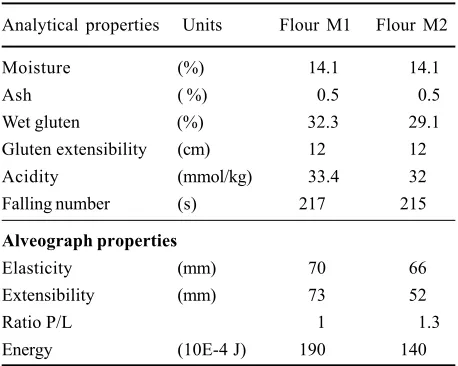
Flour quality parameters (analytical and alveograph) before storage as determined by standard methods are reported in Table 1. They corresponded to the Czech
stan-dard as fine type for bakery products. According to the characteristics obtained, flour M2 was evaluated as weaker with a lower wet gluten content and alveographic energy. Doughs prepared from these flours before storage had optimal viscoelastic behaviour as identified by a well-bal-anced ratio of gluten elasticity and extensibility.
The storage conditions (marked as P1 and P2) charac-terized by the temperature and humidity of the ambient air of the bakery storehouse were different for flour samples M1 and M2. While the highest temperature under condi-tion P1 was 15.6°C and it varied in the dependence on the season during both storage tests, the temperature in lo-cation P2 changed only a little; during both tests, howev-er, it was higher than it has been recommended for flour storage.
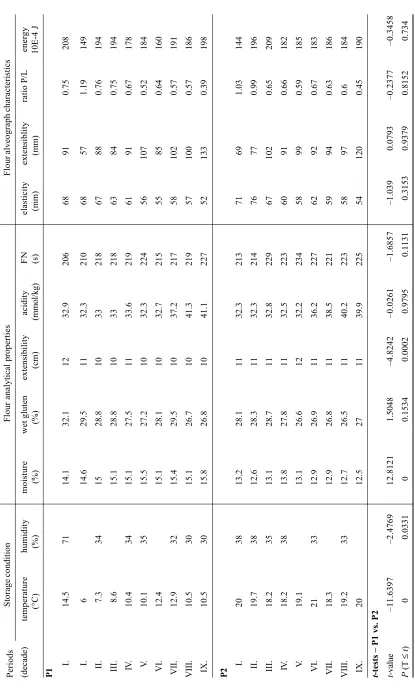
The analytical and alveographic properties of flours stored under conditions P1 and P2 are shown in Tables 2 and 3, respectively. The results of the appurtenant deter-minations expressed by average for each storage decade (approximately 5 tests) varied, as expected, with the stor-age conditions, which applies especially to moisture, acid-ity, and falling number. Different extents of their dependence were proved by F- and t-tests. The content of moisture increased under condition P1 by approx. 1.1% and 1.2%, respectively, in samples M1 and M2. Storage under dition P2 resulted in a loss of the flour moisture, the con-tent of moisture being lower in flour M1. The changes in the moisture contents depended on the short time stor-age conditions and had a different time course in the indi-vidual locations. Wet gluten content tended to decrease with time but the differences did not seem significant for the flour quality. Gluten extensibility had the same ten-dency; a more marked decrease was found in the weaker flour M2 in agreement with LUKOW and WHITE (1997). The acidity of both flours significantly increased with time regard less of the storage locations; differences were Table 1. Evaluation of wheat flours quality
Analytical properties Units Flour M1 Flour M2
Moisture (%) 14.1 14.1
Ash (%) 0.5 0.5
Wet gluten (%) 32.3 29.1
Gluten extensibility (cm) 12 12
Acidity (mmol/kg) 33.4 32
Falling number (s) 217 215
Alveograph properties
Elasticity (mm) 70 66
Extensibility (mm) 73 52
Ratio P/L 1 1.3
[image:2.595.311.540.116.299.2]T
able 2. Flour M
1
– average air and flour properties during storage time
Periods
Storage
condition
Flour analytical properties
Flour alveograph characteristics (decade) temperature humidity moisture wet gluten extensibility acidity F N elasticity extensiblity ratio P/L energy (°C) (%) (%) (%) (cm) (mmol/kg) (s ) (mm) (mm) 1 0E-4 J P1 I. 1 4.5 7 11 4. 1 32. 11 2 32.9 206 68 9 1 0.75 208 II. 1 3.8 70 1 4.2 32. 11 1 32.5 2 1 0 66 92 0.72 209 III. 1 2.5 1 4.3 3 1 .6 1 0 32.2 2 1 4 64 83 0.77 1 95 IV . 11 .2 70 1 4.7 32. 11 0 32.3 222 70 86 0.8 1 208 V. 8.3 72 1 4.8 3 1 .5 11 34.4 223 73 85 0.85 209 VI. 4. 1 1 4.9 3 1 .3 11 34. 1 226 73 74 0.98 200 VII. 2. 7 70 1 5.3 3 1 .8 11 36.3 233 72 9 1 0.79 206 VIII. 2. 6 1 5. 1 3 1 .9 1 0 36.5 232 69 84 0.82 207 IX. 2. 3 7 11 5.2 30.8 1 0 37. 1 234 64 85 0.75 2 1 0 P2 I. 1 9.6 55 1 3.9 3 1 .9 1 23 1 .9 224 73 84 0.87 2 1 5 II. 1 8.4 53 1 3.6 3 1 .2 1 23 1 .3 229 74 90 0.82 2 1 4 III. 1 8.4 58 1 3.5 32.3 1 2 32.4 225 64 9 1 0.7 1 96 IV . 1 8. 1 5 11 3.5 33.5 11 32.8 234 70 86 0.8 1 203 V. 1 8.3 1 3.4 33.5 11 33.9 238 9 1 64 1 .4 1 2 1 0 VI. 1 7.3 5 11 3.2 33 11 33.9 236 93 6 11 .52 2 1 7 VII. 1 7. 1 1 2.5 32.5 1 0 35.8 233 70 76 0.92 1 95 VIII. 1 8.2 5 11 2.7 32 1 0 36.5 23 1 74 7 11 .04 1 84 IX. 20 . 1 11 .5 3 1 .4 1 0 37.3 236 72 70 1 .02 1 79 t
-tests – P1 vs. P2 t-va
Table 3. Flour M2 – average air and flour properties during storage time Periods
Storage
condition
Flour analytical properties
Flour alveograph characteristics (decade) temperature humidity moisture wet gluten extensibility acidity F N elasticity extensiblity ratio P/L energy (°C) (%) (%) (%) (cm) (mmol/kg) (s ) (mm) (mm) 1 0E-4 J P1 I. 1 4.5 7 11 4. 1 32. 11 2 32.9 206 68 9 1 0.75 208 I. 6 1 4.6 29.5 11 32.3 2 1 06 8 57 1 . 1 9 1 49 II. 7.3 34 1 5 28.8 1 03 3 2 1 8 67 88 0.76 1 94 III. 8.6 1 5. 1 28.8 1 03 3 2 1 8 63 84 0.75 1 94 IV . 1 0.4 34 1 5. 1 27.5 11 33.6 2 1 96 1 9 1 0.67 1 78 V. 1 0. 1 35 1 5.5 27.2 1 0 32.3 224 56 1 07 0.52 1 84 VI. 1 2.4 1 5. 1 28. 11 0 32.7 2 1 5 55 85 0.64 1 60 VII. 1 2.9 32 1 5.4 29.5 1 0 37.2 2 1 75 8 1 02 0.57 1 9 1 VIII. 1 0.5 30 1 5. 1 26.7 1 04 1 .3 2 1 95 7 1 00 0.57 1 86 IX. 1 0.5 30 1 5.8 26.8 1 04 1 . 1 227 52 1 33 0.39 1 98 P2 I. 20 38 1 3.2 28. 11 1 32.3 2 1 37 1 69 1 .03 1 44 II. 1 9.7 38 1 2.6 28.3 11 32.3 2 1 4 76 77 0.99 1 96 III. 1 8.2 35 1 3. 1 28.7 11 32.8 229 67 1 02 0.65 209 IV . 1 8.2 38 1 3.8 27.8 11 32.5 223 60 9 1 0.66 1 82 V. 1 9. 1 1 3. 1 26.6 1 2 32.2 234 58 99 0.59 1 85 VI. 2 1 33 1 2.9 26.9 11 36.2 227 62 92 0.67 1 83 VII. 1 8.3 1 2.9 26.8 11 38.5 22 1 59 94 0.63 1 86 VIII. 1 9.2 33 1 2.7 26.5 11 40.2 223 58 97 0.6 1 84 IX. 20 1 2.5 27 11 39.9 225 54 1 20 0.45 1 90 t
-tests – P1 vs. P2 t-value
greater in samples M2. However, this process had no neg-ative effect on sensoric value of flours according to the storage tests. The falling number indicationg the starch damage as well as the enzymatic activity increased over the storage period. An increase of about 28 s and 17 s for samples M1 and M2, respectively, were found under con-dition P1. In the case of the location with a higher storage temperature, lower differences occurred in the values of the flour falling number. The changes in acidity and in
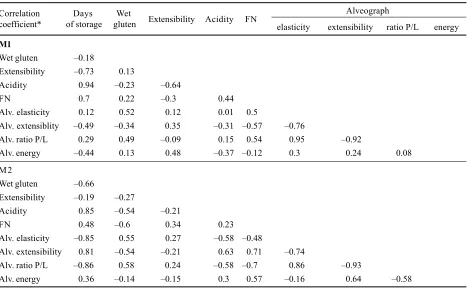
falling number were marked as significant on 99% statisti-cal level (Table 4). The correlation between these flour parameters and the storage temperature was mentioned by SRIVASTAVA and HARDIS-RAO (1992).
[image:5.595.58.527.115.404.2]Wheat dough rheological properties changed during a short term storage in the dependence on the initial char-acteristics of flour. Alveograph behaviour of the stronger flour M1 stored under the colder condition (P1) did not change significantly but in the case of storehouse with a Table 4. Coefficients of correlation for air and flour properties during storage time
Correlation Days Wet Extensibility Acidity FN Alveograph
coefficient* of storage gluten elasticity extensibility ratio P/L energy
M1
Wet gluten –0.18
Extensibility –0.73 0.13
Acidity 0.94 –0.23 –0.64
FN 0.7 0.22 –0.3 0.44
Alv. elasticity 0.12 0.52 0.12 0.01 0.5
Alv. extensiblity –0.49 –0.34 0.35 –0.31 –0.57 –0.76
Alv. ratio P/L 0.29 0.49 –0.09 0.15 0.54 0.95 –0.92
Alv. energy –0.44 0.13 0.48 –0.37 –0.12 0.3 0.24 0.08
M2
Wet gluten –0.66
Extensibility –0.19 –0.27
Acidity 0.85 –0.54 –0.21
FN 0.48 –0.6 0.34 0.23
Alv. elasticity –0.85 0.55 0.27 –0.58 –0.48
Alv. extensibility 0.81 –0.54 –0.21 0.63 0.71 –0.74
Alv. ratio P/L –0.86 0.58 0.24 –0.58 –0.7 0.86 –0.93
Alv. energy 0.36 –0.14 –0.15 0.3 0.57 –0.16 0.64 –0.58
*P ≤ 0.01 and 0.05; r ≥ 0.47 and 0.59
Fig. 1. Changes of relative average alveograph extensibility in two storages
I II III IV V VI VII VIII IX
70 120
70 120
P1 P2
% of average alveograph extensibility
[image:5.595.56.343.560.759.2]Souhrn
HRUŠKOVÁ M., MACHOVÁ D. (2002): Změny vlastností pšeničné mouky při krátkodobém skladování. Czech J. Food Sci., 20: 125–130.
Dva vzorky pšeničné mouky hladké průmyslově vyrobené z potravinářské pšenice ze sklizně roku 2000 byly skladovány po dobu tří měsíců v období listopad–duben za podmínek prostředí s různými teplotami a relativní vlhkostí vzduchu. V pravidelných intervalech byly sledovány změny analytických vlastností (vlhkost, mokrý lepek a jeho tažnost, kyselost a číslo poklesu) a reologických znaků pomocí alveografu. Vlhkost, kyselost a číslo poklesu mouk se výrazně mění dobou skladování, ale vliv změn podmínek prostředí a vstupních parametrů mouky nebyl jednoznačný. Viskoealastické vlastnosti pšeničných těst se skladováním mění výrazněji u pekařsky slabší mouky ve smyslu zlepšení kvality.
Klíčová slova:pšeničná mouka; krátkodobé skladování; změny teploty; analytické vlastnosti; alveografické charakteristiky
Corresponding author:
Ing. MARIE HRUŠKOVÁ, CSc., Vysoká škola chemicko-technologická, Ústav chemie a technologie sacharidů, Technická 3,
166 28 Praha 6, Česká republika
tel.: + 420 02 24 35 32 06, fax: + 420 2 33 33 99 90, e-mail: [email protected] higher temperature a slight decrease of alveograph
exten-sibility and energy was found. On the other hand, alveo-graph extensibility of the weaker flour M2 increased (Fig. 1) and its breadmaking quality improved as judged by aveo-graph energy. Properties of dough from weaker flours
stored for several months were reported by LINFENG
-WANG and FLOTES (1999) and CENKOWSKI et al. (2000).
Conclusion
Wheat flour analytic and alveographic parameters were influenced by short term storage under real conditions of industrial bakery in the dependence on their initial char-acteristics and the ambient environments. The moisture of flour samples depended significantly on the tempera-ture course during the storage period. Wet gluten con-tent changed only a little and differences in its extensibility were not proved statistically. Flour acidity and falling number values increased markedly but the influence of the storage conditions was not unambiguous. Dough al-veographic characteristics of the weaker flour indicated an improvement of the bread-making properties depend-ing on the duration and the conditions of storage.
R e f e r e n c e s
CENKOWSKI S., DEXTER J.E., SCANLON M.G. (2000): Me-chanical compaction of flour: the effect of storage
tempera-ture on dough rheological properties. Can. Agric. Engng., 42: 33–41.
CHEN X.,SCHOFIELD J.D. (1996): Changes in the glutathione content and breadmaking performance of white wheat flour during short term storage. Cereal Chem., 73: 1–4.
HAMPL J., PŘÍHODA J. (1985): Cereal Chemistry and Technol-ogy II. SNTL Praha: 113–115.
HANSEN L., ROSE M.S. (1996): Senzory acceptability is in-versely related to development of fat rancidity made from stored flour. J. Am. Dietetic Assoc., 96: 792–793.
LINFENG-WANG, FLOTES R.A. (1999): The effects of storage on flour quality and baking performance. Food Rev. Int., 15: 215–234.
LUKOW O.M., WHITE N.D. (1997): Influence of ambient stor-age condition on the breadmaking quality of two HRS wheats. J. Stored Prod. Res., 31: 279–289.
PYLER E.J. (1973): Baking, Science and Technology. Seibel Pub. Com., US: 358–364.
SRIVASTAVA A.K., HARIDAS-RAO P. (1992): Changing in the pasting, rheological and baking qualities of flour during short term storage. J. Food Sci. Technol., 28: 153–156.
YONEYAMA T., SUZUKA I., MUROHASHI M. (1970): Natural maturing of wheat flour. Cereal Chem., 47: 27–33.