Some of the EU countries increase a portion of ecologically cultivated areas. Proportion of eco-logically managed areas in the Czech Republic has increased since the 90th. Absence of herbicides, fungicides, insecticides and industrial fertilizers in potato growing has as a consequence a yield reduction of 30% and more (Prosba-Bialczyk 2004). Ecologically cultivated potatoes are supposed by some authors to have lower content of contami-nants, better taste qualities, reduced mechanical damage and improved storage stability. On the other hand according to other authors (Maga 1994, Rayburn et al. 1995) plants cultivated without chemicals sometimes protect themselves against diseases and pests by increasing concentration of some harmful substances, e.g. glycoalkaloids and also polyphenols, which represent substrates for enzymic browning of potatoes that occur during peeling, cutting or grating raw potato tubers and together with ferric cations contribute to potato darkening after their cooking (Lachman et al. 2003). Rembialkowska (1999) and Kolsch et al. (1991) determined in contrast with results of the authors Sawicka and Kus (2002) higher dry matter content in potatoes cultivated by ecological way of
cultivation in comparison with the conventional way. From the point of view of nitrate content a majority of the published knowledge notes at least tendency to their lesser content in tubers of ecological alternative or even significant differ-ences (Rembialkowska 1999, Prosba-Bialczyk 2004). Intensive fertilization with nitrogen could even enhance the reduction of sugar and polyphenol content (Peshin and Singh 1999). In consequence of the fertilization with nitrogen also glycoal-kaloid content in tubers could increase (Mondy and Munshi 1990). Information about the effect of ecological growing on the reduction of sugar content, glycoalkaloids and polyphenols is noted in scientific literature only minimally and it is not very homogeneous. Hamouz et al. (2000) found in ecologically cultivated potatoes a lower reduction in sugar content. In experiments of Sawicka and Kus (2002) reducing sugar content in the tubers was not affected by the way of growing. Research information about the differences in the quality of conventionally and ecologically cultivated potatoes is neither homogenous nor sufficient, on that ac-count our research was focused on the problems of selected qualitative parameters.
The effect of ecological growing on the potatoes yield
and quality
K. Hamouz, J. Lachman, P. Dvořák, V. Pivec
Czech University of Agriculture in Prague, Czech Republic
ABSTRACT
In the years 1995–1997 the effect of ecological growing on the yield and selected parameters of quality of consumer potatoes (in comparison with conventional way) were investigated. The ecological way of growing differed in the lack of chemical protection against diseases and pests and industrial fertilizers. Field trials were realised with seven vari-eties (Impala, Karin, Agria, Korela, Rosella, Santé and Ornella) on two sites (Uhříněves and Valečov). The ecological way of growing had markedly negative effect on the yield (decrease by 36%). In qualitative parameters the ecological way increased inconclusively polyphenol content (by 10.2%), decreased inconclusively nitrate content (by 11.0%) and reducing sugars (by 22%). It did not affect dry ma�er content, resistance of tubers to mechanical damage, table value and glycoalkaloid content. Variety Santé achieved the best results from the point of view of the yield and majority of qualitative parameters among varieties. Qualitative parameters of ecologically cultivated potatoes were significantly affected by the year of cultivation.
Keywords: potatoes; ecological and conventional cultivation; quality; yield
MATERIAL AND METHODS
In the years 1995–1997 precise field trials on two sites in Czech Republic were performed. At experimental station of Czech University of Agriculture in Prague-Uhříněves and on the work-ing area of Research Potato Institute Havlíčkův Brod in Valečov seven varieties of potatoes (Impala, Karin, Agria, Korela, Rosella, Santé and Ornella) were cultivated conventionally and ecologically. In Uhříněves ecologically cultivated potatoes were incorporated into a model sowing plan according to the principles of IFOAM farming, conventional potatoes were grown in common a sowing plan on an adjacent plot. In Valečov site both variants were incorporated into common sowing plan on the same plot. Winter wheat was in all cases the preceding crop. Differences in growing technology relate to fertilization and use of pesticides. Conventional technology came out from the methodology of state varietal experiments of the Central Institute for Supervising and Testing in Agriculture. Ecological technology differed by the omission of chemical protection against potato blight (with the exception of two applications of cupric oxychloride fungicide on the site Valečov), potato beetle and by dele-tion of the fertilizadele-tion with industrial fertilizers. Organic fertilization was the same in ecological and conventional variants: autumn ploughing-in of dung manure 35 t/ha(Valečov) and 30 t/ha (Uhříněves).Mineral fertilization was used only in conventional option: on both sites 100 kg N/ha, in Valečov 40 kg P/ha and 81 kg K/ha, in Uhříněves 31 kg P/ha and 73 kg K/ha. Herbicides used in conventional option: Topogard 50 WP (terbutryn + terbuthylazine) 2.5 kg/ha – preemergent ap-plication. Insecticides against potato beetle in conventional option: Cymbush 10 DP (cyper-methrin) 0.25 kg/ha. Fungicides against potato blight: in conventional option in individual years in different succession preparations Ridomil MZ (metalaxyl + mancozeb) 2.5 kg/ha, Sandofan M8 (oxadixyl + mancozeb) 2.5 kg/ha, Ripost M (cy-moxanil + oxadixyl + mancozeb) 2.5 kg/ha, Altima
500 SC (fluazinam) 0.4 l/ha – number of treatment in 1995–1997: Uhříněves 4, 6, 6, Valečov 5, 6, 7. In ecological option in Uhříněves any fungicide was not used, in Valečov two treatments with a preparation of Kuprikol 50 (cupric oxychloride) in the dosage 5 kg/ha (4.7. and 16.8.1995; 24.7. and 7.8.1996; 24.7. and 6.8.1997). After the harvest and three weeks’ healing period the samples were delivered to the laboratories of Research Potato Institute in Havlíčkův Brod and Department of Chemistry of Czech Agricultural University in Prague for analyses. Tubers resistance against mechanical damage was determined on the electrical pendulum MIDAS 88 PP, dry matter content by gravimetric method, table value by taste degustative test according to Czech State Normative ČSN 462211, reducing sugar content according Luff-Schoorl, nitrate content by ion-selective electrode, polyphenol content spectro-photometrically with Folin-Ciocalteu’s reagent, glycoalkaloid content by HPLC method.
RESULTS AND DISSCUSSION
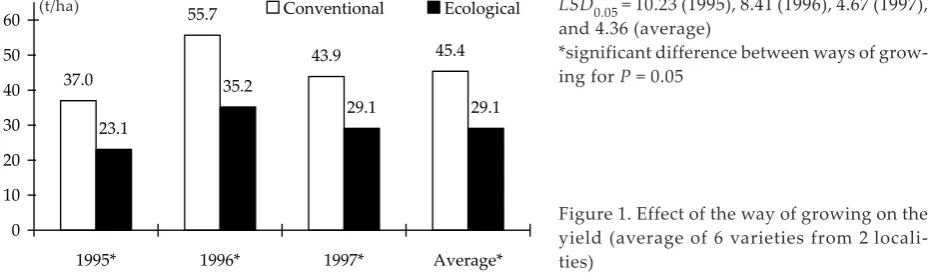
[image:2.595.67.534.624.762.2]Yield.Significantly lesser yield was determined in potatoes cultivated by the ecological way in comparison to the conventional way of growing (Figure 1). Decrease amounted to 35.9% in average of three years, which fully confirms the results of Böhm (1999) and Prosba-Bialczyk (2004). We assume insufficient stock of nutrients in soil and especially the insufficient level of the regulation of diseases and pests perchance weeds as the reason for significantly lesser yields of ecologically culti-vated potatoes. Different intensity of the attack of plants in individual years with potato beetle and potato blight proved in reduction or in untimely liquidation of the assimilation apparatus and in a decrease of yield. Santé and Rosella varieties gave the highest average yield response to ecological growing (32.05 and 31.45 t/ha).
Tubers resistance to mechanical damage.Three years of trials with seven varieties did not
dem-37.0
55.7
43.9 45.4
23.1
35.2
29.1 29.1
0 10 20 30 40 50 60
1995* 1996* 1997* Average*
t/ha Conventional Ecological LSD0.05 = 10.23 (1995), 8.41 (1996), 4.67 (1997),
and 4.36 (average)
*significant difference between ways of grow-ing for P = 0.05
Figure 1. Effect of the way of growing on the yield (average of 6 varieties from 2 locali-ties)
onstrate the effect of ecological growing on this parameter of tubers quality. Differences among values of pendulum index (indicates percentage of undamaged tubers on pendulum) between eco-logical and conventional option did not reach in any year the value of minimal significant differ-ence (Table 1). Nitrogen dose 100 kg N/ha in our experiments did not affect unfavourably maturity of tubers and in consequence of this also not their resistance to mechanical damage. Also in experi-ments of Diviš and Štěrba (1997) event the dose 120 kg N/ha did not enhance the level of mechani-cal damage. It is possible to presume that only relatively high N doses (depending on the variety
different) could have unfavourable effect on the resistance of tubers against damage.
[image:3.595.64.532.95.544.2]Table value.The way of growing did not affect demonstrably table value of tubers; only in 1995 tendency (not a significant difference) to higher table value in potatoes from ecological cultivation was determined (Table 1). Kolsch et al. (1991) came to similar information. Certain tendency in 1995 to higher table value in potatoes from ecological cultivation could have association with low average mass of consume tubers in Uhříněves in this year (the lowest yield of tubers among all experimental years 13.12 t/ha in consequence of extensive over-running with seeds, damage of haulm by Potato
Table 1. Effect of the way of growing on the qualitative properties of potatoes (average from two localities and seven varieties)
Way of growing (significance) 1995 1996 1997 Average
Pendulum index (percentage of undamaged tubers)
Conventional 80.6 42.1 60.8 61.2
Ecological 77.8 43.3 53.1 59.7
LSD/significance 10.34/ns 21.18/ns 14.20/ns 8.54/ns
Cooking quality (number of point)
Conventional 56.0 63.2 61.9 60.4
Ecological 59.7 63.4 62.8 62.0
LSD/significance 4.13/ns 8.30/ns 5.71/ns 3.32/ns
Dry matter content (%)
Conventional 20.74 19.61 22.98 21.11
Ecological 20.43 20.07 21.12 20.54
LSD/significance 0.89/ns 0.82/ns 1.58/* 0.62/ns
Nitrate content (mg NO3–/kg)
Conventional 215.2 105.1 140.8 153.7
Ecological 182.5 98.2 129.5 136.7
LSD/significance 37.65/ns 27.30/ns 29.43/ns 27.37/ns
Glycoalkaloids content in cultivar Karin (mg/kg)
Conventional 112.6 53.1 65.4 77.0
Ecological 157.0 59.2 77.5 97.9
LSD/significance 47.0/ns 35.8/ns 27.6/ns 36.9/ns
Polyphenols content (mg/100 g)
Conventional 33.4 47.8 48.5 43.2
Ecological 40.5 51.1 51.4 47.6
LSD/significance 7.00/* 8.90/ns 5.19/ns 4.17/ns
beetle and consequently very dry weather in July). Tubers size affect according to our experience firm-ness of tubers pulp after cooking (higher firmfirm-ness in lesser tubers) and cooking properties of tubers (higher softness on cooking is in bigger, esp. over-ripened tubers). Karin and Santé proved regularly the best table value.
Dry matter content. Our results did not approve the increase of dry matter of tubers in ecological way of growing as Rembialkowska (1999) and Kolsch et al. (1991) state. In the years 1995 and 1996 the differences between variants of our experiment were not significant (Table 1). In the year 1997 higher dry matter content was determined in the conventional variant. The obtained outcome from the year 1997 is in accordance with knowledge of authors Sawicka and Kus (2002), who determined higher dry matter content in potatoes from inte-grated system of farming in comparison with the ecological way. Our results show that nitrogen and potassium applied in conventional variant on given localities did not lower dry matter content. It is related apparently with the fact that at common doses of nitrogen and potassium fertilizers, which we applied in our experiments, the changes of dry matter content are little. And on the contrary often-times a shorter period of existence of assimilation apparatus of ecological variant (in consequence of its destroy by potato beetle or blight) could have as a consequence a decrease of dry matter content in this variant. This explicates our result from the 1977-year (lesser dry matter content in ecological variant, when the haulm was prematurely destroyed by potato beetle). The highest dry matter content in ecologically cultivated potatoes in the average of three years was observed in industrial Ornella variety (24.8%) and in consumer potatoes in Santé variety (21.9%).
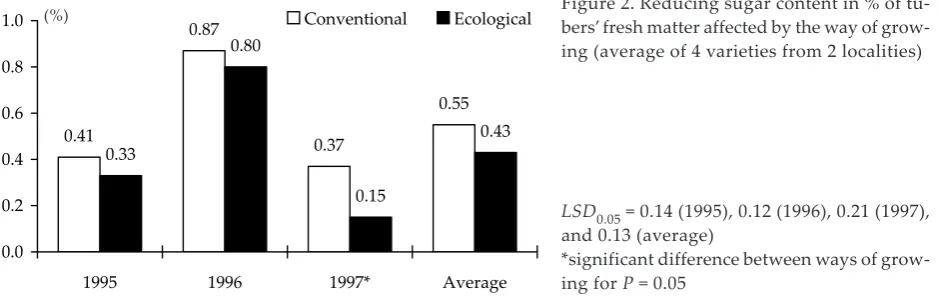
Reducing sugar content.Trend (non significant difference) to lesser reducing sugar content in the three year average results in potatoes from eco-logical growing in comparison with conventional variant was determined (Figure 1). It was confirmed
by the significant result from the 1997-year. Our result is regarding the nitrogen dose only partially comparable with the information of authors Peshin and Singh (1999) who determined that intensive nitrogen fertilization could bring an enhanced sugar content reduction, which our results par-tially explains. In the experiments of Sawicka and Kus (2002) reducing sugar content did not depend on the way of cultivation. In the ecological way of cultivation the best result in Agria, Ornella and Santé varieties (0.21, 0.22, 0.48% reducing sugars) was determined.
Nitrate content.Ourexperiments did not prove the effect of the way of growing on nitrate content, but in all years an apparent trend to its less values in potatoes from ecological cultivation appeared (Table 1). The determined trend is in accordance with published results, which in predominant majority state at least tendency to lesser nitrate content in the tubers of ecological variant and many times also significant differences (e.g. Kolsch 1991, Rembialkowska 1999). In our experiments we recorded relatively considerable difference in nitrate content between the ways of cultivation (tightly under the level of significance) in 1995, but in next two years the differences were much lower. It was evidently related with early termina-tion of vegetatermina-tion by potato beetle in ecological (chemically non treated) variant. To this situation came in 1996 and 1997 years in the period of full vegetation, when the tubers were not ripe and nitrates were in lesser extent incorporated into other compounds. Agria (58.5 mg NO3–/kg) and Santé (79.8 mg NO3–/kg) varieties in three years the average results in ecological cultivation reached the lowest nitrate content.
Glycoalkaloid content. Analyses were performed only in Karin variety. No significant difference in glycoalkaloid content was determined in potatoes cultivated by the ecological way of growing in comparison with the conventional way in any in-vestigated year. The trend of higher glycoalkaloid content in ecological variant was found only in the
0.41
0.87
0.37
0.55
0.33
0.80
0.15
0.43
0.0 0.2 0.4 0.6 0.8 1.0
1995 1996 1997* Average
% Conventional Ecological Figure 2. Reducing sugar content in % of tu-bers’ fresh matter affected by the way of grow-ing (average of 4 varieties from 2 localities)
LSD0.05 = 0.14 (1995), 0.12 (1996), 0.21 (1997), and 0.13 (average)
*significant difference between ways of grow-ing for P = 0.05
[image:4.595.66.536.71.220.2]year 1995 (Table 1). In this year higher glycoalkaloid content was recorded on the site Uhříněves, where the crop vegetation was harvested prematurely in consequence of total defoliation by potato beetle. Likewise in the experiments of Peksa et al. (2002) earlier term of harvest had in consequence higher glycoalkaloid content in tubers. In our trials in eco-logical variant hygienically allowed limit 200 mg glycoalkaloids/kg fresh matter of tubers was not exceeded in any year. The obtained results also confirm the possibility of a low glycoalkaloid con-tent with noncoventional breeding approaches of new potato genotypes on the basis of interspecific hybrids (Esposito et al. 2002).
Polyphenol content. Higher total polyphenol content was shown in potatoes from ecological growing (Table 1). Similar results we have ob-tained also in our previous work (Hamouz et al. 1997). The result could be related to the reaction of chemically non-treated plants against different stress factors (in our case potato beetle feed-mark, infection with blight). Between two assessed va-rieties lesser polyphenol content in Agria variety in comparison with Karin variety in ecologically cultivated potatoes were found (in individual years by 16.5, 6.5 and 5.6%).
REFERENCES
Böhm H. (1999): Effect of manure on yield and qual-ity of potatoes in organic agriculture. In: Abstracts 14th Triennial Conference of the European Association
for Potato Research, Sorrento: 622–623.
Diviš J., Štěrba Z. (1997): Relationship of fertilizer ap-plication and mechanical damage to potato cv. Krasa tubers. Rostlinná Výroba, 43: 199–204. (In Czech) Esposito F., Fogliano V., Cardi T., Carputo D.,
Filip-pone E. (2002): Glycoalkaloid content and chemical composition of potatoes improved with nonconven-tional breeding approaches. Journal of Agricultural and Food Chemistry, 50: 1553–1561.
Hamouz K., Lachman J., Pivec V., Orsák M. (1997): The effect of the conditions of cultivation on the content of
polyphenol compounds in the potato varieties Agria and Karin. Rostlinná Výroba, 43: 541–546. (In Czech) Hamouz K., Vokál B., Lachman J., Čepl J. (2000):
Influ-ence of environmental conditions and way of cultiva-tion on the reducing sugar content in potato tubers. Rostlinná Výroba, 46: 23–27.
Kolsch E., Stoppler H., Vogtmann H., Batz W. (1991): Potatoes in ecological farming. 2. Storage suitability, tuber contents and sensory quality. Kartoffelbau, 42: 68–75. (In German)
Lachman J., Hamouz K., Hejtmánková A., Dudjak J., Orsák M., Pivec V. (2003): Effect of white fleece on the selected quality parameters of early potato (Solanum tuberosum L.) tubers. Plant, Soil and Environment, 49: 370–377.
Maga J.A. (1994): Glycoalkaloids in Solanaceae. Food Reviews International, 10: 385–418.
Mondy N.I., Munshi C.B. (1990): Effect of nitrogen fertilization on glycoalkaloid and nitrate content of potatoes. Journal of Agricultural and Food Chemistry, 38: 565–567.
Peksa A., Golubowska G., Rytel E., Lisinska G., Ani-olowski K. (2002): Influence of harvest date on gly-coalkaloid contents of three potato varieties. Food Chemistry, 78: 313–317.
Peshin A., Singh B. (1999): Biochemical composition of potato tubers as influenced by higher nitrogen ap-plication. Journal of the Indian Potato Association, 26: 145–147.
Prosba-Bialczyk U. (2004): Ecological potato in Poland. Scientia Agriculturae Bohemica, 35: 154–157.
Rayburn J.R., Friedman M., Bantle J.A. (1995): Syn-ergistic interaction of glycoalkaloids α-chaconine and α-solanine on developmental toxicity in Xeno-pus embryos. Food and Chemical Toxicology, 33: 1013–1019.
Rembialkowska E. (1999): Comparison of the contents of nitrates, nitrites, lead, cadmium and vitamin C in po-tatoes from conventional and ecological farms. Polish Journal of Food and Nutrition Sciences, 8: 17–26. Sawicka B., Kus J. (2002): Variability of chemical
compo-sition of potato tubers using ecological and integrated production system. Zeszyty Problemowe Postepów Nauk Rolniczych, 489: 273–282. (In Polish)
Received on February 24, 2004
ABSTRAKT
Vliv ekologického pěstování na výnos a kvalitu brambor
výrazně záporný vliv na výnos (pokles o 36 %). Z kvalitativních ukazatelů ekologický způsob zvýšil neprůkazně obsah polyfenolů (o 10,2 %), snížil neprůkazně obsah dusičnanů (o 11,0 %) a redukujících cukrů (o 22,0 %), neovlivnil obsah sušiny, odolnost hlíz k mechanickému poškození, stolní hodnotu a obsah glykoalkaloidů. Z odrůd dosáhla v ekologickém pěstitelském systému nejlepších výsledků z hlediska výnosu i většiny kvalitativních parametrů od-růda Santé. Kvalitativní parametry ekologicky pěstovaných brambor byly výrazně ovlivněny ročníkem.
Klíčová slova: brambory; ekologické a konvenční pěstování; kvalita hlíz; výnos
Corresponding author: