one of the primary factor affecting the food con-sumption patterns is the consumers’ ability to pur-chase food. The last two decades have witnessed major increases in the per capita income levels of households all over the world.
A question that arises in our research is wheth-er economic factors are still the only factors that determine the world consumption, especially in Slovakia. in this regard, it is important to take note
of the studies of Bansback (1995), huston (1999) and Dickinson et al. (2003), who showed that non-economic factors (i.e. non price/income factors) are becoming more important in the recent period in determining consumers‘ purchasing decisions. For example, in a study by Bansback (1995) on the demand for meat in the EU, he showed that, for the period 1955 to 1979, price and income factors ac-counted for a higher proportion of the explanation
Structural changes in the beef meat demand in Slovakia
and demand elasticity estimation
Štrukturálne zmeny v dopyte po hovädzom mäse v SR, odhad
elasticít dopytu
D. Hupková, P. Bielik, N. Tur�eková
�eková
Faculty of Economics and Management, Slovak University of Agriculture, Nitra,
Slovak Republic
Abstract: The article focuses on assessing the consumer habits attitudes and behaviour towards the beef meat demand. The main objective of this study is to investigate the determinants of the households’ beef meat consumption using the main economic factors. Determining and analysis of consumer behaviour on the individual household categories level and the subsequent comparison of impact factors on consumer decision will give us an assumption to the complex understanding of the consumer behaviour determinants. We used panel data to estimate the beef meat demand in Slovakia. The data were obtained from the household Budget Survey of the Slovak Statistical office. The estimates of price and income elasticities of the beef meat demand are also obtained. The results indicate that the food patterns development in Slovakia during the past two decades has undergone rapid structural changes. The declining beef meat consumption is influenced mainly by the decreasing purchasing power and the occurrence of the BSE disease. According to the elasticity estimation results, we can state that the beef meat demand is price and income inelastic.
Key words: beef meat consumption, households’ consumption, price elasticity, income elasticity. BSE disease
Abstrakt: Článok sa zameriava na zhodnotenie návykov, postojov a správania sa spotrebiteľov hovädzieho mäsa. hlavným cieľom článku je stanovenie determinantov dopytu po hovädzom mäse individuálnych domácností s použitím hlavných ekonomických faktorov. Sledovanie a analýza spotrebiteľského správania na úrovni individuálnych domácností a následná komparácia vplyvu faktorov na rozhodovanie sa spotrebiteľa s agregovanou úrovňou nám dáva predpoklady k dôkladnému pochopeniu determinantov spotrebiteľského správania. Pre odhad dopytu po hovädzom mäse v Slovenskej republike boli použité panelové údaje. Dáta sme čerpali zo štatistiky rodinných účtov vedenej Štatistickým úradom Sr. Výsledkom výsku-mu sú koeficienty cenovej a príjmovej elasticity dopytu po hovädzom mäse. Výsledky indikujú, že vývoj spotrebiteľských zvyklostí na Slovensku počas posledných dvoch desaťročí prešiel zásadnými štrukturálnymi zmenami. Pokles spotreby hovädzieho mäsa je ovplyvnený najmä klesajúcou kúpnou silou a výskytom ochorenia BSE. na základe odhadu koeficientov elasticít môžeme konštatovať, že dopyt po hovädzom mäse je cenovo a príjmovo neelastický.
of changes in meat consumption than for the period 1975 to 1994. huston (1999) argues that, by focusing only on the product consistency and quality, food safety, health and nutrition concerns and conven-ience, since 1998 the US beef industry was able to stabilize beef demand. Dickinson et al. (2003) con-clude that many, but not all, canadian and American consumers would be willing to pay for the red-meat traceability, transparency, and the enhanced qual-ity assurances in red-meat products. in 1970, pork was the second most consumed meat in the world after beef. however, in 1980 pork overtook beef as the most consumed meat. The share of pork in the world consumption of meat increased from 34.6% in 1970 to 43.4% in 2003 (Barnard 2005).
The share of the total European household expen-ditures for food has declined steadily with rising incomes. currently, it ranges from 10% to 35% of the total household consumption expenditures, with the smallest shares in the EU-15 Member States and larger shares in the new Member States. The recent food safety problems such as the BSE, the pig pest, the avian flu and salmonella have led to a stronger focus on food-safety and health. The BSE outbreak was a major reason for the reduction in the consumption of bovine – red meat (EEA 2005).
A considerable research has analyzed the hypothesis of the structural change in meat demand, includ-ing Braschler (1983), chalfant and Alston (1988). The evidence from these studies is mixed, given the variety of methods and the data employed. Previous studies have generally illustrated structural change in meat demand in terms of its effects on the esti-mated elasticities. While this conveys information on whether demand reacts differently to the variations in prices and expenditure levels due to the structural change, it says nothing of the effects of the structural change on the quantity demanded with the prices and expenditure level held constant. According to the research of Moschini and Meilke (1989), the demands for beef and pork are much more elastic than those for chicken and fish. notably, beef was the only superior good. The cross-price elasticities show more complementarily relationships than expected, with ten of the twelve cross-price elasticities having a negative sign.
Fraser and Moosa (2002) determined for the UK the meat demand elasticity coefficients. According to their results, the compensated cross-price elastic-ity estimates show that all meat types – beef, pork, and poultry are net substitutes with some marked differences between the specifications. There are also differences between the expenditure elastic-ity estimates that are particularly pronounced for
beef and chicken. For beef, the expenditure elasticity estimates fall when moving to the stochastic trend and seasonality models, but for all other meats they increase. Although all the models yield sensible elas-ticity estimates, the different specifications do impact the magnitude of the elasticity estimates.
The income elasticity of the average czech house-hold’s demand for meat and meat products, including fish and fish products, was reaching the values from 1.3866 to 1.1340. According to the determined val-ues of the income elasticity coefficients, the average czech household purchased meat and meat products, including fish and fish products, as luxury goods in the studied period of years 1995–2000 (Syrovátka 2007).
in this paper, preference changes in the consumer demand for meat in Slovakia are studied. important elements of the demand and consumers behaviour analysis are elasticity coefficients. in the paper, we will determine the coefficients of the price and in-come demand elasticity. We will provide an analysis and quantification of factors influencing consumer behaviour and the individual kinds of meat consump-tion development.
DATA AND METHODOLOGY
The data set is obtained from the Slovak Statistical office and consists of the yearly observations of beef, pork and poultry per capita consumption, the average annual consumer prices of beef, pork and poultry meat and the net income per capita. The interest is aimed at the individual household cat-egories. The household Budget Survey of the Slovak Statistical office was used for the period 1993–2006. As a consequence of the survey methodology change in the year 2004, we employed the time series of the years 1993 till 2003 in pursuit of the data consistence preservation according to the individual households` categories level.
The use of the household level data offers the po-tential of providing a richer dataset that may offer an additional insight into the underlying economic relationships.
The fixed effect model assumes that the individual specific time invariant effects should be treated as the intercept term of the regression. This presents opportunities for a number of transformations of the data, which eliminate this effect. Essentially, any transformation that rids the model of the fixed effect produces a fixed effect estimator (Baltagi 2001).
By far the most extensively discussed and used fixed effects estimator is the least squares dummy variable estimator, also referred to as the within estimator (greene 2000; hsiao 1986)
The fixed effects estimation method is regarded as ridden with problems in the theoretical literature. The least squares dummy variable approach has been widely criticized. Less importantly, the LSDV ap-proach presents a loss in the degrees of freedom, due to the large number of parameters being estimated, which may or may not be a problem in practice, de-pending on the number of the observations available (Wooldridge 2002).
More importantly, the fixed effects approach rids the regression of all fixed effects, regardless whether they are contained as unobservable within the intercept term, or as observables in the matrix of regressors. Thus the effects of the individual specific regres-sors, such as sex or place of birth, on the dependent variable cannot be estimated under the fixed effects approach (Baltagi 2001).
The dependent variable is chosen to represent the per capita consumption of beef, pork and poultry meat. The coefficients are estimated with the oLS method.
The meat demand equation was specified as fol-lows:
ln(Yi)= β0 + β1 × ln(PB) + β2 × ln(PPK) + β3 × ln(PPL) + + β4 × ln(I) + β5 × (t) + β6 × (d1) +lnε
where:
Yi = per capita meat consumption for beef PB = real price of beef meat (SKK/kg) PPK = real price of pork meat (SKK/kg) PPL = real price of poultry meat (SKK/kg) I = real income per capita
t = trend
d1 = dummy variable that measures the impact of the BSE. The variable takes the value 1 if the BSE was observed in the Slovak republic and 0 otherwise
RESULTS
in recent years, an increasing attention is paid to the question of structural change in the demand for meat products, especially beef. The declining per
capita consumption of red meat and increasing con-sumption of pork and poultry meat reflects on the consumer preferences changes not only in Slovakia. The recent research on meat demand demonstrates the importance in the empirical demand analyses of identifying and measuring structural changes.
The past ten years in the countries of the former Eastern Block were connected with dramatic changes as a consequence of the transformation. The decline in purchasing power of the population and the reduction in consumer subsidies had resulted in a significant drop in meat consumption in the early 1990s. in the year 1991, there occurred in Slovakia the price liberalization which affected 85% of prices. The eco-nomic factors have the most significant impact on the foodstuff expenditure development. Decreasing food expenditures are influenced by the economy growth. Foodstuff consumption is influenced by the develop-ment of gDP, real incomes and prices. During the past years, there increased noticeably the expenses for housing, water, energy and other fuels.
According to the foodstuffs expenditures, the ex-penses for meat and meat products represent its major part. Their share stagnated on the level of about 30% during the analysed period. For comparison, the level of the expenditures for bread, cereals, milk, cheese and eggs was up to 20%.
The decreasing domestic beef meat production affects the increase of consumer prices what indi-cates the declining consumption by the stagnated purchasing power. contrariwise, poultry consumption keeps a growing trend. The consumption of fish is not satisfactory in the long term.
Although food consumption usually follows a rather steady pattern, the animal diseases that occurred dur-ing the recent years have strongly affected the meat consumption. The BSE, the foot and mouth disease and the swine fever have had a severe impact on food markets in the EU causing the demand for meat to decrease rapidly. These facts are of high importance for the analysis.
The determinants and effects of the changes in meat consumption patterns are income and the re-lated effects of the out of home consumption and the growing convenience, prices (especially for poul-try), health consciousness and to a lesser extent, the environmental consciousness. The change in the demographic structure is wide and it comprises the change of age structure, the change of the household size and marital structures, migration from rural to urban areas and many other variables.
with regard to the well-balanced diet principles. it is caused by the customary eating habits and on the other hand, by the worsened economic situation of the major part of the Slovak population as well. The course of the average meat consumption in Slovakia is represented in the Table 1.
The average consumption of beef meat per year dur-ing the years 1993–2006 in Slovakia was 52 549 tons. Through the analysed period, the average beef meat consumption decreased by 45 540 tons (57%). A con-siderable influence on of this fact has the occurrence of the BSE disease in Europe 2000/2001 and later in the Slovakia.
Beef consumption is projected to stagnate or slightly decline over the medium term as the potential increase fuelled by rising income level would be broadly offset by the sustained price increase for beef observed since the enlargement of the EU and by the low consumer preference for beef meat. Beef market prices have increased substantially in the new Member States of the EU upon the enlargement, with increases ranging between 10% and 30%. it is expected that the tight market within the EU could result in firm prices throughout the projection period.
During the analysed period, the poultry meat con-sumption increased by 45 366 tons, which presents the increase by 71%. The poultry meat consumption has a long term increasing course and in spite of this fact, it still did not reach the level of the average con-sumption of the EU 15. We suppose that the annual
rise of the poultry meat consumption in Slovakia will continue. Pork meat consumption will be more stable with a slight decrease.
The outlook for the pork meat consumption is in general positive since pork meat is likely to continue to be favoured by Slovak consumers, although evi-dently less than poultry. After the gradual decrease observed, the per capita pork consumption is projected to increase or to maintain a relatively stable level.
The future trend for poultry production remains relatively positive with respect to other meats, a strong consumer preference and the increased use in food preparations should continue to play in favour of poultry. The per capita poultry consumption is projected to increase because of the benefits from the growing consumer preference.
The beef meat consumption development according to the individual household categories in Slovakia
The average beef meat consumption was declin-ing durdeclin-ing analyzed period. Main reasons of this development are the not favourable price relations in comparison with other sorts of meat. in Slovakia, beef belongs to the expensive food category, we can state that beef is for most Slovak consumers a luxuri-ous product. The declining beef meat consumption is influenced mainly by the decreasing purchasing power. This trend was caused by the change in consumers preferences in favour of pork meat. The occurrence of BSE disease also significantly led to the decrease in beef consumption. The beef meat consumption dropped by more than 30% as a result of the BSE (Bielik, Kunova 2007).
According to the Table 2, it is evident that as the beef consumption of total society declined, the beef meat consumption decreased also in all social house-hold categories. The most dynamic decline was reg-istered by the households of pensioners. in spite of this, pensioners are still the category with the high-est proportion of beef consumption. We can state that it was caused by fact of the children absence in these households to decrease the average per capita consumption.
[image:4.595.64.291.82.322.2]identically to the beef consumption in kind, also the percentage share of the total household expenditures for beef was dramatically decreasing. The highest ex-penditures for beef are registered in the households of pensioners. Also this category belongs to the categories with the lowest level of income that means that this expensive kind of meat will represent a higher propor-tion of the total meat expenditures (Table 3).
Table 1. Per capita average meat consumption in kg
Year Beef Pork Poultry
1994 13.7 36.4 11.9
1995 11.8 36.8 13.4
1996 11.6 37.3 14.4
1997 11.7 37.2 15.5
1998 11.4 36.9 16.0
1999 10.2 35.9 17.4
2000 9.1 33.1 17.1
2001 6.9 31.8 18.5
2002 6.7 31.3 18.5
2003 6.8 32.3 20.7
2004 6.2 31.9 20.4
2005 6.3 29.8 20.3
2006 5.3 29.0 20.4
The elasticity coefficients estimation
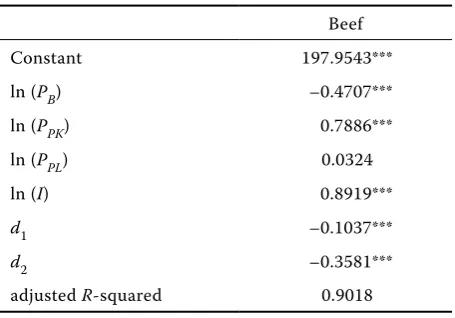
Another issue solved in research is the demand modelling with the aim to estimate the elasticity coefficients for beef meat demand in Slovakia. The simple linear demand modelwas applied. Most of the estimated coefficients are significant (Table 4).
The significant variables that affect beef meat con-sumption are the own beef meat price, pork meat price, income, trend and occurrence of the BSE disease.
The beef meat demand is inelastic with respect to own price. own price elasticity coefficient for beef
is –0.471 what can be interpreted that the increase of price by 1% per 1 kg beef meat can be followed by the decrease of beef demand by 0.47%.
According to the cross elasticity of beef demand, the increase of price by 1% per 1 kg pork meat might increase the beef demand by 0.7886%. As expected, the pork meat is a substitute for beef meat. According to the model results, the price of poultry meat has no effect on beef consumption.
[image:5.595.65.533.96.302.2]Based on the income elasticity coefficient, beef meat is a normal good for an average household in Slovakia and its demand is income inelastic. As a
Table 2. consumption of beef meat in kg per capita and year according to the individual households’ categories during the period 1993–2003
Year Workers Businessmen Employees Farmers Pensioners
1993 5.74 3.99 4.65 4.18 9.58
1994 4.87 4.51 4.14 4.18 8.52
1995 3.86 3.84 3.36 7.74 6.95
1996 4.79 3.91 3.38 3.29 6.17
1997 4.0 5.0 4.0 4.0 6.0
1998 4.0 4.0 4.0 4.0 7.0
1999 3.53 3.82 3.0 3.56 6.32
2000 3.39 3.15 2.72 3.15 5.67
2001 2.02 1.86 1.46 2.44 3.35
2002 2.0 2.0 1.48 2.43 3.38
2003 1.95 1.74 1.61 2.15 3.2
Source: household Budget Survey, Slovak Statistical office; authors’ calculations
Table 3. Beef meat expenditures share in the total household expenditures in Slovakia during the period 1993–2003 (%)
Year Workers Businessmen Employees Farmers Pensioners
1993 1.09 0.71 0.78 0.78 1.67
1994 1.04 0.89 0.85 0.87 1.62
1995 0.89 0.84 0.76 0.78 1.53
1996 0.80 0.80 0.65 0.69 1.28
1997 0.92 0.81 0.70 0.78 1.20
1998 0.81 0.68 0.62 0.74 1.35
1999 0.71 0.61 0.48 0.73 1.06
2000 0.64 0.47 0.40 0.58 0.90
2001 0.34 0.28 0.20 0.38 0.50
2002 0.34 0.28 0.21 0.43 0.53
2003 0.31 0.24 0.23 0.36 0.48
[image:5.595.63.532.358.565.2]consequence of the income increase by 1%, the beef demand will increase by 0.8919%.
During the analysed period, the beef meat demand declined by 10% yearly. This trend was caused by the change in consumers preferences in favour of pork meat. The occurrence of the BSE disease also significantly led to the decrease in beef consumption. The beef meat consumption dropped by more than 30% as a result of the BSE.
CONCLUSION
The food patterns development in Slovakia during past two decades has undergone rapid structural changes. changes in tastes, preferences, lifestyles and the economic transformation have also strongly influenced food demand.
rising income is expected to change the composition of food demand, especially in developing countries. The economists have proposed numerous hypotheses to explain the changes in the world consumer sub-stitution of poultry in the place of beef. The applied analysis has focused on such factors as the lower relative poultry prices and the consumer preference structures altered by the health concerns.
During the analysed period 1993–2006, the percent-age share of meat expenditures in the total expendi-tures was decreasing in all household categories. The reason of this decline is also the price liberalization, which occurred in the year 1991 and during it, 85% prices were liberalized.
This development was partly caused by the direct income effects of the transition. The incomes declined until the early mid-1990s, and recovered from 1995.
Another part of the decrease of consumption was due to the rising prices of meat.
The global beef consumption is expected to rise gradually by around 1.6% per year in average in the FAPri projections in relation to the income growth, notably in the emerging economies. in many devel-oped countries, the per capita consumption of beef is expected to stagnate or to fall, since consumers continue to substitute beef meat with pork and poultry meat. in the past few years, poultry meat has generally benefited from the BSE, the consumer preference in many parts of the world (in line with the changing diets towards the Western lifestyle and health considerations (European commission 2005).
The average beef meat consumption was declining during the analyzed period. The main reasons of this development are the not favourable price relations in comparison with other sorts of meat. in Slovakia, beef belongs to the expensive food category, we can state that beef is for most Slovak consumers a luxuri-ous product. The declining beef meat consumption is influenced mainly by the decreasing purchasing power and the occurrence of the BSE disease. The percentage share of the total household expenditures for beef was during the period 1993–2003 dramati-cally decreasing. The highest expenditures for beef are registered in the households of pensioners. This category belongs to the categories with the lowest level of income what means this expensive kind of meat will represent a higher proportion in the total meat expenditures. We cannot omit the important fact that in these households, there do not live children, which are increasing the average meat consumption in other categories.
According to the elasticity estimation results, we can state that the beef meat demand is price and income inelastic. Pork is a substitute to beef which is a normal good. The occurrence of the BSE disease significantly impacts the beef consumption during the analysed period.
REFERENCES
Bansback B. (1995): Towards a broader understanding of meat demand. Journal of Agricultural Econom-ics, 46 (3): 287–308.
Baltagi B. (2001): Econometric Analysis of Panel Data. 2nd ed. John Wiley& Sons; iSBn 9780470016909.
[image:6.595.64.292.94.253.2]Barnard P. (2005): global trends in the beef indus-try. Presentation at the northern cape red Meat Producers’ organisation, Upington, South Africa, March 8.
Table 4. Estimation results, dependent variable ln(Yi) – per capita meat consumption of beef
Beef
constant 197.9543***
ln (PB) –0.4707***
ln (PPK) 0.7886***
ln (PPL) 0.0324
ln (I) 0.8919***
d1 –0.1037***
d2 –0.3581***
adjusted R-squared 0.9018 *** significant at α = 0.01
Bielik P., Kunova D. (2007): The impact of BSE on Meat consumption in Slovakia. 1st Mediterranean
conference of Agro-Food Social Scientists. 103rd
EAAE Seminar ‘Adding Value to the Agro-Food Supply chain in the Future Euromediterranean Space’. Barcelona, Spain, April 23–25.
Braschler c. (1983): The changing demands structure for pork and beef in the 1970s: implications for the 1980s. Southern Journal of Agricultural Econom-ics, 15 (2): 105–110.
Dickinson D.L., hobbs J.E., Bailey D. (2003): A com-parison of US and canadian consumers’ willingness to pay for red-meat traceability. Paper prepared for presentation at the American Agricultural Eco-nomics Association Annual Meetings, Montreal, canada, July 27–30.
European commission (2005). Prospects for agricul-tural markets and income 2005–2012. Brussels, Directorate general for Agriculture. Available at http://ec.europa.eu/agriculture/publi/caprep/pros-pects2005/fullrep.pdf [Quoted 06. 03. 2009]. European Environment Agency – EEA (2005):
house-hold consumption and the environment. copen-hagen; iSSn 1725-9177.
Fraser i., Moosa i.A. (2002): Demand estimation in the presence of stochastic trend and seasonality: The case of meat demand in the United Kingdom. American Journal of Agricultural Economics, 84
(1): 83–89.
greene W. (2000): Econometric Analysis. Prentice hall, new Jersey; iSBn 0130661899.
hsiao c. (1986): Analysis of Panel Data. cambridge University Press, cambridge; iSBn 0-521-81855-9. huston J.L. (1999): Beef marketing challenges in the
US. iMS newsletter no 207 31/3/99.
Krížová S. (2009): Selected food verticals and their impact on prices of food products. Agricultural Economics – czech, 55 (2): 94–101.
Moschini g., Meilke K.D. (1989): Modeling the pat-tern of structural change in U.S. meat demand. American Journal of Agricultural Economics, 71
(2): 253–261.
Slovak Statistical office (1993–2007): incomes, ex-penditures and consumption of private households in Sr. The household Budget Survey of the Slovak Statistical office. Statistical office of the Slovak republic, Bratislava.
Syrovátka P. (2007): Exponential model of the Engel curve: Application within the income elasticity analysis of the czech households’ demand for meat and meat products. Agricultural Economics – czech, 53 (9): 411–420.
Wooldridge J.M. (2002): Econometric Analysis of cross Section and Panel Data. Mit Press, Lon-don.
Arrived on 12th May 2009
Contact address:
Daniela hupková, Peter Bielik, natália Turčeková, Slovak University of Agriculture in nitra, Tr. A. hlinku 2, 949 76 nitra, Slovak republic