ISSN Online: 2329-8448 ISSN Print: 2329-843X
A Comparative Study of Drug Susceptibility
Testing Techniques for Identification of
Drug Resistant TB in a Tertiary
Care Centre, South India
J. Anto Jesuraj Uday Kumar
1*, Hiresave Srinivasa
2, Justy Antony Chiramal
31Division of Infectious Diseases, St. John’s Research Institute, Bangalore, India 2Department of Microbiology, St. John’s Medical College Hospital, Bangalore, India
3Division of Epidemiology and Population Health, St John’s Research Institute, Bangalore, India
Abstract
India tops the global list for Drug resistant Tuberculosis, but inadequate and expensive laboratory culture techniques have led to delay in the diagnosis and treatment. We studied the potential of an alternative method which could be cost-effective by combining the drugs in the same tube for identification of drug resistance. Drug Susceptibility Test (DST) results of 1000 sputum sam-ples are got from suspected TB patients against INH (isoniazid) and Rifampi-cin by two techniques: a) a modified technique with both drugs in the same MGIT tube and b) a standard technique with the antibiotics in separate MGIT tubes for the diagnosis of MDR-TB (Multidrug Resistant). 39 samples were contaminated and were excluded from final analysis. 198 were smear positives by the concentrated Ziehl-Neelsen’s staining method. 219 were found to be culture positive out of which 195 were identified as M. tuberculosis complex. 40 (20.5%) strains were identified as MDR-TB by the conventional method and 39 were picked up by the modified DST. INH and Rifampicin mono-re- sistance accounted for 32 (16.4%) and 4 (2%) respectively. 99% concordance was observed between the two tests in categorizing MDR-TB. Similarly mod-ified technique with combination of the second line Antibiotics-Ofloxacin, Kanamycin and Capreomycin was applied on the identified MDR strains in a stepwise manner. 6 (15%) were identified as Pre-XDR strains and 2 (5%) were found to be XDR-TB strains. This study implies that combining drugs in the same tube may be an equivalent and possibly a cost-effective alternative which needs to be explored further.
Keywords
MDR TB, XDR TB, DST, Pre-XDR TB, Drug Resistance
How to cite this paper: Kumar, J.A.J.U., Srinivasa, H. and Chiramal, J.A. (2017) A Comparative Study of Drug Susceptibility Testing Techniques for Identification of Drug Resistant TB in a Tertiary Care Cen-tre, South India. Journal of Tuberculosis Research, 5, 44-57.
https://doi.org/10.4236/jtr.2017.51005
Received: January 5, 2017 Accepted: March 6, 2017 Published: March 9, 2017
Copyright © 2017 by authors and Scientific Research Publishing Inc. This work is licensed under the Creative Commons Attribution International License (CC BY 4.0).
1. Introduction
WHO declared TB (Tuberculosis) as the number one killer among the Infectious diseases in the world in 2015 [1]. In 2014, 9.6 million people were diagnosed to have TB and 1.5 million people (1.1 million HIV-negative and 0.4 million HIV-positive) were killed by TB [1]. India with 16% of the world’s population contributed to 23% of the total prevalence and incidence burden. The prevalence and incidence of TB in India were estimated to be 211 and 171 per 100,000 pop-ulation (2013), which is higher than the global average of 178 and 128 per 100,000 population respectively [2].
Drug resistance has complicated the Tuberculosis epidemic, making early di-agnosis and treatment even more difficult. Multi-Drug Resistance (MDR-TB) is defined as resistance of Mycobacterium tuberculosis to the first-line drugs, Iso-niazid and Rifampicin. Further progression of resistance across the drug catego-ries led to the isolation of Extensively Drug Resistant Tuberculosis (XDR-TB) strains in 2006 [3]. The definition of XDR-TB is resistance to Isoniazid and Ri-fampicin plus resistance to any fluoroquinolone and at least one of the three in-jectable second-line drugs used in TB treatment (amikacin, kanamycin, or ca-preomycin). Pre-XDR is a term given for strains which have a susceptibility in between MDR and XDR with resistance to either Fluoroquinolone or any one of the injectable second line drugs, in addition to INH and Rifampicin [4].
WHO in 1994 launched the Global Project on anti-tuberculosis drug resis-tance surveillance which advised for routine DST of representative samples for categorization into MDR and XDR Tuberculosis [5]. Globally, an estimated 3.3% of new TB cases and 20% of previously treated cases have MDR-TB. WHO esti-mated a total of 480,000 cases of MDR TB to be existing in India in 2014, of which only 25% were being detected and treated [6]. Though India accounts for one of the highest numbers of MDR cases in the world (after China) [7], drug susceptibility testing is not routinely done due to lack of finances, because of which there is a lack of accurate data on the statistics of MDR, Pre-XDR and XDR TB. To add on to the problem, there are only a handful of laboratories in India which have the accreditation and expertise to do DST for the 2nd line drugs [8]. A review of literature of XDR cases done from Vellore in 2012, showed a total of 598 cases reported from the various tertiary care centres in In-dia [8]. Since the isolation of Mycobacterium tuberculosis in 1882, we have come a long way with respect to diagnostics and treatment of tuberculosis, but we are still in a long way from eradication. Techniques like Gene X-pert have drastically brought down the time to diagnose drug resistance, but it has not yet replaced the culture and drug susceptibility testing as a definitive diagnostic test.
are very expensive and require technical expertise [9]. The conventional method with solid LJ (Lowenstein Jensen) medium is time consuming, and the MODS (Microscopic Observation Drug Susceptibility) liquid system is prone to conta-mination [10]. The Gene X-pert-PCR (Polymerase Chain Reaction) method is technically demanding and may have false positive results with dead bacilli [11]. Though Solid Culture with LJ medium is the gold standard, WHO in 2007 en-dorsed liquid culture as a reference standard for DST [12] in low and middle in-come settings using MGIT (Mycobacteria Growth Indicator Tube) due to the ease of use and comparatively earlier results. Our objective was to study if a combination of antibiotics—INH and Rifampicin in the same tube would yield similar DST results as the conventional technique where INH and Rifampicin were tested in separate tubes and to statistically validate the possibility of this test to be a potential alternative for DST in future. In addition to this, the MDR strains were tested for the 2nd line anti-tuberculosis drug (ofloxacin, capreomy-cin, kanamycin) using the combination method and were compared to the con-ventional MGIT DST with single drug per tube. This modified test if proven concordant with the Reference Standard (Conventional MGIT) could be studied further to limit the expenditure on drug susceptibility testing, since there is use of lesser number of MGIT tubes in the modified test compared to the conven-tional MGIT DST, though there is no advantage in terms of time.
2. Methodology
The study design is a comparative study of diagnostic accuracy. The modified test was the novel test with combination of antibiotics—INH and Rifampicin in the same MGIT tube. The Reference standard was the conventional test with INH and Rifampicin in separate MGIT tubes. The modified test and Reference standard tests were done simultaneously. The study involved 1000 patients with suspected tuberculosis-both in-patients and out-patients who presented them-selves to a tertiary-care teaching hospital in urban south India. Inclusion Criteria involved Sputum samples of patients in the age group-4 years and above with suspected tuberculosis, who were registered for sputum AFB smear examination in the RNTCP Clinic. The samples were collected from the RNTCP (Revised Na-tional Tuberculosis Control Program) clinic, between January 2013 to December 2015, purely based on the inclusion in registry and convenience sampling, after the patient’s informed consent. Sputum samples which were less than 1 ml were excluded. The study was approved by the St. John’s Medical College & Hospital Institutional Ethical Review Board. Bangalore, India and funded by the St John’s Research Institute- Infectious Diseases Unit. As this was a prospective analysis, written informed consent was obtained from the study participants. Patient in-formation was anonymized prior to analysis. The write up was done following the Standards for the Reporting of Diagnostic Accuracy Studies—STARD guide-lines. This was a Non-superiority study.
2.1. Sample Size Calculation
new modified Drug susceptibility test (DST) as compared to the conventional DST, with 10% precision and 95% Confidence Interval, at least 35 Multi drug re-sistant strains need to be isolated. The Statistics of prevalence of MDR Tubercu-losis in India is around 2% - 3% for newly diagnosed TB and around 20% for previously treated TB. Since we were not categorizing patients according to the treatment status, we took an in-between value of 10% for which 350 culture pos-itive samples were to be obtained to get 35 Drug resistant strains. Taking an ar-bitrary value of 20% of all samples would be culture positive, final number of samples required was calculated as 1750. We arrived at a final sample size of 1000 for convenience and financial reasons. (During sample collection and pro- cessing we reached 40 drug resistant cases within the 1000 sample size).
2.2. Processing of Sputum Samples Were Done as Per
Standard Guidelines
These samples were subjected to decontamination and homogenization using NaLC-NaOH method for liquid culture and solid culture. Smears made from concentrated specimens were stained by the Ziehl-Neelsen’s technique. All the smears were read within 48 hours of preparation using a light microscope (mag-nification 1000×). The slides were categorized as AFB positive or negative de-pending on the presence or absence of acid-fast bacilli (AFB) using the WHO/ IUATLD and RNTCP scale, with a positive result corresponding to ≥1 AFB per 100 high-power fields (HPFs).
Clinical samples after digestion and concentration were inoculated in liquid culture (BACTEC MGIT, Beckton Dickinson) and solid culture media (com-mercial Lowenstein Jenson Medium (LJ)) and were incubated at 37˚C. MGIT was incubated for six weeks and LJ media up to eight weeks. The culture positive samples were confirmed to be AFB by Ziehl-Neelsen’s staining. Culture positive for Mycobacteria either from liquid or solid media, were used for the study. ATCC H37Rv strain and Mycobacterium fortuitum were used as the standard Positive and negative control respectively [13].
2.3. Identification of
Mycobacterium tuberculosis
2.4. Drug Susceptibility Testing for Tuberculosis
Resistance Profiles
Reference Standard-Mycobacterial Growth Indicator Tube-Antibiotic Susceptibility Test (MGIT-AST):
MGIT-AST (Becton Dickinson, Sparks, MD, ABD) was performed as recom-mended by the manufacturer. MGIT tubes were marked as per the drug and 0.8 mL of oleic acid-albumin-dextrose-catalase was added in each of the 3 tubes (GC-Growth Control, INH, RIF) that together constituted a MGIT-AST kit: growth control. Antibiotics were added at a volume of 100 µl from the stock so-lutions. Final concentrations were 0.1 μg/mL for INH, 1 μg/mL for RIF. A 1:5 sterile saline concentration of McFarland 0.5 standard suspension was inocu-lated into each tube at a volume of 0.5 mL. Drug susceptibility testing sets were incubated at 37˚C and continuously monitored until a susceptible or resistant result was obtained. The drug susceptibility test results were reported by the in-strument (micro MGIT machine), once the GC became positive [13].
2.5. Modified Test- Combination of Drugs in Same Tube
The powdered drug Isoniazid and Rifampicin were procured from Sigma Al-drich and the dilutions were made using the suitable solvents. All stock solutions were sterilized using a 0.2 µm polycarbonate filter membrane, and the first 20% of the initial filtrate was discarded. Stock solutions were stored at −80˚C in small aliquots. A tube containing INH + RIF with concentration 0.1 μg/mL for INH, 1 μg/mL for RIF with 50 µl of each drug was added into a single tube with the combined volume of 100 µl and was incubated at 37˚C and continuously moni-tored until a susceptible or resistant result was obtained. The drug susceptibility testing set results was reported by the instrument (micro MGIT machine), once the GC became positive [13]. Validation was done against the standard test with 10 strains (details included in the supplementary material).
2.6. Drug Susceptibility Testing to 2nd Line
Anti-Tuberculosis Drugs
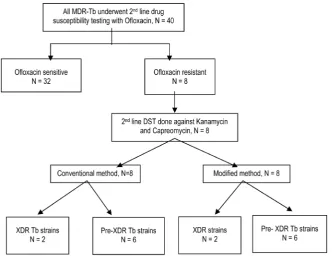
The MDR strains detected from the first DST subsequently underwent second line DST in a stepwise manner. All the MDR strains were first put through a DST with Ofloxacin alone. If found to be Ofloxacin resistant, they had to un-dergo DST against injectable drugs. Conventional method was done with single antibiotic per tube with either Ofloxacin or Kanamycin or Capreomycin at con-centration of 2.0 μg/mL for Ofloxacin, and concon-centration of 2.5 μg/mL for Ka-namycin and Capreomycin. 100 µl of each drug from the stock solutions was added per tube [15] [16]. This was compared to a Modified DST with simulta-neous combinations of Ofloxacin + Kanamycin in one tube and combination of Ofloxacin + Capreomycin in another tube. 50 μl of each drug was added at the same concentration as above mentioned to get a total volume 100 μl per tube.
combination tube due to the presence of a sensitive single drug. Validation of this test was done against the standard test with 4 strains (details included in the supplementary material).
We did an additional observation of Clinical Outcomes for the Drug resistant TB patients and it was collected via phone calls and Medical Records. Details collected included possible risk factors for developing drug resistant tuberculo-sis, clinical outcome including death/cure/ still on treatment, also past history of tuberculosis/exposure to drugs.
2.7. Statistical Analysis
The Sensitivity, Specificity, Positive and Negative Predictive Values were calcu-lated for comparison between the tests—DST-Modified test Versus Convention-al method and Liquid Culture Versus Solid culture results. PrevConvention-alence adjusted Kappa value and concordance were also calculated. McNemar’s test was used to assess the significance of the difference between the groups.
3. Results
All of the 1000 patients with presumptive TB included in the study underwent smear, culture (both solid and liquid) and once isolated, drug susceptibility test-ing (DST) in the period between 2013 and 2015. The sample processtest-ing with numbers at each step is depicted in detail in Figure 1. Since there were 39 sam-ples contaminated by culture, the final analysis was done on 961 samsam-ples as total number. Of these 198 (20.6%) samples were smear-positive for AFB and 763 samples were smear negative. The overall culture positive rate was 219 (22.7%) in total either by Solid or Liquid media. There were 168 samples positive both by the smear and culture, which shows a concordance of 76.7%. Thirty samples were smear-positive but culture negative and 51 patients were culture-positive but smear-negative. The sensitivity and specificity of smear as compared with culture was found to be 76.7% and 95.9% with Positive Predictive Value and Negative Predictive Values of 84.8% & 93.3% respectively (Table 1).
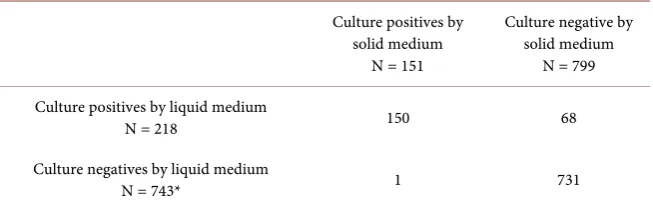
[image:6.595.211.539.599.701.2]Out of the 219 samples positive by culture, there were 151 samples positive by the LJ method-solid media and 218 samples positive by MGIT-liquid media.
Table 1. Smear vs. Culture results. Details of the Smear and culture results of the 1000 sputum samples for mycobacterium.
Culture positives Culture negative
N = 219 N = 742
smear positives 168 30
N = 198*
smear negatives 51 712
N = 763*
Figure 1. Flow Diagram of the study.
Table 2. Solid vs. Liquid culture details.
Culture positives by solid medium
N = 151
Culture negative by solid medium
N = 799
Culture positives by liquid medium
N = 218 150 68
Culture negatives by liquid medium
N = 743* 1 731
Specificity and Sensitivity for the culture for mycobacteria was found to be 91.4% and 99.3%. The PPV was 68.8% and NPV was 99.8%.
with solid media in our study compared to the liquid media, contrary to what has been observed. The overall contamination rate for LJ and MGIT was 5% and 3.9%, respectively in our study, which was statistically significant (p = 0.039).
The 219 culture positive samples were differentiated into 195 (89%)
Myco-bacterium tuberculosis complex (MTBC) and 24 (11%) MOTT—Mycobacte-
rium Other Than Tuberculosis by the MPT64 Antigen Test.
Drug Susceptibility Testing done on all the 195 MTBC strains revealed 119 (61%) susceptible (INH & RIF) strains and the remaining 76 (38.9%) strains were found to be with varying drug susceptibility profiles. Among those 76 strains, forty (20.5%) were found to be MDR TB isolates, 32 isolates were resis-tant to INH alone and 4 isolates were resisresis-tant to RIF alone by the conventional DST method. Among the mono-resistant cases, INH mono-resistance was the commonest (16.4%).
3.1. Comparison of the Modified DST to the Conventional
DST to 1st Line Drugs
All 195 culture positive strains underwent both conventional DST and the mod-ified DST. Comparing the 1st line DSTs, there were 40 detected to be MDR by the Conventional technique, compared to 39 by the Modified DST (Figure 1), with the combination of antibiotics in the same tube. The concordance between the conventional and modified tests was found to be 99%, with a prevalence ad-justed Kappa value of 99%. The sensitivity and specificity for the modified test compared to the conventional method were 97.5% and 100% respectively. The Positive predictive value and Negative predictive values were 100% and 99.1 re-spectively.
3.2. 2
ndLine DST Results
Figure 2. The2nd line Anti-Tuberculosis Drug susceptibility patterns.
We did an additional observation of interest in our study by looking at the Clinical Outcomes/previous history for the patients with Drug Resistant Tuber-culosis. Clinical outcome defined as death or cure could be obtained for only 19 patients out of the 40 MDR cases. There were 3 deaths and 16 were either cured or doing well on ongoing treatment. Among the six Pre XDR cases, 5 were lost to follow up, and one died. Among the 2 XDR cases, one died and the second patient was lost to follow up. Among the 4 Rifampicin mono-resistant cases, da-ta was obda-tained for 2 patients and they were cured by first line ATT. We also tried to get data on possible risk factors for developing drug resistance among the patients. Diabetes mellitus, Smoking and HIV (Human Immunodeficiency Virus) were found to be present in 10, 5 and 1 patient respectively for whom the information were available. The history of prior ATT use was available for a very few MDR patients, there were 9 relapse, 9 default and 7 failure cases.
4. Discussion
li-mited numbers of Drug Resistant strains, showed 99% concordance between the modified technique and the conventional technique for the first line drugs and almost 100% concordance for the second line drugs. This translates to a reduc-tion in the number of MGIT tubes involved in doing DST, which could mean a reduction in expenditure for diagnosis of drug resistance, especially in a high burden setting like India. This kind of a concept of combining antibiotics is fair-ly unexplored, as evident by the dearth of literature. Further research with for-mal sample size calculation needs to be undertaken to assess the validity of the test, since the numbers in our study were small.
There was only one sample which was not detected as MDR by the modified technique. The same sample which was positive for MDR strain by the standard technique was later re-cultured and the repeat DST showed the same strain MDR by the conventional technique and Sensitive by the Modified method. Since the conventional technique is the gold standard, it was decided to catego-rise that strain into MDR. On follow up of that particular patient by telephone, we found that the patient had responded to first line Anti Tuberculosis treat-ment and was declared cured.
The contamination rates were found to be higher in LJ media-5% compared to 3.9% with the liquid media. This has been observed elsewhere too [17]. The possible explanations could be that the addition of PANTA (Polymyxin B, Am-photericin B, Nalidixic acid, Trimethoprim, and Azlocillin) reduced the chances of contamination in liquid media [18]. Moreover, as our Hospital being a refer-ral centre, gets a large number of positive samples, which could probably lead to higher cross contamination rates [19].
This study also highlighted the trends of culture positivity prevailing in a ter-tiary care centre in urban Bangalore. 19.5% of our sputum samples (195 out of the 1000) were culture positive. This was comparable to a large scale retrospec-tive analysis done in a tertiary care centre in Delhi, where 18.9% of the sputum samples (1240 out of 6569 samples) showed positive mycobacterial culture [20]. We also found a higher yield of positive culture with liquid media compared to solid media, 21.8% and 15.1% respectively, which is consistent with earlier stu-dies [21].
These rates reiterate the importance of doing culture and drug susceptibility in all the tuberculosis cases, especially in a high burden country like India. This is possible only with a larger network of laboratories doing drug susceptibility to 1st and 2nd line drugs in India, as well as more cost effective measures of doing
DST.
Clinical outcomes of the patients with MDR were also observed in our study through chart reviews and telephone calls, but only a few could be followed up. Among those patients, the presence of high risk factors- diabetes mellitus, HIV, smoking, and prior treatment with ATT were noted [24]. These risk factors not only increase the risk of active tuberculosis, but also increase the risk for Drug Resistant TB. It has also been documented that the failure rates and sequelae are more common with the presence of risk factors. Development of drug resistance can also be attributed to the widespread abuse of antibiotics. Second line drugs like Amikacin and Flouroquinolones are being abused for other febrile illnesses, without adequate scientific evidence, which has contributed to a large pool of XDR and Pre XDR TB [25]. An important concern is the need to follow standard guidelines universally, to prevent the spread of drug resistance.
The main limitation of this study was that the numbers of MDR strains were very limited to ascertain the concordance between the modified DST technique and conventional method. In addition, the cost effectiveness of the test was not analysed using formal methods. Also, when we look at the applicability of this novel method of DST, technical experience is needed when doing combination of antibiotics in the same tube on a large scale, which is another potential limita-tion.
5. Conclusions
In general, better rapid diagnostic tests are needed for effective detection and early commencement of treatment of drug resistant TB. In a country like India with limited budget allocated to TB control, more focus needs to be given to re-duce costs on drug susceptibility testing and allocate funds in a promising po-tential alternative for DST without compromising on the sensitivity and specific-ity. Our study though small in sample size shows that combination of antibiotics in the same tube could be a potential cost-effective alternative for DST.
6. Future Implications
Further studies with a formal sample size need to be planned to look into con-cordance and validate the possibility of making the modified method as a poten-tial alternative and also look into the cost-effectiveness since there is a reduction in the number of MGIT tubes involved in this DST.
Acknowledgements
the Tuberculosis/RNTCP clinic, as well as the Department of Microbiology for their valuable support in recruitment and data. We would also like to acknowl-edge the St John’s Research Institute for giving us the laboratory support and funding for the tests and material involved.
Financial Support
This particular project was funded exclusively by the Infectious Diseases Unit of the St John’s Research Institute. This research received no specific grant from any funding agency, commercial or not-for-profit sectors.
Ethical Standards
The authors assert that all procedures contributing to this research work comply with the ethical standards of the National and Institution Ethics Committee at St. John’s National Academy of Health Sciences on the use of patient samples. It also complies with Helsinki Declaration of 1975, as revised in 2008.
References
[1] World Health Organization (2015) Global Tuberculosis Report 2015. WHO. [2] Central TB Division (2015) TB India 2015. Annual Status Report.
[3] CDC (2006) Emergence of Mycobacterium tuberculosis with Extensive Resistance to Second-Line Drugs—Worldwide, 2000-2004. Morbidity and Mortality Weekly Report, 55, 301-305.
[4] Kim, D.H., Kim, H.J., Park, S.-K., Kong, S.-J., Kim, Y.S., Kim, T.-H., et al. (2010) Treatment Outcomes and Survival Based on Drug Resistance Patterns in Mul-tidrug-Resistant Tuberculosis. American Journal of Respiratory and Critical Care Medicine, 182, 113-119. https://doi.org/10.1164/rccm.200911-1656OC
[5] World Health Organization (2015) Guidelines for Surveillance of Drug Resistance in Tuberculosis. 5th Edition, World Health Organization, Geneva, 76 p.
[6] World Health Organization (2015) Tuberculosis (Mdr-Tb) Factsheet.
[7] Olson, S., English, R.A., Guenther, R.S. and Claiborne, A.B. (2012) Facing the Real-ity of Drug-Resistant Tuberculosis in India.
http://www.ncbi.nlm.nih.gov/books/NBK92617/pdf/TOC.pdf
[8] Michael, J.S. and John, T.J. (2012) Extensively Drug-Resistant Tuberculosis in India: A Review. Indian Journal of Medical Research, 136, 599-604.
http://www.ncbi.nlm.nih.gov/pmc/articles/PMC3516027/
[9] Yadav, R.N., Singh, B.K., Sharma, S.K., Sharma, R., Soneja, M., Sreenivas, V., et al. (2013) Comparative Evaluation of GenoType MTBDRplus Line Probe Assay with Solid Culture Method in Early Diagnosis of Multidrug Resistant Tuberculosis (MDR-TB) at a Tertiary Care Centre in India. PLoS ONE, 8, e72036.
https://doi.org/10.1371/annotation/e90efdb7-91c1-45f0-ae98-a88fcb407acc
[10] Limaye, K., Kanade, S., Nataraj, G. and Mehta, P. (2010) Utility of Microscopic Ob-servation of Drug Susceptibility (MODS) Assay for Mycobacterium tuberculosis in Resource Constrained Settings. Indian Journal of Tuberculosis, 57, 207-212. [11] Barnard, M., Gey Van Pittius, N.C., Van Helden, P.D., Bosman, M., Coetzee, G. and
Journal of Clinical Microbiology, 50, 3712-3716.
https://doi.org/10.1128/JCM.01958-12
[12] World Health Organization (2007) Use of Liquid TB Culture and Drug Susceptibil-ity Testing (DST) in Low and Medium Income Settings. Policy Statement.
[13] Stop TB Partnership (2014) Mycobacteriology Laboratory Manual. 51-66.
http://www.stoptb.org/wg/gli/assets/documents/gli_mycobacteriology_lab_manual_ web.pdf
[14] Jesuraj, A., Kumar, U. and Srinivasa, H. (2015) Fast and Accurate Identification of M. tuberculosis Complex Using an Immunochromatographic MPT64 Antigen De-tection Test. Journal of Tuberculosis Research, 3, 149-156.
https://doi.org/10.4236/jtr.2015.34021
[15] Zhao, L.L., Xia, Q., Lin, N., Liu, B., Zhao, X.Q., Liu, Z., et al. (2012) Evaluation of BACTEC MGIT 960 System for the Second-Line Drugs Susceptibility Testing of Mycobacterium tuberculosis in China. Journal of Microbiological Methods, 91, 212-214. https://doi.org/10.1016/j.mimet.2012.06.010
[16] Kim, H., Seo, M., Park, Y.K., Yoo, J.I., Lee, Y.S., Chung, G.T., et al. (2013) Evalua-tion of MGIT 960 System for the Second-Line Drugs Susceptibility Testing of My-cobacterium tuberculosis. Tuberculosis Respiratory Treatment, 2013, Article ID: 108401.
[17] Boum, Y., Orikiriza, P., Rojas-Ponce, G., Riera-Montes, M., Atwine, D., Nansumba, M., et al. (2013) Use of Colorimetric Culture Methods for Detection of Mycobacte-rium tuberculosis Complex Isolates from Sputum Samples in Resource-Limited Set-tings. Journal of Clinical Microbiology, 51, 2273-2279.
https://doi.org/10.1128/JCM.00749-13
[18] Chang, C.L., Park, T.S., Oh, S.H., Kim, H.H., Lee, E.Y., Son, H.C., et al. (2002) Re-duction of Contamination of Mycobacterial Growth Indicator Tubes with a Modi-fied Antimicrobial Combination. Journal of Clinical Microbiology, 40, 3845-3847.
https://doi.org/10.1128/JCM.40.10.3845-3847.2002
[19] Ruddy, M., McHugh, T.D., Dale, J.W., Banerjee, D., Maguire, H., Wilson, P., et al. (2002) Estimation of the Rate of Unrecognized Cross-Contamination with Myco-bacterium tuberculosis in London Microbiology Laboratories. Journal of Clinical Microbiology, 40, 4100-4104. https://doi.org/10.1128/JCM.40.11.4100-4104.2002
[20] Raveendran, R., Oberoi, J.K. and Wattal, C. (2015) Multidrug-Resistant Pulmonary & Extrapulmonary Tuberculosis: A 13 Years Retrospective Hospital-Based Analysis. Indian Journal of Medical Research, 142, 575-582.
https://doi.org/10.4103/0971-5916.171285
[21] Levidiotou, S., Papamichael, D., Gessouli, E., Golegou, S., Anagnostou, S., Galana- kis, E., et al. (1999) Detection of Mycobacteria in Clinical Specimen Using the My-cobacteria Growth Indicator Tube (MGIT) and the Lowenstein Jensen Medium. Microbiological Research, 154, 151-155.
http://www.ncbi.nlm.nih.gov/pubmed/10522382
[22] Porwal, C., Kaushik, A., Makkar, N., Banavaliker, J.N., Hanif, M., Singla, R., et al. (2013) Incidence and Risk Factors for Extensively Drug-Resistant Tuberculosis in Delhi Region. PLoS ONE, 8, 1-7. https://doi.org/10.1371/journal.pone.0055299
[23] James, P., Gupta, R., Christopher, D.J., Thankagunam, B. and Veeraraghavan, B. (2011) MDR- and XDR-TB among Suspected Drug-Resistant TB Patients in a Ter-tiary Care Hospital in India. Clinical Respiratory Journal, 5, 19-25.
http://www.ncbi.nlm.nih.gov/pubmed/21159137 https://doi.org/10.1111/j.1752-699X.2009.00184.x
(2010) Risk Factors for MDR and XDR-TB in a Tertiary Referral Hospital in India. PLoS ONE, 5, e9527. https://doi.org/10.1371/journal.pone.0009527
[25] Udwadia, Z. and Moharil, G. (2014) Multidrug-Resistant-Tuberculosis Treatment in the Indian Private Sector: Results from a Tertiary Referral Private Hospital in Mumbai. Lung India, 31, 336-341.
http://ovidsp.ovid.com/ovidweb.cgi?T=JS&CSC=Y&NEWS=N&PAGE=fulltext&D =emed12&AN=2014874659\nhttp://sfx.ucl.ac.uk/sfx_local?sid=OVID:embase&id= pm-id:&id=doi:10.4103/0970-2113.142101&issn=0970-2113&isbn=&volume=31&is sue=4&spage=336&pages=336-341&date=2014&ti
https://doi.org/10.4103/0970-2113.142101
Submit or recommend next manuscript to SCIRP and we will provide best service for you:
Accepting pre-submission inquiries through Email, Facebook, LinkedIn, Twitter, etc. A wide selection of journals (inclusive of 9 subjects, more than 200 journals)
Providing 24-hour high-quality service User-friendly online submission system Fair and swift peer-review system
Efficient typesetting and proofreading procedure
Display of the result of downloads and visits, as well as the number of cited articles Maximum dissemination of your research work