Consideration on the single currency
seen from a competitiveness perspective
Iordan-Constantinescu, Nicolae and Dusa, Silvia
Journal of Euro and Competitiveness
April 2014
Online at
https://mpra.ub.uni-muenchen.de/56520/
CONSIDERATIONS ON THE SINGLE CURRENCY SEEN FROM A
COMPETITIVENESS PERSPECTIVE
Dr. Nicolae Iordan-Constantinescu*
Silvia Duşa**
Abstract : Competitiveness is a concept referred to as a sine qua non condition of growth, at both micro and macroeconomic level. But there are few approaches looking at the single currency as an instrument of competitiveness measuring and promotion. The single currency represents a right step in the development of the integration process, contributing decisively to the accomplishment of the single market by enabling fluid and efficient financial relations among states, institutions and persons, but also by promoting and asserting the EU objectives of competitiveness and so acting as a binder for a sustainable and healthy development. The adoption of the single currency represents a step towards getting an increased level of competitiveness in national and international relations, as the conditions for joining the single currency imposed both to the member and candidate states to implement programs synergic with those included in their own strategies of competitiveness and subsequently they were presumed to accomplish objectives provided for by such strategies. Even if in the present and immediate periods euro and the euro zone will be subject to strong domestic and international pressure, we are convinced that the single currency will survive such trials and the necessary lessons will be learned, first of all by a more attentive consideration of competitiveness as the proper foundation for the existence and functioning of a healthy and strong single currency!
Keywords: competitiveness, economic growth, euro, convergence , monetary policy, sustainability
JEL: E42, E61, F36, F43, G15, O47
Preliminary considerations
The global financial and economic crisis, the reverberations of which are not yet over, pointed out a several vulnerabilities of the single currency and fueled the debates about the continuation of some countries in the euro zone, but also of the euro zone as a whole and of euro as a single currency1, pushing euro in the middle of one of the fiercest dispute.
The prevailing unfavorable general climate enabled the escalation of attacks against the single currency, both from outside but mostly from inside the European Union, the single currency
*
Associate Professor, Bucharest University for Finance and Banking, President of Paneuropa Foundation Romania
**
International Economic and Financial Relations Consultant, Paneuropa Foundation Romania
1
even prior to euro launching, but afterwards as well, several authoritative voices in this domain envisaged the quick dismantle of the single currency. In July 2012 Nobel Prize Laureate Nobel Nouriel Roubini predicted that euro will last maximum six months, followed by a process of dissolution ( http://actualidad.rt.com/economia/view/50401-La-zona-euro-caduca-en-medio-a%C3%B1o)
being accused to be at the origin of all "evils" the European Union is facing presently, among them especially the excessive budgetary deficits, the enormous public debts and the inability of governments to find efficient and high performance solutions to such problems!
An important criticism points out that by accepting the single currency the countries pertaining to euro zone made a transfer of sovereignty, depriving themselves of the fundamental right to mint and manage independently their own money and so preventing them from using the monetary mechanisms to control the budgetary deficits or, as politicians like to declare, for "financing the economy in order to create employment and make social projects"! And such a transfer of sovereignty, especially in the monetary area, seems to reimburse now, in difficult times!
But such an approach is only an attempt made by the rulers of the respective states to free themselves from the responsibilities they have and should have exercised for the healthy and high performance of their economies and societies. We cannot endlessly blame theories, inventions or creations of minds or phantasies just because those elected at some point to run destinies do not know to use them or they use them improperly or even ignore them despite the rational of such theories, inventions or creations.
On the other side, we have to admit that transfer of sovereignty is not a new element in the alchemy of integration, but on the contrary, it is at the basis of the integration process since its inception, in 1951, produced by the progressive transfer of different attributes of the national sovereignties. But, there is another aspect that we have to bear in mind, the transfered attributes are exerted jointly and for the most part of them by the EU itself and the member states as shared competencies in the framework of the communitary mechanisms.
The primary justification of a currency in general and of the single currency especially is to intermediate and facilitate exchanges and circulation of goods and services in the economy and society and less to serve to some political interests, irrespective of how representative such interests could be. At the same time, in order to mark a firm distinction between political and economical in the logic of the European construction, the management of the monetary affairs was entrusted, internally, to the national central banks, who were prescribed a "status of independence" in regard to the political power, while externally, at EU level, it was given to the European Central Bank, a body enjoying also an "independent status"2.
Consequently, should it be reasons of concern or even of panic related to the existence of a single currency? The temptation of establishing a single currency at both regional and international level is not new, as the opposition to such an evolution is not also of recent date. Let us recall
2
Look at the article 130 of the Treaty on the functioning of the European Union, the consolidated version, which provides that "when exercising the powers and carrying out the tasks and duties conferred upon them by the Treaties and the Statute of the ESCB and of the ECB, neither the European Central Bank, nor a national central bank, nor any member of their decision-making bodies shall seek or take instructions from Union institutions, bodies, offices or agencies, from any government of a Member State or from any other body".
here Robert Mundell, laureate of the Nobel Prize in economics, in 1999, in recognition of his contributions to the theoretical substantiation of euro3. In the opposition camp, we could refer to another Nobel Prize laureate, Milton Friedman, founder of the monetarist school in Chicago, who shared somewhat a contradictory vision about the single currency: on the one hand, he was forecasting a quick failure of the European single currency4, even before its introduction, on the 1 January, 1999 (it didn't happen!), while, on another hand, he was proposing the establishment of universal money (sic!).
In Romania, there are already some books of reference about euro and the optimal monetary zones, but we have no comprehensive studies concerning euro strengths and weaknesses or about maintaining euro as a single currency in the near future. In Romania there are also opinions5 arguing that essentially a true "euro zone" doesn't exist, but "there are several countries using jointly a single currency called euro". Should it be this the case, one could wonder what is the difference, for example, between Luxemburg, as a member of euro zone and Monaco or Kosovo, non member countries of euro zone, even if they are all using the same European single currency. Or which could be in such a case the difference between euro zone and that of the sterling pound?
In fact, the euro zone is not a "form without content", as it is not a "content without form", but on the contrary, it is a legislative, institutional and economic entity, to which the member state accessed only after fulfilling the so-called "Maastricht criteria", prescribing macro-economic values, mostly quantitative, as inflation, long-term interests, public debt and budgetary deficits, as well as - what is even more important - by implementing, prior to their accession to euro zone, complex comprehensive programs of economic and social convergence, at the highest possible level and by submitting their national currency to the constraints of the European Exchange Rates Mechanism (minimum two years prior to the accession), thus guaranteeing that fixed rates of change will be attained and maintained as such between the respective national currencies and so the healthy existence and functioning of the single currency will be secured. That is what Luxembourg did and continues to do, but that is not the case of Monaco or Kosovo, which never committed themselves to implement at least one single element from the panoply of those agreed upon for euro zone membership.
3
Already in 1969, prof. Robert Mundell published "A Plan for a European Currency", where he argued that a European currency, "administered by a European Monetary Committee", "was the best technical solution", which "was not only compatible, but should have promoted other European objectives" (page 1).
4
In 2000, in a speach at the Bank of Canada about the flexible rates of change, Milton Friedman, referring to euro as being in its "honeymoon", considered that there are "few hopes" as "the differences will pile up among different countries and the asynchronised shocks will affect them". As to the recent history, he noticed that "we attempted in the past to have fixed rates of change but each time thae system failed ". "The verdict is not in euro favour, now it is one year, give it time to develop its deffects ". http://marginalrevolution.com/marginalrevolution/2011/09/milton-friedman-on-the-euro-and-qe3.html
5professor Daniel Dăianu sustains publicly that euro is only "a currency used jointly by several countries"
The European single currency is a natural follow-up of deepening the process of European integration and was born at a certain phase of its advancement, even if, in form and substance, it was established consensually, by a treaty, which provided its whole normative, institutional and functional construction, nonobstant that such a construction might prove to be, especially during moments of crisis, imperfect and reveal a series of weaknesses (for which it is not per se and the only one culpable).
At different stages of history there were periods when a national currency was used as a main currency for several states, for practical needs of intermediating and facilitating the economic exchanges and discounting between those states. So it happened, for example, in the case of the sterling pound, in Commonwealth, "the German mark zone ", "the French Frank zone" or "the dollar zone", the latter linked essentially to the Bretton Woods agreements.
We have to emphasize that such "monetary zones" did not dispose of their own single currency, but of a "main currency", which was circulating alongside of the national currency and was used mainly to intermediate exchanges and mutual discountings; the national currencies were not linked between them and with the "main currency" through fixed rates, there was no common monetary policy and no common authority to administer the "main currency" and the exchanges of the respective national currencies, their rates of change, were floating freely and the states, by means of their competent authorities, usually the central banks, could intervene at any moments so that the rates of change be maintained within rather tight limits.
Similarly, in the case of the European Union the introduction of the single currency had economic reasons, but represented at the same time a natural continuation and a necessary crowning of the long process of economic integration, started in 1951, using, in an unknown alchemy, the integrative engines of "communitarization" (by means of transferring national competencies to implement them jointly) and that of the "intergovernmental cooperation" (by keeping the national competencies and implement them independently), in order to achieve the necessary accomplishment of the single market by adding the only one missing ingredient - the single currency!
Genesis of the European single currency
To better understand how the single currency was born and developed, here are summarized
some milestones of the European integration history and of the correlative monetary agenda.
The monetary issues emerged rather timidly at the time of the first European community,
initially as a rather collateral concern. The Treaty of Rome in 1957 established a commitment of
exchange as a problem of common interest. There was also a mechanism of financial support.
Institutionally, a Monetary Committee was created, having as mission the coordination and
consultation on monetary matters. At that point, the need of a single currency was not examined
as a main objective, the emphasis being placed on the establishment of the single market.
In October 1970, under the pressure of the monetary turmoil in the international relations, which
finally led to the end of the gold convertibility and of the role of US dollar as an anchor of the
international monetary system established through Bretton Woods agreements in 1944, a
committee of experts was convened under the presidency of the Luxemburgish prime-minister
Pierre Werner6, whose activity was summarized in a document remembered under the name of
"Werner Report" or "Werner Plan". The core of this Report or Plan focused on "an ideal
objective, that of substituting the national currencies by a common currency” or, „in the absence
of the common currency, the national currencies were to be mutually changed on the basis of a
fixed parities”7, in a process of three successive steps planned to be implemented gradually in a
period of three years.
Institutionally, "Werner Plan" provided for the setup of a "decisional center on economic policy"
(the idea of economic governance was already contemplated at that time) and for a
"communitary system of central banks" (predecessor of the European system of the central
banks). It could be said that in such a way „Werner Plan” included all elements that configured,
twenty years later, the economic and monetary union decided in Maastricht, in 1992.
"Werner Plan" implementation started on April 3, 1973, by the establishment of the European
Monetary Cooperation Fund (EMCF), which was supposed to be the embryo of the future
European Central Bank. Unfortunately, the other steps did never see the daylight. The worsening
of the international climate, first of all the collapse, at the beginning of 1970', of the Bretton
Woods monetary system, the economic recession that preceded the first oil crisis in 1973 and
6
Pierre Werner (1913-2002) - Luxemburgish politician (Social-Christian Party), prime minister (1959-1974, 1979-1984)
7
Zorgbibe, C.. Construcţia europeană: trecut, prezent, viitor (European Construction: past, present, future) Publishing House Trei, Bucharest 1998, page 103
also the divergent national policies, an unfinished joint economic strategy and an extremely weak
political commitment, ensured by their combination the death of economic and monetary union8.
The subject of the economic and monetary union was resumed two decades later, through
"Delors Report", so called after Jacques Delors9, the president at that time of the European
Commission, who presented it, on 17 April 1989. This formula, like "Werner Plan", provided for
a three-steps plan to achieve the economic and monetary union. It included, explicitly, the
permanent establishment, during the third step of its implementation, of the parities between the
national currencies and finally their replacement with a European single currency. To attain the
economic and monetary union, "Delors Report" envisaged additionally the achievement of a high
convergence of the economic performances by strengthening the coordination of the economic
and monetary policies within the existing institutional framework. In the monetary domain, the
focus was on removing all obstacles on the way of their financial integration and intensifying the
cooperation and coordination of the relevant monetary policies.
"Delors Report" offered a maximalist vision, in the sense that it foresaw the adoption of the
single currency and the transfer of the monetary competency to a supranational central bank. It
offered also a gradual vision, envisaging a progressive transition to the single currency following
a three-phases calendar.
The gradual transition to the single currency had to be accompanied, according to "Delors
Report", by staging joint economic policies, as well as by a strict discipline of the national
financial policies.
"Delors Report" served as a basis for intense negotiations, which led finally to the drafting and
signing of Maastricht Treaty10, which mirrored, to a large extent, the provisions laid down by
„Delors Report”, especially regarding the establishment of the three phases, but went further,
8 Tsoukalis, L., Noua economie europeană revizuită (The Revised New European Economics), Publishing House
ARC, Chișinău, 2000, pages 147-148
9
Jacques Delors (1925 - ), French economist and politician, president of the European Commission for three mandate (January 1985 - December 1994), presently president of the centre-left think -tank "Notre Europe"
10
The Treaty establishing the European Union, signed on 7 February 1992 in Maastricht and entered into force on 1 November 1993
fixing, inter alia, requirements of economic discipline disguised under the convergence criteria,
which had to lead to a high degree of convergence of the economic performances that the
countries wishing to join the euro zone had to implement, but also requirements of compatibility,
performance and endurance, by maintaining the rate of change in the normal margins of
fluctuations prescribed by the Exchange Rates Mechanism, during at least two years prior to the
examination, without any devaluation of the rate of exchange of the own currency, at the
initiative of a candidate state, as against the currency of any other member state.
Under such a complex approach the treaty provided the effective transition to the single
currency, the fundamental concept, instrument and essence of the economic and monetary union,
and implicitly an essential element for the single market to function properly.
In fact, when the creation of the single currency was decided - an equally political, economic and
judicial act -, there were also defined first of all the convergence criteria, that means the
macroeconomic indicators that each candidate state was supposed to fulfill so that the single
currency could function in an optimal environment, secondly the necessary mechanisms that will
guide the whole process in that direction, i.e. the programs of convergence for the candidate
countries and the programs of stability of the member-states, but also the exchange rate
mechanism as well as a series of special procedures, regarding the "multilateral monitoring",
"procedure of the excessive budgetary deficits" and "the coordination of the broad guidelines of
economic and social development" of the member states11.
Let us notice that the objective of a "high level of economic performances convergence" is
similar to that of a "high common level of economic competitiveness", which means,
primordially, from the competitiveness angle, an increase of labor productivity at the highest
possible level in the member states, alongside with the increase of the respective countries
capacity to better satisfy the individual and general needs; from the monetary perspective, means
to ensure internally the stability of rates of exchange in the member states, alongside with putting
at the disposal of business media a strong and stable instrument.
11
Together with the single currency, the broader coordination of the national economic policies
was introduced in the practice of the European Union, having as a fundamental objective the
strengthening of the economic convergence of the member countries, avoiding the economic
sideslipping and the rebirth of major economic gaps that could wear out the fundamentals of the
single currency. Let us recall that exactly the significant economic disparities among the member
countries and the lack of policies to liquidate them and consequently to realise the convergence
of the economic performances of the participating countries caused, among other factors, the
failure of the envisaged European monetary union at the beginning of 1970' and presently
represent the main causes of the envisaged failure of the European single currency.
To remind also here, for the sake of history, that the famous "Stability and Growth Pact",
deviced to consolidate the convergence criteria with special monitoring mechanisms and
procedures, was added to the Maastricht Treaty in 1997 at the initiative and insistence of
Germany12 first of all, with the intention in mind to mobilize the member states to observe the
rules of euro membership and, if the rules were infringed, to oblige the respective countries to
come back to their observance by penalizing measures included. Unfortunately, these rules were
later on relaxed at the pressure of bigger states13 and that happened shortly after the single
currency became effective, by forcing o more permissive interpretation in the sense that penalties
were not applicable in case of "credible signs" of a positive trend towards accomplishment of the
prescribed level. Such a move diminished considerably the deterring force of such measures.
The currency in itself is neither good nor bad and the single currency should not be considered
an exception from such a perspective. All currencies are facing difficulties in their evolution,
what is quite normal as the economy is a live body, which grows and diminishes following
objective laws and the evolution of the currency is inscribed in the market logic. The money
12
The Stability and Growth Pact was proposed in 1995 by the German minister of finance, Theo Waigel, as o modality of providing healthy public finances and so to limit the inflation risks, according to convergence criteria provided by the Maastricht Treaty.
13
In 2003, upon recommandation of the European Commission, the Council established that Germany and France registered excessive budgetary deficits and thus they were subject to the provisions of excessive deficits procedure. The same year, the Commission came back on the initial proposal and submitted a second recommandation to bring the two states back into the precribed limits, but the recommandation did not obtain the necessary qualified majority in the Council so entering into a deadlock. Practically, the Stability and Growth Pact became unapplicable.
must accomplish a series of functions in a given environment and history showed us that such
functions asserted themselves differently in different periods of time, but the currencies survived
and were not necessarily presumed to disappear (e.g. the dollar in Bretton Woods agreements
configuration) or, on the contrary, had to quit (see, for example, the DM) but only to be reborn in
a new single synthesizing currency - the euro, in 2001.
Was the single currency an opportune achievement that revealed a positive role in the
development of the single market and in the accomplishment of the European integration
process? The simple answer is positive and we shall explain further the advantages of the single
currency.
The single currency - especially its advantages
Up to the introduction into the treaties of the problematic related to the single currency, the
European integration in its economic dimension passed through several important phases. First
of all, it was a free trade area, where the goods and services circulated freely between the
participating countries; afterwards, it endowed itself with a custom tariff and a commercial
policy towards third countries, becoming a custom union; by adding the free circulation of
persons and capital a common market emerged; introducing a certain degree of harmonization of
the national economic policies performed by the participating countries allowed the proper
functioning of the economic union; finally, in order to eliminate any difficulties from the
exchanges between the participants to the economic union, it was needed that the national
currencies be replaced, under determined conditions and only for the participants fulfilling
pre-established conditions, by a single currency, so achieving the monetary union.
No doubt that the integration process does not end here, neither as successive phases, nor as
overall process. There are many important aspects that need to be deepened, others that have to
be put aside for the time being, there are important projects that are now negotiated or in process
of their implementation, as the fiscal union or the banking union, as there is much talk about the
political union. But things must not be pressed, they will be done gradually, as the founding
a single plan. It will be built through concrete achievements which first create a de facto
solidarity14."
The single currency was the only one missing link for the single market to be completed, the
economic and monetary union to be accomplished and the European Union to get an increased
competitive force.
That is why the preoccupations to establish the monetary union and in such a famework to
introduce the single currency were continuous after the announcement of the common market
objective (through the treaties of Rome15), first of all by "Werner Plan" (1970) and later on,
immediately after the date of February 1, 1993 was scheduled for launching the internal market
(according to the European Single Act16), by "Delors Plan", in 1989 and finally by Maastricht
Treaty, in 1992, explicitly fixing the objective and the way in which the monetary union will be
achieved and the single currency introduced.
The advantages of the economic and monetary union were already obvious at the moment of
project initiation, coming primarily from the need to ensure that the free circulation of goods,
capitals, services and persons was not hindered or limited by barriers pertaining to distinct
national monetary spaces in the geographic area of the single market implementation but, on the
contrary, encouraged, facilitated and supported by removing these barriers and allowing a unique
monetary area.
In terms of the entry into force of the single market, the undeniable economic advantages of the
monetary union ("one market - one currency") were related to the internal efficiency of the
unitary monetary domain, the relations with third countries, the economic policy and the policy
of integration. Some economists even noted that, "according to the theory of optimal monetary
zones, the monetary integration determines the degree of commercial opening of the economy
and consequently should expedite the decision to join the economic and monetary union"17.
14
Robert Schuman Declaration on 9 May 1950
15
The two treaties signed in Rome, on 25 March, 1957 and entered into force on 1 January 1958, concerned the establishment of the European Economic Community (Common Market) and of the European Community for Atomic Energy (EURATOM)
16
The Single European Act was signed on 17 February 1986 and entered into force on 1 July 1987
17Marinaş, M., Convergenţa economică
Certainly, again, things should not be pressed, but only assisted to reach their accomplishment at
the right maturity, so that the functioning of the single currency should not be jeopardised.
The national economies of EU member states suffered, prior to the introduction of the single
currency because of the fluctuations of the local currencies in the common market, but the
introduction of the single currency, even if euro rate of exchange has not represented a cover
against the general monetary fluctuations, unified the instruments of change in all states of the
euro zone, put an end to the monetary instability within euro zone by establishing the irrevocable
fixed rates of exchange between the participating countries and reduced such instability outside
the member states.
The economic and monetary stability sustains the long term planning, reducing uncertainties and
encouraging investments. At the same time, it provokes the establishment of a sui generis
attractive zone for the promotion and support of exports. Diminishing or even liquidation of the
monetary instability reverberates positively upon exporters, who get a stronger certainty of their
business projections and generates a meaningful potential of growth.
On the other hand, businessmen are no longer obliged to make appeal to hedging operation to
counteract the risk of monetary fluctuations within the euro zone, while the commercial
transactions made in other states are no longer subject to administrative costs linked to the
monetary exchanges accounting.
The single currency generates important advantages for consumers as well. The prices are more
stable, the competition is stronger, the loans are more accessible and less expensive. The
consumers should no longer change money when they travel abroad and pay less commissions
when transferring money abroad. It was estimated that during the EU 12, that means till 1995, a
traveler visiting all member countries should have lost 40% of the used amount of money in
paying the commissions of money exchange.
The euro zone progressed rapidly after its establishment, contributing actively to the foreign
trade growth. The exports from euro zone are witnessing a continuous good performance, current
equilibrium, unlike the United States, the main competitor, suffering from a deficit of the current
account or Japan, registering excesses.
The fact that euro was used in a wider monetary zone determined its change into a second
international reserve currency, after the US dollar, contributing additionally to a single currency
less sensitive to the monetary speculations as compared to individual currencies.
Since its entering on the market and for more than ten years of existence, the single currency
witnessed a progressive growth, eloquently reflected in the evolution of the international
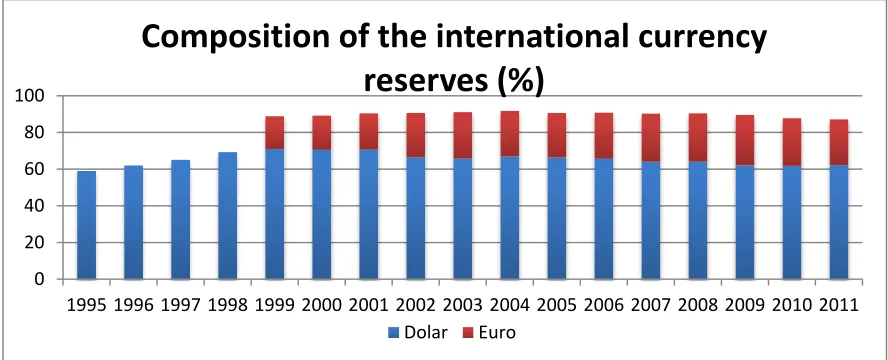
monetary reserves. If in 2000, the percentage of the US dollar in the global monetary reserves
was of about 70%, it went down, according to IMF statistics, to about 62.2% in 2011.
The place so freed by the American dollar was quickly taken over by the European single
currency, which succeeded the performance of becoming the second reserve currency as
importance at international level, euro quota increasing from 18.8%, in 2000 to 25.0%, in 2011,
[image:13.612.108.552.418.598.2]as can be seen in the Figure nr. 1.
Figure nr. 1
Source : processed IMF and ECB18 data
Similarly, more and more countries choose euro to play an important role within their strategy of assembling the structure of their monetary reserves.
18
http://www.imf.org/external/np/sta/cofer/eng/cofer.pdf http://www.ecb.int/pub/pdf/scpops/ecbocp43.pdf
0 20 40 60 80 100
1995 1996 1997 1998 1999 2000 2001 2002 2003 2004 2005 2006 2007 2008 2009 2010 2011
Composition of the international currency
reserves (%)
Dolar Euro
Euro has the advantage of being the single currency of some of the most developed and competitive economies, detaining a significant quota of the world economy. At the same time, euro is administered and sustained by a strong and independent central bank, a fact contributing fundamentally to the stability of the European economy and simultaneously playing a stabilizing role for the Central and Eastern European countries that will become at some point members of the “select club” of euro zone.
The single currency and competitiveness
International competitiveness is vital for the sustainability of an economy. In the last decades the concerns about international competitiveness increased in importance, especially from the perspective of economic development and expansion, as well as globalization of the economy.
In an almost autarchic economy, where the exchanges with the outside are accidental, the problems of competitiveness were put to a rather reduced extent, only when production exceeded significantly the demand and the issue of recovering the costs of production was raised.
In a global economy as the present one, competitiveness issues are put with acuity, as on the global market the ratio performance/cost becomes essential in taking a purchasing decision, while the offer would be focused on higher performances and lower prices in order to find buyers and get a significative share of the market! Here is an obvious relation between competition and competitiveness, in the sense that while the competition intermediate the recognition of the social utility of the expenses made individually (goods are sold and bought), the competitiveness determines to what level this recognition takes place (the manufacturer recuperates integrally the costs of production and has a profit, or partially, in this case recording a loss).
An eloquent example is represented by the evolution of German exports even during the crisis
period, as can be seen from the table19 above. Due to the export increase, Germany's Gross
19
Table taken over from http://www.tradingeconomics.com/germany/gdp-growth
Domestic Product recovered after the sharp decline of 2008, of about -5%, and remained
constantly at positive values.
The first factor of such an evolution is represented by exports with high added value, that means
of high competitiveness, which placed Germany on the fourth place in the Global
Competitiveness Report 2013-2014 (after Switzerland, Singapore and Finland) and place 9 in the
World Competitiveness Scoreboard 201320.
Such an orientation towards a stronger consideration of the competitiveness dimension called for
a deeper theorization of competitiveness, the creation of indicators of measurement and the
development of a mix of policies that could boost the success of a country in creating and
maintaining a healthy and high performance environment for the companies acting inside the
national boundaries, but also for sustaining their performance and that of the country as a whole
at the international level.
The credo of competitiveness drew numerous real supporters, determining economists from
everywhere to promote this requirement at the level of "natural law of the modern capitalist
economy "21.
At world level, there are several bodies with universal vocation dealing with the study of
competitiveness, among them especially the World Economic Forum (WEF) and the
International Institute for Management Development (IMD).
The World Economic Forum considers competitiveness as “a set of institutions, policies and
factors that determine the productivity level of a country”22, while the International Institute for
Management Development defines competitiveness of the national economy as being “the
20
Alexandra Iwulska - Golden Growth: Restoring the lustre of the European economic model – Country benchmarks, World Bank Flagship Report, 2012, p.55. In 2012, the tenth place in the top - see International Competitiveness Yearbook 2012 http://www.imd.org/uupload/IMD.WebSite/wcc/WCYResults/1/scoreboard.pdf
21
Ron Martin, Professor of Economic Geography and Fellow of the Cambridge-MIT Institute, University of Cambridge - Thinking About Regional Competitiveness: Critical Issues, East Midlands Development Agency, 26 October 2005, page 2
22
manner in which a nation manages the ensemble of its resources and competencies to raise the
prosperity of its people”23.
Both the World Economic Forum and the International Institute for Management Development
are emphasizing the importance of the economic freedom of the business environment in a
country, the openness to the international trade, the good functioning of the capital market and
the governmental efficiency.
Essentially, the competitiveness could be presented as a function of labor productivity, as, for
example is defined by professor Michael E. Porter, Institute of Strategy and Competitiveness,
Harvard Business School, an outstanding theoretician of this domain: "to understand
competitiveness, the starting point must be the sources of a nation's prosperity", and they are
originating from the level of "the productivity of an economy, measured by the values of goods
and services produces by a unit of of human, capital and natural resources" that "allows a nation
to support high wages, a strong currency and attractive out-turns of the capital and, at the same
time, a high living standard "24.
A competitive economy is an economy where an institutional environment promotes the
development of high performance companies. Such companies can pass the tests of the foreign
markets by selling the goods and services they are delivering in a profitable manner. In such a
way, they are actively contributing to the long-term economic growth, to the employment and
finally to the welfare of its citizens. The prices, costs and wages are important elements
influencing the capacity of companies to compete on international markets, but also allowing the
successful adaptation of their companies and states to the ample changes induced by
globalization.
From such a perspective, the countries of euro zone enjoy a high level of technology and highly
skilled manpower.
23
IMD’s World Competitiveness Yearbook, 2011, available online at
http://www.imd.org/research/centers/wcc/research_methodology.cfm
24
Porter, M. E., Ketels C. H. M., UK Competitiveness. Moving to the next stage, Economic and Social Research Council, London, 2003, p.11
Where and how the single currency imbricates in this complex equation of the competitiveness?
Competitiveness is a major issue for each individual member country of euro zone and for the
euro zone as a whole. By adding the policy of competitiveness at the panoply of EU working
instruments and fixing competitiveness as a fundamental objective of member states common
action, the convergence of the development level of these countries is promoted at ever higher
values, the economic and social cohesion is consolidated, thus contributing to euro stability
increase and assertion as the single currency of the entire European Union and to the raise of EU
performance and attractiveness as a whole.
Competitiveness does not mean to get rich at other's back, as suggests the erroneous doctrine
„each one for itself”. Consolidating competitiveness within euro zone means consolidating its
individual and collective sustainability, the two dimensions being inter-related.
As against the strategies of competitiveness, which have no monitoring mechanisms and
procedures and no measurable quantitative objectives25, the process of introducing and
maintaining the single currency as an ingredient of the internal market is equipped with such
functionalities, what is favorably influencing the overall functioning of the internal market and
undeniably backing the objective of the strategy on competitiveness increase.
A few conclusions
Worthy noticing that the candidate countries, while preparing the accession in the euro zone, are
prevailingly focusing on the implementation of the so-called "Maastrich criteria" on the single
currency, but they do not give enough attention to the requirements of narrowing and
maintaining their economic performances compared to those of the countries already members,
first of all the most competitive ones. Neither the member countries of euro zone do not give
enough attention to the parameters of convergence and competitiveness, so that, despite the good
intentions that underlined the programs of convergence and competitiveness, as well as the
25
we could mention as being important but never attained the indicators about the rate of employment of 75% for the population between 20 and 64 years and the allocation of 3% EU GDP for research & development
strategies for the increase of competitiveness, their provisions were not properly accomplished
and they have negative effects upon the good overall functioning of the single currency.
We could say that such programs and strategies, with a few exceptions, were only mimed, letting
different phenomena to produce their effects instead of preventing them and so making possible
the comeback and even the buildup of divergences in economic development, coupled with a
lagging behind in the "race of competitiveness", with serious consequences upon the national
development and the internal and external equilibriums necessary for the proper functioning of
the economies.
In other words, instead of being an element of accomplishing the single internal market and
contribute positively to its development, euro moved into a vector of deepening the economic
disparities above all among the member states of euro zone.
How could such a situation emerge? The answers might be multiple and diverse. We shall try to
provide our own answer in a separate study.
Selective Bibliography
• Didier, Michel; Koleda, Gilles - Compétitivité France Allemagne. Le grand écart,
Economica & Coe-Rexode, Paris 2011
• IMD’s World Competitiveness Yearbook, 2011, disponibil online la
http://www.imd.org/research/centers/wcc/research_methodology.cfm
• Iwulska, Alexandra - Golden Growth: Restoring the lustre of the European economic
model – Country benchmarks, World Bank Flagship Report, 2012
• Coriat, Benjamin; Coutrot, Thomas; Lang, Dany; Sterdyniak, Henri - L'Europe
mal-traitée. Refuser le Pacte budgétaire, ouvrir d'autres perspectives en Europe, Les Liens qui libèrent, 2012
• Marinaş, M. - Convergenţa economică, Editura economică, 2008
• Martin, Ron, Professor of Economic Geography and Fellow of the Cambridge - MIT
Institute, University of Cambridge - Thinking About Regional Competitiveness: Critical Issues, East Midlands Development Agency, 26 October 2005
• Mundell, Robert - A Plan for a European Currency, 1969
• Porter, M. E., Ketels C. H. M. - UK Competitiveness. Moving to the next stage,
• Schwab, K., Martin,S. X. - Global Competitiveness Report 2011-2012, World Economic Forum, 2011
• Tsoukalis, L. - Noua economie europeană revizuită, Editura ARC, Chișinău, 2000