ISSN Online: 1947-3826 ISSN Print: 1949-2421
DOI: 10.4236/cn.2017.93011 Aug. 9, 2017 164 Communications and Network
Single Carrier Frequency Domain Equalization
with Space-Time Trellis Codes
Ibukunoluwa Adetutu Adebanjo
1, Yekeen Olajide Olasoji
1, Michael Olorunfunmi Kolawole
21Department of Electrical and Electronics Engineering, The Federal University of Technology, Akure, Nigeria 2Jolade Strategic Environmental and Engineering Consultants, Melbourne, Australia
Abstract
Orthogonal Frequency Division Multiplexing (OFDM) is readily employed in wireless communication to combat the intersymbol interference (ISI) effect with limited success because as the capacity of MIMO systems increases, other destructive effects affect the propagation channels and/or overall system formance. As such, research interest has increased, on how to improve per-formance in the mediums where fading and ISI permeate, working on several combinatorial techniques to achieving improved effective throughput. In this study, we propose a combined model of the Space-Time Trellis Code (STTC) and Single-Carrier Frequency Domain Equalization (SC-FDE) to mitigate multiple-fading and interference effects. We present analytical performance results for the combined model over spatially correlated Rayleigh fading channels. We also show that it is beneficial to combine coding with equaliza-tion at the system’s receiving-end ensuring overall performance: a better per-formance over the traditional space-time trellis codes.
Keywords
Diversity, ISI, MMSE, STTC, Fading, SC-FDE
1. Introduction
Wireless communication is constantly expanding in scope, complexity, and high demand of data usage thereby boosting its research profile. As demand rises, there is a prevailing need to address multipath fading and intersymbol interference (ISI) [1]. In mobile outdoors environment, where a characteriz-ing-mark is the absence of the line-of-sight, multipath fading and ISI influence is unavoidable. To mitigate this effect, a multicarrier scheme—OFDM—has
constantly been incorporated in mobile designs. OFDM performs Fast Fourier
How to cite this paper: Adebanjo, I.A., Olasoji, Y.O. and Kolawole, M.O. (2017) Single Carrier Frequency Domain Equaliza-tion with Space-Time Trellis Codes. Com-munications and Network, 9, 164-171. https://doi.org/10.4236/cn.2017.93011 Received: April 4, 2017
Accepted: August 5, 2017 Published: August 9, 2017
Copyright © 2017 by authors and Scientific Research Publishing Inc. This work is licensed under the Creative Commons Attribution-NonCommercial International License (CC BY-NC 4.0).
http://creativecommons.org/licenses/by-nc/4.0/
DOI: 10.4236/cn.2017.93011 165 Communications and Network Transform (FFT) operation on transmitted and received signals over parallel
subcarrier thereby reducing or eliminating interference [2] [3]. Although
OFDM has proven limited success in combating ISI and multipath fading, it has inherent drawback because as the capacity of MIMO systems increases, other destructive effects affect the propagation channels and/or overall system
performance [4]. Equalization techniques (time and frequency domain), as
well as space-diversity techniques, are being applied to mitigate these effects [5] [6][7][8]. As such, research interest has increased, on how to improve perfor-mance in the mediums where slow and fast fading and ISI permeate, working on several combinatorial techniques to achieving improved effective throughput. In this study, space-time coding technique (STTC) was combined with SC-FDE using the rank-determinant criteria. SC-FDE has a similar performance as
OFDM [9] [10], however SC-FDE has a lower average peak-to-power ratio
than OFDM, making its dynamic range of power amplification lesser than OFDM. The background information on STTC and SC-FDE was examined, as well as the effect on the overall performance when combining coding with equalization at the receiver.
2. Background Space-Time Codes Theory
Tarokh et al. [8] pioneered the concept of space-time coding. Data sequence is propagated in space over nt number of transmit antennas, and in time, over t symbol periods yielding (nt × t) codeword and coding rate that is a fraction of the number of sequence over the symbol period.
Performance Analysis of Space-Time Codes
The performance of any wireless communication system is a measure of the percentage number of bits in error. The performance index of space-time-code is determined by the BER performance: a measure of the distance attributes of the code [11]. The BER performance analysis of space-time code can be examined by considering the Pairwise Error Probability (PEP). Generally, in the design of space-time codes, quasi-static fading model of MIMO is usually adopted [12].
Considering a space-time coding system with nt transmit antenna and nR re-ceive antenna over spatially correlated Rayleigh fading channel. The rere-ceived sequence is denoted by
R=HX +N (1)
where X, H, and N denote the transmitted signal, channel matrix, and additive white noise, respectively, and corresponding dimensions nt×T where T is the
symbol durations through nt transmit antennas, nt×nt, and nr×1. Suppose
the channel is known to the receiver, and a codeword
1 2 1 2 1 2
1 1 1 2 2 2
n n n
l l l
c=c c c c c c c c c was transmitted and the receiver decides
er-roneously in favor of signal 1 2 1 2 1 2
1 1 1 2 2 2
n n n
l l l
e=e e e e e e e e e , then a difference
DOI: 10.4236/cn.2017.93011 166 Communications and Network
( )
1 1 1 1 1 1
1 1 2 2
2 2 2 2 2 2
1 1 2 2
2
1 1 2 2 ,
l l
l l
n n n n n
l l
e c e c e c
e c e c e c
B c e
e c e c e c
− − − − − … − = − − − (2)
In the Rayleigh fading channel, the Ricean factor equals to zero. Therefore, the average pairwise error probability (PEP, or simply P C
(
→E)
) between twoar-bitrary codewords C and E over independent and identically distributed Ray-leigh fading channels is written as [7]
(
)
π2(
(
)
)
10
1
det d
π Tn nr t
P C E I ηϑ β
−
→ =
∫
+ ∆ (3)( )
(
)
( ) 1
0 2 π 1 1 1 d π r i i
ϑ∆ ηλ ϑ − β
=
=
∫
∏
+ ∆ (4)where
ϑ
is the spatio-temporal correlation matrix;( )
r
ϑ∆
is the rank ofϑ∆
;η
is the effective signal-to-noise-ratio, SNR;β
is intergrated over the maximum at π2
β
= . Equation (4) is obtained fromthe Gaussian Q-function.
Ensuring that the code is not rank-deficient, suppose the Rayleigh fading channel is stable per frame, Equation (4) can thus be reduced to [14]
(
)
π ( )(
( )
)
1 2 1 0 1 1 d π R r C i R iP C→E =
∫
∏
= +ηλ
C −β
(5)when R=Rr⊗Rt. Rr and Rt are the receive and transmit correlation
ma-trices, respectively. At high SNR, Equation (5) results in
(
)
π2 ( ) ( ) 1( )
1 1 0 1 d π RR r C
r C
i R
i
P C→E ≅
∫
η
−∏
=λ
− C −β
(6)In space-time coding, for slow fades, the rank-determinant criterion is usually used [9][15]. So,
(
)
( )( )
1 1 4
r R n r C i R i p
P C E
λ
C−
=
→ ≅ +
∏
(7)However, for high SNR using the rank-determinant criterion, Equation (7) leads to
(
)
( ) ( )( )
1 4 r R R rn r C
r C n
i R
i
p
P C E
λ
C−
− =
→ ≤
∏
(8)where nr
( )
i CR
λ− is the
r
n th power of
λ
i( )
CR .Maximization of the rank of the error matrix CR gives the diversity gain.
Coding gain is obtained by maximizing the ( )1
( )
R r
r C n
i R
i
λ
C− =
∏
quantity.3. System Model of STTC and SC-FDE
DOI: 10.4236/cn.2017.93011 167 Communications and Network
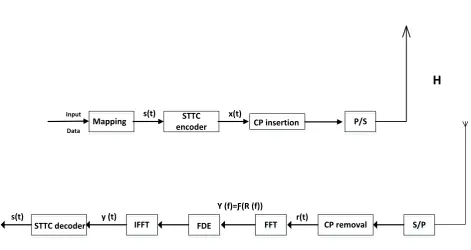
into parallel bits, and the cyclic prefix (CP) inserted into the blocks of bits, as shown in Figure 1. The prefixed data stream is grouped (L-blocked) into serial combination and sent through the channel. This explains the simplicity of the single-carrier block transmission at the transmit side [10] [16]. In combining with STTC, the output streams from the encoder are appended with the cyclic prefix, which must be longer than the channel delay spread. These N + L streams of data are sent through the wireless channel after parallel conversion.
Assuming s(t) was encoded into nt streams of data x(t) expressed as
( )
[
]
1 1 1
0 1
2 2 2
0 1 0 1
0T 1T T
t
t t
N N N
t
x x x
x x x
X t X X X
x x x
= =
(9)
and when appended with CP of length L becomes
1 1 1 1
1 0 1
2 2 2 2
1 0 1
t t
t t
x x x x
x x x x
− −
…
(10)
At the receiver, the received signal is given by
( ) ( )
1
n
j i j
t i ij t t
r =
∑
= h t x t +η
(11)where j
(
=1, 2,)
is the number of receive antennas, j tη
is the effective SNR additive white Gaussian noise at time t of antenna j; i( )
t
x t is the transmitted signal from i number of transmit antenna; h tij
( )
is the complex channelcoef-ficient. By considering the channel to be slowly fading, then Equation (11) can be written as
[ ]
CP i
R=H X +
η
(12)STTC
encoder CP insertion P/S
Mapping Input Data x(t)
H
S/P S/P r(t)Y (f)=Ƒ(R (f)) FFT
FFT CP removal
FDE IFFT
STTC decoder y (t) s(t)
[image:4.595.63.535.458.708.2]s(t)
DOI: 10.4236/cn.2017.93011 168 Communications and Network
where HCP is a block-wise circulant square matrix of size T × T in the form:
( )
(
)
(
)
( )
( )
( )
(
)
( )
(
)
(
)
( )
0 1 2 1
1 0 1 2
1 2 0
CP
H H L H L H
H H H L H
H
H L H L H
− −
−
=
− − …
(13)
Obtaining the singular value decomposition, HCP becomes H
CP Λ
, where
CP
Λ is a diagonal matrix whose elements are obtained by a block-wise FFT of
( ) ( )
0 1(
1)
H H H L−
, is the Discrete Fourier Transform (DFT)
ma-trix.
( )
2π1
0 e
j kl
L T
CP l H l
− − =
Λ =
∑
(14)The eigenvectors of HCP are independent of channel matrices H(l) [7], ΛCP
bears the full information of the channel which the FFT operation requires. Ap-plying FFT operation on the received vector, we have
( )
( )
CP( )
[( )
Y f =R f = Λ X f +
η
f (15)Performing equalization using the minimum mean square, which minimizes the mean square error between the estimated and received symbols, and assum-ing an MMSE equalizer coefficient, we write Equation (15) as
CP w
y=
ρ
WH X +η
(16)where
ρ
is the signal-to-noise ratio, W is the equalizer coefficient, and ηw,noise as a result of equalization. Performing inverse FFT on Equation (16) re-sults
( )
1 1 1 1
CP w
F− y =F− ρWH F x− +F−η (17)
which is consistent with [17].
4. Simulation Results
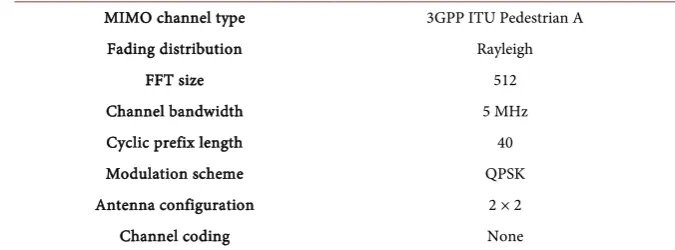
[image:5.595.200.538.583.708.2]The Bit Error Rate (BER) evaluation of the combined model over spatially cor-related Rayleigh fading channels was done. Table 1 shows the parameters used for simulation.
Table 1. Major simulation parameters.
MIMO channel type 3GPP ITU Pedestrian A Fading distribution Rayleigh
FFT size 512
Channel bandwidth 5 MHz
Cyclic prefix length 40
Modulation scheme QPSK
Antenna configuration 2 × 2
Channel coding None
DOI: 10.4236/cn.2017.93011 169 Communications and Network
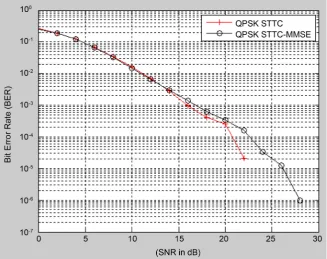
It was observed from the results shown in Figure 2 that for the same condi-tions and low SNR; that is, SNR ≤ 15 dB, the BER performances of basic STTC and STTC-FDE using MMSE systems were virtually the same. However, BER performance improves marginally as the channel becomes noisy for STTC-FDE as compared to the basic STTC. This result demonstrates that although it is possible to achieve higher level of coding gain with trellis coding alone, but in wireless communication systems targeting at broadband and mobile transmis-sions commonly face the challenge of fading channels that are both time and frequency selective, the use of space-time coding with equalization in the fre-quency domain improves the performance of the systems.
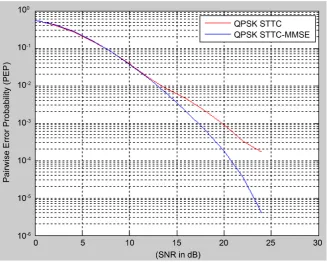
Figure 3 shows the average pairwise error probability (PEP) of basic STTC and STTC-FDE using MMSE. Minimum PEP results in space-time code when the Euclidean distance is maximized. It was observed that at low SNR, the PEP was high in both systems. At high SNR (i.e. SNR ≥12 dB), the PEP was reduced for both STTC-MMSE. The diversity order played a key role in obtaining the PEP. It was observed that the plot of STTC-MMSE gradually slopes down from a low SNR to high SNR. For the STTC, PEP gap was maintained evenly. At BER =
10−4, the PEP obtained for STTC-MMSE had a gain of 6 dB compared to the
STTC.
[image:6.595.210.538.445.704.2]The operation of having to decode the transmitted symbol in the time domain could explain the gain. The probability that the decoder would select an errone-ous signal was low due to the fact that equalization and the FFT/IFFT operations were carried out before the STTC decoding. More studies are continuing on large antenna configuration.
DOI: 10.4236/cn.2017.93011 170 Communications and Network
Figure 3. Average PEP-SNR performance plot of STTC and STTC-MMSE.
5. Conclusion
This paper has examined the performance of wireless communication when space-time trellis code is combined with Equalization in single-carrier transmis-sion. In combining the two techniques, it was observed that BER increases mar-ginally for STTC-MMSE compared to the basic STTC. Pairwise Error Probability shows an improved performance of STTC-MMSE over the traditional STTC. The error analysis obtained shows the viability of implementing a combination of diversity with frequency equalization in wireless communication.
References
[1] Coon, J. and Beach, M. (2002) An Investigation of MIMO Single-Carrier Frequen-cy-Domain MMSE Equalization. Centre for Communications Research, University of Bristol.
[2] Falconer, D.D. and Ariyavisitakul, S.L. (2002) Broadband Wireless using Single Carrier and Frequency Domain Equalization. International Conference on Wireless Personal Multimedia Communications, 27-36.
https://doi.org/10.1109/WPMC.2002.1088127
[3] Gmini, L.J. (1985) Analysis and Simulation of a Digital Mobile Channel using Or-thogonal Frequency Division Multiplexing. IEEE Transaction on Communication, 33, 665-675. https://doi.org/10.1109/TCOM.1985.1096357
[4] Kolawole, M.O. (2013) Satellite Communication Engineering. CRC Press, New York.
DOI: 10.4236/cn.2017.93011 171 Communications and Network [6] Foschini, G.J. and Gans, M.J. (1998) On Limits of Wireless Communications in a Fading Environment When using Multiple Antennas. Wireless Personal Commu-nication, 6, 311-335. https://doi.org/10.1023/A:1008889222784
[7] Clerckx, B. and Oestges, C. (2007) MIMO Wireless Communication: From Real- World Propagation to Space-Time Code Design. Academic Press, Oxford.
[8] Tarokh, V., Seshadri, N. and Calderbank, A.R. (1998) Space-Time Codes for High Data Rate Wireless Communication: Performance Criterion and Code Construc-tion. IEEE Transactions on Information Theory, 44, 744-765.
https://doi.org/10.1109/18.661517
[9] Pancaldi, F., Vitetta, G.M., Kalbasi, R., Al-Dhahir, N., Uysal, M. and Mheidat, H. (2008) Single-Carrier Frequency Domain Equalization—A Focus on Wireless Ap-plications. IEEE Signal Processing Magazine, 25, 37-56.
https://doi.org/10.1109/MSP.2008.926657
[10] Yune, T.N., Seol, D.Y., Kim, D. and Im, G.H. (2010) Single-Carrier Frequency Do-main Equalization for Broadband Cooperative Communications. Cooperative Communications for Improved Wireless Network Transmission: Framework for Virtual Antenna Array Applications, 399.
[11] Sibille, A., Oestges, C. and Zanella, A. (2011) MIMO: From Theory to Implementa-tion. Academic Press, Oxford.
[12] Chockalingham, A. and Rajan, B.S. (2014) Large MIMO Systems.Cambridge Uni-versity Press, New York.
[13] Rassool, B.A., Heliot, F., Revelly, L., Dohler, M., Nakhai, R. and Aghvami, H. (2003) Fast Search Techniques for Obtaining Space-Time Trellis Codes for Rayleigh Fading Channels and Its Performance in CDMA Systems. Proceedings of IEEE Vehicular Technology Conference, 1, 66-69. https://doi.org/10.1109/VETECS.2003.1207503
[14] Hong, Y. and Fàbregas, A.G. (2006) New Space-Time Trellis Codes for Slow Fading Channels. Proceedings of IEEE Vehicular Technology Conference, 3, 1492-1496.
https://doi.org/10.1109/VETECS.2006.1683084
[15] Jafarkhani, H. (2005) Space-Time Coding, Theory and Practice. Cambridge Univer-sity Press, New York. https://doi.org/10.1017/CBO9780511536779
[16] Falconer, D., Ajra, H., Hasan, Z., Ariyavisitakul, S.L., Benyamin-Seeyar, A. and Eidson, B. (2002) Frequency Domain Equalization for Single-Carrier Wireless Sys-tems. IEEE Communications Magazine, 40, 58-66.
https://doi.org/10.1109/35.995852
Submit or recommend next manuscript to SCIRP and we will provide best service for you:
Accepting pre-submission inquiries through Email, Facebook, LinkedIn, Twitter, etc. A wide selection of journals (inclusive of 9 subjects, more than 200 journals)
Providing 24-hour high-quality service User-friendly online submission system Fair and swift peer-review system
Efficient typesetting and proofreading procedure
Display of the result of downloads and visits, as well as the number of cited articles Maximum dissemination of your research work
Submit your manuscript at: http://papersubmission.scirp.org/