COATING OF CAFFEINE TABLETS BY USING TWO AQUEOUS
FILM COATING FORMULATIONS UNDER SPECIFIC PROCESS
PARAMETERS: A COMPARATIVE STUDY
Md Abul Haider Shipar*
Toronto Institute of Pharmaceutical Technology, Toronto, Ontario, Canada M1P 4X4.
ABSTRACT
Caffeine (65mg) tablets have produced by standard procedure. By
using two aqueous film coating formulations, the uncoated tablets have
been tested for the suitability of the coating process. Affect of the
coating process on tablet properties has been observed under specific
parameters during the coating process. The result reveals that caffeine
tablets, produced and used in the present study, are suitable for the
coating process under the specific process parameters. The
disintegration time of uncoated tablets increases for applying both of
the formulations. To achieve the specific weight gain, the formulation
containing HPMC E6, Propylene glycol, FD&C Yellow # 5 and
deionised water has been assumed taking more time than another one
containing HPMC E50, PEG 6000, FD&C Yellow # 5 and deionised water.
KEYWORDS Caffeine tablets; Aqueous film coating; Coating formulation; Coating process parameters.
1. INTRODUCTION
Nowadays, tablets are the most popular dosage form in use. Tablets comprise ease of
manufacturing, convenience in administration, accurate dosing and stability compared to oral
liquids, tamper-proofness compared to capsules, and safety compared to parenteral dosage
forms.[1] Tablets are usually coated by using coating materials. The purpose of coating is to mask unpleasant taste or odour of tablets, enhance stability of tablets against light and
moisture, produce an elegant product, or impart a functional purpose such as the modification
of drug release profiles, provide identity to products, improve swallowability, and allow
higher packaging speeds by reducing friction as well as reducing dust generation.[2,3] The
Volume 6, Issue 2, 1218-1228. Research Article ISSN 2277– 7105
*Corresponding Author
Dr. Md Abul Haider
Shipar
Toronto Institute of
Pharmaceutical Technology,
Toronto, Ontario, Canada
M1P 4X4. Article Received on 20 Dec. 2016,
Revised on 10 Jan. 2017, Accepted on 30 Jan. 2017
coating material is applied to the exterior of a tablet with the intention of conferring benefits
and properties the dosage form over the uncoated variety. In film coating, spraying of a
solution of polymer, pigments and plasticizers on to a rotated, mixed tablet bed forms a thin,
uniform film on tablet surface.[4,5] Film coating is performed by two types: aqueous film coating, in which water is used generally as a solvent, and non aqueous film coating, in which
organic solvents are generally used as solvent.[4,5] Among these two types, the first one is more preferable as the second one is associated with safety, atmospheric pollution, etc.[4,5] Aqueous film coating is applied as a thin polymeric film to the surface of a tablet.[4] Three primary components are involved in tablet coating which are tablet properties, coating
process and coating formulation.[4-6] The quality of the final coated product depends mainly upon these components.[4-14] The tablets that are to be coated must possess the proper physical characteristics.[4-6] By careful selection of uncoated tablets that to be coated, quality of the final coating tablets can partially be controlled. The parameter or variable inputs to a
film coating process derived from differences in equipment installations include but are not
limited to inlet air volume, temperature and humidity, coating pan dimensions and rotating
speed, numbers and distance between spray guns, distance between spray guns and tablet bed,
atomizing air pressure, spray rate of the coating solution, nozzle orifice size, etc.[6-14] Therefore, these parameters, relevant to the coating process, should carefully be controlled
for acceptable quality of the final coating tablets. The coating formulation, however, should
select carefully which requires extensive effort to apply and is, therefore, time consuming.
Coating formulation typically comprises polymer, plasticizer, colorants and solvents.[4,5] Because of a number of key features and advantages, hydroxypropylmethylcellulose
(HPMC), which are cellulose ethers, swellable and hydrophilic polymers, have been
identified as the most popular film formers, and are used as viscosity enhancing agents.[15] They may be used as the basic for hydrophilic matrices for controlled release oral delivery.[16] The manufacture of tablets requires numerous excipients with different functions, several of
them covered by polyglycols (PEGs).[17] Solid PEGs are also frequently used as plasticizers in tablet coatings.[18] Propylene glycol, which is a clear, colorless and hygroscopic liquid, may also be used as a plasticizer in tablet formulations.[19] caffeine (1,3,7-trimethylxanthine), which is one of the most frequently ingested pharmacologically active substance, is a central
nervous system stimulant and is a natural alkaloid found in the leaves and seeds of many
study. In the present study, caffeine tablets are produced and coated by using two aqueous
film coating formulations to test the suitability of coating and affect of the formulations on
the tablets under specific tablet and coating process parameters.
2.1. MATERIALS
All chemicals, used in the present study, were approved only for training purposes.
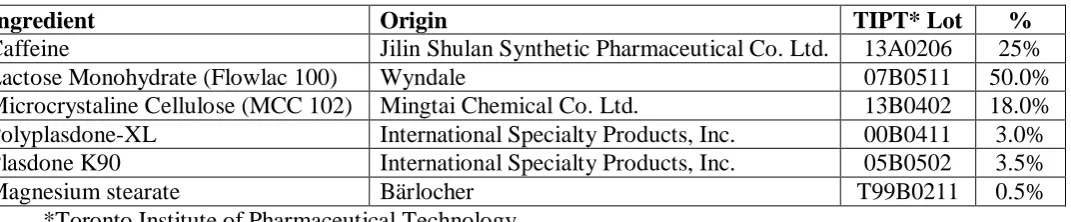
Formulation ingredients used for the production of caffeine granules are presented in Table 1. After granulation, magnesium stearate (MgSt) was used to lubricate the granules. Two coating formulations, i.e. Coating Formulation–1 and Coating Formulation–2 were used to
obtain the coating solutions. Formulation ingredients used for producing the coating solutions
are presented in Table 2.
2.2. METHODS
All methods were performed according to the Good Manufacturing Practices (GMP).[25] During the tablet production (granulation, lubrication and compression) and coating process
(coating solution preparation and coating), the temperature, relative humidity and air pressure
of the station were maintained at 20°±2°C, 20% – 40%, and >5 Pascal, respectively.
2.2.2. Granulation
Except the lubricant (MgSt), all other ingredients (caffeine, Flowlac 100, MCC 101,
Polyplasdone–XL and Plasdone K90) [Table 1] were firstly dry blended by using a twin shell
V-blender (The Patterson – Kelley Co. Inc., USA; TIPT* ID # PE95002) for 20 minutes.
40% of the binder (Plasdone K90) was used in this blend. The resulting dry blend was then
used for low shear wet granulation by using a Hobart Planetary Granulator (Toronto Institute
of Pharmaceutical Technology (TIPT) ID # PE9600). The calculated 60% void volume of the
dry blend was used as the volume of deionised water to prepare binder solution with the rest
of the 60% of the binder (Plasdone K90). The concentration of the binder solution was
calculated as 10.8%. 55ml deionised water was used as extra during the wet massing to reach
the capillary stage. After reaching the capillary stage in the wet granulation, the granules
were then passed through a Mesh 10 screen of Manesty Rotogram Granulator 184 TBS (Mark
III, England; TIPT ID # PE00002). The screened granules were then transferred into a dryer
(Gruenberg, Gruenberg Oven Co., Inc., USA; TIPT ID # PE94001), and dried until the
moisture content was reached at 2 – 3%. The dry granules were sieved with a Ro-Tap shaker
18 (1000µm), 30 (590µm), 40 (420µm) and 60 (250µm) (USA Standard Testing Sieve,
A.S.T.M. E – 11 Specification, VWR Scientific, USA).
2.2.3. Lubrication
Granules of Mesh 14, 18, 30, 40 and 60 were mixed together properly and blended with 0.5%
MgSt by using the twin shell V-blender for 3 minutes.
2.2.4. Compression
A Stokes B2 round tablet press (Manesty Betapress, F.J. Stokes Corporation, USA; TIPT ID
# PE9500) with 16 stations and 9mm round standard concave tooling was used for the
compression process. 50g of the granule was used for set-up, i.e. manual run without feed
frame, manual run with feed frame and automatic run with feed frame. Then, the final tablet
production was carried out. During the final tablet production, the following tablet parameters
were followed: tablet weight: 324 ± 10.5mg, tablet hardness: 8 Strong-Cobb Units (SCU) ±
3.0% and tablet dimension: 9mm diameter. Compression pressure was kept fixed (1.5 – 2.2
tons) for the whole period of the final tablet production. The lot of the produced tablets was
collected in three bins at a time interval of 1.0 minute. To remove excess powder on the
surface, the produced tablets were dedusted by using a deduster (KEY Industries, USA; TIPT
ID # D4005). With 10 tablets for each collected randomly during the final tablet production,
In-Line Tests were done for the tablet weight by using an electronic digital balance (Precisa
Instruments Ltd., Switzerland; TIPT ID # WS04003), tablet thickness, and hardness by using
a hardness tester (Pharma Test, Germany; TIPT ID # TE0901).
After the final production, visual inspection was performed to find out and remove defective
tablets. To pass the produced tablets for further processing, friability test[26] was performed for each of the three bins by using a friability tester (Scepter, Canada; TIPT ID # QC95/008).
Six tablets were also collected from each of the three bins to determine the disintegration
time[27] by using a tablet disintegration tester (HAAKE W13, Vankel, USA; TIPT ID # 94001). The tablets of the three bins were then mixed together and divided into two parts of
500g each for coating with Coating Formulation–1 and Coating Formulation–2 (Table2).
2.2.5. Coating solution preparation
Coating Formulation–1 (CF–1): Out of 96.3% (Table 2), ≈60% of deionised (DI) water of
the formulation was heated to 70°C – 80°C. 2.5% HPMC E50 of the formulation was
to medium speed. The resulting solution was then cooled down at ≈50°C and 1.0% PEG 6000
of the formulation was added by the ease of the Starrier. The solution was cooled down at
room temperature (≈20°C) and 0.2% FD&C Yellow # 5 of the formulation was added by using the Starrier. The rest of ≈40% of DI water of the formulation was then added, and the
solution was kept in the In-Process area for 24 hours with proper labelling.
Coating Formulation–2 (CF–2): ≈60% of DI water out of 93.6% of the formulation (Table 2)
was heated to 70°C – 80°C, and 4.0% HPMC E6 of the formulation was dispersed in it
gradually by using the Starrier accordingly. 0.4% FD&C Yellow # 5 of the formulation was
added to the solution after cooling it down at room temperature (≈20°C). 2.0% Propylene
glycol of the formulation was then added to the resulting solution slowly. The rest of ≈40%
of DI water of the formulation was heated to ≈50°C and then added to the solution gradually.
The prepared coating solution was kept in the In-Process area for 24 hours with proper
labelling.
2.2.6. Coating process
During the coating process, the following specifications were maintained: inlet air (Campbell
Housfeld AN95001, TIPT ID # AN96003) temperature: 65°C – 75°C, inlet air velocity: 0.5 –
2.0 m/s, inlet air relative humidity: >40%; exhaust setting (HEPA filter, Ereweka ER5002,
TIPT ID # PD964006): medium; tablet bed temperature: 55°C – 65°C; coating pan (Ereweka
AR400; TIPT ID # PE95004) speed: 3 – 10 RPM; atomizing air (Campbell Housfeld
AN9500, TIPT ID # PE95005) pressure: 30 – 40 psi; spray rate of spray gun (Campbell
Housfeld DH5800-F0510, TIPT ID # PE95009): 2 – 6g/min., distance between spray gun
nozzle and tablet bed: 20 – 30 cm, coating efficiency: 70%, and weight gain: 3%.
Uncoated tablets, selected for coating with CF–1 and CF–2 (500g uncoated tablets for each),
were preheated firstly in the coating pan at ≈50°C, and then 10 tablets were collected
randomly to get the initial weight for determining % weight gain per 15 min. time interval
during the coating process. The whole system of the coating process and parameter was
specified and maintained accordingly, and then, the coating process was started, and finished
when the % weight gain reached at ≈3%. By continuing the rotation of the coating pan, the
coated tablets were cooled down at room temperature gradually to avoid defects of the coated
tablets. Six tablets were collected randomly and separately from the tablets coated with CF–1
3. RESULTS
The weight, thickness and hardness of the uncoated caffeine tablets, along with the average
[image:6.595.37.573.249.360.2]value (x ), are presented in Table 3. Table 4 represents the friability of the uncoated tablets along with the x values. Disintegration time of the uncoated tablets, along with the x values, is presented in Table 5, which also represents the disintegration time of coated tablets with CF–1 and CF–2. The % weight gain at a time interval of 15 min. during the coating process for CF–1 and CF–2 is presented in Table 6.
Table 1. Formulation ingredients used for producing caffeine granules.
Ingredient Origin TIPT* Lot %
Caffeine Jilin Shulan Synthetic Pharmaceutical Co. Ltd. 13A0206 25%
Lactose Monohydrate (Flowlac 100) Wyndale 07B0511 50.0%
Microcrystaline Cellulose (MCC 102) Mingtai Chemical Co. Ltd. 13B0402 18.0%
Polyplasdone-XL International Specialty Products, Inc. 00B0411 3.0%
Plasdone K90 International Specialty Products, Inc. 05B0502 3.5%
Magnesium stearate Bärlocher T99B0211 0.5%
*Toronto Institute of Pharmaceutical Technology
Table 2. Formulation ingredients used for producing coating solutions [Coating Formulation–1 (CF–1) and Coating Formulation–2 (CF–2)].
Ingredient Origin TIPT Lot# CF–1 CF–2
HPMC E50 The Dow Chemical Co., Midland 07B0109 2.5% –
HPMC E6 The Dow Chemical Co., Midland 07B0107 – 4.0%
PEG 6000 Stepan Company, Northfield T97B103 1.0% –
Propylene glycol Van Waters & Rogers Ltd. 00B0911 – 2.0%
FD&C Yellow # 5 Warner Jenkinson Ltd., Canada AM2645 0.2% 0.4%
Deionised water – – 96.3% 93.6%
Table 3: Tablet weight, thickness and hardness of the uncoated caffeine tablets. Tablet
no.
Weight (mg) Thickness (mm) Hardness (SCU)
Bin 1 Bin 2 Bin 3 Bin 1 Bin 2 Bin 3 Bin 1 Bin 2 Bin 3
1 330 327 325 4.66 4.56 4.51 7.3 8.3 6.9
2 322 326 331 4.60 4.51 4.55 7.5 8.1 8.3
3 328 330 330 4.51 4.60 4.43 8.0 7.5 7.9
4 328 321 325 4.55 4.65 4.48 8.2 7.3 8.1
5 326 330 330 4.55 4.46 4.50 7.7 7.3 7.9
6 328 330 322 4.50 4.50 4.60 8.0 8.1 8.1
7 325 321 321 4.62 4.51 4.61 8.0 7.9 7.8
8 324 329 320 4.49 4.51 4.55 7.9 7.8 8.1
9 326 322 321 4.51 4.58 4.48 7.8 8.0 7.9
10 324 321 330 4.53 4.50 4.50 8.1 7.5 8.1
Table 4: Friability of the uncoated caffeine tablets. Bin # Initial sample weight (g) Final sample weight (g) Weight variation (%)
1 6.75 6.73 0.29
0.447
2 6.68 6.65 0.45
3 6.70 6.66 0.60
Table 5: Disintegration time (min.) of the uncoated and coated with Coating Formulation–1 (CF–1) and Coating Formulation–2 (CF–2) caffeine tablets.
Tablet #
Uncoated Coated
Bin 1 Bin 2 Bin 3 CF–1 CF–2
1 14.9 10.4 12.2 16.3 16.8
2 11.5 12.7 15.0 15.5 22.1
3 10.8 12.1 11.6 18.1 20.3
4 12.3 11.1 10.2 15.2 18.9
5 10.3 10.7 11.4 14.9 21.8
6 11.8 14.0 12.1 16.7 18.8
x 11.94 11.84 12.08 16.1 19.8
Table 6: % Weight gain at a time interval of 15 min. during the coating process with Coating Formulation–1 (CF–1) and Coating Formulation–2 (CF–2).
Time (min.) CF–1 CF–2
1 0 0
2 0.06 0.76
3 0.11 1.16
4 0.18 1.25
5 1.15 1.68
6 1.42 1.91
7 1.65 2.95
8 2.05 3.06
9 2.39 –
10 2.66 –
11 2.88 –
12 2.96 –
13 3.08 –
14 – –
15 – –
4. DISCUSSION
According to Table 3 and Table 4, the produced caffeine tablets are suitable for the coating
process. The acceptable tablet weight loss during the friability test is ≥1%.[26] Tablet disintegration is the first step for a drug to become bioavailable.[25,27] The tablet must first disintegrate and discharge the drug to the body fluids. The drug in the disintegrated tablets
to be used locally in the gastrointestinal tract (GIT). In these instances, tablet disintegration
provides drug particles with a greater surface area for increased localized activity. From
Table 5, it is obvious that the disintegration time of uncoated tablets increases by applying the coating formulations CF–1 than CF–2, which is higher for CF–2 than CF–1. The increase in disintegration time for CF–1 and CF–2 are found as ≈34.7% and ≈65.7%, respectively. This may due to the difference between formulation ingredients. However, both
of the formulations can be used for delayed drug release and CF–2 is assumed to be more efficient than CF–1 in this aspect. Table 6 indicates that the coating process takes more time
to achieve the specific weight gain for CF–2 than CF–1. No weigh gain is achieved for the initial stage of the coating process (Table 6). The total time required for achieving the
specific weight gain (≈3%) with CF–1 and CF–2 are about 13.0 min. and 8.0 min., respectively. Therefore, CF–1 takes more time to achieve the specific weight gain than that of CF–2. This may be due to the presence of more DI water in CF–1 than CF–2, which may
be inconsistent with the nature of caffeine to be spread over the tablet surface. Presence of
PEG 6000 in CF–1 may take more time to spread and evaporate than Propylene glycol present in CF–2. HPMC E50 of CF–1 and HPMC E6 of CF–2 may have some impact on this
aspect. Profound data on these aspects are still unavailable, and therefore, it is difficult to
explain. Moreover, the time required for completing the coating process also depends on
batch size or load of tablets.
5. CONCLUSION
Caffeine tablets, produced and used in the present study, have been found as disintegrated
gradually when coated with CF–1 involving HPMC E50, PEG 6000, FD&C Yellow # 5 and
DI. The disintegration time increases more for coating with CF–2 involving HPMC E6, Propylene glycol, FD&C Yellow # 5 and DI. Therefore, in the case of caffeine tablets, CF–2
is assumed more efficient than CF–1 for delayed drug release. Film coating technology has become very important, particularly in formulation development. Many factors must be well
thought-out during film coating process. However, sufficient information on these factors,
especially affect of coating formulation on coating properties, are still not available, resulting
lacking of proper understanding of the process. Further studies are, therefore, required to find
out proper explanation about the affect of various factors on coating process. The findings of
the present observation will be helpful to design further studies for the production of
eminence coated tablets with specificity to overcome disadvantages of conventional uncoated
REFERENCES
1. Bastos MdeO, Friedrich RB, Beck RCR. Effects of filler-binders and lubricants on
physicochemical properties of tablets obtained by direct compression: A 22 factorial design. Lat Am J Pharm. 2008; 27: 578-83.
2. Ratnaparakhi MP, Chaudhari SP, Dhage KE, Dhiwar SB, Bhore SS. Optimization of
coating formula and critical process parameter for aqueous film coating of tablet. Int J
Res Pharm Biomed Sci. 2012; 3: 1488-1496.
3. Cahyadi C, Heng PWS, Chan LW. Optimization of process parameters for a
Quasi-Continuous tablet coating system using design of experiments. AAPS Pharm Sci Tech.
2011; 12: 119-131.
4. Parmar KD, Bhatt NM, Pathak NL, Patel LD, Kela AN, Nathani HS, Chauhan VV. An
overview: Aqueous film coating technology on tablets. Int J Pharm Chem Sci. 2012; 1:
645-652.
5. Cole G. Pharmaceutical coating technology. 3rd ed., London; Taylor and Francis Ltd.; 1998; 1-5.
6. Ankit G, Ajay B, Kumar KM, Neetu K. Tablet coating techniques: concepts and recent
trends. Int Res J Pharm. 2012; 3: 50-58.
7. Rantanen J, Känsäkoski M, Suhonen J, Tenhunen J, Lehtonen S, Rajalahti T,
Mannermma J-P, Yliruusi J. Next generation fluidized bed granulator automation. AAPS
Pharm Sci Tech. 2000; 1: 26-36.
8. Cole GC, May G, Neale PJ, Ridgway K. The design and performance of an
instrumentation system for aqueous film coating in an industrial tablet coating machine.
Drug Dev Ind Pharm. 1983; 9: 909-944.
9. Yoakam DA, Campbell RJ. Modeling of a film coating system for computer automation.
Pharm Tech. 1984; 8: 38-44.
10.Franz RM, Doonan GW. Measuring the surface temperature of tablet beds using infrared
thermometry. Pharm Tech. 1983; 7: 55-67.
11.Porter SC, Verseput RP, Cunningham CR. Process optimization using design of
experiments. Pharm Tech. 1997; 21: 60-70.
12.Okutgen E, Jordan M, Hogan JE, Aulton ME. Effects of tablet core dimensional
instability of the generation of internal stresses within film coats. Part II: temperature and
relative humidity variation within a tablet bed during aqueous film coating in an
13.Pourkavoos N, Peck GE. Effect of aqueous film coating conditions on water removal
efficiency and physical properties of coated tablet cores containing superdisintegrants.
Drug Dev Ind Pharm. 1994; 20: 1535-1554.
14.Rege BD, Gawel J, Kou JH. Identification of critical process variables for coating actives
onto tablets via statistically designed experiments. Int J Pharm. 2002; 237: 87-94.
15.Nagargoje S, Phatak A, Bhingare C, Chaudhari S. Formulation and evaluation of
ophthalmic delivery of fluconazole from ion activated in situ gelling system. Der Pharm
Lett. 2012; 4: 1228-1235.
16.Hogan JE. Hydroxypropylmethylcellulose sustained release technology. Drug Dev Ind
Pharm. 1989; 15: 975-999.
17.Al-Nasassrah MA, Podczeck F, Newton JM. The effect of an increase in chain length on
the mechanical properties of polyethylene glycols. Eur J Pharm Biopharm. 1998; 46:
31-38.
18.Henning T. Polyethylene glycols (PEGs) and the pharmaceutical industry. Pharma Chem.
June 2002; 57-59.
19.Sullivan CJ. Propanediols. Ullmann's Encyclopedia of Industrial Chemistry. Weinheim;
Wiley-VCH; DOI: 10.1002/14356007.a22_163.
20.Murphy SJ, Benjamin CP. The effects of coffee on mouse development. Microbios Lett.
1981; 17: 91-99.
21.Dlugosz L, Bracken MB. Reproductive effects of caffeine: a review and theoretical
analysis. Epidemiol Rev. 1992; 14: 83-100.
22.Carrillo JA, Benitez J. CYP1A2 activity, gender and smoking, as variables influencing
the toxicity of caffeine. Brit J Clin Pharmaco. 1996; 41: 605-608.
23.Islam SMA, Shultana S, Sayeed MSB, Dewan I. UV-Spectrophotometric and RP-HPLC
methods for the simultaneous estimation of acetaminophen and caffeine: validation,
comparison and application for marketed tablet analysis. Int J Pharm. 2012; 2: 39-45.
24.Karmakar, P, Kibria MdG. In-vitro comparative evaluation of quality control parameters
between paracetamol and paracetamol/caffeine tablets available in Bangladesh. Int Curr
Pharm J. 2012; 1: 103-109.
25.Health Products and Food Branch Inspectorate, Good Manufacturing Practices (GMP),
Guidelines – 2009 Edition, Version 2 (GUI–0001). Health Canada. 2011
26.United States Pharmacopeia (USP): <1216> Tablet Friability, USP 32; May 1, 2009
(http://www.drugfuture.com/Pharmacopoeia/USP32/pub/data/v32270/usp32nf27s0_c121
6.html).
27.The United States Pharmacopeia Convention (Revision Bulletin) <701> Disintegration,
USP; 2008 (http://www.usp.org/sites/default/files/usp