A Thesis
Submitted to the Faculty of Purdue University by Diego Zamboni CERIAS TR 2001-42
Center for Education and Research in Information Assurance and Security,
A Thesis
Submitted to the Faculty of
Purdue University by
Diego Zamboni
In Partial Fulfillment of the Requirements for the Degree
of
Doctor of Philosophy
ACKNOWLEDGMENTS
As usual, a large number of people were very important for the completion of this thesis work, and I would like to acknowledge at least some of them.
First the official acknowledgments: Portions of the research contributing to this dis-sertation were supported by the various sponsors of CERIAS, and my stay at Purdue was partially funded by a Fulbright/Conacyt fellowship. Their support is gratefully acknowl-edged.
I would like to thank my advisor, Eugene Spafford. He received me with open arms from my first day at Purdue, and provided continuous guidance and support throughout my stay here. For that I am very, very grateful.
I would like to acknowledge the other members of my Ph.D. committee: Stephanie For-rest, Mikhail Atallah, Jens Palsberg and Carla Brodley. They provided invaluable feedback and advice for my work and for this dissertation.
students at CERIAS provided support for my work: Sofie Nystrom (who let me use her office), Kevin Du, Hoi Chang, Chapman Flack, Chris Telfer, and many others.
Substantial administrative, technical and logistic support were needed for the comple-tion of my work. The system administrators at CERIAS, Susana Soriano and Vince Koser, always maintained our computers up and running and kept up with my continuous requests and questions, even at times when what they really wanted to do was remove my account and get rid of me. All the administrative personnel at CERIAS, including Mary Jo Maslin, Lori Floyd, Paula Cheatham, Steve Hare and Andra Boehning, always gave me their sup-port. In particular, I would like to thank Marlene Walls, who tirelessly stayed on top of things at CERIAS to make sure everything was going as it should. Without her, my life (and the scheduling for seeing my advisor) would have been infinitely more complicated.
Before and throughout my stay at Purdue there were people who contributed to my ca-reer by inspiring, supporting, and challenging me. These include Gerardo Cisneros (who may not know it, but he was my main inspiration for pursuing a Ph.D.); my friends Rey-naldo Roel, Carlos Gonz´alez, Claudia Fajardo, Agust´ın and Adriana Casimiro, Luis and Claudia Graf, Luis and Carmen Teresa Mart´ınez and Eduardo Asbun, all of whom gave me so much support and friendship; Ivan Krsul, Christoph Schuba, Tanya Mastin, Kathy Price, Keith Watson and Robin Sundaram, who gave me a great welcome to the COAST laboratory and helped me through my first years at Purdue. Thank you all.
Who I am is a result of my formation, and for that I have to thank my family. My parents, Laura Zamboni and Gilberto De La Rosa, and my sisters, Ana, Daniela and In´es, have been an inexhaustible source of inspiration, support, advice, and happiness.
TABLE OF CONTENTS
Page
LIST OF TABLES . . . ix
LIST OF FIGURES . . . xi
LIST OF DEFINITIONS . . . xiii
ABSTRACT . . . xiv
1 INTRODUCTION . . . 1
1.1 Background and problem statement . . . 1
1.2 Basic concepts . . . 2
1.2.1 Intrusion detection . . . 2
1.2.2 Desirable characteristics of an intrusion detection system . . . 3
1.3 Problems with existing intrusion detection systems . . . 5
1.4 Thesis statement . . . 5
1.5 Document organization . . . 6
2 RELATED WORK AND ARCHITECTURES FOR INTRUSION DETECTION 7 2.1 Data collection architectures . . . 7
2.1.1 Data collection structure: centralized and distributed . . . 10
2.1.2 Data collection mechanisms: direct and indirect monitoring. . . . 11
2.1.3 Data collection mechanisms: host-based and network-based . . . 14
2.1.4 Data collection mechanisms: external and internal sensors . . . . 16
2.2 Data analysis architectures . . . 21
2.3 Experiences in building a distributed intrusion detection system . . . 22
2.4 Comments about intrusion detection architectures . . . 25
Page
3 AN ARCHITECTURE FOR INTRUSION DETECTION BASED ON
INTER-NAL SENSORS . . . 29
3.1 Embedded detectors . . . 29
3.1.1 How embedded detectors work . . . 30
3.1.2 Relationship between internal sensors and embedded detectors . . 31
3.1.3 Stateless and stateful detectors. . . 33
3.1.4 Strengths and weaknesses of embedded detectors . . . 34
3.2 The ESP architecture . . . 35
3.2.1 Internal sensors and embedded detectors . . . 35
3.2.2 Per-host external sensors. . . 35
3.2.3 Network-wide external sensors . . . 35
3.3 Distinguishing characteristics of the ESP architecture . . . 36
3.3.1 Types of data observed. . . 36
3.3.2 Tighter coupling between event collection and event analysis . . . 37
3.3.3 Intrusion detection at the application and operating system level . 38 3.3.4 Size of the intrusion detection system . . . 38
3.3.5 Timeliness of detection . . . 39
3.3.6 Impact on the host . . . 39
3.3.7 Resistance to attack . . . 39
4 THE ESP IMPLEMENTATION . . . 41
4.1 Purpose of the implementation . . . 41
4.2 Specific and generic detectors . . . 41
4.3 Sources of information . . . 42
4.4 Implementation platform . . . 43
4.5 Reporting mechanism . . . 44
4.6 Methodology for implementation of detectors . . . 46
4.7 Applicability of CVE entries . . . 47
Page
4.9 Naming, testing and measuring detectors . . . 49
4.10 Relationships between detectors . . . 50
4.11 Recording information about sensors and detectors . . . 51
4.12 Case studies . . . 53
4.12.1 Embedded detectors for network-based attacks . . . 53
4.12.2 Embedded detectors for sendmail attacks . . . 60
4.13 Detectors implemented. . . 65
4.13.1 By vulnerable platform or program . . . 65
4.13.2 By implementation directory . . . 67
4.13.3 By size. . . 67
4.13.4 By type . . . 70
4.13.5 By data sources used. . . 72
4.13.6 By vulnerability type . . . 74
4.13.7 By detection and implementation rates . . . 77
4.14 Auxiliary components . . . 77
4.15 Comments about the ESP implementation . . . 80
5 TESTING THE ESP IMPLEMENTATION . . . 82
5.1 Performance testing . . . 82
5.1.1 Test design and methodology . . . 82
5.1.2 Results of the NetPerf test . . . 85
5.1.3 Results of the http load test . . . 88
5.1.4 Comparison and comments about the tests. . . 88
5.2 Detection testing . . . 93
5.2.1 Test design and methodology . . . 93
5.2.2 Results from the detection test . . . 97
5.2.3 Comments about the detection test. . . 109
6 CONCLUSIONS, SUMMARY AND FUTURE WORK . . . 112
Page
6.2 Summary of main contributions . . . 114
6.3 Future work . . . 115
LIST OF REFERENCES . . . 118
APPENDICES Appendix A: Detectors and Sensors Implemented . . . 129
Appendix B: The ESP Library . . . 147
Appendix C: A Taxonomy of Software Vulnerabilities . . . 149
LIST OF TABLES
Table Page
2.1 Classification of some existing intrusion detection systems by their data
analysis and data collection structure . . . 8
2.2 Classification of some existing intrusion detection systems by their data
collection mechanisms and data analysis structure . . . 9
2.3 Advantages and disadvantages of external sensors . . . 18
2.4 Advantages and disadvantages of internal sensors . . . 19
2.5 Comparison between centralized and distributed intrusion detection systems 23
4.1 Summary of network-related detectors implemented during the study phase 55
4.2 Summary of sendmail-related detectors implemented during the study phase 61
4.3 Information about the implementation of auxiliary mechanisms . . . 79
5.1 Summary of the parameters for the performance tests . . . 84
5.2 Statistics and analysis results for data from the NetPerf experiment . . . . 86
5.3 Statistics and analysis results for data from the http load experiment . . . 90
5.4 Number of attacks in each category for the detection tests . . . 97
5.5 Distribution of original ESP detectors that responded to the attacks in the
detection test . . . 99
5.6 Attacks detected by the original ESP detectors, by Krsul classification . . 100
5.7 Changes made during the detection test of the ESP implementation . . . . 102
5.8 Distribution of ESP detectors that responded to attacks after the changes
made during the detection test. . . 103
5.9 Attacks detected by the final ESP detectors, by Krsul classification . . . . 104
5.10 Confidence intervals for the detection rates of ESP detectors . . . 111
Table Page
A.2 List of generic detectors implemented . . . 144
LIST OF FIGURES
Figure Page
3.1 Example of embedded detector on vulnerable code . . . 30
3.2 Relationships and differences between internal sensors and embedded de-tectors . . . 32
3.3 Example of embedded detector on non-vulnerable code . . . 34
4.1 Example of the XML representation of detector information . . . 54
4.2 Distribution of specific detectors by vulnerable platform or program . . . 66
4.3 Distribution of detectors by implementation directory . . . 68
4.4 Distribution of detector sizes . . . 69
4.5 Distribution of number of contiguous code blocks per detector . . . 70
4.6 Graph of detector sizes by combination of the ESAM and BOCAM metrics 71 4.7 Distribution of detectors by type . . . 72
4.8 Distribution of detectors by type of data sources used . . . 73
4.9 Distribution of detectors by type of vulnerability . . . 75
4.10 Distribution of detectors by coverage . . . 78
4.11 Distribution of detectors by number of detectors they implement . . . 78
5.1 General setup for the performance tests of the ESP implementation . . . . 83
5.2 CPU utilization measurements from the NetPerf experiment. . . 85
5.3 Difference in mean CPU utilization between the system with and without detectors in the NetPerf experiment . . . 87
5.4 CPU utilization measurements from the http load experiment . . . 89
5.5 Difference in mean CPU utilization between the system with and without detectors in the http load experiment . . . 91
Figure Page
5.7 Total number of attacks that would have been detected by the original
de-tectors and by the dede-tectors after the changes . . . 99
5.8 Distribution of attacks in the detection test by Krsul categories . . . 105
5.9 Percentages of attacks detected (by Krsul category) by the original and final
detectors, plotted asx, ycoordinates . . . 106
5.10 Percentage of attacks detected by each detector, before and after the changes
made during the detection test . . . 107
5.11 Percentage of attacks detected by each detector before and after the changes
made during the detection test, plotted asx, y coordinates . . . 108
5.12 Comparison of the distribution of vulnerability types in the ESP detectors
LIST OF DEFINITIONS
Definition Page
1.1 Intrusion . . . 2
1.2 Intrusion detection . . . 2
1.3 Intrusion detection system . . . 3
2.1 Monitored component . . . 10
2.2 Centralized data collection . . . 10
2.3 Distributed data collection . . . 10
2.4 Direct monitoring . . . 11
2.5 Indirect monitoring . . . 12
2.6 Host-based data collection . . . 14
2.7 Network-based data collection . . . 14
2.8 External sensor. . . 16
2.9 Internal sensor . . . 17
2.10 Centralized intrusion detection system . . . 21
2.11 Distributed intrusion detection system . . . 21
3.1 Embedded detector. . . 29
3.2 Stateless embedded detector . . . 33
3.3 Stateful embedded detector . . . 33
4.1 Specific detector . . . 41
4.2 Generic detector . . . 41
ABSTRACT
Zamboni, Diego. Ph.D., Purdue University, August, 2001. Using Internal Sensors for Computer Intrusion Detection. Major Professor: Eugene H. Spafford.
This dissertation introduces the concept of using internal sensors to perform intrusion detection in computer systems. It shows its practical feasibility and discusses its character-istics and related design and implementation issues.
We introduce a classification of data collection mechanisms for intrusion detection sys-tems. At a conceptual level, these mechanisms are classified as direct and indirect monitor-ing. At a practical level, direct monitoring can be implemented using external or internal sensors. Internal sensors provide advantages with respect to reliability, completeness, time-liness and volume of data, in addition to efficiency and resistance against attacks.
We introduce an architecture called ESP as a framework for building intrusion detection systems based on internal sensors. We describe in detail a prototype implementation based on the ESP architecture and introduce the concept of embedded detectors as a mechanism for localized data reduction.
We show that it is possible to build both specific (specialized for a certain intrusion) and generic (able to detect different types of intrusions) detectors. Furthermore, we provide information about the types of data and places of implementation that are most effective in detecting different types of attacks.
1. INTRODUCTION
It is feasible to perform computer intrusion detection at the host level for both known and new attacks using internal sensors and embedded detectors with reasonable CPU and size overhead. The present document discusses this assertion in detail, and describes the work done to show its validity.
1.1 Background and problem statement
The field of intrusion detection has received increasing attention in recent years. One reason is the explosive growth of the Internet and the large number of networked systems that exist in all types of organizations. The increased number of networked machines has led to a rise in unauthorized activity [20], not only from external attackers, but also from internal sources such as disgruntled employees and people abusing their privileges for per-sonal gain [113].
In the last few years, a number of intrusion detection systems have been developed both in the commercial and academic sectors. These systems use various approaches to detect unauthorized activity and have given us some insight into the problems that still have to be solved before we can have intrusion detection systems that are useful and reliable in production settings for detecting a wide range of intrusions.
Most of the existing intrusion detection systems have used central data analysis en-gines [e.g. 32, 86] or per-host data collection and analysis components [e.g. 60, 112] that are implemented as separate processes running on one or more of the machines in a net-work. In their design and implementation, all of these approaches are subject to a number of problems that limit their scalability, reliability and resistance to attacks.
of data and behavior in a program. It can also be used to implement intrusion detection sys-tems that perform their task in near real-time, that are resistant to attacks and that impose a reasonably low overhead in the hosts, both in terms of memory and CPU utilization.
This dissertation describes the concept of using internal sensors for building an intru-sion detection framework at the host level, their characteristics and abilities, and experi-mental results in an implementation.
1.2 Basic concepts
First, we introduce some basic concepts on which this dissertation is based. 1.2.1 Intrusion detection
Intrusion detection has been defined as “the problem of identifying individuals who are using a computer system without authorization (i.e., ‘crackers’) and those who have legiti-mate access to the system but are abusing their privileges (i.e., the ‘insider threat’)” [93].
We add to this definition the identification of attempts to use a computer system without authorization or to abuse existing privileges. Therefore, our working definition of intrusion matches the one given by Heady et al. [59]:
WORKING DEFINITION1.1: INTRUSION
Any set of actions that attempt to compromise the integrity, confidentiality, or avail-ability of a computer resource.
This definition disregards the success or failure of those actions, so it also corresponds to attacks against a computer system. In the rest of this dissertation we use the terms attack and intrusion interchangeably.
The definition of intrusion results in our working definition of intrusion detection:
WORKING DEFINITION1.2: INTRUSION DETECTION
The problem of identifying actions that attempt to compromise the integrity, confi-dentiality, or availability of a computer resource.
phrase to use is intrusion and insider abuse detection. In this document we use the term intrusion to mean both intrusion and insider abuse.
WORKING DEFINITION1.3: INTRUSION DETECTION SYSTEM
A computer system (possibly a combination of software and hardware) that attempts to perform intrusion detection.
Most intrusion detection systems try to perform their task in real time [93]. However, there are also intrusion detection systems that do not operate in real time, either because of the nature of the analysis they perform [e.g. 76] or because they are geared for forensic analysis (analysis of what has happened in the past on a system) [e.g. 48, 147].
The definition of an intrusion detection system does not include preventing the intrusion from occurring, only detecting it and reporting it to an operator. There are some intrusion detection systems [e.g. 25, 135] that try to react when they detect an unauthorized action. This reaction usually includes trying to contain or stop the damage, for example, by termi-nating a network connection.
Intrusion detection systems are usually classified as host-based or network-based [93]. Host-based systems base their decisions on information obtained from a single host (usu-ally audit trails), while network-based systems obtain data by monitoring the traffic in the network to which the hosts are connected.
1.2.2 Desirable characteristics of an intrusion detection system
The following characteristics are ideally desirable for an intrusion detection system (based on the list provided by Crosbie and Spafford [34]):
1. It must run continually with minimal human supervision.
2. It must be fault tolerant:
(a) The intrusion detection system must be able to recover from system crashes, either accidental or caused by malicious activity.
3. It must resist subversion:
(a) There must be a significant difficulty for an attacker to disable or modify the intrusion detection system.
(b) The intrusion detection system must be able to monitor itself and detect if it has been modified by an attacker.
4. It must impose a minimal overhead on the systems where it runs to avoid interfering with their normal operation.
5. It must be configurable to accurately implement the security policies of the systems that are being monitored.
6. It must be easy to deploy. This can be achieved through portability to different ar-chitectures and operating systems, through simple installation mechanisms, and by being easy to use and understand by the operator.
7. It must be adaptable to changes in system and user behavior over time. For example, new applications being installed, users changing from one activity to another, or new resources being available can cause changes in system use patterns.
8. It must be able to detect attacks:
(a) The intrusion detection system must not flag any legitimate activity as an attack (false positives).
(b) The intrusion detection system must not fail to flag any real attacks as such (false negatives). It must be difficult for an attacker to mask his actions to avoid detection.
(c) The intrusion detection system must report intrusions as soon as possible after they occur.
We will refer to these characteristics throughout this dissertation for description of dif-ferent intrusion detection architectures and systems, including those developed for this dis-sertation.
1.3 Problems with existing intrusion detection systems
Most existing intrusion detection systems (for example, those surveyed by Axelsson [7], plus others [e.g. 9, 137]) suffer from at least two of the following problems:
First, the information used by the intrusion detection system is obtained from audit trails or from packets on a network. Data has to traverse a longer path from its origin to the intrusion detection system, and in the process can potentially be destroyed or modified by an attacker. Furthermore, the intrusion detection system has to infer the behavior of the system from the data collected, which can result in misinterpretations or missed events. We refer to this as the fidelity problem. It corresponds to a failure to properly address desirable characteristic #8.
Second, the intrusion detection system continuously uses additional resources in the system it is monitoring even when there are no intrusions occurring, because the compo-nents of the intrusion detection system have to be running all the time. This is the resource usage problem and corresponds to a failure in addressing desirable characteristic #4.
Third, because the components of the intrusion detection system are implemented as separate programs, they are susceptible to tampering. An intruder can potentially disable or modify the programs running on a system, rendering the intrusion detection system useless or unreliable. This is the reliability problem and corresponds to a failure to address desirable characteristics #1, #2 and #3.
In this dissertation, we describe a mechanism that addresses all three of these problems and has several other desirable characteristics.
1.4 Thesis statement
1. It is possible to use internal sensors in a host to perform intrusion detection in a way that addresses the fidelity, resource usage and reliability problems described in Section 1.3.
2. Internal sensors can be used to detect both known and new attacks against a host.
In this context, intrusion detection is used as defined in Section 1.2.1. Internal sensor is a concept defined in Section 2.1.4.
1.5 Document organization
2. RELATED WORK AND ARCHITECTURES FOR INTRUSION
DETECTION
Intrusion detection is conceptually—and in practice, in most cases—performed in two dis-tinct phases: data collection and data analysis. Intrusion detection systems can be classified according to how they are structured in each of those phases.
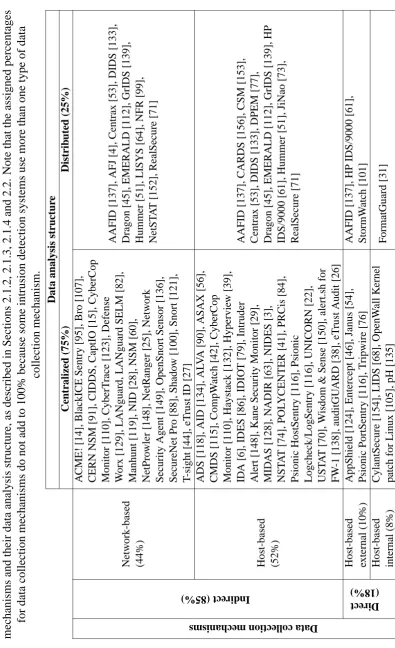
In this chapter, we describe the different structures that an intrusion detection system can have in both data collection and data analysis and draw some conclusions that guide the rest of this dissertation. We also mention related work as appropriate. Tables 2.2 and 2.1 summarize how different existing intrusion detection systems are classified according to some of the architectures described in this chapter.
2.1 Data collection architectures
ternal/internal) classifications of data collection mechanisms. We discuss the advantages and disadvantages of each one of them.
The term monitored component is used in this chapter and in the rest of this dissertation as follows:
WORKING DEFINITION2.1: MONITORED COMPONENT
A host or a program that is being monitored by an intrusion detection system. By this definition, an intrusion detection system that is explicitly monitoring several programs in a host (for example, the kernel, the email server and the HTTP server) could be considered as monitoring several components even if they are all in the same host. 2.1.1 Data collection structure: centralized and distributed
When talking about data collection architectures for intrusion detection, the classifica-tion normally refers to the locus of data collecclassifica-tion. The following definiclassifica-tions are based on those provided by Axelsson [7].
DEFINITION 2.2: CENTRALIZED DATA COLLECTION
Data used by the intrusion detection system is collected at a number of locations that is fixed and independent of the number of monitored components.
DEFINITION 2.3: DISTRIBUTED DATA COLLECTION
Data used by the intrusion detection system is collected at a number of locations that is directly proportional to the number of monitored components.
As can be seen in Table 2.1, both distributed and centralized data collection have been widely used in existing intrusion detection systems and have almost equal percentages in the systems listed in the table. A report by Axelsson [7] shows that the trend over the years has been towards distributed intrusion detection systems, which need distributed data collection.
The distinction between centralized and distributed data collection is the feature most commonly used for describing the data collection capabilities of an intrusion detection system. However, for the purposes of this dissertation, we are more interested in discussing the mechanisms used to perform data collection and the data sources utilized. These are described in the next sections.
2.1.2 Data collection mechanisms: direct and indirect monitoring
In the physical world, a direct observation is one in which we can use one or more of our senses to observe or measure a phenomenon, and an indirect observation is one in which we rely on a tool or on an observation by someone (or something) else to obtain the information.
We build similar definitions in the context of data collection for intrusion detection. When an intrusion detection system can measure a condition or observe behavior in the monitored component by obtaining data directly from it, we use the term direct monitoring. When the intrusion detection system relies on a separate mechanism or tool for obtaining the information, we use the term indirect monitoring. In other words, direct monitoring is the measurement or observation of a characteristic of an object, and indirect monitoring is the measurement or observation of the effects of the object having that characteristic.
For example, using the ps [146] command to observe CPU load on a Unix host is considered a case of direct monitoring because ps directly extracts the load data from the corresponding data structures in the kernel. By comparison, if the CPU load is recorded in a log file and later read from there, we consider it a case of indirect monitoring because we are relying on a separate mechanism (in this case, a file) for the observation.
DEFINITION 2.4: DIRECT MONITORING
The observation of the monitored component by obtaining data directly from it.
DEFINITION 2.5: INDIRECT MONITORING
The observation of the monitored component through a separate mechanism or tool.
Common examples of mechanisms through which indirect monitoring can be performed are log files and network packets. The data obtained from these mechanisms is an effect of the data having been present in the components that generated the data. If the data were obtained directly from the component that generated them (for example, by reading the appropriate data structures on the host before a packet is sent to the network), we would be performing direct monitoring.
To perform intrusion detection, direct monitoring is better than indirect monitoring for the following reasons:
Reliability: Data from an indirect data source (for example, a log file) could potentially be altered by an intruder before the intrusion detection system uses it. It could also be affected by non-malicious failures. For example, a disk becoming full or a log file being renamed could make the data unavailable to the intrusion detection system.
Completeness: Some events may not be recorded on an indirect data source. For example, not every action of the inetd daemon gets recorded to a log file.
Volume: With indirect monitoring, the data is generated by mechanisms (for example, the code that writes the audit trail) that have no knowledge of the needs of the intrusion detection system that will be using the data. For this reason, indirect data sources usually carry a high volume of data. For example, Kumar and Spafford [80] mention that a C2-generated audit trail might contain 50K-500K records per user per day. For a modest-size user community, this could amount to hundreds of megabytes of audit data per day, as pointed out by Mounji [92].
For this reason, when indirect data sources are used, the intrusion detection system has to spend more resources in filtering and reducing the data even before being able to use them for detection purposes.
A direct monitoring method has the ability to select and obtain only the informa-tion it needs. As a result, smaller amounts of data are generated. Addiinforma-tionally, the monitoring components could partially analyze the data themselves and only produce results when relevant events are detected. This would practically eliminate the need for storing data other than for forensic purposes.
Scalability: The larger volume of data generated by indirect monitoring results in a lack of scalability. As the number of hosts and monitoring elements grows, the overhead resulting from filtering data can cause degradation in the performance of the hosts being monitored or overload of the network on a centralized intrusion detection sys-tem.
Timeliness: Indirect data sources usually introduce a delay between the moment the data is produced and when the intrusion detection system can have access to them. Direct monitoring allows for shorter delays and enables the intrusion detection system to react in a more timely fashion.
the main disadvantage of direct monitoring: complexity of implementation. Direct moni-toring mechanisms have to be designed in a more specific manner to the monitored com-ponent and the type of information that it generates. Evidence to this is that most of the intrusion detection systems in Table 2.2 (except for CylantSecure [154] and pH [135]) that use direct monitoring are tailored for detecting specific types of attacks.
2.1.3 Data collection mechanisms: host-based and network-based
In practice, data collection methods are commonly classified as host-based or network-based according to the following definitions:
DEFINITION 2.6: HOST-BASED DATA COLLECTION
The acquisition of data from a source that resides on a host, such as a log file, the state of the system or the contents of memory.
DEFINITION 2.7: NETWORK-BASED DATA COLLECTION
The acquisition of data from the network. Usually done by capturing packets as they flow through it.
Most of the intrusions detected by intrusion detection systems are caused by actions performed in a host. For example: executing an invalid command or accessing a service and providing it malformed or invalid data. The attacks act on the end host although they may occur over a network.
can also be detected at the end hosts. For example, a Smurf attack [69] could be de-tected at the ICMP layer in the host by looking for the occurrence of a large number of ECHO RESPONSE packets.
In general, it is advisable to use host-based data collection for the following reasons (see also the discussion by Daniels and Spafford [37]):
• Host-based data collection allows collecting data that reflect accurately what is
hap-pening on the host, instead of trying to deduce it based on the packets that flow through the network.
• In high-traffic networks, a network monitor could potentially miss packets, whereas
properly implemented host monitors can report every single event that occurs on each host.
• Network-based data collection mechanisms are subject to insertion and evasion
at-tacks, as documented by Ptacek and Newsham [117]. These problems do not occur on host-based data collection because they act on data that the host already has.
• If the data needed by the intrusion detection system flows through disjoint paths (as
might be the case with a network with multiple gateways or when using switching hubs), performing network-based data collection can become difficult and unreliable, and the task of unifying the data coming from different collectors for use by the intrusion detection system may not be trivial.
• The use of encryption renders network-based data collection mechanisms ineffective
because they cannot examine the contents of encrypted communications.
• Network-based data collection mechanisms cannot observe actions that occur inside
a host, so they will miss local attacks.
Network-based data collection also has some advantages, including the following:
• An intrusion detection system that uses network-based data collection can be
this reason, a large number of commercial intrusion detection systems use network-based data collection.
• A network-based data collection component can be completely invisible to other
hosts (this can be achieved even at the hardware level), providing a convenient van-tage point from which to observe the actions on the network.
We consider network-based data collection as a form of indirect monitoring because the network traffic is an effect of the data and activity at the hosts (see Definition 2.5). In a more general sense, the advantages and disadvantages just described reflect the distinction between direct and indirect data collection.
The relationship between the traditional host-based/network-based classification of in-trusion detection systems [93] and the types of monitoring described in Section 2.1.2 is as follows and can be seen in Table 2.2: Intrusion detection systems normally considered as “network-based” correspond to Indirect/Network-based monitoring mechanisms, whereas Indirect/Host-based and all Direct monitoring mechanisms correspond to the “host-based” intrusion detection systems.
Both host-based and network-based data collection have been widely used in intrusion detection systems. In recent years, an increasing number of intrusion detection systems have started to use both host-based and network-based components in an attempt to obtain the most complete view of the hosts being monitored.
The architecture described in this dissertation corresponds to a system that uses host-based data collection.
2.1.4 Data collection mechanisms: external and internal sensors
All direct monitoring methods are host-based. Direct monitoring of a host can be done using external or internal sensors according to the following definitions:
DEFINITION 2.8: EXTERNAL SENSOR
DEFINITION 2.9: INTERNAL SENSOR
A piece of software that observes a component (hardware or software) in a host and reports data usable by an intrusion detection system, and that is implemented by code incorporated into that component.
For example, a program that uses the ps command [146] to obtain process information on a Unix system could be considered an external sensor. If the process-information gath-ering component was built into the Unix kernel, it would be considered an internal sensor. A library wrapper [81] is considered as an external sensor because its code is separate from that of the program it monitors. According to our definitions, an internal sensor could also be built into hardware components; for example, in the firmware of a network interface card.
Internal sensors are part of the source code of the monitored component. They can be added to an already existing program, and in that case they can be considered as a case of source code instrumentation. Ideally, internal sensors should be added during development of the program when the cost and effort of making changes and fixing errors is lower [108]. Also, at that point the sensors could be added by the original authors of the program instead of by someone else—who would have the added cost of understanding the program first.
Note that by our definitions, any portion of a program can be considered as an internal sensor, as long as it provides data that can be used by an intrusion detection system. No specification is made about how the data should be produced or transmitted.
External and internal sensors for direct data collection have different strengths and weaknesses and can be used together in an intrusion detection system. Tables 2.3 and 2.4 list the advantages and disadvantages of each type of sensor.
From the point of view of software engineering, internal and external sensors present different characteristics in the following aspects:
Table 2.3
Advantages and disadvantages of external sensors. External sensors
Advantages Disadvantages
• Easily modified, added or removed
from a host.
• Can be implemented in any
pro-gramming language that is appropri-ate for the task.
• There is a delay between the
genera-tion of the data and their use because after the data are produced they have to be made available on an exter-nal source before a sensor can access them.
• The information can potentially be
modified by an intruder before the sensor obtains it (for example, if the data are read from a log file).
• Can potentially be disabled or
modi-fied by an intruder.
• Added performance impact
be-cause the sensors are separate
components—processes, threads, or loaded libraries–possibly running continuously.
• Limited access to information
Table 2.4
Advantages and disadvantages of internal sensors. Internal sensors
Advantages Disadvantages
• Minimum delay between the
gen-eration of the information and its use because it can be obtained at its source.
• It is practically impossible for an
intruder to modify data to hide his tracks because data are never stored on an external medium before the sensor obtains them.
• Cannot be easily disabled or
mod-ified because they are not separate processes.
• Network traffic and processing load
are reduced because embedded sen-sors can look for specific pieces of information instead of reporting generic data for analysis. Also, they can partially analyze the data at the moment of acquisition.
• Embedded sensors do not cause a
continuous CPU overhead because they are only executed when re-quired. This makes it possible to in-corporate a larger number of sensors on a single host.
• Because they are implemented as
part of the program they are monitor-ing, they can access any information that is necessary for their task.
• Their implementation requires
ac-cess to the source code of the pro-gram that needs to be monitored.
• Arguably harder to implement
be-cause they require modifications to the program being monitored. How-ever, if the sensors are added dur-ing development of the program, this problem is reduced.
• Need to be implemented in the same
language as the program they are go-ing to monitor.
• If designed or implemented
incor-rectly, they can severely harm the performance or the functionality of the program they are part of.
• Harder to update or modify and to
port to different operating systems, or even to different versions of the same program.
• Reduced portability, because the
example, an agent that consumes an excessive amount of resources, or an interposed library call that incorrectly modifies its arguments). We claim that most internal sensors can be fairly small pieces of code. Their size allows them to be extensively checked for errors. Also, this problem would be reduced if sensors were added during development of the program instead of afterwards.
Maintenance: External sensors are easier to maintain independently of the program they monitor because they are not part of it. However, when internal changes to the pro-gram occur, it can be simpler to update internal sensors (which can be changed at the same time the program is modified) than external sensors (which have to be kept up to date separately).
Size: Internal sensors can be smaller (in terms of code size and memory usage) than exter-nal sensors because they become part of an existing program; thus, avoiding the base overhead associated with the creation of a separate process.
Completeness: Internal sensors can access any piece of information in the program they are monitoring whereas external sensors are limited to externally-available data. For this reason, internal sensors can have more complete information about the behavior of the monitored program. Furthermore, because internal sensors can be placed any-where in the program they are monitoring, their coverage can be more complete than that of an external sensor which can only look at the program “from the outside.”
Correctness: Because internal sensors have access to more complete data, we expect them to produce more correct results than external sensors, which often have to act based on incomplete data.
We can see in Table 2.2 that a small percentage of the intrusion detection systems sur-veyed use internal sensors and most of those were designed for detecting specific types of attacks—the two exceptions are CylantSecure [154] which uses internal sensors for collect-ing information analyzed externally, and pH [135], which fully implements data collection and detection using internal sensors, and is a good example of the potential of internal sen-sors. This can be attributed to the considerable difficulty in the implementation of internal sensors: the monitored components themselves have to be modified. On closed-source sys-tems, this is impossible unless the vendor provides the modifications, and on open-source systems it can be cumbersome and time consuming.
2.2 Data analysis architectures
Intrusion detection systems are classified as centralized or distributed with respect to how the data analysis components are distributed, as follows [137]:
DEFINITION 2.10: CENTRALIZED INTRUSION DETECTION SYSTEM
An intrusion detection system in which the analysis of the data is performed in a number of locations that is fixed and independent of the number of monitored com-ponents.
DEFINITION 2.11: DISTRIBUTED INTRUSION DETECTION SYSTEM
An intrusion detection system in which the analysis of the data is performed in a number of locations that is directly proportional to the number of monitored compo-nents.
Note that these definitions are based on the number of monitored components and not of hosts (as has been traditionally the case), so it is feasible to have an intrusion detection system that uses distributed data analysis within a single host if the analysis is performed in different components of the system.
because each running program will execute the analysis component separately. However, if the shared library will be linked against a single program and all the data analysis will occur there, we would consider it as centralized analysis. So we can see that these definitions depend not only on how the analysis components are implemented, but also on how they are used.
Both distributed and centralized intrusion detection systems may use host- or network-based data collection methods, or a combination of them.
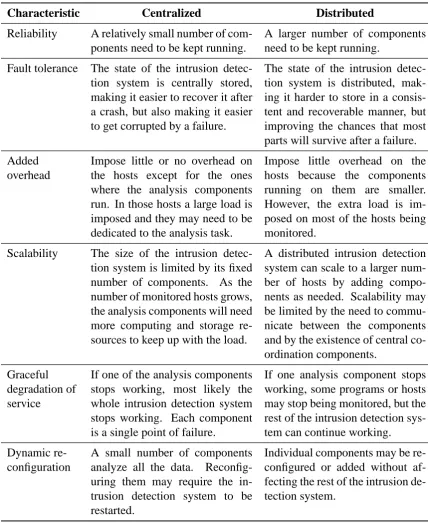
Some strengths and weaknesses of centralized and distributed intrusion detection sys-tems are shown in Table 2.5.
It can be observed from Table 2.1 that the vast majority of intrusion detection systems surveyed use centralized data analysis. This can be attributed to the difficulty in the imple-mentation of a distributed analysis mechanism.
Most weaknesses of distributed intrusion detection systems can be overcome through technical means whereas centralized intrusion detection systems have some fundamental limitations (for example, with respect to scalability and graceful degradation of service). In the last few years, an increasing number of distributed intrusion detection systems has been designed and built [e.g. 11, 66, 112, 137, 139].
2.3 Experiences in building a distributed intrusion detection system
AAFID [137] is a framework for distributed monitoring of hosts in a network specifi-cally oriented towards intrusion detection. It uses a hierarchical structure of entities. At the lowest level in the hierarchy, AAFID agents perform monitoring functions on a host and report their findings to the higher levels of the hierarchy where data reduction is performed. During the implementation of the AAFID system, we faced decisions regarding the type of monitoring to use, and we experienced the limitations of indirect monitoring and of external sensors. Even when trying to do direct monitoring, we encountered problems with the specific techniques used to perform it. These experiences prompted us to investigate new data collection techniques for intrusion detection.
Table 2.5
Comparison between centralized and distributed intrusion detection systems with respect to some of the desirable characteristics described in Section 1.2.2.
Characteristic Centralized Distributed
Reliability A relatively small number of
com-ponents need to be kept running.
A larger number of components need to be kept running.
Fault tolerance The state of the intrusion
detec-tion system is centrally stored, making it easier to recover it after a crash, but also making it easier to get corrupted by a failure.
The state of the intrusion detec-tion system is distributed, mak-ing it harder to store in a consis-tent and recoverable manner, but improving the chances that most parts will survive after a failure. Added
overhead
Impose little or no overhead on the hosts except for the ones where the analysis components run. In those hosts a large load is imposed and they may need to be dedicated to the analysis task.
Impose little overhead on the hosts because the components running on them are smaller. However, the extra load is im-posed on most of the hosts being monitored.
Scalability The size of the intrusion
detec-tion system is limited by its fixed
number of components. As the
number of monitored hosts grows, the analysis components will need more computing and storage re-sources to keep up with the load.
A distributed intrusion detection system can scale to a larger num-ber of hosts by adding compo-nents as needed. Scalability may be limited by the need to commu-nicate between the components and by the existence of central co-ordination components.
Graceful degradation of service
If one of the analysis components stops working, most likely the whole intrusion detection system stops working. Each component is a single point of failure.
If one analysis component stops working, some programs or hosts may stop being monitored, but the rest of the intrusion detection sys-tem can continue working.
Dynamic re-configuration
A small number of components
analyze all the data.
Reconfig-uring them may require the in-trusion detection system to be restarted.
Unix system and are the data source used by most intrusion detection systems. In the first implementation of the AAFID system, most of the agents obtained their data from log files. However, audit trails are an indirect data source and suffer from the drawbacks mentioned in Section 2.1.2.
To perform direct data collection appropriately, operating system support is needed, possibly in the form of hooks to allow insertion of checks at appropriate points in the system kernel and its services. Lacking this support, we implemented direct monitoring using the following mechanisms:
• Separate entities that run continuously, obtaining information and looking for
intru-sions and notable events.
This is the form of most existing AAFID agents. Some agents obtain information from the system by running commands (such as ps [146], netstat [144] or df [142]), others by looking at the state of the file system (for example, checking file permis-sions or contents) and others by capturing packets from a network interface (note that this is not necessarily the same as doing network-based monitoring because in most cases these agents will only capture packets destined to the local host, and not to other hosts). Some agents have to resort to indirect monitoring by looking at audit trails because in some cases an audit trail is the only place where information can be obtained by an external sensor.
• Wrapper programs that interact with existing applications or utilities and try to
ob-serve their behavior by looking at their inputs and outputs.
• Wrapper libraries using library interposition [81].
All these techniques of data collection can be classified as external sensors and have the weaknesses described in Section 2.1.4. For this reason, we started further exploration of the use of internal sensors which formed the basis for this dissertation.
2.4 Comments about intrusion detection architectures
In this chapter, we have described some of the main architectural concepts that are used in intrusion detection. In data collection, host-based direct monitoring using internal sen-sors presents multiple benefits in terms of efficiency, reliability and data collection abilities. However direct monitoring using internal sensors has been used by few intrusion detec-tion systems, as shown in Table 2.2. This is a consequence of the implementadetec-tion difficulty of internal sensors and of the lack of studies regarding their properties and the related de-sign and implementation issues. Also, internal sensors lack portability and increase the cost of deployment and maintenance of the intrusion detection systems because they re-quire dealing with the source code of each program that needs to be monitored. However, the general idea of using internal sensors is to get as close as possible to the data sources needed by the intrusion detection system, and are the only mechanism able to provide other desirable characteristics, including fidelity, reliability and resistance to attacks. For these reasons, it is important to explore their capabilities and limitations.
In data analysis, a distributed architecture provides multiple benefits in terms of scal-ability, reliability and efficiency. This is the reason why through the years, intrusion de-tection system research and development has tended towards working on distributed sys-tems [7].
Note that distributed intrusion detection systems are usually associated with operation on multiple hosts. However, according to the definitions given in this chapter, the compo-nents of a distributed intrusion detection system do not necessarily have to be in different hosts. If multiple parts of a single host are being monitored, and the data analysis com-ponents reside on different parts of the system, they could be considered as a single-host distributed intrusion detection system.
the intrusion detection process. Its usefulness has been shown in efforts to model the intru-sion detection process [7] and intruintru-sion detection systems [111].
In practice, essentially every intrusion detection system has followed this separation by making data collection and analysis two distinct steps separated in time and often in space. However, this separation has the following shortcomings:
• It creates a window of time between the generation and the use of data. This can
cause inconsistencies between what the intrusion detection system “sees” and the state of the system at the time the data is analyzed. It also increases the possibility that the data get modified before the intrusion detection system analyzes them, either by accident or malicious action. Furthermore, it reduces the timeliness of the reactions of the intrusion detection system: by the time it analyzes the data and reacts to an intrusion, it may be too late to do anything about it.
• It lengthens the path through which the data has to flow between its generation and
its use. This increases the amount of traffic in the system (within the host or over the network), reducing the scalability of the intrusion detection system. It also increases the time between the generation and use of the data and brings along all the problems described in the previous item.
For these reasons, in practice, the data collection and analysis steps should be as close together as possible.
The rest of this dissertation describes a distributed architecture based on internal sen-sors that addresses many of the problems mentioned above and has significant beneficial properties with respect to the desirable characteristics described in Section 1.2.2.
2.5 Related work
The work by Crosbie and Spafford [33, 35] provided the foundation for using a large number of small independent components in intrusion detection. This work also provides an idea of how internal sensors could become more complex entities when necessary. They could even learn or evolve as they capture data about their environment.
The analysis of system call sequences to detect intrusions proposed by Forrest et al. [49] is a technique that lends itself naturally to be implemented using internal sensors. This was demonstrated in practice by the further development of the pH system based on that technique [135], which is implemented almost completely inside the Linux kernel. The pH system also responds to attacks by slowing down or aborting system calls, showing the potential that internal sensors have for providing not only detection but also response capabilities.
The collection of data using specialized mechanisms for detecting certain vulnerabili-ties in a Unix kernel was described by Daniels and Spafford [37]. That work focused on low-level IP vulnerabilities, and described the generation of new audit events (which could be classified as internal sensors) and the implementation of methods for detecting certain vulnerabilities.
Erlingsson and Schneider [47] described the use of reference monitors to monitor the execution of a program. The reference monitors they describe are implemented as code that evaluates a security automaton and is inserted automatically before any instruction that accesses memory. These reference monitors could be considered as internal sensors that check for generic violations of policy. The monitors also halt the program when a violation is detected, so it can be considered as a reactive intrusion detection system.
The concept of application-level intrusion detection has been described by Sielken [131], who discussed advantages of the approach from a theoretical standpoint. We agree with the advantages that application-specific monitoring can provide for intrusion detec-tion. Internal sensors are an ideal tool for this purpose because they can be embedded into any program, whether it is a system program or a user-level application.
detec-tion. We classify it as a form of external sensors, but we think it can be further developed to provide good application-specific intrusion detection by, for example, tailoring inter-posed libraries to specific applications, or combining data generated by interinter-posed libraries with data provided by internal sensors to get a complete picture of what is happening in a program.
As shown in Table 2.2, few intrusion detection systems have been developed using internal sensors. CylantSecure [154] utilizes internal sensors but only in the form of coun-ters whose values are used to build a profile of program behavior. The values reported by the sensors are analyzed and profiled by an external program. The LIDS [68] and Open-wall [105] projects have developed kernel patches for Linux [10] that prevent certain op-erations defined as “dangerous.” These patches add checks that constitute internal sensors, but are specifically tuned for preventing those operations.
3. AN ARCHITECTURE FOR INTRUSION DETECTION BASED
ON INTERNAL SENSORS
Internal sensors have many characteristics that make them well-suited for performing host monitoring and intrusion detection, as described in Section 2.1.4. In this chapter, we de-scribe an architecture for intrusion detection called ESP (from Embedded Sensors Project) with the following main characteristics:
• Internal sensors are the main data collection component.
• It provides for distributed, localized data reduction through the use of embedded
detectors.
• It also contemplates the existence of external sensors when necessary for data
pro-cessing and higher-level operations.
The ESP architecture could be classified in the [Distributed, Distributed] cell of Ta-ble 2.1 and in the [Direct/Host-based internal, Distributed] cell of TaTa-ble 2.2.
3.1 Embedded detectors
The ESP architecture uses embedded detectors as a mechanism for localized data re-duction.
WORKING DEFINITION3.1: EMBEDDED DETECTOR
An internal sensor that looks for specific attacks and reports their occurrence.
1 char buf[256];
2 strcpy(buf, getenv("HOME"));
1 char buf[256]; 2 {
3 if (strlen(getenv("HOME"))>255) { 4 log_alert("buffer overflow");
5 }
6 }
7 strcpy(buf, getenv("HOME")); Code before inserting detector Code after inserting detector
Figure 3.1. Example of code vulnerable to a buffer overflow before and after inserting an embedded detector. On the right, lines 2–6 form the embedded detector.
Because of their detection abilities, embedded detectors are a mechanism for perform-ing localized data reduction. This is particularly important in a distributed intrusion detec-tion system for reducing the amount of data generated by the system.
3.1.1 How embedded detectors work
Figure 3.1 shows an example of a simple embedded detector. The code on the left is potentially vulnerable to a buffer-overflow attack [2] because the value of the HOME environment variable is being copied to a buffer without checking its length. On the right, lines 2–6 have been added and constitute an embedded detector. This detector computes the length of the HOME environment variable. If it is longer than the buffer into which it will be copied, the detector generates an alert. This example assumes that the function log alerthas been defined elsewhere. The string “buffer overflow” is shown only as an example—in a real detector, a more descriptive message should be provided.
This example gives an idea of how embedded detectors work in general: they look at the information available in the program to determine if an attack is taking place. If such a condition is found, an alert is generated.
flow are much harder to analyze. Our current work has focused on detection and not on reaction.
3.1.2 Relationship between internal sensors and embedded detectors
The difference between an internal sensor and an embedded detector is that sensors can observe any condition in a program and report its current state or value; whereas a detector looks for specific signs of attacks (Figure 3.2(a)). Embedded detectors are a specialized form of internal sensors.
Conceptually, an embedded detector can be considered as an internal sensor with added logic for detecting attacks, as shown in Figure 3.2(b). In some cases, the internal sensor is clearly differentiable in the code. For example, a detector for port scans [52] bases its decision on a sensor that keeps track of connections to ports and reports their number and sources.
In other cases, the internal sensor is implicitly built into the embedded detector and its value is immediately used to take a decision. For example, a detector for a Ping-of-death [16] attack can check the size of a ping packet by comparing a variable against a certain threshold and emitting an alert if it is larger. In this case, the conceptual “sensor” would be the act of reading the value of the variable, and the “detector” portion would be the comparison of the value against a threshold.
This difference between the data collection and data analysis portions of an embedded detector can be significant in practice. In some cases, data from a single internal sensor— for example, the accumulated non-requested packets that have been received from a host— can be used by multiple detectors to look for different attacks (Figure 3.2(c)). It is also possible that a single detector collects data from multiple sensors (Figure 3.2(d)).
Sensor Values Detector Alerts
Program Program
(a) Sensors generate values; detectors generate alerts.
Embedded detector
Internal sensor Logic for
(implicit or explicit) detection
(b) Conceptual structure of an embedded detector.
Sensor Detector
Detector
Detector
(c) One sensor can provide data to multiple detectors.
Sensor
Sensor
Sensor
Detector
(d) Multiple sensors can provide data to a single detector.
3.1.3 Stateless and stateful detectors
One of the distinguishing characteristics of internal sensors (and of embedded detectors by extension) is that they can be placed at any point in the monitored component. Ideally, they should be placed at the point at which the information needed to detect an attack is readily available.
However, there are some cases in which a detector may need to collect information over a period of time to detect an attack. One example is the detection of port scans. A port scan cannot be signaled at the first packet received from a host because other packets could be on their way, and they should be observed to make a proper determination about the type and scope of the port scan that is taking place. So the detector (or its associated sensor) needs to accumulate information about packets that have been received from other hosts. When enough evidence is accumulated, an alert should be produced.
Considering this possibility, embedded detectors are classified in two groups:
WORKING DEFINITION3.2: STATELESS EMBEDDED DETECTOR
A detector that bases its decisions solely on information present in the program at the time of evaluation, or that can be obtained from the system at the moment it is needed.
WORKING DEFINITION3.3: STATEFUL EMBEDDED DETECTOR
A detector that adds information to the program for the purpose of detection. It may decouple data gathering and evaluation into two separate tasks.
This classification has an impact in the way sensors are designed and implemented. Stateless sensors are usually short because they check for an existing condition. Stateful detectors almost always add additional state-keeping code, and the state kept is used later for the detection.
1 char buf[256];
2 strncpy(buf, getenv("HOME"),
3 sizeof(buf));
1 char buf[256]; 2 {
3 if (strlen(getenv("HOME"))>255) { 4 log_alert("buffer overflow");
5 }
6 }
7 strncpy(buf, getenv("HOME"),
8 sizeof(buf));
Code before inserting detector Code after inserting detector
Figure 3.3. Example of code not vulnerable to a buffer overflow before and after inserting an embedded detector. On the right, lines 2–6 form the embedded detector.
3.1.4 Strengths and weaknesses of embedded detectors
Using embedded detectors in an intrusion detection system has the advantages and dis-advantages mentioned for internal sensors in Table 2.4.
Additionally, embedded detectors can look for attempts to exploit a vulnerability in-dependently of whether the vulnerability actually exists in the host where the detector is running. For this reason, embedded detectors can detect attacks against vulnerabilities that have already been fixed, or even that are specific to a different platform or operating sys-tem. For example, a detector in a Unix system could detect attacks specific to Windows NT. In this manner, embedded detectors can be used to implement a “universal honeypot” (a honeypot is the name given to a host that is connected to a network with the purpose of allowing attackers to explore it, usually with the objective of studying the attacker in action). This feature is used in this dissertation for exploring the detection of intrusions over multiple architectures and platforms.
Figure 3.3 shows code similar to the one in Figure 3.1, but this code is not vulnerable
to a buffer overflow because the strncpy function is being used. However, the same
Another advantage of embedded detectors is that they can use the existing defense mechanisms of the monitored component (for example, if the program already looks for malicious activity) and combine them with detection.
3.2 The ESP architecture
The ESP architecture consists of three classes of components:
• Internal sensors and embedded detectors.
• Per-host external sensors
• Network-wide external sensors
3.2.1 Internal sensors and embedded detectors
These are the lowest-level components of the architecture. Internal sensors are used for direct monitoring of a host, and embedded detectors are used for performing localized data analysis in which certain types of intrusions are detected.
This layer of the architecture is its main distinguishing characteristic, and its study is the main subject of this dissertation.
3.2.2 Per-host external sensors
Although embedded detectors are able to detect a significant number of attacks, there are some attacks that may require a higher-level analysis by observing data generated by multiple internal sensors and embedded detectors, or even possibly data observed using other types of sensors.
For this reason, the ESP architecture allows for a layer of components running on each host that perform these higher-level operations. The number, structure and function of these components are left unspecified. However, it is feasible to imagine using ideas and components from other existing intrusion detection architectures [e.g. 97, 137] for this function.
3.2.3 Network-wide external sensors
for a layer of components that monitor the operations on multiple hosts and receive data from per-host external sensors or possibly even from network-based sensors.
The organization and specific functions of these components are outside the scope of this dissertation which focuses on the internal sensors layer. The use of network-wide monitoring components has been studied in other intrusion detection architectures [e.g. 97, 133, 137], and many of those concepts could potentially be applied to an ESP-based intrusion detection system.
3.3 Distinguishing characteristics of the ESP architecture
An implementation of the ESP architecture is described in Chapter 4 and is used to test the validity of the Thesis Hypotheses described in Section 1.4. In this section, the distin-guishing features of the ESP architecture are discussed. They are related as appropriate with the desired characteristics of an intrusion detection system (Section 1.2.2) and with the drawbacks of the ESP architecture.
3.3.1 Types of data observed
ESP is fundamentally different from other intrusion detection systems in that it does not observe network packets or audit trails. By being part of the programs that are moni-tored, embedded detectors can obtain all the information that could be obtained from those sources plus more information that is not available from them. The data on which an ESP intrusion detection system bases its decisions is a combination of the following elements:
• The execution flow of the program being monitored as reflected by the location of
the detector.
• The data being used by the program as stored in the variables and data structures
available to the detector.
• Other system and program state that can be obtained by the detector.
65, 66], ESP has the advantage of being able to observe the internal data and state of the program and not only its externally observable behavior.
These advantages come at the cost of losing generality in the implementation of the intrusion detection components. Detectors are built specifically for looking at certain data in certain locations, and the only way of porting them to some other location is to rewrite the code. Without a formal analysis, it is difficult to guarantee completeness of the data that is analyzed by the detectors in a practical implementation. However, as will be shown in Section 5.2, it is possible to build embedded detectors able to look for generic signs of malicious activity, regaining some generality.
Compared to other generic intrusion detection systems that use internal sensors [e.g. 36], ESP has the advantage that each embedded detector is optimized for the tasks it per-forms. The data it produces does not need (in the general case) to be post-processed to detect intrusive behavior.
Although ESP detectors look for specific actions that indicate intrusive activity, they do not necessarily have to be tied to a specific attack. As will be shown in Chapter 4, detectors can be built both for detecting specific attacks and for detecting generic intrusive activity; therefore being able to detect both known and new attacks.
Finally, because all the data is being observed from within the program that uses it, embedded detectors are able to examine information that would normally be unavailable. One example would be data that is only decrypted in memory while the program is run-ning. This improves the completeness of the data that is available to the intrusion detection system.
These characteristics relate to desirable characteristic #8 and potentially to # 7 (see Section 1.2.2).
3.3.2 Tighter coupling between event collection and event analysis
As mentioned in Section 2.4, data collection and data analysis have traditionally been two clearly distinguishable, loosely coupled steps of the intrusion detection process.