Using software abstraction to develop an agent based
system.
OTHMAN, Zulaiha Ali.
Available from Sheffield Hallam University Research Archive (SHURA) at:
http://shura.shu.ac.uk/20155/
This document is the author deposited version. You are advised to consult the
publisher's version if you wish to cite from it.
Published version
OTHMAN, Zulaiha Ali. (2004). Using software abstraction to develop an agent based
system. Doctoral, Sheffield Hallam University (United Kingdom)..
Copyright and re-use policy
See
http://shura.shu.ac.uk/information.html
Fines are charged at 50p per hour
ProQuest Number: 10697462
All rights reserved
INFORMATION TO ALL USERS
The quality of this reproduction is d ep en d en t upon the quality of the copy submitted.
In the unlikely ev en t that the author did not send a co m p le te manuscript
and there are missing p a g es, these will be noted. Also, if material had to be rem oved, a n o te will indicate the deletion.
uest
ProQuest 10697462
Published by ProQuest LLC(2017). Copyright of the Dissertation is held by the Author.
All rights reserved.
This work is protected against unauthorized copying under Title 17, United States C o d e Microform Edition © ProQuest LLC.
ProQuest LLC.
789 East Eisenhower Parkway P.O. Box 1346
Using Software Abstraction to Develop an
Agent Based System
Zulaiha Ali Othman
A thesis submitted in partial fulfilment of the requirement of
Sheffield Hallam University
for the degree of Doctor of Philosophy
KAU-A&
2004
Abstract
The main contribution of the thesis is to present a systematic process to develop an agent-based system that assists a system developer to construct the required system, through a series of modelling activities, employing several levels of abstraction to show the milestones and produce intermediate deliverables. Current practice emphasises "downstream activities" such as implementation at the expense of "upstream activities" such as "modelling".
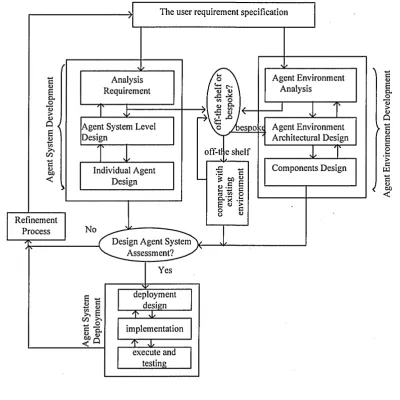
The research has found that the development process for an agent system consists of three phases: agent system development, agent environment developmentand agent system deployment. The first and second phases represent an intertwined spiral model. All three phases themselves consist of three stages. Each phase employs different development techniques and each stage uses appropriate models and tools such as problem domain model, agent use cases, scenarios, agent system architecture, plan model and individual agent model.
The proposed agent development method is applied to two case studies: a Filtering Agent Systemand
Diabetic Consultation System. Both systems have been implemented and tested. Three distinct ways were used to evaluate the proposed method. First, comparing with the criteria of a methodology. Second, comparing it with the current agent-oriented methodologies. Third, informal observations from a potential user community.
Acknowledgements
I would like to express my deepest thanks to my kindly supervisor, Professor Dr. Jawed Siddiqi who have supervised, influenced and inspired me throughout the duration o f this research project. Similarly to Dr. Peter Collingwood who has helping me in the early stage o f this research and make comment on the thesis. Never ever forget to Dr John Stone who has kindly help with the English and proof-reading o f the final thesis.
Many thanks to all the staffs o f Sheffield Hallam University, who were involved whether directly or indirectly especially, Paul Manning, Darren, Chris, Angela, Lind, and all CMS and CIS staff who provided necessary environment for the achievement o f this research, especially to the postgraduate co-tutor, Ian Morrey, who always give his full attention to all research students. Great thanks to all other researchers in similar research agent areas such as Afsaneh, Abdullah and Saadat for their technical comments.
To all my friends that I know them in Sheffield such as Zainah, Mariani, Liana, Tracy and both Aminah, who always cheers up my life in here, our brotherhood will never be forget forever.
No amount o f thanks can suffice for my husband Roslan for encouraging me all the time, from the beginning to the end o f this research, sharing the hardship o f doing research and helping me to use my time efficiency. To my three sons Mutasim, Muaz and Mustaqiim, a deep appreciation from your mum for being patient, understanding and tolerant for several years o f motherless days. Your great behaviour really encouraged me throughout the research.
I would like to extend my heartfelt thanks to my parents, brothers and sisters, whose constantly provided great advice and encouragement. All o f you are the sources o f my determination to
complete the PhD.
Finally, thanks to my sponsor, the National University o f Malaysia, which provide financial support for this research.
Contents
Pages
Abstract ...i
Acknowledgement...ii
Abbreviations... vi
Figures ...viii
Tables ...x
CHAPTER ONE
Introduction
1.0. MOTIVATION OF THE RESEARCH... 11.1. THE CONTRIBUTION MADE IN THE RESEARCH PROJECT...5
1.2. TOUR OF THE THESIS...6
CHAPTER TWO
Background Literature Review
2.0. INTRODUCTION...82.1. AGENTS...8
2.1.1. Characterising Agents...9
2.1.2. Key Issues for Agent Technology...12
2.1.3. Status o f Agent Technology...21
2.2. SOFTWARE DEVELOPMENT METHODOLOGY...25
2.2.1. Principles o f Software Development Methodology....25
2.2.2. System Development Approach... 27
2.3. SOFTWARE ABSTRACTION... 32
2.3.1. Software architecture...33
2.3.2. Architecture Patterns ;...34
2.3.3. Design Patterns...35
2.3.4. Architectural Description Language(ADL)...36
2.3.5. Frameworks... 37
2.3.6. Framework Development Process...40
2.4. THE CRITERIA OF AN AGENT BASED SYSTEM...41
2.5 SUM M ARY...47
CHAPTER THREE
The Building Blocks Towards a Process for
Agent System Development
3.0. INTRODUCTION... 493.1.2. Analysis o f Existing Agent-Oriented Methodologies...55
3.1.3. Reverse Engineering...55
3.1.4. Scrutiny o f the Existing Environment...57
3.2. THE ESSENCE OF THE DERIVATION OF RESULT TOWARDS THE PROPOSAL OF AN AGENT SYSTEM METHOD...58
3.2.1. Analysis and Design Concepts for Development Agent System...59
3.2.2 Software Development Process...67
3.2.3 Analysis, Design and Modelling Techniques for Agent System Development.. 69
3.2.4. Analysis, Design and Modelling Techniques for Development Agent Environment ...77
3.3. SUMMARY...85
CHAPTER FOUR
Towards a Method to Develop an Agent-based
System
4.0. INTRODUCTION...864.1. AGENT SYSTEM DEVELOPMENT
...
924.1.1. Analysis Requirement........93
4.1.2. Agent System Level Design...101
4.1.3. Individual Agent Design.....109
4.1.4. Refinement.
...
1134.2. AGENT ENVIRONMENT DEVELOPMENT...115
4.2.1. Agent Environment Analysis...117
4.2.2. Agent Environment Architectural Design...124
4.2.3. Component Design...128
4.2.4. Development o f Jade Agent Environment....129
4.3. REUSE OF ‘OFF-THE-SHELF’ AGENT ENVIRONMENTS...132
4.3.1. Process to Reuse the Ofif-theShelf Agent Environment....133
4.3.2. Common Features o f an Agent Environment...135
4.4. AGENT SYSTEM DEPLOYMENT...138
4.3.3. Deployment Design Process...139
4.5. SUMMARY... 142
CHAPTER FIVE
Development of Agent System - Case Studies
5.0. INTRODUCTION...1445.1. FILTERING AGENT SYSTEM...145
5.1.1. Requirement Specification...145
5.1.2. PHASE 1: Agent System Development.... .’...147
5.1.3. PHASE 2: Agent Environment Development. ...173
5.1.4. PHASE 3: Agent System Deployment....178
5.2. DIABETICS CONSULTATION SYSTEM (DCS)...181
5.2.1. Requirement Specification...181
5.2.2. PHASE 1: Agent System Development....182
5.2.4. PHASE 3: Agent System Deployment....212
5.3. SUMMARY...213
CHAPTER SIX
Evaluation and Discussion.
6.0 EVALUATION PROCESSES...2156.1 EVALUATION AGAINST THE CRITERIA OF A SOFTWARE DEVELOPMENT METHODOLOGY... 218
6.2 COMPARISON WITH THE CURRENT AGENT-ORIENTED METHODOLOGIES ... 225
6.2.1 Agent Paradigm...226
6.2.2 Development process and Techniques...228
6.2.3 Modelling Techniques and Notatbns...234
6.3 POTENTIAL COMMUNITY EVALUATION...242
6.4 ANALYSIS OF EVALUATION RESULT...244
6.5 DISCUSSION...251
6.6 FUTURE RESEARCH...253
6.7 CONCLUSION...256
REFERENCES 259
INTERNET REFERENCES 278
APPENDIX A Analysis Existing Agent-Oriented Methodologies
281APPENDIX B : Reverse Engineering
294APPENDIX C
: The Scrutiny of Agent Frameworks
319APPENDIX D
: Software Abstraction in Agent Environment
336Abbreviations
ACL Agent Communication Language ADL Architecture Description Language AEA Agent Environment Analysis
AEAD Agent Environment Architectural Design
AEAOMs Analysis of the Existing Agent-Oriented Methodologies AED Agent Environment Development(AED)
AI Artificial Intelligent AR Analysis Requirement ASD Agent System Development ASDO Agent System Deployment ASLD Agent System Level Design AUML Agent Unified Modelling Language BDI Beliefs, Desire and Intention
CD Component Design
CORBA Common Object Request Broker Architecture DCOM Distributed Common Object Management DCS Diabetics Consultation System
FAS Filtering Agent System
FIPA Foundation for Intelligent Physical Agents FIPA-OS FIPA-Operating System
FTP File Transfers Protocol GP General Practice
GSM Global System for Mobile Communication HTML Hypertext Markup Language
HTTP High Transportation Protocol IAD Individual Agent Design
ISO International Standardisation Organisation JDBC Java Database Compiler
KIF Knowledge Interchange Format
KQML Knowledge Query Manipulation Language OFSAE ‘Off-the-Shelf Agent Environment OMG Object Management Group
SAEF Scrutiny of Existing Agent Frameworks SL Semantic Language
SMTP Simple Mail Transfer Protocol
TCP/IP Transmission Control Protocol/Internet Protocol UDP User Datagram Protocol
UML Unified Modelling Language
Figures
_______ _________ ___
Figure 1.1: An Overview of the Research Process...4
Figure 2.1: Characterisation of a Multi-agent System...13
Figure 2.2: Components of an Agent Architecture ...13
Figure 2.3: Inter-agent Communication between Two Heterogeneous Agents...15
Figure 2.4: Example of a KQML message... 17
Figure 2.5: Example of FIPA language...18
Figure 2.6: The Evolution of the Software Development Methodologies...28
Figure 2.7: Dissemination of the Use Framework for Traditional and Agent-based Application ...39
Figure 2.8: The Ability of Agent to Communicate Across Multi-Agent System... 45
Figure 3.1: Devivation Process Towards Development of Agent System Development 51 Figure 3.2: The Sequence of the Derivation Process...52
Figure 3.3: Identification of Software Abstraction Process... 54
Figure 3.4: The Reverse Engineering Process... ...56
Figure 3.5: Agent Overview...63
Figure 3.6: Agent Modelling...67
Figure 3.7: A Life-cycle of an Agent System Development... 68
Figure 3.8: The Agent System Design for Filter Agent System...72
Figure 3.9: Interaction Modelling Between Two Agents... 74
Figure 3.10: A UserModelAgent M odel...75
Figure 3.11: Agent Design Framework... 76
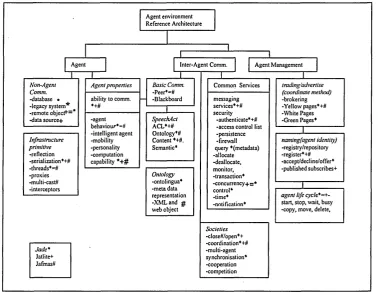
Figure 3.12: The Agent Environment Reference Architecture... 83
Figure 4.1: The Artefacts of Agent Development Method...87
Figure 4.2: Agent System Design Artefacts...93
Figure 4.3: Agent Problem Domain... 94
Figure 4.4: The Filtering Application System Goal Model... 96
Figure 4.5: The User Event Use Case... 98
Figure 4.6: The Use Case for Filtering Application... 99
Figure 4.7: Filtering Application Agent Identification... ...103
Figure 4.8: UserAgent Abstraction...104
Figure 4.9: The Agent System Architecture... ...106
Figure 4.10: The Plan Sequence M odel... 107
Figure 4.11: The Plan Activity Model...108
Figure 4.12: UserAgent Model...110
Figure 4.13: Communication Data Structure...110
Figure 4.14: UserModelAgent Plan M odel... ...111
Figure 4.15: The Attributes to Define the User profile...112
Figure 4.16: The Association between FilterAgent and Learning Techniques...112
Figure 4.17: Agent Environment Development Process... 116
Figure 4.18: The Artefact of Identifying the Agent Environment Requirement... 118
Figure 4.19: The Agent Environment Design Artefacts... 125
Figure 4.20 : The Structure of Relationship between the Components... 130
Figure 4.21: The JADE Organisation Architecture...131
Figure 4.22: Reuse off-the-shelf Agent Environment...133
Figure 4.23: UML Class Diagram to Specify Agent Behaviour... 140
Figure 4.24: The Inheritance of Agent Abstract Class...140
Figure 4.25: Assigning an Agent Role with Simplebehaviour...141
Figure 5.1: The Filtering System Goal ...148
Figure 5.2: The Filtering Agents System Context Diagram...149
Figure 5.3: Event User Enquiry...151
Figure 5.5 : Event TimeTable...152
Figure 5.6: The Filtering Agent System Use Case... 153
Figure 5.7: Assigning Roles to Agent... 155
Figure 5.8: Agent System Architecture...157
Figure 5.9: Agent Interactions...158
Figure 5.10: The Filtering Agent System Activity Diagram (the user initiator)...159
Figure 5.11: Activity Diagram from Clock Event (scheduler initatior)...160
Figure 5.12: The Filtering Agent System Plan... 161
Figure 5.13 Enquirer User Interface...162
Figure 5.14: Feedbacker User Interface...162
Figure 5.15: UserAgent M odel...163
Figure 5.16: The UserAgent State Model Diagram...165
Figure 5.17: UserModel Agent Model... 165
Figure 5.18: Internal State Diagram of UserModelAgent ...166
Figure 5.19: SearchAgent M odel...:... 167
Figure 5.20: SearchAgent State Diagram...167
Figure 5.21 :Document A gent...168
Figure 5.22:Document Agent State Diagram...169
Figure 5.23: Indexing Process...169
Figure 5.24: FilterAgent Diagram... 170
Figure 5.25: FilterAgent State Diagram...171
Figure 5.26:ScheduleAgent Diagram... 173
Figure 5.27: Internal Design of a ScheduleAgent...172
Figure 5.28: UserAgent Class Diagram... 179
Figure 5.29: The Diabetics Consultation System- Context Diagram...183
Figure 5.30: The Diabetic Consultation System Goal... 184
Figure 5.31: Patient Use Case...187
Figure 5.32:Doctor Use Case...187
Figure 5.33: The Diabetic Consultation Use Cases... 188
Figure 5.34: Assigning Roles to Agent... 190
Figure 5.35: Agent System Architecture... 192
Figure 5.36: Agent Interactions...195
Figure 5.37: The Diabetic Consultant System Plan...196
Figure 5.38 Patient Enquiry... 197
Figure 5.39: Patient Set timetable... 197
Figure 5.40 : PatientAgent Data M odel... 198
Figure 5.41: The PatientAgent Plan model... 199
Figure 5.42: Patient Treatment of Doctor User Interface... 200
Figure 5.43: DoctorAgent Model...200
Figure 5.44: DoctorAgent State Diagram... 201
Figure 5.45: ExpertAgent Model...202
Figure 5.46: ExpertAgent State Diagram... 203
Figure 5.47:ReminderAgent Model... 204
Figure 5.48: Reminder Agent State Diagram ...205
Figure 5.49: StockAgent Model...206
Figure 5.50: StockAgent State Diagram...206
Figure 5.51: Diabetic Consultation Execution architecture... 207
Figure 5.52 :Patient Agent Class Diagram...212
Figure 6.1 Evaluation Process...217
Tables
Table 2.1: Analysis vs. Design... 27
Table 2.2: Software Abstraction... 32
Table 2.3: Four aspects of Software architecture [Soni+95]... 34
Table 2.4: Characteristics of Agent-oriented Developments... 41
Table 3.1: The Agent Environment Abstraction of Filtering application and NewsFilter — Application... 61
Table 4.1: Event Scenario... 97
Table 4.2: Agent Architecture Entities to Present Agent Behaviour...120
Table 4.3: The Principle of Providing the Physical Environment...122
Table 4.4: Agent Environment Characteristics... 123
Table 4.5: The JADE Functional Requirement... 124
Table 4.6: Example of Comparison Criteria of the Existing Agent Frameworks... 134
Table 5.1: Event User Enquiry...149
Table 5.2: Event User Feedback... 150
Table 5.3: Event Time Scheduler... 150
Table 5.4: Agent Abstraction...156
Table 5.5: The Schedule Timetable...172
Table 5.6: The Comparison analysis for Filtering agent environment...177
Table 5.7: Event User Enquiry...185
Table 5.8: Event Time Scheduler... 186
Table 5.9: Agent Abstraction... 191
Table 5.10: The Comparison analysis for Diabetic Consultation Agent Environment 210 Table 6.1: Comparison (stages) between the Propose of Our Agent Method with the Current AOMs...232
Table 6.2: Afsaneh Personal Evaluation... 243
Table 6.3: Saadat Personal Evaluation...243
CHAPTER 1
1 .Introduction
1.0. MOTIVATION OF THE RESEARCH
Software applications have been developed for some 50 years and their complexity has gradually increased in parallel with the complexity of the problem domains in which software is required. In the early 1970s, the problem domain of software was to perform largely routine tasks but often to facilitate the performance of large-scale tasks. Later, the complexity of software increased as it was needed to handle a massive volume of data, distributed, concurrent and so on. Software is used in increasingly complex problem domains.
A simple system solution may have several lines of implementation code, which are easy to understand, but a complex system consists of thousands of lines of code, so that it is difficult to understand and impossible to maintain without proper documentation of the process to develop the system. With complex systems, producing a systematic process for development of software applications becomes a necessity. The study of this area is called methods for software development[Hice+74].
Over decades, many methodologies been developed and introduced, specifically to overcome several kinds of difficulties for different problem domains and no methodology has been wholly successful in fulfilling its objectives, partly because computing is a highly dynamic field and the nature of the software domain problem is constantly changing in parallel with the invention of new technologies. Yesterday’s solution will never completely solve today’s problem.
Nevertheless, methodologies promises to increase the speed of development of software applications, reduce cost, facilitate easy maintenance and provide better quality[Jaya94]. Methodology can help to ensure that the user’s requirements are met completely. They can promote communication between project participants, by defining essential participants and interactions, and can give a structure to the whole process and provide a standardisation of process and documentation[Simo+99].
Introduction
to show systematically how to develop a software application, and covers stages of the development process.
The main element of a methodology provides a method that describes a way of structuring the designer’s thinking on how to solve a software problem. A method describes how to chunk the software problem into a hierarchy of sub-problems[Somm+97]. Despite many methodologies in use to develop applications for domain-specific problems[Somm+97], for our purpose three categories are sufficient to classify methodological approaches: structured, object-oriented and knowledge-based methods. These methodologies describe different design strategies or ways designers think about chunking the software problem into useful software application solutions. Moreover they indicate the abstraction employed.
The pioneering method introduced was the structured method[Your79][DeMa+78]. In structured methods, the designer thinks in terms of operation or functions to break down the software problem [Ash+90]. The executing system is made up from sequences of functions or operations using a data flow diagram. Later, this method was found to be inadequate to support several difficulties in system development. [Your89] is process-oriented while [Finkl89] is data- oriented, which can lead to difficulty in co-ordinating these two views of models. The later SSADM methodology [Ash+90] is undoubtedly very successful, but again it is only suitable to provide solutions for specific problem domains.
In later years, a new way of design thinking was introduced, so-called object technology. In this method, the designer thinks in terms of ‘objects’ instead of operations or functions[Wool+95][Mull96], The system solution is shown as a result of interacting objects that maintain their own local state and provide operations on that state, resulting in benefits that have features of independence. Object-oriented design modelling uses object classes and relationships, using the object-oriented concepts of inheritance, encapsulation, polymorphism and aggregation[Booc94]. The object-oriented method has been accepted and used for development of various kinds of software in the industrial, commercial and academic domains such as Object Management Technology(OMT) [Rumb91].
Introduction
Based on the above discussion, we can generalise that new methods are developed associated with new technology is implemented.
Today’s software applications are used to develop complex problem domains with high independent and dependent attributes that run under a complex technology. Today applications are also extensively networked and distributed, and operate under multiple, jurisdictions each with their own mandate and prerogatives. Thus, the domain of software problems consists of the elements of distribution of data, decision and location, intelligence, concurrency, complex rules, high independence and dependence, and self-organisation, thus increasing the complexity of software solutions.
With such kinds of software problem domains, in the early 1990s, the term agent was introduced as a new paradigm for the design of software applications. An agent is simply another kind of software abstraction, an abstraction in the same way as functions and objects. An agent may be software or an entity that presents itself with human capability, such as autonomy, reactivity, proactivity, social-ability and intelligence. The agent paradigm is believed to be appropriate to provide the above characteristics of software problem domains. Agents present a high level of abstraction of design solutions. The agent paradigm lets designers think in terms of agents rather than objects or functions. The agent exhibits presents high dependency compared with an object-oriented approach. Such a software application needs an appropriate software development method. Existing software development methods are not suitable for the development of agent systems.
Why are existing methods not suitable for development agent system? Is the agent a totally new paradigm with a new software development method or does it adapt existing methods? If so, which method is most appropriately adapted? How do other methods play a role in the agent development method? Which agent paradigm is the most appropriate to be adopted? When and how should it be adopted? Can the existing development life-cycle be adapted? What modelling and modelling processes are suitable for an agent based system? These other questions will be answered in the following chapters.
The term ‘agent paradigm’ has been exploited to develop several types of complex applications in an ad hoc fashion using their different agent paradigms, exploiting existing methods and existing languages. Even though some agent methodologies have been proposed, they are tied to a specific perspective, described at a very high level of design, with an unclear process and only a partial indication of the development process.
Introduction
methodology, such as defining the set of concepts used to illustrate the agent paradigm, defining the life-cycle of agent-oriented development, which consists of several stages of the development process, identifying suitable techniques and modelling to describe the various level of abstractions. The overall aim is to show a systematic process for development of an agent-based system and guidelines to development agent systems. However, in terms of modelling processes we focus on transformational modelling between analysis and design. The methodology proposed follows the traditional software development method that uses several levels of abstraction to present a systematic process of development system (so called software abstraction). This is because agent abstractions and models offer expressiveness and flexibility that conventional notation lacks; it omits details throughout the development of a system from a high-level to lower level [Triem99][Shaw+96]. At least three software abstraction levels are used: requirements, design and implementation [Triem99]. Today’s increasingly fast-paced and fluid demands in software engineering suggest that agent abstraction could be useful for supporting the agent development process in general.
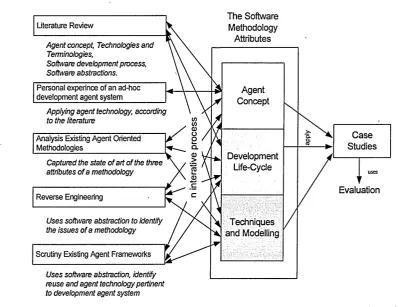
Literature Review
Agent concept, Technologies and Terminologies,
Software development process, Software abstractions.
Personal experince of an ad-hoc development agent system
Applying agent technology, according to the literature
The Software Methodology Attributes
Analysis Existing Agent Oriented Methodologies
Captured the state of art of the three attributes of a methodology
Reverse Engineering
Uses software abstraction to identify the issues of a methodology
Scrutiny Existing Agent Frameworks
Uses software abstraction, identify reuse and agent technology pertinent to development agent system
Agent Concept
Development Life-Cycle
Techniques and Modelling
Case Studies
Evaluation
Figure 1.1: An Overview of the Research Process
[image:18.612.85.484.322.629.2]Introduction
development process, and techniques and modelling notation in each stage. Figure 1.1 shows the integration of the research activities that leads to the research contribution in the area of development of an agent-oriented methodology. The figure shows that the research is conducted through the following activities: literature reviews about agents, software development and software abstraction including the current practice of agent development; experience in implementation of agent systems in an ad hoc fashion; analysis of existing agent-oriented methodologies; analysis of existing agent frameworks. The figure shows an 'ri iterative processes of activities for identifying the issues and attributes of agent-oriented methodologies. The reverse engineering and scrutiny process are the core activities in identifying appropriate concepts, stages and modelling. The applicability of the proposal methodology is demonstrated in two case studies: a Filtering agent system and a Diabetic agent system. The proposed of the methodology is evaluated at three stages. First, evaluate according to the common criteria of software development methodology. Second, comparative analysis with the current agent- oriented methodologies developed in parallel with this research and the last evaluation is according to the criteria of methodology in Information System perspective.
1.1. THE CONTRIBUTION MADE IN THE RESEARCH
PROJECT
Our research goal is to propose an agent-oriented methodology. When the research started 1998, the agent paradigm was in its infancy; the concept of agents was not clearly identified. We believe that our research makes a significant contribution in the area of development of an agent-oriented methodology as stated below.
• It shows how software abstraction is used in identifying software development process. • The abstraction process is able to define a set of agent concepts to illustrate the agent
paradigm.
• The comparative analysis of the existing agent-oriented methodologies is able to show that other agent concepts, techniques, tools (modelling) and stages may be suitable in particular domains of agent system.
• The future of the agent-oriented development life-cycle is explored, illustrating the framework of the whole process of agent analysis, design, implementation and applicability to the specific agent paradigm of agent development. The description of stages is applicable to most types of agent system.
Introduction
Part of the subject matters addressed in this thesis has been published in the following conference proceedings and technical reports:
[0thm99][0thm00][0thm+02a][0thm+02b][0thm+02c][0thm+03] as shown in the bibliography. The first two are technical reports on reverse engineering of the Filtering application and NewsFilter application. The others were published in conference proceedings. Those papers describe the case studies presented in this thesis.
1.2. TOUR OF THE THESIS
The chapters in this thesis are structured in such a way as to show the process of development of the proposed agent-oriented methodology. The tour throughout the chapters will provide understanding of the development of an agent-based system.
Chapter 2- Background Literature Review
The literature review aims to provide basic knowledge about the development of an agent- oriented methodology. It is divided into three parts. The first part is the literature review on the concept of agent, agent technology, the terminology and the domain of agent based systems. The second part reviews the principles of software development methodology that can be used to identify the criteria and scope of our agent-oriented methodology. This entails a comparison of the existing software development methodologies, which leading to the identification of an appropriate approach suitable to be extended to present the agent paradigm. The third part discusses the concept of abstraction and several types of software abstraction tools used for the development of complex software applications.
Chapter 3- The Building Block Towards a Process for Agent System Development
Introduction
Chapter 4- A Method to Develop an Agent-Based System
This chapter aims to gather the agent concepts and techniques used, to present a proposal for an agent-oriented methodology. It is an expansion of the overview of the methodology presented in chapter three. In this chapter we demonstrate the life cycle of the development process from requirements to implementation, and show how agent modelling is performed throughout the stages. However, the agent modelling process presented here focuses only on the first part of design of the agent system. The development of an agent environment uses the component- based method adopted in the object-oriented framework approach and the development of the agent environment life-cycle adopts the software architecture development process. The software abstraction tools such as architecture pattern and design patterns, as presented in chapter four, are shown to be useful tools in developing the agent environment. In addition, we provide the criteria to analyse the reusable agent environment that can be deployed to implement the agent system. At this stage we can show the detailed design of the agent system.
Chapter 5- Development of Agent System -The Case Studies
The aim of this chapter is to show how the methodology presented in the previous chapter is used, through the presentation of two case studies. The case studies present the deliverable of documents at each stage. The two case studies are a Filtering agent system and a Diabetics Consultation system. The agent environment reference architecture presented in chapter five is used to analyse the reusability of the agent environment.
Chapter 6- Evaluation and Conclusion
CHAPTER 2
2. Background Literature Review
2.0. INTRODUCTION
This chapter presents the three areas of background to the study. The first section focuses on the concept of an agent, agent technologies and terminology pertinent to the development of an agent methodology. The second focus of discussion is literature on software development methodologies; their meaning is reviewed and several software development approaches are used in development of software applications are presented. The third topic considered the existence of software abstraction tools, which are commonly used for development of a software application. Each area is discussed in more detail in the following sub-sections in order to establish the theoretical context of the present research, which is based on the integration of these three areas.
2.1. AGENTS
Agents present a new paradigm for the current and next generation of system development solutions because they are is flexible1, and bring intelligence2 and autonomy[Wool+01][Jenn+98a]. Agent technology arises from a blend of the following technologies: network communication [Harr93], artificial intelligence [Wins79], multi-agent systems[Weis99], distributed problem solving[Less87], distributed systems[Mull93], concurrency [Rank94], knowledge engineering[Adel90], distributed artificial intelligence[Bond+88] and object-oriented technology[Booc94]. A problem resulting from the inheritance of these technologies is a multiplicity of agent definitions, stemming from different communities, and reflecting their different perspectives. With such technology, in practice agents have been used to address the diversity and complexity of many real world problems of software applications [Brad97a]. In earlier research, agent technologies were influenced by Artificial Intelligence [Rusel+95] and Distributed Artificial Intelligence leading to notions of strong and weak agents respectively[Treu+98][Wool+95]. This also leads to multiplicity of
agent definition. Clearly, agents are not expert system3 nor DAI[Alan88][Mamd98][Shen97] 4 but as Etzioni states, agent based systems are 99% computer science and 1% Artificial Intelligent [Etzi96].
2.1.1. Characterising Agents
Despite various definitions of an agent, we will agree with [Wool+95] who takes a simplistic view, namely, an agent is one who acts. Therefore, an agent may represent a variety of things such as a person, a machine or a piece of software. However, this view is too general and not suitable for presenting an agent paradigm for software development. As a first step towards that goal, we concur with [Wool+95] [Wool+95a] and consider an agent as consisting of a combination of the following properties:
Autonomous: able to act without direct external intervention. The agent has some degree of control over its internal state and action based on its own experiences [Maes90].
Reactive: Agents perceive their environment (which may be the physical world, a user via a graphical user interface, a collection of other agents, the Internet, or perhaps all of these combined), and respond in a timely fashion to changes that occur in it [Wool+95].
Interactive: able to communicate with other agents and its environment [Wool+95].
Sociable: capable of two-way conversation, in which one party asks questions and the other verifies or answers. The conversation allows inter-agent co-operation which enables agents to exchange their knowledge, beliefs and plans and to work together to solve large problems which are beyond an individual’s capabilities[Wool+95].
Proactive: having a goal-oriented ability or a purpose. The agent does not simply react to the environment[Maes90].
Proxy: able to act on behalf of someone or something, that is, acting in the interest of, as a representative of, or for benefit of some entity [Maes90].
Co-ordinative: able to perform some activity in a shared environment with other agents. Usually
this activity consists of a well devised plan and workflows, including some other process management mechanism[Geor+95][Jenn93].
Co-operative: able to co-ordinate with other agents to achieve a common purpose (some scholars define this as collaboration)[Weih+95][Krau97].
Competitive: able to co-ordinate with other agents, such that the success of one agent implies the failure of another. This feature contradicts co-operation[Bacl92].
Intelligent: able to state formalised knowledge such as beliefs, goals and assumptions and to interact with other agents using symbolic language[Wool+95].
Mobility - agents can move around in their environment from one place to another and carry data along with intelligent instructions and execute remotely [App+94].
Risk and trust- address the issue of delegation of tasks with at least a reasonable assurance that the user wants to delegate the task, and that the agent can bring back the result the user wanted[Jenn+98].
Rational - able to choose an action based on internal goals and the knowledge that a particular
action will bring it closer to its goals[Mamd98].
There are many more agent characteristics. Up to now a standard definition has not been established to describe an agent. Jenning said agent must, at least, be an autonomous entity that can interact with its environment [Jenn+98]. But, based on the various definitions and the realisation of their usefulness for agent oriented development as we agreed with Etzioni[Etzi96] and Wooldridge[Wool+95]. An agent should possess at least the first two of the above properties to give a degree of usefulness to the agent paradigm in developing software applications. The rich combinations of these behaviours can generate various degrees of complexity of agent systems, with attributes in which an agent is able to keep observing changes in its environment, as well as provide features of reasoning, capability to act rationally, be pro-active, learn, adapt, etc. However, Kendal believes agents should be provided with beliefs, desire and intention characteristics (BDI agent)[Kend+95].
The combinations of these properties have led to the emergence of several types of agent systems: mobile agents, interface agents, reactive agents, autonomous agents, interface agents, interactive agents, information agents, intelligent agents, entertainment agents, wrapper agents, hybrid agents and collaborative agents[Brad97a][Jenn+98]. From detailed examination of these types of agent systems, agents can be identified in other forms such as broker agent, mediator agent, facilitator agent, services agent, etc. These agents play a role in the system to be developed.
Agents can be put into two categories: single agent systems and multi-agent systems(MAS)[Treu+98][Weis99]. A commercial agent system such as information search is a single agent. The agent is launched in order to return appropriate information as needed by the requester. The single agent method is unsuitable in large scale problem domains. It does not
4 DAI only focus with distributed static intelligent component (without autonomous), limited
Li tera Cure Reviews
reduce the complexity of the system, nor does it utilised the various agent characteristics stated earlier. The next section discusses in further detail the issues associated to agent technology.
There are various types of multi-agent system, for example, a Travelling multi-agent system consisting of various travel agents that negotiates a good price of a ticket. Such situations can be viewed in terms of agents needing co-ordination either through co-operation, competition, or a combination of both. Another speculative example involves various agents handling a household system comprising an alarm clock, house heater, coffee maker and toaster. When the alarm clock rings in the morning, as set by the owner, it co-operates with the house heater to indicate when to start the heater. At the same time, the heater co-operates with the environment to identify the right temperature of the heater. Based on the owner's preferences for the time of having a bath and dressing, the alarm also co-operates with the coffee maker and toaster, indicating when the coffee and toast should be ready. The coffee maker and toaster negotiate with each other with the aim that the toast and coffee should be ready at the same time or that the difference between the time of coffee and toast being ready should be minimal.
These two examples represent different types of multi-agent system environment that allow the agents to co-operate with each other. In the first example, the multi-agent system environment may consist of at least two layers of multi-agent environment: a software agent to present the user agent, tourist agent and travel agent, and networking is needed to allow the agents to communicate with each other. In contrast, in the second example, the appliances themselves are the agents. It may only need a physical interconnection among the agents to allow the appliances to co-operate with each other. Based upon these two examples we can see that the development of an agent system consists of two parts: design of an agent system to achieve the system goal, and identification of an appropriate agent environment in which the agent can be exhibited.
From these examples, we can see that communication is the main issue in a multi-agent system, irrespective of agent behaviour. It allows an agent to send messages to other agents and the receiver agents are able to reply to the message to enable agent interaction. Such basic interaction has an influence on several methods of agent socialisation such as negotiation, co operation and co-ordination.
A real autonomous multi-agent system is likely to become a future paradigm of agent systems, but now it is very much at an initial research stage [Mller+97][Jenn+98][Jenn+98a]. The recent research has narrowed down the term into a more general term; instead of a real autonomous multi-agent system, the paradigm is one of a multi-agent system composed of several autonomous components that are able to autonomously interact. Thus, this paradigm can be characterised as follows: each agent has the ability to solve a problem with its own expertise; there is no global system control, data is decentralised and computation is asynchronous.
Through the discussion of the characteristics of a multi-agent system, we are able to identify the key issues representing agent technology as discussed in the next section.
2.1.2. Key Issues for Agent Technology
According to the previous discussion we abstract three key issues as necessary for agent technology. The first relates to the nature of the agent; the second relates to agent communication and the third relates to agent management. Each of these issues discussed in the following sub-sections.
2.1.2.1. Nature of Agent
An illustration of an archetype of a multi-agent system can be seen in Figure 2.1. The figure also shows the features of a multi-agent system environment [Zam+00]. From the figure, it can be seen that a multi-agent system consists of several agents, which interact with each other. The figure shows that Agent 1 interacts with Agent2 and Agent2 interacts with Agent3. Interaction protocol describes how these agents communicate (such as negotiate, requesting, biding). Interaction medium describes the medium by which agent interacts, e.g. HTTP, SMTP.
Interaction medium
Interaction Protocols o
3 [anisationl
Agent management
Agent 2
Agent 1 Agent 3
to
3'
(Q
(D
>
(Q
CD
3
Behaviour
Sensor/ effector
^Environment
Figure 2.1: Characterisation of a Multi-agent System
At the same time, each agent may communicate with its own environment or external world, which may influence the interaction between agents. Each agent is also provided with certain types of behaviours that represented as roles or tasks. Agent management is needed to allow agents to socialise. Agentl is registered in Organisation2, Agent3 is registered in Organisation 1, while Agent2 is registered in both organisations. Even though Agentl and Agent3 are registered in different organisations that they can interact.
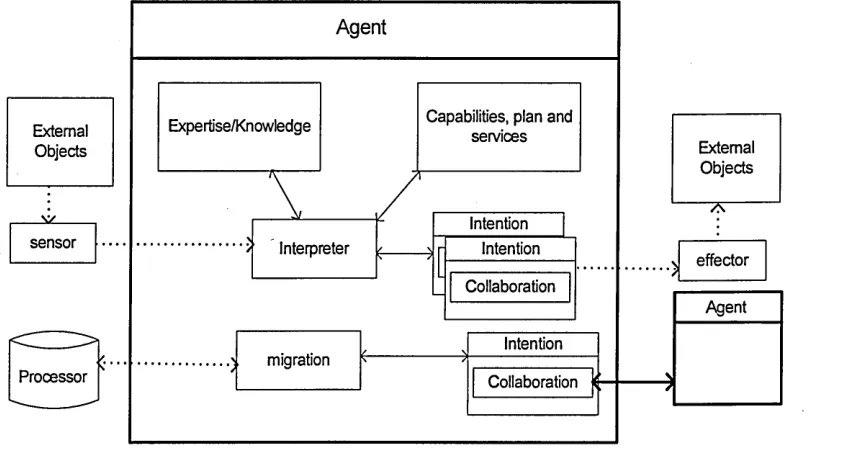
Figure 2.2 shows an example of the internal architecture of an individual agent that interacts within agent components, external world and processor, and other agents as shown with dotted line, straight line and thick line respectively.
External Objects
sensor
Processor
Agent
Expertise/Knowledge Capabilities, plan andservices
Interpreter
Intention Intention
Collaboration
migration Intention
Collaboration
External Objects
~75~
effector
[image:27.612.96.519.451.687.2]Agent
An agent uses a sensor or effector to interact with the external world and an agent interacts with other agents based on its intention. An intention is an action that leads to communication. The use of the term intentions reflects the fact that the action is not fixed, but rather may change according to several factors.
A weak agent consists, at least, of autonomous behaviour and ability to interact with other agents through its intention, a strong agent is able to carry out reasoning through its expertise, and select plans capable of achieving its goals. A simple agent presents itself with beliefs using a passive object that represents the agent’s knowledge. A strong agent has the capability to retrieve a plan from a library. These plans are invoked when a triggering event occurs, according to the agents interactions. Agent intentions are designed in such a way as to occur concurrently. Figure 2.2 shows three types of intentions: involving interactions with external objects, collaboration with other agents and migration with other processors[Kend+95]. As indicated in the figure, the co-operation or negotiation agents are based on agent collaboration.
The main issue in relation to the agent is identifying the components or elements to represent agent architecture. Agent architecture shows in Figure 2.2 consists of the following elements: expertise, plan, intention and interpreter, while the external elements communicate with other agents, external objects and the processor but these components may or may not be necessary used to describe agents. An agent may consist of other kinds of components as well. In our research we use these components to illustrate agents.
Agent Communication Issues
Based upon the description of an agent above, two types of agent communications are identified: first, communication with external objects including human-user, legacy systems, files, etc., so called local communication, and second, communication between other agents, named inter-agent communication. Inter-agent communication focuses on a multi-agent system. Besides these, there is a special type of inter-communication, is categorised as inter-agent communication but differing in the source of inter-communication. The former communication focuses on an agent, while this communication focuses on communication as mobile agents. The two communication types has shown diagrammatically in Figure 2.1 and Figure 2.2.
L i t e r a t . i i r e R e v i e w s
Mobile communication focus on mobile agents. The mobile agent is a special case of agent communication[Whit+97]. In order for agents to communicate, they have to move to a different physical location to negotiate, for instance, rather than sending a message through a communication channel. Therefore, mobile agents are special cases of implementation of an agent system. The difference is the agent environment level rather than in the design of the agent system itself. Inter-agent communication is the major issue in presenting agent technology. Agent technology has initiated new communication techniques, which differentiate between traditional applications and agent applications. In the next section, our discussion focuses on inter-agent communication.
2.1.2.2. Inter-Agent Communication
The main concept of inter-agent communication of heterogeneous agents can be described diagrammatically in Figure 2.3 below. The figure shows that discussion of inter-agent communication requires consideration of two levels of inter-agent communication: logical inter-agent communication and physical inter-agent communication.
Logical Logical
Agent Platform Agent Platform
Operating System <--- >Physical Operating System
Hardware Hardware
Figure 2.3: Inter-agent Communication between Two Heterogeneous Agents
Agent Communication Language
According to [Gene97] there are two approaches to designing an agent communication language(ACL), the procedural approach and the declarative approach. Communication in the procedural approach is based on executable content that can be accomplished using a programming language such as Java [Arno+98] or Tel [Obje+98]. However, this approach has limitations based on the difficulty of controlling the executable content, co-ordination and merging. Recent research suggests using a declarative, which is based on elocutionary acts such as request, send, command, query, etc[Fini+93]. The two most popular declarative languages are KQML(Knowledge Query and Manipulation Language)6 and FIPA( Foundation for Intelligent Agents)7.
Both ACLs demonstrate three key elements of ACL[Fini+97][Huhn+98][Fini+98] [FIPA+97b]: • a common agent communication language and its protocol,
• a common format content of communication and • a shared ontology.
The common ACL protocol is known as performatives using speech act languages such as send, accept, reject, etc. that mimic human of communication. Therefore the use of an ACL system development provides a certain level of behaviour.
The common format content of communication and shared ontology exhibits the openness of agent interaction. The common format content of communication describes language for interpreting the information in the content field of the message, called ‘ontolingua1, whereas
ontology identifies the ontology to interpret the information in the content field of the message. The content field provides the exact content of information to send or receive.
Ontologies are defined as specification schemes for describing concepts and their relationships
in a domain of discourse [Fini+97][Guar+94][Guar+95]. It is important not only that agents have ontologies to conceptualise a domain, but also that they have ontologies with similar constructions. Such ontologies, when they exist, are called common ontologies. Once interacting agents have committed to a common ontology, it is expected that they will use this ontology to interpret communication interactions, thereby leading to mutual understanding and
5 The ACL is from knowledge representation language[Gene+92] of AI research.
Literature Reviews
(ultimately) to predictable behaviours. Ontolingua [Grub+93] is often mentioned in the literature as a system that provides a vocabulary for the definition of reusable, portable and shareable ontologies. Ontolingua definitions are described using syntax and semantics similar to those of the Knowledge Interchange Format [Gins+91], also known as KIF, which is a format to standardise knowledge representation schemes based on first-order logic. KIF is the language used to interpret the KQML ontology whereas FIPA uses the semantic language’s ontolingua[Holt+82] , i.e. SLO or SL1 and it is based on FIPA ontology [FIPA+97b]. This means agents using interaction in KQML and FIPA do not have a similar ontology, due to their different ontolingua. Details on FIPA can be found in [FIPA+97b].
The semantic language allows one to represent a belief, desire or uncertain belief of an agent as well as action that agents perform. It is used to define a constraint that the sender of the message must satisfy. For example [FIPA+97b]:
The semantics of the request are as follows:
< i, request(j,a)>
feasibility precondition: BjAgent(ot,j) A BJjDone(a)
rational effect: Done (a)
The SL defines B/ as statement of believes of an i condition, Agent(a,j) means that the agent Of action a is j (i.e. j is the agent who performs a ), Ij as statement of intention j and Done(a) means that the action a has been done. Thus agent / is requesting agent j to perform action a
under assumptions that agent i believes that the agent of a is j (the message is right) and agent i
believes that agent j does not currently intend that a is done. Figure 2.4 shows the example of use KQML, while Figure 2.5 shows the example of use FIPA8.
(register
:sender agentA rreceiver agentB :reply-with message2
: language common_language :ontology common_ontology
:content "(ServiceProvision Manufacturing:TaskDecomposition)" )
Figure 2.4:. Example of a KQML message.
7 FIPA was formed in 1996 to produce software standards for heterogeneous and interacting agents and agent-based systems. It collaboration of various memberships[MEM02] to produce a standard
ACL[FIPA99],
Li terature Reviews
Both figures show the similarity of using ACLs. FIPA is based on KQML [FIPA+97b], therefore they have similar syntax languages, forms of message and message parameters. However, FIPA agent communication language tied to FIPA architecture9. FIPA has additional functionalities such as agent management. Agents are able to register, un-register, recommend, recruit, broker and advertise, therefore Figure 2.5 do not use have 'register' command compare to KQML. With this functionality, FIPA is restricted to agent management components in the architecture, whereas KQML is not restricted to any architecture.
Begin M essage Structure
M essage param eter
^JD om m u n cation act type
Inform‘d
:sender agentl
rreceiver hpl-aution-server :content
(price (bid good02) 150) :in-reply-to round-4
:reply-with bid04 language SL1 :ontology hpl-auction,
)
M essage content expression
P aram eter expression
Figure 2.5: Example of FIPA language
The differences mentioned above lead to incompatibility in communicating agents using KQML and FIPA. Current research states that FIPA has become a standard for agent interaction[FIPA00]. Although KQML and FIPA are the main declarative languages, however, other research may use KIF or XML for interaction to present the openness of the internet environmentAmun02]. The use of ACL provides the basic communication for several types of socialising agents. The pattern of agent interaction is called the interaction protocol10.
Up to now we have discussed agent communication at the logical level as a basis of agent socialisation. The next discussion is focused on physical inter-agent communication.
Network Inter-agent Communication
Physical inter-agent communication focuses on providing interoperability of inter-network communication. It aims for agent interoperability, interconnecting from multiple network resources at different locations. Inter-network communication is not a new technology for agent technology; rather, it an enhancement of the existing network communication technology. For the purpose of the agent paradigm, we can categorise the physical inter-agent communication into three layers: agent platform, operating system and hardware. The hardware communication is usually the lowest level of communication, such as the use of RS232 or broadband, etc. The
9 FIPA ACL can also applied to any architecture that open to FIPA architecture.
operating system level uses a standard communication protocol. Telecommunication network management usually use the ISO (International Standardisation Organisation) and OSI (Open System Interconnection) group. This network communication is needed for management.
On top of this, several middle-wares can be used for a specific purpose for agent communication. For example, CORBA and DCOM are used to provide interoperability of distributed heterogeneous agents. The middle-ware includes the agent communication management mechanism as well, which most include in the agent platform, the so-called message transport mechanism.
Message Transportation Mechanism
As previously stated, agent communication needs an agent environment that allows messages to be scheduled, as well as event driven. The transportation mechanism should be able to identify the unique agent address. At the same time, transportation mechanism should support other communication terms such as uni-cast, multi-cast and broadcast to support the socialising agent. These mechanisms are provided in middle-ware such as Common Object Request Broker Architecture [Corba99], Object Management Groups (OMG) message services, the Java messaging service, remote method invocation (RMI), Distributed Common Object Model (DCOM) and enterprise Java Bean Events services.
2.1.2.3. Agent Management
In the previous discussion, we focused on the message transport mechanism, whereas in this section we discuss agent management. The agent management provides mechanisms for advertising, finding, fusing, using, presenting, managing, and updating agent services and information[Wied+92]. To address these issues, the notion of middle agents [Deck+97] was proposed. Middle agents are entities to which other agents advertise their capabilities, and which are neither requesters nor providers from the standpoint of the transaction under consideration. The advantage of middle agents is that they allow a multi-agent system to operate robustly when confronted with agent appearance, disappearance, and mobility. There are several types of agents that fall under the definition of middle agents. Note that these types of agents, which are described below, are defined so vaguely that sometimes it is difficult to make a clear differentiation between them.
Literature Reviews
- Mediators: agents that exploit encoded knowledge to create services for a higher level of applications [Wied+92].
- Brokers: agents that receive requests and perform actions using services from other agents in conjunction with their own resources [Deck+96].
- Matchmakers and yellow pages: agents that assist service requesters to find service provider agents based on advertised capabilities [Deck+96].
- Blackboards: repository agents that receive and hold requests for other agents to process [Nii89] [Cohen+94].
Life Cycle Management
An agent runs in its environment. Refering back to the kitchen appliance example, the toaster agent must always be plugged into the electric socket and turned on. Nevertheless, such agents also need a mechanism to regulate such activities as starting, stopping, waiting, being traced and removing. Mobile agents, for example, need other lifecycle issues such as permission to run, permission to perform certain tasks, and communication in different locations[Flor99].
The agent life cycle needs to be identified and managed. A variety of messaging techniques exist for this purpose. An event-style model is the most popular technique, guaranteeing message delivery. Another method is a more casual method, where an agent sees a message of interest to itself. A message may be sent based on a peer to peer approach, a store and forward approach, or a published and subscribed approach.
In distributed systems, an agent may move to another server, which changes its unique identification. In some situations, an agent may provide historical information on its action, so the agent can learn what decisions have been taken before and can use it to evaluate the prior actions.
Agent Security, Identity and Policy
Agent identity is becoming compulsory in agent systems, especially in multi-agent systems. An agent may be identified by its name, role or group. However at the lower level, the agent should be identified by the address where it is executed. In certain cases, an agent is identified by a logging name.
Literature Reviews
Policy is a technique to reduce risk. It refers to how access to a valuable resource is controlled. For example, an agent is limited to a certain type of processing job.
The above discussion only presents the common issues in representing agent technology. However, there are more issues involves in agent technology such as mobile agent, real autonomous agent, strong agent versus weak agent, etc., which entails an additional set of to represent agent technology. However, we are not concerned here with mobile agents. Discussion of mobile development systems can be found in [Arid+98][Oshi+98] [B aum+97b] [B aum+97c] [B aum+97d] [B aum+98] [ZamO 1 ].
The current method to represent agent technology is to use architecture. There are many different attributes to present agent architectures, such as FIPA architecture [FIPA+97a], BDI architecture [Geor+95] and Kasbah architecture [Chav+96]. In addition, there are various agent environment architectures used to represent agent technology such as KASBAH[Chav+96], ARCHON[Cock+96], JADE[Bell+99], ZEUS[Nwan+99] and FIPA-OS[FIPAOSOO].
Taking into account the various issues and techniques used to present agent technology, we believe designers are free to build or chose appropriate architecture for particular domain of solution.11
An agent environment is an executable system that is used to implement an agent system. Differences in agent architectures may cause problems of communication between agents. For example, a FIPA agent may not communicate with KASBAH agent due to different architecture. Therefore, the criteria for choosing open agent architecture are important in agent development for future maintenance. For example JADE and FIPA-OS are developed based on FIPA architecture, so agents which are developed based on JADE can openly communicate with agents developed based on FIPA-OS. However, recent research has proved that agents can communicate even in different agent architecture [FIPAOO]. For example, the ZUES agent can communicate with JADE agent in FIPA architecture. This means FIPA architecture presented as open architecture. Similarly JACK agent is based on BDI architecture, it can communicate with JADE agent in FIPA architecture. This means JACK is an open architecture.
2.1.3. Status o f Agent Technology
technology is not for a specific kind of application but rather for various kinds of applications which are suited to solutions with certain properties of agents. Agents can function as part of an operating system or an application environment. In other situations, agents may strengthen the human-computer interaction aspects of a system.
In practice, agents have been used in several kinds of complex software, for a wide range of applications: information filtering and retrieval, entertainment, air traffic control, network management and telecommunication, electronic commerce, management of business processes, groupware, manufacturing, and as personal agents[Bren+98][Treu+99][Janc96]. The nature of agent applications in these areas is described below:
1. Information filtering and retrieval.
Agents are used in all the services needed to help users to find information they request more easily, quickly and accurately. Examples of such agent applications are Yahoo[Yahoo99], AltaVista[Alta99], MetaCrawler[Craw99], Google[GoogOO]. They range from simple search engines like NewsWatcher [Watch99], WebCrawler[Wcraw01] and HotBot[HotbOO] to meta-search engines which provide learning behaviour, like Copemic[Coper99]. The use of agents in information filtering has reduced the user time in finding information through the Web [SmartOO].
2. Entertainment.
Agents are also used in entertainment systems such as games, cartoons, films and advertisements. For instance, in games, agents are used to provide autonomous interaction between game characters, the environment and multiple players. In film, a camera agent is used to provide automatic motion, focus and reaction, 3D graphical agents and avatars in computer animated features films, cartoons and advertisements [SmartOO]. Other entertainment applications related to the Web are Lifestyle Finder [SmartOO], FireFly[Fly98], Netradio and OpenSesame[Open99].
3. Air traffic control.
In air traffic control systems, for example OASIS [Ljun+92], agents are used to represent both aircraft and the various air traffic control system loads with information and goals corresponding to real world aircraft.
4. Network management and telecommunication.
In the network management and telecommunication application area, agent applications are used in network control[Flet94] and network services[Mage96].
5. Electronic commerce.
In electronic commerce, applications involve configuration and delivery of user requested services at the right time, cost and quality of services. Among these types of applications are buying and selling services like BargainFinder, Bargain Bot, Fido and AdHound, Jango and Kasbah[Broke99].
6. Business process management.
In the management of business processes, agents deal with the management of business tasks and resources, provision of services and carrying out business operations. Examples of this type of application are workflow management[Reic+98], financial services[Wen+98] and telecommuting[App+94],
7. Groupware.
Groupware applications include computer conference systems such as e-mail, decision support systems and appointment scheduling programs [Bren+98]. Examples of groupware applications are Pleiades[Sycr95] and MAXIMS[Maes94].
8. Manufacturing.
In manufacturing applications, agents are used due to the dynamic nature of manufacturing processes. Agents are used in industrial robots[Broo86] and factory automation [Bake96]. 9. Personal agent.
A personal agents system is one that uses agents to reduce the complexity of user tasks. There are several types of system categorised as personal agents. In email and news filtering systems, the used agents are focused on the interface for filtering. In personal schedule management and personal automatic secretary, the agent is used to work on behalf of the user by providing an ability to be aware of any changes that occur. In information filtering and retrieval, the agents are used for advising and focusing information using an intelligence learning capability. Examples of such applications are Letizia[Lieb95], Webdoggie[Webd99] and Copernic[Coper99].
Early applications of agent technology depended on the technology available at that time. Often this was not appropriate to the available technology and new paradigm needed to be sought. Some of the applications present the value of agent without applying the current means of agent technology as discusses in previous section.
Literature Reviews
languages are associated with the object-oriented paradigm and Prolog is ba