Determinants, Outcomes and Predictions
in 21
stCentury Western Europe
By
P
IAH
ELBINGSupervised by
B
RIANM. L
UCEYSchool of Business
T
RINITYC
OLLEGEU
NIVERSITY OFD
UBLINA dissertation submitted to the University of Dublin in accordance with the requirements of the degree of DOCTOR OFPHILOSOPHYin the School of Business.
I
declare that this thesis has not been submitted as an exercise for a degree at this or any other university and it is entirely my own work. I agree to deposit this thesis in the University’s open access institutional repository or allow the Library to do so on my behalf, subject to Irish Copyright Legislation and Trinity College Library condi-tions of use and acknowledgement. I consent to the examiner retaining a copy of the thesis beyond the examining period, should they so wish (EU GDPR May 2018).T
his doctoral thesis offers insights into the determinants, outcomes and predictions of IPO withdrawal in 21st-century Western Europe by focusing on three distinct investigations. These investigations are motivated by acomprehensive literature review and underpinned by an overview of the European
IPO setting. An integrative database is created on completed and withdrawn IPO filings from 2001 to 2017 in France, Germany, Italy, Spain and the UK. Regulatory,
economic and market conditions as well as offer, firm and corporate governance
characteristics are explored.
The first investigation establishes the IPO withdrawal as a common feature of
the main markets in Europe. Most companies that withdraw blame unfavourable
market conditions; however, IPO offer and corporate governance characteristics
emerge to be the main drivers of IPO withdrawal. A pronounced alignment of the
determinants of IPO withdrawal is revealed under the lens of European equity
market integration.
The second investigation focuses on the determinants and timing of the different
post-IPO withdrawal outcomes: private, inactive, M&A and trading. It is suggested
that the IPO is one of several alternatives in which private equity and venture
capital pursue a dual-track strategy. Better corporate governance at the time of the
IPO filing reduces the probability of a negative post-withdrawal outcome. Little
evidence on second time IPOs disregards the market timing arguments.
The third investigation suggests that IPO withdrawal can be predicted and is
not random. It is demonstrated that there are common determinants of IPO
with-drawal shared byallEuropean IPOs, regardless of the particular stock exchange or country of domicile. Superior post-IPO withdrawal outcomes exhibit a higher
predicted IPO withdrawal probability which implies a dual-track strategy.
Finally, the three investigations in this thesis provide compelling results to
answer the set of specific research questions. Additional and potential inquiries are
D
ucunt volentem fata nolentem trahunt.Seneca’s quote vividly describes my PhD journey. It all started with a Corporate Finance lecture in October2015. Professor Brian Lucey discussed IPOs and IPO withdrawal. Coming
to Trinity, never would I have thought to pursue an academic career from a simple
question I asked in class: Where is the European evidence?
The support, encouragement and guidance I have received from Brian since
then is unprecedented. Brian introduced me to the exciting world of academia
and finance research. When I was not feeling ready or insecure, Brian constantly
encouraged me to get out there with my ideas. Brian enabled me to build up a
profound research and teaching portfolio. I have always felt supported, respected
and encouraged. From the bottom of my heart, I want to thank Brian for believing
in me before I did. I hope that one day I can be such an exceptional supervisor as
you are. Extended gratitude goes to Mary who is as interested and caring about
the PhD students. Might it be in Asia, Australia, Europe or the USA: Auf die Freundschaft!
I also want to pay special gratitude to Dr. Samuel Vigne and Dr. Kyran McStay.
Sam has been there from the start and has never fallen short in encouraging me.
He has been a true friend and I am looking forward to our prosperous research
collaborations in the future. Kyran McStay has an inspiring vision about teaching
finance. I would like to thank Kyran for his support and advocacy from day one. It
has been a great journey so far and I am excited to continue working with you.
The Trinity Business School has been a supportive place to undertake my
doctoral studies. Many people made me feel welcome. The Dean, Professor Andrew Burke, has allowed me to contribute to the Trinity Business School, which has been
any of my endeavours. If it was travelling to remote areas in the world, or taking
time off to study chemistry. They have taught me to be curious, resilient, and to
strive for excellence. I am blessed with the loving support of my grandparents and
siblings who have been very understanding during stressful times. Thanks to my
sister, I chose to come to Trinity in the first place! I also thank my dear friends
Abbey, Lana and Annika for being supportive, understanding and accommodating
during this challenging time of my PhD.
I would like to thank the Friedrich Naumann Foundation for Freedom for the
intellectual, financial and ideational support. It was a great honour to have been selected as a doctoral scholar. The continuous support from the Friedrich Naumann
Foundation for Freedom has allowed me to enrich my PhD research with excellent
discussions, presentations and endeavours around the world.
Overall, this has been a great journey. I have met truly inspiring academics
such as Arnie Cowan who shares the same love for finance research. I look forward
to starting my academic career as an Assistant Professor in Leeds University
Business School and want to express my gratitude to Dr. Conor Neville and Dr.
Page
List of Tables xiii
List of Figures xvii
1 Introduction 1
1.1 Background and Motivation . . . 2
1.2 Contribution . . . 3
1.2.1 What Determines IPO Withdrawal in Europe? . . . 4
1.2.2 Sell or Die: What Happens to Firms after the IPO Withdrawal? 6 1.2.3 Doomed to Failure: Predicting IPO Withdrawal . . . 8
1.3 Aims and Objectives . . . 10
1.4 Structure . . . 11
1.5 Publications from this Doctoral Thesis . . . 12
2 A Review on IPO Withdrawal 15 2.1 Motivation for an IPO . . . 18
2.2 IPO process . . . 22
2.2.1 Underwriting of the IPO . . . 23
2.2.2 Other Advisors of the IPO . . . 24
2.2.3 Direct and Indirect Costs of the IPO . . . 25
2.3 Alternatives to an IPO . . . 27
2.4 Motivation for an IPO Withdrawal . . . 29
2.4.1 Overview on the IPO Withdrawal Research . . . 31
2.4.2 IPO Withdrawal Frameworks . . . 33
2.4.3 A Bibliometric Perspective on IPO Withdrawal Research . . . 36
2.6 Factors Influencing IPO Withdrawal and the post-IPO Withdrawal
Outcome . . . 42
2.6.1 Market Characteristics . . . 42
2.6.2 Firm Characteristics . . . 46
3 European IPO Setting 53 3.1 European Stock Exchanges . . . 57
3.1.1 France . . . 58
3.1.2 Germany . . . 58
3.1.3 Italy . . . 59
3.1.4 Spain . . . 59
3.1.5 United Kingdom . . . 59
3.2 Financial Integration through EU Directives . . . 61
3.3 Listing Standards and Requirements . . . 63
3.4 Alternative Investment Market . . . 65
4 Research Philosophy 67 4.1 Positivism . . . 67
4.2 Positivist Research Output . . . 68
4.3 Research Interpretation under a Positivist Paradigm . . . 68
5 Data 69 5.1 IPO Data Sources . . . 72
5.2 Identification of the IPO Withdrawal and post-IPO Withdrawal Out-come . . . 74
5.3 Data Cleaning Procedure . . . 76
5.4 Data Description and Sources . . . 78
6 Methodology 83 6.1 Descriptive Statistics . . . 84
6.2 Probit Model . . . 84
6.2.1 Binary Probit Model . . . 84
6.2.1.1 Marginal Effects . . . 85
6.2.1.2 Goodness-of-fit Statistics . . . 86
6.2.2 Multinomial Probit Model . . . 86
6.2.3 Predicting IPO Withdrawal . . . 87
6.3.1 Fundamental Definitions . . . 88
6.3.2 Cox Proportional Hazards Model . . . 89
6.3.3 Kaplan-Meier Curve . . . 90
6.4 Robustness Checks . . . 91
6.4.1 Stepwise Probit Regression . . . 91
6.4.2 Difference-in-Differences . . . 91
6.4.2.1 A Population-Average Panel Data Model . . . 92
6.4.2.2 Using Generalised Estimation Equations . . . 92
7 What Determines IPO Withdrawal? 95 7.1 Determinants of IPO Withdrawal . . . 99
7.1.1 France . . . 108
7.1.2 Germany . . . 113
7.1.3 Italy . . . 118
7.1.4 Spain . . . 123
7.1.5 United Kingdom . . . 126
7.2 Comparison with Existing Findings . . . 133
7.3 Robustness Checks . . . 135
7.3.1 Stepwise Probit Regression . . . 138
7.3.2 Testing for Regulatory Change – MiFID . . . 138
7.3.3 Interplay of Corporate Governance and Age . . . 141
7.4 Discussion on the Determinants of IPO Withdrawal . . . 143
8 Sell or Die: What Happens to Firms after the IPO Withdrawal? 147 8.1 Determinants of post-IPO Withdrawal Outcomes . . . 152
8.1.1 A Survival Analysis on post-IPO Withdrawal Outcomes . . . . 159
8.1.2 Role of Private Equity and Venture Capital . . . 166
8.2 Comparison with Existing Findings . . . 176
8.3 Robustness Checks . . . 178
8.4 Discussion on the Determinants of post-IPO Withdrawal Outcomes . 183 9 Doomed to Failure: Predicting IPO Withdrawal 185 9.1 Predicting IPO Withdrawal . . . 190
9.1.1 Individual Probabilities of IPO Withdrawal 2016–2017 . . . . 196
9.1.2 Role of Private Equity and Venture Capital . . . 199
9.2.1 Dataset: 2001–2015 . . . 201
9.2.2 Dataset: 2016–2017 . . . 204
9.3 Robustness Checks . . . 206
9.4 Discussion on Predicting IPO Withdrawal . . . 210
10 Conclusion and Implications of Research 213 10.1 Summary of Results . . . 214
10.2 Implications of Future Research . . . 216
A Negative News Search 219
B The Descriptive Statistics for the AIM and OL 2001–2015 223
TABLE Page
1a Data Description – Regulatory and Economic Environment . . . 44
1b Data Description – Market Environment . . . 45
1c Data Description – Offer Characteristics . . . 49
1d Data Description – Firm Characteristics . . . 50
1e Data Description – Corporate Governance Characteristics . . . 51
3.1 Differences in European Listing Requirements . . . 64
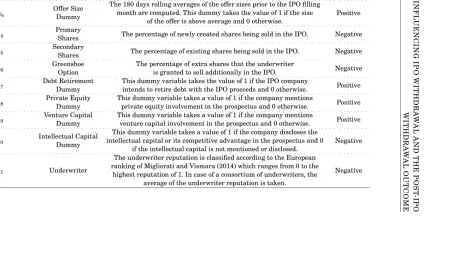
5.1 Variables and Sources . . . 79
7.1 Withdrawn and Successful IPOs 2001–2015 . . . 97
7.2 Descriptive Statistics – Europe 2001–2015 . . . 100
7.3 Determinants of IPO Withdrawal – Europe 2001–2015 . . . 103
7.4 Withdrawn and Successful IPOs in France 2001–2015 . . . 108
7.5 Descriptive Statistics – France 2001–2015 . . . 110
7.6 Determinants of IPO Withdrawal – France 2001–2015 . . . 112
7.7 Withdrawn and Successful IPOs in Germany 2001–2015 . . . 114
7.8 Descriptive Statistics – Germany 2001–2015 . . . 115
7.9 Determinants of IPO Withdrawal – Germany 2001–2015 . . . 117
7.10 Withdrawn and Successful IPOs in Italy 2001–2015 . . . 118
7.11 Descriptive Statistics – Italy 2001–2015 . . . 120
7.12 Determinants of IPO Withdrawal – Italy 2001–2015 . . . 122
7.13 Withdrawn and Successful IPOs in Spain 2001–2015 . . . 123
7.14 Descriptive Statistics – Spain 2001–2015 . . . 125
7.15 Withdrawn and Successful IPOs in the United Kingdom 2001–2015 . . 126
7.16 Descriptive Statistics – United Kingdom 2001–2015 . . . 128
7.18 Determinants of IPO Withdrawal – AIM 2001–2015 . . . 132
7.19 Determinants of IPO Withdrawal – Continental Europe 2001–2015 . . 136
7.20 Determinants of IPO Withdrawal – Crisis Dummy 2001–2015 . . . 137
7.21 Determinants of IPO Withdrawal – Stepwise Probit Regression 2001– 2015 . . . 138
7.22 Difference-in-Differences Model 2001–2015 . . . 140
7.23 Age Distribution 2001–2015 . . . 141
7.24 Determinants of IPO Withdrawal – Mature, Young and AIM Results 2001–2015 . . . 142
8.1 Descriptive Statistics of post-IPO Withdrawal Outcomes 2001–2015 . . 153
8.2 Determinants of post-IPO Withdrawal Outcomes 2001–2015 . . . 156
8.3 Survival Analysis of post-IPO Withdrawal Outcomes – Inactive 2001– 2015 . . . 160
8.4 Survival Analysis of post-IPO Withdrawal Outcomes – Merger & Ac-quisitions 2001–2015 . . . 162
8.5 Survival Analysis of post-IPO Withdrawal Outcomes – Trading 2001– 2015 . . . 165
8.6 Descriptive Statistics – non-backed versus backed IPO Withdrawals 2001–2015 . . . 169
8.7 Descriptive Statistics – PE Targets 2001–2015 . . . 172
8.8 Survival Analysis of post-IPO Withdrawal Outcomes – PE Target 2001–2015 . . . 173
8.9 Determinants of post-IPO Withdrawal Outcomes – Subset 2001–2015 . 179 8.10 Determinants of post-IPO Withdrawal Outcomes – Dummy Specifica-tion 2001–2015 . . . 180
8.11 Determinants of post-IPO Withdrawal Outcomes – Crisis Dummy 2001–2015 . . . 181
8.12 Determinants of post-IPO Withdrawal Outcomes – Stepwise Selection 2001–2015 . . . 182
8.13 Survival of post-IPO Withdrawal Outcomes – Stepwise Selection 2001– 2015 . . . 182
9.1 Withdrawn and Successful IPOs 2016–2017 . . . 186
9.2 Descriptive Statistics – Europe 2016–2017 . . . 189
9.4 Descriptive Statistics – Predicted IPO Probability 2016–2017 . . . 191
9.5 Average Predicted IPO Withdrawal Probability for Withdrawn and Successful IPOs 2016–2017 . . . 192
9.6 Average Predicted IPO Withdrawal Probability for Withdrawn and
Successful IPOs 2016–2017 according to Country . . . 193
9.7 Determinants of IPO Withdrawal – Europe 2016–2017 . . . 195
9.8 List of Withdrawn IPOs, Predicted Probability of IPO Withdrawal and
post-IPO Withdrawal Outcomes 2016 . . . 196
9.9 List of Withdrawn IPOs, Predicted Probability of IPO Withdrawal and
post-IPO Withdrawal Outcomes 2017 . . . 197
9.10 Average Predicted IPO Withdrawal Probability for PE backed and non-PE backed IPO Filings 2016–2017 . . . 199
9.11 Average Predicted IPO Withdrawal Probability for VC backed and
non-VC backed IPO Filings 2016–2017 . . . 200
9.12 Withdrawn and Successful IPOs 2016–2017 – Excluding∆GDP . . . . 206
9.13 Average Predicted IPO Withdrawal Probability for Withdrawn and
Successful IPOs 2016–2017 – Excluding∆GDP . . . 207
9.14 List of Determinants of IPO Withdrawal in Europe – Dummy
Specifi-cation 2001–2015 . . . 207
9.15 Withdrawn and Successful IPOs 2016–2017 – Dummy Specification . . 208 9.16 Average Predicted IPO Withdrawal Probability for Withdrawn and
Successful IPOs 2016–2017 – Dummy Specification . . . 209
B.1 Descriptive Statistics – Official List UK 2001–2015 . . . 224
FIGURE Page
2.1 Global IPO Volume in Numbers . . . 16
2.2 Global IPO Volume in USD mn . . . 16
2.3 Global IPO Volume and Number by Region . . . 17
2.4 Global IPO Volume by Major Countries . . . 17
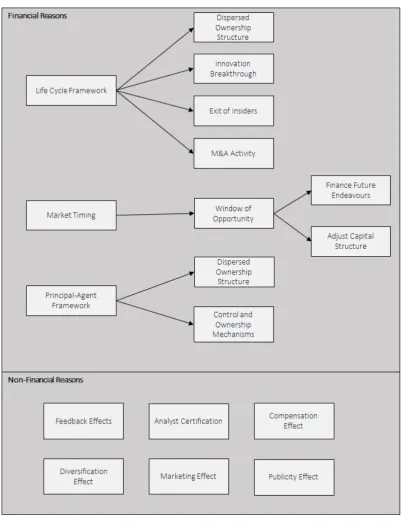
2.5 Overview of Reasons for Going Public . . . 21
2.6 Overview of the IPO Process . . . 22
2.7 Alternatives to an Initial Public Offering . . . 27
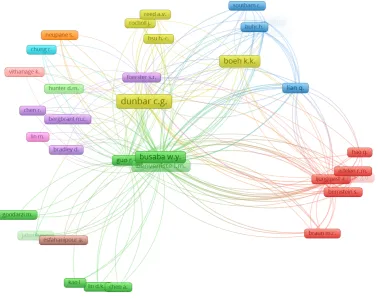
2.8 Journals – VOSViewer . . . 36
2.9 Most Frequent Keywords on IPO Withdrawal – VOSViewer . . . 37
2.10 Most Frequent Research Themes on IPO Withdrawal – VOSViewer . . 37
2.11 Most Recent Research Themes on IPO Withdrawal – VOSViewer . . . 38
2.12 Citations by Author – VOSviewer . . . 39
2.13 A Taxonomy of Withdrawal Theories Boeh and Dunbar (2013) . . . 41
3.1 IPO Numbers in Eastern and Western Europe 1970–2017 . . . 54
3.2 Distribution of IPO Filings in Eastern and Western Europe . . . 54
3.3 Number of IPO Filings in the European Dataset 2001–2017 . . . 56
5.1 Coverage of the Manually Collected IPO Database . . . 71
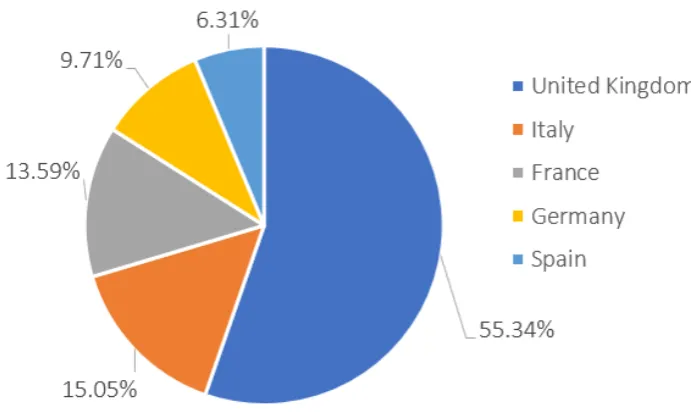
5.2 Distribution of IPO Filings per Country 2001–2015 . . . 72
5.3 Distribution of IPO Filings per Country 2016–2017 . . . 73
5.4 Possible Outcomes of an IPO Withdrawal . . . 74
5.5 Suggested Data Hierarchy . . . 76
7.1 IPO Listings and Withdrawals per Country in Comparison with the Country-specific IPO Withdrawal Rate 2001–2015 . . . 98
7.3 Negative Marginal Effects of the Determinants of IPO Withdrawal . . 106
7.4 Distribution of IPO Listings versus Withdrawals according to Industry in France 2001–2015 . . . 109
7.5 Distribution of IPO Listings versus Withdrawals according to Industry in Germany 2001–2015 . . . 113
7.6 Distribution of IPO Listings versus Withdrawals according to Industry in Italy 2001–2015 . . . 119
7.7 Distribution of IPO Listings versus Withdrawals according to Industry in Spain 2001–2015 . . . 124
7.8 Distribution of IPO Listings versus Withdrawals according to Industry and Exchange in the United Kingdom 2001–2015 . . . 127
8.1 Post-IPO Withdrawal Outcomes in Europe 2001–2015 . . . 149
8.2 Distribution of post-IPO Withdrawal Outcomes in the Sample of 296 IPO Withdrawals . . . 150
8.3 Distribution of post-IPO Withdrawal Outcomes per Country . . . 151
8.4 Survival of ‘inactive’ post-IPO Withdrawal Outcome . . . 161
8.5 Survival of ‘M&A’ post-IPO Withdrawal Outcome . . . 163
8.6 Survival of ‘trading’ post-IPO Withdrawal Outcome . . . 164
8.7 Superior post-IPO Withdrawal Outcomes for PE, VC and non-backed IPO Withdrawals . . . 166
8.8 Distribution of post-IPO Withdrawal Outcomes according to PE and VC Involvement . . . 167
8.9 Distribution of IPO Withdrawal Companies Acquired by PE . . . 170
8.10 Survival of PE Targets post-IPO Withdrawal . . . 174
9.1 IPO Listings and Withdrawals per Country in Comparison with the Country-specific IPO Withdrawal Rate 2016–2017 . . . 187
9.2 Average Predicted Probability of IPO Withdrawal according to post-IPO Withdrawal Outcomes 2001–2015 . . . 202
C
H
A
P
1
I
NTRODUCTION
A
n initial public offering (IPO) is fascinating. It marks the transition from a private to a public company. To gain access to equity markets, the firmmust file for an IPO. However, not all companies that file for an IPO end up
as public companies. Some withdraw from the IPO, despite the high financial and
organisational burden the withdrawal inflicts on the firm. Arguably, the decision
to go public, to launch an initial public offering, is one of the most important decisions in a company’s life cycle. The IPO process is undoubtedly linked to agency
conflicts in which potential investors and IPO insiders might come to diverging IPO
valuations. The IPO numbers and volume may vary from region to region, but the
phenomenon of IPO withdrawal is evident everywhere. This thesis aims to uncover
the determinants that influence the IPO withdrawal and post-IPO withdrawal
outcome as well as the prediction on the likelihood of IPO withdrawal. All common
stock IPOs between 2001 to 2017 in the largest economies in Western Europe
are examined. Regulatory, economic and market conditions as well as offer, firm
and corporate governance characteristics are explored. The European IPO setting
1.1
Background and Motivation
Why do companies, having filed for an initial public offering and incurred the costs
thereof, not follow through? What happens to companies after the IPO withdrawal?
And finally, is it possible to predict IPO withdrawal at the time a company first files
for an IPO? These are the questions I have been asking myself ever since learning
about Irish Denis O’Brien’s IPO withdrawal of Digicel in October 2015. Digicel
wanted to go public in the USA and filed the prospectus in June 2015. However, the news reported that Digicel withdrew from the IPO in October 2015. Only in
August 2016, did Digicel issue the following statement to defend the decision of
withdrawing the IPO:
“The Company is requesting such withdrawal in light of current
unfa-vorable market conditions that make any offering of common shares by
the Company inopportune.”1
In a newspaper article published in The Irish Times, Professor Jay Ritter argued (Carswell, 2015):
“For a company that is not growing with $ 2.8 billion in annual sales,
that is not profitable, a $ 4 billion – $ 5 billion valuation seems to be
pretty hard to justify and that appears to be the reaction they got from
the market.”
There seems to be a discrepancy in respect to the determinants of the IPO with-drawal proposed by Digicel and by Professor Jay Ritter. Digicel blames unfavourable
market conditions, much in contrast to Professor Jay Ritter who proposes firm
characteristics to have determined the IPO withdrawal. Digicel is not a unique
case of IPO withdrawal. In fact, around 30% of the companies in the USA that
file for an IPO withdraw, whereas the numbers for Europe are lower at 12%. The
culmination of complex market and firm level factors alongside the aftermath of
the IPO withdrawal is the true subject of this work. This doctoral thesis focuses on
the determinants, outcomes and predictions of IPO withdrawal aiming to uncover
and explain this IPO phenomenon in 21st-century Western Europe. To the best of my knowledge, this is the first study on completedandwithdrawn IPOs in Europe.
To date, all research on the extent and determinants of these withdrawals
have been conducted on US data, drawing an empirical conclusion based on one country alone. What determines the IPO withdrawal? What determines post-IPO
withdrawal outcomes? Can we predict an IPO withdrawal at the time of the IPO
filing?
1.2
Contribution
There are about a handful of publications, focusing on the US American market, which try to answer this question. These studies are dominantly of empirical nature.
Findings from US studies are often taken as evidence for Europe without further
proof. However, this might not hold true. Therefore, a gap of empirical work can be
identified for Europe as well as a lack of explanations for this specific kind of IPO
phenomenon: an IPO withdrawal.
This doctoral thesis attempts to fill the empirical gap, but more importantly
intends to shed light on the neglected IPO phenomenon of withdrawal within a
theoretical framework. This mostly empirical study will enrich the
understand-ing of European IPOs and market particularities. Insights into the determinants,
outcomes and predictions of IPO withdrawal inform us about the phenomenon
of an IPO itself. How can we understand the rationales, effects and institutional framework surrounding IPOs if we are unaware of a part of the puzzle? Empirical
evidence will help to illuminate what determines IPO withdrawal and why
compa-nies might make this decision. The results and findings on the post-IPO withdrawal
will help to identify dual-track strategies of IPO companies and whether an IPO
withdrawal is a negative or positive event. The determinants of IPO withdrawal
will provide a framework to predict likely candidates for an IPO withdrawal. The
results of this doctoral thesis also demonstrate the interplay between IPOs and
private equity (PE) transactions through empirical evidence on IPO withdrawal.
One major contribution of this thesis is the creation of a coherent and complete
European IPO filing database in English, for both completedandwithdrawn IPO offerings. A wide range of market data are gathered and considered. In particu-lar, an extensive range of firm specific IPO prospectus information are collected
manually. This makes this dataset unique in its extent, detail and depth.
to academics, practitioners and policy makers alike. Finally, I hope this research
will spark further research on a holistic IPO approach in academia which will be both empirically and theoretically driven. In essence, three research questions
are addressed and presented in separate chapters as outlined in the following
subsections.
1.2.1
What Determines IPO Withdrawal in Europe?
A key moment in a company’s life cycle is to go public: to launch an initial
pub-lic offering. While the benefits are clear, the IPO decision itself is always costly,
financially and organisationally. Why do companies not follow through with an IPO
after filing for one? This question is investigated by examining common stock IPOs
for the largest countries in Western Europe. This chapter analyses a dataset of
all IPO filings from 2001 to 2015 in France, Germany, Italy, Spain and the United Kingdom (UK). Regulatory, economic and market conditions as well as offer, firm
and corporate governance characteristics are explored.
In a probit model, key characteristics influencing the probability of withdrawal
are identified. A number of these stand in stark contrast to previous, US based
research on IPO withdrawal, questioning the empirical validity of previous
conclu-sions. Findings indicate that venture capital (VC) or private equity involvement,
the presence of negative news, CEO duality, or the intent to retire debtincreasesthe probability of IPO withdrawal. On the other hand, higher levels of corporate
gover-nance or trading volumedecreasethe probability of IPO withdrawal. It is argued that imminent agency conflicts and the lack of appropriate control mechanisms can force a company to withdraw from the IPO.
The larger the offer size, the higher the probability of withdrawal. One
possibil-ity is that larger issues are more likely to be withdrawn when they face scepticism
at the aggregated demand from potential investors (Benveniste et al., 2002). It is
assumed that this finding is driven by the determinants of IPO withdrawal in the
UK and France. The CEO duality dummy unexpectedly reduces the probability of
IPO withdrawal by almost 3% (Bhagat and Bolton, 2008). In the country-specific
analysis it is discovered that the results seem to be driven by France and Italy.
Latham and Braun (2010) clarify that in the end the decision of IPO withdrawal
resides with the CEO. Lock-up periods are important in Europe, while in
advantages mitigates information asymmetries in all countries but France and
Germany (Singh and van der Zahn, 2007). In particular, this observation provides demonstrable evidence for the benefits of disclosing information. Companies that
withdraw their IPOs disclose their intellectual capital or competitive advantages
less frequently which imposes a higher evaluation cost on the potential investors. In
conclusion, the benefit of information disclosure, which reduces the uncertainty of
the IPO company, exceeds the cost of the same. These findings signal the importance
of agency based theories in explaining IPO withdrawal in Europe.
A substantial portion of this thesis is dedicated to investigating the determi-nants of IPO withdrawal. Various robustness checks are conducted as this chapter
introduces the fundamentals for the second and third research questions. The
determinants of post-IPO withdrawal outcomes and predicting IPO withdrawal
are directly linked to the analysis of the determinants of IPO withdrawal. What
are the empirical and theoretical implications of the results? It is postulated that
Europe is different from the USA when it comes to the level and determinants of
IPO withdrawals. Therefore, this research aims to extend the empirical knowledge
on drivers of IPO withdrawal.
Drawing on the empirical evidence, the following theoretical implications for the
determinants of IPO withdrawal can be named. First, the observations made in this
chapter reinforce the argument by Owen-Smith et al. (2015) that the process of IPO
withdrawal is affected by a network of strong, weak, positive and negative signals.
Second, imminent agency conflicts and the lack of appropriate control mechanisms
can force a company to withdraw from the IPO. Third, the dominance of
firm-level determinants on the probability of withdrawal indicates that the life cycle
theory is important. As firms grow, a more dispersed ownership from insiders is
required, which is closely interlinked with potential agency conflicts (Chemmanur and Fulghieri, 1999). Finally, light is shed on the differences and similarities
between the determinants of IPO withdrawal under the lens of European equity
market integration. The empirical evidence reveals a pronounced alignment of the
country-specific determinants of IPO withdrawal.
Most companies that withdraw, blame unfavourable market conditions,
indi-cating that market timing theories can be used to explain IPO withdrawal. In this
study, however, IPO offer and corporate governance characteristics are identified as
US, while the determinants of withdrawal depend on the institutional and market
setting. It is argued that a further planned alignment in the European Union (EU) legislation will harmonise differences in the determinants of IPO withdrawal.
1.2.2
Sell or Die: What Happens to Firms after the IPO
Withdrawal?
This chapter analyses a unique dataset of all IPO filings from 2001 to 2015 in
France, Germany, Italy, Spain and the UK. Between 2001 and 2015, 296 IPO withdrawals can be documented for the European dataset. Having withdrawn, a
company can reissue. Withdrawn IPO companies might be perceived as riskier
and face the ‘lemon’ problem (Akerlof, 1970). Potential investors might find it
more difficult to distinguish between a ‘good’ and ‘bad’ withdrawn IPO company.
The post-withdrawal outcome of IPO candidates has received limited attention.
Surprisingly, we do not know much about the afterlife of an IPO withdrawal,
despite the frequency and importance of withdrawals. Regulatory, economic and
market conditions as well as offer, firm and corporate governance characteristics
are explored at the time of the IPO filing to uncover what happens to the company
after an IPO withdrawal. The post-IPO withdrawal events are divided into four possible categories: private, inactive, merger and acquisition (M&A) and trading.
The last two categories can be considered as a superior alternative to an IPO
withdrawal.
Companies that withdraw from the IPO predominantly blame unfavourable
market conditions for the IPO withdrawal. This means that we should be able to observe a large proportion of withdrawn companies returning to the market and
filing for a second time IPO. Another prevailing claim calls into question the quality
of the prospective IPO company. If we assume that the listing process is a filter
for identifying ‘bad’ candidates, we should consequently observe a major share of
‘inactive’ companies post-withdrawal. Over the last decade it has become more
common for companies to operate a dual-track approach (see Field and Karpoff
(2002) or more recently Aktas et al. (2018)) whereby, concurrent to the IPO filing,
trade sale opportunities are sought (Boeh and Dunbar, 2016). Such a dual-track
strategy should be observed through a large proportion of M&A post-withdrawal.
company is not dependent on going public.
Some interesting results crystallise. The majority of companies remain private
post-IPO withdrawal followed by M&A whereas only a small proportion successfully
files for a second time IPO. The univariate investigation reports better corporate
governance for backed IPO withdrawals which substantiates the importance of
agency costs in the IPO process. PE and VC backed companies that withdraw from
the IPO are more likely to have a superior alternative such as returning or engaging
in M&A. The empirical evidence indicates that VC and PE exit the withdrawn IPO companyshortlyafter the IPO filing. The particular institutionalised investment framework of PE and VC companies pressure a timely and lucrative exit. A survival
analysis setting reveals that companies exhibit a positive post-IPO withdrawal
outcome (M&A or trading) shortly after an IPO withdrawal while the rate of death is
constant. This leads to the conclusion that companies file for an IPO while pursuing
other alternatives. 44 companies (15%) that withdraw the IPO are acquired by
private equity. Consequently, it is hypothesised that private equity seizes the
opportunity and moves into withdrawn IPO companies that show low corporate
governance measurements. A majority of 61% of withdrawn IPO companies that are
targeted by PE post-IPO withdrawal are either backed by PE or VC. This serves as further evidence on secondary buyouts. PE and VC managers pursue a dual-track
strategy. The IPO is withdrawn in favour of a superior exit (Cumming, 2008).
This chapter supplements and contributes to the IPO as well as PE literature.
It further intends to expand the knowledge on the post-IPO withdrawal outcome
and provide empirical evidence. The results and augmentations will contribute to
the understanding of the afterlife and consequence of an IPO withdrawal. First, the determinants of the different post-IPO withdrawal outcomes are identified to
establish whether the withdrawal was in favour of a supposedly superior alternative.
This allows us to determine whether an IPO withdrawal is a positive or negative
event. It moreover implies that an IPO is one of several alternatives in which private
equity and venture capital pursue a dual-track strategy. Second, the post-IPO
withdrawal outcomes are explained under life cycle and agency conflict frameworks
rather than market timing arguments in consideration of the small number of
successful second time IPOs post-withdrawal. Better corporate governance at the
time of the IPO filing not only reduces the probability of IPO withdrawal but also
the prospective IPO company an attractive target for PE and M&A. To the best
of my knowledge, this chapter analyses the pattern of private equity moving into withdrawn IPO companies for the first time. Finally, the time-to-event for the
specific outcome reveals that the faith of the withdrawn IPO company is decided
within the first 24 to 48 months after the IPO filing.
Apart from the empirical implications, the theoretical implications suggest
that an IPO withdrawal is not per se a negative event. The IPO company can withdraw in favour of a superior alternative such as M&A and a second time IPO
(41%). The majority of IPO companies does not have a superior alternative after
an IPO withdrawal. One in four companies that did not sell dies, becomes inactive.
Therefore, the conclusion can be drawn that an IPO withdrawal and its afterlife
are driven by life cycle and agency conflict based ideas rather than market timing – at least in Europe.
1.2.3
Doomed to Failure: Predicting IPO Withdrawal
Can IPO withdrawal be predicted at the time of the IPO filing? In other words, are
certain IPO companies doomed to failure? In an effort to answer these questions,
the individual probability of IPO withdrawal is estimated for companies that filed
for an IPO between 2016 and 2017. Using the significant determinants of IPO
withdrawal identified in Chapter 7, the probability of withdrawal for all filings in
2016 and 2017 is estimated.
The numbers of successful versus withdrawn IPOs 2016–2017 are lower than in
previous years but generally show similarities in the wave like nature of IPO filings
in Europe. The average predicted probability for observed, withdrawn IPOs is 25% compared to 13% for successful IPOs with an estimated withdrawal rate of 14%.
The overall, yearly and country-specific withdrawal estimates indicate that IPO
withdrawal can be predicted, at least to a certain extent. It demonstrates that there
are common determinants of IPO withdrawal shared byallEuropean IPOs. This is especially interesting in light of the efforts to align financial markets in Europe
through various EU Directives. The sample size and data environment alike do
not allow for more sophisticated prediction models; nonetheless the predictions
and analyses do yield great insights as to the probability of IPO withdrawal. The
predicted effect asserts a positive relationship between the predicted withdrawal
case-by-case examination of withdrawn IPOs 2016–2017 provides further contextualisation
and evidence to accurately predict IPO withdrawal. It moreover illustrates the
indicative, in contrast to the absolute, nature of predicting IPO withdrawal. Overall, companies that file for an IPO exhibit a higher probability of IPO withdrawal when
private equity is involved which is less pronounced for venture capital.
This chapter contributes to and complements the existing literature on IPOs and
IPO withdrawal. First, the results suggest that IPO withdrawal can be predicted
and is not random. Second, the findings provide further evidence on the taxonomy
of IPO withdrawal. An IPO might be withdrawn in favour of a superior alternative
or because the benefits of remaining private exceed those of being publicly traded.
An IPO constitutes one alternative of several routes. Third, it implies that an IPO is not a negative event per se and that risk capital providers pursue a
dual-track strategy when filing for an IPO. Finally, it is demonstrated that there are
common determinants shared byallEuropean IPO companies that can predict IPO withdrawal, regardless of the particular stock exchange or country of domicile. The
absolute ‘cut-off probability’ that the IPO is withdrawn, however, is not determined
here. The predicted probability of IPO withdrawal can be used as an indication but
cannot be asserted as to the exact value. The estimated probability of withdrawal
1.3
Aims and Objectives
This thesis is a comprehensive investigation into three distinct questions about the
determinants, outcomes and predictions of IPO withdrawal in 21st-century Western Europe.
The aim of all three research questions is to minimise the research bias as much
as possible and to assure a certain distance from the investigation itself. This is
guaranteed through the creation of a comprehensive, systematic database and a
thorough methodology optimised for the three different investigations.
Distinct objectives can be identified for the three chapters that display and discuss the results obtained from the formal investigations (see Chapters 7, 8 and
9). A first objective is to derive, identify and examine the determinants of IPO
withdrawal to increase the understanding of this particular IPO phenomenon. A
second objective focuses on the understanding of the aftermath post-withdrawal.
The objective is to identify post-IPO withdrawal outcomes, explore how these
are determined and establish when the post-withdrawal event occurs. A third
objective is to test whether IPO withdrawal can be predicted to further increase
the understanding of the implications of a withdrawal. Overall, the objective of
this doctoral thesis is to increase accessibility and knowledge on completed and
1.4
Structure
Chapter 1 introduces the background, rationale, aims and objectives to set the
stage.
The next chapter provides the reader with the theoretical knowledge and
em-pirical evidence on IPOs and withdrawal.
Chapter 3 outlines the European IPO setting providing an introduction to the
history and particularities of the European IPO market.
Chapter 4 presents the philosophical position taken for this research and its
implications.
Chapter 5 introduces the dataset considered throughout the following chapters,
the data environment and data cleaning procedure.
Chapter 6 presents the entire methodology and methods utilised throughout
this doctoral dissertation.
The following chapters discuss the results obtained from the formal
investiga-tions into the different research quesinvestiga-tions outlined above.
Chapter 7 identifies and analyses the determinants of IPO withdrawal for the
consolidated European dataset employing a battery of robustness checks.
Chapter 8 discusses the different post-IPO withdrawal outcomes.
In Chapter 9, a model to predict IPO withdrawal is proposed, executed and
discussed.
Finally, Chapter 10 concludes and discusses the main contributions of this
1.5
Publications from this Doctoral Thesis
This PhD research was presented and discussed at the New Zealand Finance
Meeting, PhD Forum, Auckland Centre for Financial Research at the Faculty of
Business, Economics and Law in Queenstown in December 2018.
Larger parts of Chapter 2 are published in theInternational Review of Financial Analysis{ABS3} as:
• Helbing, P., A Review on IPO Withdrawal.International Review of Financial Analysis(2018).
Preliminary findings of Chapter 7 are published in theInternational Review of Financial Analysis{ABS3} as:
• Lucey, B.M., Future directions in international financial integration research
– A crowdsourced perspective. International Review of Financial Analysis
(2018).
Main findings of Chapter 7 are accepted for publication in the Journal of Corporate Finance{ABS4} as:
• Helbing, P., Lucey, B.M. and Vigne, S.A., The Determinants of IPO Withdrawal
– Evidence from Europe.
Large parts of Chapter 7 “What Determines IPO Withdrawal in Europe?” were
presented and discussed at various research seminars:
• Queen’s University Management School in March 2017
• Trinity Business School in November 2017
• Alliance Manchester Business School in May 2018
Large parts of Chapter 7 “What Determines IPO Withdrawal in Europe?” were
presented and discussed at various conferences:
• INFINITI Conference in Valencia in June 2017
• Money Macro and Finance Research Group in London in September 2017
• Eastern Finance Association in Philadelphia in April 2018
• European Financial Management Association in Milan in June 2018
Parts of Chapter 8 “Sell or Die: What Happens to Firms after the IPO
With-drawal?” were presented and discussed at various research seminars and
confer-ences:
• University of Liverpool Business School in October 2018
• University of Lille in November 2018
• INFINITI Conference in Poznan in June 2018
• British Accounting and Finance Association Corporate Finance and Asset
Pricing Symposium in Manchester in July 2018
• INFINITI Asia-Pacific in Syndey in December 2018
C
H
A
P
2
A R
EVIEW ON
IPO W
ITHDRAWAL
T
his chapter provides a thorough literature review to assure that the con-tribution can be pinpointed to gaps in the current academic knowledge. First, the motivation for an IPO is outlined. Second, the IPO process isdiscussed. Here, especially the roles of the underwriter as well as other advisors
are examined and the costs of the IPO portrayed. Third, alternatives to an initial
public offering that are proposed by academic research are briefly listed. Fourth, the
motivation for an IPO withdrawal is explored where IPO withdrawal frameworks
and a bibliometric perspective are given. Fifth, the scarce research on the afterlife
of an IPO withdrawal is reviewed. Finally, the factors influencing IPO withdrawal
and post-IPO withdrawal outcomes are introduced.
In this chapter, the status quo of knowledge about IPO withdrawal is
sum-marised and critically reviewed. The focus is set on contrasting the theoretical and
empirical evidence on the reasons of going public with the decision to withdraw from
the IPO. What can we learn from such a puzzling decision as an IPO withdrawal?
The findings of this literature review are threefold. First, the phenomenon of IPO
withdrawal is not specific to a country, jurisdiction or vintage. Second, there is a
surprising scarcity of research on IPO withdrawal in consideration of the economic
significance. Third, the presumption that market level determinants are the main
driver of IPO withdrawal is challenged. The existing theoretical and empirical
Figure 2.1: Global IPO Volume in Numbers
In the early 1980s the global IPO volume kicked off. Since, IPO volume and
numbers have increased throughout the globe with daily IPO filings. Starting in the mid 1990s a particular phenomenon emerges: a company files for an IPO but
does not follow through. The company cancels and withdraws from the IPO. Figure
2.1 depicts the global volume of IPO and indicates that the IPO withdrawal is a
side effect of the IPO mechanisms. The aggregated global IPO volume since 1980
accumulates to USD 4.36 trillion, about 12% are IPO withdrawals which constitute
foregone investment opportunities of around USD 0.54 trillion. Comparing Figures
2.1 and 2.2 the IPO withdrawal pattern of number and volume is similar over time
and follows the overall IPO filing pattern.
filings against IPO withdrawals from 1980 to 2017 are contrasted by region. Asia
shows the highest number of IPO filings, followed by North America, Europe and
Australia. The lowest IPO numbers are in the Middle East, Africa and Latin
America. The global withdrawal rate appears steady at 10-15% whereas a higher
rate is witnessed for North and Latin America. Europe has the highest IPO volume
in USD, with a lower number of IPO filings compared to Asia and North America
but a similar withdrawal rate. While the IPO numbers and volume may vary from
region to region, the phenomenon of IPO withdrawal is evident everywhere.
Figure 2.3: Global IPO Volume and Number by Region
Further breaking down the main drivers of the IPO market, USA and Canada
dominate the North American region. While China and Japan are the major players for Asia and the UK dominates Europe (see Figure 2.4). Most IPO volume and
quantity is attracted by few countries – though all show the phenomenon of IPO
withdrawal. An IPO withdrawal poses a puzzling event as the company incurs the
cost of filing for an IPO and possibly further costs when withdrawing from the very
same IPO.
2.1
Motivation for an IPO
Arguably, the decision to go public, to launch an initial public offering, is one of
the most important undertakings in a company’s life cycle. The IPO is a prime
source of information to the firm about its value. The price of the public company
aggregates the valuation of many potential investors (Grossman and Stiglitz, 1980).
The IPO phenomenon has attracted much attention in academic research. This
includes the arrays of the going public decision, IPO valuation, IPO underpricing,
IPO underperformance, and IPO withdrawal beyond others.
Understanding the motivation of companies to file for an IPO in the first place
holds valuable insights into understanding the motivation of companies to revoke
the very same decision and withdraw from the IPO. The company files for an IPO
when the benefits of being publicly traded exceed the insiders’ private benefits
(Loughran and Ritter, 1995). Research on the motivation for an IPO in the UK
suggests that either the company needs funds to finance growth, wants to take
advantage of market timing or is advised to go public by the investment bank
(Burton et al., 2006). Most explanations to uncover the decision to go public draw from life cycle, market timing or agency cost based theories (see Figure 2.5).
The life cycle framework entails that at some stage in a company’s life cycle it
becomes optimal to have a more dispersed ownership structure. The company goes
public in consequence. Early in the company’s life cycle it is beneficial to be private.
Chemmanur and Fulghieri (1999) hypothesise that when a firm grows sufficiently
large, it implies an IPO as the conclusive step in a company’s life cycle since a more
dispersed ownership is required; while the IPO marks the most important public information event, opening a two-way information channel. Bernstein (2015) posits
that companies choose to go public after innovation breakthroughs. An IPO can be
an attractive exit for insiders such as for venture capitalists or founders. Insiders
can (partially) cash out at the IPO. Zingales (1995) argues that by going public,
insiders facilitate the acquisition of their company. Insiders retain a certain level
of ownership to be converted into cash at a future date. Such transactions can be
easily executed in the light of the high level of liquidity of publicly traded shares
(Ritter and Welch, 2002). An IPO facilitates future acquisition activity in general
(Brau and Fawcett, 2006) and might be part of a firm’s subsequent takeover strategy
insiders, founders or for instance venture capitalists, sell the company at a higher
value when being public.
Under the market timing framework and in the presence of asymmetric
informa-tion, there will be divergence from the optimum price resulting in a temporary
over-and undervaluation of the company’s equity. Companies will aim to exploit this ‘window of opportunity’ and consequently file for an IPO in times of favourable
mar-ket overvaluation (Lowry, 2003). Companies will stay private when unfavourable
market conditions result in an undervaluation. Henceforth, when the market offer
price is below a fundamental value from insiders, the company remains private
(Loughran and Ritter, 1995).
It is suggested that an IPO is undertaken to finance future endeavours, to raise
capital (Benninga et al., 2005). Likewise, companies may go public to adjust their
capital structure given a favourable equity market timing environment (Baker and
Wurgler, 2002). Over the last decade it has become more common for companies to
operate a dual-track approach (see Field and Karpoff (2002) or more recently Aktas
et al. (2018)) whereby, concurrent with the IPO filing, trade sale opportunities are
also sought. Boeh and Dunbar (2016) argue that firms in positive cash requirement
should pursue a private placement alongside the IPO filing. However, in most cases the existence of a dual-track approach is only observable ex-post.
Principal-agent models play an important role when separating ownership
and control (Jensen and Meckling, 1976). Potential agency conflicts arise not only between potential investors (principals) and management (agents) in public
companies with a more dispersed ownership structure, but also between the IPO
company and its underwriter(s) or risk capital providers such as PE or VC sponsors.
In their study Brau and Fawcett (2006) ask chief financial officers about the reasons
for remaining private. Interestingly they demonstrate that most companies stay
private due to decision-making control and ownership reasons. Bancel and Mittoo
(2009) argue that, once public, the company is exposed to outsider monitoring which
can both be a substantial benefit or cost. The equity market mechanism can act as
a corporate control in reducing agency costs. On the downside, public companies must adhere to strict reporting, monitoring, and listing standards which can be
seen as a cost burden (Bessler et al., 2017).
Lowry et al. (2017) summarise different non-financial reasons why companies
valuation of many potential investors (Grossman and Stiglitz, 1980). Likewise, the
certification of analysts can yield benefits as the information production potentially reduces the uncertainty around the company and increases liquidity (Ljungqvist
et al., 2006). Chod and Lyandres (2011) argue that owners of public companies
can tolerate variability of profits due to their ability to diversify. This means that
public companies can improve their competitive position through riskier investment
strategies which might be a motivation to go public. The IPO puts the company in
the limelight. From a marketing perspective, the IPO can increase the reputation
as well as customer base. Finally, the IPO facilitates performance based stock
compensation. As a consequence, personnel can be attracted and retained better
(Lowry et al., 2017). Non-financial reasons such as increased publicity as well as reputation, which in consequence can enhance firm value, only play a subordinated
role according to Ritter and Welch (2002).
In summary, as displayed in Figure 2.5, there are vast financial and
non-financial reasons for companies to go public, to undertake an initial public offering.
Figure 2.5 represents a simplified overview on the financial and non-financial
reasons grouped by finance theory frameworks. It is noted that for illustration
purposes, the connections are simplified and not exhaustive but indeed ambiguous.
On purpose, the non-financial reasons are not linked to the finance concepts to
illustrate the shortcoming of the academic knowledge to integrate non-financial reasons into financial frameworks. Most likely, the reason for going public will affect
the decision to withdraw from the IPO. It indicates whether an IPO withdrawal
is a negative or positive event. For instance, if a company files for an IPO to
finance an investment, a dual-track private placement might be more beneficial
2.2
IPO process
The process of going public is multi-directional and complex. The IPO process
involves an array of decisions which include but are not limited to the timing of the IPO, the measures to ensure the success of the IPO, the afterlife of the IPO and the
option of alternatives to the IPO (Burton et al., 2006). The process of the IPO is
portrayed in Figure 2.6 which is purposely kept simple.
Figure 2.6: Overview of the IPO Process
Usually, the idea of going public organically grows in the company or is pushed
forward by risk capital providers such as venture capital or private equity investors
(Bancel and Mittoo, 2009). The prospective IPO company may be approached by
investment banks (Burton et al., 2006). The prospective IPO company must select
an underwriter to advise and underwrite the offer (Lowry et al., 2017). When a
company decides to go public for the first time, it must formally file for an initial
public offering at the corresponding regulatory authorities (Ritter, 1987). When the
intent is noticed with the respective authority, a preparation of a filing prospectus is generally required (Lowry and Schwert, 2004). Here, all registration documents
and requirements will be assessed for adequacy before the company can proceed
with its intent to go public. This process can span up to several weeks with multiple
meetings between the IPO company, the underwriter and other advisors (Barondes
et al., 2007). Finally, the prospectus is drafted to be filed at the corresponding
regulatory authorities (Hanley and Hoberg, 2010). In case all necessary regulatory
requirements are approved, the IPO company can proceed and eventually be listed
on the chosen stock-exchange within due time. The final offer price and exact
number of shares in the IPO are only released in the final prospectus. Usually the
2017). The underwriter takes care of the after-market stabilisation and deposits
the net proceeds from the IPO in the following days (Hogan, 1997).
The going public process usually takes several months and involves multiple parties (Boeh and Dunbar, 2014). While no two IPO processes are exactly the same,
there is a large degree of similarities of the IPO process. The next sub-sections
outlines the IPO underwriting process, the involvement of other advisors and the
direct as well as indirect costs of the IPO.
2.2.1
Underwriting of the IPO
The process of an IPO involves an underwriter to conduct the price discovery process
(Busaba and Chang, 2010). The IPO company employs a designated underwriter
with a letter of intent. Multiple investment banks can underwrite the IPO. In
recent years, IPOs tend to be underwritten by multiple investment banks as part of an underwriting syndicate (Corwin and Schultz, 2005). Carter and Manaster (1990)
and Krigman et al. (2001) establish a positive signalling effect of the underwriters’
reputation for the USA. While Klein et al. (2016) argue that companies in Europe
chose their underwriter not on reputation but by previous linkages. It is noted that
to a large extent the process by which underwriters set the offer price, allocate the
share or influence the IPO withdrawal is still unclear to the public and academics
alike. This is mainly due to the proprietary nature of private transaction data
between the underwriter and its customers and stakeholders.
The method that is predominantly used for companies going public is
book-building (Sherman, 2005). As described by Benveniste and Spindt (1989), the underwriter undertakes an analysis of the IPO company’s future prospects and
de-rives a price range. An IPO prospectus is created thereafter disclosing all necessary
and any additional information. The IPO company, together with the underwriter, is
thus trading-off the costs and benefits of the optimal level of information revelation
in order to increase the accuracy of price discovery (Sherman and Titman, 2002). In
case, particular negative or positive information is revealed during the registration
and listing process, an amended prospectus is drafted and published (Lowry et al.,
2017).
A roadshow follows where the IPO is promoted to mainly institutional investors
and interest is solicited (Ritter, 1987). Any interest in number and price of shares
of interest (Benveniste and Spindt, 1989). As Benveniste and Wilhelm (1990)
point out, the underwriter markets the offer in soliciting the interest from potential investors and henceforth is building the book. The underwriter gathers and assesses
the investors’ demand on the offer in an effort to incorporate as much information as
possible into the price discovery process (Busaba, 2006). The main advantage of the
bookbuilding is the information revelation from potential investors likewise from
the IPO company (Benveniste and Spindt, 1989). Work on the IPO bookbuilding
process in terms of information revelation casts doubt on the actual information
production in Europe (Jenkinson and Jones, 2004). The main role of the underwriter
is to provide and secure information on the market (Hogan, 1997).
After the IPO company is listed, the underwriter takes care of the provision of
analyst recommendations (Benveniste and Busaba, 1997) and stabilises the after-market (Hogan, 1997). During the IPO process the underwriter usually handles
the pricing, distribution, stabilisation as well as support of the equity issuance. The
IPO company relies on the expertise of the underwriter which introduces agency
conflicts such as moral hazard and adverse selection. The underwriter might not
act in the best interest of the IPO company. Jenkinson et al. (2018) question in
particular the role of the underwriter in the IPO allocation process. A quid pro
quo is asserted to the underwriter who determines the IPO allocation based on
underwriting revenue maximisation.
2.2.2
Other Advisors of the IPO
Apart from the underwriter, the IPO company hires different experts throughout the IPO process. In general, academic research is scarce in examining the specific
roles and influences of advisors other than underwriters in an initial public offering.
In Europe for instance, brokers are hired to promote the company to investors and
recently have been gradually more involved in the bookbuilding process (Burton
et al., 2006). The accounts of the prospective IPO company must be audited by
independent auditors to compile with the listing requirements (see Chapter 3.3).
Despite the legal requirement to include audited accounts in the IPO prospectus,
auditors play a dual role. First, auditors are hired to reveal financial information
about the IPO company to the potential investors. Second, auditors provide an
insurance role in case of fraud or audit failure (Willenborg, 1999). The main role
project financial future of the IPO company (Hogan, 1997). This attestation might
reduce the information asymmetry between the IPO company and the potential investors. The inverse relationship between the auditor and IPO underpricing is
most pronounced for higher quality auditors (Beatty, 1989).
Lawyers, accountants and public relations advisors are employed to either
assure fulfilment of the listing requirements or for promotional purposes. Other
advisors are less prominent in an initial public offering compared to underwriters,
nonetheless lawyers have a meaningful impact on the disclosure of information.
Lawyers exert control in the IPO process (Barondes et al., 2007). In a first attempt to
uncover the impact of law firms on IPO underpricing Bates et al. (2018) examine the
lawyer’s reputation. They identify a significant relationship between the lawyer’s
reputation and IPO underpricing. Almost all IPO companies hire legal advisors to ensure compliance with securities regulations. However, there is no further
published research on the role of the lawyer during the IPO.
2.2.3
Direct and Indirect Costs of the IPO
There is little evidence with respect to the costs associated with an initial public
offering due to the level of difficulty to obtain and quantify this information. Costs
of an IPO include but are not limited to direct costs such as hiring underwriters,
lawyers and auditors as well as paying listing fees. This suggests that an IPO is
extremely costly and time-consuming. The economic benefits of being public must
exceed the overall costs of the IPO (Burton et al., 2006).
In a survey with European CFOs, Bancel and Mittoo (2009) identify professional fees of underwriters, lawyers and accountants as the main direct IPO costs. Busaba
et al. (2015) refer to accounting, auditing, legal costs as well as the indirect cost
derived by management distraction to the offering as ‘filing’ costs. Legal and
auditing fees seem to be directly related to the level of informative content in the
prospectus (Hanley and Hoberg, 2010). In Europe, listing fees vary from stock
exchange and country and are discussed in Chapter 3.3. Applying economies of
scale to the direct costs of an IPO, the relative costs are higher for smaller IPO
companies than for larger issues (Krigman et al., 2001).
Bancel and Mittoo (2009) argue that European CFOs are less concerned about
direct costs but pay special attention to indirect costs arising by information
and accountants. This shift of focus from the day-to-day business to prepare the
IPO has often resulted in a short-term decline of the performance. Indirect costs of an IPO are especially difficult to quantify but include the dedication of vast
resources to going public, beyond others. Burton et al. (2006) estimate indirect
costs for the UK around 2–14%. The costs of underpricing is assumed to constitute
the majority part of the indirect costs (Ritter, 1987). Zingales (1995) also identifies
underpricing costs, ongoing compliance and disclosure costs as well as potential
agency costs to be among the most significant contributors to the costs of an IPO.
Ritter (1987) quantifies direct costs as well as underpricing to average around 21%
of the realised market value which can be considered notable.
An investigation into the direct and indirect costs associated with an initial public offering as well as an IPO withdrawal, while insightful, is beyond the scope
2.3
Alternatives to an IPO
There are alternative routes to an initial public offering that can be identified. In
Figure 2.7 several alternatives to going public are presented. Academic research is limited when it comes to contrasting different alternatives to an IPO. Most
proposed alternatives focus on financial reasons why a company wants to go public
in the first place.
Figure 2.7: Alternatives to an Initial Public Offering
The first proposed alternative to IPOs are mergers and acquisitions. Gao et al.
(2013) argue that M&A posit an alternative to going public. They show that this
trend has started in the mid-1990s. Rather than preparing an IPO and going public,
the company is merged or acquired. Signori and Vismara (2018) furthermore
argue that it is more beneficial for smaller companies to be acquired than to grow
organically through the life cycle. They hypothesise that the synergies from a M&A
exceed the benefits of growing independently through the life cycle. In particular,
instead of going public, the company can be acquired by PE or VC. Zingales (1995)
argues that the size of proceeds from a trade sale M&A is directly linked to the controlling rights.
Second, as listed in Figure 2.7 companies might divest through spin-offs or
sell-outs. A spin-off represents a split off from a unit or division from the parent
to the assets (Bergh et al., 2008). The generated cash flows can be used to finance
future growth or to service other investment needs. During investor optimism and particularly when market valuations are low compared to intrinsic asset values,
companies tend to spin-off assets. Underperforming assets are more likely to be
sold-off. Prezas and Simonyan (2015) furthermore show that companies have a
higher long-term operating performance after a sell-off rather than a spin-off. It is
noted that spin-offs and sell-offs are difficult to identify given the private nature of
the transactions.
Third, instead of the IPO, the company might prefer a private placement. It is
suggested that when information asymmetries are extreme, private placements
might be most beneficial. Private placements are evidenced to sell at a substantial discount compared to public offers. Still, lower direct and indirect costs are involved
with private placements compared to initial public offerings. Henceforth, a private
placement allows a company to raise a greater amount of capital, either equity or
debt (Hertzel and Smith, 1993). Cronqvist and Nilsson (2005) argue that corporate
control considerations as well as monitoring mechanisms are determining the
choice of a private placement. In summary, the decision to go public or raise funds
through other means is influenced by the motivation, shareholder structure and
2.4
Motivation for an IPO Withdrawal
Despite clearly understood benefits, there are costs to the decision to pursue an
initial public offering. Overt and hidden costs of going public, such as increased oversight for instance, can lower the number and volume of IPOs (Bessler et al.,
2017). In consequence, it is by all means not surprising to see a certain proportion
of IPO withdrawals.
An IPO withdrawal is universally defined as an event when a company files for
an IPO but does not follow through. An IPO withdrawal can either be done actively
or passively. Having filed for an IPO the company can actively cancel the filing or
passively not list in due time after filing for an IPO. Despite the involvement of
multiple other parties along the way to go public, it is assumed that the ultimate
decision to withdraw from the IPO resides with the CEO (Latham and Braun,
2010). Interestingly, there is divergence as to the regulatory requirement of an IPO
withdrawal. For instance, in the USA, the company must file its IPO withdrawal with the SEC (Form RW, SEC 2001 harbor Rule 155, Rule 457 and Rule 477).2In Europe, there is no such requirement, in fact the event of an IPO withdrawal is not
even mentioned in the EU or country directives (see Chapter 3).
At an initial public offering the company is valued for the first time. Due to
the limited information nature of private companies, information asymmetries are
identified during the price discovery process. Potential investors and IPO insiders
might come to diverging IPO valuations which leaves the IPO company to withdraw
its IPO (Loughran and Ritter, 1995). Under market timing theory, and assuming
asymmetric information, the valuation of an IPO company is influenced by a
variety of firm and non-firm specific characteristics (Allen and Faulhaber, 1989).
Status signalling as well as a combination of resource and information transfer
is identified by Owen-Smith et al. (2015) to influence this valuation. The IPO company and underwriter must consider the optimal level of information revelation
in conjunction with the desired accuracy of price discovery (Sherman and Titman,
2002). The equilibrium offer price can be noisy. Introducing signalling theory,
potential investors value the IPO company based on a subjective probability of expectation of future success. Owen-Smith et al. (2015) suggest that this valuation
is influenced by a network of strong and weak, positive and negative signals
represented by firm and non-firm characteristics.