warwick.ac.uk/lib-publications
Manuscript version: Author’s Accepted Manuscript
The version presented in WRAP is the author’s accepted manuscript and may differ from the
published version or Version of Record.
Persistent WRAP URL:
http://wrap.warwick.ac.uk/110666
How to cite:
Please refer to published version for the most recent bibliographic citation information.
If a published version is known of, the repository item page linked to above, will contain
details on accessing it.
Copyright and reuse:
The Warwick Research Archive Portal (WRAP) makes this work by researchers of the
University of Warwick available open access under the following conditions.
Copyright © and all moral rights to the version of the paper presented here belong to the
individual author(s) and/or other copyright owners. To the extent reasonable and
practicable the material made available in WRAP has been checked for eligibility before
being made available.
Copies of full items can be used for personal research or study, educational, or not-for-profit
purposes without prior permission or charge. Provided that the authors, title and full
bibliographic details are credited, a hyperlink and/or URL is given for the original metadata
page and the content is not changed in any way.
Publisher’s statement:
Please refer to the repository item page, publisher’s statement section, for further
information.
An
O
(
log
k
)
-competitive algorithm for Generalized Caching
∗ANNA ADAMASZEK,
University of Copenhagen, DenmarkARTUR CZUMAJ,
University of Warwick, UKMATTHIAS ENGLERT,
University of Warwick, UKHARALD RÄCKE,
Technical University Munich, GermanyIn the generalized caching problem, we have a set of pages and a cache of sizek. Each pagephas a sizewp ≥1 and fetching costcpfor loading the page into the cache. At any point in time, the sum of the sizes of the pages stored in the cache cannot exceedk. The input consists of a sequence of page requests. If a page is not present in the cache at the time it is requested, it has to be loaded into the cache incurring a cost ofcp.
We give a randomizedO(logk)-competitive online algorithm for the generalized caching problem, improving the previous bound ofO(log2k)by Bansal, Buchbinder, and Naor (STOC’08). This improved bound is tight and of the same order as the known bounds for the classic paging problem with uniform weights and sizes.
We use the same LP based techniques as Bansal et al. but provide improved and slightly simplified methods
for rounding fractional solutions online.
CCS Concepts: •Theory of computation→Caching and paging algorithms;Design and analysis of
algorithms;Online algorithms;
Additional Key Words and Phrases: Online primal dual, knapsack cover inequalities
ACM Reference Format:
Anna Adamaszek, Artur Czumaj, Matthias Englert, and Harald Räcke. 1111. AnO(logk)-competitive algorithm for Generalized Caching.ACM Trans. Algor.1, 1, Article 1 ( January 1111),18pages.https://doi.org/0000001. 0000001
1 INTRODUCTION
In the basic two-level caching problem we are given a collection ofnpagesand acache(a fast access memory). The cache has a limited capacity and can store up tokpages. At each time step a request to a specific page arrives and can be served directly if the corresponding page is in the cache; in that case no cost is incurred. If the requested page is not in the cache, a page fault occurs and in order to serve the request the page must be fetched into the cache, possibly evicting some other page, and a cost of one unit is incurred. The goal is to design an algorithm that specifies which page to evict in case of a fault such that the total cost incurred on the request sequence is minimized.
∗
A preliminary version of this paper appeared in proceedings of the 23rd ACM-SIAM Symposium on Discrete Algorithms
(SODA), 2012, pages 1681-1689.
Authors’ addresses: Anna Adamaszek, Department of Computer Science (DIKU), University of Copenhagen, Denmark,
[email protected]; Artur Czumaj, Department of Computer Science and Centre for Discrete Mathematics and its Applications
(DIMAP), University of Warwick, Coventry, UK, [email protected]; Matthias Englert, Department of Computer
Science and Centre for Discrete Mathematics and its Applications (DIMAP), University of Warwick, Coventry, UK, M.
[email protected]; Harald Räcke, Department for Informatics, Technical University Munich, Garching, Germany,
Permission to make digital or hard copies of all or part of this work for personal or classroom use is granted without fee
provided that copies are not made or distributed for profit or commercial advantage and that copies bear this notice and
the full citation on the first page. Copyrights for components of this work owned by others than ACM must be honored.
Abstracting with credit is permitted. To copy otherwise, or republish, to post on servers or to redistribute to lists, requires
prior specific permission and /or a fee. Request permissions from [email protected].
© 1111 Association for Computing Machinery.
1549-6325/1111/1-ART1 $15.00
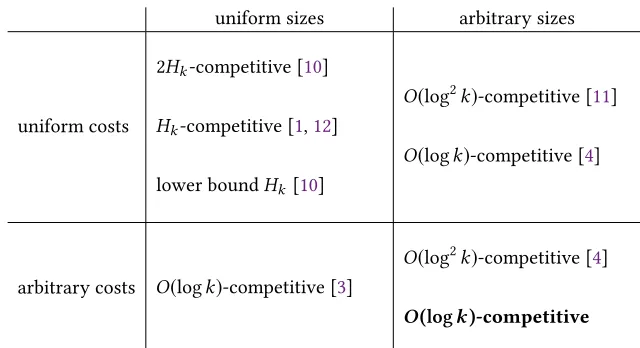
uniform sizes arbitrary sizes
uniform costs
2Hk-competitive [10]
Hk-competitive [1,12]
lower boundHk[10]
O(log2k)-competitive [11]
O(logk)-competitive [4]
arbitrary costs O(logk)-competitive [3]
O(log2k)-competitive [4]
[image:3.486.81.401.81.255.2]O(logk)-competitive
Table 1. An overview of the results for the online caching problem in the randomized setting. The new result is highlighted in bold.
This classical problem can be naturally extended to thegeneralized caching problem, by allowing pages to have non-uniform fetching costs and to have non-uniform sizes. In the general model we are given a collection ofnpages. Each pagepis described by a fetching costcp≥0 and a size wp ≥1. The cache has limited capacity and can only store pages up to a total size of at mostk. The framework of generalized caching has been motivated by applications in web caching and networking. The non-uniform sizes of the pages can correspond to the scenarios of caching web pages of different sizes, and the non-uniform costs of fetching a page can model scenarios in which the pages have different locations in a large network.
Various special cost models have been proposed in the literature. In thebit model[4,11], each page phascp=wp, and thus, for example, minimizing the fetching cost can correspond to minimizing the total traffic in the network. In thefault model[4,11], for each page we have the fetching cost cp =1 and the sizewpmay be arbitrary; in this case the fetching cost corresponds to the number of times a user has to wait for a page to be retrieved. In theweighted cachingmodel [3,11], for each pagepwe have the sizewp=1 and the fetching costcpmay be arbitrary; this models situations where some pages are more expensive to fetch than others because they may be on far away servers, or slower disks.
We consider theonlineversion of the generalized caching problem. In this version as soon as a page is requested, it has to be loaded into the cache, and while processing the request we have no information about the sequence of pages which will be requested later.
1.1 Related Work
The study of the caching problem with uniform sizes and costs (the paging problem) in the online setting has been initiated by Sleator and Tarjan [13] in their work that introduced the framework of competitive analysis. They show that well known paging rules like LRU (Least Recently Used) or FIFO (First In First Out) arek-competitive, and that this is the best competitive ratio that any deterministic algorithm can achieve.
online paging algorithm can be better thanHk-competitive. Subsequently, McGeoch and Sleator [12], and Achlioptas et al. [1] design randomized online algorithms that achieve this competitive ratio. Weighted caching, where pages have uniform sizes but can have arbitrary cost, has been studied extensively because of its relation to thek-server problem. The results for thek-server problem on trees due to Chrobak et al. [8] yield a tight deterministick-competitive algorithm for weighted caching. The randomized complexity of weighted caching has been resolved only recently, when Bansal et al. [3] designed a randomizedO(logk)-competitive algorithm.
The caching problem with non-uniform page sizes seems to be much harder. Already the offline version is NP-hard [11], and there was a sequence of results [2,9,11] that lead to the work of Bar-Noy et al. [5] which gives a 4-approximation for the offline problem.
For the online version, the first results consider special cases of the problem. Irani [11] shows that for the bit model and for the fault model in the deterministic case LRU is(k+1)-competitive. Cao and Irani [7], and Young [14], extend this result to the generalized caching problem.
In the randomized setting, Irani [11] gives anO(log2k)-competitive algorithm for both bit and fault models, but for the generalized caching problem noo(n)-competitive ratio was known until the work of Bansal et al. [4]. They show how to obtain a competitive ratio ofO(log2k)for the general model, and also a competitive ratio ofO(logk)for the bit model and the fault model.Table 1
presents an overview of the results for the online caching problem in the randomized setting. Since it has been known that no randomizedo(logk)-competitive online algorithm for general-ized caching exists, the central open problem in this area was whether it is possible to design a randomizedO(logk)-competitive algorithm.
1.2 Result and Techniques
We present a randomizedO(logk)-competitive online algorithm for the generalized caching problem, improving the previous bound ofO(log2k)by Bansal et al. [4]. This improved bound unifies all earlier results for special cases of the caching problem. It is asymptotically optimal as already for the problem with uniform page sizes and uniform fetching costs there is a lower bound ofΩ(logk) on the competitive ratio of any randomized online algorithm [10].
Our approach is similar to the approach used by Bansal, Buchbinder, and Naor in their results on weighted caching [3] and generalized caching [4]. In both these papers the authors first formulate a packing/covering linear program that forms a relaxation of the problem. They can solve this linear program in anonlinemanner by using the online primal-dual framework for packing and covering problems introduced by Buchbinder and Naor [6]. However, using the framework as a black-box only guarantees anO(logn)-factor between the cost of the solution obtained online and the cost of an optimal solution. They obtain anO(logk)-guarantee by tweaking the framework for this specific problem. Note that thisO(logk)-factor is optimal, i.e., in general one needs to lose a factor ofΩ(logk)when solving the LP online.
In the second step, they give a randomized rounding algorithm to transform the fractional solution into a sequence of integral cache states. Unfortunately, this step is quite involved. In [4] they give three different rounding algorithms for the general model and the more restrictive bit and fault models, where in particular the rounding for the fault model is quite complicated.
We use the same LP as Bansal et al. [4] and also the same algorithm for obtaining an online fractional solution. Our contribution is a more efficient and also simpler method for rounding the fractional solution online. In particular, our rounding algorithm maintains a distribution over only k2
We first give a rounding algorithm for monotone cost models (wherewp ≥wp′impliescp ≥cp′) and then extend it to work for the general model. Our rounding algorithm only loses a constant factor and, hence, we obtain anO(logk)-competitive algorithm for generalized caching.
2 THE LINEAR PROGRAM
This section describes an LP for the generalized caching problem. It also shows how to generate good variable assignments which are used in the rounding algorithm of the next section. Although there are some minor notational differences, this largely follows the work of Bansal, Buchbinder, and Naor [4].
We assume that cost is incurred when a page is evicted from the cache, not when it is loaded into the cache. This means we will not pay anything for the last time we load a page into the cache that remains in the cache at the end. In the general model, we may assume that the last request is always to a page of sizekand zero cost. This does not change the cost of any algorithm in the original cost model. However, it does ensure that the cost in our alternate cost model matches the cost in the original model.
We begin by describing an integer program IP for the generalized caching problem. The IP has variablesx(p,i)indicating if pagephas been evicted from the cache after the page has been requested for thei-th time. Ifx(p,i)=1, pagepwas evicted after thei-th request to pagepand has to be loaded back into the cache when the page is requested for the(i+1)-st time. The total cost is thenÍpÍicpx(p,i).
LetB(t)denote the set of pages that have been requested at least once until and including timet and letr(p,t)denote the number of requests to pagepuntil and including timet. In a time steptin which pagept is requested, the total size of pages other thanpt in the cache can be at mostk−wp
t . Thus, we require
Õ
p∈B(t)\{pt}
wp(1−x(p,r(p,t))) ≤k−wp
t .
Rewriting the constraint gives
Õ
p∈B(t)\{pt}
wpx(p,r(p,t)) ≥
Õ
p∈B(t)
wp−k .
To shorten the notation, we define the total weight of a set of pages S asW(S) := Íp∈Swp. Altogether, this results in the following IP formulation for the generalized caching problem.
min
Õ
p
Õ
i
cpx(p,i)
s.t.∀t :
Õ
p∈B(t)\{pt}
wpx(p,r(p,t)) ≥W(B(t)) −k
∀p,i : x(p,i) ∈ {0,1}
(IP 1)
To decrease the integrality gap of our final LP relaxation, we add additional, redundant constraints to the IP.
min
Õ
p
Õ
i
cpx(p,i)
s.t.∀t∀S⊆B(t):W(S)>k :
Õ
p∈S\{pt}
wpx(p,r(p,t)) ≥W(S) −k
∀p,i : x(p,i) ∈ {0,1}
(IP 2)
Procedure 1fix-set(S,t,x,y)
Input: Current time stept, current variable assignmentsxandy, a minimal setS⊆B(t).
Output: Terminates ifS becomes non-minimal or constraintt,S inprimal-LPis satisfied and returns the new assignments forxandy.
1: whileÍp∈S\{p
t}w˜pS·x(p,r(p,t))<W(S) −kdo{constraint fort,Sviolated}
2: infinitesimally increaseyS(t)
3: foreachp ∈Sdo
4: v:=Íτ:r(p,τ)=r(p,t),p ,pτ
Í
S⊆B(τ):p∈S,W(S)>kw˜pSyS(τ) −cp {vis a violation of the dual constraint forx(p,r(p,t))}
5: ifv ≥0thenx(p,r(p,t)):= 1
kexp v
cp
6: ifx(p,r(p,t))=1then return{Sis not minimal any more}
7: end for
8: end while
9: return {the primal constraint for steptand setSis fulfilled}
the constraints without affecting an integral solution. For this, we definew˜Sp Bmin{W(S) −k,wp}. Relaxing the integrality constraint, we obtain an LP. As shown in Observation 2.1 of Bansal et al. [4], we can assume without loss of generality thatx(p,i) ≤1. This results in the final LP formulation.
min
Õ
p
Õ
i
cpx(p,i)
s.t.∀t∀S⊆B(t):W(S)>k:
Õ
p∈S\{pt} ˜
wpSx(p,r(p,t)) ≥W(S) −k
∀p,i : x(p,i) ≥0
(primal-LP)
The dual ofprimal-LPis
max
Õ
t
Õ
S⊆B(t):W(S)>k
(W(S) −k)yS(t)
s.t.∀p,i :
Õ
t:r(p,t)=i,p,pt
Õ
S⊆B(t):p∈S,W(S)>k ˜ wS
pyS(t) ≤cp
∀t∀S⊆B(t):W(S)>k : yS(t) ≥0 .
(dual-LP)
Procedure 1will be called by our online rounding algorithm to generate assignments for the
LP variables. Note that, as the procedure will not be called for all violated constraints, the variable assignments will not necessarily result in a feasible solution toprimal-LPbut will have properties which are sufficient to guarantee that our rounding procedure produces a feasible solution. We assume that all primal and dual variables are initially zero.
Theorem 2.1. Letx(p,i)be the final variable assignments generated by successive calls to
Proce-dure 1(with different subsets). The total costÍ
pÍicpx(p,i)is at mostO(logk)times the cost of an optimal solution to the caching problem.
Observe that our online algorithm generates the calls toProcedure 1. Sometimes it may succeed in constructing a rounded solution from an infeasible assignment to thex(p,i)’s. In this case it will not continue to callProcedure 1and, hence, the final assignment to thex(p,i)’s may not be feasible. However, this is not a problem for the analysis.
3 THE ONLINE ALGORITHM
The online algorithm for the generalized caching problem works as follows. It computes primal and dual assignmentsxandyfor LPsprimal-LPanddual-LP, respectively, by repeatedly finding violated primal constraints and passing the constraint together with the current primal and dual solution toProcedure 1.
Procedure 2online-step(t)
1: x(pt,r(pt,t))B0 {put pagept into the cache} {some constraints may be violated}
2: SB{p∈B(t) |γ·x(p,r(p,t))<1}
3: whileconstraint forSis violateddo
4: fix-set(S,t,x,y) {change the current solution}
5: adjust distributionµto mirror newx
6: SB{p∈B(t) |γ ·x(p,r(p,t))<1}{recomputeS}
7: end while
{the constraints are fulfilled}
In addition to the fractional solutionsx andy, the online algorithm maintains a probability distribution over valid cache states. Specifically,µwill be the uniform distribution overk2subsets — each subset specifying the set of pages that are not present in the cache. Some of thek2subsets may be identical. A randomized algorithm then chooses a random numberrfrom[1, . . . ,k2]and behaves according to ther-th subset, i.e., whenever ther-th subset changes it performs the corresponding operations. Note that this rounding approach differs substantially from the results by Bansal, Buchbinder and Naor [3,4], since it constructs a distribution over a small number of cache states. The approaches in [3] and [4] do not allow to obtain a good upper bound on the number of states. We will design the distributionµin such a way that it closely mirrors the primal fractional solutionx. InSection 3.1we will show that each set in the support ofµis a complement of a valid cache state, i.e., the size constraints are fulfilled and the currently requested page is contained in the cache. InSection 3.2we will show the way of updatingµin such way that a change in the fractional solution of the LP that increases the fractional cost byεis accompanied by a change in the distributionµwith (expected) cost at mostO(ε).
The rounding algorithm loses only a constant factor, which gives us aO(logk)-competitive algorithm for generalized caching.
Procedure 2gives the outline of a single step of the online algorithm, whereγ is a scaling factor
L
S
0S
1 [image:8.486.157.326.91.268.2]S
i`w
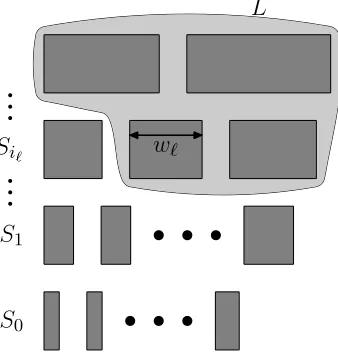
`Fig. 1. The size classesSiand the set of large pagesLobtained from the setS.
3.1 Ensuring that Cache States are Valid
We will set up some constraints for the sets in the support ofµ, which guarantee that the sets describe complements of valid cache states. In order to define these constraints we introduce the following notation.
Lettdenote the current time step and and setxp Bx(p,r(p,t)). Letγ ≥2 denote a scaling factor to be chosen later, and definezp Bmin{γxp,1}. The variablezpis a scaling of the primal fractional solutionxp. We also introduce a rounded version of the scaling: we define ¯zp B⌊k·zp⌋/k, which is simply the value ofzprounded down to the nearest multiple of 1/k. Note that due to the way the LP-solution is generated,zp>0 implies thatzp ≥γ/k. Therefore, rounding down can only change the value ofzpby a small factor. More precisely, we have ¯zp ≥ (1−1/γ) ·zp.
We useSto denote the set of pagespthat are fractional in the scaled solution, i.e., havezp <1 (or equivalently ¯zp <1). We divide these pages intosize classesas follows. The classSi contains pages whose size falls into the range[2i,2i+1). SeeFigure 1for an illustration.
We construct a setL⊆Sof “large pages” by selecting pages fromSin decreasing order of size (ties broken according to page-id) until either the values of ¯zfor the selected pages add up to at least 1, or all pages inShave been selected. We usewℓto denote the size of the smallest page inL, andiℓto denote its class-id. Note that this construction guarantees that either 1≤Íp∈Lz¯p <2 or L=S. The following claim shows that the second possibility only occurs when the weight ofSis small compared to the size of the cachekor while the online algorithm is serving a request (for example when the online algorithm iterates through the while-loop ofProcedure 2).
Claim 3.1. After a step of the online algorithm, we either have1≤Íp∈Lz¯p <2orW(S) ≤k.
Proof. IfW(S) ≤kthere is nothing to prove. Otherwise, we have to show that we do not run out of pages during the construction of the setL. Observe that after the while-loop ofProcedure 2
finishes, the linear program enforces the following condition for the subsetS:
Õ
p∈S
In particular, this means thatÍp∈Sxp ≥1 and henceÍp∈Sz¯p ≥ (1−1/γ)γ ≥1, asγ ≥2. Since the values of ¯zpfor the pagespinSsum up to at least 1, we will not run out of pages when constructing
L.
LetDdenote a subset of pages that are evicted from the cache. With a slight abuse of notation we also useDto denote the characteristic function of the set, i.e., for a pagepwe writeD(p)=1 if pbelongs toDandD(p)=0 if it does not. We are interested whether at timetthe setDdescribes a complement of a valid cache state.
Definition 3.2. We say that a subsetDof pagesγ-mirrorsthe fractional solutionxif:
(1)∀p ∈B(t): ¯zp=0impliesD(p)=0(i.e.,pis in the cache).
(2)∀p ∈B(t): ¯zp=1impliesD(p)=1(i.e.,pis evicted from the cache). (3)For each classSi:⌊Íp∈S
iz¯p⌋ ≤ Í
p∈SiD(p). (class constraints) (4) ⌊Íp∈Lz¯p⌋ ≤Íp∈LD(p). (large pages constraint)
Herez¯is the solution obtained after scalingxbyγand rounding down to multiples of1/k.
We refer to the constraints in the first two properties asintegrality constraints, to the constraints in the third property asclass constraints, and the constraint in the fourth property is called thelarge pages constraint.
Lemma 3.3. A subset of pages thatγ-mirrors the fractional solutionxto the linear program, describes a complement of a valid cache state forγ ≥16.
Proof. LetDdenote a set that mirrors the fractional solutionx. In order to show thatDis a complement of a valid cache state we need to show that the pageptwhich is accessed at timetis not contained inD, and that the size of all pages which are not inDsums up to at mostk.
Observe that the fractional solution is obtained by applyingProcedure 1. Therefore, at timetthe variablexp
t =x(pt,r(pt,t))has value 0. (It is set to 0 whenProcedure 2is called for timet, and it is not increased byProcedure 1.) Hence, we have ¯zp
t =0 andProperty 1inDefinition 3.2guarantees thatptis not inD.
It remains to show that the size of all pages which are not inDsums up to at mostk. This means we have to show
Õ
p∈B(t)\{pt}
wpD(p) ≥W(B(t)) −k . (1)
Because of the integrality constraints we have
Õ
p∈B(t)\{pt}
wpD(p)= Õ p∈B(t)\S
wpD(p)+ Õ p∈S\{pt}
wpD(p)=
= Õ
p∈B(t)\S
wp+
Õ
p∈S\{pt}
wpD(p)=W(B(t)) −W(S)+ Õ p∈S\{pt}
wpD(p) .
In order to obtainEquation 1it suffices to show that
Õ
p∈S\{pt}
wpD(p) ≥W(S) −k .
For the case thatW(S) ≤ k this is immediate, since the left hand side is always non-negative. Therefore in the following we can assume thatW(S)>k, and, hence, 1 ≤Íp∈Lz¯p <2 due to
Claim 3.1. Recall thatwℓis the size of the smallest page inL, and thatiℓdenotes the corresponding
If 2iℓ ≥W(S) −k, then
Õ
p∈S
wpD(p) ≥Õ p∈L
wpD(p) ≥2iℓ
Õ
p∈L
D(p) ≥2iℓ ≥W(S) −k ,
where the third inequality follows from the large pages constraint, and the fact thatÍp∈Lz¯p ≥1.
In the remainder of the proof we can assume 2iℓ <W(S) −k. We have
Õ
p∈S
wpD(p) ≥ Õ i≤iℓ
Õ
p∈Si wpD(p)
≥Õ
i≤iℓ
2i ·
Õ
p∈Si D(p)
≥Õ
i≤iℓ
2i ·
Õ
p∈Si ¯ zp−1
=1
2
Õ
i≤iℓ
Õ
p∈Si
2i+1z¯p−
Õ
i≤iℓ 2i
≥ 1
2
Õ
i≤iℓ Õ
p∈Si
wpz¯p−2iℓ+1
≥γ
4
Õ
i≤iℓ Õ
p∈Si ˜ wS
pxp−2(W(S) −k) .
(2)
Here the second inequality follows sincewp ≥2i forp∈Si, the third inequality follows from the class constraints, and the fourth inequality holds sincewp ≤2i+1forp ∈Si. The last inequality uses the fact that ¯zp≥ (1−1/γ)γxp ≥γ/2·xpfor everyp ∈S, and thatwp ≥w˜pS.
Using the fact that ¯zp ≥γ/2·xpwe get γ
4
Õ
p∈L\Siℓ ˜ wpSxp ≤
1 2
Õ
p∈L
˜ wpSz¯p ≤
1 2
(W(S) −k)Õ
p∈L
¯
zp≤W(S) −k ,
where the last inequality usesÍp∈Lz¯p ≤2. Adding the inequality 0≥ γ 4
Í
p∈L\Siℓw˜pSxp− (W(S) −k)
toEquation 2gives
Õ
p∈S
wpD(p) ≥γ
4
Õ
p∈S ˜ wS
pxp−3(W(S) −k) ≥ (γ/4−3)(W(S) −k) ≥W(S) −k ,
forγ ≥16. Here the second inequality holds because after serving a request the online algorithm guarantees that the constraintÍp∈Sw˜pSxp ≥W(S) −kis fulfilled for the current setS.
3.2 Updating the Distribution Online
We will show how to update the distributionµover subsets of pages online in such a way, that we can relate the update cost to the cost of our linear programming solutionx. We show that in each step the subsets in the support ofµmirrorthe current linear programming solution. Then
Lemma 3.3guarantees that we have a distribution over complements of valid cache states.
C
i`C
i2C
i1C
i0 [image:11.486.100.385.80.185.2]S
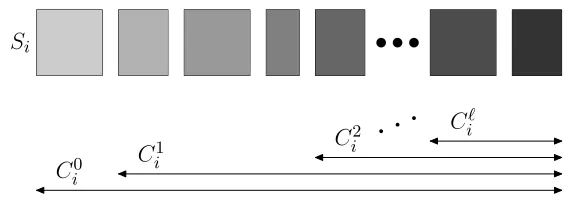
iFig. 2. Cost classes.
From these two distributions we obtain the distributionµas follows. We sample a subsetD1 from the first distribution and a subsetD2from the second distribution, and computeD=D1∪D2 (orD=max{D1,D2}ifDis viewed as the characteristic function of the set).
Clearly, if both setsD1andD2fulfillProperty 1fromDefinition 3.2, then the union fulfills
Prop-erty 1. Furthermore, if one ofD1,D2fulfills one of the properties 2, 3, or 4, then the corresponding
property is fulfilled by the union as these properties only specify a lower bound on the characteristic functionD.
We will constructµ1andµ2to be uniform distributions overk subsets. Then the combined distributionµis a uniform distribution overk2subsets, where some of the subsets may be identical. In the following we assume that the values of ¯zpchange in single steps by 1/k. This is actually not true. Consider for exampleLine 1ofProcedure 2where, after the time stept is increased, the variablex(pt,r(pt,t))is set to 0. Asxp
t is a shorthand forx(pt,r(pt,t)), the value ofxpt, and therefore also the value of ¯zp
t, is set to 0. However, the drop in the value of ¯zpt larger than 1/kcan be simulated by several consecutive changes by a value of 1/k.
3.2.1 Maintaining Distributionµ1. In order to be able to maintain the distributionµ1at a small cost we strengthen the conditions that the setsDin the support ofµ1have to fulfill. For each size classSiwe introducecost classesCi0,C1i, . . . whereCis ={p ∈Si :cp ≥2s}(seeFigure 2). Note that we haveSi =C0
i.
For the subsetsDin the support ofµ1we require
A. For each subsetD, for each size classSi, and for all cost classesCs
i
Õ
p∈Cs i ¯ zp
≤Õ
p∈Cs i D
(p) ≤
Õ
p∈Cs i ¯ zp
.
B. For each pagep
Õ
DD(p) ·µ1(D)=z¯p .
Note that the first set of constraints ensures that class constraints are fulfilled. This holds because C0
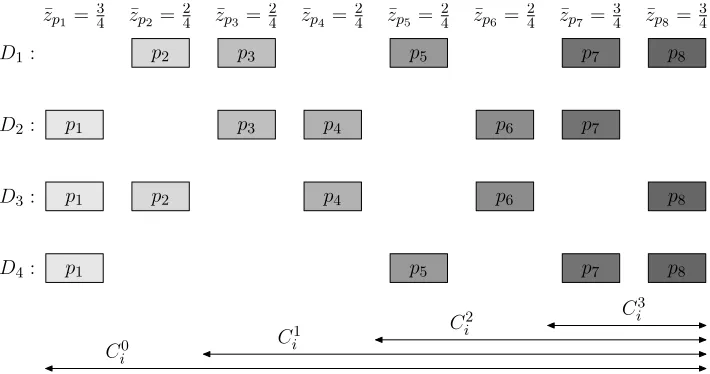
i =Si. Hence, the left inequality forCi0is exactly the class constraint for classSi. The second set of constraints imply the integrality constraints. An example of a distribution that satisfies the constraintsAandBis given inFigure 3.
Increasingz¯p.Suppose that for some pagepthe value of ¯zpincreases by 1/k(seeFigure 4for an example). Assume thatp ∈ Si andcp ∈ [2r,2r+1), i.e.,p ∈C0i, . . . ,Cir. As we have to satisfy the propertyÍDD(p)µ1(D) =z¯p, we have to add the pagep to a setD
D1:
D2:
D3:
D4:
¯
zp1=
3
4 ¯zp2 =
2
4 z¯p3=
2
4 z¯p4 =
2
4 z¯p5=
2
4 z¯p6=
2
4 z¯p7 =
3
4 z¯p8=
3 4 p1 p1 p1 p2 p2 p3
p3 p4
p4 p5 p5 p6 p6 p7 p7 p7 p8 p8 p8
Ci3 Ci2
C1
i
[image:12.486.66.421.93.280.2]Ci0
Fig. 3. An example of distributionµ1for the cache of sizek=4and the set of pagesSi ={p1,p2, . . . ,p8}. The
valuesz¯p
i are given at the top of the figure.µ1is a uniform distribution over4sets:D1={p2,p3,p5,p7,p8},
D2={p1,p3,p4,p6,p7},D3={p1,p2,p4,p6,p8}, andD4={p1,p5,p7,p8}. ConstraintsAandBare satisfied.
However, after this step some of the constraints
Õ
p∈Csi ¯ zp
≤Õ
p∈Csi D(p) ≤
Õ
p∈Cis ¯ zp
corresponding to the cost classesCs
i fors ≤ r may become violated. We repair the violated constraints step by step froms=r to 0. We do that by moving the pages between the setsDin such a way, that while repairing the constraints for the cost classCis we keep the following invariant: all but one of the setsDfrom the support ofµhave the same number of pages from the setCsi, as they had before we increased the value of ¯zp. The remaining set, which we denote byD+, has one additional page. At the beginningD+=D∗.
Notice thatÍp∈Cs i z¯p =
Í
DÍp∈Cs
i D(p) ·µ1(D)is equal to the average number of pages fromCsi that a set in the support ofµ1has. If the number of pages fromCsi in the setsDin the support of µ1differs by at most one, each set has either⌊Íp∈Cs
iz¯p⌋or⌈ Í
p∈Cisz¯p⌉pages fromCsi, and all the constraints forCis are satisfied.
Fixs and assume that the constraints hold for alls′ > s, but some are violated fors. Let aB⌈Íp∈Cisz¯p−
1
k⌉, i.e., before increasing the value of ¯zpeach setDcontained at mosta, and at leasta−1, pages fromCis. As the only set that has now a different number of pages fromCis isD+, and some constraints forCis are violated, it must be the case thatD+has nowa+1 pages from Cs
i, and some setD′with positive support inµ1hasa−1 pages fromCis. The constraints forCs+ 1
i
are satisfied, so the number of pages in classCis+1differs by at most 1 betweenD+andD′. Hence, there must exist a page inCs
D1:
D2:
D3:
D4: ¯
zp1 = 3 4 ¯zp2=
2 4 z¯p3=
2 4 z¯p4 =
2 4 z¯p5 =
2 4 ¯zp6=
3 4 z¯p7=
3 4 z¯p8=
3 4 p1 p1 p1 p2 p2 p3
p3 p4
p4 p5 p5 p6 p6 p6 p7 p7 p7 p8 p8 p8 C3 i C2 i
Ci1 C0
i
a)
D1:
D2:
D3:
D4: p1 p1 p1 p2 p2 p3
p3 p4
p4 p5 p5 p5 p6 p6 p6 p7 p7 p7 p8 p8 p8 b)
D1:
D2:
D3:
D4:
p1 p1 p1 p2 p2 p2 p3
p3 p4
[image:13.486.65.420.92.521.2]p4 p5 p5 p6 p6 p6 p7 p7 p7 p8 p8 p8 c)
Fig. 4. In the setting as inFigure 3the value ofz¯p
6increases by1/k=1/4.a)To satisfyConstraint B, we add
pagep6to the setD4. After this modificationConstraint Ais not satisfied for the cost classC2
i ={p5,p6,p7,p8}
and the setD4.b)To satisfyConstraint Afor the cost classC2
i we move the pagep5fromD4toD3. Now
Constraint Ais satisfied for the cost classesC3
i,Ci2andCi1, but it is violated forCi0and the setsD3,D4.c)To
satisfyConstraint Afor the cost classC0
i we move the pagep2fromD3toD4. Now all the constraints are
Performing the above procedure incurs expected cost of 2s+1/kforsfromr to 0. In total we have expected costO(2r/k). The increase of ¯zpincreases the LP-cost by at least 2r/k. Therefore, the cost in maintaining the distributionµ1can be amortized against the increase in LP-cost.
Decreasingz¯p. When for some pagepthe value of ¯zpdecreases, we have to delete the pagep from a setDin the support ofµ1that currently containsp. The analysis for this case is completely analogous to the case of an increase in ¯zp. The resulting cost ofO(2r/k), wherecp ∈ [2r,2r+1), can be amortized against the cost of LP — at a loss of a constant factor we can amortizeO(2r/k)against the cost of LP when the value of ¯zpincreases, and the same amount when the value of ¯zpdecreases.
Change of the setS. The class constraints depend on the setS that is dynamically changing. Therefore we have to check whether the constraints are fulfilled if a page enters or leaves the set S. When a pagepwithcp ∈ [2r,2r+1)increases its ¯zp value to 1 we first add it to the only set in the support ofµ1that does not contain it. This induces an expected cost of at most 2r+1/k. Then we fixConstraint A, as described in the procedure for increasing a ¯zp value. This also induces expected costO(2r/k). After that we remove the page from the setS.Constraint Awill still be valid because for every cost classCis that containspand for every setDin the support ofµ1the values ofÍp∈Cs
i z¯pand Í
p∈Csi D(p)change by exactly 1.
3.2.2 Maintaining Distributionµ2. We will show how to maintain a distributionµ2over subsets of pages, such that each setDin the support ofµ2fulfills the large pages constraint and does not contain any pagepfor which ¯zp=0. Note that asÍp∈Lz¯p <2, the large pages constraint can be reformulated as follows: ifÍp∈Lz¯p ≥1 then each subsetDin the support ofµ2contains at least one page from the set of large pagesL.
In the following we introduce an alternative way of thinking about this problem. A variable ¯zp can be in one ofk+1 different states{0,1/k,2/k, . . . ,1−1/k,1}. We view thek−1 non-integral states aspoints. We say that theℓ-th point for pagepappears(orbecomes active) if the value of ¯zp changes from(ℓ−1)/k toℓ/k. Points can disappear for two reasons. Suppose theℓ-th point for pagepis active. We say that itdisappears(orbecomes inactive) if either the value of ¯zpdecreases fromℓ/kto(ℓ−1)/k, or when the value of ¯zpreaches 1.
Note that if for a pagepwe have ¯zp =1, the pagepis not in the setS, and it only entersSonce the value of ¯zpis decreased to 0 again. The appearance of a point for pagepcorresponds to a cost ofcp/kof the LP-solution. At a loss of a factor of 2 we can also amortizecp/kagainst the cost of the LP-solution when a point for pagepdisappears.
Observation 3.4. The set of pages with active points is the set of pages inSwith the valuez¯p,0.
The above observation says that if we guarantee that a setDin the support ofµ2can contain only those pages fromSwhich have an active point, we guarantee one of our constraints — the set Ddoes not contain any pagepfor which ¯zp =0.
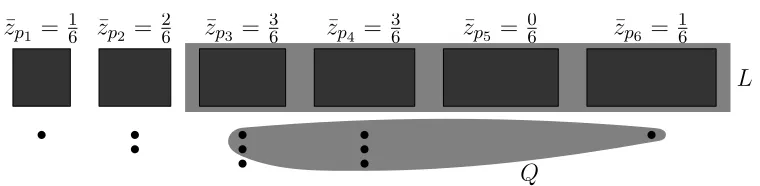
We assign priorities to the active points, according to the size of the corresponding page, where points corresponding to larger pages have higher priorities. Ties are broken first according to page-ids, and then to the point-numbers. At any time step,Qdenotes the set of thekactive points with highest priority, or all active points if there are less thank (seeFigure 5). The following observation follows directly from the definition ofQ andL, as we used the same tie-breaking mechanisms for both constructions.
Observation 3.5. For any time step, the set of pagespinLthat have a value ofz¯p,0is exactly the set of pages that have at least one point inQ.
L
¯
z
p1=
16z
¯
p2=
26z
¯
p3=
36z
¯
p4=
3
6
z
¯
p5=
06
z
¯
p6=
1 6 [image:15.486.54.434.78.171.2]Q
Fig. 5. Each pagep∈Swithz¯p=i/khasicorresponding points (herek=6). The set ofkpoints with highest
priority (Q) and the set of large pages (L) are marked in grey.
time theℓ-th set consists of pages for which one of the corresponding points has labelℓ. In general we will allow a point to have several labels. Note that this definition of the sets in the support ofµ2 directly ensures that a page that has ¯zp=0 is not contained in any set in the support ofµ2, because a page with this property does not have any active points.
Adding a label to a pointqincreases the expected cost of the online algorithm by at mostcp(q)/k, wherep(q)is the page corresponding to the pointq. Deleting a label is for free, and in particular if a point disappears (meaning its labels also disappear), the online algorithm has no direct cost while we can still amortizecp/kagainst the LP-cost.
The following observation forms the basis for our method of maintaining the distributionµ2.
Observation 3.6. If the points inQ have different labels, then all sets in the support of the distributionµ2fulfill the large pages constraint.
This means that we only have to show that there is a labeling scheme that on one hand has a small re-labeling cost, i.e., the cost for re-labeling can be related to the cost of the LP-solution, and that on the other hand guarantees that at any point in time no two points fromQhave the same label. We first show that a very simple scheme exists if the cost function is monotone in the page size, i.e.,wp ≤wp′impliescp ≤cp′for any two pagesp,p′. Note that the bit model and the fault model that have been analyzed by Bansal et al. [4] have monotone cost functions. Therefore, the following section gives an alternative proof for anO(logk)-competitive algorithm for these cost models.
3.2.3 Maintainingµ2for Monotone Cost.We show how to maintain a labeling of the setQsuch that all labels assigned to points are different. Assume that currently every point in the setQhas a single unique label.
Appearance of a pointq. Suppose that a new pointqarrives. Ifqdoes not belong to thek points with the highest priority, it will not be added toQand we do not have to do anything.
If the setQcurrently contains strictly less thankpoints, then the new point will be contained in the new setQ, but at least one of theklabels has not been used before and we can labelqwith it. In the new setQall points have different labels. The online algorithm paid a cost ofcp(q)/k, where p(q)denotes the page corresponding to the pointq.
IfQ already containsk pages, then upon appearance ofq, a pointq′ with lower priority is removed fromQandqis added. We can assign the label ofq′to the new pointq, and then all points in the new setQhave different labels. Again the online algorithm pays a cost ofcp(q)/k.
In all cases the online algorithm pays at mostcp(q)/kwhereas the LP-cost iscp(q)/k.
¯
z
p1=
1 6
c
p1= 5
¯
z
p2=
2 6
c
p2= 2
¯
z
p3=
3 6
c
p3= 3
¯
z
p4=
3 6
c
p4= 6
¯
z
p5=
0 6
c
p5= 1
¯
z
p6=
1 6
c
p6= 1
Q
0Q
1 [image:16.486.59.435.73.203.2]Q
2Fig. 6. Each pagep∈Swithz¯p=i/khasicorresponding points (herek=6). The setsQiof points with the
highest priority that correspond to the pages with cost at least2i have been marked. The setsQ0andQ1
havekpoints each, and the setQ2has less thankpoints.
points in total). We giveq′the same label thatqhad. This incurs a cost ofcp(q′)/k ≤cp(q)/k, where the inequality holds due to the monotonicity of the cost function (note that this is the only place where monotonicity is used). Since we can amortizecp(q)/kagainst the cost of the LP-solution we are competitive.
3.2.4 Maintainingµ2for General Cost.We want to assign labels to points inQin such a way that we are guaranteed to seekdifferent labels if the setQcontains at leastkpoints. In the last section we did this by always assigning different labels to points inQ. For the case of general cost functions we proceed differently.
LetQi denote the set ofkactive points with the highest priority that correspond to pages with cost at least 2i. In case there are less thanksuch points,Qi contains all active points corresponding to pages with cost at least 2i (seeFigure 6). Note that Q=Q0.
Essentially our goal is to have a labeling scheme with small re-labeling cost that guarantees that each setQi sees at least|Qi|different labels. SinceQ =Q0, this gives the desired result. However, for the case of general cost, it will not be sufficient any more to assign unique labels to points, but we will sometimes be assigning several different labels to the same point. At first glance, this may make a re-labeling step very expensive in case a point with a lot of labels disappears.
To avoid this problem we say that a setQi has to commit to a unique label for every pointq contained in it, where the chosen label is from the set of all labels assigned toq(seeFigure 7). The constraint forQi is that it commits to different labels for all points contained in it. If a point currently has labelsℓandℓ′, then a setQi may either commit toℓorℓ′, but furthermore during an update operation it may switch the label it commits to for free, i.e., no cost is charged to the online algorithm. Recall that if a point corresponding to a pagephas several labels then all setsD corresponding to these labels contain the pagep; therefore committing to a different label is for free as no change has to be made for any setDfrom the support ofµ2. The label to which a setQi commits for a pointq∈Qi is denoted byQi(q).
Q
0:
Q
1:
Q
2:
{
1
,
2
}
{
4
}
4
{
3
}
{
2
,
3
}
2
3
{
1
,
4
}
4
{
2
}
2
2
{
1
}
1
1
1
{
3
,
4
}
3
4
[image:17.486.76.397.77.218.2]3
Fig. 7. Labelings for the setsQi (k =4). The8active points are ordered increasingly with respect to the
priority. The size of the dots corresponds do the cost of1,2or4of the respective pages — larger dots represent
larger costs. Each point has a set of labels assigned to it. Each setQi contains4points with the highest
priorities amongst the points with cost at least2i. For each setQiwe are given a valid labeling.
It remains to adjust the labeling so that the labeling of every setQibecomes valid again. The sets Qs wheres >r are not affected by the appearance ofq0, and their labelings remain valid. We only have to fix the labelings for the setsQs wheres ≤r. We will do this while only paying at most O(2s/k)for everys ≤r. This cost can be amortized against the cost of the LP.
Assume that labelings for all setsQs′wheres′>sare valid, but the labeling forQs is violated. We want to fix it, paying onlyO(2s/k). We call a labelℓaduplicate labelforQs if there exist two points inQs for whichQs commits toℓ. We call the corresponding pointsduplicate points. The labeling is valid iff there exist no duplicate points. We call a labelℓfreeforQs if currently there is no point inQsfor whichQs commits toℓ. When we start processingQs there exists at most one duplicate label, namely the labelℓ0that we assigned toq0, and for which we haveQs(q0)=ℓ0.
Since the total number of labels isk and there are at mostkpoints inQs, there must exist a free labelℓfree. We could fix the condition forQs by assigning the labelℓfreeto one of the duplicate pointsq, and settingQs(q)=ℓfree. However, this would create a cost that depends on the cost of the page corresponding to the chosen pointq. This may be too large, as our aim is to only pay O(2s/k)for fixing the condition for setQs. Therefore, we will successively switch the labels that Qscommits to for the duplicate points, until the cost of one of the duplicate pointsqis in[2s,2s+1). During this process we will maintain the invariant that there are at most two duplicate points for Qs. Hence, in the end we can assign the free labelℓfreeto a duplicate pointqwith cost at most 2s+
1 , setQs(q)=ℓfree, and obtain a valid labeling forQs.
The process of switching the labels for the setQs is as follows. Suppose that currentlyℓdenotes the duplicate label and that the two duplicate points both correspond to pages with cost at least 2s+1. This means that both points are in the setQs+1. As the labeling forQs+1is valid, we know thatQs+1commits to different labels for these points. One of these labels must differ fromℓ. Letq
′
denote the duplicate point for whichQs+1commits to a labelℓ ′
,ℓ. We setQs(q′)=ℓ′. Now,ℓ′ may be the new duplicate label for the setQs.
Q
0:
Q
1:
Q
2:
{
1
,
2
}
{
2
,
4
}
4
→
2
{
3
}
{
2
,
3
}
2
3
→
2
{
1
,
4
}
4
{
2
}
2
2
{
1
}
1
1
1
{
3
,
4
}
3
4
→
3
3
{
4
}
4
4
[image:18.486.61.422.74.219.2]4
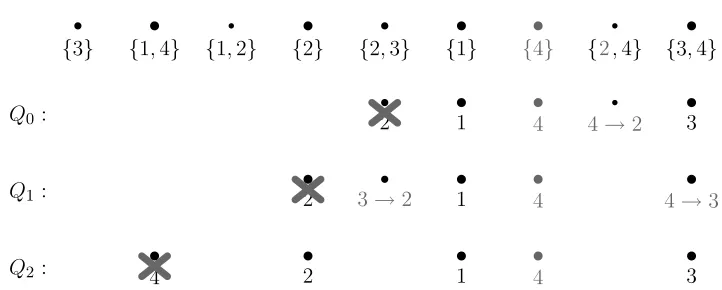
Fig. 8. In the setting as inFigure 7a new point (marked in grey) arrives, which is assigned Label4. Then the
point with lowest priority disappears from eachQi. AfterwardsQ2containskdifferent labels. ForQ1the rightmost element re-commits to Label3, and afterwards the label of the leftmost element is changed to2at
small cost. ForQ0only the label of the third element is changed.
An example of fixing the labeling after adding a new point can be seen inFigure 8. As we only pay cost 2s+1/kfor fixing the labeling ofQs, the total payment summed over all setsQs withs ≤r isO(2r/k), which can be amortized to the cost of LP.
Disappearance of a pointq. Now, suppose that a pointqcorresponding to a pagepwithcp ∈
[2r,2r+1)is deleted. Then a new point may enter the setsQs for whichs ≤r. The only case for which this does not happen is whenQsalready contains all active points corresponding to pages with cost at least 2s. For eachQs we commit to an arbitrary label for this point (recall this doesn’t induce any cost, as any point, when it becomes active, gets a label). Now, for eachQs we have the same situation as in the case when a new point appears. The set either fulfills its condition or has exactly two duplicate points. As before we can fix the condition for setQs at costO(2s/k), and the total cost ofO(2r/k)can be amortized to the cost of LP.
ACKNOWLEDGMENTS
This work is supported by the Centre for Discrete Mathematics and its Applicaitons (DIMAP) under EPSRC award EP/D063191/1 and by EPSRC grant EP/F043333/1.
REFERENCES
[1] Dimitris Achlioptas, Marek Chrobak, and John Noga. 2000. Competitive analysis of randomized paging algorithms.
Theoretical Computer Science234, 1-2 (2000), 203–218. https://doi.org/10.1016/S0304- 3975(98)00116- 9
[2] Susanne Albers, Sanjeev Arora, and Sanjeev Khanna. 1999. Page Replacement for General Caching Problems. In
Proceedings of the 10th ACM-SIAM Symposium on Discrete Algorithms (SODA). 31–40. https://doi.org/10.1145/314500. 314528
[3] Nikhil Bansal, Niv Buchbinder, and Joseph Naor. 2012. A Primal-Dual Randomized Algorithm for Weighted Paging.J.
ACM59, 4 (2012), 19. https://doi.org/10.1145/2339123.2339126
[4] Nikhil Bansal, Niv Buchbinder, and Joseph Naor. 2012. Randomized Competitive Algorithms for Generalized Caching.
SIAM J. Comput.41, 2 (2012), 391–414. https://doi.org/10.1137/090779000
[5] Amotz Bar-Noy, Reuven Bar-Yehuda, Ari Freund, Joseph Naor, and Baruch Schieber. 2001. A Unified Approach to
Approximating Resource Allocation and Scheduling.J. ACM48, 5 (2001), 1069–1090. https://doi.org/10.1145/502102. 502107
[6] Niv Buchbinder and Joseph Naor. 2009. Online Primal-Dual Algorithms for Covering and Packing.Mathematics of
Operations Research34, 2 (2009), 270–286. https://doi.org/10.1287/moor.1080.0363
[7] Pei Cao and Sandy Irani. 1997. Cost-Aware WWW Proxy Caching Algorithms. InUSENIX Symposium on Internet
[8] Marek Chrobak, Howard J. Karloff, T. H. Payne, and Sundar Vishwanathan. 1991. New Results on Server Problems.
SIAM Journal on Discrete Mathematics4, 2 (1991), 172–181. https://doi.org/10.1137/0404017
[9] Edith Cohen and Haim Kaplan. 2002. Caching Documents with Variable Sizes and Fetching Costs: An LP-Based
Approach.Algorithmica32, 3 (2002), 459–466. https://doi.org/10.1007/s00453- 001- 0081- z
[10]Amos Fiat, Richard M. Karp, Michael Luby, Lyle A. McGeoch, Daniel D. Sleator, and Neal E. Young. 1991. Competitive
Paging Algorithms.Journal of Algorithms12, 4 (1991), 685–699. https://doi.org/10.1016/0196- 6774(91)90041- V
[11]Sandy Irani. 2002. Page Replacement with Multi-Size Pages and Applications to Web Caching. Algorithmica33, 3 (2002), 384–409. https://doi.org/10.1007/s00453- 001- 0125- 4
[12]Lyle A. McGeoch and Daniel D. Sleator. 1991. A Strongly Competitive Randomized Paging Algorithm.Algorithmica6, 6 (1991), 816–825. https://doi.org/10.1007/BF01759073
[13]Daniel D. Sleator and Robert E. Tarjan. 1985. Amortized Efficiency of List Update and Paging Rules.Commun. ACM28, 2 (1985), 202–208. https://doi.org/10.1145/2786.2793
[14]Neal E. Young.2002. On-Line File Caching. Algorithmica 33,3 (2002),371–383. https://doi.org/10.1007/ s00453- 001- 0124- 5