
Yet Another Text Captcha Solver:
A Generative Adversarial Network Based Approach
Guixin Ye
Northwest University, China [email protected]
Zhanyong Tang
∗Northwest University, China [email protected]
Dingyi Fang
Northwest University, China [email protected]
Zhanxing Zhu
Peking University, China [email protected]
Yansong Feng
Peking University, China [email protected]
Pengfei Xu
Northwest University, China [email protected]
Xiaojiang Chen
Northwest University, China [email protected]
Zheng Wang
∗Lancaster University, United Kingdom [email protected]
ABSTRACT
Despite several attacks have been proposed, text-based CAPTCHAs1 are still being widely used as a security mechanism. One of the
reasons for the pervasive use of text captchas is that many of the
prior attacks are scheme-specific and require a labor-intensive and
time-consuming process to construct. This means that a change
in the captcha security features like a noisier background can
sim-ply invalid an earlier attack. This paper presents a generic, yet
effective text captcha solver based on the generative adversarial
network. Unlike prior machine-learning-based approaches that
need a large volume of manually-labeled real captchas to learn
an effective solver, our approach requires significantly fewer real
captchas but yields much better performance. This is achieved by
first learning a captcha synthesizer to automatically generate
syn-thetic captchas to learn a base solver, and then fine-tuning the base
solver on a small set of real captchas using transfer learning. We
evaluate our approach by applying it to 33 captcha schemes,
includ-ing 11 schemes that are currently beinclud-ing used by 32 of the top-50
popular websites including Microsoft, Wikipedia, eBay and Google.
Our approach is the most capable attack on text captchas seen to
date. It outperforms four state-of-the-art text-captcha solvers by
not only delivering a significantly higher accuracy on all testing
schemes, but also successfully attacking schemes where others have
zero chance. We show that our approach is highly efficient as it
can solve a captcha within 0.05 second using a desktop GP U. We
demonstrate that our attack is generally applicable because it can
bypass the advanced security features employed by most modern
∗Corresponding faculty authors: Zhanyong Tang and Zheng Wang. 1
To aid readability, we will use the acronym in lowercase thereafter.
Permission to make digital or hard copies of all or part of this work for personal or classroom use is granted without fee provided that copies are not made or distributed for profit or commercial advantage and that copies bear this notice and the full citation on the first page. Copyrights for components of this work owned by others than ACM must be honored. Abstracting with credit is permitted. To copy otherwise, or republish, to post on servers or to redistribute to lists, requires prior specific permission and /or a fee. Request permissions from [email protected].
CCS ’18, October 15–19, 2018, Toronto, ON, Canada
© 2018 Association for Computing Machinery. ACM ISBN 978-1-4503-5693-0/18/10. . . $15.00 https://doi.org/10.1145/3243734.3243754
text captcha schemes. We hope the results of our work can
encour-age the community to revisit the design and practical use of text
captchas.
CCS CONCEPTS
•Security and privacy→Authentication;Graphical /
vi-sual passwords;Access control;
KEYWORDS
Text-based CAPTCHAs; deep learning; transfer learning;
gener-ative adversarial networks
ACM Reference Format:
Guixin Ye, Zhanyong Tang∗, Dingyi Fang, Zhanxing Zhu, Yansong Feng, Pengfei Xu, Xiaojiang Chen, and Zheng Wang. 2018. Yet Another Text Captcha Solver:, A Generative Adversarial Network Based Approach. In 2018 ACM SIGSAC Conference on Computer and Communications Security
(CCS ’18), October 15–19, 2018, Toronto, ON, Canada.ACM, New York, NY, USA, 17 pages. https://doi.org/10.1145/3243734.3243754
1
INTRODUCTION
Text-based captchas are extensively used to distinguish humans
from automated computer programs [58–60]. While numerous
al-ternatives to text-based captchas have been proposed [2, 12, 44, 50],
many websites and applications still use text-based captchas as a
security and authentication mechanism. These include the majority
of the top-50 popular websites ranked byalexa.comas of April 2018, including Google, Microsoft, Baidu, and many others. Due
to the wide deployment of text-based captchas, a compromise on
the scheme can have significant implications and could result in
serious consequences.
Breaking captchas2is certainly not a new research topic. Over the past decade, researchers have demonstrated different ways for
automatically recognizing text-based captchas [15, 16, 43, 64].
How-ever, many of the prior attacks are hard-coded for a few specific
captcha schemes, and tuning the attacking heuristics or models
requires heavy expert involvement and follows a labor-intensive
and time-consuming process of data gathering and labeling. Since
2
text captchas are keeping evolving and have become more robust,
the newly introduced security features make many of the previous
scheme-specific attacks no longer applicable [17]. Recently, some
more generic attacks were proposed [8, 10, 17]. However, these
methods only target text captchas with relatively simple security
features such as simple noisy backgrounds and a single font style.
The success of these generic attacks lies on the effectiveness of
character segmentation [11], but the recent development of text
captchas has made it more challenging by introducing e.g., more
complex backgrounds as well as distorted and overlapping
charac-ters.
This paper presents a generic, low-effort yet effective approach
to automatically solve text-based captchas based on deep
learn-ing [31, 48]. Unlike previous machine-learnlearn-ing-based attacks [55]
that all require a large volume of captchas (which are increasingly
difficult to gather) to train an effective solver, our approach
signif-icantly reduces the number of real captchas needed. We achieve
this by first using automatically generated synthetic captchas to
train a base solver and then fine-tune the basic model by applying
transfer learning [48] to a small set of real captchas of the target
scheme. Our approach is based on the recently proposed
genera-tive adversarial network (GAN) architecture that has demonstrated impressive performance on image translation tasks [22, 31]. Our
method not only greatly reduces the human involvement and
ef-forts needed in building a successful captcha solver, but also yields
significantly better performance in solving a wide range of modern
captcha schemes. Since our attack requires little human
involve-ment, a captcha solver can be easily built to target a new or revised
captcha scheme. This makes our attack a particular serious threat
for text-based captchas.
We evaluate our approach by applying it to a total of 33
text-based captcha schemes, of which 11 are currently being used by 32
of the top-50 popular websites ranked byalexa.comas of April, 2018. These include schemes being used by Google, Microsoft, eBay,
Wikipedia and Baidu, many of which employ advanced security
features. We demonstrate that our generic attack needs as few as 500
real captchas instead of millions [21] to learn a text-based captcha
solver, but the resulting solver can significantly outperform four
state-of-the arts [8, 10, 17, 19]. Experimental results show that our
approach can successfully crack all testing schemes, judged by the
commonly used standard [10], and solve a captcha in less than 50
milliseconds using a desktop GP U.
This paper makes the following contributions:
•We present the firstGAN-based approach for automatically generating training data and constructing solvers for
text-based captchas (Section 4.1).
•We apply, for the first time, transfer learning to train text-based captcha solvers. Our approach reduces the number
of real captchas needed for building an effective solver by
several orders of magnitudes when compared with prior
machine-learning-based attacks (Section 4.3).
•Our work provides new insights, showing that the security features employed by the current text-based captcha schemes
are particularly vulnerable under deep learning methods
(Section 6).
6. Noisy background 1. Occluding
line 2. Character overlapping
3. Solid and hollow fonts
5. Different font sizes and colors
4. Character rotating, distortion or waving
[image:2.612.318.568.82.172.2](a) (b) (c) (d)
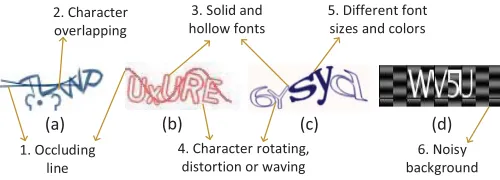
Figure 1: Captcha security features targeted in this work. Examples in (a), (b), (c) and (d) are samples collected from Baidu, Sina, Microsoft and JD captcha schemes, respectively.
2
BACKGROUND
In this section, we describe the threat model and introduce the
GANarchitecture.
2.1
Threat Model
In this work, we assume that the adversary can access and
cor-rectly label some text-based captchas of the target scheme. Since
our approach can work effectively using no more than 500 captchas
collected from the target scheme, we consider the overhead of
col-lecting and labeling captchas to be low. We also assume the attacker
has the computation power to generate synthetic captchas, and to
train and deploy the solver. Later in the paper, we show that a
mod-ern GP U cloud server will provide sufficient computation power
for launching the attack.
Without loss of generality, to make our experiments
manage-able, we restrict our scope to six widely used security features
employed by the current text captcha schemes. These security
fea-tures (as illustrated in Figure 1), including anti-segmentation and
anti-recognition features. They are used by the top-50 popular
web-sites ranked byalexa.comat the time this work was conducted. Specifically, an anti-segmentation feature makes it harder for a bot
program to segment the characters. The features labeled as 1, 2 and
6 in Figure 1 give some of the anti-segmentation features targeted
in this work. In a similar vein, an anti-recognition feature increases
the difficulty of character recognition by using a variety of font
styles. The features labeled as 3, 4 and 5 in Figure 1 illustrate some
of the anti-recognition features investigated in the work. More
details on how these features are used by each evaluated captcha
scheme is given later in Table 1.
2.2
Generative Adversarial Networks
Our attack is based on the recently proposedGANarchitecture [22]. AGANconsists of two models: agenerativenetwork for creating synthetic examples and adiscriminativenetwork to distinguish
the synthesized examples from the real ones. We use
backpropaga-tion [28] to train both networks, so that over the training iterabackpropaga-tions,
the generator produces better synthetic samples, while the
discrim-inator becomes more skilled at flagging synthetic samples.GANs have shown impressive results in image [31, 67] and natural
lan-guage [39, 66] processing tasks. However, due to the newness of
Captcha Synthesizer
real captchas synthetic captchas
Training
base solver
Fine Tuning
fine-tuned solver
real clean captchas
1
3
4
Preprocessing
[image:3.612.71.555.86.165.2]2
Figure 2: Overview of our approach. We first use a small set of real captchas of the target scheme to learn a captcha synthesizer 1 . The captcha synthesizer is then used to automatically generate synthetic captchas (with and without background confu-sion) to learn a pre-processing model to remove security features, e.g., noisy backgrounds and occluding lines, from the input captcha image 2 . At the same time, the synthetic captchas (with and without security features) are used to train a base solver
3 . The base solver is then refined to build the final, fine-tuned solver using a few real clean captchas 4 .
[image:3.612.319.570.252.310.2]3
OVERVIEW OF OUR APPROACH
Figure 2 depicts the four steps of building a captcha solver using
our approach. Each of the step is described as follows.
Step 1. Captcha synthesis.The first step is to generate captchas that are visually similar to the target captchas. OurGAN-based captcha generator consists of two parts: a captcha generator that
tries to produce captchas which are as similar as possible to the
target captchas, and a discriminator that tries to identify the
syn-thetic captchas from the real ones. This generation-discrimination
process terminates when the discriminatorfailsto identify a large
portion of the synthetic captchas. Once training has terminated, we
can then use the trained generator (referred as captcha synthesizer)
to automatically generate an unbounded number of captchas (for
which the characters of each synthetic captcha are known). This is
detailed in Section 4.1.
Step 2. Preprocessing.Before presenting a captcha image to a solver, we use a pre-processing model to remove the captcha
se-curity features and standardize the font style (e.g., filling hollow
characters and standardizing gaps between characters). The
pre-processing model is based on a specificGANcalled Pix2Pix [14]. It is trained fromsynthetic captchasfor which we also have the
corresponding clean captchas (i.e., captcha images without
secu-rity features). The trained model can then be used for anyunseen
captchas of the target captcha scheme. This is detailed in Section 4.2.
Step 3. Training the base solver.With the captcha synthesizer and the pre-processing model in place, we then generate a large
number of synthetic captchas together with their labels (i.e.,
corre-sponding characters) and use this dataset to learn a base solver for a
target captcha scheme. Our captcha solver is a convolutional neural
network (CNN). The trained solver takes in a pre-processed captcha image and outputs the corresponding characters. This process is
described in more details at Section 4.3.
Step 4. Fine-tuning the base solver.In the last step, we apply transfer learning to refine the base solver by using a small set of
manually labeled captchas that are collected from the target website.
Transfer learning allows us to leverage knowledge learned from
synthetic captchas to reduce the cost of collecting and labeling
captchas, and to further improve performance of the base model.
This is described in Section 4.3.
Generator Network
Discriminator Network synthetic captchas
real captchas
classification accuracy Terminate? Adjusting synthesizer parameters
captcha synthesizer Yes
No
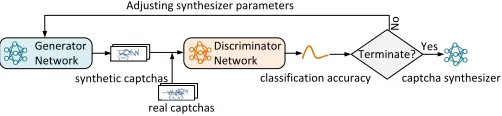
Figure 3: The training process of ourGAN-based text captcha synthesizer.
4
IMPLEMENTATION DETAILS
We now describe how to build the captcha synthesizer
(Sec-tion 4.1), pre-processing model (Sec(Sec-tion 4.2) and solver (Sec(Sec-tion 4.3)
in more details.
4.1
Captcha Synthesizer
Deep neural networks typically require a large volume of training
examples to learn an effective model. Prior work shows that to
build an effectiveCNN-based captcha solver would require over 2.3 million unique training images [19]. Collecting and manually
labelling such number of real captchas would require intensive
human involvement and incur significant costs. In this paper, we
show that it is possible to minimize the human involvement and
the associated costs via captcha synthesis. The idea is that using
a captcha synthesizer, we can populate the training data with an
unbounded number of synthetic captchas (that are similar to the
real captchas). This allows the training data to cover the problem
space far more finely than what could be achieved by exclusively
using human-labelled training data.
Figure 3 illustrates the process of training a captcha synthesizer
usingGANs. The training process is largely automatic except that a user needs to provide a small set of real captchas (500 in this
work) of the target captcha scheme, and to define the set of security
features. The security feature definition is achieved by configuring
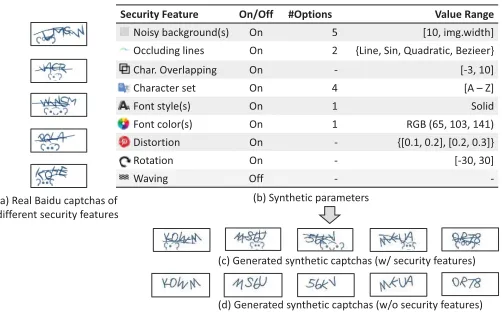
a set of pre-defined parameters. Figure 5 lists the set of security
parameters considered in this work and the specific settings for
the Baidu captcha scheme. We stress that these parameters can be
easily extended and adjusted to target other captcha schemes.
Our captcha synthesizer consists of two components, a generator
Captcha Image Generator Parameter settings
LCxW
Random captcha words
[image:4.612.320.571.82.238.2]Generator Network
Figure 4: Our captcha generator model includes a image gen-erator and a gengen-erator network. The image gengen-erator pro-duces a captcha image at the word level, and the generator network modifies the produced captcha image at the pixel level to add security features.
trained discriminator,D, which is trained to do as well as possible at detecting the synthetic captchas.
Captcha generator.As depicted in Figure 4, our captcha generator model includes a captcha image generator which automatically
generates captcha images according to a given parameter setting
and captcha word, and aCNNmodel that modifies the generated synthetic captcha at the pixel level. We provide the image generator
and the learning engine a large number of free fonts so that the
learning engine can learn which font best suits the target scheme.
The image generator takes in the security feature configuration
setting provided by a user and tries to find a set of configurable
parameter values so that the synthetic captchas are as similar as
possible to the ones from the target captcha scheme. We use the grid
search method presented in [4] to search for the optimal parameters
for a given captcha scheme. Like the image generator, theCNNmodel learns how to modify the generated images at the pixel level so that
the resulting captcha contains security features that are similar to
the real ones of the target scheme. The similarity is measured by the
ratio of synthetic captchas that cannot be distinguished from the
real ones by the discriminator. In other words, the more synthetic
captchas that can “fool" the discriminator, the higher quality the
synthetic captchas are.
Captcha discriminator.We use the discriminator network de-fined in [52], which is a convolutional network whose last layer
outputs the probability of an input captcha being a synthetic one.
We use batched captchas to train the discriminator, where each
mini-batch consists of randomly sampled synthetic captchas,xi and real captchas,yj, and the target labels are 0 for everyyand 1 for everyx.
The discriminator network updates its parameters by minimizing
the following loss function:
LD=−Õ
i
logD(xi) − Õ
j
log(1−D(yj)) (1)
which is equivalent to cross-entropy error for a two class
classifi-cation problem whereD(.)is the probability of the input being a synthetic captcha, and 1−D(.)that of a real one.We note that the real captchas in training are different from the one used to test our
approach.
Training.We use the minibatch stochastic gradient descent (SGD) and the Adam solver [34] with a learning rate of 0.0002 to train our
captcha synthesizer. The overall training objective follows the
gen-eralGANapproach [52], using theL1 norm with the regularization termλset to 0.0001. The training objective is defined as:
Security Feature On/Off #Options Value Range
Noisy background(s) On 5 [10, img.width] Occluding lines On 2 {Line, Sin, Quadratic, Bezieer} Char. Overlapping On - [-3, 10] Character set On 4 [A – Z]
Font style(s) On 1 Solid
Font color(s) On 1 RGB (65, 103, 141) Distortion On - {[0.1, 0.2], [0.2, 0.3]}
Rotation On - [-30, 30]
Waving Off -
-(a) Real Baidu captchas of different security features
(b) Synthetic parameters
(c) Generated synthetic captchas (w/ security features)
[image:4.612.54.307.84.115.2](d) Generated synthetic captchas (w/o security features)
Figure 5: Example synthetic captchas for the Baidu scheme. Our captcha synthesizer is trained using a set of real captchas (a). The parameter setting (b) defines the security feature space. The trained captcha synthesizer is used to pro-duce synthetic captchas with (c) and without (d) the security features (i.e., noisy backgrounds and occluding lines in this example) included.
G∗=
arg min
G ,
max
D
LcGAN(G,D)+λLL1(G) (2)
where the generator,G, tries to minimize the difference between the generated captchas and the real ones, while the discriminator,D, tries to maximize it. During training, when updating the parameters
of the generator, we fix the parameters of the discriminator; and
when updating the discriminator, we fix the parameters of the
gen-erator. Training terminates when the discriminator fails to identify
more than 5% of the synthetic captchas. Training the synthesizer
takes around 2 days for one captcha scheme on our platform. The
trained generator network (together with the captcha image
gener-ator) can then be used to quickly generate synthetic captcha images.
In our case, it takes less than one minute to generate one million
captchas images.
Example.We use the Baidu captcha scheme to explain the pro-cess for training the captcha synthesizer. To initialize the training,
we provide a set of real captchas for theGANlearning engine and initial parameter values for the image generator. The generator
then produces a batch of synthetic captchas which are examined
by the discriminator. If the discriminator can successfully
distin-guish a large number of synthetic captchas from the real ones, the
grid search method is employed to adjust the parameter values
for synthesizing another batch of captchas. This process continues
until the discriminator can distinguish less than 5% of the synthetic
captchas from the real ones (see Section 6.6). When the process is
terminated, the learning engine will output the optimal
parame-ter values that are used by the image generator and the generator
network for synthesizing captcha images. As an example, Figure 5
(a) shows a real Baidu captcha while (b) and (c) in Figure 5 are the
synthetic captchas with and without background security features
+
Discriminator trainingDiscriminator training
Generator training
+
accuracy
+
Generatortraining
(a) Pre-training (b) Generator training
[image:5.612.55.303.85.201.2](c) Discriminator training
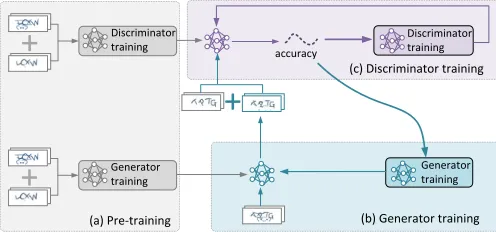
Figure 6: The training process of our GAN-based pre-processing model. The generator tries to remove as much noisy backgrounds and occluding lines from the input captchas, while the discriminator tries to identify which of the input clean captchas are produced by the generator. All the captchas used in the training are generated by our captcha synthesizer.
security features of the synthetic captchas are visually similar to
the real captchas.
4.2
Captcha Preprocessing
Previous successful attacks have led to the development of more
robust text-based captchas that include advanced security features
like occluding lines (e.g., Figure 1a) and distorted hollow fonts (e.g.,
Figure 1 b and c). These features make the previous pre-processing
methods like [16, 64] inapplicable (see Section 6.3).
To remove these security features, we turn again to employ
deep learning to build a pre-processing model. The goal of our
pre-processing model is to remove noise and occluding lines from
the background and to standardize the font style (such as filling
hollow parts of characters and widening and standardizing the
gap between two characters - see also Section 6.3). Specifically, we
adapt thePix2Piximage-to-image translation framework [14]. This
algorithm was developed to transform an image from one style to
another. In our case, the images to be translated are captcha images
with background noises such as the Baidu captchas (Figure 1a)
or different font styles such as the Microsoft captchas (Figure 1c).
Our model is also able to remove multiple security features (e.g.,
Figure 5b) at once. It is to note that we train a pre-processing model
for each captcha scheme using synthetic data.
Our pre-processing model is also aGANconsisting of a gener-ator and discrimingener-ator. The training goal is to learn a genergener-ator
to remove security features and standardize the font style.
Fig-ure 6 illustrates the training process of our pre-processing model.
The generator works at the pixel level, which tries to amend some
pixels of the input captcha image to e.g., remove noise from the
background (Figure 6b). By contrast, the discriminator tries to
dis-tinguish the pre-processed captchas from theclean captchasthat
are produced by the captcha synthesizer described in Section 4.1.
To train the pre-preprocessing model, we first learn an initial
dis-criminator and generator using some synthetic captchas (Figure 6a).
The training captchas are organized as pairs where each pair
con-tains a synthetic captcha with the target security features enabled
(e.g., noisy backgrounds and occluding lines) and a corresponding
captcha with these security features excluded. Since the training
captchas are generated by our captcha synthesizer, it is trivial to
exclude the security features from the generation process. After
having the initial discriminator and generator, we then train them
under the generative adversarial framework. The process is similar
to how we train our captcha synthesizer (Section 4.1). Over time,
the generator would become better in removing security features,
i.e., the resulting captchas are increasingly like the clean captchas;
and the discriminator would become better in recognizing security
features of the captcha (even the changes are small). Training
termi-nates when the discriminator fails to identify more than 5% of the
generated captchas from the clean counterparts (Figure 6c). After
that, we use the trained generator to pre-processunseencaptcha
images of the target scheme.
4.3
Captcha Solvers
To build a captcha solver, we follow a two-step approach. We
first learn a base solver fromsyntheticcaptchas. We then fine-tune
the base solver using the same set ofrealcaptchas used to build the
captcha synthesizer.
4.3.1 Solver model structure.Our captcha solver tries to recognize the characters of a pre-processed captcha image. The solver is based
on a classicalCNNcalledLeNet-5[38]. We have also considered other influentialCNNstructures including ResNet [27], Inception [56] and VGG [53]. We found that there is little difference for solving
text-based captchas among these models. We choose LeNet-5 due to
the simplicity of the network, which gives the quickest inference
(i.e., prediction) time and requires least training data for applying
transfer learning. We use the same network structure for the base
and the fine-tuned solvers, but we train a solver for each captcha
scheme using synthetic data.
LeNet-5was originally proposed to recognize single characters
but we introduce some additional layers (2x convolutional and
3x pooling layers) to extend its capability to recognize multiple
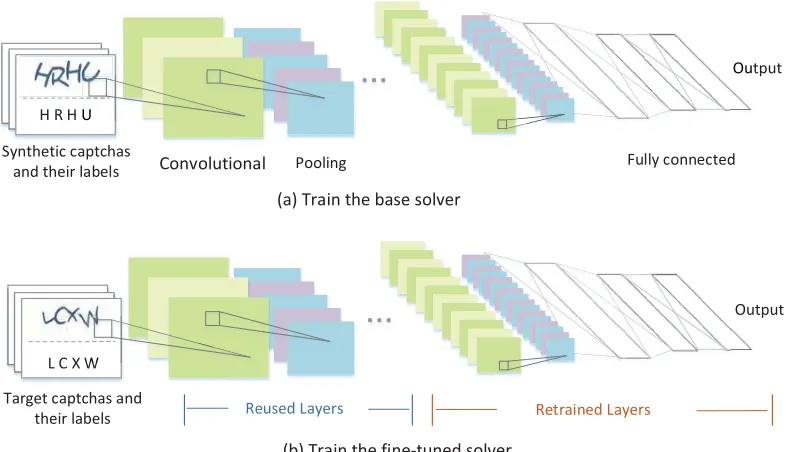
characters. Figure 7a shows the structure of our solver which has
five convolutional layers, five polling layers followed by two
fully-connected layers. Each of the convolutional layer is followed by
a pooling layer. We use a 3×3 filter for the convolutional layer and a max-pooling filter for the pooling layer. We use the default
parameters ofLeNet-5for the rest of the network structures.
The output layer of our solver consists of a number of neurons,
one neuron for a character of the target scheme. For example, if a
captcha scheme usesncharacters, the output layer will consist ofn neurons where each neuron corresponds to a candidate character.
Each neuron applies an activation functionf(x)over its inputs. The
activation of each neuron represents the model’s confidence that
the corresponding character is the correct one. To obtain the
pre-dicted characters, we find the neurons with the largest activations
for a given captcha scheme and map the chosen neurons to the
corresponding characters. For example, for a captcha scheme of
four characters, we will choose the four neurons with the largest
activation values and then translate the chosen neurons to the
H R H U
Synthetic captchas and their labels
Target captchas and their labels
(a) Train the base solver
(b) Train the fine-tuned solver
Retrained Layers
Reused Layers
Output
L C X WW
Output
U
Out
[image:6.612.110.503.83.309.2]Convolutional Pooling Fully connected
Figure 7: Overview of ourCNNbased captcha solver. The base solver is trained using synthetic captchas (a), which is then refined using a small number (500 in this work) of real captchas (b).
4.3.2 Training the base solver.We train a base solver for each target captcha scheme. If the number of characters in a captcha from a
scheme is not fixed, we also train a base solver for each possible
number of characters. We use 200,000 synthetic captchas generated
by our scheme-specific captcha synthesizer to train a base solver.
Each training sample consists of a captcha image (without security
features) and an integer vector that stores the character IDs of
the captcha. Note that we assign an unique ID to each candidate
character of the target captcha scheme. We use a Bayesian based
parameter tuner [20] to automatically choose the hyperparameters
for training the base solver. Training a base solver takes around five
hours using 4x NVIDIA P40 GP Us on a cloud server (see Section 5.2).
The trained base solver can then be applied to anyunseencaptcha
image of the target scheme. Note that before passing a raw captcha
image to the solver, we first use the pre-processing model to remove
the security features of the captcha image.
4.3.3 Building the fine-tuned solver. In the final step, we apply transfer learning[65] to update later layers (i.e., those that are
closer to the output layer) of the base solver using a small set of
manually-labeled real captchas. The idea of transfer learning is
that in neural network classification, information learned at the
early layers of neural networks (i.e. closer to the input layer) will be
useful for multiple classification tasks. The later the network layers
are, the more specialized the layers become [48]. Our work exploits
this property to caliberater the base solver to avoid any bias and
over-fitting that may arise from the synthetic training data.
Figure 7b illustrates the process of applying transfer learning to
refine the base solver. Transfer learning in our context is as simple
as keeping the weights of the early layers and then update the
parameters of the later layers by applying the standard training
process using the real captchas. The fine-tuning process is quick,
taking then less than 5 minutes on our training platform.
5
EXPERIMENTAL SETUP
In this section we describe our experimental parameters and
evaluation platforms.
5.1
Data Preparation
We use two sets of captchas in this work: one for training and the
other for testing. Most of our training data are synthetic captchas
generated by our captcha synthesizer. To train and test ourGAN -based synthesizer and the fine-tuned solver, we use in total 1,500
labeled, real captchas collected from the target website. From the
1,500 real captchas of a captcha scheme, we use 500 captchas for
training and the remaining 1,000 captchas for testing. We make
sure that the testing captchas are different from the ones used to
train our models.
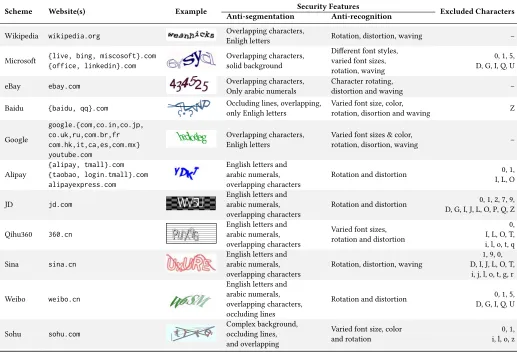
Captcha schemes.Our main evaluation targets 11 current text-based captcha schemes used by 32 of the top-50 popular websites
ranked by Alexa3. We note that some of the websites use the same captcha scheme, e.g., Youtube uses the Google scheme, and Live,
Office and Bing use the Microsoft scheme. The websites we
exam-ined cover a wide range of domains including e-commerce, social
networks, search, and information portals. Table 1 lists the captcha
schemes tested in this work and the target websites. We note that
many captcha schemes exclude characters that are likely to cause
confusion after performing the character distortion. Examples of
such characters include ‘o’ and ‘0’, ‘1’ and ‘l’, etc. These excluded
3
Security Features
Scheme Website(s) Example
Anti-segmentation Anti-recognition Excluded Characters
Wikipedia wikipedia.org
Overlapping characters, Enligh letters
Rotation, distortion, waving –
Microsoft {live, bing, miscosoft}.com {office, linkedin}.com
Overlapping characters, solid background
Different font styles, varied font sizes, rotation, waving
0, 1, 5, D, G, I, Q, U
eBay ebay.com
Overlapping characters, Only arabic numerals
Character rotating, distortion and waving
–
Baidu {baidu, qq}.com
Occluding lines, overlapping, only Enligh letters
Varied font size, color, rotation, disortion and waving
Z
google.{com,co.in,co.jp, co.uk,ru,com.br,fr com.hk,it,ca,es,com.mx} youtube.com
Overlapping characters, Enligh letters
Varied font sizes & color, rotation, disortion, waving
–
Alipay
{alipay, tmall}.com {taobao, login.tmall}.com alipayexpress.com
English letters and arabic numerals, overlapping characters
Rotation and distortion
0, 1, I, L, O
JD jd.com
English letters and arabic numerals, overlapping characters
Rotation and distortion
0, 1, 2, 7, 9, D, G, I, J, L, O, P, Q, Z
Qihu360 360.cn
English letters and arabic numerals, overlapping characters
Varied font sizes, rotation and distortion
0, I, L, O, T, i, l, o, t, q
Sina sina.cn
English letters and arabic numerals, overlapping characters
Rotation, distortion, waving
1, 9, 0, D, I, J, L, O, T,
i, j, l, o, t, g, r
Weibo weibo.cn
English letters and arabic numerals, overlapping characters, occluding lines
Rotation and distortion
0, 1, 5, D, G, I, Q, U
Sohu sohu.com
Complex background, occluding lines, and overlapping
Varied font size, color and rotation
[image:7.612.54.571.85.437.2]0, 1, i, l, o, z
Table 1: Text-based captcha schemes tested in our experiments.
characters are also given in Table 1. When compared to prior
at-tacks, we extend our evaluation to 22 other captcha schemes used
in prior studies. These captcha schemes are listed in Table 4. It
is worth mentioning that while we collected the captchas from
the official websites, many of the captcha schemes we tested are
also used by third-party websites and applications as a security
mechanism.
Synthesizing training captchas.To generate synthetic captchas for a target scheme, we first initialize the security feature
parame-ters as described in Section 4.1. We then use the initial parameparame-ters
to generate the first batch of synthetic captchas which are used
to-gether with 500 real captchas to automatically train our synthesizer.
Once we have trained the synthesizer, we then use it to generate
synthetic samples to learn the preprocessing model and the base
solver. Specifically, we use 20,000 and 200,000 synthetic captchas to
train the pre-processing model and the base solver respectively.
Collecting testing captchas.The real captchas are automatically collected using a web crawler written in Python. Each collected
captcha is manually labeled by three paid participants (nine
partici-pants in total) recruited from our institution. We use only captchas
where a consensus has been reached by all the three annotators. In
total, we have used 1,500 real captchas for each target scheme. We
randomly divided the collected captchas to two sets, one set of 500
captchas for training our synthesizer and final solver, and the other
set of 1,000 captchas for testing our solver. It takes up to 2 hours
(less than 30 minutes for most of the scheme) to collect 500 captchas
and less than 2 hours to label them by one user. This means that
the effort and cost for launching our attack on a particular captcha
scheme is low.
5.2
Implementation and Evaluation Platforms
Our prototype system4is implemented using Python. Specifi-cally, the pre-processing model is built upon thePix2Pix
frame-work [14], implemented using Tensorflow v. 1.2.1, and the captcha
solver is coded using Keras v. 2.1.2.
We use two different hardware platforms. For training, we use
a cloud server with a 2.4GHz Intel Xeon CP U, four NVIDIA Tesla
P40 GP Us and 256GB of RAM, running Centos 7 operating system
with Linux kernel 3.10. The trained solver is then run and tested
4
Success rate Scheme
Base Solver Fine-tuned Solver
Running Time per Captcha (ms)
Sohu 83% 92% 43.78
eBay 52% 86.6% 4.22
JD 60% 86% 43.18
Wikipedia 7% 78% 4.71
Microsoft 36.6% 69.6% 46.06
Alipay 23% 61% 3.75
Qihu360 48.6% 56% 3.10
Sina 40.6% 52.6% 42.81
Weibo 4.7% 44% 3.41
Baidu 6% 34% 41.57
Google 0% 3% 4.02
Table 2: The overall success rate and solver running time for each captcha scheme.
(a) Real Google captchas
(b) Synthetic Google captchas
Figure 8: Real Google captchas and the synthetic versions generated by our captcha synthesizer.
on a workstation with a 3.2GHz Intel Xeon CP U, a NVIDIA Titan
GP U and 64GB of RAM, running the Ubuntu 16.04 operating system
with Linux kernel 4.10. All trained models run on the NVIDIA Titan
GP U for inference.
6
EXPERIMENTAL RESULTS
In this section, we first present the overall success rate of our
ap-proach on 11 current captcha schemes, showing that it can break all
the testing schemes – judged by the criterion commonly used by the
captcha community [10] . We then compare our approach against
prior attacks on another 22 text captcha schemes, demonstrating
that our approach significantly outperforms all prior attacks.
Fi-nally, we analyze the working mechanism our approach before
discussing the implications of the attack.
6.1
Evaluation on Current Captcha Schemes
Table 2 shows the success rate given by our base and fine-tuned
solvers, as well as the average time in solving a captcha. All the tests
were performed on real captchas which are not used for training
the solvers. Since the base and the fine-tuned solvers use the same
network structure, there is no difference in their running time. For
each captcha scheme, we report the average running time across
1,000 tested captchas. We observe little variation in the running
time, less than 0.5% across test runs.
Scheme Captcha Image Ground Truth Solver Output
Sohu d4sk d4sh
eBay 934912 994912
JD BHER BFER
Wikipedia mewsboxes mewsbores
Microsoft XK6NK XK6VK
Alipay B7JK B7YK
Qihu360 s34Ea s3VFa
Sina nG3uu nG3uv
Weibo 4TXB 4TX8
Baidu WFIH WFEH
[image:8.612.316.570.84.335.2]Google irgandoca igiruloca
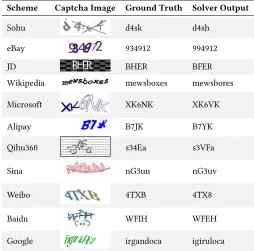
Table 3: Example incorrectly labeled captchas.
Our base solver, built from synthetic data, is able to solve most of
the captcha schemes with a success rate of over 20%. This
demon-strates the capability ofCNNmodels in performing image recogni-tion. However, it gives a low success rate for some of the schemes
such as Weibo (4.7%) and Google (0%). The fine-tuned solver, refined
using transfer learning, significantly boosts the performance of the
base solver. In particular, it improves the success rate for Wikipedia
from 7% to 78%, Weibo from 4.7% to 44%, Alipay from 23% to 61%
and Microsoft from 36.6% to 69.6%. This result shows that transfer
learning in combination of captcha synthesis can reduce the data
collection efforts for building an effective text-based captcha solver.
Furthermore, the fine-tuned solver also improves the success
rate for Google from 0% to 3%. While this success rate is lower than
other schemes because of the strong security features like distorted
characters and dynamic font styles employed by the Google scheme.
The strong security features make it difficult our synthesizer to
generate high-quality synthetic data. This is depicted in Figure 8
where our synthetic captchas are not similar enough to the real
captchas (especially for the font styles). However, 3% is still above
the 1% threshold for which a captcha is considered to be
ineffec-tive [10]. We also note that there is no prior attack can successfully
crack the current Google captcha scheme under this criterion.
Table 3 gives some example captchas that are incorrectly labeled
by our fine-tuned solver. For most of these captchas, our solver only
incorrectly labels one character and the mis-identified character
is similar to the ground-truth character. For example, for the eBay
captcha shown in Table 3, our solver incorrectly label character
“3" to “9" due to character overlapping. For the Google scheme,
our solver often fails to label several characters in the middle due
(a) reCaptcha (b) Microsoft
(c) QQ (d) Yahoo!
Figure 9: Examples of the captcha schemes (left) tested in prior work, and the synthetic versions (right) generated by our captcha synthersizer. Our captcha synthesizer is highly effectively in synthesizing captcha images.
many of these incorrectly labeled captchas, our annotators were
also struggling to recognize the characters in the first attempt.
Finally, the running time for solving a captcha using our solvers is
negligible, taking less than 50 milliseconds on a NVIDIA Titan
Desk-top GP U. Overall, our approach can solve all the testing schemes
under the commonly used criterion [10] with a quick running time.
6.2
Compare to Prior Attacks
In this experiment, we compare our approach against four
state-of-the-art attacks [8, 10, 17, 19] on 24 distinct captcha schemes,
including the eBay and Wikipedia schemes from Table 1 and other
22 schemes. To provide a fair comparison, we try to use captchas in
total) that these methods were tested on. Whenever possible, we use
the same dataset or captchas from the original scheme where the
prior work was tested on. For those obsolete schemes (21 out of 24
schemes), we collected the test data from public datasets, or using
captcha generation tools developed by independent researchers.
Specifically, we use (1) public datasets of previous captcha schemes,
(2) online captcha generators, such ascaptchas.netwhich was used by some of the previous captcha schemes, and (3) open-sourced
captcha generators used in the prior work.
For each captcha scheme, we collected 1,500 samples for which
we use 500 for training and 1,000 for testing. Figure 9 gives some
examples of the real captchas and the one produced by our
synthe-sizer. The figure suggests that our synthesizer can produce captchas
that are visually similar to real examples from the target scheme.
Table 4 compares our fine-tuned solver to previous attacks. In
this experiment, our approach outperforms all comparative schemes
by delivering a significantly higher success rate. For many of the
testing schemes, our approach boosts the success rate by 40%. It
can successfully solve all the captchas of Blizzard, Megaupload and
Authorize used in [10]. Our approach achieves a success rate of
87.4% and 90% for reCAPTCHA 2011 and 2013 respectively. This
scheme was previously deemed to be strong where the human
accu-racy is 87.4% [19]. As a result, our solver matches the capability of
humans in solving reCAPTCHA. To achieve a comparable accuracy
for reCAPTCHA, aCNN-based captcha solver [21] would require 2.3 million unique real captcha images [19].
We want to stress that unlike all the competitive approaches
which require manually tuning a character segmentation method,
our approach bypasses this process by learning an end-to-end solver.
(a) Input Baidu captchas
(e) Applying our pre-processing model (b) Applying a 2 1 filter kernel
×
(c) Applying a 2 2 filter kernel
×
[image:9.612.318.569.83.293.2](d) Applying a 3 1 filter kernel
×
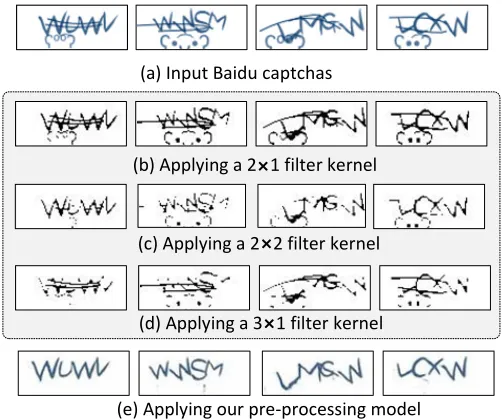
Figure 10: Comparing a filtering-based method with our ap-proach for removing noisy backgrounds and occluding lines. The filtering-based method fails to remove security features from the latest captcha schemes while our approach can.
As a result, our approach requires less expert involvement, yet it
delivers better performance.
6.3
Pre-processing Security Features
One of the key steps in solving text-based captchas is to remove
the security features and standardize the font style of an input
captcha image. In this evaluation, we compare our pre-processing
model against prior pre-processing methods on removing noisy
backgrounds [8, 10, 32]and standardize font styles [11, 16].
Remove security features.Filtering is often used in prior at-tacks for pre-processing text-based captchas [8, 10, 32]. The idea
is to apply a fix-sized window, or filter kernel, throughout the
im-age to remove the occluding lines and noise while keeping edges
of the characters. Figure 10 compares a previously used filtering
method [8, 10, 32] against our automatically learned pre-processing
model. Finding the right filter kernel size for the input captchas
shown in Figure 10a is non-trivial, because the filter either fails to
eliminate the background and occluding lines (b and c in Figure 10)
or it over does it by eroding edges of the characters (which makes
it harder to recognize the characters). While filtering was
effec-tive for prior text-based captchas, the latest captcha schemes have
introduced more sophisticated security features which make
filter-ing no longer feasible. In contrast to filterfilter-ing, our pre-processfilter-ing
model can successfully eliminate nearly all the background noise
and occluding lines from the input image, leading to a much cleaner
captcha image while keeping the character edges, as depicted in
Figure 10a. This experiment shows that our pre-processing model
is highly effective in processing and removing security features
Success rate Success rate Captcha Scheme Captcha Example
Ref. [10] Our approach Captcha Scheme Captcha Example Ref. [17] Our approach
Megaupload 93% 100% Baidu (2016) 46.6% 97.5%
Blizzard 70% 100% QQ 56% 94%
Authorize 66% 100% Taobao 23.4% 90.7%
Captcha.net 73% 99.6% Sina 9.4% 90%
NIH 72% 99% reCAPTCHA (2011) 77.2% 87.4%
Reddit 42% 98% eBay 58.8% 86.6%
Digg 20% 95% Amazon 25.8% 79%
eBay 43% 86.6% Wikipedia 23.8% 78%
Slashdot 35% 86.4% Microsoft 16.2% 72.1%
Wikipedia 25% 78% Yahoo! (2016) 5.2% 63%
Success rate Success rate
Captcha Scheme Captcha Example
Ref. [8] Our approach Captcha Scheme Captcha Example Ref. [19] Our approach
reCAPTCHA (2013) 22.3% 90% PayPal 57.1% 92.4%
Baidu (2013) 55.2% 89% reCAPTCHA (2011) 66.6% 87.4%
reCAPTCHA (2011) 22.7% 87.4% Yahoo! (2016) 57.4% 63%
eBay 51.4% 86.6%
Baidu (2011) 38.7% 83.1%
Wikipedia 28.3% 78%
Yahoo! (2014) 5.3% 75.1%
[image:10.612.69.547.85.625.2]CNN 51.1% 51.6%
(b) Results given by [16]
(a) Example hollow captchas from Sina and Microsoft schemes
[image:11.612.55.303.79.190.2](c) Results given by our pre-processing model
Figure 11: Comparing font style standardization between a state-of-the-art hollow captcha solver [16] and our pre-processing model. Our pre-pre-processing model is able to fill the hollow parts more effectively.
(a) Wikipedia
(b) Microsoft
[image:11.612.318.560.83.239.2](c) Sina
(d) Baidu
Figure 12: Character segmentation produced by our pre-processing model. For each scheme, the left image is the in-put captcha, and the right image is the outin-put of our pre-processing model.
Filling hollow characters.Figure 11 compares our pre-processing model against a state-of-the-art hollow captcha solver [16]. The
task in this experiment is to fill the hollow parts of the characters.
Here, we apply both schemes to the testing hollow captchas from
Sina and Microsoft schemes. Figure 11a gives some of the examples
from these two schemes, while Figure 11b and Figure 11c present
the corresponding results given by the hollow filling method in [16]
and our approach respectively. As can be seen from the diagrams,
our pre-processing model is able to fill most of the hollow strokes,
while the state-of the-art method leaves some hollow strokes
un-filled. Therefore, our approach is more effective in standardizing
the font style. We also note that unlike prior attacks which require
manually designing and tuning an individual method to process
each security feature, our approach automatically learns how to
process all features at one go. As a result, our approach requires
less effort for implementing a holistic pre-processing model.
Standardizing character gaps.Prior research suggests that the robustness of text captchas largely relies on the difficulty of finding
where the character is (i.e., segmentation) rather than what
charac-ter it is (i.e., recognition) [11]. This segmentation-resistance
princi-ple has become a crucial part for designing text captcha schemes.
The examples given in Figure 12 suggest that our pre-processing
model is effectively not only in removing security features (like
noisy backgrounds and occluding lines) and standardizing font
styles, but also in segmenting characters by widening and
stan-dardizing the gap between collapsed characters. The high-quality
2nd CL
3rd CL
4th CL
5th CL
1st FC
0
20
40
60
80
100
Fine-tuned
solver
success
rate
(%)
Beginning layer for transfer learning
Google Wikipedia eBay Microsoft Baidu
Alipay JD Sina Sohu Weibo Qihu360
Figure 13: How the beginning layer for transfer learning af-fects the resulting performance of the fine-tuned solver.
character segmentation produced during pre-processing has a
pos-itive contribution to the success rate of our solver, helping it to
achieves a higher accuracy compared to existing attacks.
6.4
Transfer Learning
Recall that we only use 500 real captchas to refine the base
solver by employing transfer learning (Section 4.3). Our strategy
for transfer learning is to only retrain some of the latter neural
network layers of the base solver (see Figure 7). In this experiment,
we investigate how the choice of transfer learning layers affects
the performance of the fine-tuned solver. To that end, we apply
transfer learning to different levels of the base solver, by changing
the starting point of transfer learning from the 2nd convolutional
layer (CL) all the way down to the first fully-connected layer (FC). Figure 13 reports performance of the resulting fine-tuned solvers
trained under different transfer learning configurations for the 11
captcha schemes given in Table 1. Overall, applying transfer
learn-ing to the second or thirdCLonward leads to the best performance. To determine the best starting layer for transfer learning, we apply
cross-validation to the real captcha training dataset. Specifically,
we divide the 500 real captchas into two parts, the first part of 450
captchas is used to refine the base solver, and the rest 50 captchas
are used to validate the refined solver. We vary the beginning layer
for transfer learning, and then test the refined base solver on the
validation set to find out which beginning layer leads to the best
performance. Since we only train and validate on 500 captchas, this
process for finding the optimal beginning layer only takes several
minutes on our training platform.
6.5
Impact of Fine-tuning Training Data Sizes
In this experiment, we evaluate how the number of real captchas
used in transfer learning affects the success rate of the fine-tuned
solver. Figure 14 shows the success rates of the fine-tuned solver
when using different numbers of real captchas in transfer learning.
When the number of training examples is 500, our approach reaches
a high success rate. For most captcha schemes, the success rate drops
significantly when the number of training examples less than 400.
[image:11.612.55.302.261.351.2]200
400
500
800
1000
0
20
40
60
80
100
Fine-tuned solver success rate (%)
Number of real captchas
[image:12.612.315.560.81.255.2]Google Wikipedia eBay Microsoft Baidu Alipay JD Sina Sohu Weibo Qihu360
Figure 14: The achieved success rates when the fine-tuned solver is trained using different number of real captchas.
0.80
0.85
0.90
0.95 0.97
0
20
40
60
80
100
Fine-tuned
solver
success
rate
(%)
Ratio of mis-classified synthetic captchas
Microsoft Wikipedia eBay Baidu JD
Figure 15: How the synthesizer training termination crite-rion affects the solver performance. Training terminates when the discriminator fails to classify a certain ratio of syn-thetic captchas.
the number of training examples is 500. Such a number allows an
attacker to easily collect from the target website.
6.6
Synthesizer Training Termination Criteria
Our captcha synthesizer is trained under theGANframework, and training terminates when the discriminator fails to classify a certain
ratio of synthetic captchas (Section 4.2). Figure 15 reports how the
termination criterion affects the quality of the synthetic captchas.
The x-axis shows the ratio (from 0.8 to 0.97) of synthetic captchas
that are misclassified as a real captcha by the discriminator when
training terminates. The y-axis shows the success rate achieved
by the fine-tuned solver for five current captcha schemes, where
the base solver is trained on the resulting synthetic captchas using
different termination criteria but the fine-tuned solver is trained
on the same set of real captchas.
In general, the more synthetic captchas that the discriminator
fails on, the higher the quality the generated synthetic captchas
(a) Overlapped characters
(b) Rotated characters
(c) Distorted characters
[image:12.612.53.297.84.239.2](e) Waved characters
Figure 16: Example captchas with single security features.
will be, which in turns leads to a more effective captcha solver.
However, the increase in the success rate reaches a plateau at 0.95.
Further increasing the similarity of the synthetic captchas to real
ones does not improve the success rate due to overfitting. Based
on this observation, we choose to terminate synthesizer training
when theGANdiscriminator can successfully distinguish less than 5% (i.e., fail on 95% or more) of the synthetic captchas. We found
that this threshold works well for all the captcha schemes tested in
this work.
6.7
Impact of Captcha Security Features
In this experiment, we evaluate how security features affect the
effectiveness of our solver. Having this knowledge is crucial for
designing a more robust captcha scheme. This experiment
consid-ers four common security features for text captchas: overlapping,
rotation, distoration, and waving. We exclude noisy backgrounds
and occluding lines when evaluating individual features, as the two
features have been shown to be vulnerable under ourGAN-based pre-processing model in Section 6.3. We use athird-partycaptcha
generator [36] to generate captchas of different security feature
settings. For each setting, we generate 220,000 synthetic captchas.
We then train ourCNN-based solver on 200,000 captchas and test it on the remaining 2,000 captchas. Note that we do not fine-tune the
solver in this experiment because the test data are also synthetic
captchas.
Overlapping.By decreasing the space between adjacent charac-ters, overlapping is a widely for anti-segmentation [10]. For captcha
images of 150×70 pixels, when the overlapping area of adjacent characters are 4, 6, 8 and 10 pixels (as depicted in Figure 16a), the
success rate of our solver is 65%, 50.1%, 42.6% and 25.1%, respectively.
The success rate is still significantly higher than the 1% threshold
at which captchas are considered to be ineffective. It is worth
men-tioning that prior study has shown that if the resulting overlapping
area is greater than 6 pixels, the resulting captcha will significantly
affect user experience because it becomes difficult for humans to
[image:12.612.55.296.285.446.2]No. Sample Overlapping Rotation Distortion Waving Success
Rate
1
√ √
74.85%
2
√ √
65.05%
3
√ √
58.8%
4
√ √
64.95%
5
√ √
82.35%
6
√ √
62.45%
7
√ √ √
57.50%
8
√ √ √ √
52.50%
[image:13.612.54.295.83.296.2]9 All security features 46.30%
Table 5: Impacts of multiple combined security features.
Rotation.In this experiment, we apply our solver to captchas where the characters are rotated clockwise/anti-clockwise with an
angle of 15, 30, 45 and 60 degrees. Figure 16b illustrates some of the
rotated captchas generated by our synthesizer. Our solver correctly
recognizes all (100%) the captchas when characters are rotated at a
15- or 30-degree angle. It only fails to recognize 3 (99.85%) and 9
(99.55%) out of 2,000 captchas when characters are rotated at a
45-and a 60-degree angles respectively. Our solver fails to recognize
some captchas because some of the characters of these captchas
are largely overlapping with each due to rotation. We note that the
rotation angle used by most of the current captcha schemes is under
30 degrees, because a greater rotation angle may have a negative
impact on user experience. The results indicate that rotation alone
does not enhance the security of text captchas under our attack.
Distortion.Character distortion can confuse bot programs as two different characters could look similar when they are distorted. For
example, “O" and “0" are visually similar when they are distorted.
Figure 16c gives some of the synthetic, distorted captchas that are
used to test our solver. For this set of testing captchas, our solver
correctly labels 92.9% of the captchas. This experiment suggests
that distortion alone is not strong enough to defeat our attack.
Waving.Figure 16d shows some of the testing captchas with vari-ous waving degrees. Our solver is able to successfully label 98.85%
of the captchas, outperforming the 93.6% success rate presented in
[36]. Our solver only fails on 23 captchas which contain characters
that are similar after waving, such as “O" and “0", and “l" and “1".
For some of those failed captchas, our annotators also did not reach
a consensus.
Combining security features.Table 5 shows how the combina-tion of security features affect the accuracy of our solver. Combining
multiple security features does improve the robustness of a captcha
scheme. This can be seen from the drop in the solver’s success rate
when using two or more security features together. Specifically,
character overlapping and distortion are more effective compared
to rotation and waving, because overlapping and distortion can
result in significant alterations to the shape of a character. This
observation is also confirmed by the relatively lower success rate
presented in rows No. 1 to No. 4 (where overlapping or distortion
is used) compared with the 82.35% success rate at row No. 5 when
rotation and waving (but not overlapping nor distortion) are used.
Moreover, while using more security features results in a stronger
captcha scheme, it reduces the usability of captchas. For example,
our annotators struggle to recognize the captcha presented in row
No. 8 in the first attempt. If we now consider Row No. 9, an example
with all the security features considered in this work (including
background noise and occluding lines), all our annotators consider
this captcha to be user unfriendly and fail to correctly recognize
it in the first attempt. For all the cases presented in Table 5, our
solver success rate is above 46%, which is still greater than the 1%
threshold when a captcha scheme is considered to be ineffective.
Therefore, the results of this experiment suggest that balancing the
security strength and usability of a text captchas under our attack
is non-trivial.
6.8
Captcha Usability Study
Captcha is designed to be easy for humans to recognize while
hard for bots. However, balancing the security strength and user
experience is becoming increasingly difficult. In this experiment,
we perform user study to quantify the impact of security features
on user experience (i.e., captcha usability) and the success rate
of our solver. To do so, we have conducted an online survey by
recruiting 20 participants to fill in an anonymous questionnaire.
Our participants are at the age group of under 30s and are familiar
with text captchas. In the questionnaire, we present 100 synthetic
captchas with different security strengthes. We give each
partic-ipant one minute to label a captcha. We divide the captchas into
six categories based on the number of characters and the security
parameters used for generating the captacha. In the user study, we
ask each participant to rate the usability of five captchas from each
category on a 5-point Likert-scale, where 1 = very poor and 5 =
excellent usability.
Table 6 gives the criteria used to determine the captcha
diffi-culties and an example captcha image for each category. For each
captcha category, we also give the averaged success rates achieved
by our participants and our solver, as well as the averaged rating
given by the participants.
While using more security features increases the difficulty for
a computer program to solve a captcha challenge, doing so also
makes it harder for a user to recognize the content of the captcha.
For example, the averaged human success rate for the captchas
in category 6 of Table 6 is below 70%, meaning that nearly
one-third of the time a user will enter a wrong answer for captchas in
this category. Therefore, captchas in this category were given the
lowest usability score of 2.1 is not surprising. Also, as we expected,
humans in general are better than computers at solving captchas,
and the success rate of a computer solver drops as the difficulty of
Security Features Success Rate No. Example
Anti-segmentation Anti-recognition Humans Our approach
Usability
1 English letters and arabic numerals Rotation, varied font sizes 95.25% 100% 4
2 English letters Rotation, varied font sizes 90.25% 88% 2.75
3 English letters, complex background Rotation, distortion 91% 96% 2.8
4 English letters, overlapping characters, complex background
Varied font sizes, rotation, distortion 89.25% 86% 2.7
5 English letters Varied font sizes, ratation, distortion 79.75% 77% 2.8
6 English letters, overlapping characters Varied font sizes, rotation, distortion, wav-ing
[image:14.612.53.562.84.258.2]68.75% 40% 2.1
Table 6: Example captchas used in our user study, the success rates of humans and our approach, and the usability rating.
If we now consider categories 3 and 4 in Table 6 where
back-ground confusion is used, we find that noisy backback-grounds have a
negative impact on the user experience because our participants
gave an overaged usability score of less than 3 for captchas in these
categories. On the other hand, background confusion has little
con-tribution to the security strength of captchas under our attack. This
can be confirmed from the similar, or even better solving
perfor-mance given by our solver when compared to human participants
for captchas in the two categories. This finding suggests that
com-plex background confusion perhaps should be abandoned in future
text captcha schemes.
Overall, this user study shows that a deep-learning-based captcha
solver can achieve comparable performance for solving text captchas
when compared to humans, but balancing the security and usability
of a text captcha scheme is non-trivial.
7
DISCUSSIONS
In this section, we discuss the limitations of our approach and
the potential countermeasures for our attack.
7.1
Limitations
Naturally there is room for further work and possible
improve-ments. We discuss a few points here.
Captchas with variable numbers of characters.Our current implementation targets text-based captchas with a fixed number
of characters, but it can be extended to captachs with a variable
numbers of characters. This can be achieved by first predicting
how many characters are in the captcha and then selecting a model
specifically trained for that number of characters. Our preliminary
results show that we can learn aCNNmodel to predict the number of characters of an input captach image with a accuracy of 89% and
70% for Wikipedia and Google schemes respectively.
Multi-word captchas.Our approach can be easily extended to multi-word captchas too. This can be done by either treating all
words as a sequence of characters, or first segmenting the words
and then recognizing individual words.
Extend to other captcha schemes.Our approach is generally ap-plicable and can be naturally extended for video and image captchas
by adapting the network architecture to recognize objects from the
inputs; and favorably, the process of synthetic data generation,
model training and tuning still is unchanged. This flexibility allows
one to attack various types of captchas, not just text-based ones.
For example, to target NuCAPTCHA [2], a motion-based captcha
scheme, we need to replace ourCNNsolver with a model similar to the Mask R-CNN [26]. The idea is to first segment the video frames
into images and then recognize characters from individual images.
After replacing the solver structure, we also need to extend our
GAN-based captcha synthesizer to generate a sequence of synthetic images (as recognition is performed at the image level). For
motion-based captchas, the key is to maintain the temporal relationships
among images, for which a temporalCNNcan be useful [37].
7.2
Countermeasures
Recent studies have shown that adversarial examples generated
byGANscan confuse machine learning classifiers [57]. By insert-ing some imperceptible perturbation on captcha images, one can
mislead a machine learning model [47, 57] and at the same time
the small perturbation does not interfere with a successful
recogni-tion of the image contents by humans. However, the perturbarecogni-tion
to be put on the captcha image is tightly coupled to not only the
captcha image itself, but also the captcha solver and its parameters.
To generate effective adversarial examples requires having a way to
observe the solver behavior. Doing so is difficult in practice because
an adversary is unlikely to release the solver, while a small change
in the solver structure (e.g., by changing the number and types of
some neural network layers) is often sufficiently enough to invalid
the adversarial mechanism. This work shows that it is possible to
quickly learn a highly accurate captcha solver using a small set of
real captchas. This means the structure of the solver can be quickly
changed to invalid a adversarial mechanism used by a captcha
scheme. While our work does not necessarily pronounce a death
sentence to text-based captchas – as they are keeping evolving, we
![Table 4: Comparing our approach against four prior attacks [8, 10, 17, 19] on 24 captcha schemes where the prior methodswere tested on](https://thumb-us.123doks.com/thumbv2/123dok_us/9355886.437726/10.612.69.547.85.625/table-comparing-approach-attacks-captcha-schemes-methodswere-tested.webp)
![Figure 11: Comparing font style standardization betweena state-of-the-art hollow captcha solver [16] and our pre-processing model](https://thumb-us.123doks.com/thumbv2/123dok_us/9355886.437726/11.612.55.302.261.351/figure-comparing-standardization-betweena-hollow-captcha-solver-processing.webp)
