Research into Forecasting Practice
“In theory, there is no difference between theory and practice. In practice, there is.”
—Multiple attributions, including Albert Einstein and Yogi Berra
Preview
Continuing our discussions in recent issues of the need for better connections between academic research in forecasting and business needs and practices, Robert Fildes, a founder of the International Institute of Forecasters in 1980 and founding director of the Lancaster Centre for Forecasting in the UK, has taken a close look at the publications in forecasting journals, finding a troubling deficiency of research for improving supply chain management.
The fix isn’t easy and requires much better collaboration among researchers, businesses, and software vendors.Key Points
Too little forecasting research is focused on supply chain forecasting, and too little research of any kind is grounded in organizational requirements.
Too few companies have shown a willingness to engage with the latest research, relying instead on software vendors who themselves have proved very conservative in
implementing new knowledge.
All three sides of the triangular relationship between academics, software suppliers, and business users must work together if potential improvements are going to be realised. Today, with a few important exceptions, academics don’t work either with software designers or software users to improve systems that deliver best value for customers. A training and development program should be at the heart of any forecast improvement
initiative.
INTRODUCTION: LINKS IN THE RESEARCH TO VALUE CHAIN
In the 1980s, the International Institute of Forecasters established the two academic forecasting journals, The International Journal of Forecasting (IJF) and The Journal of Forecasting (JoF), as well as the annual International Symposium on Forecasting, now in its 37th year. Various workshops on forecasting came later, as did the practitioner journal Foresight in 2005. All voice as one of their principal objectives:
Bridge the gap between theory and practice in business, economics, and management applications.
In his earlier Foresight article, Sujit Singh (2016) offered a critique of “academic” research, arguing for more emphasis on research that demonstrates the practical value of improved techniques and processes and that helps businesses evaluate the ROI of new forecasting investments.
Commentaries from academics and practitioners followed his discussion, highlighting areas of agreement and disagreement.
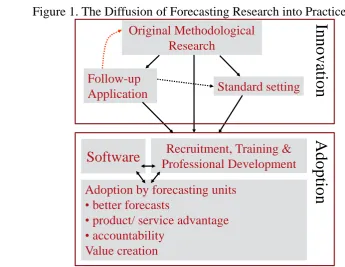
applications. While such follow-up articles may either support or contradict the original argument, they eventually lead to new standards for methodological advances.
Standards of good practice are required in certain sectors; in finance, for example, value at risk has become a standard for calculating the worst-case outcomes for investments, and many research articles have explored how it should be measured. The standard itself is sometimes a powerful driver of innovation.
An alternative route for methodological advance is directly through software innovations, perhaps in tandem with industry. For example, retailers’ demands on supplier service levels and quality have led to the sharing of demand information up the chain (CPFR). But convincing demonstrations of value are still needed; otherwise, uptake will be slow at best.
Original Methodological
Research
Standard setting
Follow-up
Application
Software
Adoption by forecasting units
• better forecasts
• product/ service advantage
• accountability
Value creation
[image:2.595.76.422.239.506.2]Recruitment, Training &
Professional Development
Figure 1. The Diffusion of Forecasting Research into Practice
The dotted arrows show weak links
Adoption
Innovati
on
Regardless of whether innovation originates from original research, follow-up applications, or standard settings, software suppliers are almost always a gate through which innovation must pass in order to get adopted. Recruitment, education, and training also play an important role. Programs have to be designed so that potential users of the new software can understand and justify
adoption.
In Figure 1, you notice that methodological innovations are not driven by downstream demand in the user community: I’m unaware of any cases that contradict this. In other words, this is a top-down approach. We academics get our rewards through accolades from our peers, and these are typically self-referential within the small community of peers working in the problem area. We follow currents in our discipline. Our theoretical work within this discipline is—perhaps
RESEARCH IN FORECASTING JOURNALS
My survey of the forecasting journals and oft-cited articles going as far back as 1982 shows that certain topics have endured (dogs that bark) while others have not resonated (dogs that sleep).
Dogs that Bark Topic Changes over 30 years from 1985
Causal econometric methods A rapid increase in research, mainly macroeconomic or financial
applications
Univariate time series Declining from a high start Uncertainty models (e.g. GARCH) Nobel prizes in economics! Forecast comparisons Increasingly focused on specific
sectors, including multivariate methods
Computer-intensive methods Influential articles with many applications published outside the forecasting journals
Dogs that Sleep Judgment in forecasting Limited research throughout the period from a small group of researchers
Organizational aspects No focus on organizational improvement
Technology/marketing & new products
Sporadic research, though other journals are more focused on these topics
Grounded applications in organizational settings such as supply chain
Applications that have a real context, possibly with a real client and real-time data
Forecasting support systems A core aspect of the diffusion of new methods has remained neglected
Of all these categories, causal econometric methods have received the most research attention, and there is little doubt of their use in macroeconomic modeling and financial applications. Yet surveys of forecasting practice in companies (McCarthy and colleagues, 2006; Weller and Crone, 2012) reveal that econometric models have been of limited use, especially in supply chain applications. It is, as Singh points out, a case where research is way ahead of the curve, with organizational
applications left far behind. Even in those situations where econometric methods have been shown to work well, such as estimating promotional uplifts or holiday and weather effects, their use is limited.
Forecasting researchers haven’t published much work that is grounded in an organizational setting, using data from companies under the timing, resource, and expertise constraints that companies experience. The problem may be that the organizational setting is hugely complex, and anything that does justice to it is probably unpublishable. So academics abstract heavily, thus losing the
organizational setting. Case studies would seem to have promise but these are difficult to publish in scholarly journals. And companies can be utterly paranoiac about having their data or processes made public.
In terms of subject areas, the forecasting journals are heavily focused on macroeconomics and financial markets, areas where the user’s quant skills are highest. Here again, however, there has been little discussion of the organizational aspects of their implementation.
So, organizational applications have been neglected, even in key application areas where forecasting techniques are critical—forecasting to support supply chain operations. The supply chain was an early focus of forecasting research by such luminaries as Box and Jenkins and Bob Brown, the latter the developer of exponential smoothing. In contrast to the picture drawn in Figure 1, they worked in application areas (the major multinationals, ICI in the UK and IBM respectively) and also made major methodological advances. But in the last five years, very few articles published in the IJF and JoF have been grounded in supply chain operations. Even the International Journal of Production Economics has been little better. And yet I speculate there are more forecasters working in this area than any other: of all the academic-practitioner mismatches, this is perhaps the most extreme.
FORECASTING TO SUPPORT SUPPLY CHAIN OPERATIONS
Unlike most academic journals, practitioner journals such as Foresight have published extensively on the realities of demand planning and forecasting for supply chain operations (Tuomikangas & Kaipia, 2014). In contrast, most research papers in academic journals do not recognize the nature of the supply chain. For example, a number of theoretical studies have examined the benefits of collaboration between a retailer and its suppliers—but the realities of incompatible time and quantity buckets, mismatched computer systems, staff motivations, and gaming in the system mean that the results have no credibility beyond the obvious: that some gains in accuracy are potentially achievable. Wow!
What is needed, and what we in the Lancaster Centre for Forecasting have attempted to do, is research that is founded in the operational experiences, objectives, and constraints of supply chain companies. As Figure 2 shows, we need to look into a diverse set of companies and see what information they have available and use for forecasting, what S&OP processes they undertake, and what software they use. As Paul Goodwin (2016) notes in his commentary on Singh, no two
companies are alike, and the numerical estimates of KPIs such as accuracy or ROI presented in these studies and calculated from new (and often overly restrictive) theoretical models cannot be read into any particular organization. In contrast, methodologies based on case-by-case observation should help identify the available data, resources, and the barriers to forecast improvement.
Setting up such a simulation may not be trivial if you wish to capture a realistic part of the supply chain planning that goes on. Perhaps it’s relatively easy in retail, because batching and logistic rules are hard coded. But in industry there are many more opportunities for human interventions in post-forecast planning. We need plausible approximations, and hard-coded rules could help.
However, software vendors prioritise the allocation of their resources towards maximising the perceived value of their products. This could be the result of better engineering and integration with existing systems and databases, or the development of advanced interfaces such as mobile
applications. Unfortunately, such software developments will always take priority compared with implementing a fancy new forecasting algorithm (which may add forecasting value).
At the same time, professional development programs are designed by business or IT managers with limited forecasting backgrounds, and erroneously focus on technologies rather than on
methodologies and statistics. Understanding the concepts behind the forecasting algorithms and their parameters will inevitably lead to better forecasts, especially in systems where user
[image:5.595.118.473.349.590.2]intervention is not only allowed but also promoted.
Figure 2. Researching grounded supply chain applications
Population of diverse supply chain companies
Processes, information use, and demand forecasting
Models of information
use in decisions Questionnaire/
Stat explanatory models
Hypotheses & normative implications Experiments:
To test out user reactions and
improve
Case observation/ action research
The dotted arrows show weak links
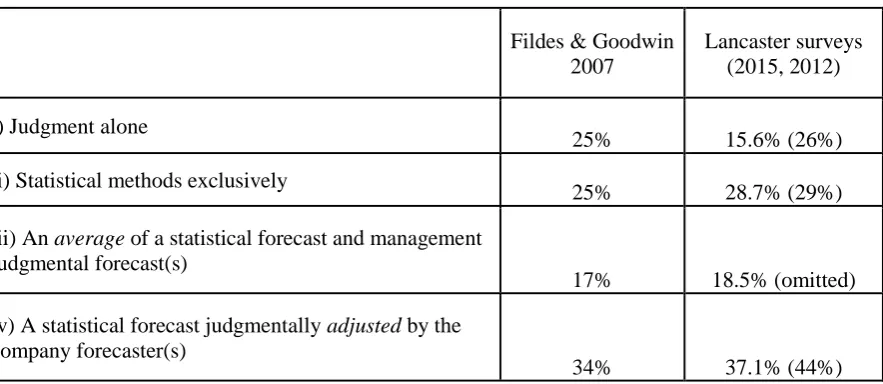
Table 1. Percentage of Companies Reporting Use of Statistical and Judgmental Forecasting Methods
Fildes & Goodwin 2007
Lancaster surveys (2015, 2012)
i) Judgment alone
25% 15.6% (26%)
ii) Statistical methods exclusively
25% 28.7% (29%)
iii) An average of a statistical forecast and management judgmental forecast(s)
17% 18.5% (omitted)
iv) A statistical forecast judgmentally adjusted by the company forecaster(s)
34% 37.1% (44%)
REQUIREMENTS FOR IMPROVEMENT IN ORGANIZATIONAL PERFORMANCE
So what’s to be done if forecasting practices are to be improved? Unfortunately, there is little research that has demonstrated improvements (in terms of accuracy or ROI) in an organizational setting. Nevertheless, we can suggest several demonstrable needs.
Accounting for important features of the data needs to form a part of any effective solution. For retailers, there is microdata at the level of SKU x store x day. The data form into multiple hierarchies by time, location, and product. There are short product histories, products with complex seasonality, and those with intermittent demand. Information from electronic points-of-sale and downstream forecasts may be available. Inclusion of the impact of promotional activity is crucial. And the value of improved forecasting depends on the business ordering rules being used—if order size is large compared to the accuracy improvements, no benefits will accrue.
No single method or approach can capture all these features. While there are new models and frameworks derived from understanding the key features of the data—hierarchy, intermittence, and promotional events—there are constraints on the time and expertise of the companies’ forecasting teams. Overcoming these constraints requires automatic model-building capabilities and forecasting support systems that match user processes, support judgmental/statistical interactions, and provide meaningful error measurement.
Trapero and colleagues (2012, 2013) showed that a simple extension of exponential smoothing that includes promotional information and judgment delivered a 42% accuracy improvement over the company’s forecasts. Novel modeling techniques designed for store x SKU-level forecasting (including product-category competition and cannibalisation) have been developed. One study found that these techniques improved accuracy over a standard benchmark by 8%; when combined with promotional-optimization models, they meet Singh’s requirement of a 17% improvement in profits (Ma & Fildes, 2016).
interactions, we need to understand how users can be encouraged to make best use of the
information collected and shared, as well as model-based forecasts. Detailed case observations and experiments come in—but as yet there is little research to guide us on forecasting support systems (FSS) design. One exception is from Lee and colleagues (2007), who offer a successful example of improved software design to help judgmental estimates of promotional effects.
But while these novel methods have been engineered to meet business requirements, they have yet to pass the adoption test, first into commercial software and then into company operations. Instead, we’ve found poor statistical routines in many software implementations; even tuning these can be worth 10%.
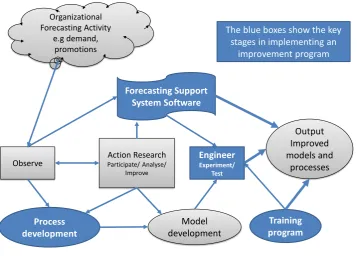
Figure 3 shows the overall picture of what I think it will take to bridge the disconnect between
[image:7.595.121.479.322.578.2]forecasting research and improved organizational performance. Emphasis must be given to the role of the forecasting support system and how it can be “engineered” to the specific requirements of an organization. Together with new organizational process developments and a training program, the gap between novel research ideas and organizationally valuable results can be overcome.
Figure 3. Bridging the Gap: Observe, Engineer, Experiment, Educate
Organizational Forecasting Activity
e.g demand, promotions
Observe EngineerExperiment/
Test
Action Research
Participate/ Analyse/ Improve
Model development
Forecasting Support System Software
Process development
Output Improved models and
processes
Training program
The blue boxes show the key stages in implementing an
improvement program
The key elements are:
Observation in companies: to understand the processes and the data; Process redesign: to overcome information silos and limit biases; Action research: to achieve change in current practices;
Model development: to capitalize on an expanded data base and the new methods available from the research literature;
Software development: to engineer the new methods and the new novel processes into the organizational setting;
Unfortunately, often companies focus on professional training programs alone, as the other elements are considered costly while managers underestimate their value.
SUMMARY
I’ve described a research program aimed at improving forecasting accuracy and delivering the ROI that Sujit Singh asks for. However, in these circumstances, it takes three to tango. Too few
companies have shown a willingness to apply the latest research, relying instead on software vendors who themselves have proved very conservative. Academic research must become better grounded in organizational requirements. And software companies need to engage with and
influence the developing research agenda. With self-centred academics, complacent customers, and short-term-profit-hungry software vendors, there doesn’t seem much hope for improvement.
But with academics engaged in improving the value of forecasting through holistic methods, with educated and demanding customers, and with innovative software vendors, we should be able to make a substantive contribution to improved supply chain performance, not just by increasing profitability but lessening waste within a greener supply chain. All three sides of the triangular relationship between academics, software suppliers, and users need to work together if potential improvements are going to be realised. Business users need to demand these changes, software people need to understand that they add value, and academics need to deliver the necessary realistic algorithms.
References
Catt, P. (2007), Assessing the Cost of Forecast Error: A Practical Example, Foresight, Issue 7 (Summer 2007), 5-10
Fildes, R., Goodwin, P., Lawrence, M., & Nikolopoulos, K. (2009). Effective forecasting and judgmental adjustments: an empirical evaluation and strategies for improvement in supply-chain planning. International Journal of Forecasting, 25, 3-23.
Fildes, R. and F. Petropoulos (2015). Improving forecast quality in practice. Foresight: International Journal of Applied Forecasting Issue 36 (Winter 2015), 5-12..
Franses, P. H. (2014). Expert Adjustments of Model Forecasts: Theory, Practice and Strategies for
Improvement: Cambridge University Press.
Goodwin, P. (2016). Academic Frameworks for practitioner use. Foresight: International Journal of Applied
Forecasting, 42(Summer), 30-32.
Gotz,N. & Kohler, C. (2006), The New SAP Forecasting and Replenishment Solution: Is It an Improvement over mySAP ERP?, Foresight, Issue 5 (Fall 2006), 45-50.
Lee, W. Y., Goodwin, P., Fildes, R., Nikolopoulos, K., & Lawrence, M. (2007). Providing support for the use of analogies in demand forecasting tasks. International Journal of Forecasting, 23, 377-390.
Ma, S., & Fildes, R. (2016). A retail store SKU promotions optimization model for category multi-period profit maximization Lancaster.
Singh, S. (2016). Forecasting: Academia versus Business. Foresight: The International Journal of Applied Forecasting, Issue 41 (Spring 2016), 46-47.
Trapero, J. R., Pedregal, D. J., Fildes, R., & Kourentzes, N. (2013). Analysis of judgmental adjustments in the presence of promotions. International Journal of Forecasting, 29, 234-243.
Trapero, J.R., Kourentzes, N., & Fildes, R. (2012). Impact of information exchange on supplier forecasting performance. Omega: International Journal of Management Science, 40, 738-747.
Tuomikangas, N., & Kaipia, R. (2014). A coordination framework for sales and operations planning (S&OP): Synthesis from the literature. International Journal of Production Economics, 154, 243-262.
Weller, M., & Crone, S. F. (2012). Supply Chain Forecasting: Best Practices & Benchmarking Study. In. Lancaster Centre for Forecasting. Downloadable: http://goo.gl/MPbAjz