Secure Interchange Routing
Mark Hartong1, Rajni Goel2, Duminda Wijesekera3
1
Federal Railroad Administration, Washington DC, USA 2
Howard University, Washington DC, USA 3
George Mason University, Fairfax, USA
E-mail: [email protected]; [email protected]; [email protected] Received January 24, 2011; revised February 21, 2011; acceptedApril 6, 2011
Abstract
Locations that connect tracks from different rail-road companies—referred to as interchange points—ex- change crew, locomotives, and their associated consists. Because trains have a single degree of freedom in movement, that is, they can only operate along the tracks, any delay occurring at an interchange point causes cascading delays in connecting tracks. In addition, authentication and authorization that is expected to take place at interchanges in PTC controlled train movement may add extra delays due to mutual authentication between two security domains. In this paper we propose a model that can address safety and security con- cerns and their interrelationships that govern train movement through an interchange point. We show how a profile of safe operations can be computed for operating an interchange point.
Keywords:Railroad, Routing, Interchange, Safety, and Security
1. Introduction
The primary objective of inter-domain rail operation is to minimize rail traffic delay at interchange points while maintaining safe operating conditions. Delays add to a railroads cost of business and can have a significant im- pact on the US economy. Techniques used to minimize delays are categorized as tactical (i.e. addresses local
scheduling decisions) and strategic (i.e. addresses global
scheduling decisions over regions). Taken together they control the end-to-end delays encountered by a trains moving from point A to point B. We address the specific case where points A and B are on different sides of a single rail track that connects two regions belonging to two railroad companies that is commonly referred to as an interchange point. This problem is significant because, if both regions are controlled by the proposed Positive Train Control (PTC) systems, then each side has its own authentication and authorization system that must com- municate with the other side to allow an approaching train to go through the interchange point. Our model shows how the two regions can control the movements of trains while maintaining safe inter-train distance and au- thenticating the crew, and locomotives.
The rest of the paper is written as follows. Section 2 discuses delay in the trail environment as it applies to se- cure interchange operations. Section 3 outlines our
pro-posed model, and the conditions required for safe secure interchange operation. Section 4 takes the conditions for safe secure interchange operations and relates them to underlying physics associated with train operations and communications. Section 5 illustrates the application of our model. Finally Section 6 discusses the limitations of our model, and outlines areas of further research to re-duce those limitations.
2. Delays and Delay Modeling
points. In this larger planning and scheduling problem, we model the tactical behavior of regarding inter-domain operations.
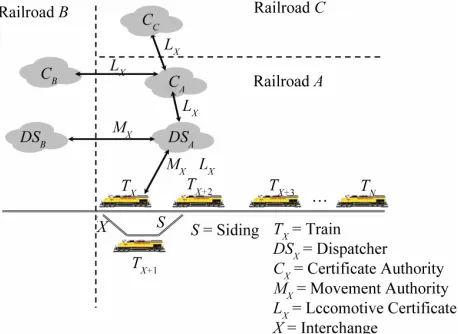
Figure 1 shows three railroads referred to as Rail-road A, Railroad B and Railroad C, where we concen-
trate on the interchange point between Railroad A and Railroad B. As independent entities, each one operates its
own trust management system within its own security domain, and consequently has Certificate authorities CA, CB and Dispatcher systems DSA and DSB respectively.
We consider the case where trains arriving on Railroad
A’s track attempts to enter the interchange point to
Rail-road B’s side (that is from the bottom right hand side to
the bottom left hand track in Figure 1). The trains are named T1,, TX ,TXN where X and N are integers.
When Railroad A wishes to send Train TX,,TXN to Railroad B’s tracks, two communications may occur. The
first is that CA and CB may exchange certificates LX, and DSA and DSB may exchange messages (say MX) in
addi-tion to DSA and/or DSB exchanging messages with trains.
Figure 1, only illustrate the communications of DSA with CA, TX with DSB and DSA with CA, where other trust ma-
nagement messages may flow.
Traffic delays can be a combination of two separate, but interrelated elements. First are delays resulting from the specific physical operating characteristics of the trust management, dispatching and communication systems. The physical operating characteristics include slack time built into the train schedule, traffic congestion, scheduled stops, authorized speeds, location of other trains, on track equipment, maintenance of way work zones, track physi- cal condition, status of signals and communication band- width. Although there is an extensive body of work on optimization of network wide routing in general, and railroad networks in particular, such as those described in [3-10], we do not attempt to either develop new, or imp- rove upon existing dispatching and routing methodolo-
Figure 1. Railroad security domains.
gies or consider more complex interchange configura-tions in this paper.
The second category of delays arise due to sched-uleing at interchange points, where two pre-requisites must be satisfied before movement authority is granted: 1) Lo- comotive and the crew must be authenticated and 2) Tra- ck space must be available in the second domain.
Assuming a single unidirectional track with a single siding but no other merging or branching greatly simpli-fies the optimization of delay at interchanges. Although there are numerous approaches ([11-21]), addressing this configuration these solutions do not consider authentica-tion delays that may occur due to the imposiauthentica-tion of a trust management system. Although other more complex track configurations such as using multiple parallel facing or reverse spurs can be built or combinations of facing and reverse spurs can be considered, these cost more money to construct [22].
Having one siding gives the dispatcher much needed room to rearrange the order of trains that proceed to the interchange. For example, the delay of Train TX at the in-
terchange point may be mitigated to some extent by the availability of a siding S. If the train dispatcher for Com-
pany A is aware, sufficiently in advance of the arrival of TX , to the interchange point of a potential delay, the
dis-patcher could direct TX into the siding S, allowing Train 1
X
T to proceed along the main line to the interchange point. However, if the siding S is not available, or TX has
passed the point in which will allow the dispatcher to direct TX into the siding S, TX will block the following trains from reaching the interchange point. Even if the dispatcher was able to safely divert TX into the siding S,
allowing TX1 to proceed along the mainline to the in-terchange point, any delay encountered in the process of moving Train TX1 at the interchange point will delay the following Trains TX2 through TXN.
3. Cross Domain Operations
Our model of the tactical behaviors of Dispatcher A and
Dispatcher B relies on the following assumptions:
There is a main track and a single siding in do-main A and a single main track in domain B.
All trains in domain A are of the same length, but
may have different priorities for movement.
Train movements are from Domain A to Domain B.
Dispatcher A (DSA) and B (DSB) have exchanged a
session key between each other. Dispatcher A (DSA)
has authenticated locomotive TX and the associated
engineer EX prior to receiving movement requests.
Dispatcher A (DSA) controls the signal whose aspect
controls the movement of a train from domain A
while Dispatcher B (DSB) controls the signal whose
B.
For a train to leave domain A and enter domain B,
both the Dispatcher A and Dispatcher B have to
au-thorize movement, coordinating the signal aspects. The siding S is of length L and can contain only one
train. The main track parallel to the siding may also contain one train.
There are up to N trains in the queue awaiting
au-thorization to enter domain B.
Requests for authorizations from A to B are in order
of increasing distance of trains from interchange point.
A train TX is comprised of EX the engineer’s
certifi-cate, LX the locomotive certificate, PTCX’, the in-stalled PTC system, VX, the initial train velocity, and DBX the safe stopping (braking) distance.
CAA is the certificate authority of domain A. CAB is
the certificate authority of domain B.
MAX is a movement authority.
These conditions reflect actual railroad operating prac-tices.
A train TX that has requested entry from one domain to
another is prohibited from proceeding into the new do-main until the movement authority MAA has been appro-
ved by the dispatcher of the new domain. In the event that TX does not receive a response to a request, or the
response to a request is delayed, TX proceeds to the limit
of its currently granted authority and stops. If TX is
al-ready at the limits of the authority, then TX remains
halted until the authority to proceed is received. The mo- vement of subsequent trains, Ti for i > (X + 1) and i≤N, are rescheduled by the dispatcher in the cur- rent domain by modifying the movement authorities to preclude col-lisions and overrun of authority limits as necessary. If the dispatcher DSB approves MAX for TX(i.e. the track in domain B is available), dispatcher DSA relays the
ap-proved MAX to TX , and TX transitions from domain A to
domain B. Dispatcher DSA may then reschedule TX1 to advance to the block vacated by TX and advance
subse-quent trains Tifor i≥ (X + 2).
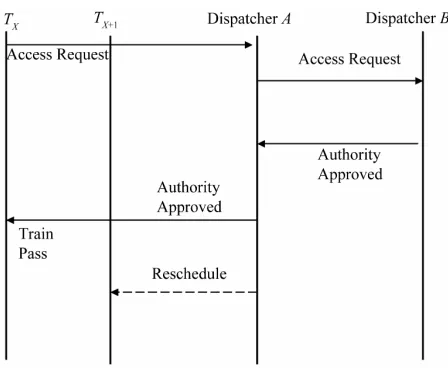
This process is illustrated in Figure 2. This scenario assumes that Dispatcher A is already in possession of the
authentication information associated with EX and LX. A
train TX that intends to move from domain A to domain B
submits the requested movement authority MAX, the
en-gineers certificate EX and the locomotive certificate, LX ,
(the Access Request in Figure 2) to the Dispatcher A. .
Dispatcher A, already being in possession of the
neces-sary certificate information authenticates the requests and forwards it to the Dispatcher in Domain B. Dispatcher B
evaluates the feasibility of allowing TX to enter B’s
do-main. If Dispatcher B approves the movement, he appro-
[image:3.595.311.535.74.258.2]ves MAX and returns it to Dispatcher A. Dispatcher A then
Figure 2. Movement authority approval.
passes MAX back to TX. TX enters Railroad B’s domain, and Dispatcher A reschedules the movement of TX1. Additional scenarios are described in [22].
There are three possible situations that may be en-countered by a train TX1 that is following train TX in Domain A with a single siding.
If the main line and siding are clear, TX1may take the main or siding and proceed to the interchange point without delay.
If the main is clear and the siding is blocked or the main is blocked and the siding is cleared, TX1 may take the clear track and proceed to the inter-change point without delay.
If the main and siding are blocked TX1 may have to wait until the main or siding is clear in order to proceed to the interchange point.
In the later situation TX1 can continue movement to the interchange point if the length of time it takes for TX
to receive their authority MAA and move beyond the in-
terchange point is less than the time it takes to stop 1
X T .
In the simplest case, where there is a single mainline running between domains A and B, denial of entry of
Train TX will require rescheduling of the movement of
subsequent trains TX1,TX2,,TN. In order to pre- clude a train-to-train collision between the end of Train
TX with the head of train TX1, train TX1 must receive notification of the requirement to stop before it proceeds beyond the safe stopping distance BDX1. If the move- ment of train TX1 is not rescheduled, and train TX1 does not stop before reaching the location of TX, TX1, and TXmay collide. If the stopped train TX is released to proceed into the next domain before the train TX1, reaches the safe stopping distance, a collision can be avoided.
train TX will be affected by the velocity of train TX1, the time of release of a stopped train TX, the communication
delays associated with information exchanges between
CAA and CAB , the dispatcher processing delays DSA and DSB , as well as the PTC system processing times PTCX,
and PTCX1. The velocity VX1 of train TX1 directly affects the safe stopping distance BDX1. As VX1 in- creases, the safe stopping distance BDX1 increases, re- quiring greater separation of trains TX and TX1 to pre- clude a collision.”
3.1. Safe Stopping Distance
Stopping distances and times for train have been exten- sively studied (for example [23-26]). Commercial tools to calculate this information using more complex models are exist, most notably the RailSim Train Performance Calculator (TPC) by Systra Consulting, and the Train Operation and Energy Simulator (TOES) by the Associa- tion of American Railroads. These estimators reflect a railroads operating philosophy, the type of train (for ex- ample passenger or freight), the mass and its distribution of the train, the gradient of the territory the train is oper- ating on at the time of braking, the crews reaction time, and the type of braking (full service, dynamic, or emer- gency) and the associated deceleration rate induced by the brakes. The braking calculation variables include the types of cars (i.e. tank, box, railrider, etc.), variations in
the methods and type of braking (emergency or dynamic, conventional air or electronic pneumatic), track profile (grades and curves), behavior of the locomotive power based on track conditions, details of consist loading and position in the consist of power (head end, middle, or pushing). More approximate estimates for to calculate braking distance exist. For example, [27] is used to pre- dict braking distances for the European Train Control System (ETCS) system. The International Union of Railways (UIC) has promulgated standard 546 [28]. A similar standard is under development by the IEEE [29]. Additional work on braking curves can be found in Ref- erences [30-35].
3.2. Delay
In general, delays of trains proceeding from A to B are
prevented when the total delay time associated with cer- tificate authentication and movement authorization is less than the time required to stop the train. If the former is less than the later, then the dispatcher is able to pass the appropriate authorizations to an on-coming train suf- ficiently in advance of the required safe stopping dis- tance to enable the oncoming train to pass at speed. Pre- vention of a collision requires that the delays for a train
occupying either a siding or mainline block and the clea- rance time for the train to clear the block must be less or equal to the time it takes for a following train to brake to a zero velocity.
At maximum capacity, the movement of a train from one location to the next requires that the lead train clear the location it is occupying before the trailing train can stop in the location just cleared. This worst-case scenario may occur as a consequence of communication delays compounded by initial authentication of the actors and the first message exchanged. To obtain the total time for a consist to clear, or a consist to stop, the communica- tions overhead times TOH must added to the time to clear
of TX and time to stop TX1. Provided TX and TX1 re- quire the same length of time to authenticate (i.e. TOH is a
constant for train TX or train TX1, the delay TOH cancels out and the delay between individual trains (TX and TX1) remains the same as previously calculated.
The assumption that there are no authentication or communications delays is, however, unrealistic. Even in a benign environment, communications disruptions may occur as a consequence of phenomena such as normal at- mospheric interference, electromagnetic interference by the AC or DC generators onboard the locomotive, or physical items such as buildings or foliage. To ensure that collisions between a leading train TX and a following
train TX1 do not occur, the authentication and the com- munications delays TCOMMDELAYX associated with train TX
must be less than the communications delays 1
COMMDELAYX
T associated with train TX1. If the differ- ence in communications delays is greater than the al- lowable delay between TX and TX1, then the potential exists for the trains to collide.
System designs assume that communications disrupt- tions are likely to occur. To mitigate against this eventu-ality, not only are the commands retransmitted several times to ensure receipt and acknowledgement, each transmitting and receiving device is equipped with a ti-mer. In the event of a communications disruption that precludes receipt of a valid message, a timer on the de- vice will expire, forcing the device to its most restrictive safe state. This ensures the safety of following trains, albeit with a decrease in system throughput.
4. Physics of Braking and Accelerating
Trains
The approximate estimate for time to stop assumes con- stant deceleration in ideal track conditions (i.e. straight
are identical and have similar braking characteristics. Likewise, the time to clear a block assumes an identical train operating under the same conditions.
4.1. Time to Clear Tx
Assuming constant acceleration from an initial velocity of 0, the time for a train TX stopped at an interchange
point (in seconds) where the corresponds to the consist length can be estimated as follows:
2 375 X X X X X A X L M TC F M R V (1)RA is estimated using the Davis equation. First developed
in the mid 1920’s, and modified in the late 1970’s, it provides an estimate of the rolling resistance in pounds per ton [28].
2 20 0.6 0.01A X X
X
a X
X X X
R M V
K V Car n (2) Where
MX is the weight of the train TX (tons) LX is the length of the TX (feet) VX is the final velocity of TX(mph)
FX is the tractive force of TX locomotives (HP)
RA is the drag of the consist when accelerating (lb/ton) wX is the weight per axle per consist car in TX (tons) nX is the number of axles per consist car in TX CarX is the number of cars in the consist in TX Ka is the acceleration drag coefficient Ka = 0.07
The tractive force FX is given by
X Loco
F N HP E (3)
Where
NLoco is the number of locomotives in TX HP is the Horsepower per locomotive in TX E is the locomotive efficiency %.
4.2. Time to Stop TX + 1
Assuming constant deceleration, the time to stop TSX1 (i.e. final velocity VX10) in seconds is
1
1
1
1
0.04583 X X X X D M V TS F R
(4)
and the drag RD of TX1 is given by
1 1 1 2 11 1 1
20
0.6 0.01
D X X
X
b X
X X X
R M V
K V Car n (5) Where 1 X
M is the mass of the train TX1 (tons) 1
X
V is the initial velocity of TX1 (mph) 1
X
F is the braking force of consist TX1
RD is the drag of the consist TX1 when decelerating 1
X
is weight per axle per consist car in TX1 1
X
n is the number of axles per consist car in TX1
Kb is the braking drag coefficient. Kb = 1.4667 1
X
Car is the number of cars in the consist in TX1 The braking force FX1 is given by
1 1 1
2000
X X X
Avail
F Car CarWeight
BF Brake (6) Where 1 X
Car is the number of cars in the consist TX1 1
X
CarWeight is the weight of a car in the consist 1
X
T (tons)
BF is the brake ratio (5%)
BrakeAvail is the % operable brakes.
4.3. Consist Delay and Safety
Safe operation of the railroad requires that any Train TX1 not run into the preceding Train TX. For this safety crite-
rion to occur the consist delay between Train TX and TX1 must satisfy the equation.
1
X X
ConsistDelay TC TS (7)
Solving Equation (7) for Consist Delay and substitut-ing Equations (1) and (4) yields the maximum delay that between two trains TX and TX1.
1 1 1 0.04583 2 375 X X X D X X X X A X M V ConsistDelay F R L M F M R V (8)where RA and RB are as defined in Equations (2) and (5).
of advancing through the interchange point, the inter- change point is simply a special case of a block boundary. Instead of being the boundary between two adjacent blo- cks in the same domain, it is simply the boundary be-tween two adjacent blocks, one of which is one domain, the other of which is a second domain. If trains TX and
1 X
T occupy the main and siding, subsequent trains 2
X
T through TXN are blocked from advancing since the trains are restricted to a single degree of motion along the track.
4.4. Communications Delay
The physics of train movement, and the impact of com- munications and authentication delays can be combined into a single equation. The right hand of the inequality is Equation (8), while the left hand side is the time delay due to padding, propagation, and processing delays plus the system response time (SYSRESPONSETIME and SYSPROPA- GATION) and the operators response time (OPRESPON- SE-TIME ). See Equation (9), where MX1, MX, VX, VX1, LX,
1 X
L , LX, LX1, RD, RA, FX, and FX + 1 are as previ-ously defined and
BSENDERADDRES is the number of bytes of information to
identify the sender
BRECEIVERADDRESSis the number of bytes of information required to identify the receiver
PINFORMATION is the number of bytes of information
re-quired to format the information I for transmission
CDATA is the number of bytes of information required
to control the transmission across the media
CPADDING is the number of bytes of information re- quired to format CDATA
SDATA is the number of bytes required to convey any
security information required for integrity and authentic-ity
SPADDING is the number of bytes required to format SDATA,
TR is the communication transmission rate
SYSRESPONSETIME is the length of time it takes for the
system to process the data once received and change it into information
OPRESPONSETIME is the length of time it takes for the op-
erator to respond to a command once received.
SYSPROPAGATION is the propagation delay for the com-
munications medium
SYSRESPONSETIME is a function of the performance char-
acteristics of the office subsystem, wayside subsystem, and the onboard subsystem involved in a particular mes-sage exchange. OPRESPONSETIME is a function of human
factors behavior in receiving, processing, and executing a received command.
The advantage of establishing this single safety equa- tion relating all elements is that it allows for the designer to develop risk based performance budgets for the vari- ous elements in their design. As long as the overall equa- tion remains true, the designer is free to experiment with various options to achieve the required performance at a particular cost point.
5. An Illustrative Example
The behavioral characteristics of the railroad vary greatly depending upon the operating parameters of the trains operating along the railroad. Finding the optimal combi- nation of train parameters that minimizes Consist Delay is a complex problem in operations research. The follow- ing example, however, illustrates the use of these equa-tions. For the purposes of this example we will assume
TX and TX1 are identical with properties as follows:
Number of Locomotives = 3 Length of locomotive = 100 feet Horsepower per locomotive = 4500 HP Weight per locomotive = 200 tons Locomotive Efficiency = 95% Number of Cars = 100 Weight of a Car = 60 tons Length of a Car = 100 feet Braking Efficiency = 5% Axles per Car = 2
Percent of Brakes Operable = 85% (Minimum op-erating brakes allowed by Federal Regulations) Train Length = 10300 Feet
Communications Bandwidth = 4800 bps
All braking is provided by consist cars, locomotive dy- namic braking is not considered. More complex scenar-ios are analyzed in [22].
Re Re Re Pr
1 1
1
0.04583 2
375
Data Padding
SenderAddress ceiverAddress Information Data Padding sponseTime sponseTime opagation
X X X X
X D X
X A
X
S S
B B P C C SYS OP SYS
TR
M V L M
F R F
M R
V
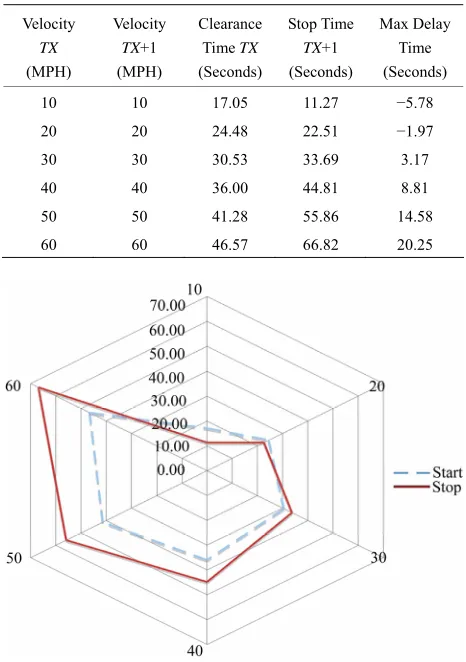
Based on the assumptions in the example, the time re- quired for TX to accelerate and clear, the time for the
fol-lowing TX1 to decelerate and stop, and the associated delays between the two is shown in Table 1.
Negative numbers indicate that a collision can occur. Train TX will not have cleared the interchange point be-
fore Train TX1 arrives. An alternative way to view combinations of leading train clearance time, and follow- ing train stopping time is with a radar chart (Figure 3). In this chart, the spokes represent the locomotive speeds, the rings represent clearance times in seconds. As can be seen, for the example configuration, in almost all cases, the time for a leading train to clear the block is less than the time it takes to stop the following train and some delay can occur without adversely impacting subsequent train movements. Changes in locomotive tractive effort and train length also can affect clearance and stopping times, This also is more fully discussed in [22].
[image:7.595.55.288.375.706.2]The allowable delays previously calculated are based on the physical characteristics of the locomotive and con- sist as well as the communications bandwidth (4800 bps) available to exchange data. Provided TX and TX1 re-
Table 1. Allowable delays
X X + 1
V = V .
Velocity TX (MPH)
Velocity TX+1 (MPH)
Clearance Time TX (Seconds)
Stop Time TX+1 (Seconds)
Max Delay Time (Seconds)
10 10 17.05 11.27 −5.78
20 20 24.48 22.51 −1.97
30 30 30.53 33.69 3.17
40 40 36.00 44.81 8.81
50 50 41.28 55.86 14.58
[image:7.595.55.287.378.708.2]60 60 46.57 66.82 20.25
Figure 3. Clearance & stopping time.
quire the same length of time to authenticate (i.e. TOH is a
constant for train TX or train TX1), the delay TOH can-cels out and the delay between individual trains (TXand
1 X
T ) remains the same as previously calculated.
With trains TXand TX1 operating with under condi- tion of nearly simultaneous movement authorities (a me-thod of operation known as moving block and a capa- bility made possible with Positive Train Control (PTC), the required train separation is significantly less than if train movements were not simultaneously. PTC is a wire- less communication SCADA system that utilizes a con- tinuous high bandwidth RF data communications net- work that allows train-to-wayside and wayside-to-train exchange of control and status information. Wayside, office, and trainborne computers process received train status and control data to provide continuous train con- trol [36,37].
With the moving block method of operations, the se- paration between trains moving at 60 mph can be as low as roughly 3/10th of a mile. When contrasted to the r- oughly 1.1 miles required by fixed blocks, the traffic density can be increase by roughly a factor of three. This makes significantly better use of the available track re- sources, and increases system throughput.
6. Conclusions
We presented a model for an interchange between two railroad domains governed by interoperating PTC sys- tems for a unidirectional track with a single siding. We showed how to compute the safe conditions by using communication and trust management delays between the two domains. This work provides the signal engineer designing interchanges of some idea of the feasibility of the proposed design. The work needs to be expanded to account for bidirectional train movements on a single tra- ck, multiple mainline track with crossovers, multiple sid- ings, and spurs. Once these more complex tactical rou- ting configurations have be addressed, they can be inte-grated into strategic models, Establishing these relation-ships is essential to determine the optimum use of limited resources and continues to remain an open research area.
ting environment and the particular implementation me-chanisms. Ongoing research in this will provide us with more accurate estimators to support detailed system de-sign and cost evaluation.
7. References
[1] B. Weinstein and T. Clower, “The Impact of the Union Pacific Service Disruptions on the Texas and National Economies: An Unfinished Story,” Railroad Commission of Texas, Austin, February 1998.
[2] “Joint Petition for Service Order, STB Service Order No. 1518,” Surface Transportation Board, Washington DC, 31 October 1997.
[3] Transportation Research Board of the National Acad-emies, “US Railroad Efficiency: A Brief Economic Over-view,” Proceedings of the Workshop on Research to En-hance Rail Network Performance, Washington DC, 5-6 April 2006, pp. 63-71.
[4] M. Dessouky, Q. Lu, J. Zhao and R. Leachman, “An Exact Solution Procedure to Determine the Optimal Dis-patching Times for Complex Rail Networks,” IEE Transactions, Vol. 32, No. 2, 2006, pp. 141-152.
[5] M. Khan, D. Zhang, M. Jun and J. Zhu, “An Intelligent Search Technique to Train Scheduling Problem Based on Genetic Algorithms,” Proceedings of the 2006 Interna-tional Conference on Emerging Technologies, Perhwar, 13-14 November 2006, pp. 593-598.
doi:10.1109/ICET.2006.335970
[6] A. Tazoniero, R. Gonclaves and F. Gomide, “Decision Making Strategies for Real Time Train Dispatch and Control Analysis and Design of Intelligent Systems Using Soft Computing Techniques,” Advances in Soft Comput-ing, Springer, Vol. 41, 2007, pp. 193-204.
[7] F. Li, Z. Gao, K. Li and L. Yang, “Efficient Scheduling of Railway Traffic Based on Global Information of Train,” Transportation Research, Part B: Methodological, Vol. 42, No. 10, 2008, pp. 1008-1030.
[8] M. Penicka, “Formal Approach to Railway Applications,” Formal Methods and Hybrid Real Time Systems, Lecture Notes in Computer Science, Springer, Vol. 4700, 2007, pp. 504-520. doi:10.1007/978-3-540-75221-9_24
[9] M. Carey and I. Crawford, “Scheduling Trains on a Net-work of Busy Complex Stations,” Transportation Re-search, Part B: Methodological, Vol. 41, No. 2, 2007, pp. 159-178.
[10] J. Tornquist, “Computer-Based Decision Support for Railway Traffic Scheduling and Dispatching, A Review of Models,” Proceedings of the 5th Workshop on Algo-rithmic Methods and Models for Optimization of Rail-ways, Palma de Mallorca, 14 September 2005.
[11] L. Anderegg, I. Stephan, E. Gantenbein and I Stature, “Train Routing Algorithms: Concepts, Design Choices, and Practical Considerations,” Proceedings of the 5th Workshop on Algorithm Engineering and Experiments, Baltimore, 11 January 2003, pp. 106-118.
[12] M. Lubbecke and U. Zimmermann, “Engine Routing and
Scheduling at Industrial In-Plant Railroads,” Transporta-tion Science, Vol. 37, No. 2, 2003, pp. 183-197. [13] A. E. Kozan and A. Higgins, “Modeling Train Delays in
Urban Networks,” Transportation Science, Vol. 32, No.4, 1998, pp. 346-357.
[14] Q. Lu, M. Dessouky and R. Leachman, “Modeling Train Movements through Complex Rail Networks,” ACM Transactions on Modeling and Computer Simulations (TOMACS), Vol. 14, No. 1, 2004, pp. 48-75.
[15] D. Parkes and L. Ungar, “An Auction Based Method For Decentralized Train Scheduling,” Proceedings of the 5th International Conference on Autonomous Agents, Mont-real, 28 May-1 June 2001, pp. 43-50.
[16] J. Lee, K. Sheng and J. Guo, “Fast and Reliable Algo-rithm for Railway Train Routing,” Proceedings of the IEEE Region 10 Conference on Computers, Communica-tions, Control Engineering, Beijing, 19-21 October 1993, pp. 652-655.
[17] D. Ariano, M. Pranzo and I. Hansen, “Conflict Resolution and Train Speed Coordination for Solving Time Table Perturbations,” IEEE Transactions on Intelligent Trans-portation Systems, Vol. 8, No. 4, 2007, pp. 208-222. [18] T. Ho, J. Norton and C. Goodman, “Optimal Traffic
Con-trol at Railway Junctions,” IEE Proceedings of Electric Power Applications, Vol. 144, No. 2, 1997, pp. 140-148. [19] M. Lewellen and K. Tumay, “Network Simulation of a
Major Railroad,” Proceedings of the 30th Winter Simula-tions Conference, Washington DC, 13-16 December 1998, pp. 1133-1138.
[20] S. Graff and P. Shenkin, “A Computer Simulation of a Multiple Track Rail Network,” Sixth International Con-ference on Mathematical Modeling, St. Louis, 4-7 August 1987, pp. 472-475.
[21] T. Ho and T. Yeung, “Railway Junction Traffic Control by Heuristic Methods,” IEE Proceedings of Electric Power Applications, Vol. 148, No. 1, 2001, pp. 771-772. [22] M. Hartong, “Secure Communications Based Train
Con-trol Operations,” Doctoral Dissertation, George Mason University, Fairfax, May 2009.
[23] D. Barney, D. Haley and G. Nkandros, “Calculating Train Braking Distances,” Proceedings of the 6th Australian Workshop on Safety Critical Systems and Software, Bris-bane, 6 July 2001, pp. 23-29.
[24] “IEEE Std. 1474.1-2004,” IEEE Standard for Communi-cations-Based Train Control, Appendix D, IEEE, Pis-cataway, 2004.
[25] T. M. Malvezzi, P. Presciani, B. Allotta and P. Toni, “Probabilistic Analysis of Braking Performance In Rail-ways,” Proceedings of the Institution of Mechanical En-gineers, Part F: Journal of Rail and Rapid Transit, Vol. 217, No. 3, 2003, pp. 149-165.
24 May 2006, pp. 199-211.
[27] B. Friman, “An Algorithm for Braking Curve Calcula-tions in ERTMS Train Protection Systems,” COMPRAIL 2006 10th International Conference on Computer System Design and Operation in the Railway and Other Transit Systems, Prague, 10-12 July 2006, pp. 421-430.
[28] “BS 05/19984709 DC (UIC-546) EN 15179. Railway Applications Braking. Requirements for the Brake Sys-tem of Passenger Coaches,” British Standards Institution, London, March 2005.
[29] “Draft Guide for the Calculation of Braking Distances for Rail Transit Vehicles, IEEE P1698/D1.3,” IEEE, Pis-cataway, 2008.
[30] F. Yan and T. Tang, “Formal Modeling and Verification of Real-time Concurrent Systems,” Proceedings of the IEEE International Conference on Vehicular Electronics and Safety, ICVES 2007, Beijing, 13-15 December 2007, pp. 1-6.
[31] E. Khmelnitsky, “On an Optimal Control Problem of Train Operation,” IEEE Transactions on Automatic Con-trol, Vol. 45, No. 7, 2000.
[32] L. Y. Zhang, P. Li, L. M. Jia and F. Y. Yang, “Study on the Simulation for Train Operation Adjustment under Moving Block,” Proceedings of the 2005 Intelligent
Transportation Systems,” Vienna, 13-16 September 2005, pp. 351-356. doi:10.1109/ITSC.2005.1520153
[33] H. Takeuchi, C. Goodman and S. Sone, “Moving Block Signaling Dynamics: Performance Measures and Re-starting Queued Electric Trains,” IEE Proceedings Electric Power Applications, Vol. 150, No. 4, 2003, pp. 483-492.
[34] H. Krueger, E. Vaillancourt, A. Drummie, S. Vucko and J. Bekavac, “Simulation in the Railroad Environment,” Proceedings of the 2000 Winter Simulation Conference, Orlando, 10-13 December 2000, pp. 1048-1055.
[35] W. Rudderham, “Longitudinal Control System of the Intermediate Capacity Transit System,” Proceedings of the 33rd IEEE Vehicular Technology Conference, To-ronto, 25-27 May 1983, pp. 183-190.
doi:10.1109/VTC.1983.1623131
[36] “Railroad Communications and Train Control, Report to Congress,” Federal Railroad Administration, Washington DC, July 1994