Reactive systems over cospans
Vladimiro Sassone
University of Sussex
Paweł Soboci´nski
Universit`a di Pisa
∗Abstract
The theory of reactive systems, introduced by Leifer and Milner and previously extended by the authors, allows the derivation of well-behaved labelled transition systems (LTS) for semantic mod-els with an underlying reduction semantics. The derivation pro-cedure requires the presence of certain colimits (or, more usually and generally, bicolimits) which need to be constructed separately within each model. In this paper, we offer a general construc-tion of such bicolimits in a class of bicategories of cospans. The construction sheds light on as well as extends Ehrig and K¨onig’s rewriting via borrowed contexts and opens the way to a unified treatment of several applications.
Introduction
Some of the most important operational techniques, devel-oped through research on concurrency, involve the use of labelled transition systems (LTS) and the accompanying no-tions of operational preorders and equivalences, bisimula-tion being chief among these, in order to reason about pro-cess equivalence. Some basic concepts, common to many applications where such operational techniques apply, in-clude the notions of term, context and reaction.
Such notions began to be studied in the seminal work of Berry and Boudol [3] on the chemical abstract ma-chine. More recently, Leifer and Milner’s [11] introduced the framework of reactive systems, aimed at providing a general setting where such notions can be studied. Reac-tive systems can be seen as a generalisation of ground term-rewriting systems, where a collection of ground rewrite rules is closed under a set of “reactive” contexts to obtain the rewrite relation. Contexts are themselves organised as the arrows of a categoryC.
Leifer and Milner’s chief contribution was to utilise a universal categorical construction, dubbed relative pushout ∗Research partly supported by EU FET-GC ‘MTS: Models and
Types for Security in Mobile Distributed Systems’, IST-2001-32617 and ‘A: Architectures for Mobility’, IST-2001-32747; EC RTN
2-2001-00346 SV; and BRICS, Basic Research in Computer Science
(www.brics.dk), funded by the Danish National Research Foundation,
University of Aarhus.
(RPO), in order to equip each reactive system with an LTS, whose labels can be characterised as the smallest contexts that allow reactions to occur – an idea originally due to Sewell [19]. Such LTSs are very well-behaved; in particu-lar, bisimilarity is a congruence with respect to all contexts,
provided that Chas “enough” RPOs. In [16], the authors
proposed an approach based on a 2-dimensional generali-sation of RPOs, the groupoidal relative pushout (GRPO), which has been shown in [15] to encompass previous ap-proaches addressing these issues. Of course, one retains the congruence theorems (bisimilarity, trace and failures equiv-alences) in the more general setting.
Several constructions of GRPOs have been proposed in the literature for particular categories of models. For in-stance, Milner explicitly constructed such bicolimits for bi-graphs [13] in full detail,1but there has been little work on understanding how such constructions may be performed in other models. Indeed, the main applications our theory of reactive systems have so far involved relatively simple ex-amples [16, 15].
In the paper we address this by giving a construction of GRPOs for a wide range of models – those which can be expressed as certain cospans over adhesive categories. The class of adhesive categories, introduced in [9], includes many categories where the objects are variants of graphs – for instance, the category Graph of graphs and graph ho-momorphisms is adhesive.
An important application of our results is Ehrig and K¨onig’s rewriting via borrowed contexts, an extension of the double-pushout (DPO) graph transformation approach with a contextual semantics that allows transfer of con-cepts and techniques from the field of process algebra to graphs. The labels of their LTS are the so-called “borrowed-contexts” – certain contexts which allow a DPO transforma-tion to be performed.
Other applications include a partial treatment of Milner’s bigraphs [13], a model introduced to model various fun-damental notions arising from the study of process calculi such as the pi-calculus, as well as a Petri net-based model
1Milner actually constructs ordinary RPOs in a precategory – this is
equivalent to constructing GRPOs in the bicategory which results from taking support translations as 2-cells (see [15]).
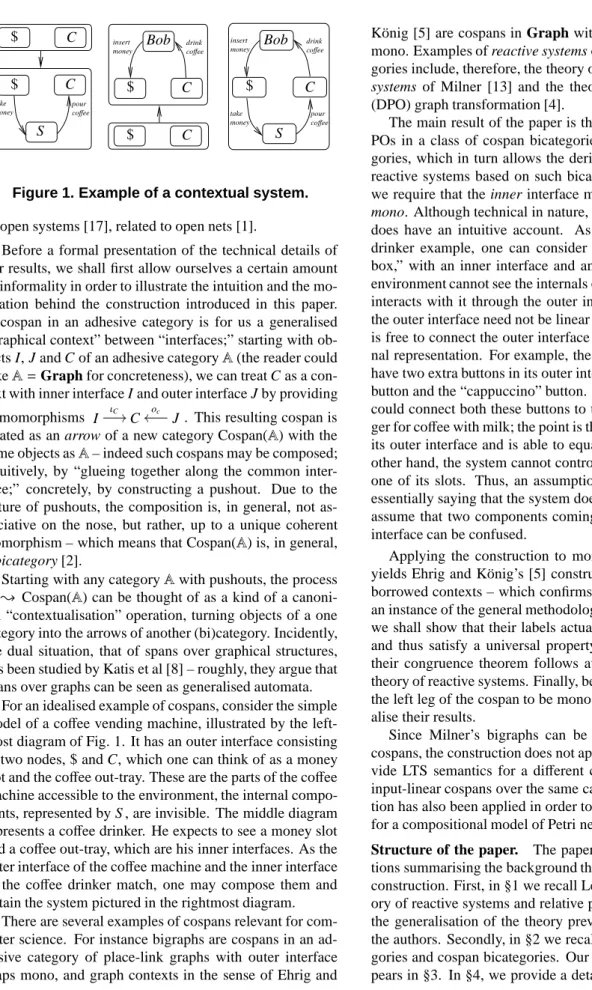
$ $ S C C take money pour coffee $ $ C C Bob insert money drink coffee $ S C Bob take money pour coffee insert money drink coffee
Figure 1. Example of a contextual system.
of open systems [17], related to open nets [1].
Before a formal presentation of the technical details of our results, we shall first allow ourselves a certain amount of informality in order to illustrate the intuition and the mo-tivation behind the construction introduced in this paper. A cospan in an adhesive category is for us a generalised “graphical context” between “interfaces;” starting with ob-jects I, J and C of an adhesive categoryA(the reader could
takeA=Graph for concreteness), we can treat C as a
con-text with inner interface I and outer interface J by providing homomorphisms I ιC //Coo oc J. This resulting cospan is
treated as an arrow of a new category Cospan(A) with the
same objects asA– indeed such cospans may be composed;
intuitively, by “glueing together along the common inter-face;” concretely, by constructing a pushout. Due to the nature of pushouts, the composition is, in general, not as-sociative on the nose, but rather, up to a unique coherent
isomorphism – which means that Cospan(A) is, in general,
a bicategory [2].
Starting with any categoryAwith pushouts, the process
A { Cospan(A) can be thought of as a kind of a
canoni-cal “contextualisation” operation, turning objects of a one category into the arrows of another (bi)category. Incidently, the dual situation, that of spans over graphical structures, has been studied by Katis et al [8] – roughly, they argue that spans over graphs can be seen as generalised automata.
For an idealised example of cospans, consider the simple model of a coffee vending machine, illustrated by the left-most diagram of Fig. 1. It has an outer interface consisting of two nodes, $ and C, which one can think of as a money slot and the coffee out-tray. These are the parts of the coffee machine accessible to the environment, the internal compo-nents, represented by S , are invisible. The middle diagram represents a coffee drinker. He expects to see a money slot and a coffee out-tray, which are his inner interfaces. As the outer interface of the coffee machine and the inner interface
of the coffee drinker match, one may compose them and
obtain the system pictured in the rightmost diagram. There are several examples of cospans relevant for com-puter science. For instance bigraphs are cospans in an ad-hesive category of place-link graphs with outer interface maps mono, and graph contexts in the sense of Ehrig and
K¨onig [5] are cospans in Graph with both interface maps mono. Examples of reactive systems over such cospan cate-gories include, therefore, the theory of bigraphical reactive systems of Milner [13] and the theory of double-pushout (DPO) graph transformation [4].
The main result of the paper is the construction of GR-POs in a class of cospan bicategories over adhesive cate-gories, which in turn allows the derivation of LTSs for all reactive systems based on such bicategories. Specifically, we require that the inner interface map of every cospan is mono. Although technical in nature, the linearity condition
does have an intuitive account. As alluded in the coffee
drinker example, one can consider a cospan as a “black box,” with an inner interface and an outer interface. The environment cannot see the internals of the system and only interacts with it through the outer interface. The fact that the outer interface need not be linear means that the system is free to connect the outer interface arbitrarily to its
inter-nal representation. For example, the coffee machine could
have two extra buttons in its outer interface; the “caf´e latte” button and the “cappuccino” button. The machine internals could connect both these buttons to the same internal trig-ger for coffee with milk; the point is that the system controls its outer interface and is able to equate parts of it. On the other hand, the system cannot control what is plugged into one of its slots. Thus, an assumption of input-linearity is essentially saying that the system does not have the right to assume that two components coming in through the inner interface can be confused.
Applying the construction to mono cospans in Graph yields Ehrig and K¨onig’s [5] construction of rewriting via borrowed contexts – which confirms that their approach is an instance of the general methodology of reactive systems; we shall show that their labels actually arise from GRPOs and thus satisfy a universal property. As a consequence, their congruence theorem follows automatically from the theory of reactive systems. Finally, because we require only the left leg of the cospan to be mono, we are able to gener-alise their results.
Since Milner’s bigraphs can be seen as output-linear cospans, the construction does not apply. However, we
pro-vide LTS semantics for a different class of bigraphs: the
input-linear cospans over the same category. The construc-tion has also been applied in order to derive LTS semantics for a compositional model of Petri nets [17].
Structure of the paper. The paper begins with two sec-tions summarising the background theory necessary for our construction. First, in§1 we recall Leifer and Milner’s the-ory of reactive systems and relative pushouts together with the generalisation of the theory previously worked out by the authors. Secondly, in§2 we recall about adhesive cate-gories and cospan bicatecate-gories. Our main construction ap-pears in§3. In§4, we provide a detailed exposition of the
relevance to Ehrig and K¨onig’s [5] and mention other appli-cations.
Preliminaries. Throughout the paper we assume a basic
knowledge of category theory, as well as basic acquaintance with the concepts of 2-categories and bicategories. Here we mention only that a bicategory [2] can be described, roughly, as a 2-category where associativity and identity laws of horizontal composition hold up to isomorphisms. We shall denote all associativity isomorphisms by a, as for
example, a : h(g f ) ⇒ (hg) f . The isomorphisms are
re-quired to respect well-known coherence axioms [12]. We
use idX to denote the identity at X, while 1f and • stand,
respectively, for identity 2-cells and vertical composition.
1
Reactive Systems and GRPOs
Here we briefly recall an extension of Leifer and Milner’s notion of reactive system to categories with 2-dimensional structure, as previously introduced by the authors [16]. The basic idea of a reactive system is to bring together a collec-tion of contexts, which form the arrows of a category, with a set of reaction rules on terms. From the reaction rules one generates a reaction relation by contextual closure. Us-ing certain pushouts, one equips a reactive system with an LTS on which bisimilarity is a congruence with respect to all contexts.
Apart from trivial examples, it is the norm that the con-texts of a reactive system have some notion of isomorphism – often referred to as structural congruence in the field of process calculi. It turns out that ignoring such structure is often problematic (cf. [16]) and one solution is to include the isomorphism/structural congruence as part of the struc-ture; i.e., to consider 2-categories of contexts instead of cat-egories. Guided by examples, we usually consider only iso-morphic 2-cells. In order to generate an LTS and extend the congruence results still, one then needs to consider bi-pushouts (rather than bi-pushouts) [16].
In this paper we consider cospans as contexts; since the composition is associative up to isomorphism, we shall need to work in bicategories instead of 2-categories. Apart from changing the definition of reactive system, this generalisa-tion poses no difficulty – bicolimits are naturally a bicate-gorical notion.
Definition 1.1 (Reactive System). A reactive system C
consists of
1. a bicategoryBwith all 2-cells iso;
2. a collectionDof arrows ofBcalled the reactive
con-texts; it is required to be closed under 2-cells and be composition-reflecting (see below);
3. a distinguished object 0∈B; arrows with domain 0 are often referred to as terms;
4. a set of pairs of terms, the reaction rulesR. The terms l,r of any given pairhl,ri ∈ Rhave the same codomain as arrows ofB.
The reactive contexts are those inside which evaluation
may occur. Composition-reflecting means that dd′∈D
im-plies d and d′ ∈ D, while the closure property means that
given d ∈ Dand an isomorphismρ: d ⇒ d′inBimplies
d′∈D.
The reaction relation ⊲is defined by taking a ⊲a′
if there ishl,ri ∈ R, d ∈ D,α: dl⇒ a andα′: a′ ⇒ dr.
This represents that, up to structural congruenceα, a is the left-hand side l of a reduction rule in a reactive context d, while a′is, up to structural congruenceα′, the right-hand side r in the same context.
Leifer and Milner [11] developed the derivation of a canonical LTS associated to any given reactive system. The derivation uses a universal construction, dubbed relative-pushout (RPO), which is a relative-pushout in a slice category. Bisimulation on the resulting LTS is a congruence, pro-vided that the underlying category of the reactive system has enough RPOs; we shall make the meaning of “enough” precise below.
A groupoidal-relative pushout (GRPO) is the generalisa-tion of an RPO to categories with 2-dimensional structure.
We recall the definition below,2 and due to lack of space
refer the reader to [16] for a full presentation. Note that although GRPOs are introduced there in the setting of G-categories (2-G-categories with iso 2-cells), the development is easily transferred to bicategories with iso 2-cells – it suf-fices to introduce the coherent associativity isomorphisms where necessary. In order to increase readability, we leave these out within the definition below.
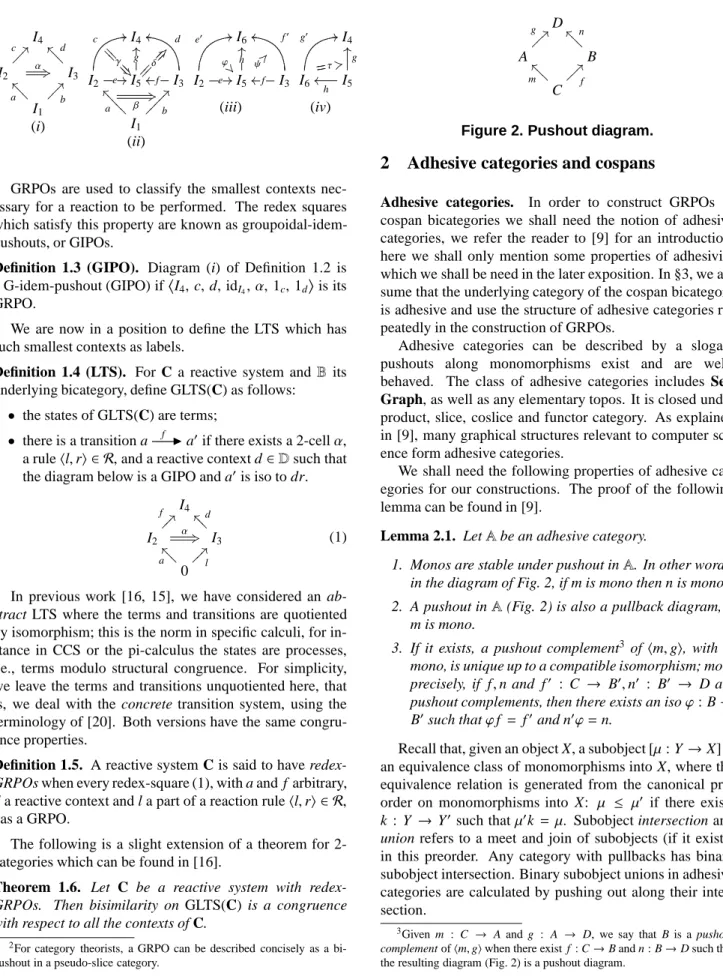
Definition 1.2 (GRPO). A candidate for square (i) is a
tu-plehI5,e, f,g, β, γ, δisuch thatδb•gβ•γa=α. In other
words, the 2-cells γ, β and δ, illustrated in diagram (ii), paste together to giveα.
A groupoidal-relative-pushout (GRPO) is a candidate which satisfies a universal property, namely, for any other candidatehI6,e′, f′,g′, β′, γ′, δ′ithere exists a mediating morphism, that is a quadruple
h : I5→I6, ϕ: e′⇒he, ψ: h f ⇒ f′, τ: g′h′⇒g
illustrated in diagrams (iii) and (iv). The equations that need to be satisfied are: 1.τe•g′ϕ•γ′=γ; 2.δ′•g′ψ•τ−1f =δ; and 3.ψb•hβ•ϕa=β′.
Such a mediating morphism must be essentially unique, namely, for any other mediating morphismhh′, ϕ′, ψ′, τ′i
there must exist a unique 2-cellξ: h⇒h′which makes the two mediating morphisms compatible, i.e.: 1. ξe•ϕ =ϕ′; 2.ψ•ξ−1f =ψ′; and 3.τ′•g′ξ=τ.
I4 I2 c ?? α + 3 I3 d _ _ >>> I1 a _ _ >>> b ? ? (i) γ > >> > # > > > > I4 I2 c 00 e // β + 3 I5 δ ; C gOO I3 f o o d n n I1 a _ _ >> >>> b ? ? (ii) ϕ " I6 I2 e′ 00 e //I5 ψ < D h O O I3 f o o f′ n n (iii) I4 I6 g′ 00 τ d dd d .6 I5 h o o g O O (iv)
GRPOs are used to classify the smallest contexts nec-essary for a reaction to be performed. The redex squares which satisfy this property are known as groupoidal-idem-pushouts, or GIPOs.
Definition 1.3 (GIPO). Diagram (i) of Definition 1.2 is
a G-idem-pushout (GIPO) ifI4,c,d,idI
4, α, 1c,1d
is its
GRPO.
We are now in a position to define the LTS which has such smallest contexts as labels.
Definition 1.4 (LTS). For C a reactive system and Bits
underlying bicategory, define GLTS(C) as follows:
• the states of GLTS(C) are terms;
• there is a transition a f ◮a′if there exists a 2-cellα, a rulehl,ri ∈ R, and a reactive context d∈Dsuch that
the diagram below is a GIPO and a′is iso to dr. I4 I2 f ?? α + 3 I3 d _ _ >>> 0 a _ _ ??? l ? ? (1)
In previous work [16, 15], we have considered an ab-stract LTS where the terms and transitions are quotiented by isomorphism; this is the norm in specific calculi, for in-stance in CCS or the pi-calculus the states are processes, i.e., terms modulo structural congruence. For simplicity, we leave the terms and transitions unquotiented here, that is, we deal with the concrete transition system, using the terminology of [20]. Both versions have the same congru-ence properties.
Definition 1.5. A reactive system C is said to have
redex-GRPOs when every redex-square (1), with a and f arbitrary, d a reactive context and l a part of a reaction rulehl,ri ∈ R, has a GRPO.
The following is a slight extension of a theorem for 2-categories which can be found in [16].
Theorem 1.6. Let C be a reactive system with
redex-GRPOs. Then bisimilarity on GLTS(C) is a congruence with respect to all the contexts of C.
2For category theorists, a GRPO can be described concisely as a
bi-pushout in a pseudo-slice category.
D A g ?? ~ ~ ~ B n _ _ @@@ C m _ _ ??? f ? ?
Figure 2. Pushout diagram.
2
Adhesive categories and cospans
Adhesive categories. In order to construct GRPOs in
cospan bicategories we shall need the notion of adhesive categories, we refer the reader to [9] for an introduction; here we shall only mention some properties of adhesivity which we shall be need in the later exposition. In§3, we as-sume that the underlying category of the cospan bicategory is adhesive and use the structure of adhesive categories re-peatedly in the construction of GRPOs.
Adhesive categories can be described by a slogan: pushouts along monomorphisms exist and are well-behaved. The class of adhesive categories includes Set,
Graph, as well as any elementary topos. It is closed under
product, slice, coslice and functor category. As explained in [9], many graphical structures relevant to computer sci-ence form adhesive categories.
We shall need the following properties of adhesive cat-egories for our constructions. The proof of the following lemma can be found in [9].
Lemma 2.1. LetAbe an adhesive category.
1. Monos are stable under pushout inA. In other words,
in the diagram of Fig. 2, if m is mono then n is mono. 2. A pushout inA(Fig. 2) is also a pullback diagram, if
m is mono.
3. If it exists, a pushout complement3 ofhm,gi, with m mono, is unique up to a compatible isomorphism; more precisely, if f,n and f′ : C → B′,n′ : B′ → D are pushout complements, then there exists an isoϕ: B→
B′such thatϕf = f′and n′ϕ=n.
Recall that, given an object X, a subobject [µ: Y→X] is an equivalence class of monomorphisms into X, where the equivalence relation is generated from the canonical
pre-order on monomorphisms into X: µ ≤ µ′ if there exists
k : Y → Y′such thatµ′k =µ. Subobject intersection and union refers to a meet and join of subobjects (if it exists) in this preorder. Any category with pullbacks has binary subobject intersection. Binary subobject unions in adhesive categories are calculated by pushing out along their inter-section.
3Given m : C → A and g : A → D, we say that B is a pushout
complement ofhm,giwhen there exist f : C→B and n : B→D such that
C+I2D C 9 9 s s s D e e KKK I1 ιC ?? I2 oC e e KKKK ιD 9 9 r r r r I3 oD _ _ ??
Figure 3. Composition of cospans.
Cospan bicategories. We shall assume thatCis a
cate-gory with chosen pushouts. That is, for arrows m : C →A
and f : C→B, there exists unique “chosen” object A+CB
and arrows A → A+C B and B → A+C B such that the
resulting square is a pushout.
The bicategory of cospans Cospan(C) has the same
objects as C, but arrows from I1 to I2 are cospans.
I1 ιC //Coo oC I2 . We will denote such cospans CoC
ιC :
I1→ I2, and omitιC(resp. oC) when I1(resp. I2) is initial. We shall sometimes refer to I1and I2as, respectively, the inner and outer interfaces of CoC
ιC. Intuitively, we can think
of a cospan as a generalised context, where C are the inter-nals, (the image via oCof) I2represents the public view of C, and (the image viaιCof) I1the view of C afforded to the “holes” in it. A 2-cell h : CoC ιC ⇒ C oC′ ιC′ : I1 → I2 in Cospan(C) is an arrow h : C → C′ inC satisfying hι C = ιC′ and hoC =
oC′. The isomorphic 2-cells provide a canonical notion
of “structural congruence.” We shall denote the bicate-gory of cospans which has the 2-cells limited to isomor-phisms by Cospan(C). Given cospans CoC
ιC : I1 → I2 and
DoC′
ιC′ : I2 →I3, their composition is the cospan obtained by
taking the pushout of oC andιD, as illustrated by Fig. 3.
Note that in the resulting composition, I2 is “forgotten.”
Composition is associative up to a unique isomorphism. It is easy to check that the associativity isomorphisms satisfy the coherence axioms, and thus yield a bicategory
To perform our construction we need a certain linearity restriction. In particular, the notion of input-linear cospan.
Definition 2.2 (Linearity). A cospan CoC
ιC is said to be
input-linear when ιC is a mono, output-linear when oC is mono, and linear when it is both input-linear and output-linear.
A simple corollary of the first part of Lemma 2.1 is that the composition of two input-linear cospans over an adhe-sive category yields an input-linear cospan. Similarly, com-position preserves output-linearity and linearity.
Definition 2.3. Assuming that A is adhesive, let ILC(A)
be the bicategory consisting of input-linear cospans and
2-isomorphisms. Similarly, let LC(A) be the bicategory of
linear cospans and 2-isomorphisms.
3
GRPOs for cospans
In this section we present a general construction of GRPOs for a class of reactive systems over cospan bicategories.
Construction. The following result is the main original contribution of this paper. Several implications of Theo-rem 3.1 and of the construction which constitutes its proof are considered in§4.
Theorem 3.1. IfAis adhesive, ILC(A) has GRPOs.
The remainder of this section presents a proof of the above theorem. We first outline an algorithm for the
con-struction of the desired minimal candidate. Because of
space constraints, we have omitted most technical details; these can be found in the second author’s Ph.D. thesis [20] and in [18].
An arbitrary square in ILC(A), as illustrated in
dia-gram (i) below, amounts to a commutative diadia-gram (ii) in
A, withαan isomorphism. I4 I2 α +3 C ?? I3 D _ _ >>> I1 A _ _ >>> B ? ? (i) C i I4 oC o o oD //D i I2<< ιC y<< y y y y oAEE"" E E EA+I2C α / / B+I3D I3 oB | | yyyy y b b ιD b b EEEE E AOO i O O I1// ιB / / o o ιA o o (ii) BOO iOO
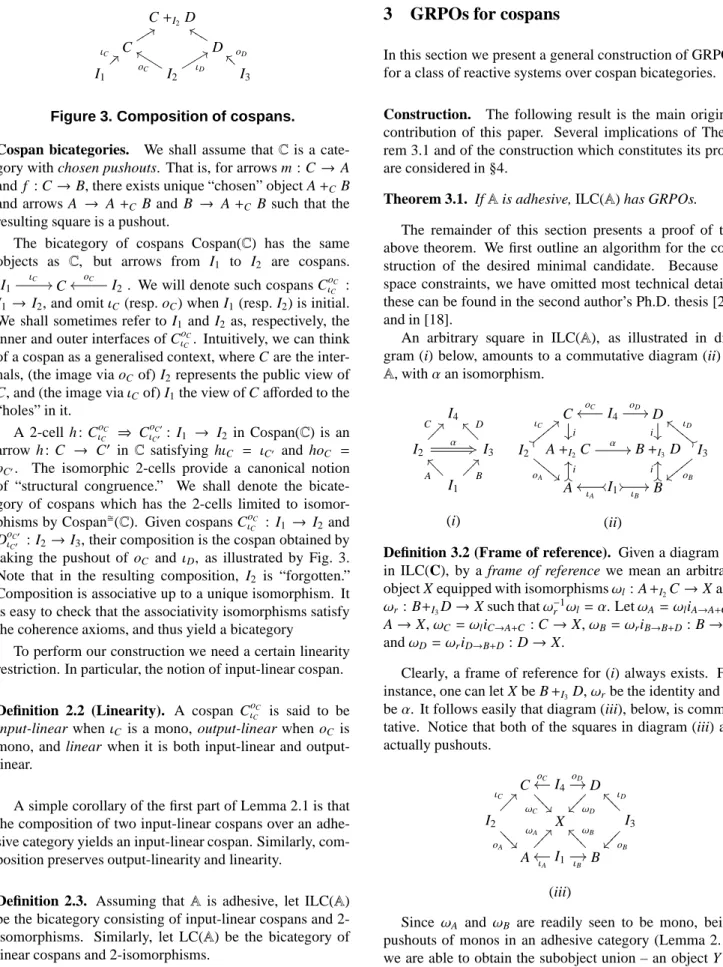
Definition 3.2 (Frame of reference). Given a diagram (i)
in ILC(C), by a frame of reference we mean an arbitrary
object X equipped with isomorphismsωl: A+I2C→X and
ωr: B+I3D→X such thatω
−1
r ωl=α. LetωA =ωliA→A+C :
A→X,ωC =ωliC→A+C: C→X,ωB=ωriB→B+D: B→X
andωD=ωriD→B+D: D→X.
Clearly, a frame of reference for (i) always exists. For instance, one can let X be B+I3D,ωrbe the identity andωl
beα. It follows easily that diagram (iii), below, is commu-tative. Notice that both of the squares in diagram (iii) are actually pushouts. C ωC>> > > I4 oC o o oD//D ωD I2 oA>> > > ιC @@ X I3 ιD _ _ >>>> oB A ωA @@ I1 (iii) ιA o o ιB / /B ωB _ _ >>>>
Since ωA and ωB are readily seen to be mono, being
pushouts of monos in an adhesive category (Lemma 2.1),
A∪B and monomorphismsµ : Y → X,ǫ1 : A → Y and
ǫ2: B→Y satisfyingµǫ1 =ωAandµǫ2=ωB.
Notice that sinceµis mono andµǫ1ιA =ωAιA =ωBιB =
µǫ2ιBwe have thatǫ1ιA =ǫ2ιB. We obtain the commutative diagram (iv). X A ǫ1 // ωA 00 Y µ O O B ωB n n ǫ2 o o I1 ιA _ _ ?? ?? ?? ιB ? ? (iv) I5 oE w w oooooo ιG ? ? oF E σ1 ρ1 ? ? G π2 π1 w w nnnnnn C ωC F σ2 oo w w ooo ρ2 A A Y µ@ @ D ωD w w nnnnnn X (v) γ > >> > # > > > > I4 I2 C 11 E // β + 3 I5 δ < D G O O I3 F o o D m m I1 A _ _ ?? ?? ?? B ? ? (vi)
Algorithm 3.3 (GRPO Construction in ILC(A)). The
construction of the components of the minimal candidate is outlined below. They are illustrated in diagrams (v) and (vi). We obtain:
1. G as the pullback ofωC : C→X andωD: D→X;
2. E as the pullback ofµ: Y→X andωC : C→X;
3. F as the pullback ofµ: Y→X andωD: D→X;
4. I5 as the pullback of ρ2: F → D and π2: G → D;
notice that due to the properties of pullbacks, we obtain
a morphism oE : I5 → E such that all the faces of (v)
are pullbacks.
The following two lemmas show that the construction of Algorithm 3.3 indeed results in a GRPO, and complete the proof of Theorem 3.1.
Lemma 3.4. The construction as outlined in Algorithm 3.3
provides a candidate for square (i).
Proof. In order to prove the lemma, we are required to: 1. demonstrate the existence of appropriate inner and
outer interfaces for each of E, F and G;
2. show that there exist isomorphisms β : A+I2 E →
B+I3F,γ: C→E+I5G andδ: F+I5G→D;
3. show that these isomorphisms paste together in way which results in a 2-cell equal toα: A+I2C→B+I3D.
We omit the details, and refer the reader to [18, 20].
Lemma 3.5. The candidate constructed using
Algo-rithm 3.3 satisfies the universal property of a GRPO. More
0 1 1 +3 2 @@ 1 2 ^ ^ == === 0 1 ^ ^ == === 1@@ 0 1 γ +3 2 @@ 1 2 ^ ^ == === 0 1 ^ ^ == === 1@@ 1 < < < < < < " < << < 0 1 1 + 3 2 22 1 //1 1 < D 2 O O 1 1 o o 2 m m 0 1 ^ ^ >> >>>> >> 1 @ @ 1 < < < < < < " < << < 0 1 γ +3 2 22 2 //2 1 < D 2 O O 1 2′ o o 2 m m 0 1 ^ ^ >> >>>> >> 1 @ @
Figure 4. GRPOs inILC(Set).
precisely, given any other candidate for diagram (i), as illus-trated in diagram (xiii), there exists a mediating morphism:
γ′ > > > > # > > > > I4 I2 C 11 E′ // β′ +3 I6 δ′ < D G′ O O I3 F′ o o D m m I1 A _ _ ?? ?? ?? B ? ? (xiii)
a cospan I5// ιH //Hoo oH I6 (an arrow H : I5 → I6of
ILC(A)) and isomorphismsϕ: E′→E+
I5H,ψ: F+I5H→
F′andτ: H+
I6G
′→G in C which form 2-cells of ILC(A) and which satisfy the required equations:
(E+I5τ)a(ϕ+I6G ′) γ′=γ, δ′(ψ+I6G ′)a(F+ I5τ −1)= δ
and (B+I3ψ)a(β+I5H)a(A+I2ϕ)=β
′
.
Moreover, the mediating morphismhH, ϕ, ψ, τiis required to be essentially unique (see Definition 1.2). This means that for any other mediating morphismhH′, ϕ′, ψ′, τ′iwhich satisfies analogous equations, there exists a unique
isomor-phismξ : H → H′which makes the two mediating
mor-phisms compatible: (E+I5ξ)ϕ=ϕ ′ , ψ(F+I5ξ −1 )=ψ′ and τ′(ξ+I6G ′ )=τ.
Proof. Omitted, see [18, 20].
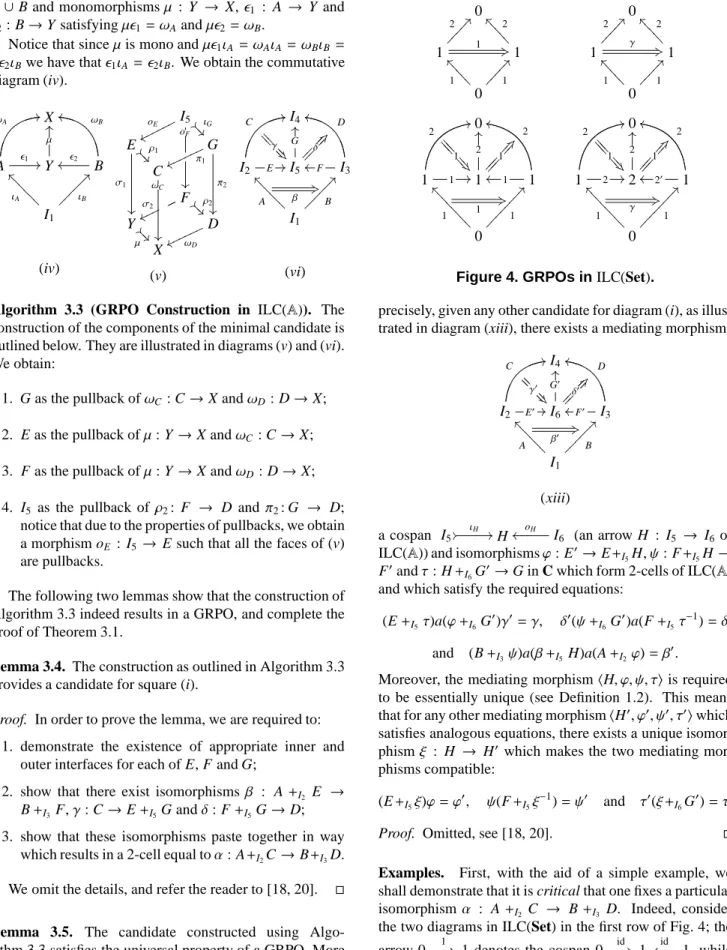
Examples. First, with the aid of a simple example, we
shall demonstrate that it is critical that one fixes a particular
isomorphism α : A+I2 C → B+I3 D. Indeed, consider
the two diagrams in ILC(Set) in the first row of Fig. 4; the
∅ a b d a O O a1 a2 a1 a2 c d a1 O O a2 O O c a1 O O a2 b ∅ c a1,1 O O a1,2 a2,1 a2,2 a1,1 a1,2 a2,1 a2,2 d a1 a2 O O a1 a2 b ιA ιB oA oB ιC ιD oC oG oD ιG oE ιE ιF oF
Figure 5. GRPOILC(Graph)
1 −→2 0 denotes the cospan 1−→0 2 ←−! 0, andγ: 2→ 2
is the bijection which swaps the two elements. We illustrate the two resulting candidates in the second row of Fig. 4:
1 −→id 1 is the identity cospan 1 −→id 1 ←−id 1, whereas
1 −→2 2 is the cospan 1 −→0 2 ←−id 2 and 1 2
′
−→ 2 is the
cospan 1−→0 2←−γ 2.
Intuitively, in the first case, the two lower arrows corspond to the same element. Thus the context contains re-dundant information which can be factored out resulting in a candidate which is just the identity context. Conversely, they are different in the second case, meaning that the con-text has to be kept in the minimal candidate.
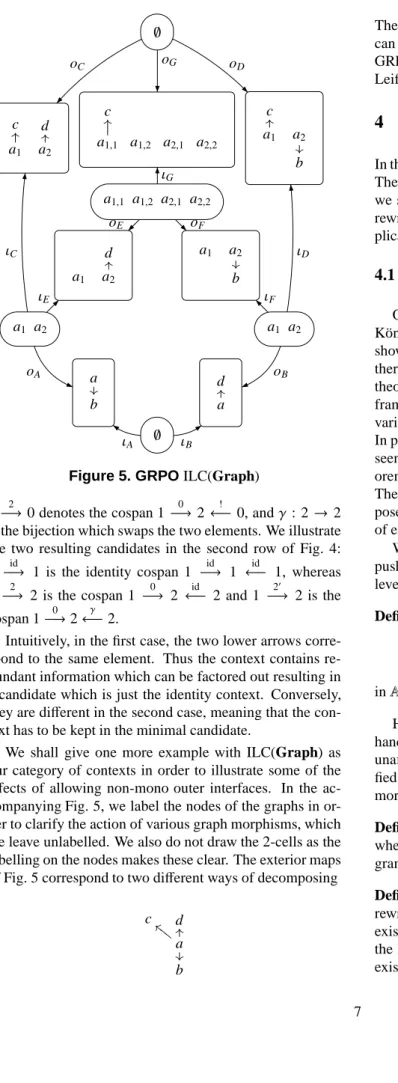
We shall give one more example with ILC(Graph) as our category of contexts in order to illustrate some of the
effects of allowing non-mono outer interfaces. In the
ac-companying Fig. 5, we label the nodes of the graphs in or-der to clarify the action of various graph morphisms, which we leave unlabelled. We also do not draw the 2-cells as the labelling on the nodes makes these clear. The exterior maps of Fig. 5 correspond to two different ways of decomposing
c d a b b EEE OO b
The GRPO is illustrated in the interior of the diagram. One can compare this “blowing up” of the outer interface in the GRPO with the phenomenon of “forking” as described by Leifer [10, Fig. 1.4].
4
Applications
In this sections we shall examine some of the applications of Theorem 3.1 and Algorithm 3.3. Due to space restrictions, we shall concentrate on the application Ehrig and K¨onig’s rewriting via borrowed contexts and briefly summarise ap-plications to bigraphs and Petri nets.
4.1
Rewriting via borrowed contexts
Our results both shed light on and extend Ehrig and K¨onig’s rewriting via borrowed contexts [5]. First, we shall show that borrowed contexts correspond to GIPOs, and therefore satisfy a universal property. Consequently, the theory of rewriting via borrowed contexts falls within the framework of reactive systems [11, 16, 15] and therefore the various congruence properties and constructions carry over. In particular, Ehrig and K¨onig’s congruence theorem can be seen as an application of the congruence of bisimilarity the-orem for reactive systems. Finally, due to the generality of Theorem 3.1, we relax some of the technical conditions im-posed by Ehrig and K¨onig and thereby introduce the notion of extended borrowed contexts (Definition 4.7).
We begin with a brief account of a variant of double-pushout (DPO) graph transformation [4], working at the level of an arbitrary adhesive categoryA.
Definition 4.1 (Rewrite Rule). A rewrite rule p is a span
Loo l K r //R (2)
inA. No assumptions are made about either l or r.
Here L and R represent respectively the left and right-hand side of the rule, while K is information which remains unaffected by the rewrite. A redex in an object C is identi-fied by matching a rule’s left-hand side, which is done via a
morphism f : L→C.
Definition 4.2 (Grammar). An grammar G is a pairhC,Pi
whereC is a category and P is a set of rewrite rules. A
grammar is said to be adhesive whenCis adhesive.
Definition 4.3 (Rewrite rule application). Object C
rewrites to D with rule p, in symbols C ◮p,f D, if there
exist an object E and morphisms so that the two squares in
the Fig. 6 are pushouts. We shall write C ◮ D if there
L f K g l o o r //R h Coo v E w //D
Figure 6. Rewrite rule application (DPO).
Using the conclusion of the third part of Lemma 2.1, one can show that in adhesive grammars, the application of left-linear rewrite rules is functional, so that C ◮p,f D and C ◮p,f D′implies that DD′(cf. [9]).
Any grammar G = hC,Pi can be seen translated into
a reactive system on Cospan(C). Let 0 denote the empty
graph, and the set Rcontain for each rewrite rule p (2) a
pair
D
0→L←−l K,0→R←−r KE.
We choose all arrows of Cospan(C) be reactive. Let ⊲
denote the resulting reaction relation. The translation pre-serves semantics, as demonstrated by the following lemma, which is similar to a previously published result [6] and can
be considered folklore. We use the shorthand C ⊲D to
mean that C and D are cospans with empty inner and outer interfaces. It is crucial for us because it serves as a founda-tion for relating the theory of DPO transformafounda-tion systems and reactive systems over cospans.
Lemma 4.4. C ◮D iffC ⊲D.
In order to apply Theorem 3.1, we need restrict to graph transformation systems which correspond to reactive sys-tems over input-linear cospans.
Definition 4.5 (Input-Linear Rewrite Application).
Ob-ject C rewrites to D input-linearly with rule p, in symbols C ◮il
p,f D, if C ◮p,f D and in addition f , g and h of Fig. 6 are mono.
It follows that starting with an adhesive grammar G =
hA,Piand an input-linear rewrite relation ◮il, we may construct a corresponding reactive system A over the
bicat-egory of input-linear cospans ILC(A). Clearly, Lemma 4.4
specialises, and thus semantics is preserved. Now, using the construction of GRPOs of Theorem 3.1, we obtain an LTS;
let LTS(G)=GLTS(A). Using the congruence theorem for
bisimilarity from [16] on such an LTS, we obtain that bisim-ilarity on LTS(G) is a congruence.
A rewrite rule (2) is called linear when both l and r are mono. If we restrict our view to DPO rewriting systems with linear rewrite rules and input-linear rewrites then we are in a position to compare the resulting LTS with rewriting via borrowed contexts, which requires these extra assump-tions.
Precisely, given an adhesive grammar G=hA,Pi, where
P consists of linear rewrite rules, let RBC(G) be the LTS
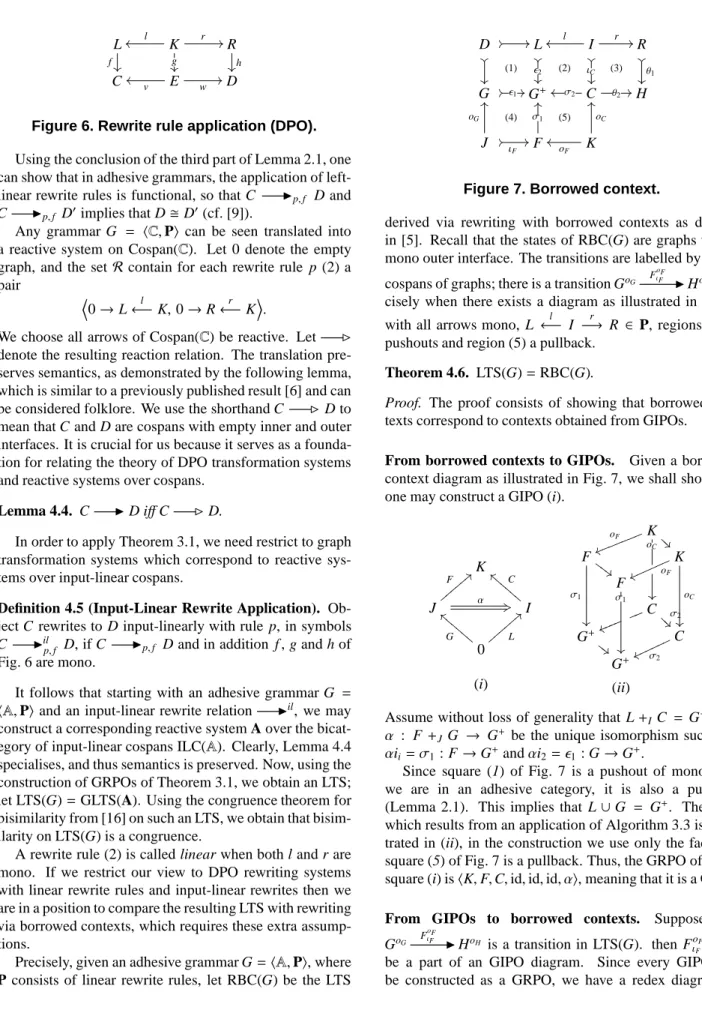
D (1) / / //L (2) ǫ2 I (3) ιC l o o r //R θ1 G (4) / / ǫ1 //G+ (5) C σ2 o o θ2 //H J oG O O / / ιF / /F σ1 O O K oC O O oF o o
Figure 7. Borrowed context.
derived via rewriting with borrowed contexts as defined in [5]. Recall that the states of RBC(G) are graphs with a mono outer interface. The transitions are labelled by mono cospans of graphs; there is a transition GoG F
oF ιF
◮HoH
pre-cisely when there exists a diagram as illustrated in Fig. 7
with all arrows mono, L ←−l I −→r R ∈ P, regions (1–4)
pushouts and region (5) a pullback.
Theorem 4.6. LTS(G)=RBC(G).
Proof. The proof consists of showing that borrowed con-texts correspond to concon-texts obtained from GIPOs.
From borrowed contexts to GIPOs. Given a borrowed
context diagram as illustrated in Fig. 7, we shall show that one may construct a GIPO (i).
K J α +3 F zz== z z z z I C a a CC CCCC 0 G a a DD DD DD L = = { { { { { { (i) K oF u u llllll lo AA C F σ1 # # G G G K oC oF v v mmmmmm F σ1 C ll v v llll σ2 @ @ G+ " " F F C σ2 v v nnnnnn G+ (ii)
Assume without loss of generality that L+IC = G+. Let
α : F +JG → G+ be the unique isomorphism such that
αii=σ1: F→G+andαi2=ǫ1 : G→G+.
Since square (1) of Fig. 7 is a pushout of monos and we are in an adhesive category, it is also a pullback
(Lemma 2.1). This implies that L∪G = G+. The cube
which results from an application of Algorithm 3.3 is illus-trated in (ii), in the construction we use only the fact that square (5) of Fig. 7 is a pullback. Thus, the GRPO of redex square (i) ishK,F,C,id,id,id, αi, meaning that it is a GIPO.
From GIPOs to borrowed contexts. Suppose that
GoG F oF ιF
◮HoH is a transition in LTS(G). then FoF
ιF must
be a part of an GIPO diagram. Since every GIPO can be constructed as a GRPO, we have a redex diagram as
γ > > > > " > > > > I4 I2 β + 3 F′ 00 F //I5 δ < D GOO I3 C o o C′ n n 0 G _ _ ?? ??? L?? (iii) I3 oR // iC R θ1 C θ2 / /H (iv) G∩L // // G ǫ1 L // ǫ2 / /Y (v) I5 oF / / oC F σ1 C σ 2 / /Y (vi) I2 oG / /iF //F σ1 G // ǫ1 / /Y (vii) I3 oL / /iC //C σ2 L // ǫ2 / /Y (viii) the outside of diagram (iii), with hLoL,RoRi being a
reac-tion rule, corresponding via the translareac-tion of Lemma 4.4
to the rewrite rule Loo oL I3 oR //R. The candidate
hI5,F,C,G, β, γ, δiillustrated is the GRPO obtained via the
construction of Algorithm 3.3.
We also have HoH CoC
iC ◦R
oR, which in other words
means that diagram (iv) is a pushout with oH : I5 → H
equal toθ2◦oC.
Recall that from the construction, we have that diagram (v) is a pushout, diagram (vi) is a pullback, dia-grams (vii) and (v) are pushouts. Diadia-grams (iv) through to (viii) paste together to give the required borrowed
con-text.
We end this section with an extension of borrowed con-texts suggested by the linearity conditions imposed in the construction of Algorithm 3.3.
Definition 4.7 (Extended Borrowed Contexts). Given an
adhesive grammar G=hC,Piwith an arbitrary set of rules
P, we shall construct a labelled transition system with:
−−− States: Graphs with outer interfaces, J −→oG G where oGis arbitrary;
−−− Transitions: Cospans of graphs J−→ιF F ←−oF K where
ιFis mono and oFis arbitrary. We derive a transition GoG F
oF ιF
◮HoH if there exists a
commutative diagram as in Fig. 7, where (1), (2), (3) and (4) are pushouts, while square (5) is a pullback. The indicated morphisms are assumed to be mono, the others are arbitrary. As a corollary of the translation between borrowed con-texts and GIPOs of Theorem 4.6 and the congruence we have that bisimilarity on the labelled transition system re-sulting from Definition 4.7 is a congruence with respect to arbitrary input-linear graph contexts.
4.2
Bigraphs and Petri nets
Bigraphs are a graphical formalism originally introduced
by Milner [13] in order model dynamic systems with inde-pendent locality and connectivity structures [7]. Bigraphs can be seen as ‘output-linear’ cospans over a certain adhe-sive category, as we discuss below. It follows that by con-sidering an input-linear variant – a model which yet incor-porates many of bigraphs’ fundamental features – we meet the requirements of our framework. Using Algorithm 3.3, we are then able to derive an LTS for any reactive system on such bigraphical structures. Such an LTS coincides with Milner’s on the bigraphs in the intersection of the respective definitions. Here we offer only a brief discussion, the reader is referred to [18, 20] for details. We introduce the adhesive category of place-link graphs, which can be considered “bi-graphs without interfaces.” Interfaces will be handled by considering the bicategory of cospans over such category.
Fixed an alphabet of controlsΣ, we define a place-graph G to be a directed graph with nodes labelled overΣ. Here edges represent (a generalisation of) the nesting of
loca-tions. The connectivity of each K ∈ Σis determined by
an arity function ar : Σ→N,so thatKhas ports numbered
1, . . . ,ar(K). By “set of ports” of G we indicate the disjoint
union of all the ports associated to all the nodes of G.
Definition 4.8 (Place-Link Graphs). A place-link (pl)
graph is a place-graph G together with a link map l : P→S , where P is the set of ports of G. The role of l and S is to jointly describe the connections between ports. A place-link (pl) morphism is a graph morphism which preserve node
la-bels and port connections. Let PLGraphΣbe the category
of pl-graphs and pl-graph morphisms overΣ.
It is easy to construct a categoryXΣ so that PLGraph
Σ is a presheaf category SetXΣ and, as such, is adhesive. We
can then conclude as follows.
Corollary 4.9. ILC(PLGraphΣ) has GRPOs, calculated
using Algorithm 3.3.
There are two aspects of our bicategory of pl-graphs that generalise the theory of bigraphs. Firstly, interfaces here need not be “discrete,” i.e., specify just nodes to be merged and ports to be connected, but allow for more com-plex forms of composition. Secondly, place graphs are usu-ally forests of trees, and their input (resp. output) interfaces reach only leaves (resp. roots), while we allow all directed graphs. One can, however, prove that Corollary 4.9 remains
valid when the arrows of ILC(PLGraphΣ) are restricted to
such bigraphs.
The main difference with bigraphs remains the
input-vs output-linearity issue, which has the interesting effect of banning name aliasing in respectively the inner and the
outer interface. We leave a deeper analysis of this di-chotomy as future work.
Petri nets provide another application of our framework,
described in [17]. The model consists of adding an ele-mentary notion of interface to Petri nets, similarly to other proposals in the literature, as e.g. [1, 14]. Specifically, we equip each net with two ordered subsets of places: the in-ner and the outer interface. This, together with morphisms that respect net topologies and interfaces, yields a bicate-gory INet, which can easily be recast in terms of cospans over an adhesive category. Formally, let MNet be the cat-egory of marked Petri nets and structure-preserving homo-morphisms. As MNet is adhesive, we have the following result, where GRPOs are calculated via Algorithm 3.3.
Corollary 4.10. ILC(MNet) has GRPOs,
INet consists of the linear cospans with discrete
inter-faces in ILC(MNet) and, once again, the existence of GR-POs is not affected by this restriction. Then, considering the usual Petri “token game” as a reactive system over INet, we automatically derive an LTS for Petri nets with interfaces over which bisimulation is congruence.
As it turns out, such a bisimulation admits a very sim-ple characterisation consisting of only three kinds of tran-sitions: p τ ◮p′, if p′results from p through an internal firing; p +i◮p′if p′results from p by adding a token at its ith outer place; and p −i◮p′if p′results from p by remov-ing a token from its ith outer place. We remark that this is the same bisimulation as derived by Milner using a bigraph-based representation of Petri nets with interfaces [14].
5
Conclusion
We have constructed groupoidal relative pushouts (GRPOs) in a general framework of generalised contexts and inter-faces, represented by cospan bicategories over adhesive cat-egories. This allows us to systematically derive a composi-tional semantics for each reactive system in the framework, in the form of a LTS determining a bisimulation congru-ence. We have shown in detail how Ehrig and K¨onig’s rewriting via borrowed contexts [5] falls within the frame-work and can be obtained as an application of our theory, and mentioned two others, a variant of Milner’s bigraphs and a compositional approach to Petri nets [17].
As future work, we plan to investigate conditions under which a general construction of GRPOs exist for output-linear cospan bicategories.
Acknowledgements. The authors would like to thank Vincent Danos and the anonymous referees for their helpful comments.
References
[1] P. Baldan, A. Corradini, H. Ehrig, and R. Heckel. Compo-sitional modeling of reactive systems using open nets. In
CONCUR ’01, volume 2154 of LNCS. Springer, 2001.
[2] J. B´enabou. Introduction to bicategories. In Midwest
Cat-egory Seminar, volume 42 of LNM, pages 1–77. Springer,
1967.
[3] G. Berry and G. Boudol. The chemical abstract machine.
Theoretical Computer Science, 96:217–248, 1992.
[4] H. Ehrig, G. Engels, H.-J. Kreowski, U. Montanari, and G. Rozenberg, editors. Graph Grammars and Computing
by Graph Transformation, Vol. 1-3. World Scientific, 1999.
[5] H. Ehrig and B. K¨onig. Deriving bisimulation congruences in the DPO approach to graph rewriting. In FOSSACS ’04, volume 2987 of LNCS, pages 151–166. Springer, 2004. [6] F. Gadducci and R. Heckel. An inductive view of graph
transformation. In WADT ’97, pages 223–237, 1997. [7] O. H. Jensen and R. Milner. Bigraphs and mobile processes.
Technical Report 570, University of Cambridge, 2003. [8] P. Katis, N. Sabadini, and R. F. C. Walters. Bicategories of
processes. J. Pure Appl. Algebra, 115:141–178, 1997. [9] S. Lack and P. Soboci´nski. Adhesive categories. In
FOS-SACS ’04, volume 2987 of LNCS. Springer, 2004.
[10] J. Leifer. Operational congruences for reactive systems. Phd thesis, University of Cambridge, 2001.
[11] J. Leifer and R. Milner. Deriving bisimulation congruences for reactive systems. In CONCUR ’00, volume 1877 of
LNCS, pages 243–258. Springer, 2000.
[12] S. MacLane and R. Par´e. Coherence for bicategories and in-dexed categories. J. Pure Appl. Algebra, pages 59–80, 1985. [13] R. Milner. Bigraphical reactive systems. In Concur ’01,
volume 2154 of LNCS, pages 16–35. Springer, 2001. [14] R. Milner. Bigraphs for Petri nets. In Lectures on
Con-currency and Petri Nets 2003, volume 3098 of LNCS, pages
686–701. Springer, 2004.
[15] V. Sassone and P. Soboci´nski. Deriving bisimulation con-gruences: 2-categories vs precategories. In FOSSACS ’03, volume 2620 of LNCS. Springer, 2003. Full version to ap-pear in Theor. Comp. Sci.
[16] V. Sassone and P. Soboci´nski. Deriving bisimulation congru-ences using 2-categories. Nord. J. Comput., 10(2):163–183, 2003.
[17] V. Sassone and P. Soboci´nski. A congruence for Petri nets. In Workshop on Petri Nets and Graph Transformation, 2004. Available at the authors’ web pages.
[18] V. Sassone and P. Soboci´nski. Congruences for contextual graph-rewriting. Technical Report RS-14, BRICS, 2004. [19] P. Sewell. From rewrite rules to bisimulation congruences.
Theoretical Computer Science, 274(1–2):183–230, 2002.
[20] P. Soboci´nski. Deriving process congruences from reaction