1Abstract—Gigabit passive optical network (GPON) and Long Term Evolution (LTE) are two promising broadband access technologies for next-generation fiber-wireless network. With the advantage of their complementary features can be used to make up each other’s drawbacks, optical part can unrestricted from the geography and wireless part can have higher transfer rate, we propose an integrated architecture to converge GPON and LTE. Based on this architecture, a hierarchical dynamic bandwidth assignment with admission control is proposed to well transmit heterogeneous traffic in this paper. First, we combine the ONU with evolve node B into an ONU-eNB device and briefly describe each function module. Second, a dynamic delay-based admission control scheme is proposed to guarantee the required QoS for each request to maximize the throughput. Third, we propose two steps hierarchical DBA that first layer optical line terminal allocates the bandwidth and the second layer bandwidth reassignment will be executed followed by service level agreement in ONU-eNB. Simulation results show that the proposed scheme can improve the throughput about 3~10% and increase about 60~210 requests for users while the QoS is met.
Index Terms
—
GPON-LTE converged network, Hierarchical dynamic bandwidth assignment, Admission control,QoS.I. INTRODUCTION
ASSIVE Optical Network (PON) is recognized as the most cost-effective solution linking to the end users in order to promote high-bandwidth and fault tolerance which makes the network more efficiency and easily managed for the Home/Curb/Building (FTTx) networks [1]
Passive Optical Network (PON) is recognized as the most cost-effective solution linking to the end users in order to promote high-bandwidth and fault tolerance which makes the network more efficiency and easily managed for the Home/Curb/Building (FTTx) networks. [1] With the 10Gbps Ethernet Passive Optical Network (EPON) standard - IEEE 802.3av as well as GPON network by ITU-T G.984.3 announcement; these are viewed as one of the best solution for building broadband access network. In contrast, GPON [2] provides not only a variety of QoS requirements with a better transfer rate, more stringent QoS definition and the advantages of high efficiency. In addition, GPON adapts a variety of transmission tools by GPON Transmission Convergence (GTC) layer to take the Asynchronous Transfer Mode (ATM)
I.S. Hwang, A.F. Pakpahan and A. Nikoukar are with the Department of Computer Science and Engineering, Yuan-Ze University, Chung-Li 32003, Taiwan (e-mail: [email protected]. edu.tw).
B.J. Hwang is with the Department of Computer and Communication Engineering, Ming Chuan University, Taoyuan 33348, Taiwan.
contained units or GPON encapsulation method (GEM) framework. GPON [3] supports symmetric and asymmetric line rates in the GTC layer, which makes the PON can provide a full range of services in the high transmission rate. GPON provides a bi-directional transmission that the point-to-multipoint in the downstream from the optical line terminal (OLT) to the optical network units (ONUs) and multipoint-to-point in the upstream from the ONUs to OLT. In the upstream direction, the T-CONTs reports queue status using piggyback REPORT messages by time division multiple access (TDMA) to avoid signal collisions. In the downstream direction, the OLT grants GATE messages by broadcasting to coordinate the transmission window of T-CONTs. In addition, GTC 983.4 [4] contains five transport containers which the T-CONT 1 is guaranteed fixed bandwidth assignment for time-sensitive applications; the T-CONT 2 is guaranteed assured bandwidth assignment for video that not time-sensitive applications; the T-CONT 3 is guaranteed a minimum assured bandwidth and additional non-assured bandwidth; the T-CONT 4 is not guaranteed for best effort, dynamically assigns bandwidth, and the T-CONT 5 includes the above service categories.
However, the construction of fiber-optic network will encounter some limitations, such like 1) provisioning fiber pipeline is not easy that resulting in operator and network routers are not consecutive; 2) due to considerations of cost, geography, environment, high investment cost, the Internet Service Provider (ISP) cannot provision the optical network in remote areas. The wireless communication technology can provide end user enjoying high-speed Internet that becomes the best choice for the last mile communications technology. Worldwide Interoperability for Microwave Access (WiMAX) and Long Term Evolution (LTE) [6] compete to become one of the best solutions for broadband wireless communication technology due to rapidly set up, easy to maintain, highly scalable, long transmission distance and support high-speed mobile services. LTE broadband wireless access technology provides the designated and mobile application services with orthogonal frequency division multiple accesses (OFDMA) as the physical layer of the transmission by evolved nodeB (eNB). This method through adaptive modulation and admission control (AC) can increase the number of users and support diversity of required QoS. Admission control plays a major role in resource management for QoS provisioning, most of AC schemes are designed according to different environments or requirements that all used for improving channel utilization, achieving prescribed QoS or preventing the waste of bandwidth.
Adaptive Delay Constraint Admission Control
with Hierarchical DBA over GPON-LTE
Converged Network
I-Shyan Hwang, Bor-Jiunn Hwang, Andrew Fernando Pakpahan, AliAkbar Nikoukar
REPORT Generator
LTE and GPON Request Aggregator ONU-eNB
End user 1
OLT End user n
LTE UL-MAP Receiver Control Plane
Data Plane REPORT
GATE
LTE Traffic
UE Scheduler
Packet Classifier Packet
Reconstructor Packet
QCI 1
QCI 9 T-CONT 1
QoS Mapper GPON ONU
Scheduler
UL-MAP for UE GPON
Bandwidth Assignment Module
ONU-eNB Bandwidth Reassignment
Module
LTE Uplink-Map Generator GPON Grant
Generator Local Admission
controller
Global Admission controller UE Req.
T-CONT 2
T-CONT 3
T-CONT 4
VOICE
VIDEO
FTP
HTTP LTE Uplink
Scheduler GPON Upstream
Scheduler
T-CONT 1 T-CONT 2 T-CONT 3 T-CONT 4 QCI 1,3,5 QCI 2,4 QCI 6,7 QCI 8,9
LTE Traffic GPON Traffic
(a) (b)
(c) (d)
(e) (f)
GPON Request Generator
LTE UE Request Generator GPON Req.
GPON Traffic flow Grant GPON
GPON Grant Receiver
Four fixed mobile convergence (FMC) architectures to integrate the wired network and wireless network were proposed in [5] to significantly reduce overall design and operational costs for next-generation broadband access network.The integration of EPON and WiMAX is proposed as a promising solution in realizing the FMC network in [5]. Based on the hybrid architecture, the related control and operation issues are addressed to the benefits gained by this integration, which an ONU and a WiMAX BS are integrated in a single system box (ONU-BS). A QoS-aware dynamic bandwidth assignment (DBA) is proposed to specifically tailored to the unique features and requirements of this converged network. The proposed DBA enables a smooth data transmission across optical and wireless network, an end-to-end differentiated service to user traffics of diverse QoS requirements, and supports the bandwidth fairness by reallocating bandwidth at the ONU-BS level and class-of-service (CoS) fairness at wireless subscriber level. A novel frame-based dynamic bandwidth allocation scheme is proposed to accommodate the different protocols of EPON and broadband wireless access networks, respectively [7].
A simple and cost-effective all-packet-based converged fixed-mobile access networking solution that enables the integration of next-generation PON (NG-PON) and fourth-generation (4G) mobile broadband access technologies into the envisioned fixed-mobile platform has been outlined and presented in [8]. The integrated Optical Network Unit-evolved Node B (ONU-eNB) is connected to OLT, and each OLT is connected to the LTE core network elements. An appropriate DBA algorithm can be employed to improve QoS performance by efficiently allocating bandwidth among ONU-eNBs; furthermore, an efficient intra-ONU-eNB scheduling mechanism together with QoS mapping mechanism between LTE in IntServ mode and 10GEPON in DiffServ mode. A QoS mapping strategy is defined for GPON-LTE converged network, and the Synchronous Interleaved Dynamic Bandwidth Assignment (SIDBA) scheme is proposed to alleviate the asynchrony problem in upstream bandwidth allocation due to the cycle time of GPON (between 1ms and 2ms) and the frame size of LTE (5ms or 10ms) are mismatched. Simulation results show that the proposed scheme can effectively enhance the system performance, especially for the
polling cycle time of GPON/frame size of LTE pair is 2ms/5ms [9].
The rest of paper is organized as follows. Section II introduces the GPON-LTE network architecture and describes the interoperation of modules, delay constraint admission control and hierarchical bandwidth assignment. Simulation performances of the proposed approach are conducted and compared in Section III. Conclusion is given in Section IV.
II. PROPOSED GPON-LTECONVERGED NETWORK
ARCHITECTURE
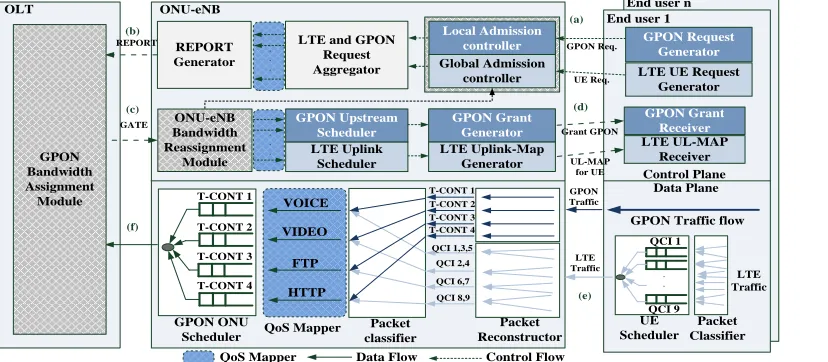
An integration of GPON-LTE network architecture, shown in Fig. 1, includes optical line terminal (OLT), passive splitter (PS), hybrid optical network unit with e-Node B (ONU-eNB) and user equipment (UEs).
A. Interoperation of modules in GPON-LTE architecture The ONU-eNBhas Control Plane and Data Plane, shown in the Fig. 2, which is responsible for coordinating request admission control for GPON and LTE, and traffic mapping for GPON and LTE scheduled for the transmission, respectively.
The functionality of ONU-eNB can be divided into two categories in terms of Control Plane and Data Plane, shown in the Fig. 2. The main tasks of these two planes are responsible for coordinating request admission control for GPON and LTE, and traffic mapping for GPON and LTE scheduled for the transmission, respectively.
[image:2.612.323.563.149.281.2]The operational procedures of modules in GPON-LTE architecture, shown in Fig. 2, are described as follows:
[image:2.612.106.520.547.728.2]Procedure (a): After LTE UE Request Generator and GPON Request Generator send requests to Local and Global Admission Controller, the delay constraint based admission control is executed and then the REPORT Generator generates REPORT message and sends to OLT.
Procedure (b), (c):When OLT receives REPORT message, GPON Bandwidth Assignment Module executes the DBA scheme; then assigns the required bandwidth to each ONU-eNB through GATE message.
Procedure (d): ONU-eNB Bandwidth Reassignment Module sends the current system information to admission controller once receiving the GATE message and reassigns the bandwidth for both GPON users and UEs users. After sending the services segment grant to GPON Upstream Scheduler and Grant Generator to each user, the LTE transmits the necessary bandwidth and the transmission time by Grant message via the LTE Uplink Scheduler and LTE Uplink-MAP Generator by microwave to UEs.
Procedure (e): Admission control scheme and transmission scheduling mechanism have completed. Both types of users will transmit data based on the timeslot assigned via fiber or microwave link to the ONU-eNB.
Procedure (f): All of QoS Class of Identifier (QCI) data transmit to ONU-eNB by UE scheduler then reconstruct and sort by priority with Packet Reconstruct and Classifier via the QoS mapper mapping to GPON priority queue. While GPON ONU Scheduler transfers data at a predetermined time to the OLT, these data include the REPORT messages. Finally, the UEs data will be transmitted with delay constraint based on admission control through the ONU-eNB to OLT.
B. Delay Constraint Admission Control
Delay constraint based admission control is implemented in admission controller based on the current system status of traffic request with predefined delay bounds [6,10]. When user from LTE or GPON sends out a request, the connection is established if the connection delay can met with predefined delay bound for different traffic. The constituent of connection delay, LTE
UE
D , for LTE UE, GPON ONU
D , for GPON user, , from the request initiated to receive the service for users. The DUEsLTE can be expressed as:
LTE LTE LTE LTE
UE req DBA fra gra
D
D
D
D
D
, (1) whereD
reqLTE is the request delay from the UE sending out a request until the request arrives at OLT;D
DBA is the execution time of DBA at OLT;D
LTEfra is the delay time for the OLT sending the GRANT message arrives at ONU-eNB, and relaying to UE, andD
graLTE is the waiting time in LTE from UE receiving the GRANT message to ONU-eNB receiving data transmitted by UE.Once the connection delay DUELTE for UE user is higher than delay budget defined in TABLE I for different traffic types, the request will be rejected.
Similarly, the connection delay for GPON users, GPON ONU D , can be expressed as:
GPON GPON GPON GPON
ONU req DBA cyc gra
D D D D D , (2)
where DreqGPON is the mean transmission delay which is equal to the half cycle time as TcycleGPON/2, the delay of cycle time, GPON
cyc D
is shown as
N
ONU(
G B R
/ )
, whereN
ONUis the number of ONU-eNBs andG
is the guard time.B
,R
are the transmission bandwidth and transmission rate respectively, and the waiting time of grant bandwidth for GPON users to transmit data to OLTOnce the connection delay DUELTE for GPON user is higher than delay budget defined in TABLE II for different traffic types, the request will be rejected.
C. Hierarchical Bandwidth Assignments
In this section, we propose a hierarchical bandwidth assignment to guarantee the QoS requirements. One is the limited dynamic bandwidth assignment (LDBA) with prediction scheme executed at OLT to improve the system bandwidth utilization. The other is bandwidth reassignment at ONU-eNB to redistribute bandwidth granted from OLT for each user by service level agreement (SLA) to achieve the integrated heterogeneous system.
1) Dynamic Bandwidth Assignment at OLT
ONU-eNB sends the REPORT to OLT for both LTE UEs and GPON users, and then the OLT executes the LDBA algorithm with the prediction scheme of GPON DBA [11] with the past ten cycles. If there are N ONU-eNBs, R is the total transmission rate, TcycleGPON is the GPON cycle time, G is guard time, and each ONU-eNB has the same weight. Then, the bandwidth assigned to each ONU-eNB, avg
onu B , is:
( GPON )
cycle avg
onu
T n G R
B
N
[image:3.612.325.571.57.208.2] . (3)
TABLE II. PERFORMANCE TARGETS FOR DIFFERENT APPLICATIONS [10]
T-CONT Delay bound Bandwidth Traffic type
1 50ms Fixed Voice
2 100ms Assured Video
3 200ms Assured, non-assured FTP
[image:3.612.318.560.358.413.2]4 300ms Best effort HTTP
TABLE I. LTE STANDARDIZED QCI CHARACTERISTICS [6]
QCI Resource
type Priority Delay
budget Example services
1
GBR (Guarantee bandwidth rate)
2 100ms Conversational voice
2 4 150ms Conversational video (live
streaming)
3 3 50ms Real time gaming
4 5 300ms Non-conversational video
5
Non-GBR
1 100ms IMS signalling
6 6 300ms Video (buffered) TCP-based
7 7 100ms Voice, Video (live), gaming
8 8
300ms Video(buffered)TCP-based
When ONU-eNBj request bandwidth is more than
B
onuavg, we give more bandwidth than the prediction bandwidth for T-CONT 2 and T-T-CONT 3, which is described as follows:, ,
onuj T T
n n j n j
G
R
P
. (4)j
onu n
G is grant bandwidth for ONU-eNBj at cycle n, ,
T n j
R
isONU-eNBj request bandwidth for traffic type T at cycle n,
,
T n j
P
is the prediction bandwidth of the traffic type T at cycle n of ONU-eNBj, where traffic type T{T-CONT 2, T-CONT 3}. The prediction formula is described as follows:, , ,
T T T
n j n j n j
P
R
H
, (5) where, T n j
H is the average demand traffic bandwidth in past ten cycles at cycle n of ONU-eNBj for traffic type T. So after estimating prediction bandwidth, the excess bandwidth can be computed, and then reassigned to ONU-eNBj which the request bandwidth is less than
j
avg onu
B . The excess bandwidth is described as follows:
1
( G j)
j
n
onu avg
excess onu n
i
B B
. (6) The extra bandwidth assigned to the heavy load ONU-eNB is described as follows:G
hj
onu avg excess
n onu
B
B
h
, (7) where h is the number of heavy load ONU-eNBs.2) Bandwidth Reassignment at ONU-eNB
Once the OLT sends the grant bandwidth to ONU-eNB through GATE message, the bandwidth is redistributed to GPON users and LTE UEs based on the Service Level Agreement (SLA). One more important function at ONU-eNB Bandwidth Reassignment Module is to get a minimum rate for each traffic request of both LTE UEs and GPON users by obtaining current system information to dynamically adjust the delay constraint.
III. PERFORMANCE ANALYSIS
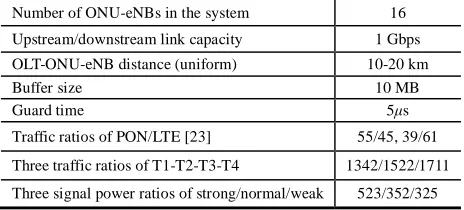
This section presents a performance evaluation of the proposed hierarchical DBA with IPACT [12] with/without admission control by using the OPNET modeller in terms of the packet delay, blocking probability, throughput and system improvement, request improvement. The simulation scenario is shown in TABLE III. The packet sizes are uniformly
different high priority traffic and signal power ratio, the proportion of traffic profile is analysed by simulating three scenarios which are scenario one 10%, 30%, 40% and 20% represent as 1342, scenario two 10%, 50%, 20% and 20% as 1522, scenario three 10%, 70%, 10% and 10% as 1711 for different traffic type T-CONT1 to T-CONT4, respectively. And the wireless users are uniform distribution within three zones with ratio 50%, 20% and 30% as 523, 30%, 50% and 20% as 352, and 30%, 20% and 50% as 325 for different power ratio of strong (64QAM), normal (16QAM) and weak (QPSK), respectively. We assume that 64QAM, 16QAM, QPSK can transmit the six sixths, four sixths and two sixths of bandwidth [13], respectively.
A. Delay and T-CONT 2 Jitter
Figure 3shows the packet delay of OLT DBA with reassign that with/without AC with GPON/LTE traffic loads of 55%/45% and 39%/61% for three kinds of scenario 1342, 1522, 1711. And the signal power ratios are 50%, 20%, 30%. In Figures 3(a), 3(b),simulation results show that the delays of proposed AC scheme with DBA and reassign are close to delay bound 50ms, 100ms, 200ms, and 300ms of T-CONT 1 to 4, respectively.
B. Blocking probability
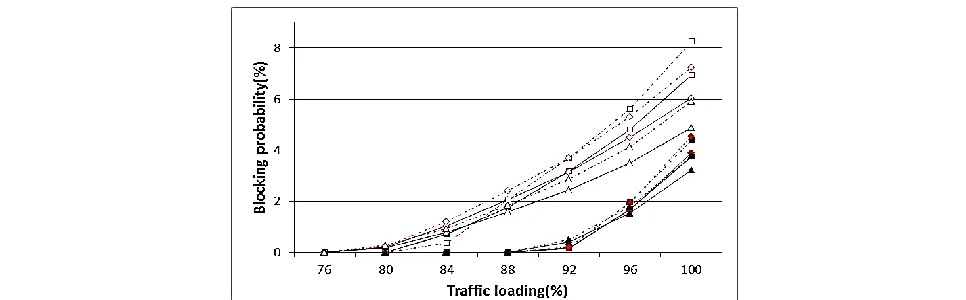
Figure 4 shows blocking probability for different traffic loads and scenarios. The total blocking probability shows that the proposed AC scheme has better performance than original one. Considering the effect of signal ratio, when wireless traffic is more than optical in case of 55%/45% has better performance than 39%/61%.
C. Throughput Improvement
Figure 5 shows the throughput improvement of different traffic ratios (10%,30%,40%,20%, 10%,50%,20%,20%, 10%, 70%,10%,10%) of proposed scheme with/without AC with IPACT for two optical/wireless traffic loads of 55%/45% and 39%/61%, and the signal power ratio with 50%, 20%, 30%. Simulation results show that the proposed scheme can improve the throughput about 3~10% and increase about 60~210 requests for users under the predefined QoS delay.
IV. CONCLUSIONS
[image:4.612.67.299.514.619.2]This paper has addressed the issues on the GPON and LTE integrated broadband access networks and proposed a delay-constraint based admission control with hierarchical bandwidth assign scheme that can meet the required QoS and improve the system performance in the heterogeneous networks. The proposed scheme takes into account the specific features of the integrated network to enable a smooth data transmission across optical and wireless networks, admission control and bandwidth reassignment is done for supporting different services. Simulation results show that the proposed scheme can improve the throughput about 3~10% and increase about 60~210 requests for users while the predefined QoS delay is met. Our work in this paper only presents some preliminary study in this area with a particular focus on admission control. Some other topics such as blocking
TABLE III. SIMULATION SCENARIO
Number of ONU-eNBs in the system 16
Upstream/downstream link capacity 1 Gbps
OLT-ONU-eNB distance (uniform) 10-20 km
Buffer size 10 MB
Guard time 5μs
Traffic ratios of PON/LTE [23] 55/45, 39/61
Three traffic ratios of T1-T2-T3-T4 1342/1522/1711
REFERENCES
[1] D. Breuer, F. Geilhardt, R. Hulsermann, M. Kind, C. Lange, T. Monath, and E. Weis, “Opportunities for next-generation optical access,” IEEE Communications Magazine, vol. 49, no. 2, pp. s16-s24, 2011. [2] ITU-T Recommendation G.984.3, “Gigabit-capable passive optical
networks (GPON): transmission convergence layer specification,” 2008. [3] J. Chen, J. Ahmed, L. Wosinska, and B. Mukherjee, “A comparison of
dynamic bandwidth allocation for EPON, GPON, and next-generation TDM PON,” IEEE Communications Magazine, vol. 47, no. 3, pp. s40-s48, Mar. 2009.
[4] ITU-T Recommendation G.983.4, “A broadband optical access system with increased service capability using dynamic bandwidth assignment,” 2001.
[5] G. Shen, R.S. Tucker, and C.J. Chae, “Fixed mobile convergence architectures for broadband access: integration of EPON and WiMAX,”
IEEE Communications Magazine, vol. 45, no. 8, pp. 44-50, Aug. 2007. [6] M. Alasti, B. Neekzad, J. Hui and R. Vannithamby, “Quality of service in WiMAX and LTE networks,” IEEE Communications Magazine, vol. 48, no. 5, pp. 104-111, May 2010.
[7] C.L. Lai, H.T. Lin, H.H. Chiang, and Y.C. Huang, “Design and analysis of a frame-based dynamic bandwidth allocation scheme for fiber-
wireless broadband access networks”, IEEE/OSA Journal of optical communications and networking, vol. 6, no. 5, pp. 486-500, May, 2014. [8] C. Ranaweera, E. Wong, C. Lim, and A. Nirmalathas, “Next generation optical-wireless converged network architectures,” IEEENetwork, vol. 26, issue 2, pp. 22-27, Mar./Apr. 2012.
[9] T.J. Yeh, “A novel synchronous interleaved dynamic bandwidth allocation for QoS over GPON-LTE converged network,” M.S. Thesis,
Dept. of Computer Science and Engineering, Yuan-Ze University, Taiwan, June 2013.
[10] J. Monfort, “Basic requirement to quality of service (IP centric)”, S8-3, Workshop on standardization in E-health, ITU-T Study Group 12, Geneva, May 2003.
[11] D. Nowak, P. Perry, and J. Murphy, “Bandwidth allocation for service level agreement aware ethernet passive optical networks,” in IEEE Proc. Global Telecommun. Conf., Dallas, TX, 2004, vol. 3, pp. 1953-1957. [12] G. Kramer, B. Mukherjee, and G. Pesavento, “IPACT: a dynamic
protocol for an ethernet PON (EPON),” IEEE Communications Magazine, vol. 40, no. 2, pp. 74-80, Feb. 2002.
[image:5.612.50.560.273.455.2][13] B.J. Hwang, I.S. Hwang and W.R. Chen, “Adaptive Radio Resource Management for Interactive User-centric IPTV Services in Mobile WiMAX Networks”, Information Sciences: An International Journal, Vol. 181, Issue 18, pp. 4024-4040, Sept. 2011.
Figure 4 Total blocking probability comparison of the proposed scheme with/without AC, signal power ratio (50%,20%,30%) and two optical/wireless traffic loads (55%/45%, 39%,61%) for three different T1-T2-T3-T4 traffic ratios (10%,30%,40%,20%, 10%,50%,20%,20%,
10%,70%,10%,10%).
(a) T1 packet delay (b) T4 packet delay
[image:5.612.65.548.513.663.2](a) System improvement of 1342 (b) System improvement of 1522
[image:6.612.45.564.55.440.2](c) System improvement of 1711
Figure 5. Throughput improvement of different T1-T2-T3-T4 traffic ratios (a) 10%,30%,40%,20%, (b) 10%,50%,20%,20%, (c) 10%,70%,10%,10% of proposed scheme with/without AC with IPACT for two optical/wireless traffic loads of 55%/45% and 39%/61%, and the signal power ratio with
50%,20%,30%.
0 30 60 90 120 150 180 210
0 2 4 6 8 10 12
55/45, 523
39/61, 523
55/45, 352
39/61, 352
55/45, 325
39/61, 325
Nu
mb
er
o
f
re
q
u
e
st
P
e
rc
e
n
ta
ge
(%
)
![TABLE I. LTE STANDARDIZED QCI CHARACTERISTICS [6] Resource Delay](https://thumb-us.123doks.com/thumbv2/123dok_us/450028.542964/3.612.318.560.358.413/table-i-lte-standardized-qci-characteristics-resource-delay.webp)