DOI: 10.1051/apido:2005008
Review article
The evolutionary significance of long copulation duration
in bumble bees
1Mark J.F. BROWNa* and Boris BAERb
a Department of Zoology, Trinity College Dublin, University of Dublin, Dublin 2, Ireland
b Institute of Biology, Department of Population Biology, Universitetsparken 15, 2100 Copenhagen, Denmark
Received 10 October 2004 – Revised 22 November 2004 – Accepted 24 November 2004
Published online 1 June 2005
Abstract – Copulation duration – the time spent in copula – is of particular interest in social insects. Female social insects (or queens) generally only mate during a short, initial post-emergence period, and in the absence of extensive pre- or post-copulatory mate guarding, copulation is the only point in time at which the sexes directly interact with each other. Although copulation duration is likely to be under natural selection, because queens depend upon successfully transferred sperm, longer copulation durations offer males the possibility to manipulate paternity in their own interest. Consequently, copulation duration might be one of the few traits in social insects where sexual selection has resulted in evolutionary conflict between the sexes. Here we review the available data on copulation duration in bumble bees and, by relating it to other aspects of mating in Bombus, develop a framework within which we may understand the selective forces that have shaped this enigmatic behaviour.
Bombus / mating / sperm transfer / mating plug / polyandry / sexual selection
1. INTRODUCTION
Mating in animals is a complex process, involving numerous pre- and post-copulatory behaviours (Eberhard, 1985; Eberhard and Cordero, 1995; Birkhead and Moller, 1998; Simmons, 2001; Baer, 2003; Boomsma et al., 2005). A key feature of mating is the actual amount of time animals spend in copula. While copulation initially evolved to facilitate sperm transfer, it also provides an arena for sexual conflict, and the duration of copulation will reflect these two forces (Simmons, 2001). Cop-ulation entails costs, both physiological, e.g., the amount of energy put into copulation itself, and ecological, e.g., an enhanced exposure to parasitism or predation. This latter cost may be especially important in social insects, where the main defensive weapon, the sting, is immo-bilised during copulation, and where
copulat-ing pairs have greatly reduced mobility. Con-sequently, one might expect copulation to take up only that amount of time required for the successful transfer of sperm. This seems to be the case in honey bees, where copulation is over in a matter of seconds (Koeniger and Koeniger, 1991; Winston, 1991), and stingless bees, where matings take less than a minute (Engels and Engels, 1988). Nevertheless, although cop-ulation duration is therefore expected to be rel-atively short, males may be selected to prolong the period in copula to enable them to guard females in response to the elevated risk of sperm competition due to queen remating (Simmons, 2001). Furthermore, prolonged copulation behaviour allows males to manipu-late females, either mechanically with their sexual organs (Eberhard, 1985) or chemically with gland compounds transferred during or shortly after sperm transfer (Simmons, 2001).
* Corresponding author: [email protected] 1Manuscript editor: Gudrun Koeniger
In contrast to honey bees and stingless bees, bumble bees have been shown to have much longer copulation durations (Foster, 1992; Duvoisin et al., 1999; Brown et al., 2002). While mate guarding has been suggested as a potential reason for extended copulation (Foster, 1992; Duvoisin et al., 1999), no com-prehensive attempt has been made to analyse variation among and within species in copula-tion duracopula-tion and its relacopula-tion to other features of mating in bumble bees. Given that copula-tion duracopula-tion is a feature of mating that appears to be under solely male control (Baer, 2003), such an analysis may provide important insights into the role of males in the evolution of mating strategies in bees. In this paper, we conduct the first examination of inter- and intra-specific variation in copulation duration
in bumble bees, and suggest useful directions for future research.
2. SHOULD I STAY OR SHOULD I GO?
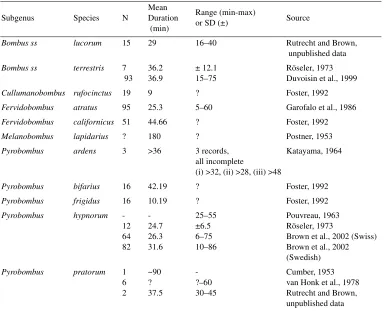
A summary of our current knowledge of copulation duration in bumble bees is presented in Table I. All of these data are based on mat-ings in the laboratory, or in semi-natural flight cages. However, given the readiness with which male bumble bees attempt to copulate under laboratory conditions, it seems unlikely that natural copulations would differ in terms of copulation duration.
[image:2.595.118.502.198.509.2]Generally, the mean copulation duration for bumble bee species is substantially longer than Table I. Copulation duration in bumble bees. Data shown are the sample size, mean copulation duration and range of copulation durations (where available). Data for Bombus ardens are observations which stopped prior to the end of copulations, and for B. lapidarius are of unknown provenance (the author states that in normal cases the pair remain in copula for three hours) but are included for completeness.
Subgenus Species N
Mean Duration (min)
Range (min-max)
or SD (±) Source
Bombus ss lucorum 15 29 16–40 Rutrecht and Brown,
unpublished data
Bombus ss terrestris 7
93 36.2 36.9
± 12.1 15–75
Röseler, 1973 Duvoisin et al., 1999
Cullumanobombus rufocinctus 19 9 ? Foster, 1992
Fervidobombus atratus 95 25.3 5–60 Garofalo et al., 1986
Fervidobombus californicus 51 44.66 ? Foster, 1992
Melanobombus lapidarius ? 180 ? Postner, 1953
Pyrobombus ardens 3 >36 3 records,
all incomplete
(i) >32, (ii) >28, (iii) >48
Katayama, 1964
Pyrobombus bifarius 16 42.19 ? Foster, 1992
Pyrobombus frigidus 16 10.19 ? Foster, 1992
Pyrobombus hypnorum
-12 64 82
-24.7 26.3 31.6
25–55 ±6.5 6–75 10–86
Pouvreau, 1963 Röseler, 1973
Brown et al., 2002 (Swiss) Brown et al., 2002 (Swedish)
Pyrobombus pratorum 1
6 2
~90 ? 37.5
-?–60 30–45
for honey bees and stingless bees, and appears to be much longer than would be expected if there were no advantages to staying in copula. Out of the nine species for which we have esti-mates for mean copulation duration (values for
B. ardens and lapidarius are not means), only
two have a mean copulation duration of less than 25 minutes. Copulation durations reported for the two remaining species in the table were both longer than 45 minutes. Across all species, mean copulation duration varies almost 5-fold, and excluding the two outlier species (frigidus and rufocinctus) with unusually short mean copulation durations, more than 1.5-fold. Thus, at the interspecific level we are faced with two questions: (1) why is copulation duration so long in bumble bees, and (2) what explains the variation among species in copulation dura-tion? We address these questions in the first section below.
In addition to interspecific variation in cop-ulation duration, there is a large amount of var-iation across males within a species as to how long they remain in copula. For example, in
B. hypnorum copulations range from six to
86 minutes in length, a 14-fold (or, within a sin-gle population, 12.5-fold) difference (Tab. I). While intra- and interspecific variation are likely to be related, we deal with the problem of intraspecific variation in a separate second section.
3. WHY IS COPULATION DURATION SO LONG IN BUMBLE BEES?
3.1. Sperm transfer
A simple explanation for long copulation durations in bumble bees might be that sperm transfer from the male to the female takes an equally long time. This is a functional explana-tion, implying that copulation has evolved solely under natural selection for efficient sperm transfer. However, the available data strongly suggest that this is not the case. Duvoisin et al. (1999) found that sperm transfer took between 30 and 120 s in B. terrestris, in contrast to a mean copulation duration of 36.9 minutes. Given the anatomical similarity of Bombus species, there is no good a priori reason to suggest any great difference in sperm
transfer rates across species. Thus sperm trans-fer seems unlikely to explain copulation dura-tion data in bumble bees.
3.2. Sperm migration
After deposition in the bursa copulatrix of a female, sperm has to migrate to the spermath-eca (Duvoisin et al., 1999). Again, the only data we have are from B. terrestris where Duvoisin et al. (1999) showed that, on average, 50% of the sperm have migrated into the spermatheca by about 43 minutes after the start of copula-tion. This is 6–7 minutes after the end ofthe average copulation (see Tab. I). There are at least two potential reasons that copulation duration and sperm migration might be linked. Firstly, the initiation of migration may require the continued presence of the male. A feature of bumble bee copulation is the continuous abdominal contractions of the attached male, long after transfer of the sperm and mating plug (see below) has been accomplished. Such con-tractions may produce a physical stimulus for sperm migration from the bursa copulatrix to the spermatheca. Secondly, if a subsequent sec-ond mating could interfere with sperm migra-tion (Sauter et al., 2001), the extended copula-tion might be explained as mate guarding to facilitate successful filling of the spermatheca. However, the mean copulation duration in B.
terrestris is shorter than the time required for
complete sperm migration (see above). Thus, sperm migration is unlikely to completely explain long copulation durations across
Bombus.
3.3. Mating plug dynamics
One of the most exciting recent discoveries in bumble bee mating biology was the exist-ence of mating plugs that chemically inhibit queens of B. terrestris from remating (Duvoisin et al., 1999; Baer et al., 2000, 2001; Sauter and Brown, 2001; Sauter et al., 2001; Baer, 2003). Mating plugs are produced in the accessory glands and have also been found in
B. hypnorum (Brown et al., 2002) and B. luco-rum (Baer, unpublished data). Despite the
fact that males in the polyandrous species B.
hypnorum would be expected to invest less
behaviour) and more into sperm production (see Baer and Boomsma, 2004), males of
hyp-norum and terrestris appear to have similar
investment into the plug-producing accessory glands (Fig. 1). However, it should be noted that mating plugs deteriorate more rapidly in polyandrous B. hypnorum queens than in B.
ter-restris queens (Brown et al., 2002), which
might imply that the chemical composition of the mating plug differs between these species (but see Mikheyev, 2003). The presence of plugs in two widely separated subgenera sug-gests that they are likely to occur throughout the genus and mating plugs have even been hypothesized to be widespread in social insects in general (Boomsma et al., 2005). In B.
terres-tris the mating plug is completely transferred
within about 10 minutes (Duvoisin et al., 1999) and thus transfer alone cannot be an explanation for prolonged copulation duration. Because males are capable of moving previ-ously-placed sperm and mating plugs when copulating with a non-virgin queen (Sauter et al., 2001), it also seems unlikely that pro-longed copulations are designed to enhance the functionality of plugs, despite the fact that males clearly face the risk of getting their sperm displaced by competitors. However, if plug chemicals require some time in which to take physiological effect, long copulation durations may still play a role in facilitating mating plug function.
3.4. Tentative conclusions
From this survey, it appears that the facili-tation of sperm migration into the spermatheca, whether physically, chemically or by mate guarding, is the most likely reason for long cop-ulations across bumble bee species. However, this is not a complete explanation. Firstly, as noted above, copulation duration does not match the amount of time required to com-pletely fill the spermatheca. It is possible that the initial movement of sperm into the sper-matheca is the most important step to safeguard male reproductive success, but we can think of no a priori reason as to why this should be true. Secondly, at least two species of bumble bee have dramatically shorter copulation durations (Tab. I). Investigation of the rates of sperm migration in these two species could be a cru-cial test of the idea that copulation duration is related to the successful migration of sperm into the spermatheca.
4. DIFFERENT STROKES: WHAT EXPLAINS THE VARIATION AMONG SPECIES IN COPULATION DURATION?
4.1. Sperm transfer, sperm migration and mating plug transfer
The discussion above suggests that differ-ences in sperm migration rates among species might explain variation in the mean copulation duration of different species (Tab. I). Similarly, the possible absence of a mating plug in B.
frig-idus and rufocinctus might explain their
anom-alously short copulation durations. However, species-level differences in mating behaviour may also play an important role.
4.2. Pre-mating behaviour
[image:4.595.116.298.161.283.2]Bumble bee species have different male pre-mating strategies (Alford, 1975; Baer, 2003). These include perching (where males rest on a perch and then fly out and engage prospective mating partners), nest-guarding (where males search for and stake-out conspecific nests and attempt to mate with virgin queens when they leave the nest), territoriality, and flight-paths (where males scent mark routes and patrol Figure 1. Colony-level variation in male
them). These strategies clearly vary in their physiological cost, with the flight-path strategy probably being the most energetically expen-sive, and thus might be expected to trade-off with other costly mating activities such as cop-ulation duration. However, of the eleven spe-cies in Table I, only B. rufocinctus and B.
cal-ifornicus do not follow the flight path strategy,
and these two species cover the range of mean copulation durations. Consequently, from the present data it seems unlikely that pre-mating behaviour influences copulation duration, but further studies are clearly needed.
4.3. Monandry vs. polyandry
Both Foster (1992) and Brown et al. (2002) suggested that copulation duration might be related to the occurrence of multiple mating. Based on observational data of mating rates, Foster (1992) showed that for the North Amer-ican species rufocinctus, californicus, bifarius and frigidus there was a strong positive corre-lation between copucorre-lation duration and fre-quency of multiple mating. Foster argued that this might indicate mate-guarding by males to prevent queens from remating (Simmons, 2001). In contrast, the polyandrous European
hypnorum has the shortest copulation duration
of the four European species, and Brown et al. (2002) argued that the reduced cost of shorter copulations might explain the existence of pol-yandry in this species. This explanation was supported by data showing that the shorter a queen’s first copulation, the more likely she was to mate for a second time. In fact, it seems logical that shorter copulation durations are more likely to be found in polyandrous species. Since mate-guarding is obviously ineffective in
polyandrous species, males are expected to reduce reproductive investment in copulation duration and instead attempt to gain additional copulations. In contrast, if mate-guarding is effective, then species with long copulation durations should be associated with monandry (as the genetic data for the European species shows (Schmid-Hempel and Schmid-Hempel, 2000)). As acknowledged by Foster (1992), observational data on copulation frequencies are an inaccurate measure of actual mating fre-quencies in natural populations (Boomsma and Ratnieks, 1996), and because even normally monandrous species will remate under artifi-cial conditions (Sauter et al., 2001; personal observations), it is unclear whether the positive correlation between copulation duration and mating rate in North American species is spu-rious.
4.4. Body size
Despite their morphological similarity, bumble bee species do vary strongly in size. If the energy costs of copulation, or the physical effects of abdominal contractions (assuming that these play a role in effective copulation – see above) scale non-linearly, then they might explain cross-species variation in copulation duration. Size can be measured in a number of ways, either as male size, queen size, or the ratio of the two. In Table II we present data cal-culated from von Hagen (2003) for the four European bumble bee species for which we know mean copulation duration. While this is a small sample size, the data give no support to the idea that there is a correlation between any measure of body size and the length of time that species spend in copulation.
Table II. Relation between body size and copulation duration across species. L = body length, W = wingspan, r = rank (large, 1, to small, 4, across the four species), R = mean rank across all body size measurements, CD = species ranked by copulation duration (long to short; see Tab. I). All L and W measurements are in mm.
Male Queen Ratio (Q:M)
Bombus L r W r L r W r L r W r R CD
terrestris 15 1 31.5 1 21.5 1 40.5 1 1.43 1 1.29 1 1 2
lucorum 15 1 31 2 19.5 2 37.5 2 1.3 3 1.21 2 2 3/4
hypnorum 15 1 30 3 18.5 3 36.5 3 1.23 4 1.22 3 2.83 3/4
4.5. Tentative conclusions
Given our current state of (or lack of!) knowledge, the two most likely explanations for species-level variation in copulation dura-tion seem to be the mate-guarding hypothesis and its relation to multiple mating, and the sperm migration hypothesis. These are not mutually exclusive explanations, and they could in fact be working together or even against each other in the evolution of copulation duration. For example, if males are selected to reduce time spent in copula but sperm migra-tion requires extended copulamigra-tion, the actual copulation duration will be some trade-off between the two.
5. NATURAL VIAGRA: WHAT CAUSES INTRASPECIFIC VARIATION IN COPULATION DURATION?
The huge amount of variation across males within a species in how long they spend in cop-ula demands an explanation. Simple explana-tions might be that this variation reflects differ-ences among males in age, male quality, or previous mating experience (see below). How-ever, in the experiments of Duvoisin et al. (1999) and Brown et al. (2002) males were age-controlled, fed ad libitum from larvae to sexual maturity, and virgin. So, what other factors might determine the duration of an individual copulation?
5.1. Sperm migration
Sperm migration has already been impli-cated as a possible cause for the classically long bumble bee copulation. In addition, data on sperm migration also showed significant vari-ation among copulvari-ations (Duvoisin et al., 1999). For example, of the 24 queens who had their copulation terminated between 20 and 60 min after the start of copulation, 33% showed no evidence of sperm migration, whilst 17% already had a filled spermatheca. Further-more, the first full spermatheca was seen at 30 min after the start of copulation, whilst unfilled spermathecae could still be found after 70 min. In the absence of correlational data between copulation duration and sperm
migra-tion rate, it is impossible to say whether males time their copulation duration to enable com-plete sperm migration. However, it is certainly possible that copulation duration may be related to sperm migration. Males may remain in copula in order to prevent matings with a sec-ond male from disrupting sperm migration (Sauter et al., 2001), and differences among males in sperm migration rate might result in differences among males in copulation dura-tion.
5.2. Male quality
While male quality – as measured by age, size, immunocompetence or colony-of-origin – is unlikely to explain differences among spe-cies in copulation duration, it might easily play an important role in determining variation among males within a species. As has already been mentioned, males vary among colonies in their investment into the glands responsible for mating plug production (Fig. 1), Baer (2003) found significant variation across males within and among colonies in sperm length in three
Bombus species, and Tasei et al. (1998) found
substantial variation in the number of sperm virgin males possess in their accessory testes, ranging from 4 000 to 230 000. Males also vary greatly in size (personal observation). In B.
atratus larger males, unsurprisingly, have more
sperm (Garofalo et al., 1986). Unfortunately, no study has quantified the relationship between any of these factors and copulation duration, although there is good reason to hypothesise that these factors might have a sub-stantial influence. For example, males possess-ing few sperm might invest more into mate-guarding or gland compounds, to maximise their chances of securing sole paternity. Simi-larly, males who transfer the chemicals needed to prevent queens from remating at a low rate may need to remain in copula longer to inhibit remating to the same degree as a male who can rapidly transfer large amounts of the inhibitory chemicals.
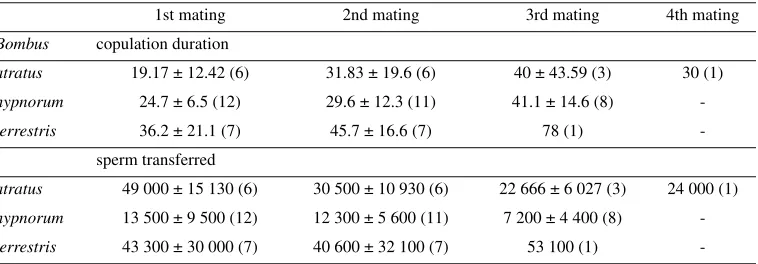
(Tab. III). While B. terrestris exhibits no change in sperm transfer from one copulation to the next, males show a similar increase in copulation duration across subsequent matings (Tab. III; Röseler, 1973). Thus, it seems that males invest more into mate-guarding-type behaviour with each copulation. This makes sense if males value copulations with respect to their relative investment. Given that bumble bee males cannot make new sperm after matu-ration, each time they ejaculate their remaining sperm become relatively more valuable. Con-sequently, to maximise their reproductive fit-ness we would expect males to invest more into protecting later copulations, which is what we see in all three species described above (Tab. III). An alternative explanation might be that it takes longer to transfer sperm and mating plug material with each copulation, perhaps due to a decline in available supplies. However, there are as yet no data to support either con-tention.
5.3. An honest signal?
If copulation duration reflects male quality, as measured by fitness or in terms of the amount of sperm transferred, and as it is energetically costly to the male, it may act as an honest signal of male quality. Data from the polyandrous B.
hypnorum (Brown et al., 2002) initially
sup-ported this idea. In this species, queens are more likely to accept a second mate the shorter their first copulation was. The authors inter-preted this from the perspective of a queen min-imizing her own energetic or time cost of mat-ing. However, it could also be interpreted as
queens using copulation duration as a signal of male quality, and re-mating on the basis of this signal. But how reliable is copulation duration as an honest signal? Given that copulation duration increases with an apparent decrease in male quality (see above, Tab. III), it would appear that if B. hypnorum queens are using copulation duration as a signal, then they are making non-adaptive decisions as re-mating is least likely when the 1st copulation took place with a low quality, non-virgin male.
5.4. Reaction to female status?
[image:7.595.99.478.189.321.2]So far, we have mostly discussed copulation duration as if it were a fixed trait of the male. However, data from B. hypnorum (Brown et al., 2002) suggest that males can actually make decisions about how long to remain in copula based on the intrinsic value of the copulation event. In their experiments, Brown et al. found that when a queen mated for a second time, the duration of copulation was significantly shorter than that for first matings. As copulation dura-tion is controlled by males, and as males avail-able for second matings were virgin and of the same age as males used for first matings, these data suggest that males were able to assess the already mated status of the females and reduce their energetic investment into copulation. Given that males have a lower fitness return from a doubly-mated queen (Baer and Schmid-Hempel, 2001), such a strategy makes evolu-tionary sense. How males recognise female sta-tus remains unknown, although it may depend upon chemoreceptors in the male genitalia. Table III. The relation between number of copulations, sperm transfer and copulation duration. Data shown are mean ± SD (sample size) for time in minutes and number of sperm, and for B. terrestris and hypnorum are from Röseler (1973) and for B. atratus are from Garofalo et al. (1986).
1st mating 2nd mating 3rd mating 4th mating
Bombus copulation duration
atratus 19.17 ± 12.42 (6) 31.83 ± 19.6 (6) 40 ± 43.59 (3) 30 (1)
hypnorum 24.7 ± 6.5 (12) 29.6 ± 12.3 (11) 41.1 ± 14.6 (8)
-terrestris 36.2 ± 21.1 (7) 45.7 ± 16.6 (7) 78 (1)
-sperm transferred
atratus 49 000 ± 15 130 (6) 30 500 ± 10 930 (6) 22 666 ± 6 027 (3) 24 000 (1)
hypnorum 13 500 ± 9 500 (12) 12 300 ± 5 600 (11) 7 200 ± 4 400 (8)
-5.5. Tentative conclusions
While factors such as size, age and experi-ence may all play a role in generating variation among males in copulation duration, current data indicate that other factors must be at least as important. Again, sperm migration may explain some of this variation, but the fact that males can control the duration of copulation suggests that this trait should be viewed from a context-dependent perspective.
6. CONCLUSIONS AND SUGGESTIONS
FOR A RESEARCH PROGRAM
We suggest that the problem of explaining copulation duration in bumble bees needs to be approached at three different levels. While explanations for generally long copulations in
Bombus, species-level variation in this trait,
and intraspecific variability may be related, there are also likely to be factors, e.g., male size, which have explanatory power at only one of these levels. Given that our current state of knowledge is preliminary at best, and given that this behaviour deserves explanation, what might be the best routes down which to direct future work?
As we have shown, sperm migration rates and mate-guarding seem the most likely expla-nation for long copulations at the genus level. The role of sperm migration rate could be tested quite simply. By conducting a series of labora-tory matings and splitting queens into two groups, one where males are removed after sperm transfer and the other where they are left undisturbed, and flash-freezing queens at reg-ular time-points after the onset of copulation, it should be possible to determine whether male presence is necessary for, or enhances sperm migration. Further experiments to test the mate-guarding hypothesis could involve artificial insemination techniques (Baer and Schmid-Hempel, 2000), for example, by placing sperm in the bursa copulatrix of females and then test-ing for effects on sperm migration in the absence and presence of a subsequent copula-tion. The sperm present in the spermatheca could then be genotyped using quantitative PCR to determine how each set of sperm contributed to successful insemination of the
female. If mate-guarding is important we would expect to see less of the artificially inseminated sperm in the spermatheca of sub-sequently mated females.
At the species level, sperm migration rates, the presence or absence of a sperm plug, and the mating system (monandry vs. polyandry) may all have an influence on variation in copulation duration. While sperm migration rate and the existence of sperm plugs should be examined in those species where we already know copu-lation duration, our greatest need here is for new comparative studies. Given the ease with which bumble bees can be reared and mated in laboratory settings, we would encourage researchers to examine copulation duration, sperm migration rates and sperm plug dynam-ics in the 19 species for which we already know the mating system (Estoup et al., 1995; Schmid-Hempel and Schmid-Hempel, 2000; Payne et al., 2003).
precedence might explain shorter copulation duration times for second males (as seen in B.
hypnorum), and so it would be interesting to
study the relative contribution of different males to offspring of multiply-mated queens based on the order of mating.
The role of males in the mating biology of social insects has been neglected for too long (Baer, 2003). Copulation duration in bumble bees represents an easily defined and poten-tially costly and important trait that is amenable to study and may shed great insight into the fac-tors that have determined male mating behav-iour in this genus. We believe that future stud-ies of this trait and how it relates to other aspects of mating biology would be highly productive.
ACKNOWLEDGEMENTS
We would like to thank Gudrun Koeniger for inviting us to write this manuscript, and giving us the chance to develop our views on the role of copulation duration in the mating biology of bum-ble bees. The ideas within have been enhanced by critical discussion in the symposium “The neglected gender: biology of the male social bee” at the 1st European Conference of Apidology 2004, and by comments from two reviewers. Many thanks to Kazuki Tsuji and Johan Billen for accessing and translating references for us. MJFB was supported by grants EI-SC/2002/209 from the Enterprise Ireland Basic Research Grants Scheme and HEA/ NSP Strand 1 from the Higher Education Authority North-South Programme for Collaborative Research. BB was supported by a SNF grant for advanced researchers PA00A-104991.
Résumé – La longue durée de copulation chez les bourdons : quelle signification du point de vue de l’évolution ? La durée de copulation – période durant laquelle un couple reste in copula – est un aspect central de l’accouplement chez les animaux. La longueur de la durée de copulation devrait être déterminée par une série de pressions de sélection, par exemple la sélection naturelle sur l’efficacité du transfert de sperme et la minimisation du temps et des coûts énergétiques de l’accouplement et par la sélection sexuelle des mâles qui maximalisent la paternité. Les abeilles mellifères (Apis spp) et les abeilles sans aiguillon (Meliponinae) ont des durées de copulation courtes, indiquant que la sélection naturelle prédomine chez ces groupes. Par contre, les bourdons (Bombus spp) ont des durées de copu-lation à la fois longues et très variables, ce qui sug-gère que la durée de copulation peut représenter un exemple de conflit évolutif entre les deux sexes. Nous avons analysé les données disponibles pour
les bourdons à trois niveaux – interspécifique, intraspécifique et intraindividuel – afin de détermi-ner les facteurs sous-jacents à l’évolution de la durée de copulation chez ce groupe. Les durées moyennes de copulation spécifiques d’une espèce dépassent en général 25 min (Tab. I). Etant donné que le transfert du sperme et du bouchon d’accouplement (secrété par le mâle) prend moins de 10 min, la seule explication possible pour la lon-gue durée de copulation semble être qu’elle facilite la migration du sperme dans la spermathèque. Cette hypothèse doit pourtant être testée, car certaines espèces ont des durées de copulation relativement courtes (Tab. I). Par ailleurs la durée de migration du sperme ne correspond pas entièrement au temps passé in copula.
La variation interspécifique de la durée de copula-tion ne peut pas s’expliquer par des différences entre espèces concernant le comportement avant l’accouplement ou la taille de l’insecte (Tab. II). Pourtant des différences entre espèces dans le com-portement de protection de la femelle (en liaison avec l’existence d’accouplements multiples) et dans le taux de migration du sperme pourraient expliquer la variation interspécifique dans la durée de copula-tion. Au sein d’une même espèce les mâles passent un temps très variable in copula. Les derniers résul-tats suggèrent que les facteurs suivants contribuent tous à la variation intraspécifique : variation simi-laire des taux de transfert du sperme, qualité du mâle (investissement dans la physiologie de la reproduction (Tab. I), taille, immunocompétence, passé d’accouplement), réaction des mâles au statut de la femelle (par ex. vierge vs. non vierge). Finale-ment les mâles passent un temps variable in copula en fonction du nombre antérieur d’accouplements. Trois niveaux différents doivent être pris en compte pour expliquer la durée de copulation. Tandis que l’explication de la durée de copulation générale-ment longue chez Bombus pourrait être en rapport avec les variations de ce caractère au niveau spéci-fique et avec la variabilité intraspécispéci-fique, il existe vraisemblablement d’autres facteurs, par ex. la taille du mâle, pour lesquels l’explication n’est pos-sible qu’à l’un de ces niveaux. La recherche future devrait s’attacher, par des expérimentations contrô-lées, à démêler les diverses causes potentielles et les pressions de sélection qui s’exercent sur la durée de copulation des bourdons.
Bombus / accouplement / transfert de sperme /
polyandrie / sélection sexuelle / signe de fécondation
die die Spermaübertragung optimieren oder die Zeit- und Energiekosten einer Kopulation minimie-ren. Neuere Studien zeigen jedoch, dass die Kopulationsdauer auch von sexueller Selektion beeinflusst werden kann, wobei die Männchen bei-spielweise ihren eigenen Reproduktionserfolg auf Kosten des weiblichen maximieren. Kopulationen bei Honigbienen (Apis spp.) und Stachellosen Bie-nen (Meliponinae) dauern nur einige wenige Sekunden, was darauf hinweist, dass die natürliche Selektion eine wichtige Rolle für die Evolution der Kopulationsdauer bei diesen Arten gespielt hat. Bei Hummeln der Gattung Bombus dauern Kopulatio-nen wesentlich länger und variieren sowohl zwi-schenartlich als auch innerartlich erheblich. Dies kann als Hinweis darauf gewertet werden, dass bei Hummeln ein zwischengeschlechtlicher evolu-tionärer Konflikt über die ideale Länge der Kopula-tion vorhanden ist.
Hier präsentieren wir verfügbare Daten über das Kopulationsverhalten bei Hummeln und analysie-ren diese auf drei verschiedenen Ebenen: zwischen-artlich, innerartlich und individuell. Dies erlaubt uns, mögliche Faktoren zu isolieren, die für die Evolution der langen Kopulationsdauer in dieser Gruppe verantwortlich sind. Die artspezifische Kopulationsdauer bei Hummeln ist typischerweise länger als 25 Minuten (Tab. I). Da der Transfer der Spermien und des Kopulationspfropfs in den weib-lichen Geschlechtstrakt normalerweise weniger als 10 Minuten in Anspruch nimmt, scheint sich die lange Kopulationsdauer vor allem durch eine vereinfachte Migration der Spermien in die Sper-matheka zu erklären. Diese Hypothese muss jedoch noch überprüft werden, und weitere Arbeiten sind notwendig, vor allem bei Arten mit relativ kurzer Kopulationsdauer und bei Arten, bei denen die Kopulationsdauer nicht mit der Länge der Sper-mienmigration in die Spermatheka übereinstimmt. Interspezifische Unterschiede in der Kopulations-dauer können nicht durch Körpergröße oder Unter-schiede im Verhalten der Geschlechter vor der copula erklärt werden (Tab. II). Die Unterschiede in der Kopulationsdauer zwischen unterschiedlichen Hummelarten scheint sich am besten durch die Länge des männlichen mate guarding (vor allem im Zusammenhang mit Polyandrie) und die Dauer der Spermienmigration in die Spermatheka erklären zu lassen. Innerartlich finden wir sehr große Unter-schiede in der Zeit, die Männchen in copula mit ihren Partnerinnen verbringen. Die verfügbaren Daten zeigen, dass die innerartliche Kopulationsdauer durch eine ganze Reihe von Faktoren beeinflusst werden kann; zum Beispiel die Geschwindigkeit der Spermienmigration in die Spermatheka, die Qualität des Männchens, (gemessen als männliche Investitionen in die Reproduktionsphysiologie), die Körpergröße, die Qualität des Immunsystems, oder der reproduktive Status des Weibchens (virginell versus non – virginell). Interessanterweise wird die männliche Kopulationsdauer auch durch vorange-gangene Kopulationen beeinflusst.
Die beobachtete lange Kopulationsdauer bei Hum-meln muss deshalb auf drei Ebenen erklärt werden. Während Erklärungen für die generell lange Kopu-lationsdauer bei Bombus, artspezifische Unter-schiede in der Kopulationsdauer wie auch innerartli-che Variation in direktem Zusammenhang zueinan-der stehen könnten und deshalb auf allen drei Ebenen Erklärungspotenzial haben, scheinen gewisse Faktoren (wie zum Beispiel Körpergröße) nur für eine dieser Ebenen von Bedeutung zu sein. Es scheint klar, dass weitere experimentelle Arbeiten nötig sind, um die verschiedenen Faktoren und Gründe genauer zu isolieren, die die Evolution der beobachteten langen Kopulationsdauern bei Hummeln erklären können.
Paarung / Spermaübertragung / Begattungszei-chen / Polyandrie / sexuelle Selektion
REFERENCES
Alford D.V. (1975) Bumblebees, Davis-Poynter, London.
Baer B. (2003) Bumblebees as model organisms to study male sexual selection in social insects, Behav. Ecol. Sociobiol. 54, 521–533.
Baer B., Boomsma J.J. (2004) Male reproductive investment and queen mating frequency in fungus growing ants, Behav. Ecol. 15, 426–432. Baer B., Schmid-Hempel P. (2000) The artificial
insemination of bumblebee queens, Insectes Soc. 47, 183–187.
Baer B., Schmid-Hempel P. (2001) Unexpected consequences of polyandry for parasitism and fitness in the bumblebee B. terrestris, Evolution 55, 1639–1643.
Baer B., Maile R., Schmid-Hempel P., Morgan E.D., Jones G.R. (2000) Chemistry of a mating plug in bumblebees, J. Chem. Ecol. 26, 1869–1875. Baer B., Morgan E.D., Schmid-Hempel P. (2001) A
non-specific fatty acid within the bumblebee mating plug prevents females from remating, Proc. Natl. Acad. Sci. USA 98, 3926–3928. Birkhead T.R., Moller A.P. (1998) Sperm Competition
and Sexual Selection, Academic Press, New York. Boomsma J.J., Baer B., Heinze J. (2005) The evolution of male traits in social insects, Annu. Rev. Entomol. 50, 395–420.
Boomsma J.J., Ratnieks F.L.W. (1996) Paternity in eusocial Hymenoptera, Phil. Trans. R. Soc. London B Biol. Sci. 351, 947–975.
Brown M.J.F., Baer B., Schmid Hempel R., Schmid Hempel P. (2002) Dynamics of multiple-mating in the bumble bee Bombus hypnorum, Insectes Soc. 49, 315–319.
Cumber R.A. (1953) Some aspects of the biology and ecology of humble-bees bearing upon the yields of red-clover seed in New Zealand, N.Z. J. Sci. Tech. 34, 227–240.
Duvoisin N., Baer B., Schmid-Hempel P. (1999) Sperm transfer and male competition in a bumblebee, Anim. Behav. 58, 743–749. Eberhard W.G. (1985) Sexual selection and animal
genitalia, Harvard University Press, Cambridge. Eberhard W.G., Cordero C. (1995) Sexual selection
by cryptic female choice on male seminal products. A new bridge between sexual selection and reproductive physiology, Trends Ecol. Evol. 10, 493–496.
Engels E., Engels W. (1988) Age dependent queen attractiveness for drones and mating in the stingless bee Scaptotrigona postica, J. Apic. Res. 27, 3–8.
Estoup A., Scholl A., Pouvreau A., Solignac M. (1995) Monoandry and polyandry in bumble bees (Hymenoptera: Bombinae) as evidenced by highly variable microsatellites, Mol. Ecol. 4, 89– 93.
Foster R.L. (1992) Nestmate recognition as an inbreeding avoidance mechanism in bumble bees (Hymenoptera: Apidae), J. Kans. Entomol. Soc. 65, 238–243.
Garofalo C.A., Zucchi R., Muccillo G. (1986) Reproductive studies of a neotropical bumblebee, Bombus atratus (Hymenoptera, Apidae), Rev. Brasil. Genet. 9, 231–243
Katayama E. (1964) Observations on the later stages of Bombus ardens Smith (Hymenoptera, Apidae), Kontyu 32, 393–402.
Koeniger N., Koeniger G. (1991) An evolutionary approach to mating behaviour and drone copulatory organs in Apis, Apidologie 22, 581– 590.
Mikheyev A.S. (2003) Evidence for mating plugs in the fire ant Solenopsis invicta, Insectes Soc. 50, 401–402.
Paxton R.J., Thorén P.A., Estoup A., Tengö J. (2001) Queen-worker conflict over male production and sex ratio in a facultatively polyandrous bumble
bee, Bombus hypnorum: the consequences of nest usurpation, Mol. Ecol. 10, 2489–2498.
Payne C.M., Laverty T.M., Lachance M.A. (2003) The frequency of multiple paternity in bumble bee (Bombus) colonies based on microsatellite DNA at the B10 locus, Insectes Soc. 50, 375–378. Postner M. (1953) Kopulationsverhalten bei den Gattungen Bombus und Psithyrus (Apidae, Hymenoptera), Zool. Anz. 151, 300–306. Pouvreau A. (1963) Observations sur l’accouplement
de Bombus hypnorum L. (Hyménoptère, Apidae) en serre, Insectes Soc. 10, 111–118.
Röseler P.-F. (1973) Die Anzahl der Spermien im Receptaculum Seminis von Hummelköniginnen (Hym., Apoidea, Bombinae), Apidologie 4, 267– 274.
Sauter A., Brown M.J.F. (2001) To copulate or not? The importance of female status and behavioural variation in predicting copulation in a bumblebee, Anim. Behav. 62, 221–226.
Sauter A., Brown M.J.F., Baer B., Schmid-Hempel P. (2001) Males of social insects can prevent queens from multiple mating, Proc. R. Soc. Lond. B 268, 1449–1454.
Schmid-Hempel R., Schmid-Hempel P. (2000) Female mating frequencies in Bombus spp. from Central Europe, Insectes Soc. 47, 36–41. Simmons L.W. (2001) Sperm Competition and Its
Evolutionary Consequences in the Insects, Princeton University Press, Oxford.
Tasei J.N., Moinard C., Moreau L., Himpens B., Guyonnaud S. (1998) Relationship between aging, mating and sperm production in captive Bombus terrestris, J. Apic. Res. 37, 107–113. van Honk C.G.J., Velthuis H.H.W., Röseler P.-F.
(1978) A sex pheromone from the mandibular glands in bumblebee queens, Experientia 34, 838–839.
von Hagen E. (2003) Hummeln, Fauna Verlag, Nottuln.