Original citation:
Charles, Nickie. (2014) Doing gender, practising politics : workplace cultures in local and devolved government. Gender, Work, and Organization, 21 (4). pp. 368-380.
Permanent WRAP URL:
http://wrap.warwick.ac.uk/89117
Copyright and reuse:
The Warwick Research Archive Portal (WRAP) makes this work by researchers of the University of Warwick available open access under the following conditions. Copyright © and all moral rights to the version of the paper presented here belong to the individual author(s) and/or other copyright owners. To the extent reasonable and practicable the material made available in WRAP has been checked for eligibility before being made available.
Copies of full items can be used for personal research or study, educational, or not-for profit purposes without prior permission or charge. Provided that the authors, title and full bibliographic details are credited, a hyperlink and/or URL is given for the original metadata page and the content is not changed in any way.
Publisher’s statement:
This is the peer reviewed version of the following article: Charles, N. (2014), Doing Gender, Practising Politics: Workplace Cultures in Local and Devolved Government. Gender, Work and Organization, 21: 368–380. doi:10.1111/gwao.12042, which has been published in final form at https://doi.org/10.1111/gwao.12042 . This article may be used for non-commercial purposes in accordance with Wiley Terms and Conditions for Self-Archiving.
A note on versions:
The version presented here may differ from the published version or, version of record, if you wish to cite this item you are advised to consult the publisher’s version. Please see the ‘permanent WRAP url’ above for details on accessing the published version and note that access may require a subscription.
Doing gender, practising politics: workplace cultures
in local and devolved government
Nickie Charles
Centre for the Study of Women and Gender
Department of Sociology
University of Warwick
Coventry CV8 1ET
Email:
[email protected]
Tel: 02476 528428
Acknowledgments
Doing gender, practising politics: workplace cultures in local and devolved government
Abstract
This paper takes a workplace perspective to explore the ways in which institutional arrangements influence the doing of gender and the practising of politics. It compares the workplace culture of the National Assembly for Wales (NAfW) with that of local government in Wales, showing that the culture of the NAfW is experienced as less masculinised than local government and that women, and men, are less constrained to perform an aggressive, confrontational masculinity. This suggests that, in new
political institutions, practising politics may be less closely tied to a particular way of doing gender and as a result may challenge the gendering of politics. Theoretically the paper engages with debates about doing, redoing and undoing gender, arguing that in order to understand how change can be brought about, attention needs to be paid to the structural context within which gender is done as well as the interactional level of doing gender.
Key words: politics, gender, local government, workplace culture, National
Assembly for Wales, devolution, doing gender
Doing gender, practising politics: workplace cultures in local and devolved government
The National Assembly for Wales (NAfW) is a new political institution which came into being in 1999 when devolution was implemented in the UK. 1 It is characterised by a gender balance amongst political representatives, modern working practices and a commitment to inclusivity which contrasts with local government in Wales where women are in a minority and there has been no process of modernisation.2 This contrast provides an opportunity to investigate how politics is practised at these different levels of government, how practising politics is also doing gender, and how both doing gender and practising politics are shaped by organisational context. In order to explore these questions I approach politics as a form of gendered work; this involves understanding political institutions as gendered organisations with particular cultures and investigating whether their working environments enable women
politicians to perform their ‘representative role’ effectively and in the way that they want (Threlfall et al, 2012: 145; Dahlerup, 2006).
Much research has investigated the ways in which jobs and organisations are
gendered, with men predominating in positions of power and authority and masculine modes of behaviour and sociability being taken as the norm (Acker, 1990, 2011; Witz and Savage, 1992; Halford and Leonard, 2001; Charles and Davies, 2000; Kerfoot and Knights, 1998; Knights and Kerfoot, 2004). This creates difficulties for women who aspire to senior managerial positions or who enter other masculinised
occupations such as politics; they may face discrimination and, in order to be accepted, they have to behave in ways which are appropriate to the organisation and the job. Political organisations and institutions are no exception to this; their cultures have been characterised as masculinist, they are ‘institutionally sexist’ and women experience their working environments as hostile and incompatible with domestic and caring responsibilities (Lovenduski, 2005; Sones et al, 2005). In the UK, for instance, the House of Commons is not ‘conducive to women acting in a feminised way’ (Childs, 2004: 8) and practising politics entails the doing of a competitive, confrontational masculinity (cf. Knights and Kerfoot, 2004; Davey, 2008).
In the devolved legislatures of Scotland and Wales, however, there is evidence that women are not constrained in this way and consequently are able to do gender and practise politics differently (Mackay, 2008). This can be seen as a result both of women making significant inroads into positions of power within these political institutions and of modernisation processes being put in train which alter working practices (Jones, Charles and Davies, 2009; Mackay et al, 2003). Thus, where women have entered the political field in significant numbers, there is some evidence of less pressure on both women and men to behave in an aggressively ‘macho’ way (Bochel and Briggs, 2000; Childs, 2004; Grey, 2002; Ross, 2002; Chaney et al, 2007; Jones, Charles and Davies, 2009). Moreover these changes are linked with institutional change and, in the case of devolved government in Wales, the establishment of a new institution with a significant input from equality campaigners and feminists (Chaney et al, 2007).
focus is how structural (institutional) and interactional levels work together to produce change (Deutsch, 2007; Benschop and Verloo, 2011). I first discuss how notions of doing, undoing and redoing gender have been deployed to understand how the gender order is both challenged and reproduced within different work settings. I then present the findings of a study which compares the culture of local and devolved government in Wales focussing specifically on how changes in institutional and organisational contexts enable a different doing of gender and practice of politics.
Doing, redoing and undoing gender
In the late 1980s West and Zimmerman argued for an interactional understanding of gender as something fluid and accomplished rather than something which people are or have (West and Zimmerman, 1987). This way of understanding gender focuses attention on individual interaction, often shifting it away from the institutional contexts within which it is situated, and has given rise to a body of research which explores how the gender order is reproduced (Risman, 2009; Deutsch, 2007). Studies have shown that women entering male-dominated occupations have to ‘do
masculinity’ in order to be accepted, but that this undermines their sense of
themselves as women (Pilgeram, 2007:585) and may involve collusion with men’s denigration of women as a group (Irvine and Vermilya, 2010; Powell et al, 2009). Furthermore, by doing masculinity women reaffirm that the occupation they have entered is ‘inherently masculine’ (Pilgeram, 2007:588; Powell et al, 2009). In this way, doing gender can disrupt the routine practices of gender and its mapping onto particular, biological bodies while, at the same time, reinstating its ‘essential’ nature (West and Zimmerman, 1986); it can involve both resisting and complying with normative expectations (Martin, 2006; Cockburn, 1991).Thus, although women doing masculinity may undo or ‘complicate’ gender (Pilgeram, 2007:592), they challenge neither the underlying power relationships nor the categorical distinctions between male and female, masculinity and femininity; the gender binary is ultimately reasserted because women are either understood as ‘not enacting gender
appropriately’ (Kelan, 2010:189) or as creating an expanded range of meanings associated with doing gender (Kelan, 2010:187-8). This is illustrated in Connell’s study of transgender people who deliberately set out to subvert the gender binary but found that it was reasserted by others in processes of interaction (Connell, 2010). Thus what is seen as masculine or feminine may change in response to women ‘doing gender differently’ (Kelan, 2010:188) but the gender binary and its implicit hierarchy is reasserted (see also Knights and Kerfoot, 2004).
The idea of ‘undoing’ gender is associated with Deutsch (2007) and, more frequently, Butler (2004), and has been defined as challenging ‘the essentialism of binary
distinctions between people based on sex category’ (Risman, 2009:83). Deutsch argues for a focus on undoing gender which she defines as ‘social interactions that reduce gender difference’ (Deutsch, 2007: 122; see also Kelan, 2010). Her concern is how to ‘dismantle the gender system to create real equality between men and women’ (Deutsch, 2007:123). Butler, in contrast, understands undoing gender as unsettling ‘restrictively normative conceptions of sexual and gendered life’ (Butler, 2004: 1) thereby establishing ‘more inclusive conditions for sheltering and maintaining life that resists modes of assimilation’ (Butler, 2004:3).
organisational practices certain ‘modes of gender performativity’ are prescribed (Hancock and Tyler, 2007: 513, 518; Pullen and Rhodes, 2012) which deny the complexity of gender (Hancock and Tyler, 2007: 518) and that organisational cultures ‘recreate normative values and identities’ (Borgerson, 2005: 71). A feminist politics involves ‘unsettling [these] gendered norms of work’ (Pullen and Knights, 2007: 510). Parody is one way that they can be unsettled but, perhaps more critically for our present purposes, so are women’s incursions into ‘masculine’ occupations (see for eg Hall et al, 2007). The process of undoing gender and unsettling gender norms may not, however, be unproblematic; indeed Butler suggests that it may lead to the undoing of ourselves rather than the undoing of gender (Kelan, 2010; Powell et al, 2009). Thus, as well as denying their own femininity in order to fit in, women in positions of power may do extreme forms of both masculinity and femininity (Muhr, 2011) or, like Shakespeare’s Lady Macbeth, un-sex and de-gender themselves to such an extent that they are understood as ‘inhuman’; their undoing of gender leads to a profound undoing of their humanity (Butler, 2004; see also West and Zimmerman, 1987:146).
For feminists who are interested in changing the gender order and challenging the gendered power relations which underpin it, the idea of undoing gender is problematic for different reasons. Firstly it is difficult to apply the idea of undoing gender to empirical data; research shows that it is a complex process which is dependent on context (Pilgeram, 2007) and that it is difficult to assess ‘how far undoing gender is in fact subverting or reinforcing it’ (Kelan, 2010:190). Secondly, following West and Zimmerman, it is hard to conceive of, let alone identify, a situation where gender becomes irrelevant (Kelan, 2010) and, if Butler’s approach is taken, gender is always both doing and undoing. In this paper I therefore talk about undoing gender as ‘doing gender differently’ and, in the process, ‘rattling’ and ‘unsettling’ gender norms associated with the practice of politics (Butler, 2004:27). The third reason is that organisational change requires more than a change in the doing of gender, whether this be conceptualised as redoing or undoing, and it is rare for women to succeed in challenging and transforming organisational cultures only by doing gender in a different way; indeed the normative gender order is re-established even though ways of un/doing gender change (West and Zimmerman, 1987; Butler, 2004).
These discussions, and the difficulties of bringing about cultural change within organisations through individual women or groups of women doing gender
differently, raise questions about the ‘links between social interaction and structural change’ and how they can be theorised (Deutsch, 2007:107). In much research that takes a doing gender approach, the focus is on interaction at an individual level. and even though context is invoked as the setting for different ways of doing gender, the relationship between institutional and organisational practices, on the one hand, and how gender is practised within organisations, on the other hand, is rarely the focus of attention (for exceptions see Martin, 2006; Pullen and Knights, 2008). The link between the interactional and institutional is, however, emphasised by both West and Zimmerman and Butler in different ways. West and Zimmerman argue that it is important to explore ‘how historical and structural circumstances bear on the creation and reproduction of social structure in interaction, and how shifts in the former result
in changes in the latter’ (West and Zimmerman, 2009:119 my emphasis); the
(Butler, 2004: 48); it is both an ‘organised set of constraints’ and a ‘regulatory mechanism’ (Butler, 2004:49). The implications of these theoretical positions is that doing gender differently at an individual level is unlikely in and of itself to bring about change in the normative gender order or in the institutional practices which support certain modes of doing gender and to which individuals are held accountable (Connell, 2009).
The study
The research on which I draw explored gender and political processes in the context of the creation of a new political institution in the UK, the National Assembly for Wales.3 It was carried out by a team of researchers who chose Wales as a case study because, after the second Assembly elections in 2003, women constituted 50% of Assembly Members (AMs) and 5 of the 9 Ministers were women. At that time the proportion of women councillors4 in local government across Wales was 22% with a high of 37% and a low of 3%.5 Given these differences one of our aims was to explore how politics was practised at these two levels of government and whether the
different institutional contexts were associated with different ways of doing gender. We were also interested in whether political representatives understand differences between different levels of government in terms of gender and the extent to which they see gender as a salient social identity in the political sphere. Such understandings are part of doing gender; seeing behaviours as ‘expressions of masculine and feminine “natures”’ (West and Zimmerman, 1987:126) affirms the biological essence of gender and, conversely, denying the relevance of gender serves to mask gendered power relations (Martin, 2006).
We carried out interviews with AMs, councillors, council officials and civil society organisations as well as observing debates in the debating chamber and committees; in addition we analysed written records of NAfW debates and policy documents. Here I draw mainly on our interviews with AMs and councillors which provide ‘stories about practising gender at work’ (Poggio, 2006: 229), using this data to explore descriptive accounts of gender as it is accomplished within contrasting political institutions (West and Zimmerman, 2009: 116). Although I do not explicitly refer to the observational material, it provides part of the context within which these narrative accounts are understood.
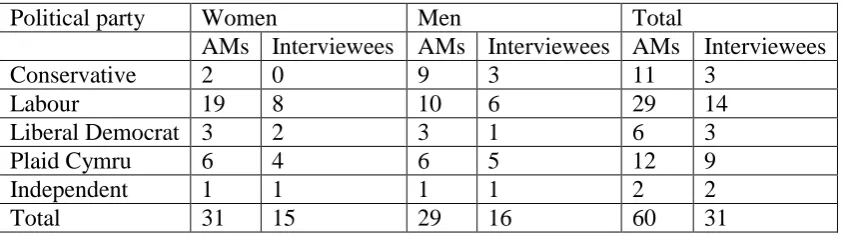
Between 2005 and 2007 (during the second term of the Welsh Assembly
Government) we carried out 31 interviews with AMs, 15 women and 16 men. Our interviewees were drawn from the four main political parties in Wales – the Labour Party, Plaid Cymru/the Party of Wales, the Liberal Democrat Party and the
Conservative Party. We also interviewed two Independents (see Table 1).
[Table 1 about here]
Between 2005 and 2008 we carried out 21 interviews with councillors (9 women and 12 men) in three local authority areas (see Table 2).
[Table 2 about here]
authority with a Liberal Democrat-led coalition in control of the council where women comprised just under a third of councillors. The second was a primarily rural local authority where the council was controlled by an Independent-led coalition, here women comprised under a fifth of councillors. The third was a post-industrial7 local authority which had for decades been controlled by Labour but at the time of our study was run by an all-party coalition; here fewer than 10% of councillors were women.
The interviews were semi-structured, covering a range of topics, and interviewees were asked to consider whether gender was salient to their understandings of different policy areas and to their own and others’ experiences as politicians. We therefore explicitly encouraged interviewees to reflect upon the practice of politics and how it related to the doing of gender. All interviews were transcribed verbatim and, in the process of analysis, themes emerged which were then compared across the different levels of government. We were interested in exploring emic understandings of gender and how they differed; these differences provided important insights into the
gendering of politics as it is practised within political institutions and how gender was done differently in the NAfW and local government. They also enabled us to gain an understanding of the distinct organisational cultures operating at local and devolved level.
Working practices
The NAfW was set up quite explicitly to change the way politics was done and to establish working practices which would differentiate politics in the NAfW from the confrontational politics of Westminster. This attempt to change the practice of politics related to the idea that Welsh politicians had more that united than divided them and was also influenced by the involvement of feminist activists in drawing up the blueprint for the NAfW (Chaney et al, 2007; Charles, 2010). This blueprint was designed to provide a framework that enabled a consensual rather than adversarial way of doing politics, one which was no longer associated with a competitive, aggressive masculinity. It also ensured a commitment to gender equality, which is enshrined in the NAfW’s constitution (Chaney and Fevre, 2002), and to increasing the number of women political representatives (Charles, 2010). These institutional
arrangements permit a more ‘fluid’ doing of gender (Jones, Charles and Davies, 2009) which speaks to Butler’s notion of undoing in the sense of loosening the constraints of gender norms.
There was a clear perception amongst AMs that politics was done differently in the NAfW in comparison with both local government (16 of the AMs we interviewed had been councillors) and Westminster (4 had been MPs). It was seen as less adversarial and more consensual. They linked this both to the NAfW being a new institution and to its gender composition. Several male AMs told us that the presence of women altered and ‘civilised’ men’s behaviour (see also Charles and Davies, 2000) and there was a widespread view that women practised politics differently from men and brought different qualities to politics. These differences were understood in terms of gender with the sparring and jousting of debate being associated with masculinity and men, and cooperative working being associated with femininity and women. Research evidence supports the idea that gender shapes the behaviour of political
Despite the view that women’s presence led to a change in the way politics was practised, there was still evidence of a ‘macho’ masculinity being done, particularly in the run up to elections, and not only on the part of men. And we found that some men, especially those from the Conservative party, preferred to engage in more robust debate and adopted a more ‘Westminster style’ than other AMs (see also Chaney et al, 2007). But AMs also talked about men doing politics in a consensual way,
particularly when engaged in committee work, and when talking about differences between adversarial, party political debates in the chamber and the more consensual committee work, they said that both women and men worked cooperatively at committee level.
Alongside this there was a view that in order for politics to be seen as interesting and for government to work properly there had to be healthy disagreement. Consensus, which AMs associated with a more feminine political style, was said to be ‘boring’ and even though some men practised a more ‘feminine’ politics, and some women did a macho masculinity, it was women’s political style that was characterised as
consensual.
Women do things in a different way, do debate in a more consensual style not, I mean many of us have learnt to be less consensual, for publicity reasons, ’cause the media aren’t interested in consensus, but I mean our natural way of working is, probably more practical and more low key. (Lib Dem AM Female)
This comment is interesting because, while asserting that there are gender-based differences in behaviour and that these are ‘natural’, there is also an awareness that women may learn to practice politics in a different, more ‘masculine’, way because this is expected by the media and is necessary in order to be seen to be doing ‘real’ politics. Another AM said:
I don’t like making generalisations because I know women who are just as aggressive as men, and I know men who can be as calm and sensible as many women I know, but I think on the whole the women that I know have got a different way of working and think things through, and aren’t sort of overly aggressive. (Labour AM Female)
In both these extracts there is a recognition that women and men vary in behaviours and that women, like men, can ‘do’ masculinity and behave in ‘macho’ ways. This points to an undoing of gender but, almost in the same breath, there is a reassertion of normative patterns of doing gender which can be understood as gender being redone in the way that West and Zimmerman suggest (2009).
sitting. Such jobs are clearly gendered (Acker, 1990) (and classed) in so far as they assume that the incumbents will be free of domestic and caring responsibilities.
At local level the job of political representatives also involves long hours, especially for those who are officers or in the cabinet. Rather than being professional and salaried, it is voluntary, done in addition to paid work and closely linked to the wards which are being represented so, unlike the job of an AM, it does not involve long periods of time away from home. In contrast to AMs, very few of the 21 councillors interviewed identified as feminist (2 women – one Labour and one Plaid Cymru), there was little gender awareness and there was hostility to positive measures across the political spectrum (Charles and Jones, 2013). Indeed many of the older, male councillors held the view that politics is a man’s world. One of the women councillors said:
Well you have to remember that I was a member of a Valleys council and it had been controlled by the Labour Party since 1925, it was largely made up of older men who felt that the place for a woman was in the home, and also that they [the men] had a right to run everything locally. (Plaid Cymru AM Female)
The structure of the job, which involves ward-level work as well as debating in the chamber, was associated with doing gender and definitions of what constituted practising politics.
I always felt local politics should be non political because you are there for the good of the people. (Lib Dem Councillor Female)
Working at ward level to try and improve conditions for those living there was understood as being non-political and as something women were good at.
You have got to, you have got to have an ability to empathise and maybe women are better at that, you know. Certainly a lot of my elderly residents and people with problems, they will come to me about a whole range of things and I sometimes wonder, well would they do the same, well they certainly wouldn’t have done the same to the previous ward member. But, you know, depending on the personality of the male incumbent, you know, would they have come to a male in quite the same way. (Lib Dem Councillor Female)
This councillor’s comments suggest that in responding to the problems that people bring to a councillor a woman might be better than a man and it is this sort of work, akin to some of the constituency work engaged in by AMs, that is seen as not being political. Gender comes into this in two ways: women are understood as having different qualities from men, and the work that they are good at is ‘non-political’. It is the men who engage in the conflictual party politics of the council chamber; women tend to be reluctant to practise politics in this way because its strong association with masculinity means that it is incompatible with doing femininity.
masculinity and neither is doing gender so closely tied to particular, biological bodies. Moreover, ‘gender-equality principles are strongly embedded in organisational
culture’ (Connell, 2006: 449). At the same time there is a tension in so far as
practising ‘real’, interesting politics involves doing a competitive masculinity, and the gender binary is reasserted in observations about differences in the ‘natural’
behaviours of men and women. At local level institutional practices reinforce a more restrictive gender norm which prescribes a close association between practising politics and doing an aggressive, confrontational masculinity. This means that gender is tightly mapped onto the different aspects of a councillor’s job and that women find it difficult to undo this association.
Family-friendly measures
Organisational cultures have been distinguished by their willingness to accept women in positions of power and their differential commitment to family-friendly measures (eg Haas and Hwang, 2007; Lewis, 1997). Working hours in political legislatures, in line with other gendered organisations, are often premised on the assumption that political representatives do not have any domestic or caring responsibilities. This is not the case in the NAfW and is largely due to feminist influence on the establishment of the NAfW as a result of which ‘family friendly’ working hours were formalised in its Standing Orders (Chaney et al, 2007; Charles, 2010).
The commitment to family-friendly working hours means that the NAfW sits only during school term time, its plenary sessions finish by 5.30pm and AMs are only expected to be present in the National Assembly on 3 days a week. These measures have both practical and symbolic significance. They have practicalsignificance for some AMs and for Assembly employees, while their symbolic importance relates to the fact that they institutionalise a recognition that political representatives have domestic and caring responsibilities. This both challenges the public-private divide (Haas and Hwang, 2007) and the gendering of the job of an AM, making it more available to women. There is, however, considerable pressure to bring the Assembly’s working hours more into line with those of Westminster and it is women from across the different parties who have resisted such pressure; there is thus contestation over measures which might enable the undoing of gender.
In contrast to the NAfW, the culture of local government is masculinist and embedded in the working-class culture of the localities where the councils are situated; this alerts us to the existence of contrasting inequality regimes (Acker, 2011) at these different levels of government. At local level we found that working practices do not take into account domestic or caring responsibilities and that masculine patterns of working are the norm.9 As one of the women councillors put it:
The lack of a crèche and the scheduling of meetings were seen as difficult for both men and women but particularly for women. And the extra barriers faced by women because of their domestic and childcare responsibilities, frequently in addition to paid work, were often not appreciated.
At local level there is a separation of public and private which means that councillors’ family lives are not taken into consideration resulting in a lack of family-friendly working practices (Haas and Hwang, 2007). And masculine hegemony (Haas and Hwang, 2007) is much more evident in local than devolved government, even in the local authority where women were almost a third of councillors.
Doing masculinity, practising politics
At local level all three councils shared a similar gender culture which, in contrast to the political and organisational culture of the National Assembly, was highly
masculinised and meant that women councillors felt that in order to be accepted and taken seriously by their male colleagues they had to do gender in a particular, ‘masculine’ way. As a woman councillor put it:
Women in politics have to be very, very tough and very resilient and very pushy so maybe we have certain features that (laugh) to our personality that, that maybe you would associate with, with a male, … in politics, you can’t be a retiring reclining sort of accepting type of person, you have to have that tough streak and, and be determined and, you know, sometimes I think ‘Am I really this kind of person?’ (Lib Dem Councillor Female)
She was speaking as a member of the council where almost 30% of councillors were women, a proportion that is often seen as constituting a ‘critical mass’, but her comments suggest that even in this environment she feels constrained to do
masculinity and that this is at odds with her identity as a woman (see also Pilgeram, 2007). This can be understood as ‘a process of undoing’ as she is producing
‘coherence at the cost of [her] own complexity’ (Hancock and Tyler, 2007: 513). She is complying with an ‘organisationally compelled mode’ of gender performativity (Hancock and Tyler, 2007: 513) which enables her practice of politics to be recognised and effective (cf Dahlerup, 2006).
The prescription to do masculinity was linked by some to the fact that women were in a minority although it clearly also operated where they were quite a sizeable minority. A woman in the council where women constituted fewer than 10% of councillors said:
I have come to the conclusion that unless you have a critical mass of female councillors – approaching 50% - then the culture of the council will be male and any minority female members can only hope to fit into that culture by acting in a similar way to the male councillors….. (Labour Councillor Female)
These comments alert us to the importance of a collective challenge to gendered organisational cultures and show how difficult it is for individual women to do
women remain in a minority, they are unable to change the culture of highly masculinised workplaces (Faulkner, 2009). Once a critical mass has been reached, cultural change within an organisation is possible though not inevitable. The evidence supporting the idea of critical mass is unclear; there are suggestions that
organisational cultures are affected by the predominance of women or men (Haas and Hwang, 2007; Faulkner, 2009) and there is evidence that the presence of significant numbers of women is associated with changes in the way politics is done (Jones, Charles and Davies, 2009). It is not possible, however, to link cultural change within an organisation simply to there being a critical mass (often taken to be around 30%) of women present (see for eg. Irvine and Vermilya, 2010) and there is considerable debate about the usefulness of this concept (see for e.g. Childs and Krook, 2006; Grey, 2006; Dahlerup, 1988). What our evidence suggests is that numbers alone are not sufficient to bring about change and that women (and men) have to conform to institutional norms of doing gender and gendered ways of doing politics. At local level this meant that practising politics was synonymous with an aggressive and competitive masculinity.
Most of the male councillors, as a result, thought that gender was irrelevant to
practising politics, a view which masks the gendering of the work of a councillor and the association of political power at local level with men (Martin, 2006). Alongside this view it was also suggested – somewhat contradictorily -- that women were different from men in so far as they brought different qualities to the job. They were seen as less inclined to indulge in political posturing, as being more empathetic and approachable, and having different and valuable life experiences. These views reassert the gender binary, relying on essentialised notions of gender difference, but also gave rise to the view that there should be more women in local politics.
As in the NAfW, women’s different way of doing politics meant that they were able to come together from across the political spectrum in order to cooperate on particular issues rather than taking entrenched party political positions resulting in conflict (cf. Cockburn, 1998). This was evident when ‘women’s’ issues were under discussion.
I was very supportive of the domestic abuse strategy, I supported that and I found it very exciting that when that came to Council that women who didn’t normally speak very fluently actually spoke quite fluently, you know, about it and it was clear that there was a feeling across the Chamber that all women who perhaps wouldn’t have, because they were in different political parties, did actually feel that they were supporting something together. (Plaid Cymru Councillor Female)
Women’s engagement with so-called women’s issues and, in the process, working in a consensual and cooperative way can be understood, in Butler’s terms, as both doing and undoing gender; women confirm their feminine gender identity by intervening on this particular question and, at the same time, challenge the divisive, conflictual and highly masculinised practices of party politics.
doing masculinity and the association of doing masculinity with male bodies - at the same time they reinforce the political as a masculine realm by doing masculinity themselves.
Discussion
These findings show that working practices and organisational cultures are markedly different at local and devolved level and that they are associated with different ways of practising politics and doing gender. I have argued that the jobs of AMs and of councillors are gendered but that at devolved level this gendering has been partially challenged by an institutional commitment to equality, consensual working practices and the adoption of family-friendly measures. At local level, in contrast, the job is based on an assumption that politics is a man’s world in which women only have a place if they play by the rules and there is as yet little acceptance of the need to change the rules which are regarded by most as fair.
The gendering of politics has also been challenged because, in contrast to local government, the NAfW is a new political institution which was set up quite explicitly to do politics differently from how it is done at Westminster and women’s
organisations and feminists were an integral part of this process (Charles, 2010). This not only involved institutionalising working practices which were more in line with considerations of equal opportunities but also ensuring that boorish and abusive behaviour had no place in the debating chamber. This does not mean that such behaviour never occurs but that there is an ongoing attempt to do politics differently and in a way which is more compatible with what are seen as feminine characteristics of cooperation and consensus. Practising politics is no longer so closely tied to doing masculinity although, as we have seen, this de-linking is contested. Thus the gender balance of the NAfW is understood as inhibiting men’s propensity to engage in confrontational politics while, at local level, there is no such inhibition and men regularly do masculinity in this way. Indeed, at local level, women as well as men are obliged to do masculinity while in the NAfW both women and men feel much less constrained to ‘do’ a competitive, macho masculinity. This leads to different ways of practising politics at local and devolved level; at devolved level practising politics is not so closely tied to a particular way of doing masculinity and the organisational culture characterising the NAfW is less masculinist (Jones, Charles and Davies, 2009), thereby exerting less pressure on political representatives ‘to compete, exploit and dominate’ (West and Zimmerman, 1987:268). In this sense gender is being undone because, on the one hand, the gender order is more inclusive and, on the other hand, doing a competitive, confrontational masculinity is neither so tightly tied to particular bodies nor to the practice of politics.
Women who enter the masculine domain of politics are undeniably challenging the routine ‘doing’ of gender and what is culturally accepted as ‘feminine’. As our evidence shows, women councillors feel that they have to behave like men to get on in politics and, as a result, gender is mapped onto bodies differently (Kelan,
seen as essentially feminine ways of working; gender is redone rather than undone because while the gender order is challenged, it is reproduced both by women’s practice of politics and by their own and men’s understanding of these practices. It is also clear that most of the AMs and a significant proportion of the women councillors understood women’s and men’s mode of doing politics in terms of gender and many saw essential differences between their political behaviours. This understanding can itself be seen as an aspect of doing gender which reinforces the gender binary even in circumstances when women are undoing gender.
As well as this ‘redoing’ of gender at the interactional level, however, our findings also provide evidence of substantial change in the ways in which both politics and gender are done and this, we suggest, relates to the new institutional context provided by the NAfW. These changes have led to a proliferation of different ways of doing gender and provide an illustration of how gender can be undone even while it is being done and redone. In the NAfW practising politics is being uncoupled from doing a certain form of competitive masculinity because of the institutionalisation of family-friendly working practices, the gender balance of political representatives, and the institutional commitment, enshrined in working practices, to gender equality. This is linked to a more feminised organisational culture which enables those (men as well as women) who do not wish to conform to a competitive, aggressive masculinity to do gender differently as well as practising politics effectively. This suggests that, while individual women’s attempts to undo gender can be incorporated into the normative gender order, the NAfW is challenging the gendering of politics through
institutionalising different ways of working that allow for a de-coupling of doing masculinity and practising politics. It also suggests that women’s and feminists’ collective presence and active engagement, both in the establishment of the NAfW and in its continuing existence, are a crucial means of changing both the way politics is practised and its relation to the doing of gender. Thus an organisation which
institutionalises a practice of politics which is associated with consensus, and modern working practices which support gender equality, opens the door to the de-coupling of politics from doing competitive masculinity, allows different ways of doing gender and practising politics to flourish, and fosters a differently gendered organisational culture. Where this has not happened, as in local government, even where there is a critical mass of women, changes in doing gender and practising politics are not apparent and the association between doing a particular form of masculinity and practising politics is reproduced at both the interactional and organisational level.
These findings offer support to those who argue that it is difficult to change
workplace cultures simply by doing gender differently at an individual level; as Butler and West and Zimmerman argue, this may result in an undoing of the self rather than a challenge to the gender order. Furthermore, it is difficult to assess empirically the relation between un/doing gender at an individual level and changes in the normative gender order (Kelan, 2010). I have therefore argued, using evidence from contrasting political institutions, that in order to understand how change is brought about,
Table 1: Gender and party composition of National Assembly at time of interviewing (2006-7)
Political party Women Men Total
AMs Interviewees AMs Interviewees AMs Interviewees
Conservative 2 0 9 3 11 3
Labour 19 8 10 6 29 14
Liberal Democrat 3 2 3 1 6 3
Plaid Cymru 6 4 6 5 12 9
Independent 1 1 1 1 2 2
Total 31 15 29 16 60 31
Note: We approached women and men AMs from across the political spectrum but were unable to secure interviews with Conservative women AMs.
Table 2: Gender and party composition of local government interviewees
Note: In order to preserve confidentiality we do not provide the overall party composition of local government in the three case study areas.
Political party Local authority
Rural Post-industrial Urban All
Women Men Women Men Women Men Total
Conservative 0 0 0 0 0 0 0
Labour 2 1 1 2 1 1 8
Liberal Democrat 1 0 0 0 1 1 3
Plaid Cymru 1 0 0 0 1 0 2
Independent 0 1 0 2 1 1 5
Other 0 1 0 2 0 0 3
[image:16.595.90.475.308.487.2]References
Acker, J (1990) ‘Hierarchies, jobs, bodies: a theory of gendered organisations’ in
Gender and Society, 4 (2): 139-158
Acker, J (2006) ‘Inequality regimes: gender, class and race in organizations’ in
Gender and Society, 20 (4): 441-464
Acker, J (2011) ‘Theorizing gender, race, and class in organizations’ in E L Jeanes, D Knights and P Y Martin (eds) Handbook of Gender, Work, and Organization,
Chichester: Wiley, pp.65-80
Author (2000) (2008) (2009) (2010) (2013)
Benschop, Y and Verloo, M (2011) ‘Gender change, organizational change, and gender equality strategies’ in E L Jeanes, D Knights, P Yancey Martin (eds)
Handbook of Gender, Work, and Organization, Chichester: Wiley, pp. 277-290
Bicquelet, A, Weale, A and Bara, J (2012) ‘In a Different Parliamentary Voice?’ in
Politics and Gender, 8: 83–121
Bochel, C. & Briggs, J. (2000) ‘Do women make a difference?’, Politics 20(2): 63-68.
Borgerson, J (2005) ‘Judith Butler: on organising subjectivities’ in C Jones and R Munro (eds) Contemporary Organizational Theory, Sociological Review
Monograph/Wiley Blackwell, pp. 63-79
Butler, J (2004) Undoing gender, New York: Routledge.
Chaney, P and Fevre, R (2002) The Equality Policies of the government of the
National Assembly for Wales and their Implementation, Cardiff: Institute of Welsh
Affairs
Chaney, P, Mackay, F, & McAllister, L (2007) Women, Politics and Constitutional
Change: The First Years of the National Assembly for Wales, Cardiff: University of
Wales Press
Charles, N and Davies, C A (2000) 'Cultural stereotypes and the gendering of senior management' in The Sociological Review, 48 (4):544-569
Charles, N (2010) ‘Setting the scene: devolution, gender politics and social justice’ in Charles N and Davies CA (eds) Gender and social justice in Wales, Cardiff
University Press, 2010
Childs, S (2004) ‘A feminized style of politics? Women MPs in the House of Commons, British Journal of Politics and International Relations, 6 (1):3-19
Childs S and Krook M L (2006) ‘Should feminism give up on critical mass? A contingent yes’ in Politics and Gender 2 (4): 522-530
Cockburn, C (1998) The space between us: negotiating national identities in conflict, Zed Books: London
Cockburn, C (1991) In the way of women, Macmillan: Basingstoke
Connell, C (2010) ‘Doing, Undoing, or Redoing Gender? Learning from the Workplace Experiences of Transpeople’, Gender and Society, 24 (1) 31-55
Connell, R (2009) ‘Accountable conduct: doing gender in transsexual and political retrospect’, Gender and Society, 23(1): 104-11
Connell, R W (2006) ‘The experience of gender change in public sector organizations’, Gender, Work and Organization, 13 (5): 435-452
Dahlerup, D (2006) ‘The story of the theory of critical mass’ in Politics and Gender, 2 (4):511-522
Dahlerup, D (1988) ‘From a small to a large minority: women in Scandinavian politics’ in Scandinavian Political Studies, 11: 275-98
Davey, Mackenzie K (2008) Women’s accounts of organizational politics as a gendering process in Gender, Work and Organization in 15(6): 650-671
Davies, N and Williams, D (2009) Clear red water: Welsh devolution and socialist
politics, Francis Boutle Publishers
Deutsch, F M (2007) ‘Undoing gender’ in Gender & Society 21:106-27.
Electoral Reform Society Wales (2012) Women and local government
Faulkner, W (2009) ‘Doing gender in engineering workplace cultures. I. Observations from the field’, in Engineering Studies, 1 (1): 3-18
Grey, S (2006) ‘Numbers and beyond: the relevance of critical mass in gender research in Politics and Gender 2 (4):492-502
Grey, S (2002) Does size matter? Critical mass and New Zealand’s women MPs,
Parliamentary Affairs, 55 (1):19-29
Haas, L and Hwang, P C (2007) ‘Gender and organizational culture: correlates of companies’ responsiveness to fathers in Sweden’, Gender and Society, 21: 52-79
Hall, A, Hockey, J and Robinson, V (2007) ‘Occupational Cultures and the
Embodiment of Masculinity: Hairdressing, Estate Agency and Firefighting’, Gender,
Work and Organization, 16 (6): 534-51
Hancock, P and Tyler, M (2007) ‘Undoing gender and the aesthetics of organizational performance’, Gender, Work and Organization, 14 (6): 512-533
Irvine, L and Vermilya, J R (2010) ‘Gender Work in a Feminized Profession : The Case of Veterinary Medicine’ in Gender and Society, 24: 56-82
_459 174.. 194
Jones, S, Charles, N and Davies C A (2009) ‘Transforming masculinist political cultures? Doing politics in new political institutions’, Sociological Research Online, 14 (2/3), http://www.socresonline.org.uk/14/2/1.html
Kelan, E K (2010) ‘Gender logic and (un)doing gender at work’ in Gender, Work and
Organization, 17 (2): 174-194
Kenny, M (2007) ‘Gender, institutions and power: a critical review’, Politics, 27 (2): 91-100
Kerfoot, D. and Knights D. (1998) Managing masculinity in contemporary organizational life: a ‘man’agerial project. Organization, 5 (1):7–26.
Knights, D and Kerfoot, D (2004) ‘Between Representations and Subjectivity: Gender Binaries and the Politics of Organizational Transformation’ in Gender, Work and Organization, 11 (4):430-454
Lewis, S (1997) ‘”Family friendly” employment policies: a route to changing organizational culture or playing about at the margins?’ in Gender, Work and
Organization, 4 (1):13-23
Lovenduski, J (2005) Feminizing politics, Cambridge: Polity
Mackay, F (2008) ‘“Thick” conceptions of substantive representation: women, gender and political institutions’ in Representation, 44 (2):125-138
Mackay, F (2004) ‘Gender and political representation in the UK: the state of the discipline’, British Journal of Politics and International Relations, 6 (1):99-120
Mackay, F, Myers, F and Brown, A (2003) ‘Towards a new politics? Women and the constitutional change in Scotland’ in A. Dobrowolsky & V. Hart (eds) Women
Making Constitutions: New Politics and Comparative Perspectives, Basingstoke:
Palgrave: 84-98
Martin, P Y (2006) ‘Practising gender at work: further thoughts on reflexivity’ in
Gender, Work and Organization, 13 (3): 254-276
Pilgeram, R (2007) ‘“Ass-kicking” women: doing and undoing gender in a US livestock auction’, Gender, Work and Organization, 14 (6): 572-595
Poggio, B (2006) ‘Editorial: Outline of a theory of gender practices’, Gender, Work
and Organization, 13 (3): 225-233
Powell, A, Bagilhole, B and Dainty, A (2009) ‘How women engineers do and undo gender: Consequences for gender equality’ in Gender, Work and Organization, 16 (4):410-428
Pullen, A. and Knights, D. (2008) ‘Undoing gender: organizing and disorganizing Performance’ in Gender, Work & Organization, 14 (6): 505–11
Pullen, A and Rhodes, C (2012) ‘Parody, subversion and the politics of gender at work: the case of Futurama’s ‘Raging Bender’’, Organization, 0 (0): 1-22
Puwar, N (2004) ‘Thinking about making a difference’ in British Journal of Politics
and International Relations, 6:65-80
Risman. B J (2009) From doing to undoing: gender as we know it, in Gender and Society, 23: 81-84
Ross, K (2002) ‘Women’s place in ‘male’ space: gender and effect in parliamentary contexts’ in Parliamentary Affairs 55: 189-201
Sones B with Moran, M and Lovenduski, J (2005) Women in Parliament: the new
suffragettes, Politico’s: London
Stokes, W. (2005) Women in Contemporary Politics, Cambridge: Polity Press.
Threlfall, M, Freidenvall, L Fuszara, M and Dahlerup, D (2012) ‘Remaking political citizenship in multicultural Europe’ in B. Halsaa, S Roseneil and S Sumer (eds)
Remaking citizenship in multicultural Europe, Palgrave
West, C and Zimmerman, D H (2009) ‘Accounting for doing gender’, Gender and
Society, 23 (1): 112-22
West, C and Zimmerman, D H (1987) ‘Doing gender’, Gender and Society, 1 (2):125-151
Witz A and Savage M, (1992) ‘The gender of organizations’ in M.Savage and A. Witz (eds) Gender and bureaucracy, Blackwell Publishers/ The Sociological Review: Oxford: 3-62
1 The first elections to the devolved government of Wales took place in 1999. Sixty
are elected by a system of proportional representation known as the Additional
Member System; 40 are elected on a first past the post basis and 20 from regional lists.
2 At local level councillors are elected in a first-past-the-post system.
3 The research was funded by the ESRC (grant number RES 000231185). The
research team consisted of Nickie Charles (PI). University of Warwick, Charlotte Aull Davies and Stephanie Jones (Co-Investigators), Swansea University.
4 In the UK local political representatives are known as councillors and are elected to
serve on councils.
5 After the 2012 local elections the proportion of women councillors rose to 26% but
the slow rate of increase means that gender balance in political representation would not be achieved in local government until 2075 (ERSW, 2012).
iii In order to protect the anonymity of our interviewees we only provide a rough
indication of the gender composition of our case study councils. We also give the label ‘Independent’ to any councillor who is not a member of one of the four main political parties in Wales.
iv. Post-industrial refers to an area which is not a large conurbation and was previously
dominated by coal and/or steel production which has now, to all intents and purposes, ceased.
8Support for positive measures and high levels of gender awareness were particularly
associated with Welsh Labour and Plaid Cymru AMs and, of the 31 AMs we interviewed, 23 were from these two parties (Table 1).
9 ‘All organizations have inequality regimes, defined as loosely interrelated practices,