Original citation:
Chen, Zhen-Qing, Croydon, David A. and Kumagai, Takashi. (2014) Quenched invariance principles for random walks and elliptic diffusions in random media with boundary. The Annals of Probability. ISSN 0091-1798
Permanent WRAP url:
http://wrap.warwick.ac.uk/63798
Copyright and reuse:
The Warwick Research Archive Portal (WRAP) makes this work by researchers of the University of Warwick available open access under the following conditions. Copyright © and all moral rights to the version of the paper presented here belong to the individual author(s) and/or other copyright owners. To the extent reasonable and practicable the material made available in WRAP has been checked for eligibility before being made available.
Copies of full items can be used for personal research or study, educational, or not-for-profit purposes without prior permission or charge. Provided that the authors, title and full bibliographic details are credited, a hyperlink and/or URL is given for the original metadata page and the content is not changed in any way.
A note on versions:
The version presented in WRAP is the published version or, version of record, and may be cited as it appears here.For more information, please contact the WRAP Team at:
Quenched Invariance Principles
for Random Walks and Elliptic Di
↵
usions
in Random Media with Boundary
Zhen-Qing Chen⇤, David A. Croydon and Takashi Kumagai† Dedicated to Professors Martin T. Barlow and Ed Perkins
on the occasion of their 60th birthdays.
January 20, 2014
Abstract
Via a Dirichlet form extension theorem and making full use of two-sided heat kernel estimates, we establish quenched invariance principles for random walks in random environments with a boundary. In particular, we prove that the random walk on a supercritical percolation cluster or amongst random conductances bounded uniformly from below in a half-space, quarter-space, etc., converges when rescaled di↵usively to a reflecting Brownian motion, which has been one of the important open problems in this area. We establish a similar result for the random conductance model in a box, which allows us to improve existing asymptotic estimates for the relevant mixing time. Furthermore, in the uniformly elliptic case, we present quenched invariance principles for domains with more general boundaries.
AMS 2000 Mathematics Subject Classification: Primary 60K37, 60F17; Secondary 31C25,
35K08, 82C41.
Keywords: quenched invariance principle, Dirichlet form, heat kernel, supercritical percolation, random conductance model
Running title: Quenched invariance principles for random media with a boundary.
1
Introduction
Invariance principles for random walks ind-dimensional reversible random environments date back to the 1980s [27, 40, 42, 43]. The most robust of the early results in this area concerned scaling limits for the annealed law, that is, the distribution of the random walk averaged over the possible realizations of the environment, or possibly established a slightly stronger statement involving some form of convergence in probability. Studying the behavior of the random walks under the quenched law, that is, for a fixed realization of the environment, has proved to be a much more difficult
⇤Research partially supported by NSF Grants NSF Grant DMS-1206276, and NNSFC Grant 11128101.
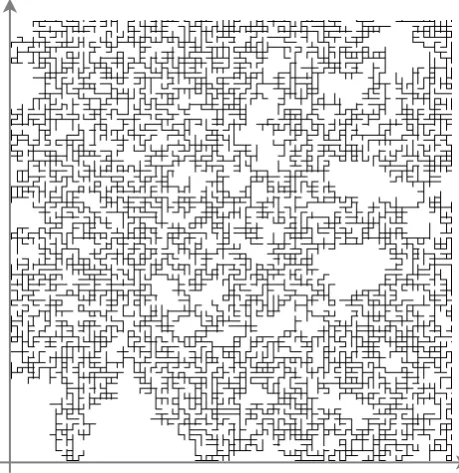
Figure 1: A section of the unique infinite cluster for supercritical percolation onZ2+with parameter
p= 0.52.
task, especially when there is some degeneracy in the model. This is because it is often the case that a typical environment has ‘bad’ regions that need to be controlled. Nevertheless, over the last decade significant work has been accomplished in this direction. Indeed, in the important case of the random walk on the unique infinite cluster of supercritical (bond) percolation onZd, building on the detailed transition density estimates of [6], a Brownian motion scaling limit has now been established [15, 46, 52]. Additionally, a number of extensions to more general random conductance models have also been proved [3, 8, 17, 45].
Whilst the above body of work provides some powerful techniques for overcoming the technical challenges involved in proving quenched invariance principles, such as studying ‘the environment viewed from the particle’ or the ‘harmonic corrector’ for the walk (see [16] for a survey of the recent developments in the area), these are not without their limitations. Most notably, at some point, the arguments applied all depend in a fundamental way on the translation invariance or ergodicity under random walk transitions of the environment. As a consequence, some natural variations of the problem are not covered. Consider, for example, supercritical percolation in a half-space Z+⇥Zd 1, or possibly an orthant of Zd. Again, there is a unique infinite cluster (Figure 1 shows
a simulation of such in the first quadrant ofZ2), upon which one can define a random walk. Given
are lacking. For this reason, it has been one of the important open problems in this area to prove the quenched invariance principle for random walk on a percolation cluster, or amongst random conductances more generally, in a half-space (see [15, Section B] and [16, Problem 1.9]). Our aim is to provide a new approach for overcoming this issue, and thereby establish invariance principles within some general framework that includes examples such as those just described.
The approach of this paper is inspired by that of [19, 20], where the invariance principle for random walk on grids inside a given Euclidean domainD is studied. It is shown first in [19] for a class of bounded domains including Lipschitz domains and then in [20] foranybounded domainD
that the simple random walk converges to the (normally) reflecting Brownian motion on D when the mesh size of the grid tends to zero. Heuristically, the normally reflecting Brownian motion is a continuous Markov process on D that behaves like Brownian motion in D and is ‘pushed back’ instantaneously along the inward normal direction when it hits the boundary. See Section 2 for a precise definition and more details. The main idea and approach of [19, 20] is as follows: (i) show that random walk killed upon hitting the boundary converges weakly to the absorbing Brownian motion in D, which is trivial; (ii) establish tightness for the law of random walks; (iii) show any sequential limit is a symmetric Markov process and can be identified with reflecting Brownian motion via a Dirichlet form characterization. In [19, 20], (ii) is achieved by using a forward-backward martingale decomposition of the process and the identification in (iii) is accomplished by using a result from the boundary theory of Dirichlet form, which says that the reflecting Brownian motion on D is the maximal Silverstein’s extension of the absorbing Brownian motion in D; see [19, Theorem 1.1] and [23, Theorem 6.6.9].
time Markov process that jumps from a vertex at a rate equal to its degree to a uniformly chosen neighbor (see Section 3 for further details). In this setting, similar results to that stated can be obtained for the so-called constant speed random walk (CSRW), which has mean one exponential holding times, or the discrete time random walk (see Remark 3.18 below).
Let Z+:={0,1,2, . . .} andR+:= [0,1). Then the following is our main theorem.
Theorem 1.1. Fix d1, d2 2Z+ such thatd1 1 andd:=d1+d2 2. LetC1 be the unique infinite
cluster of a supercritical bond percolation process onZd1
+⇥Zd2, and letY = (Yt)t 0 be the associated
VSRW. For almost-every realization of C1, it holds that the rescaled process Yn = (Ytn)t 0, as
defined by
Ytn:=n 1Yn2t,
started fromY0n=xn2n 1C1, wherexn!x2Rd+1⇥Rd2, converges in distribution to{Xct;t 0},
where c2(0,1) is a deterministic constant and{Xt;t 0} is the (normally) reflecting Brownian
motion on Rd1
+ ⇥Rd2 started fromx.
As an alternative to unbounded domains, one could consider compact limiting sets, replacingYn
in the previous theorem by the rescaled version of the variable speed random walk on the largest percolation cluster contained in a box [ n, n]d\Zd, for example. As presented in Section 4.1, another application of Theorem 2.1 allows an invariance principle to be established in this case as well, with the limiting process being Brownian motion in the box [ 1,1]d, reflected at the boundary. Consequently, we are able to refine the existing knowledge of the mixing time asymptotics for the sequence of random graphs in question from a tightness result [13] to an almost-sure convergence one (see Corollary 4.4 below).
Although in the percolation setting we only consider relatively simple domains with ‘flat’ bound-aries, this is mainly for technical reasons so that deriving the percolation estimates in Section 3.1 required for our proofs is manageable. Indeed, in the case when we restrict to uniformly elliptic random conductances, so that controlling the clusters of extreme conductances is no longer an is-sue, we are able to derive from Theorem 2.1 quenched invariance principles in any uniform domain, the collection of which forms a large class of possibly non-smooth domains that includes (global) Lipschitz domains and the classical van Koch snowflake planar domain as special cases. These applications are discussed in Section 4.2.
setting appears in Section 4.3. Note further that in this setting we resolve the open problem on the quenched invariance principle starting from arbitrary starting points posed in [51, pp. 1004–1005]. The remainder of the paper is organized as follows. In Section 2, we introduce an abstract framework for proving invariance principles for reversible Markov processes in a Euclidean domain. This is applied in Section 3 to our main example of a random conductance model in half-spaces, quarter-spaces, etc. The details of the other examples discussed above are presented in Section 4. Our results for the random conductance model depend on a number of technical percolation estimates, some of the proofs of which are contained in the appendix that appears at the end of this article. The appendix also contains a proof of a generalization of existing quenched invariance principles that allows for arbitrary starting points (previous results have always started the relevant processes from the origin, which will not be enough for our purposes).
Finally, in this paper, for a locally compact separable metric spaceE, we useCb(E) andC1(E) to denote the space of bounded continuous functions on E and the space of continuous functions on E that vanish at infinity, respectively. The space of continuous functions on E with compact support will be denoted byCc(E). For real numbers a, b, we usea_b anda^bfor max{a, b} and min{a, b}, respectively.
2
Framework
The following definition is taken from V¨ais¨al¨a [55], where various equivalent definitions are dis-cussed. An open connected subset DofRd is calleduniformif there exists a constantC such that for every x, y 2 D there is a rectifiable curve joining x and y in D with length( ) C|x y|
and moreover min{|x z|,|z y|} Cdist(z, @D) for all points z 2 . Here dist(z, @D) is the Euclidean distance between the point zand the set@D. Note that a uniform domain with respect to an inner metric is calledinner uniform in [35, Definition 3.6].
For example, the classical van Koch snowflake domain in the conformal mapping theory is a uniform domain in R2. Every (global) Lipschitz domain is uniform, and every non-tangentially accessible domaindefined by Jerison and Kenig in [37] is a uniform domain (see (3.4) of [37]). How-ever, the boundary of a uniform domain can be highly nonrectifiable and, in general, no regularity of its boundary can be inferred (besides the easy fact that the Hausdor↵dimension of the boundary is strictly less than d).
It is known (see Example 4 on page 30 and Proposition 1 in Chapter VIII of [39]) that any uniform domain in Rdhasm(@D) = 0 and there exists a positive constant c >0 such that
m(D\BE(x, r)) c rn for all x2D and 0< r1, (2.1)
wherem denotes the Lebesgue measure in Rd and BE(x, r) denotes the Euclidean ball of radiusr
centered atx.
LetDbe a uniform domain inRd. Suppose (A(x))
x2D is a measurable symmetricd⇥d matrix-valued function such that
whereI is the d-dimensional identity matrix andc is a constant in [1,1). Let
E(f, g) := 1 2
Z
Dr
f(x)·A(x)rg(x)dx forf, g2W1,2(D), (2.3)
where
W1,2(D) := f 2L2(D;m) : rf 2L2(D;m) .
An important property of a uniform domain D ⇢ Rd is that there is a bounded linear extension operator T :W1,2(D) ! W1,2(Rd) such that T f =f a.e. on D for f 2W1,2(D). It follows that
(E, W1,2(D)) is a regular Dirichlet form onL2(D;m) and so there is a continuous di↵usion process
X= (Xt, t 0;Px, x2D) associated with it, starting fromE-quasi-every point. Here a property is said to holdE-quasi-everywhere means that there is a setN ⇢Dhaving zero capacity with respect to the Dirichlet form (E, W1,2(D)) so that the property holds for points in Nc. According to [35, Theorem 3.10] and (2.1) (see also [12, (3.6)]), X admits a jointly continuous transition density functionp(t, x, y) on R+⇥D⇥D and
c1t d/2exp
✓
c2|x y|2 t
◆
p(t, x, y)c3t d/2exp
✓
c4|x y|2 t
◆
(2.4)
for every x, y 2 D and 0 < t 1. Here the constants c1, . . . , c4 > 0 depend on the di↵usion
matrixA(x) only through the ellipticity bound cin (2.2). Consequently, X can be refined so that it can start from every point in D. The process X is called a symmetric reflecting di↵usion on
D. We refer to [21] for sample path properties of X. When A=I,X is the (normally) reflecting Brownian motion on D. Reflecting Brownian motion X on D in general does not need to be semimartingale. When@Dlocally has finite lower Minkowski content, which is the case when Dis a Lipschitz domain, X is a semimartingale and admits the following Skorohod decomposition (see [22, Theorem 2.6]):
Xt=X0+Wt+
Z t
0
~n(Xs)dLs, t 0. (2.5)
Here W is the standard Brownian motion in Rd, ~n is the unit inward normal vector field of D on @D, and L is a positive continuous additive functional of X that increases only when X is on the boundary, that is, Lt = R0t1{Xs2@D}dLs for t 0. Moreover, it is known that the reflecting
Brownian motion spends zero Lebesgue amount of time at the boundary@D. These together with (2.5) justify the heuristic description we gave in the introduction for the reflecting Brownian motion inD.
2.1 Convergence to reflecting di↵usion
In this subsection,Dis a uniform domain inRd andXis a reflecting di↵usion process onD associ-ated with the Dirichlet form (E, W1,2(D)) onL2(D;m) given by (2.3). Denote by (XD,PD
x, x2D) the subprocess ofX killed on exitingD. It is known (see, e.g., [23]) that the Dirichlet form of XD
on L2(D;m) is (E, W1,2
0 (D)), where
Suppose that {Dn;n 1} is a sequence of Borel subsets of D such that each Dn supports a measure mn that converges vaguely to the Lebesgue measure m on D. The following result plays a key role in our approach to the quenched invariance principle for random walks in random environments with boundary.
Theorem 2.1. For each n 2 N, let (Xn,Pn
x, x 2 Dn) be an mn-symmetric Hunt process on Dn.
Assume that for every subsequence {nj}, there exists a sub-subsequence {nj(k)} and a
continu-ous conservative m-symmetric strong Markov process (X,e ePx, x2 D) such that the following three
conditions are satisfied:
(i) for every xnj(k) !x withxnj(k) 2Dnj(k), P
nj(k)
xnj(k) converges weakly in D([0,1), D) to ePx;
(ii) XeD, the subprocess of Xe killed upon leavingD, has the same distribution as XD;
(iii) the Dirichlet form ( ˜E,F˜) of Xe onL2(D;m) has the properties that
C⇢F˜ and E˜(f, f)C0E(f, f) for every f 2C, (2.6)
where C is a core for the Dirichlet form (E, W1,2(D))and C02[1,1) is a constant.
It then holds that for every xn ! x with xn 2Dn, (Xn,Pnxn) converges weakly in D([0,1), D) to
(X,Px).
Proof. With both Xe and X being m-symmetric Hunt processes on D, it suffices to show that their corresponding (quasi-regular) Dirichlet forms on L2(D;m) are the same; that is (Ee,Fe) = (E, W1,2(D)). Condition (iii) immediately implies that W1,2(D)⇢Fe and
e
E(f, f)C0E(f, f) for every f 2W1,2(D).
Next, observe that sinceXe is a di↵usion process admitting no killings, its associated Dirichlet form is strongly local. Thus for every u 2 Fe, Ee(u, u) = 12µehui(D), where µehui is the energy measure corresponding tou. By the proof of [47, Proposition on page 389] ,
e
µhui(dx)C0ru(x)A(x)ru(x)dxcC0|ru(x)|2dx on D for every u2W1,2(D).
This in particular implies that
e
µhui(@D) = 0 foru2W1,2(D). (2.7)
On the other hand, by the strong local property of µehui and the fact that XeD has the same distribution asXD, we have that every bounded function in Fe– the collection of which we denote by Feb – is locally inW01,2(D) and
1D(x)µehui(dx) =1D(x)ru(x)A(x)ru(x)dx foru2Feb. (2.8)
This together with (2.7) implies thatEe(u, u) =E(u, u) for every bounded u2W1,2(D), and hence
for every u 2 W1,2(D). Furthermore, (2.8) implies that for u 2 Feb, R
D|ru(x)|2dx < 1 and so
Remark 2.2. (i) Note that if (Xn
t)t 0 is conservative for eachn2N and {P
nj(k)
xnj(k)} is tight, then ˜
X is conservative.
(ii) Theorem 2.1 can be viewed as a variation of [19, Theorem 1.1]. The di↵erence is that in [19, Theorem 1.1], the constantC0 in (2.6) is assumed to be 1 but the limiting processXe only need to
be Markov and does not need to be continuous a priori, while for Theorem 2.1, the condition on the constantC0 is weaker but we need to assume a priori that the limit process Xe is continuous.
2.2 Sufficient condition for subsequential convergence
In this subsection, we give some sufficient conditions for the subsequential convergence of{Xn}; in other words, sufficient conditions for (i) in Theorem 2.1. For simplicity, we assume that 02Dnfor all n 1 throughout this section, though note this restriction can easily be removed.
We start by introducing our first main assumption, which will allow us to check an equi-continuity property for the -potentials associated with the elements of{Xn}(see Proposition 2.4 below). In the statement of the assumption, we suppose that ( n)n 1 is a decreasing sequence in
[0,1] with limn!1 n= 0 and such that|x y| n for all distinct x, y2Dn. (When n⌘0, this condition always holds. However, our assumption will give an additional restriction.) We denote by ⌧A(Xn) the first exit time of the processXn from the setA.
Assumption 2.3. There existc1, c2, c3, , 2(0,1), N0 2N such that the following hold for all n N0, x0 2BE(0, c1n1/2), and n1/2r 1.
(i) For all x2BE(x0, r/2)\Dn,
En x ⇥
⌧BE(x0,r)\Dn(Xn)⇤c2r .
(ii) If hn is bounded in Dn and harmonic (with respect to Xn) in a ball BE(x0, r), then
|hn(x) hn(y)|c3
✓
|x y| r
◆
khnk1 for x, y2BE(x0, r/2)\Dn.
Define for >0 the -potential
Unf(x) =Enx Z 1
0
e tf(Xtn)dt forx2Dn.
Proposition 2.4. Under Assumption 2.3 there exist C =C 2(0,1) and 0 2 (0,1) such that
the following holds for any bounded functionf onDn, for anyn N0 and anyx, y2Dn such that
x2BE(0, c1n1/2) and |x y|<1/4:
|Unf(x) Unf(y)|C|x y| 0kfk1. (2.9)
In particular, we have
lim
!0n Nsup0x,y sup
2Dn\BE(0,c1n1/2):
|x y|<
Proof. The proof is similar to that of [11, Proposition 3.3]. Fix x0 2 BE(0, c1n1/2) \Dn, let 1 r 1n/2, and suppose x, y2BE(x0, r/2). Set ⌧rn:=⌧BE(x0,r)\Dn(X
n). By the strong Markov property,
Unf(x) = Enx Z ⌧n
r
0
e tf(Xtn)dt+Enxh(e ⌧rn 1)U
nf(X⌧nn
r)
i
+EnxhUnf(X⌧nn
r)
i
= I1+I2+I3,
and similarly when xis replaced by y. We have by Assumption 2.3(i) that
|I1| kfk1Enx⌧rnc2r kfk1,
and by notingkUnfk1 1kfk1 that
|I2| Enx⌧rnkUnfk1c2r kfk1.
Similar statements also hold when x is replaced byy. So,
Unf(x) Unf(y) 4c2r kfk1+ EnxUnf(X⌧nn
r) E
n
yUnf(X⌧nn
r) . (2.11)
But z!En
zUnf(X⌧nn
r) is bounded in R
d and harmonic inB
E(x0, r), so by Assumption 2.3(ii), the
second term in (2.11) is bounded by c3(|x y|/r) kUnfk1. So by kUnfk1 1kfk1 again, we have
Unf(x) Unf(y) c
✓
r + 1
✓
|x y| r
◆ ◆
kfk1 forx, y2BE(x0, r/2). (2.12)
Now, for distinct x, y2Dn withx2BE(0, c1n1/2) and ( 1n/2)2|x y|<1/4 (note that since
|x y| n for distinct x and y, the first inequality always hold), let x0 = x and r =|x y|1/2.
Then n r <1/2 and y 2BE(x0, r/2) (because|x0 y|=r2 < r/2). Thus we can apply (2.12)
to obtain
Unf(x) Unf(y) c⇣|x y| /2+ 1|x y| /2⌘kfk1
c(1 + 1)|x y|( ^ )/2kfk1.
So (2.9) holds with C = c(1 + 1) and 0 = ( ^ )/2. The result at (2.10) is immediate from (2.9).
Proposition 2.5. Let R 2 [2,1] and t > 0. Suppose there exist c1 > 0 and N1 2 N (that may
depend on R and t) such that for every g2L1(BR, mn),
kPn,BR
t gk1,n,Rc1kgk1,n,R, for all n N1.
Suppose in addition that Assumption 2.3 holds with Xn,BR andB
R in place ofXn and Dn,
respec-tively. It then holds that there exist constants c2(0,1) and N2 1 (that also may depend on R
and t) such that
Pn,BR
t f(x) Ptn,BRf(y) c2|x y| 0
kfk2,n,R,
for every n N2, f 2 L2(BR;mn), and mn-a.e. x, y 2 BR/2 with |x y| < 1/4. Here 0 is the
constant of Proposition 2.4.
Proof. We follow [11, Proposition 3.4]. For notational simplicity, we drop the sufficesn N0 and BR throughout the proof. Using spectral representation theorem for self-adjoint operators, there exist projection operators Eµ=Eµn,R on the space L2(BR;mn) such that
f =
Z 1
0
dEµ(f), Ptf = Z 1
0
e µtdEµ(f), U f = Z 1
0
1
+µdEµ(f). (2.13)
Define
h=
Z 1
0
( +µ)e µtdEµ(f).
Since supµ( +µ)2e 2µtc, we have
khk22 = Z 1
0
( +µ)2e 2µtdhEµ(f), Eµ(f)i c Z 1
0
dhEµ(f), Eµ(f)i=ckfk22,
where for f, g2L2,hf, gi is the inner product off and g inL2. Thush is a well defined function
inL2.
Now, supposeg2L1. By the assumption,kPtgk1ckgk1, from which it follows thatkPtgk2 ckgk1. Since supµ( +µ)e µt/2c, using Cauchy-Schwarz we have
hh, gi= Z 1
0
( +µ)e µtdhEµ(f), gi
✓Z 1
0
( +µ)e µtdhEµ(f), f)i
◆1/2✓Z 1
0
( +µ)e µtdhEµ(g), gi ◆1/2
c
✓Z 1
0
dhEµ(f), fi
◆1/2✓Z 1
0
e µt/2dhEµ(g), gi ◆1/2
=ckfk2kPt/2gk2 c0kfk2kgk1.
Taking the supremum overg2L1 withL1 norm less than 1, this yieldskhk
1ckfk2. Finally, by
(2.13),
U h=
Z 1
0
e µtdEµ(f) =Ptf, a.e.,
Let D(R+, D) be the space of right continuous functions on R+ having left limits and taking
values in D that is equipped with the Skorohod topology. For t 0, we use Xt to denote the coordinate projection map onD(R+, D); that is,Xt(!) =!(t) for!2D(R+, D). For subsequential
convergence to a di↵usion, we need the following.
Assumption 2.6. (i) For any sequence xn!x with xn2Dn,{Pnxn} is tight in D(R+, D).
(ii) For any sequencexn!x withxn2Dn and any ">0,
lim
!0lim supn!1 P n xn(J(X
n, )>") = 0,
where J(X, ) :=R01e u 1^sup
tu|Xt Xt | du.
We need the following well-known fact (see, for example [7, Lemma 6.4]) in the proof of Propo-sition 2.8. For readers’ convenience, we provide a proof here.
Lemma 2.7. Let K be a compact subset of Rd. Supposef andfk,k2N, are functions onK such
that limk!1fk(yk) = f(y) whenever yk 2 K converges to y. Then f is continuous on K and fk
converges to f uniformly on K.
Proof. We first show that f is continuous on K. Fix x0 2K. Let xk be any sequence in K that converges to it. Since limi!1fi(x) = f(x) for every x 2 K, there is a sequence nk 2 N that increases to infinity so that|fnk(xk) f(xk)|2
kfor everyk 1. Since lim
k!1fnk(xk) =f(x0),
it follows that limk!1|f(x0) f(xk)|= 0. This shows thatf is continuous atx0 and hence onK.
We next show thatfk converges uniformly tof onK. Suppose not. Then there is">0 so that for everyk 1, there arenk kandxnk 2K so that|fnk(xnk) f(xnk)|>". SinceK is compact,
by selecting a subsequence if necessary, we may assume without loss of generality thatxnk !x0 2
K. As limk!1fnk(xnk) =f(x0) by the assumption, we have lim infk!1|f(x0) f(xnk)| ". This
contradicts to the fact thatf is continuous onK.
Now, applying the argument in [7, Section 6], we can prove that any subsequential limit of the laws of Xn under Pnxn is the law of a symmetric di↵usion. For this, we need to introduce a projection map from D to Dn. For each n 1, let n : D ! Dn be a map that projects each
x 2 D to some n(x) 2 Dn that minimizes |x y| over y 2 Dn (if there is more than one such point that does this, we choose and fix one). If needed, we extend a function f defined on Dn to be a function onD by settingf(x) =f( n(x)). Note that eachDn supports the measure mn that converges vaguely to m. This implies that for each x 2 D and r > 0, there is an N 1 so that
n(x)2BE(x, r) for everyn N. From this, one concludes that
n(xn)!x0 for every sequencexn2D that converges tox0. (2.14)
Proposition 2.8. Suppose that Assumptions 2.3 and 2.6 hold and that {Xn,Pn
x, x 2 Dn} is
conservative for sufficiently large n. For every subsequence {nj}, there exists a sub-subsequence
{nj(k)} and a continuous conservative m-symmetric Hunt process (X,e Pxe , x 2 D) such that for every xnj(k) !x, P
nj(k)
xnj(k) converges weakly in D([0,1), D) to eP
Proof. For notational simplicity, let us relabel the subsequence as {n}. We first claim that there exists a (sub-)subsequence{nj}such thatUnjf converges uniformly on compact sets for each >0
and f 2Cb(D). Indeed, let { i} be a dense subset of (0,1) and {fk} a sequence of functions in
Cb(D) such that kfkk1 1 and whose linear span is dense in (Cb(D),k·k1). For fixed m and i, by Proposition 2.4 and the Ascoli-Arzel`a theorem, there is a subsequence ofU i
n fk that converges uniformly on compact sets. By a diagonal selection procedure, we can choose a subsequence{nj} such that U i
njfk converges uniformly on compact sets for every m and i to a H¨older continuous
function which we denote as U if
k. Noting that
Un Un = ( )UnUn, kUnk1!1 1, kUn Unk1!1 , (2.15)
a careful limiting argument shows thatUnjf converges uniformly on compact sets, say to U f, for any >0 and any continuous functionf, and (2.15) holds as well for{U }. By the equi-continuity of Unjf , we also have Unjf(xnj)!U f(x) for eachxnj 2Dnj that converges to x2D.
We next claim that Pnj
xnj converges weakly, say to Pex. Indeed, by Assumption 2.6(i), {Pnxjnj} is tight, so it suffices to show that any two limit points agree. Let P0 and P00 be any two limit points. Then, one sees that
E0Z 1
0
e sf(Xs)ds =U f(x) =E00 Z 1
0
e sf(Xs)ds ,
for anyf 2Cb(D). So, by the uniqueness of the Laplace transform,
E0[f(X
s)] =E00[f(Xs)]
for almost all s 0 and hence for every s 0 since s ! Xs is right continuous. So the one-dimensional distributions of Xt under P0 and P00 are the same. Set Psf(x) := E0f(Xs). We have
Pnj
s f(xnj) ! Psf(x) for every sequence xnj 2 Dnj that converges to x. Recall the restriction
map n introduced proceeding the statement of this theorem. It follows from (2.14) that Psnj(f nj)(ynj)!Psf(y) for every sequenceynj 2Dthat converges to y. Thus by Lemma 2.7, P
nj
s (f nj) converges to Psf uniformly on compact subsets of Dand Psf 2Cb(D) for every f 2Cc(D).
Forf, g2Cc(D) and 0s < t, by the Markov property ofX underPnxnjj ,
Enj
xnj[g(Xs)f(Xt)] = Exnjnj ⇥((Pt sn f)g)(Xs) ⇤
= Enj
xnj [((Pt sf)g)(Xs)] +Enxnjj ⇥((Pt sn f Pt sf)g)(Xs)⇤.
The first term of the right-hand side converges to E0[((Pt sf)g)(Xs)] by the above proof, while the second term goes to 0 since Pnj
t sf ! Pt sf uniformly on compact sets. Repeating this, we conclude that for everyk 1 and every 0< s1 < s2<· · ·< sk and fj 2Cc(D),
E0 2 4
k Y
j=1
fj(Xsj)
3 5=E00
2 4
k Y
j=1
fj(Xsj)
3
5=Ps1(f1Ps2 s1(f2Ps3 s2(f3. . .))) (x). (2.16)
Next we show that {ePx:x2D}is a strong Markov process. Note that X is conservative with e
Px(X0 = x) = 1, and under Assumption 2.6(ii), Xt is continuous a.s. under ePx. We also have
Ptf 2 Cb(D) for f 2Cc(D). It is easy to deduce from these properties and (2.16) that for every
f 2Cc(D) and every stopping time T,
Ex[f(XT+t)|FT+] =Ptf(XT), x2D.
See the proof of Theorem 2.3.1 on p.56 of [24]. From it, one gets the strong Markov property ofX
by a standard measure-theoretic argument (see p.57 of [24]). SinceX is continuous and has infinite lifetime, this in fact shows that X is a continuous conservative Hunt process.
Finally, forf, g2Cc(D), by the convergence of semigroups and vague convergence of measures, it holds that, for everyt >0,
Z
Dn
(Pnj
t f)(x)g(x)mnj(dx)!
Z
D
(Ptf)(x)g(x)m(dx).
Since Xnj is m
n-symmetric, this readily yields the desiredm-symmetry of ˜X.
Remark 2.9. Note that we did not use any special properties of the Euclidean metric in this section, so that all the arguments in this section can be extended to a metric measure space without any changes.
By Theorem 2.1, Remark 2.2 (i) and Proposition 2.8, we see that in order to prove (Xn,Pnxn) converges weakly to (X,Px) in D([0,1), D) as n ! 1, it suffices to verify condition (ii), (iii) in Theorem 2.1, vague convergence of the measure mn tom onD, Assumptions 2.3 and 2.6, and the conservativeness of (Xn,Pnxn) for eachn2N.
3
Random conductance model in unbounded domains
In this section we will obtain, as a first application of our theorem, a quenched invariance prin-ciple for random walk amongst random conductances on half-spaces, quarter-spaces, etc. The assumptions we make on the random conductances include the supercritical percolation model, and random conductances bounded uniformly from below and with finite first moments. For the main conclusion, see Theorem 3.17.
Fix d1, d2 2 Z+ such that d1 1 and d := d1 +d2 2. Define a graph (L, EL) by setting
L:=Zd1
+ ⇥Zd2 andEL :={e={x, y}: x, y2L,|x y|= 1}. GivenO✓EL, letC1(L,O) be the infinite connected cluster of (L,O), provided it exists and is unique (otherwise set C1(L,O) :=;). Let µ= (µe)e2EL be a collection of independent and identically distributed random variables on [0,1), defined on a probability space (⌦,P) such that
p1 :=P(µe>0)> pbondc (Zd), (3.1)
where pbond
c (Zd) 2 (0,1) is the critical probability for bond percolation on Zd. We assume that there isc >0 so that
and
E(µe)<1. (3.3) This framework includes the special cases of supercritical percolation (where P(µe = 1) = p1 = 1 P(µe = 0)) and the random conductance model with conductances bounded from below (that is, P(cµe<1) = 1 for some c > 0) and having finite first moments. For each x 2 L, set
µx=Py⇠xµxy. Set
O1 :={e2EL :µe>0}, C1:=C1(L,O1).
Note that for the random conductance model bounded from below,C1=L.
For each realization of C1, there is a continuous time Markov chain Y = (Yt)t 0 on C1 with
transition probabilitiesP(x, y) =µxy/µx, and the holding time at eachx2C1being the exponential distribution with mean µ 1
x . Such a Markov chain is sometimes called a variable speed random walk (VSRW). The corresponding Dirichlet form is (E, L2(C1;⌫)), where ⌫ is the counting measure
on C1 and
E(f, g) = 1 2
X
x,y2C1, x⇠y
(f(x) f(y))(g(x) g(y))µxy forf, g2L2(C1;⌫).
The corresponding discrete Laplace operator isLVf(x) =Py(f(y) f(x))µxy. For each f, g that have finite support, we have
E(f, g) = X x2C1
(LVf)(x)g(x).
We will establish a quenched invariance principle forY in Section 3.3, but we first need to derive some preliminary estimates regarding the geometry of C1 and the heat kernel associated with Y.
3.1 Percolation estimates
In this section, we derive a number of useful properties of the underlying percolation cluster C1.
Most importantly, we introduce the concept of ‘good’ and ‘very good’ balls for the model and provide estimates for the probability of such occurring, see Definition 3.4 and Proposition 3.5 below.
Since a variety of percolation models will appear in the course of this paper, let us now make explicit that the critical probability for bond/site percolation on an infinite connected graph con-taining the vertex 0 is
pc := inf{p2[0,1] : Pp(0 is in an infinite connected cluster of open bonds/sites)>0},
where Pp is the law of parameter p bond/site percolation on the graph in question. Note in particular that the critical probability for bond percolation on Lis identical to pbondc (Zd), see [32, Theorem 7.2] (which is the bond percolation version of a result originally proved as [33, Theorem A]). Recall
O1 :={e2EL :µe>0}, C1:=C1(L,O1).
That C1 is non-empty almost-surely is guaranteed by [10, Corollary to Theorem 1.1] (this covers
Now, suppose that µis actually a restriction of independent and identically distributed (under P) random variables (µe)e2EZd, where EZd are the usual nearest-neighbor edges for the integer
latticeZd, and define
˜
O1 :={e2EZd:µe>0}, C˜1 :=C1(Zd,O˜1).
For sufficiently largeK so that
q=q(K) :=P(0< µe< K 1) +P(µe> K)< p1 pbondc (Zd),
and writing ˜OI :={e2EZd:µe 2I}forI ✓[0,1), we let
˜
OR := O(0˜ ,K 1)[(K,1),
˜
OS := n
e2O1˜ :e\e0 6=; for somee02O˜R o
,
˜
O2 := O1\˜ O˜S.
We will also define O2:= ˜O2\EL, and setC2 :=C1(L,O2) – the next lemma will guarantee that this set is non-empty almost-surely.
To represent the set of ‘holes’, let H:=C1\C2. Moreover, forx2C1, letH(x) be the connected component of C1\C2 containing x. The following lemma provides control on the size of these components. Since its proof is a somewhat technical adaptation to our setting of that used to establish [3, Lemma 2.3], which dealt with the whole Zd model, we defer this to the appendix. Note, though, that in the percolation case (i.e. when µe are Bernoulli random variables) or the uniformly elliptic random conductor case, the proof of the result is immediate; indeed, for large enoughK, we have that O2=O1, and so H=;.
Lemma 3.1. For sufficiently large K, the following holds.
(i) All the connected components of H are finite. Furthermore, there exist constants c1, c2 such
that: for each x2L,
P(x2C1 and diam(H(x)) n)c1e c2n,
where diam denotes the diameter with respect to the `1 metric on Zd.
(ii) There exists a constant ↵ such that, P-a.s., for large enough n, the volume of any hole inter-secting the box [ n, n]d\L is bounded above by(logn)↵.
In what follows, we will need to make comparisons between two graph metrics on (C1,O1), and the Euclidean metric. The first of these, d1, will simply be defined to be the shortest path metric
on (C1,O1), considered as an unweighted graph. To define the second metric,d1, we follow [8] by
defining edge weights
t(e) :=CA^µe1/2,
where CA < 1 is a deterministic constant, and then letting d1 be the shortest path metric on (C1,O1), considered as a weighted graph (in [8], the analogous metric was denoted ˜d). We note that the latter metric on C1 satisfies
for anyx, y, z2C1with{y, z}2O1. Observe that, since the weightst(e) are bounded above byCA, we immediately have thatd1is bounded above byCAd1, Hence the following lemma establishes both
d1 and d1 are comparable to the Euclidean one. An easy consequence of this is the comparability
of balls in the di↵erent metrics, see Lemma 3.3. The proofs of both these results are deferred to the appendix.
Lemma 3.2. There exist constants c1, c2, c3 such that: forR 1,
sup x,y2L:
|x y|R
P(x, y2C1 and d1(x, y) c1R)c2e c3R, (3.4)
and also, for every x, y2L,
P x, y2C1 and d1(x, y)c11|x y| c2e c3|x y|. (3.5)
Lemma 3.3. There exist constants c1, c2, c3, c4 such that: for every x2L, R 1,
P {x2C1}\ C1\BE(x, c1R)✓B1(x, R)✓B1(x, CAR)✓BE(x, c2R)
c
c3e c4R,
where B1(x, R) is a ball in the metric space (C1, d1), B1(x, R) is a ball in (C1, d1), and BE(x, R) is
a Euclidean ball.
We continue by adapting a definition for ‘good’ and ‘very good’ balls from [3]. In preparation for this, we defineµ0
e :=1{e2O1}, setµ
0
x := P
y2Lµ0{x,y} forx2L, and then extendµ0 to a measure on L. Moreover, we set := 1 2(1 +d) 1.
Definition 3.4. (i) Let CV, CP, CW, CR, CD be fixed strictly positive constants. We say the pair (x, R)2C1⇥R+ is goodif:
B1(x, CA1r)✓B1(x, r)✓B1(x, CDr), 8r R, (3.6)
|y z| CR1R, 8y2B1(x, R/2), z2B1(x,8R/9)c, (3.7)
CVRdµ0(B1(x, R)), (3.8)
diam(H(y))R , 8y2BE(x, R)\C1, (3.9)
and the weak Poincar´e inequality
X
y2B1(x,R)
f(y) fˇB1(x,R)
2
µ0y CPR2
X
y,z2B1(x,CWR):
{y,z}2O1
|f(y) f(z)|2 (3.10)
holds for every f : B1(x, CWR) ! R. (Here fˇB1(x,R) is the value which minimizes the left-hand side of (3.10)).
(ii) We say a pair(x, R)2C1⇥R+ is very good if: there existsN =N(x,R) such that(y, r) is good
whenever y2B1(x, R) andN rR. We can always assume that N 2. Moreover, if N M,
(iii) Let ↵ 2 (0,1]. For x 2 C1, we define R(x↵) to be the smallest integer M such that (x, R) is
R↵-very good for all R M. We set Rx(↵)= 0 if x62C1.
The following proposition, which is an adaptation of [3, Proposition 2.8], provides bounds for the probabilities of these events and for the distribution ofRx(↵).
Proposition 3.5. There exist c1, c2, CV, CP, CW, CR, CD (depending on the law of µ and the
di-mension d) such that the following holds. For x2L, R 1, ↵2(0,1],
P(x2C1, (x, R) is not good)c1e c2R , (3.11)
P(x2C1, (x, R) is notR↵-very good)c1e c2R↵ . (3.12) Hence
P⇣x2C1, Rx(↵) n⌘c1e c2n ↵
. (3.13)
Proof. That
P(x2C1, (3.6) does not hold)c3e c4R
is a straightforward consequence of Lemma 3.3. For the second property, we have
P(x2C1, (3.7) does not hold)
= P x2C1, 9y2B1(x, R/2), z2B1(x,8R/9)c : |y z|< CR1R
P x2C1, 9y2BE(x, c5R)\B1(x, R/2), z2B1(x,8R/9)c : |y z|< CR1R
+c6e c7R
c6e c7R+
X
y2BE(x,c5R)
X
z2BE(y,CR1R)
P y, z 2C1, d1(y, z)> R/3
c8e c9R
where we apply Lemma 3.3 to deduce the first inequality, and (3.4) to obtain the final one. For (3.8), applying Lemma 3.3 again yields
P(x2C1, (3.8) does not hold)
= P⇣x2C1, µ0(B1(x, R))< CVRd ⌘
c10e c11R+P
⇣
x2C1, |C1\BE(x, c12R)|< CVRd ⌘
.
Now, letQ ✓BE(x, c12R)\L be a cube of side-length c13R such that infy2L\Q|x y| c13R/2.
Moreover, if we letC+(Q) be the largest connected component of the graph (Q,O1), then
P(x2C1, (3.8) does not hold)
P⇣x2C1\C+(Q), |C1\Q|< CVRd ⌘
+P x2C1\C+(Q) +c10e c11R
P⇣|C+(Q)|< CVRd ⌘
+P⇣x2C˜1\C+(Q)
⌘
This bound is now expressed in terms of the fullZdmodel, for which appropriate estimates already exist. In particular, the first term here is bounded above by P(G(Q)c), where G(Q) is the event that |C+(Q)| 12P(02C1˜)|Q|(recall that ˜C1 :=C1(Zd,O1˜ )). Consequently, by simply translating the relevant part of [3, Lemma 2.6] to our setting (taking K =1), we obtain that it is bounded above by c13e c14R . That the second term is bounded above by c15e c16R can be established by
applying [6, Lemma 2.8].
To check the fourth property, we simply note
P(x2C1, (3.9) does not hold) X y2BE(x,R)\L
P⇣y2C1,diam(H(y))> R
⌘
,
which may be bounded above byc17e c18R by applying Lemma 3.1.
Finally, for the Poincar´e inequality, we will apply [6, Proposition 2.12]. In particular, this result yields that if Q is a cube of side-length 2R contained in L, C+(Q) is the largest connected component of the graph (Q,O1), andH(Q) is the event that
min a
X
y2C+(Q)
(f(y) a)2µ0y CR2 X
y,z2C+(Q):
{y,z}2O1
|f(y) f(z)|2
for everyf :C+(Q)!R, thenP(H(Q)c)c19e c20R . Furthermore, it is clear that if H(Q) holds
and also B1(x, R)✓C+(Q)✓B1(x, c21R), then (3.10) holds. This means that
P(x2C1, (3.10) does not hold)
c22e c23R +P {x2C1}\ B1(x, R)✓C+(Q)✓B1(x, c21R) c ,
whereQis chosen such thatBE(x, R)\L✓Q. Noting as above thatP(x2C1\C+(Q))c24e c25R,
at the expense of adjusting constants, we may replace{x2C1}by {x2C1\C+(Q)} in the above
bound. On the event {x 2 C1 \C+(Q)}\{B1(x, R) ✓ C+(Q)}c, it is elementary to check that B1(x, R)6✓BE(x, R), which is impossible. SinceC+(Q)✓BE(x,2R), we have thus shown that
P(x2C1, (3.10) does not hold)
c26e c27R +P({x2C1}\{BE(x,2R)✓B1(x, cR)}c).
By applying Lemma 3.3 once again, this expression is bounded above byc28e c29R , and so we have
completed the proof of (3.11).
Given (3.11), a simple union bound subsequently yields (3.12), and the inequality at (3.13) is a straightforward consequence of this.
Remark 3.6. It only requires a simple argument to check that if (x, R) is good andy2C1 satisfies d1(x, y) CDR, then
CD1d1(x, y)d1(x, y)CAd1(x, y)
(cf. [8, Lemma 2.10(a)]).
Lemma 3.7. There exists a constant c such that ifQ✓L is a cube of side length n, then
P⇣⌫˜(Q) ⌫(Q) nd 1(logn)d+1⌘cn 2.
3.2 Heat kernel estimates
LetDn=n 1C1,D=Rd+1 ⇥Rd2 (recallR+:= [0,1)). Let Y be the VSRW onC1, and for a given
realization of C1 =C1(!), !2⌦, writeP!
x for the law ofY started fromx 2C1. Moreover, define
Z to be the trace ofY on C2, that is, the time change of Y by the inverse of At = R0t1(Ys2C2)ds.
Specifically, writingat= inf{s: As> t} for the right-continuous inverse ofA, we set
Zt=Yat, t 0.
Note that unlike Y, the process Z may perform long jumps by jumping over the holes of C2. If x2C2(!) then we have Z0 =Y0=x,Px!-a.s., but otherwiseZ0 =Ya0.
Given the percolation estimates of Section 3.1, we can follow [3, Section 4] to establish the following theorems, which correspond to Proposition 4.7(c) and Theorem 4.11 in [3]. We remark that the second of the two results will be used in this paper only for the proof of Theorem 3.12. Since it is the case that, given Proposition 3.5, the proofs are a simple modification of those in [3], we omit them. For the statement of the first result, we set
(R, t) = (
e R2/t ift > e 1R,
e Rlog(R/t) ift < e 1R.
Proposition 3.8. Write ⌧AZ = inf{t : Zt 62 A}, ⌧AY = inf{t : Yt 62 A}. There exist constants
, ci 2(0,1) and random variables (Rx, x2L) with
P(Rx n, x2C1)c1e c2n , (3.14)
such that the following holds: for x2C1, t >0 andR Rx,
Px!(⌧BZ
E(x,R)< t)c3 (c4R, t),
Px!(⌧BYE(x,R)< t)c3 (c4R, t).
Theorem 3.9. There exist: constants , ci 2 (0,1); a set ⌦1 ⇢ ⌦ with P(⌦1) = 1; and random
variables (Sx, x2L) satisfying Sx(!)<1 for each !2⌦1 andx2C2(!), and
P(Sx n, x2C2)c1e c2n ;
such that the following statements hold.
(a) For x, y 2 C2(!) the transition density of Z, as defined by setting qZt(x, y) := Px!(Zt = y),
satisfies
qtZ(x, y)c3t d/2exp( c4|x y|2/t), t |x y|_Sx,
(b) Further, if x2C2(!), t Sx and B=B2(x,2pt) then
qZ,Bt (x, y) c7t d/2 for y2B2(x,
p
t),
where B2(x, R) is a ball in the (unweighted) graph (C2,O2), and qZ,B is the transition of Z killed
on exiting B, i.e. qtZ,B(x, y) :=Px!(Zt=y,⌧BZ > t).
Applying Proposition 3.8, we can establish the following, which corresponds to [3, Proposition 5.13 (b)]. To state the result, we introduce the rescaled processYn= (Ytn)t 0 by setting
Ytn:=n 1Yn2t.
Proposition 3.10 (Tightness). Let K, T, r > 0. For P-a.e. !, the following is true: if xn 2
Dn, n 1, x2BE(0, K) are such thatxn!x, then
lim
R!1lim supn!1
Pnx!n sup sT|
Ysn|> R
!
= 0, (3.15)
lim
!0lim supn!1
Pnx!n sup
|s1 s2|,siT
|Ysn2 Ysn1|> r
!
= 0. (3.16)
In particular, for P-a.e. !, if xn2Dn, n 1,x2D are such that xn!x, under Pnx!n, the family
of processes (Ytn)t 0, n2N is tight in D([0,1), D).
Proof. Since the statement is slightly di↵erent from [3, Proposition 5.13], we sketch the proof. Note that since xn! x2BE(0, K), then by setting M =K+ 1 we have that nxn2BE(0, nM) for all
nsuitably large. LetnR >supnRnxn. Then, by Proposition 3.8,
Pnx!n sup sT|
Ysn|> R
!
=Pnx!n⇣⌧BYE(0,nR) < n2T⌘c1 (c2nR, n2T).
Considering separately the cases 1/n < T /R and 1/n T /R, we deduce that
Pnx!n sup sT|
Ysn|> R
!
c3e c4R
2/T
_e R.
Since lim supnRnxn/nlim supnsupx2BE(0,M n)Rx/n <1,P-a.s., due to the Borel-Cantelli
argu-ment using (3.14), we obtain (3.15). We next prove (3.16). Write
p(x, T, , r) =Px! sup
|s1 s2|,siT
|Ys2 Ys1|> r
!
,
so that
Pnx!n sup
|s1 s2| ,siT
|Ysn2 Ysn1|> r
!
Arguing similarly to the proof of [3, Proposition 5.13], we have
p(nxn, n2T, n2 ,2nr)cexp( cnT1/2) +c(T / ) exp( cr2/ ),
provided
T1/2 n 1Rx2/3, > n 1r, r n 1 max
y2BE(nxn,n3/2T3/4)
Ry. (3.17)
Note that BE(nxn, n3/2T3/4) ⇢BE(0, nM +n3/2T3/4) for large n. If T, r and are fixed, due to the Borel-Cantelli argument using (3.14), each of conditions in (3.17) holds whennis large enough. So, forP-a.e. !,
lim sup
n!1 p(nxn, n
2T, n2 ,2nr)
c(T / ) exp( cr2/ ),
and (3.16) follows.
Using (3.15) and (3.16), we have tightness for {P!
nxn} by [31, Corollary 3.7.4].
We can further establish the following theorems, which correspond to [17, Lemma 5.6, Propo-sition 6.1] and [3, Theorem 7.3]. We denote by (qtY(x, y))x,y2C1,t>0 the heat kernel associated with
Y, i.e. for x, y2C1,t >0,
qYt (x, y) :=Px!(Yt=y).
(We recall that the invariant measure ofY is the uniform measure⌫ on C1).
Proposition 3.11. There exist c1, c2, c3, 2(0,1) (non-random) and random variables (Rx, x2 L) with
P(Rx n, x2C1)exp( c1n ), (3.18)
such that if x, y2C1, then
qYt (x, y)c2t d/2 for t (c3_2d1(x, y)_Rx)1/4.
Proof. Note that the corresponding result for Z-process is given in [3, Corollary 4.3]. We need to obtain similar result for Y-process. First, note that because we have Proposition 3.5, the proof of [3, Proposition 4.1 and Corollary 4.3] (with "= 1/4 for simplicity) goes through once (4.7) in [3] is verified. To check [3, (4.7)], we use [8, Theorem 2.3], which can be proved almost identically in our case. Note that in [8, Theorem 2.3], the metric ˜d is used, but thanks to Remark 3.6, we can obtain the same estimates using the metricd1. Finally, using Cauchy-Schwarz, we obtain the
desired inequality.
ForG⇢C1, we define@out(G) to be the exterior boundary of Gin the graph (C1,O1), i.e. those
vertices ofC1\G that are connected toG by an edge in O1, and set cl(G) =G[@out(G). We say
that a functionh is Y–harmonic inA⇢C1 ifh is defined oncl(A) and LVh(x) = 0 for x2A.
Theorem 3.12 (Elliptic Harnack inequality). There exist random variables (Rx0, x2L) with
and a constant CE such that if x0 2C1, R R0x0 and h :cl(B1(x0, R)) ! R+ is Y–harmonic on
B1 =B1(x0, R), then writing B10 =B1(x0, R/2),
sup B0
1
hCEinf
B0
1
h.
Proof. Given Lemma 3.1, the proof is almost identical to that of [3, Theorem 7.3].
3.3 Quenched invariance principle
To prove a quenched invariance principle for Y (see Theorem 3.17 below), we will check the con-ditions of Theorem 2.1 one by one. We choose n = c2⇤/n, where c⇤ is a constant that will be chosen later. First, since Xn is a continuous time Markov chain with holding time at x being an exponential random variable of mean µx1, it is conservative. Condition (ii) in Theorem 2.1 is a consequence of the quenched invariance principle for the whole space (cf. [3]) and the fact that
C1 ✓ C˜1, which is a consequence of the uniqueness of the infinite percolation clusters in the two
settings. Since in the original papers quenched invariance principles are uniformly stated in terms of the random walk started from the origin, whereas we require such to hold from an arbitrary starting point, we state the following generalization of existing results. We will suppose that ˜Py!
refers to the quenched law of the VSRW ˜Y on ˜C1 started fromy 2C1˜, and ˜Ynrefers to the rescaled process defined by setting ˜Yn
t :=n 1Y˜n2t. The proof of the result can be found in the appendix.
Theorem 3.13. There exists a deterministic constantc2(0,1)such that, forP-a.e!, the laws of the processesY˜n underP˜!
nxn, wherenxn2C1 andxn!x, converge weakly to the laws of(Bct)t 0,
where (Bt)t 0 is standard Brownian motion on Rd started fromx.
Concerning Assumption 2.3(i), we will prove the following: there exist c⇤, c1 2 (0,1)
(non-random) andN0(!) such that for alln N0(!),x0, x2BE(0, n1/2)\Dn andc⇤/n1/2 r0 1,
Ex! ⌧BE(x0,r0)\Dn(Yn) c1r02. (3.19)
Applying Proposition 3.11, we have the following: for all x0, x 2 BE(0, n3/2)\C1 and r n, if
c2r2 (c3_2 supz2BE(x0,r)\C1d1(x, z)_Rx)
1/4, then
Px!⇣⌧BYE(x0,r)\L c2r2⌘ Px! Yc2r2 2BE(x0, r) =
Z
BE(x0,r)
qYc2r2(x, z)µ0(dz)
c
(c2r2)d/2µ 0(B
E(x0, r))
cc4rd
cd/2 2rd 1/2, (3.20)
where we used µ0(BE(x0, r)) c4rd and we set c2 := (2cc4)2/d_c13/4. Now, using Lemma 3.3,
there exists N1(!) 2 N that satisfies P(N1(!) m) c1e c2m such that BE(x, c1R) ⇢ B1(x, R)
forx2BE(0, R)\C1 andR N1(!). On the other hand,|x z||x|+|x0|+|x0 z|2n3/2+r
P(N2(!) m) c1e c2m such that c2r2 (2 supz2BE(x0,r)\C1d1(x, z))
1/4 holds for n N 2(!).
Next, by (3.18),
P sup
x2BE(0,n3/2)\C1
Rx n
!
n3d/2e c1n .
Summarizing, (3.20) holds for all x0, x 2 BE(0, n3/2)\C1, c⇤n1/2 r n and n N0(!) := N2(!)_N3(!), where N3(!) := supx2BE(0,n3/2)\C1Rx. Moreover, the random variable N0(!) is
almost-surely finite; in fact, we have the following tail bound for it, which will be useful in Example 4.1 below:
P(N0(!) m)c1e c2m . (3.21)
Using the Markov property, we can inductively obtain
Px!⇣⌧BYE(x0,r)\L kc2r2
⌘
(1/2)k, 8k2N.
So,
Ex!⇣⌧BY
E(x0,r)\L
⌘
X
k
(k+ 1)c2r2Px! ⇣
kc2r2⌧BYE(x0,r)\L<(k+ 1)c2r
2⌘3c 2r2.
ForYn=n 1Y
n2t, we therefore have: for n N0(!),x0 2BE(0, n1/2)\Dn,x2BE(0, n1/2)\Dn
and c⇤/n1/2r0 1,
Enx! ⌧BE(x0,r0)\Dn(Y
n)
n12E
! nx
⇣
⌧BYE(nx0,r)\L⌘ 1
n2 ·3c2r
2 = 3c2r02,
wherer =nr0. Thus (3.19) holds, and so Assumption 2.3(i) holds with n=c2
⇤/n, = 2.
Regarding Assumption 2.3(ii) we observe that, using Theorem 3.12, the relevant condition can be obtained similarly to [9, Proposition 3.2]. (Note that Proposition 3.2 in [9] is a parabolic version, whereas we just need an elliptic version.) Indeed, taking (logn)2/ asnin Theorem 3.12,
P sup
x2BE(0,cn2)\C1
Rx0 (logn)2/ !
cdn2de c0(logn)2 c0/n2.
Thus, by the Borel-Cantelli lemma, there existsN1(!)2Nsuch that
sup x2BE(0,cn2)\C1
R0x(logn)2/ , 8n N1(!),
so the elliptic Harnack inequality holds for Y-harmonic functions on balls BE(x0, R) with x0 2
BE(0, cn2), R (logn)2/ . By scaling Yn(t) = n 1Yn2t, the elliptic Harnack inequality holds
uniformly for Yn-harmonic functions on B
E(x0, R) with x0 2BE(0, cn), R (logn)2/ /n. Given the elliptic Harnack inequality, we can obtain the desired H¨older continuity in a similar way as in the proof of Proposition 3.2 of [9]. Thus, setting n:=c2⇤/n, Assumption 2.3(ii) holds forR n1/2, since n1/2 (logn)2/ /n.
Next, we remark that part (i) of Assumption 2.6 is direct from Proposition 3.10, and part (ii) follows from Proposition 3.10 (especially (3.16) implies the condition).
Proposition 3.14. P-a.s., the measures (mn)n 1 converge vaguely to m, a deterministic multiple
of Lebesgue measure on D.
Proof. First note that if Q ⇢ D is a cube of side length , then applying Lemma 3.7 in a Borel Cantelli argument yields that, P-a.s.,
˜
⌫(nQ) ⌫(nQ)
nd !0. (3.22)
Next, consider a rectangle of the form R= [0, 1]⇥· · ·⇥[0, d]. Since the fullZd model is ergodic under coordinate shifts, a simple application of a multidimensional ergodic theorem yields that, P-a.s.,
˜
⌫(nR)
nd !c1
d Y
i=1
i,
wherec1 :=P(02C˜1)2(0,1]. An inclusion-exclusion argument allows one to extend this result to
any rectangle of the form [x1, x1+ 1]⇥· · ·⇥[xd, xd+ d], wherexi 0 fori= 1, . . . , d. Clearly the particular orthant is not important, so the result can be further extended to cover any rectangle
R⇢D, and, in particular, we have that, P-a.s., ˜
⌫(nQ)
nd !c1
d.
Applying (3.22), we obtain that the above limit still holds when ˜⌫is replaced by⌫. The proposition follows.
Finally, in order to verify Condition (iii) in Theorem 2.1, we first give a lemma.
Lemma 3.15. Let {⌘i}i 1 be independent and identically distributed with E|⌘1| < 1. Suppose {an
k}nk=1 is a sequence of real numbers with |akn| M for all k, n (here M > 0 is some fixed
constant) such that the following two limits exist:
a:= lim n!1 1 n n X k=1
ank, lim
n!1 1 n n X k=1 |ank|.
It then holds that n1Pnk=1an
k⌘k converges to aE[⌘1]almost surely as n! 1.
Proof. This can be proved similarly to Etemadi’s proof of the strong law of large numbers (see [30]).
Proposition 3.16. If C0:=E(µe)<1, then P-a.s.,
˜
E(f, f)lim sup n!1 E
(n)(f, f)
C0
Z
D|r
f(x)|2dx, 8f 2Cc2(D), (3.23)
whereCc2(D)is the space of compactly supported functions onDwith a continuous second derivative, and
E(n)(f, f) := n
2 d
2
X
x,y2C1:
{x,y}2O1
(f(x/n) f(y/n))2µx,y
is the Dirichlet form onL2(Dn;mn) corresponding toYn. In particular, condition (iii) in Theorem
Proof. The first inequality of (3.23) is standard. Indeed,
˜
E(f, f) = sup t>0
1
t(f Ptf, f) = supt>0
lim inf k!1
1
t(f P
nj(k)
t f, f)
lim inf k!1 supt>0
1
t(f P
nj(k)
t f, f) = lim inf k!1 E
(nj(k))(f, f),
where the first inner product is inL2(D;m), and the other two are inL2(Dnj(k);mnj(k)). Moreover,
to establish the second inequality of (3.23) we apply the local uniform convergence of Pnj(k)
t f to
Ptf (cf. the proof of Proposition 2.8) and the vague convergence ofmnj(k) tom (Lemma 3.14). We
now prove the second inequality. Suppose Suppf ⇢BE(0, M)\D for someM >0, then
E(n)(f, f) = n
2 d
2
X
(x,y)2Hn,M
(f(x/n) f(y/n))2µx,y,
where Hn,M := {(x, y) : x, y 2 BE(0, nM) \C1,{x, y} 2 O1}. Clearly, this quantity increases when Hn,M is replaced by Hn,M0 := {(x, y) : x 2 BE(0, nM) \L,{x, y} 2 EZd}. Note that
#Hn,M0 ⇠c1(nM)d. Moreover, setan(x,y) := n2(f(x/n) f(y/n))2 and ⌘(x,y) := µx,y. Then, since
f 2C2
c, 0a(x,y)M0 for someM0 >0, and further,
lim
n!1(2c1(nM)
d) 1 X (x,y)2H0
n,M
an(x,y)=c11M d
Z
D|r
f(x)|2dx,
by applying Lemma 3.15 we obtain that, P-a.s.,
lim n!1n
d X
(x,y)2H0
n,M
an(x,y)⌘(x,y)= 2C0
Z
D|r
f(x)|2dx.
The result at (3.23) follows.
Putting together the above results, we conclude the following.
Theorem 3.17. For the random conductance model on L with independent and identically
dis-tributed conductances (µe)e2EL satisfying (3.1), (3.2) and (3.3), there exists a deterministic
con-stant c2(0,1) such that, for P-a.e !, the laws of the processes Yn under P!
nxn, where nxn2C1
and xn ! x, converge weakly to the laws of {Xct;t 0}, where {Xt;t 0} is the reflecting
Brownian motion onD started from x.
Remark 3.18. (i) The di↵usion constantcis the same for the model restricted toLas for the full Zd model.
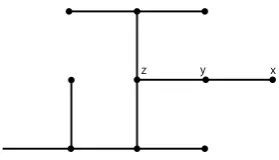
(ii) When the conductance is not bounded from below, we cannot apply our theorem because Assumption 2.3(i) does not hold in general, and we do not know how to obtain the quenched invariance principle without this. Indeed, consider the realization of edge weights shown in Figure 2, where the conductance on{x, y}is 1 and it isO(n ↵) on{y, z}where↵>2. One can easily compute that Ex!⌧BE(x,2)(Y) c1n
↵ n2. Let p
x y
[image:27.595.236.376.68.148.2]z
Figure 2: An example trap structure.
⌦n:= {9xn 2BE(0, n/2) such thatEx!n⌧BE(xn,2)(Y) c3n
↵}. If we have P(0< µ
e x) c4xd/↵
for smallx >0, thenP(⌦n) 1 (1 c4n d)nd 1 e c5 for large n. In particular, lim sup
n⌦n occurs with positive probability. SetXtn:=n 1Yn2t. Then, for!2⌦n, we have
En! 1xn ⌧BE(0,1)\Dn(Xn) =Ex!n ⌧BE(0,n)\D0(Yn2·) Ex!n ⌧BE(xn,2)(Yn2·) c3n↵ 2.
Since ⌦n occurs infinitely often with positive probability, Assumption 2.3(i) does not hold for any choice of >0 (by choosingx0= 0, r= 1).
(iii) There is another natural continuous time Markov chain on C1, namely with transition proba-bilityP(x, y) =µxy/µx and the holding time being the exponential distribution with mean one for each point. (Such a Markov chain is sometimes called a constant speed random walk (CSRW).) It is a time change of the VSRW; the corresponding Dirichlet form is (E, L2(C1;µ)), and the correspond-ing discrete Laplace operator is LCf(x) = µ1xPy(f(y) f(x))µxy. For the whole space case, one can deduce the quenched invariance principle of CSRW from that of VSRW by an ergodic theorem. (See [3, Section 6.2] and [8, Section 5]. Note that the limiting process degenerates if Eµe = 1.) Since our state spaceLfeatures a lack of translation invariance, we cannot use the ergodic theorem. So far, we do not know how to circumvent this issue to prove the quenched invariance principle for general CSRW onL. (However, we do note that for the case of random walk on a supercritical percolation cluster, the CSRW and VSRW behave similarly, and the quenched invariance principle for the CSRW can be proved in a similar way as for the VSRW case. Moreover, the quenched invariance principle for the discrete time simple random walk onC1 follows easily from that for the CSRW.)