warwick.ac.uk/lib-publications
A Thesis Submitted for the Degree of PhD at the University of Warwick
Permanent WRAP URL:
http://wrap.warwick.ac.uk/106761
Copyright and reuse:
This thesis is made available online and is protected by original copyright. Please scroll down to view the document itself.
Please refer to the repository record for this item for information to help you to cite it. Our policy information is available from the repository home page.
Visually Lossless Coding for the HEVC Standard:
Efficient Perceptual Quantisation Contributions for HEVC
by
Lee James Prangnell
MSc, University of Liverpool, 2012A THESIS SUBMITTED IN PARTIAL FULFILMENT OF THE REQUIREMENTS FOR THE DEGREE OF:
Doctor of Philosophy
in
Computer Science
FACULTY OF SCIENCE THE UNIVERSITY OF WARWICK
Acknowledgements
Abbreviations and Acronyms Abstract
Chapter 1. Introduction
1.1. Overview of the HEVC Standard and Quantisation in HEVC
1.1.1. Visually Lossless Coding (Perceptual Quantisation) in HEVC
1.2. Experimental Evaluation Procedure
1.3. PhD Thesis: Contributions to Knowledge and Thesis Outline
1.3.1. TCPQ
1.3.2. CCCPQ and CBPQ
1.3.3. Pixel-PAQ
1.3.4. List of Publications Relevant to the Thesis
Chapter 2. Literature Review
2.1 Related Background Information
2.1.1 The Physics of Visible Light
2.1.2 The Human Visual System
2.1.3 RGB and YCbCr
2.2. Visually Lossless Coding and Review of Related Work
Chapter 3. Transform Coefficient-Level Perceptual Quantisation (TCPQ)
3.1 Related Background
3.2 Proposed TCPQ Technique
3.3 Experimental Evaluations, Results and Discussion
3.4 Summary
Chapter 4. Cross-Colour Channel and CB-Level Perceptual Quantisation
4.1 Related Background
4.1.1 AdaptiveQP in HEVC
4.2 Proposed Cross-Colour Channel Perceptual Quantisation Technique (CCCPQ)
4.2.1 CCCPQ: Experimental Evaluations, Results and Discussion
4.3 Proposed CB-Level Perceptual Quantisation Method for 4:4:4 Data (CBPQ)
4.3.1 CBPQ: Experimental Evaluations, Results and Discussion
Chapter 5. JND-Based Perceptually Adaptive Quantisation (Pixel-PAQ)
5.1 Related Background
5.2 Pixel-PAQ: JND-Based Luma and Chroma Perceptual Quantisation
5.2.1 JND-Based Luminance Perceptual Quantisation
5.2.2 JND-Based Chrominance Perceptual Quantisation
5.3 Experimental Evaluations, Results and Discussion
5.4 Summary
Chapter 6. Conclusions and Future Work
6.1 PhD Thesis: Overview of Contributions to Knowledge
6.1.1 TCPQ (Chapter 3)
6.1.2 CCCPQ and CBPQ (Chapter 4)
6.1.3 Pixel-PAQ (Chapter 5)
6.1.4 Other Contributions to Knowledge
6.1.5 Comparisons of the Proposed Techniques
6.2 Future Research Directions
References
80
81
82
82
85
90
104
105
105
105
106
107
108
108
111
Declaration
This thesis is submitted to the University of Warwick in support of my application for the degree of Doctor of Philosophy. It has been composed solely by myself and has not been submitted in any previous application for any degree. I carried out all of the work including the scientific research, the novel technique development, the design of the experimental evaluations, the data analysis, the written work and the proofreading.
All of the contributions proposed in the thesis are based on several publications; the publications are listed below. Note that the co-authors’ contributions in each paper consisted of providing useful feedback in order to strengthen the publication. I carried out all of the work including the scientific research, the novel technique development, the design of the experimental evaluations, the data analysis, the written work and the proofreading.
L. Prangnell, “Visually Lossless Coding in HEVC: A High Bit Depth and 4:4:4 Capable JND-Based Perceptual Quantisation Technique for HEVC,” Elsevier Signal Processing: Image Communication Journal, vol. 63, pp. 125-140, 2018.
L. Prangnell and V. Sanchez, “JND-Based Perceptual Video Coding for 4:4:4 Screen Content Data in HEVC,” in Proceedings of the 43rd IEEE International Conference on Acoustics, Speech and Signal Processing, Calgary, Alberta, Canada, 2018. In Press.
L. Prangnell, M. Hernández-Cabronero and V. Sanchez, “Coding Block Level Perceptual Video Coding for 4:4:4 Data in HEVC,” in Proceedings of the 24th IEEE International Conference Image Processing, Beijing, China, 2017, pp. 2488-2492.
L. Prangnell, M. Hernández-Cabronero and V. Sanchez, “Cross-Color Channel Perceptually Adaptive Quantization for HEVC,” in Proceedings of the 27th IEEE Data Compression Conference, Snowbird, Utah, USA, 2017, pp. 456.
Acknowledgements
I dedicate this PhD thesis to my beloved mother and father. The unconditional love, the outstanding emotional support and also the wonderful encouragement they have consistently provided during my candidacy have undoubtedly facilitated my academic progression, for which I am — and always will be — eternally grateful.
The research in this thesis was conducted in the SIP Lab within the Multimedia Processing and Computer Vision Laboratory. I received a full PhD scholarship from The Engineering and Physical Sciences Research Council (EPSRC) to fund the PhD research.
I would like to thank all staff in the Department of Computer Science. In particular, I wish to thank my supervisor, Dr. Victor Sanchez, for the excellent supervision, feedback and advice that he has consistently provided during the PhD course. With respect to the annual review procedure and related duties, I am grateful to Prof. Chang-Tsun Li for acting as my PhD advisor. In addition, I wish to show gratitude to Dr. Alexandra Cristea and also Sharon Howard for the all of the help and support that they provided during my PhD registration.
In terms of collaborations, I wish to thank to Dr. Victor Sanchez, Dr. Miguel Hernández-Cabronero and Dr. Rahul Vanam for their valuable feedback as co-authors of my conference publications. In addition, I wish to thank Shevach Riabtsev for the useful feedback that he provided for my journal publication.
Abbreviations and Acronyms
1080p 1920×1080 Pixel Resolution
4K 3840×2160 Pixel Resolution (2160p)
8K 7680×4320 Pixel Resolution (4320p)
AC Alternating Current
AI All Intra
AIP Angular Intra Prediction
AVC Advanced Video Coding Standard (H.264/MPEG-4 Part 10)
AVMP Advanced Motion Vector Prediction
CABAC Context Adaptive Binary Arithmetic Coding
Cb Chroma (Blue Difference)
CBPQ Coding Block Perceptual Quantisation
CCCPQ Cross-Colour Channel Perceptual Quantisation
Cr Chroma (Red Difference)
CRT Cathode Ray Tube
CSF Contrast Sensitivity Function
CB Coding Block
CPU Central Processing Unit
CT Computerised Tomography
CTB Coding Tree Block
CTU Coding Tree Unit
CU Coding Unit
DC Direct Current
DCT Discrete Cosine Transform
DDR5 Double Data Rate (Type Five)
DF Deblocking Filter
DST Discrete Sine Transform
DRAM Dynamic Random Access Memory
eV Electronvolts
FWM Frequency Weighting Matrix
GB Gigabytes
GHz Gigahertz
GOP Group of Pictures
GPU Graphics Processing Unit
HD High Definition
HDR High Dynamic Range
HM JCT-VC HEVC Reference Software
HEVC High Efficiency Video Coding Standard
HVS Human Visual System
IDSQ Intensity Dependent Spatial Quantisation
IEC International Electrotechnical Commission
IEEE Institute of Electrical and Electronics Engineers
ISO International Organization for Standardisation
ITU International Telecommunication Union (United Nations)
J Joules
JCT-VC Joint Collaborative Team on Video Coding
JND Just Noticeable Distortion
JPEG Joint Photographic Experts Group
L, M, S Long, Medium, Short
LCD Liquid Crystal Display
LCU Largest Coding Unit
LED Light Emitting Diode
m/s Metres Per Second
MB Megabytes
MC Motion Compensation
MDIS Mode Dependent Intra Smoothing
ME Motion Estimation
MF Multiplication Factor
MHz Megahertz
MOS Mean Opinion Score
MPEG Moving Picture Experts Group
MSE Mean Squared Error
nm Nanometres
PB Prediction Block
PET Positron Emission Tomography
PhD Doctor of Philosophy Degree
Pixel-PAQ Pixel Perceptually Adaptive Quantisation
PSNR Peak Signal-to-Noise Ratio
PU Prediction Unit
QM Quantisation Matrix
QMs Quantisation Matrices
QP Quantisation Parameter
QT QuadTree
RA Random Access
RDO Rate Distortion Optimisation
RDOQ Rate Distortion Optimised Quantisation
RDT Rate Distortion Theory
RGB Red, Green, Blue (Colour Space)
RSP Reference Sample Padding
SAO Sample Adaptive Offset
SCU Smallest Coding Unit
SDRAM Synchronous DRAM
SF Scaling Factor
SSIM Structural Similarity Index
TB Transform Block
TCPQ Transform Coefficient Perceptual Quantisation
THz Terahertz
TU Transform Unit
TV Television
URQ Uniform Reconstruction Quantisation
VCEG Video Coding Experts Group
VDU Visual Display Unit
WCG Wide Colour Gamut
Y Luma
YCbCr Luma and Chroma Colour Space (Digital)
Abstract
In the context of video compression, visually lossless coding refers to a form of perceptual compression. The objectives are as follows: i) to lossy code a raw video sequence to the lowest possible bitrate; ii) to ensure that the compressed sequence is perceptually identical to the raw video data. Because of the vast bitrate reductions which cannot otherwise be achieved, the research and development of visually lossless coding techniques (e.g., perceptual quantisation methods) is considered to be important in contemporary video compression research, particularly for the High Efficiency Video Coding (HEVC) standard.
The default quantisation techniques in HEVC — namely, Uniform Reconstruction Quantisation (URQ) and Rate Distortion Optimised Quantisation (RDOQ) — are not perceptually optimised. Neither URQ nor RDOQ take into account the Modulation Transfer Function (MTF)-based visual masking properties of the Human Visual System (HVS); e.g., luma and chroma spatial masking. Moreover, URQ and RDOQ do not intrinsically possess the capacity to distinguish luma data from chroma data. Both of these shortcomings can lead to coding inefficiency (i.e., wasting bits by not removing perceptually irrelevant data). Therefore, it is desirable to develop visually lossless coding (perceptual quantisation) techniques for HEVC. For example, by taking chrominance masking into account, perceptual quantisation techniques can be designed to discard — to a very high degree — chroma-based psychovisual redundancies from the chroma channels in raw YCbCr video data. To this end, four novel perceptual quantisation contributions are proposed in this thesis.
In Chapter 4, two novel perceptual quantisation methods are proposed, which are based on HVS visual masking in the spatial domain. The first technique operates at the Coding Unit (CU) level and the second operates at the Coding Block (CB) level. Both techniques exploit the fact that the HVS can tolerate high levels of distortion in high variance (busy) regions of compressed luma and chroma data. The CU-level method adjusts the Quantisation Parameter (QP) of a 2N×2N CU based on cross colour channel variance computations. The CB-level technique separately adjusts the QP of the Y, Cb and Cr CBs in a CU based on separate variance computations in each colour channel.
In Chapter 5, a novel CB-level luma and chroma perceptual quantisation technique — based on a Just Noticeable Distortion (JND) model — is proposed for HEVC. The objective of this technique is to attain visually lossless coding at extremely low bitrates by exploiting HVS-related luminance adaptation and chrominance adaptation. Consequently, this facilitates JND perceptual quantisation based on luminance spatial masking and chrominance spatial masking. The proposed technique applies high levels of perceptual quantisation to luma and chroma data, which is achieved by separately adjusting the Quantisation Step Sizes (QSteps) at the level of the Y CB, the Cb CB and the Cr CB in a CU. To the best of the author’s knowledge, this is the first JND-based perceptual quantisation technique that is compatible with high bit depth YCbCr data irrespective of its chroma sampling ratio.
Chapter 1. Introduction
Raw video data in the YCbCr colour space contains various forms of redundancy in each colour channel including spatial, temporal and psychovisual redundancies [1, 2]. A raw YCbCr sequence typically requires a vast bandwidth capacity. The bitrate of a sequence is dictated by its pixel resolution, its bit depth, its chroma sampling ratio and the number of frames in the sequence. Using the example of a raw 1080p 10-bit YCbCr (4:4:4 full chroma) sequence comprising 150,000 frames (e.g., a two hour sequence), this type of sequence could easily consume many megabits per second, which is impractical. This is the reason why video compression is necessary.
In terms of compressing raw video data while maximally preserving its fidelity in HEVC, this can be achieved by employing mathematically lossless compression (i.e., no compression distortion: a Mean Squared Error (MSE) = 0 and a PSNR = ∞ dB). However, the bitrate reduction attained by mathematically lossless compression is usually very modest. Therefore, lossy coding dominates contemporary video compression research because of the comparatively high bitrate reductions it attains.
Lossy coding algorithms in video compression standards employ Rate Distortion Optimisation (RDO), which is based on Rate Distortion Theory (RDT [3]). In HEVC [4, 5], spatial and temporal redundancies are discarded from raw video data using RDO-based lossy coding algorithms [6]. RDO facilitates an acceptable balance between bitrate reduction and quantisation-induced distortion. However, RDO-based lossy coding techniques do not maximally discard psychovisual redundancies from raw video data, which has given rise to visually lossless coding research.
1.1 Overview of the HEVC Standard and Quantisation in HEVC
The Joint Collaborative Team on Video Coding (JCT-VC) developed and standardised HEVC [4, 5] to supersede the ubiquitous Advanced Video Coding (AVC) standard [7, 8]. The standardisation of HEVC version 1 took place in January 2013; note that HEVC version 5 is the latest version of the standard [4, 5]. In comparison with AVC, the key improvement that HEVC attains is the outstanding coding efficiency improvement that it yields. With its enhanced video coding algorithms, HEVC improves coding efficiency by up to 50% compared with AVC. These vast improvements in coding efficiency facilitate the coding and decoding of high quality bitstreams for utilisation on appreciably high display resolution environments (including Ultra HD 4K and 8K).
In basic terms, the video encoder in HEVC involves the following processes. Firstly, the raw video data is partitioned into blocks. After this, HEVC processes the partitioned data using algorithms known as intra prediction (spatial prediction) and inter prediction (spatiotemporal prediction). Intra prediction errors [9] and inter prediction errors [10, 11] produce luma and chroma (Cb and Cr) residual values. Subsequently, integer approximations of the DCT and the Discrete Sine Transform (DST) convert the prediction residual values into the frequency domain [12, 13], which produces transform coefficients. Quantisation of the transform coefficients then takes place using a combination of URQ and RDOQ. Finally, Context Adaptive Binary Arithmetic Coding (CABAC) — which is a lossless compression algorithm — compresses the quantised transform coefficients.
Figure 2.2: A block diagram, developed by Sullivan et al. [5], of a typical video encoder in the HEVC standard.
The partitioning mechanism in HEVC splits a CTU into four constituent CUs for the prediction decision process. The CU assumes the role of the decision making point in terms of choosing whether to perform either intra prediction only or combined intra prediction and inter prediction. The Largest Coding Unit (LCU) is 64×64 samples in size and the Smallest Coding Unit (SCU) is 8×8 samples in size [14]. The CU, in which the luma and chroma CBs and syntax elements reside, contains all of the prediction information required for the coding process. It is important to note that the size of the chroma Cb and Cr CBs in each CU depends on the chroma sampling ratio in the raw YCbCr video data [15, 14].
Like the PU partitioning structure, the TU block transform structure has its root at the CU level. As stated in [4, 5], a CB-level luma prediction residual block can be identical to a luma TB. Furthermore, the residual block can be further partitioned into smaller TBs depending on the type of residual block, the energy of the residual block and the type of linear transformation that is applied to the residual values (e.g., the integer approximation of DCT). Note that the sizes of the luma and chroma TBs range from 4×4 to 32×32 samples; a larger transform typically equates to improved coding efficiency (at the expense of increased computational complexity) [16].
In HEVC, there is a sophisticated form of intra prediction, which includes angular intra prediction (33 spatial prediction modes for luma and chroma data), mode dependent intra smoothing and reference sample padding [9]. All Intra (AI) coding (i.e., coding using intra prediction only) is seldom utilised in contemporary lossy video compression applications. This is because of the high bitrate costs incurred due to the lack of Group Of Pictures (GOP)-based inter-frame considerations. Therefore, if All Intra coding mode is employed, quantisation-induced compression artifacts are typically vastly more conspicuous in the compressed video data. In lossy video coding, the useful combination of intra prediction and inter prediction is ubiquitous. In this mode, intra coded frames are utilised as key frames, after which bidirectional inter prediction — e.g., using the Random Access (RA) configuration — is utilised for subsequent frames. In HEVC, inter prediction includes motion estimation, motion compensation and advanced motion vector prediction [10, 11]. Motion data coded with GOP-based inter prediction can be signalled using merge mode, motion vector differences, picture reference indices and the direction of the inter prediction [10].
URQ is the default uniform quantisation technique in HEVC [5, 13]; it quantises transformed luma and chroma residual values (i.e., transform coefficients). URQ includes a QStep value — controlled by the QP — that applies equal levels of quantisation to all transform coefficients in luma and chroma TBs irrespective of the frequency sub-band of a coefficient. Therefore, this means that URQ is not perceptually optimised, thus leaving room for improvement. The QStep in URQ increases uniformly by approximately 12% for each value increment of the QP [17]. Note that there is a binary logarithmic relationship between the QP and the QStep.
The luma and chroma QSteps, denoted as QStepY, QStepCb and QStepCr, are defined in
(1.1) to (1.3), respectively:
2 6 4Y QP
Y Y
QStep QP
(1.1)
2 6 4Cb QP
Cb Cb
QStep QP
(1.2)
2 6 4Cr QP
Cr Cr
QStep QP
(1.3)
where QPY, QPCb and QPCr correspond to the integer luma and chroma QP values,
respectively; they are defined in (1.4) to (1.6), respectively.
6 log2
4Y Y Y
QP QStep QStep (1.4)
6 log2
4Cb Cb Cb
QP QStep QStep (1.5)
6 log2
4Cr Cr Cr
QP QStep QStep (1.6)
To reiterate, after quantisation, CABAC losslessly compresses the quantised transform coefficients; this is the point at which the actual data compression takes place in HEVC. Assuming that high levels of quantisation have been applied to coefficients during the coding process (i.e., a high QP value has been applied), this gives rise to a decrease in non-zero quantised coefficients. CABAC can then efficiently quantise the zeroed out coefficients, thus resulting in a compressed bitstream with fewer bits.
1.1.1 Visually Lossless Coding (Perceptual Quantisation) for HEVC
In HEVC, the DCT and DST basis functions correspond to the Modulation Transfer Function (MTF) characteristics of the HVS [12, 13]; the MTF is derived from the Contrast Sensitivity Function (CSF). Focusing on the DCT, it prioritises the preservation of low frequency data. This is because the HVS is vastly more sensitive to gradations in the low frequencies of compressed video and image data (e.g., quantisation-induced compressed artifacts). The DCT linear transformation compacts the prediction residual energy into the DC coefficient and the very low frequency AC coefficients. In terms of scalar quantisation in HEVC, it is desirable to quantise perceptually insignificant AC coefficients more aggressively to maximise bitrate reductions. URQ does not take into account the perceptual relevance of individual transform coefficients at different frequency sub-bands. Therefore, URQ does not take advantage of the MTF characteristics of the HVS, which leaves significant room for improvement. In this context, the visually lossless coding (perceptual quantisation) technique proposed in Chapter 3 [21] significantly improves upon URQ.
1.2 Experimental Evaluation Procedure
Before providing an overview of the proposed four perceptual quantisation contributions, we firstly provide detailed expositions of the experimental setup. An exhaustive evaluation procedure is utilised on all four techniques proposed in this thesis (i.e., the novel techniques proposed in Chapter 3, Chapter 4 and Chapter 5). The objective visual quality evaluations correspond, as closely as possible, to the Common Test Conditions and Software Reference Configurations recommended by JCT-VC [26, 27]. The experimental setup utilised in this thesis includes testing the proposed techniques with five initial QP data points (i.e., QPs 17, 22, 27, 32 and 37) and the All Intra (AI) and Random Access (RA) encoding configurations [26, 27].
In the objective visual quality evaluations, we employ the Structural Similarity Index (SSIM) [28] and the PNSR visual quality metrics to assess the reconstruction quality of the compressed video frames; i.e., in the sequences coded by the proposed techniques and the reference techniques (anchors). The SSIM and PSNR values presented in each contribution chapter correspond to objective spatial reconstruction analyses of the intra-frames (in the AI tests) and also the inter-frames — in addition to the intra key frames — (in the RA tests), per sequence. In other words, the mean SSIM and PSNR values are computed by comparing the coded frames, using initial QPs 17, 22, 27, 32 and 37, with the frames in the raw data; this is carried out in bitmap image form for each sequence and each QP.
Figure 1.1: JCT-VC BirdsInCage 4:4:4 Raw Data (HD 1080p) for HEVC Evaluations
Figure 1.2: JCT-VC DuckAndLegs 4:4:4 Raw Data (HD 1080p) for HEVC Evaluations
Figure 1.4: JCT-VC OldTownCross 4:4:4 Raw Data (HD 1080p) for HEVC Evaluations
Figure 1.5: JCT-VC ParkScene 4:4:4 Raw Data (HD 1080p) for HEVC Evaluations
Table 1.1. The criteria for quantifying the MOS with respect to the visual reconstruction quality of a compressed video sequence (compared with the raw video data).
Because all of the proposed techniques are optimised for perceptual compression, it is of significant importance to undertake exhaustive subjective visual quality evaluations (in addition to the aforementioned objective visual quality evaluations). Therefore, we employ a United Nations’ ITU-T standardised subjective evaluation procedure [31]. The subjective visual quality evaluations are the most important set of experiments in terms of measuring the visually quality of perceptually compressed video sequences (especially so for extremely low bitrate visually lossless coding techniques).
The computer hardware utilised in the experimental setup consists of a desktop PC that contains an Intel Core i7-4770 CPU — 4 cores and 8 threads — running at 3.4 GHz per core. The volatile memory in the PC is as follows: 24 GB of Double Data Rate type 3 (DDR3) Synchronous Dynamic Random Access Memory (SDRAM) running at a frequency of 680 MHz. The GPU installed in the PC is an NVIDIA GeForce 750 Ti with a core clock speed of 1020 MHz, 2 GB of DDR5 SDRAM and a memory bandwidth of 86.4 GHz/s. It is an Ultra HD 4K and High Dynamic Range (HDR)-capable GPU that can support YCbCr 4:4:4 and RGB data of bit depths up to 12-bits per sample per channel (i.e., 36-bits per sample). The subjective evaluations are conducted on the following TV/Visual Display Unit (VDU): HD 1080p 32 inch Samsung F5500 LED Smart TV. On the aforementioned hardware used in the experimental setup, note that, due to the higher dynamic ranges and the increased levels of chroma saturation in the raw YCbCr 4:4:4 and 4:2:2 10-bit sequences, the superior visual quality of this data is perceptually discernible in comparison with the chroma subsampled raw 4:2:0 8-bit sequences.
MOS Visual Quality Difference
5 Imperceptible (Visually Lossless)
4 Very Slightly Perceptible
3 Moderately Perceptible
2 Significantly Perceptible
Figure 1.7: A diagram that illustrates the viewing conditions of the subjective evaluations. This includes the screen size of the TV/VDU, the viewing distance of the participant from the TV/VDU and the illuminance.
The main objectives of the subjective evaluations are as follows: i) to establish if the proposed techniques achieve visually lossless coding — compared with the raw video data — at low bitrates; ii) to ascertain if the proposed techniques outperform or match the performance of the references techniques (anchors) in terms of visual quality. To reiterate, we follow, as closely as possible, the directions of the internationally
standardised United Nations’ ITU subjective evaluations entitled: Subjective Video
Quality Assessment Methods (ITU-R Rec. P.910 [31]). In ITU-R Rec. P.910, the following conditions are recommended: Number of Participants ≥ 4 and ≤ 40;
Viewing Distance: 1-8 × H, where H is the height of the TV/VDU; Compute Mean
Opinion Score (MOS) — see Table 1.1; Spatiotemporal Analysis.
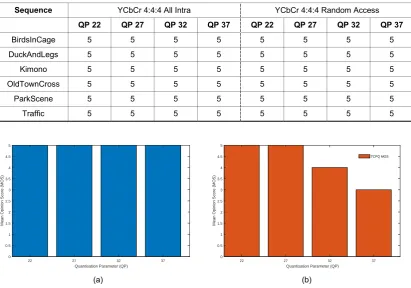
In accordance with the recommended conditions specified in the ITU-R Rec. P.910 subjective evaluation procedures, four individuals participated in an exhaustive assessment (AI and RA tests at QP 22, 27, 32 and 37). Note that two additional individuals participated in preliminary subjective evaluations (AI and RA tests at QPs 17 and 22 only). The viewing distance of the participants from the TV/VDU is 1.5m in all evaluations (1.5m ≈ 59.1 inch). The height H of the TV/VDU is 15.7 inch and the viewing distance is approximately 4 × H (see Figure 1.7).
Screen Size = 32 Inch
Viewing Distance = 59.1 Inch
[image:23.595.127.459.84.288.2]Concerning the two additional subjective evaluations, the objective is to ascertain if the proposed techniques achieve visually lossless coding (MOS = 5) in the AI and RA tests at QPs 17 and 22 only. To this end, the participants confirmed that an MOS = 5 was recorded in these additional subjective evaluations.
1.3 PhD Thesis: Contributions to Knowledge and Thesis Outline
There exists a research gap in the literature for novel visually lossless coding algorithms, particularly for application in HEVC and for utilisation on high bit depth and HD YCbCr 4:4:4 data. The techniques proposed in this thesis constitute novel approaches as regards the perceptual compression of HD YCbCr 4:4:4, 4:2:2 and 4:2:0 raw video data of various bit depths. In addition to this, the combined objective and subjective evaluations may also be considered a contribution to knowledge. For instance, perceptual quantisation techniques have not been evaluated on different chroma sampling versions and different bit depth versions of the same sequence (e.g., the YCbCr 4:4:4 10-bit version and the YCbCr 4:2:0 8-bit version of DuckAndLegs).
1.3.1 TCPQ (Chapter 3)
1.3.2 CCCPQ and CBPQ (Chapter 4)
Psychophysical experiments reveal that the HVS is not significantly sensitive to distortions in high variance (busy) regions of picture data, such as quantisation induced noise [37, 38]; this is known as (HVS-related) spatial masking. Therefore, in accordance with this spatial masking component of the HVS, we exploit this phenomenon in the novel techniques proposed in Chapter 4. To this end, two perceptual quantisation techniques are proposed for HEVC at the CU level and at the CB level. Cross-Colour Channel Perceptual Quantisation (CCCPQ) [22] and Coding Block-level Perceptual Quantisation (CBPQ) [23], respectively, are the names of these techniques. CCCPQ and CBPQ improve upon on the luma-only perceptual quantisation technique in HEVC, named AdaptiveQP [39]-[41]. That is, we extend AdaptiveQP to facilitate the perceptual quantisation of data in the chroma channels.
CCCPQ perceptually adjusts the QP at the CU level by computing the spatial variances across the Y CB, the Cb CB and the Cr CB. Therefore, this mechanism equates to cross-colour channel dependency for QP selection at the CU level. With CCCPQ, the CU-level QP is perceptually increased if high spatial variance is detected (across all colour components in a CU). In other words, the QP is adjusted at the CU level and, therefore, the corresponding QP is applied to all three CBs in the CU (i.e., one QP per CU is signalled to the decoder).
1.3.3 Pixel-PAQ (Chapter 5)
Inspired by the research gap within the area of JND-based visually lossless coding in HEVC, we propose a high bit depth capable, JND-based perceptual quantisation technique (for both luma and chroma data) in Chapter 5; the technique is named Pixel Perceptually Adaptive Quantisation (Pixel-PAQ). The proposed technique improves upon a luma-only JND-based perceptual quantisation method developed for HEVC by Naccari and Mrak; Intensity Dependent Spatial Quantisation (IDSQ) is the name of this technique [42].
Pixel-PAQ exploits JND-based luminance adaptation and chrominance adaptation, the objective of which is to accomplish visually lossless coding at extremely low bitrates. Based on a novel JND model, Pixel-PAQ achieves its objective by perceptually increasing the Y QStep, the Cb QStep and the Cr QStep at the CB level. This is accomplished by employing parabolic piecewise functions to facilitate luminance masking and chrominance masking (these functions are utilised to perceptually adjust the aforementioned CB-level QSteps). The luminance adaptation and chrominance adaptation psychophysical experiments conducted by X. H. Zhang et al. [43] and G. Wang et al. [44], respectively, form the basis of the proposed piecewise functions.
In addition, Pixel-PAQ accounts for the bit depth of the raw YCbCr video data, which constitutes a novel extension to Naccari’s and Mrak’s IDSQ technique in [42] (i.e., IDSQ accounts for 8-bit luma data only). Pixel-PAQ is compatible with raw YCbCr video data of any bit depth. This is significant because YCbCr 4:4:4 video data, for example, usually contains higher bit depth samples — i.e., 10-bits per sample per channel — in comparison with chroma subsampled 4:2:0 video data. Furthermore, as is the case with the proposed CBPQ technique in Chapter 4, the CU-level chroma QP offset and signalling mechanism is also exploited by Pixel-PAQ.
1.3.4 List of Publications Relevant to the Thesis
L. Prangnell, “Visually Lossless Coding in HEVC: A High Bit Depth and 4:4:4
Capable JND-Based Perceptual Quantisation Technique for HEVC,” Elsevier Signal
Processing: Image Communication Journal, vol. 63, pp. 125-140, 2018. (Chapter 5).
L. Prangnell and V. Sanchez, “JND-Based Perceptual Video Coding for 4:4:4 Screen Content Data in HEVC,” in Proceedings of the 43rd IEEE International Conference on Acoustics, Speech and Signal Processing, Calgary, Alberta, Canada, 2018. In Press. (Chapter 5).
L. Prangnell, M. Hernández-Cabronero and V. Sanchez, “Coding Block Level Perceptual Video Coding for 4:4:4 Data in HEVC,” in Proceedings of the 24th IEEE International Conference Image Processing, Beijing, China, 2017, pp. 2488-2492. (Chapter 4).
L. Prangnell, M. Hernández-Cabronero and V. Sanchez, “Cross-Color Channel
Perceptually Adaptive Quantization for HEVC,” in Proceedings of the 27th IEEE
Data Compression Conference, Snowbird, Utah, USA, 2017, pp. 456. (Chapter 4).
Chapter 2. Literature Review
2.1 Related Background Information
2.1.1 The Physics of Visible Light
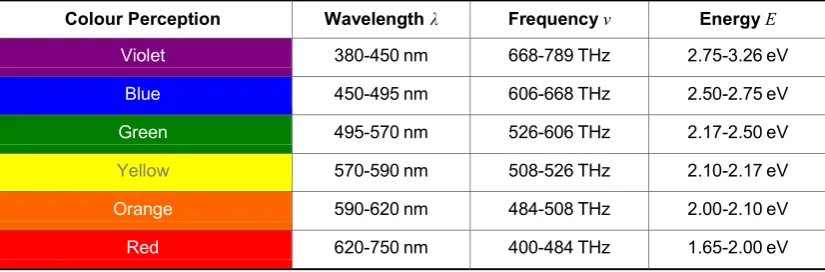
Every form of electromagnetic radiation in the electromagnetic spectrum, including visible light, microwaves and gamma rays, is a different manifestation of light; the photon is the fundamental particle of light. As is the case with all elementary particles, the photon behaves simultaneously as both a particle and a wave; (i.e, the wave-particle duality phenomenon in nature, as discovered in the field of quantum mechanics [45]). Visible light is a small range of light in the electromagnetic spectrum that is visible to human observers by virtue of the HVS. The established photon wavelength range in the visible light spectrum is approximately 380 to 750 nm, which equates to a frequency range of 668 to 484 THz, respectively [45]. Note that the photon energy of visible light ranges from 2 to 2.75 eV [45]; therefore, the energy of a photon is inversely proportional to its wavelength.
Colour vision in humans equates to the combined visual perception of the different luminance levels and photon energies emitted from either natural or synthetic visible light sources. Every aspect of colour that humans visually perceive is ultimately contingent upon the natural processes of visible light and the subsequent biological processing of such. In other words, colour is the subjective interpretation of electromagnetic radiation in the spectrum of visible light [46]-[48].
As previously mentioned, the photon acts as both a wave and a particle. Photon energy E is measured in either J or eV [25]; E is quantified in (2.1):
h c E
Table 2.1: The wavelength, frequency and energy of photons in the visible light range of the electromagnetic spectrum. This range of photon energies (and the corresponding wavelengths) manifests perceptually as a range of colours in the visual systems of humans, African monkeys, apes and chimpanzees.
where h and c are physical constants. Planck’s constant h = 6.626×10⁻¹⁸ J seconds, which computes the quantum of action. Constant c = 3×10⁸ m/s and approximates the speed of light in a vacuum. Lambda λ refers to the wavelength of a photon in nm. Note that 1 J = 6.242×10¹⁸ eV.
Utilising the formula in (2.1), we can quantify the photon energy of electromagnetic radiation — visible light range — that humans perceive as red (red light), denoted as
Ered, in (2.2).
34
8
19
red 9
6 10 J s 3 10 m/s
2.8 10 J 1.8eV 700 10 m
E
(2.2)
As shown in (2.2), assuming the wavelength of 700 nm, the photon energy of red light is approximately 1.8 eV (see Table 2.1). The number of photons N emitted per second by a visible light source is contingent upon the energy of the visible light source P, measured in J, and also the energy of the photon [49, 45], which is given by (2.3).
P N
E
(2.3)
Colour Perception Wavelength λ Frequency ν Energy E
Violet 380-450 nm 668-789 THz 2.75-3.26 eV
Blue 450-495 nm 606-668 THz 2.50-2.75 eV
Green 495-570 nm 526-606 THz 2.17-2.50 eV
Yellow 570-590 nm 508-526 THz 2.10-2.17 eV
Orange 590-620 nm 484-508 THz 2.00-2.10 eV
[image:29.595.93.506.130.266.2]2.1.2 The Human Visual System
From the perspective of the Darwinian paradigm of evolutionary biology, the HVS is the product of billions of years of evolution by natural selection [50]. The interaction of photons with the retinal photoreceptor systems facilitates colour vision, wherby the photons are biologically converted into electrical signals in the retina [51, 52]. Visual perception of colour depends on the level of excitation of the different cones. Furthermore, in general terms, the visual cortex system in the brain is responsible for differentiating the signal response received from the Long, Medium and Short (L, M, S) cones. This facilitates the discernment of a vast range of signals that are perceived in the form of a wide range of colours.
With a focused concentration on retinal photoreceptors, as shared by all species in the taxonomic order of primate (including humans), rods and cones constitute the key photoreceptors. The retinal photoreceptor system is dominated by rods (120,000,000 units) compared with cones (6,400,000 units). Rods are specialised for low visible light conditions [51, 52]. When subjected to higher intensities of visible light the transmitter release stops because the rod’s response to the visible light is much slower than the cone’s response. Cones are the retinal photoreceptors that facilitate colour vision and colour perception. They are able to adapt to a vast variety of visible light intensities [51, 52].
2.1.3 RGB and YCbCr
The Young-Helmholtz theory of trichromatic colour vision is the scientific basis for the RGB colour space. The RGB colour model is an additive tristimulus colour model that is ubiquitous in computer science applications and consumer electronics devices. It amalgamates colour from the following primary colours: red, green and blue, which results in a range of colours depending on the corresponding sample intensity, colour gamut and the associated bit depth. In terms of the physical (hardware) pixels built TVs and monitors, each pixel in these devices contain visible light sources. Therefore, the physics of visible light and the biology of colour vision always apply.
The interaction of the HVS with luminance and photon energy, emitted from the VDU or TV (light source), is the physical process by which visible light and the associated luminance is visually perceived as brightness and colourfulness. RGB-based colour values can be represented by normalised arithmetic, percentage or base-10 integer representations of binary numbers. Expressed as a triplet, the binary representations of R, G and B data are dependent on the bit depth of each channel. There are 2b sample intensities in each colour channel, where b denotes the bit depth of the data.
For a bit depth of 8-bits per sample per channel (i.e., 24-bits per sample), the integer
value ranges are as follows: R ∈ [0,255], G ∈ [0,255] and B ∈ [0,255]. In this
example, R=0, G=0 and B=0 represents absolute black (low energy). Conversely,
R=255, G=255 and B=255 represents absolute white (high energy). For image or video data with higher bit depths (e.g., 48-bits per sample), this equates to a greater number of colours in each sample. For 48-bit image or video data, the value ranges are as follows: R∈ [0,65535], G ∈ [0,65535] and B ∈ [0,65535], where R=65535,
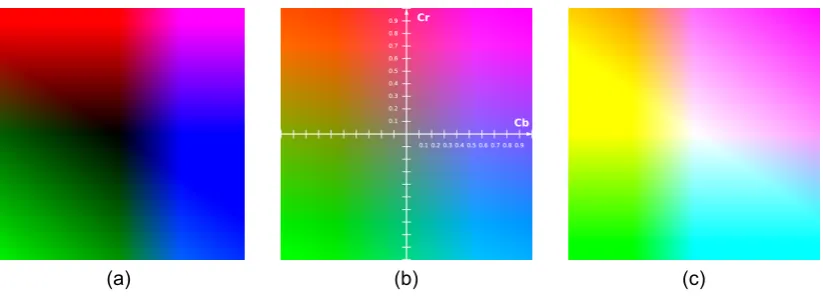
Figure 2.1: The chrominance Cb' and Cr' colour planes using the RGB colour gamut range; in these examples, the Cb' and Cr' planes are in the range [−1,1] for a normalised Y' value (i.e., Y' ∈ [0,1]). Subfigure (a) shows the Cb and Cr colour planes when Y' = 0; subfigure (b) shows the Cb and Cr colour planes when Y' = 0.5; subfigure (c) shows the Cb and Cr colour planes when Y' = 1.
In YCbCr, luma (Y) refers to an achromatic colour channel that is derived via an approximation of gamma-corrected luminance. The human perception of the brightness of colour in the luma channel is conceptualised as relative luminance, in which the values are normalised to 1 or 100. On a percentage scale, 0% represents absolute black and 100% represents absolute white; moreover, the luma channel contains the vast majority of the finer detail in an image. Chrominance (Cb and Cr) refers to the difference colour channels, which are as follows: blue difference (Cb) and red difference (Cr) with reference to the luma (Y) channel; Cb and Cr collectively correspond to the saturation of the colour in an image (see Figure 2.1).
In a mathematical sense, Y, in YCbCr, which is referred to as luma, corresponds to the weighted sum of RGB values (not gamma corrected). The gamma corrected version is denoted as Y'. Concentrating on the gamma corrected version, Y', from ITU-R BT.709 [53], is computed in (2.4).
Y' = (0.2627·R') + (0.6780·G') + (0.0593·B') (2.4)
The parameter values applied to the gamma corrected RGB data (R', G' and B') are weights determined by a luminosity function. It has been shown, in empirical testing, that humans are perceptually more sensitive to green in terms of brightness perception, in which case G' is assigned the largest weight. Conversely, B' is assigned the lowest weight.
Cb' and Cr' are colour difference channels with reference to the Y' colour channel; the perceived hue and saturation in the Cb' and Cr' is dependent on the value of the Y'
channel (see Figure 2.1). The gamma corrected versions of Cb and Cr, from ITU-R BT.709 [53], are computed in (2.5) and (2.6), respectively.
1.8814
B Y
Cb (2.5)
1.4746
R Y
Cr (2.6)
Note that YCbCr 4:4:4, 4:2:2 and 4:2:0 refer to the sampling (resolution) ratios of the chrominance data with respect to the resolution of the luma data. In 4:4:4 data, the Cb and Cr data is the same resolution as the Y data (i.e., no chroma subsampling). The YCbCr 4:2:2 and 4:2:0 versions use spatial chroma subsampling, which is a form of compression. In 4:2:2 data, the Cb and Cr data is half the resolution of the Y data, and in 4:2:0 data, the Cb and Cr data is quarter the resolution of the Y data.
2.2 Visually Lossless Coding and Review of Related Work
In early video coding research, scientists discovered that spatially subsampling the analogue chrominance components (U and V) in YUV analogue video data is usually not noticeable to the HVS [58] (note that this was discovered on obsolete CRT-based visual display technologies). This gave rise to YUV 4:2:0 (analogue) and also YCbCr 4:2:0 (digital) chroma subsampling. Concentrating on the coding of raw digital data, this means that YCbCr 4:2:0 data, for example, has already been compressed prior to being further compressed by a video coding platform such as HEVC and/or AVC. It is important to note that, although the aforementioned coding techniques, including GOP-based inter prediction, transform coding and scalar quantisation are designed to reduce certain redundancies in raw video data, these techniques can be perceptually optimised in order to maximally reduce perceptual redundancies in the compressed video data. It is important to affirm the fact that subsampling compression artifacts in 4:2:0 data are typically conspicuous on contemporary 4:4:4 and HDR capable TVs and VDUs. This is the reason why 4:4:4 data is becoming increasingly popular.
Focusing on scalar quantisation in HEVC, recall that the default quantisation technique in HEVC is URQ [5, 13, 17]. Because URQ equally quantises entire TBs of luma and chroma transform coefficients, it does not intrinsically possess the capacity to consider the perceptual importance of individual coefficients in a TB. This has engendered the emergence of coefficient-level quantisation methods including RDOQ [35, 36] and perceptual quantisation schemes based on a JND model.
Studies have shown that a compressed video with a PSNR measure of 40 Decibels (dB), or above, typically constitutes visually lossless coding. That is, a coded video with a PSNR ≥ 40 dB is perceptually indistinguishable from the raw video data. Moreover, using the example of PSNR ≥ 40 dB for visually lossless coding, this also implies that targeting a reconstruction quality of PSNR > 40 dB (i.e., PSNR = 50 dB) is superfluous. That is, unnecessary bits are wasted by achieving the superior mathematical reconstruction quality required for the PSNR = 50 dB measurement. This is the main reason why subjective evaluations are extremely important.
In addition to the primary objective of improving coding efficiency, most lossy video coding algorithms employed in HEVC HM are developed with an emphasis on increasing the PSNR values in the compressed video data. These algorithms include RDO [60, 61], RDOQ [35, 36], Deblocking Filter (DF) [62] and Sample Adaptive Offset (SAO) [63]. RDO, RDOQ, DF and SAO are effective methods in terms of increasing PSNR values for the reconstructed video. However, the reconstruction quality improvement attained by these techniques, as quantified by PSNR, is usually negligible in terms of how the human observer interprets the perceived quality of the compressed video data.
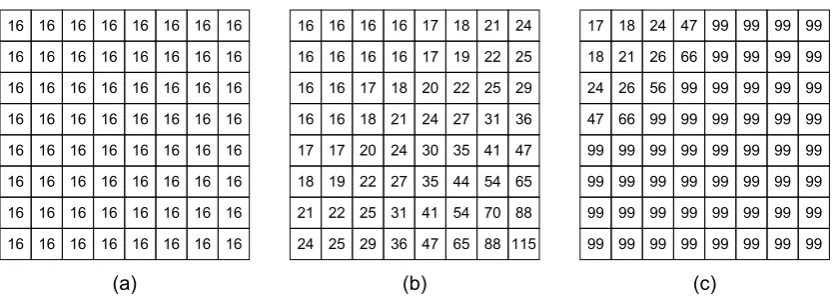
Figure 2.3: QMs utilised in the JPEG standard. Subfigures (a), (b) and (c) show a flat QM, the luma QM and the chrominance QMs, respectively.
The built-in visual distortion masking properties are exploited in visually lossless coding techniques; this includes the aforementioned spatiotemporal visual masking phenomenon [1, 64]. By default, video coding standards, including HEVC, already employ redundancy reduction methods including spatiotemporal prediction, transform coding and scalar quantisation; however, these techniques are not perceptually optimised by default. Visually lossless coding methods are coveted because, by definition, they often dramatically reduce the number of bits required to store a sample (e.g., a 10-bit sample in the luma channel of a YCbCr raw data file).
A primitive example of visually lossless coding at the transform coefficient-level is the QM (see Figure 2.3). In the Joint Photographic Experts Group (JPEG) still image coding standard [65], QMs are employed based on a CSF-based psychovisual model. As previously mentioned, the DCT basis functions operate according to the MTF characteristics of the HVS. After decorrelating an image into the frequency domain, the DC transform coefficient and the low frequency AC transform coefficients contain almost all of the important detail of the image; therefore, the very high frequency AC coefficients in luminance data can be discarded (zeroed out). Therefore, the default QMs for the JPEG standard are designed on this principle. In addition to this, the HVS is much less sensitive to compression artifacts in chrominance data. Therefore, the luminance QM differs considerably from the chrominance QM. The luminance QM discards the very high frequency coefficients. Conversely, the chrominance QM discards the medium frequency and all high frequency AC coefficients (see Figure 2.3). This is because it is significantly more difficult for the HVS to detect quantisation-induced compression artifacts in compressed chrominance data.
16 16 16 16 16 16 16 16 16 16 16 16 16 16 16 16 16 16 16 16 16 16 16 16 16 16 16 16 16 16 16 16 16 16 16 16 16 16 16 16 16 16 16 16 16 16 16 16 16 16 16 16 16 16 16 16 16 16 16 16 16 16 16 16 16 16 16 16 17 18 21 24 16 16 16 16 17 19 22 25 16 16 17 18 20 22 25 29 16 16 18 21 24 27 31 36 17 17 20 24 30 35 41 47 18 19 22 27 35 44 54 65 21 22 25 31 41 54 70 88 24 25 29 36 47 65 88 115 17 18 24 47 99 99 99 99 18 21 26 66 99 99 99 99 24 26 56 99 99 99 99 99 47 66 99 99 99 99 99 99 99 99 99 99 99 99 99 99 99 99 99 99 99 99 99 99 99 99 99 99 99 99 99 99 99 99 99 99 99 99 99 99
Wang et al. in [33] developed a HVS-based QM for the JPEG standard; this approach is based on Daly’s 2D spatial CSF method [66]. In [33], the authors propose a CSF based QM technique in which Frequency Weighting Matrices (FWMs) are derived. After scaling the FWM values to integer values, the integer QM values are derived. The QM technique by Wang et al. in [33] is employed as the default QM technique in the HEVC standard [34]. A significant issue with this, however, is that this QM method is applied to both luma and chroma coefficients during the frequency dependent scaling process in HEVC, which is not appropriate. Similarly, in [67], Naccari and Pereira propose a CSF-based QM technique for the AVC standard. In this work, the luminance JND visibility threshold is applied to both luma and chroma data. This is based on the assumption that the luminance and chrominance spatial CSFs exhibit similar properties; it is well established, however, that the HVS is vastly more sensitive to luminance (achromatic) contrast.
Numerous psychophysical experiments have revealed that the HVS is less sensitive to quantisation-related distortions within regions of image data that comprise high spatial variations [68, 37, 1]; this constitutes a form of visual masking in the spatial domain. Therefore, in comparison with standard uniform quantisers including URQ, perceptual quantisers of this nature can be designed to exploit the aforementioned spatial domain visual masking phenomenon of the HVS. In the context of video coding and perceptual quantisation, this means that higher levels of quantisation can be applied to high spatial activity regions in the frames of a sequence, thus potentially giving rise to bitrate reductions.
In HEVC, AdaptiveQP [39]-[41] is an example of a HVS-based perceptual quantisation method which can exploit the spatial masking phenomenon of the HVS. A notable shortcoming of AdaptiveQP, however, is that it adjusts the QP of an entire 2N×2N CU based solely on the sample variance in the constituent luma CB. If, for example, AdaptiveQP is employed to decrease overall bitrates by increasing the CU level QP (based only on the sample variance in a luma CB), an inappropriate QP adjustment may be applied to the chroma Cb and Cr CBs; this is particularly pertinent to high bit depth 4:4:4 video data. The chroma Cb and Cr channels in, for example, 10-bit 4:4:4 video sequences may contain higher sample variances compared with the sample variances in the luma channel. This is by virtue of the nature of 10-bit 4:4:4 video data; i.e., 30-bits per sample in addition to an absence of chroma subsampling.
Mannos’ and Sakrison’s pioneering work in [69] formed a useful foundation for all frequency domain luminance CSF-based JND techniques which target HVS-based redundancies in luminance image data. In [70], Ahuma and Peterson devise the first DCT-based JND technique, in which a luminance spatial CSF is incorporated. In [71], Watson expands on Ahuma’s and Peterson’s work by incorporating luminance masking and contrast masking into the DCT-based method; note that power functions corresponding to Weber’s law are utilised in this method.
Chou and Chen propose a pioneering spatial domain JND profile in [72], in which luminance masking and contrast masking functions are proposed for utilisation in the spatial domain (luma samples of 8-bit precision). This method is based on average background luminance and luminance adaptation. The authors further expand on this method in [73] by adding a temporal masking component, in which inter-frame luminance is exploited. X. Yang et al. in [74] propose a spatiotemporal domain JND contribution to eradicate the overlapping effect between luminance masking and contrast masking effects. This technique also includes a filter for motion-compensated residuals, in which they employ a modified version of Chou’s and Chen’s spatiotemporal domain JND methods.
More recently (i.e., from 2013 onwards), several JND-based perceptual coding techniques have been proposed, mainly for the HEVC standard. In [42], Naccari and Mrak propose a luminance JND-based perceptual quantisation method for HEVC. It is designed to exploit luminance adaptation-related intensity masking and is based on the research conducted by X. H. Zhang et al. in [43]. Y. Zhang et al. in [78] expand on Naccari’s and Mrak’s JND technique in [42] by adopting it for HDR-related tone mapping applications in HEVC.
Kim et al. in [79] propose a hybrid frequency domain and spatiotemporal domain JND technique for HEVC. This method combines the following visual masking properties to create a JND visibility threshold: spatial CSF, luminance masking, luminance temporal masking and contrast masking. Note that the spatial domain aspect of the technique is utilised for transform skip mode in HEVC. In [80], Bae et al. propose a JND-based perceptual video coding scheme for HEVC, in which the JND visibility threshold adapts to the size of the transform. In addition, the frequency sub-band of luma transform coefficients is taken into account. As with previously proposed JND techniques, the JND profile in this method is based on luminance spatial CSF, luminance masking and contrast masking.
Wu et al. in [81] propose a luminance-based JND model for images with pattern complexity. This technique exploits the fact that the HVS is less sensitive to compression artifacts in high variance regions of luminance data; therefore, these regions can be compressed to a much higher degree than low variance regions. This method is based primarily on luminance contrast and pattern masking.
As is evident in the vast majority of the previously proposed perceptual coding techniques reviewed in this section, the JND of chrominance data is typically neglected; it is important to note, however, that the method proposed by G. Wang et al., in [44], does account for the chrominance data. Moreover, many of these methods share one or more of the same features, which are as follows: luminance-based spatial masking, luminance-based contrast masking, luminance-based temporal masking and luminance-based spatial CSF. In many of the JND techniques reviewed in this section, the JND visibility threshold for chrominance data is treated as identical to the JND visibility threshold for luminance data. This is a significant shortcoming of the previously proposed techniques because chrominance data is demonstrably different from luminance data. Chrominance data can be compressed to a significantly higher degree than luminance data; therefore, this fact should be exploited in visually lossless coding techniques.
Chapter 3. Transform Coefficient-Level Perceptual Quantisation
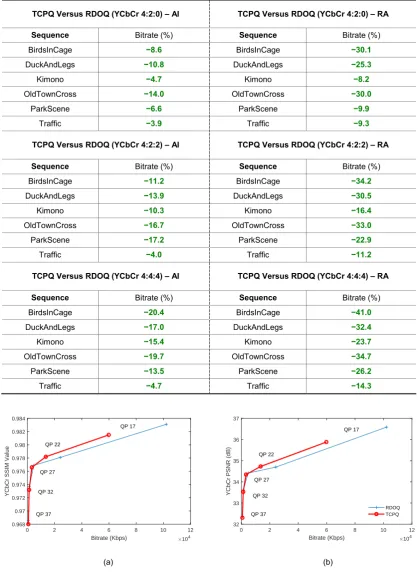
In this chapter, a transform coefficient-level perceptual quantisation technique is proposed (named TCPQ [21]). TCPQ individually quantises transform coefficients according to a Euclidean distance parameter. It quantises coefficients based on the distance of the individual AC coefficient from the DC coefficient in luma and chroma TBs. TCPQ is thus designed to quantise high frequency AC transform coefficients to a much greater level than the DC coefficient and the low frequency AC coefficients. Moreover, the proposed method is compatible with raw video data of any bit depth and any chroma sampling ratio. TCPQ facilitates a reduction of non-zero quantised coefficients; therefore, the corresponding data can be compressed more efficiently during the entropy coding process with CABAC [20]. The objective and subjective evaluations reveal that TCPQ achieves important bitrate reductions and visually lossless coding.
The rest of the chapter is organised as follows. Section 3.1 includes background information relevant to the proposed method. In section 3.2, the proposed technique is presented. In section 3.3, thorough subjective and objective experimental evaluation results are presented and discussed. Finally, section 3.4 concludes this chapter.
3.1 Related Background
To reiterate, it is well known that the DC coefficient and the low frequency AC transform coefficients are more important than the high frequency AC coefficients (in terms of reconstructing the compressed video signal). Because each coefficient frequency sub-band in a TB constitutes a different level of perceptual importance in a compressed video signal [83], the distance of AC coefficients from the DC coefficient can be quantified in terms of Euclidean distance. That is, the DC coefficient is the starting point and the distance of each AC coefficient from the DC coefficient represents the perceptual importance of the current AC coefficient.
Recall that the URQ technique [5, 13, 17] is the compulsory uniform quantisation method in HEVC. Assuming that chroma QP offsets are not employed in HEVC, the QStep computation for luma data is identical to the QStep computations applied to chroma Cb and Cr data. As such, the luma and chroma QSteps in HEVC, denoted as
QStepY, QStepCb and QStepCr are defined in (3.1) to (3.3), respectively:
2 6 4Y QP
Y Y
QStep QP
(3.1)
2 6 4Cb QP
Cb Cb
QStep QP
(3.2)
2 6 4Cr QP
Cr Cr
QStep QP
(3.3)
where QPY, QPCb and QPCr correspond to the integer luma and chroma Cb and Cr QP
values, respectively; they are defined in (3.4) to (3.6), respectively.
6 log2
4Y Y Y
QP QStep QStep (3.4)
6 log2
4Cb Cb Cb
QP QStep QStep (3.5)
6 log2
4Cr Cr Cr
Table 3.1: The first six values of QP, QStep, m and s.
In terms of the quantisation of luma and chroma transform coefficients in HEVC and the association of the QP and QStep with the Multiplication Factor (MF) and the Scaling Factor (SF), the quantised transform coefficient within an N×N TB, denoted as t, is computed in (3.7):
2
21 log
6 2
QP N
C m o t
(3.7)
where C denotes the transform coefficient, m corresponds to the MF associated with the QP, o refers to the offset corresponding to the error level incurred by quantisation rounding including the level of deadzone and N denotes the N value of an N×N TB [5, 13, 17]. QStep values are integer approximated in HEVC. The inverse quantised transform coefficient, denoted as C', is computed in (3.8):
2
6
log 1
2 2
QP
N
t s
C (3.8)
where s is the SF employed for inverse quantization. The URQ method in HEVC is designed such that coefficients in a TB are equally quantised according to the frame level QP; therefore, a single QP value is applied to an entire TB of transform coefficients. MF m and SF s can be computed in (3.9) and (3.10), respectively.
14 2
m
QStep
(3.9)
6
2
s QStep (3.10)
QP 0 1 2 3 4 5
QStep 0.6300 0.7071 0.7937 0.8909 1.0000 1.1225
m 26214 23302 20560 18396 16384 14564
Due to the MF and the associated bitwise operations, the values associated with quantisation and inverse quantisation are quantified without the need for divisions and floating point operations. Moreover, as shown in Table 3.1, the MF is inversely proportional to the QP and the QStep. Therefore, any decreases to the MF will induce greater levels of quantisation. One main objective is to ensure that an increment of QP
(i.e., QP + 1) equates to an increase of QStep by approximately 12 % [5, 13, 17].
RDOQ [35, 36], which is dependent on URQ, is enabled by default in the JCT-VC HEVC HM software [29, 30]; it is, therefore, the default quantisation technique when following the common test conditions. RDOQ is a soft decision quantisation method which individually quantises coefficients, in both luma and chroma TBs, based on rate-distortion theory. This is achieved by minimising the rate-distortion Lagrangian cost function [84]. RDOQ is designed to search for an optimal set of quantised coefficients in order to establish a suitable trade-off between bitrate and quantised induced distortion; as such, a calculation for each transform coefficient is performed separately. In essence, RDOQ manipulates the quantised transform coefficients according to the final RD performance [35, 36]; therefore, it significantly outperforms URQ in terms of reducing bitrates.
In luma and chroma TBs of size N×N, each transform coefficient C with RDOQ is quantised to three level values, which are as follows: 0, l1 and l2. According to [35], for each transform coefficient position in a TB, the Lagrangian cost of each value of C
is calculated when the quantisation level value, denoted as li, is equal to 0, l1 or l2.
When C is quantised to value li, the Lagrangian cost J (λ, li) is computed as follows in
(3.11):
, i
, i
iJ l r C l b l (3.11)
where λ denotes the Lagrangian multiplier (the value is computed in [35], where r
denotes the quantisation error if C is quantised to level li and where b corresponds to
the number of bits required to code li. Variables l1 and l2 are computed in (3.12) and
1
15 6
2
QP
m
l C
(3.12)
2 1 1
l l (3.13)
Recall that m is the MF, as computed in (3.9). The final quantised level, denoted as q, is computed in (3.14). Therefore, the Lagrangian cost function is updated to J (λ,q).
arg min , i
q J l (3.14)
A notable drawback of RDOQ is the computational complexity associated with the rate-distortion decisions it carries out. Recall that it is designed primarily to select an optimal quantisation level, with (3.11), to find a suitable trade-off between rate and distortion; this process alone requires significant computational complexity [36].
3.2 Proposed TCPQ Technique
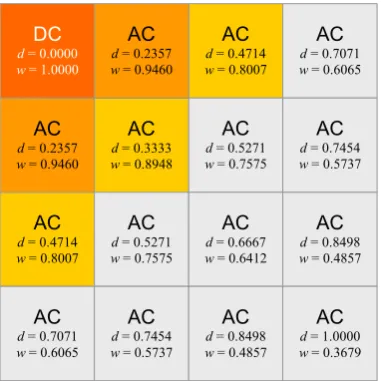
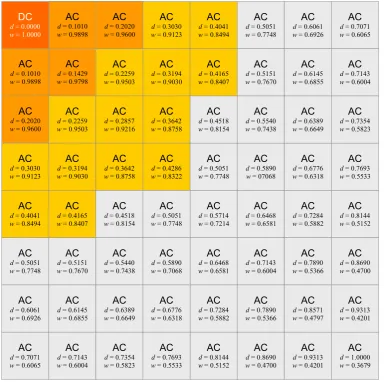
Figure 3.1: A graphical representation of the normalised Euclidean distance d and weight w associated with transform coefficient locations in a 4×4 TB. The darker orange, lighter orange, yellow and grey squares correspond to the DC coefficient, low frequency AC coefficients, medium AC frequency coefficients and high frequency AC coefficients, respectively.
By decreasing the MF, the corresponding larger QStep value is employed primarily for quantising high frequency AC coefficients more aggressively, thus giving rise to perceptual quantisation. More specifically, the level of quantisation applied to each transform coefficient is modified indirectly by weighting — and subsequently decreasing — the corresponding MF value according to a normalised Euclidean distance parameter (see examples in Figure 3.1 and Figure 3.3). The distance parameter is a constituent of an exponentially decreasing function. It is employed for decreasing the MF and subsequently increasing the levels of quantisation applied to each AC coefficient.
The proposed technique reduces non-zero quantised coefficients. Therefore, a significant decrease in bitrates can be accomplished without incurring a perceptually discernible decrease in reconstruction quality; this is confirmed in the objective and subjective evaluations. To reiterate, TCPQ is designed with the simple objective of modifying the MF m, such that the resulting modified MF value, denoted as m', increases the QStep applied to each AC transform coefficient according to its distance from the DC coefficient, thus allowing for an efficient encoder side implementation. Note that, in the proposed TCPQ technique, modified MF m' in (3.15) replaces unmodified MF m in (3.7). The modified MF m' is computed in (3.15):
DC d = 0.0000
w = 1.0000
AC
d = 0.2357 w = 0.9460
AC
d = 0.2357 w = 0.9460
AC
d = 0.3333 w = 0.8948
AC
d = 0.4714 w = 0.8007
AC
d = 0.5271 w = 0.7575
AC
d = 0.7071 w = 0.6065
AC
d = 0.7454 w = 0.5737
AC
d = 0.4714 w = 0.8007
AC
d = 0.7071 w = 0.6065
AC
d = 0.5271 w = 0.7575
AC
d = 0.7454 w = 0.5737
AC
d = 0.6667 w = 0.6412
AC
d = 0.8498 w = 0.4857
AC
d = 0.8498 w = 0.4857
AC
[image:48.595.203.394.71.262.2]![Figure 2.2: A block diagram, developed by Sullivan et al. [5], of a typical video encoder in the HEVC](https://thumb-us.123doks.com/thumbv2/123dok_us/9460388.452768/15.595.93.503.71.328/figure-block-diagram-developed-sullivan-typical-video-encoder.webp)