A S T O C H A S T I C FINITE-STATE W O R D - S E G M E N T A T I O N A L G O R I T H M
F O R C H I N E S E
Richard Sproat
Chilin Shih
William
Gale
AT&T Bell Laboratories
600 Mountain Avenue,
Room
{2d-451,2d-453,2c-278}
Murray Hill,
NJ, USA, 07974-0636
{rws, cls, g a l e } @ r e s e a r c h , att. c o m
Nancy Chang
Harvard University
Division of Applied Sciences
Harvard University
Cambridge, MA 02138
nchang@das, harvard, edu
Abstract
We present a stochastic finite-state model for segment- ing Chinese text into dictionary entries and produc- tively derived words, and providing pronunciations for these words; the method incorporates a class-based model in its treatment of personal names. We also evaluate the system's performance, taking into account the fact that people often do not agree on a single seg- mentation.
THE PROBLEM
The initial step of any text analysis task is the tok- enization of the input into words. For many writing systems, using whitespace as a delimiter for words yields reasonable results. However, for Chinese and other systems where whitespace is not used to delimit words, such trivial schemes will not work. Chinese writing is morphosyllabic (DeFrancis, 1984), meaning that each hanzi- 'Chinese character' - (nearly always) represents a single syllable that is (usually) also a sin- gle morpheme. Since in Chinese, as in English, words
may be polysyllabic, and since hanzi are written with no intervening spaces, it is not trivial to reconstruct which hanzi to group into words.
While for some applications it may be possible to bypass the word-segmentation problem and work straight from hanzi, there are several reasons why this approach will not work in a text-to-speech (TI'S) sys- tem for Mandarin Chinese - - the primary intended application of our segmenter. These reasons include:
1. Many hanzi are homographs whose pronunciation depends upon word affiliation. So, ~ is pronounced
deO ~ when it is a prenominal modification marker, but di4 in the word [] ~ mu4di4 'goal'; ~ is nor- mally ganl 'dry',but qian2 in a person's given name. 2. Some phonological rules depend upon correct word- segmentation, including Third Tone Sandhi (Shih, 1986), which changes a 3 tone into a 2 tone be- fore another 3 tone: , J ~ ] ~ xiao3 [lao3 shu3] 'lit-
t We use pinyin transliteration with numbers representing
tie rat', becomes xiao3 [ lao2-shu3 ], rather than
xiao2 [ lao2-shu3 ], because the rule first applies within the word lao3-shu3, blocking its phrasal ap- plication.
While a minimal requirement for building a Chi- nese word-segmenter is a dictionary, a dictionary is in- sufficient since there are several classes of words that are not generally found in dictionaries. Among these:
I. Morphologically Derived Words: PJ~l~f{l xiao3- jiang4-menO (little general-plural) 'little generals'. 2. Personal Names: ~ , ~ zhoul enl-lai2 'Zhou
Enlai'.
3. Transliterated Foreign Names: ~ i ~ : : , , ~ bu4- lang 3-shi4-wei2-ke4 'Brunswick'.
We present a stochastic finite-state model for seg- menting Chinese text into dictionary entries and words derived via the above-mentioned productive processes; as part of the treatment of personal names, we dis- cuss a class-based model which uses the Good-Turing method to estimate costs of previously unseen personal names. The segmenter handles the grouping of hanzi
into words and outputs word pronunciations, with de- fault pronunciations for hanzi it cannot group; we focus here primarily on the system's ability to segment text appropriately (rather than on its pronunciation abili- ties). We evaluate various specific aspects of the seg- mentation, and provide an evaluation of the overall
segmentation performance: this latter evaluation com- pares the performance of the system with that of several human judges, since even people do not agree on a sin- gle correct way to segment a text,
PREVIOUS WORK
Chert and Liu's (1992) algorithm matches words of an input sentence against a dictionary; in cases where various parses are possible, a set of heuristics is applied to disambiguate the analyses. Various morphological rules are then applied to allow for morphologically complex words that are not in the dictionary. Preci- sion and recall rates of over 99% are reported, but note that this covers
only
words that are in the dictionary: " t h e . . . statistics do not count the mistakes [that occur] due to the existence of derived words or proper names" (Chen and Liu, 1992, page 105). Lin et al. (1993) de- scribe a sophisticated model that includes a dictionary and a morphological analyzer. They also present a gen- eral statistical model for detecting 'unknown words' based onhanzi
and part-of-speech sequences. How- ever, their unknown word model has the disadvantage that it does not identify a sequence ofhanzi
as an un- known wordof a particular category,
but merely as an unknown word (of indeterminate category). For an ap- plication like TTS, however, it is necessary to know that a particular sequenceofhanzi
is of a particular category because, for example, that knowledge could affect the pronunciation. We therefore prefer to build particular models for different classes of unknown words, rather than building a single general model.D I C T I O N A R Y R E P R E S E N T A T I O N
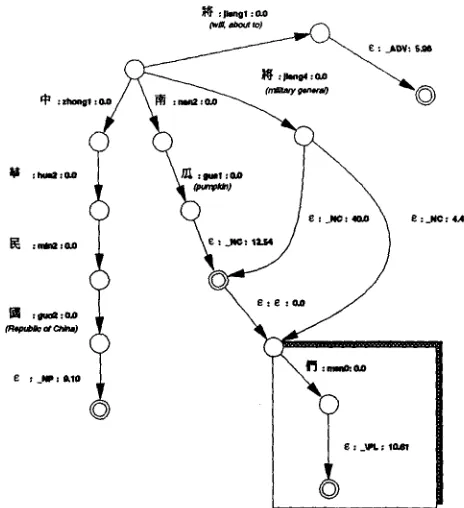
The lexicon of basic words and stems is represented as a
weightedfinite-state tranducer
(WFST) (Pereira et al., 1994). Most transitions represent mappings betweenhanzi
and pronunciations, and are costless. Transitions between orthographic words and their parts-of-speech are represented by e-to-category transductions and aunigram
cost (negative log probability) of that word estimated from a 20Mhanzi
training corpus; a portion of the WFST is given in Figure 1. 2 Besides dictionary words, the lexicon contains allhanzi
in the Big 5 Chi- nese code, with their pronunciation(s), plus entries for other characters (e.g., roman letters, numerals, special symbols).Given this dictionary representation, recognizing a
single
Chinese word involves representing the input as a finite-state acceptor (FSA) where each arc is labeled with a singlehanzi
of the input. Theleft-restriction
of the dictionary WFST with the input FSA contains all and only the (single) lexical entries correspond- ing to the input. This WFST includes the word costs on arcs transducing c to category labels. Now, input2The costs are actually for
strings
rather thanwords:
we currently lack estimates for the words themselves. We assign the string cost to lexical entries with the likeliest pronuncia- tion, and a large cost to all other entries. Thus ~j~/adv, with the commonestpronunciafionjiangl
has cost 5.98, whereas ~/nc, with the rarerpronunciatJonjiang4,
is assigned a high cost. Note also that the current model is zeroeth order in that it uses only unigram costs. Higher order models, e.g. bigram word models, could easily be incorporated into the present architecture if desired.sentences consist of one or more entries from the dic- tionary, and we can generalize the word recognition problem to the word segmentation problem, by left- restricting the transitive closure of the dictionary with the input. The result of this left-restriction is an WFST that gives all and only the possible analyses of the in- put FSA into dictionary entries. In general we do not want all possible analyses but rather the
best
analysis. This is obtained by computing the least-cost path in the output WFST. The final stage of segmentation involves traversing the best path, collecting into words all se- quences ofhanzi
delimited by part-of-speech-labeled arcs. Figure 2 shows an example of segmentation: the sentence [] 5 ~ , ~ - ~ "How do you say octopus in Japanese?", consists of four words, namely []ri4-wen2
'Japanese', ~ ,zhangl-yu2
'octopus', ,~zen3-mo
'how', and -~shuol
'say'. In this case,[] ri4
is also a word (e.g. a common abbreviation for Japan) as are 3 ~wen2-zhangl
'essay', and ~,yu2
'fish', so there is (at least) one alternate analysis to be considered.M O R P H O L O G I C A L A N A L Y S I S
The method just described segments dictionary words, but as noted there are several classes of words that should be handled that are not in the dictionary. One class comprises words derived by productive morpho- logical processes, such as plural noun formation us- ing the suffix ~I
menO.
The morphological anal- ysis itself can be handled using well-known tech- niques from finite-state morphology (Koskenniemi, 1983; Antworth, 1990; Tzoukermann and Liberman, 1990; Karttunen et al., 1992; Sproat, 1992); so, we represent the fact that ~ attaches to nouns by allowing c-transitions from the final states of all noun entries, to the initial state of the sub-WFST representing ~I. However, for our purposes it is not sufficient to rep- resent the morphological decomposition of, say, plu- ral nouns: we also need an estimate of the cost of the resulting word. For derived words that occur in our corpus we can estimate these costs as we would the costs for an underived dictionary entry. So, ~ Ijiang4-menO
'(military) generals' occurs and we esti-: jlengl : 0.0
= :.==..o.o
~ ~ ; : o o
I
L~ : mini : o:o c.: 1
()
@ ' I
I"~. : guo2 : 0.0
(Repubilc of Chr, a)
Figure 1: Partial chinese Lexicon ( N C = noun; NP = proper noun)
i
ESSAY FISH
I~ :_nc ~ :wen2 ]~- :zhangl I~ :_nc ,,~,. :yu2
JAPAN[] " r i 4 . . . ~ ... .
....}...~"~.~;%" %. ... *o";.2; " %
./ 10.28 i e : nc
: JAPANESE OCTOPUS , - HOW SAY
i [] :ri4 ~ :wen2 g :_nc -~-:zhangl ,~! .~/u2 E: nc [ ~ :zen3 ~ :moO E:_adv -~:shuol g:_vb
i I
10.63 13.18 7.96 5.55
[image:3.612.177.457.102.374.2] [image:3.612.55.571.449.651.2]~i~ : pare91 : 0.0 ~ )
:/klcql4 : GO
E : JP, DV: SAt,
: m l n l : n n I
: i l l :GO
~ : J q ¢ : 40.0
I E : e : G O
laJ : m l ~ : GO
: . . N C : 4A1
: k i l t . . " 1 0 J I l
Figure 3: An example o f affixation: the plural affix
c o s t ( ~ r ] ) is computed in the obvious way. Fig- ure 3 shows how this model is implemented as part of the dictionary WFST. There is a (costless) transition between the NC node and ~]. The transition from ~] to a final state transduces c to the grammatical tag \ P L with cost costte~t(unseen(~])): cost(l~}~f~
) = cost(~)~) + costt,~t(unseen([])), as desired.
For the seen word ~ 1 'generals', there is an e:nc transduction from ~ to the node preceding t~]; this arc has cost c o s t ( ~ ] ) - costt,~:t(unseen(~])), so that the cost of the whole path is the desired cost(~t~]
). This representation gives ~ ] an appropriate mor- phological decomposition, preserving information that would be lost by simply listing ~ [ ~ I as an unanalyzed form. Note that the backoffmodel assumes that there is a positive correlation between the frequency of a singu- lar noun and its plural. An analysis of nouns that occur both in the singular and the plural in our database re- veals that there is indeed a slight but significant positive correlation - - R 2 = 0.20, p < 0.005. This suggests that the backoff model is as reasonable a model as we can use in the absence of further information about the expected cost of a plural form.
CHINESE PERSONAL NAMES
Full Chinese personal names are in one respect sim- ple: they are always of the form FAMILY+GIVEN. The FAMILY name set is restricted: there are a few hundred single-hanzi FAMILY names, and about ten
double-hanzi ones. Given names are most commonly
two hanzi long, occasionally one-hanzi long: there
are thus four possible name types. The difficulty is that GIVEN names can consist, in principle, of any hanzi or pair ofhanzi, so the possible G I V E N names are limited only by the total number of hanzi, though some hanzi
are certainly far more likely than others. For a sequence of hanzi that is a possible name, we wish to assign a probability to that sequence qua name. We use an esti- mate derived from (Chang et al., 1992). For example, given a potential name o f the form FI G1 G2, where F1 is a legal FAMILY name and G1 and G2 are each hanzi,
we estimate the probability of that name as the prod- uct of the probability of finding any name in text; the probability of F1 as a FAMILY name; the probability of the first hanzi of a double GIVEN name being G1; the probability of the second hanzi of a double GIVEN name being G2; and the probability of a name of the form SINGLE-FAMILY+DOUBLE-GIVEN. The first probability is estimated from a name count in a text database, whereas the last four probabilities are esti- mated from a large list of personal names) This model is easily incorporated into the segmenter by building an WFST restricting the names to the four licit types, with costs on the arcs for any particular name summing to an estimate of the cost of that name. This WFST is then
summed with the WFST implementing the dictionary
and morphological rules, and the transitive closure of the resulting transducer is computed.
[image:4.612.190.422.41.295.2]There are two weaknesses in Chang et al.'s (1992) model, which we improve upon. First, the model as- sumes independence between the first and second
hanzi
of a double GIVEN name. Yet, somehanzi
are far more probable in women's names than they are in men's names, and there is a similar list of male-orientedhanzi:
mixinghanzi
from these two lists is generally less likely than would be predicted by the independence model. As a partial solution, for pairsofhanzi
that cooccur suf- ficiently often in our namelists, we use the estimated bigram cost, rather than the independence-based cost. The second weakness is that Chang et al. (1992) as- sign a uniform small cost to unseenhanzi
in GIVEN names; but we know that some unseenhanzi are
merely accidentally missing, whereas others are missing for a reason - - e.g., because they have a bad connotation. We can address this problem by first observing that for manyhanzi, the
general 'meaning' is indicated by its so-called 'semantic radical'.Hanzi
that share the same 'radical', share an easily identifiable structural component: the plant names 2 , -~ and M share the GRASS radical; m a l a d y names m[, ~ , , and t~ share the SICKNESS radical; and ratlike animal names 1~, [~, and 1~ share the RAT radical. Some classes are bet- ter for names than others: in our corpora, many names are picked from the GRASS class, very few from the SICKNESS class, and none from the RAT class. We can thus better predict the probability of an unseenhanzi
occurring in a name by computing awithin-class
Good-Turing estimate for each radical class. Assum- ing unseen objectswithin each class are
equiprobable, their probabilities are given by the Good-Turing theo- rem as:p~t, o~
E(N{ u)
N , E(N~tS )
(1)where
p~t,
is the probability of one unseenhanzi
in classcls, E(N{ t')
is the expected number ofhanzi
incls
seen once, N is the total number ofhanzi, and
E(N~ t')
is the expected number of unseenhanzi
in classcls. The
use of the Good-Turing equation pre- sumes suitable estimates of the unknown expectations it requires. In the denominator, the N~ u are well mea- sured by counting, and we replace the expectation by the observation. In the numerator, however, the counts of N{ l' are quite irregular, including several zeros (e.g. RAT, none of whose members were seen), However, there is a strong relationship betweenN{ t" and the
number ofhanzi
in the class. ForE(N~ZS),
then, we substitute a smooth against the number of class ele- ments. This smooth guarantees that there are no zeroes estimated. The final estimating equation is then:S( N~'N;,!
(2)p~U oc N *
The total of all these class estimates was about 10% off from the Turing estimate
N t / N
for the probability ofall
unseenhanzi,
and we renormalized the estimates so that they would sum toN t / N .
This
class-based
model gives reasonable results: for six radical classes, Table 1 gives the estimated cost for an unseenhanzi
in the class occurring as the secondhanzi
in a double GIVEN name. Note that the good classes JADE, GOLD and GRASS have lower costs than the bad classes SICKNESS, DEATH and RAT, as desired.T R A N S L I T E R A T I O N S O F F O R E I G N W O R D S
Foreign names are usually transliterated using
hanzi
whose sequential pronunciation mimics the source lan- guage pronunciation of the name. Since foreign names can be of any length, and since their original pronunci- ation is effectively unlimited, the identification of such names is tricky. Fortunately, there are only a few hun- dredhanzi
that are particularly common in translitera- tions; indeed, the commonest ones, such as ~bal, ~I
er3, and PJ al are
often clear indicators that a sequence ofhanzi
containing them is foreign: even a name like~ Y ~ f xia4-mi3-er3
'Shamir', which is a legal Chi- nese personal name, retains a foreign flavor because of i~J. As a first step towards modeling transliterated names, we have collected allhanzi
occurring more than once in the roughly 750 foreign names in our dictionary, and we estimate the probability of occurrence of eachhanzi
in a transliteration(pT~;(hanzii))
using the max- imum likelihood estimate. As with personal names, we also derive an estimate from text of the probabil- ity of finding a transliterated name of any kind (PTN). Finally, we model the probability of a new transliter- ated name as the product of PTN andpTg(hanzii)
for eachhanzii
in the putative name. 4 The foreign name model is implemented as an WFST, which is then summed with the WFST implementing the dictionary, morphological rules, and personal names; the transitive closure of the resulting machine is then computed.E V A L U A T I O N
In this section we present a partial evaluation of the current system in three parts. The first is an evaluation of the system's ability to mimic humans at the task of segmenting text into word-sized units; the second eval- uates the proper name identification; the third measures the performance on morphological analysis. To date we have not done a separate evaluation of foreign name recognition.
Evaluation of the Segmentation as a Whole: Pre- vious reports on Chinese segmentation have invariably
Table I: The cost as a novel GIVEN name (second position) for hanzi from various radical classes.
JADE GOLD GRASS SICKNESS DEATH RAT
14.98 15.52 15.76 16.25 16.30 16.42
cited performance either in terms of a single percent- correct score, or else a single precision-recall pair. The problem with these styles of evaluation is that, as we shall demonstrate, even human judges do not agree perfectly on how to segment a given text. Thus, rather than give a single evaluative score, we prefer to com- pare the performance of our method with the judgments
of several human subjects. To this end, we picked 100
sentences at random containing 4372 total hanzi from a test corpus. We asked six native speakers - - three from Taiwan (T1-T3), and three from the Mainland (M1-M3) - - to segment the corpus. Since we could not bias the subjects towards a particular segmentation and did not presume linguistic sophistication on their part, the instructions were simple: subjects were to mark all places they might plausibly pause if they were reading the text aloud. An examination of the subjects' bracketings confirmed that these instructions were sat- isfactory in yielding plausible word-sized units.
Various segmentation approaches were then com- pared with human performance:
1. A greedy algorithm, GR: proceed through the sen- tence, taking the longest match with a dictionary entry at each point.
2. An 'anti-greedy' algorithm, AG: instead of the longest match, take the shortest match at each point.
3. The method being described - - henceforth ST.
Two measures that can be used to compare judgments are:
1. Precision. For each pair of judges consider one judge as the standard, computing the precision of
the other's judgments relative to this standard. 2. Recall. For each pair of judges, consider one judge
as the standard, computing the recall of the other's judgments relative to this standard.
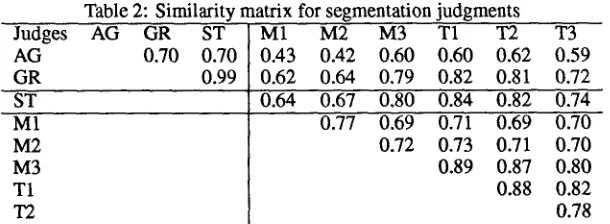
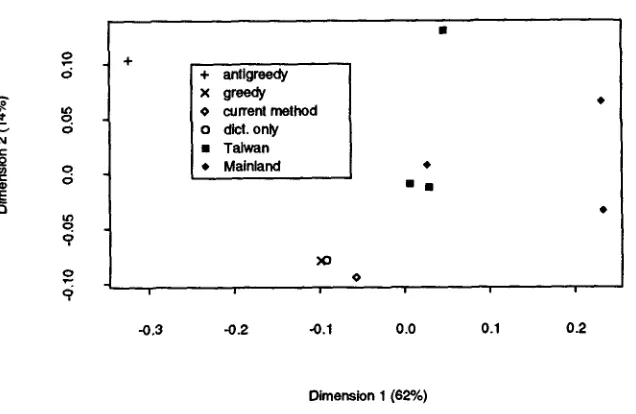
Obviously, for judges J1 and J2, taking ,/1 as stan- dard and computing the precision and recall for J2 yields the same results as taking J2 as the standard, and computing for Jr, respectively, the recall and pre- cision. We therefore used the arithmetic mean of each interjudge precision-recall pair as a single measure of interjudge similarity. Table 2 shows these similarity measures. The average agreement among the human judges is .76, and the average agreement between ST and the humans is .75, or about 99% of the inter-human agreement. (GR is .73 or 96%.) One can better visu- alize the precision-recall similarity matrix by produc- ing from that matrix a distance matrix, computing a multidimensional scaling on that distance matrix, and
plotting the first two most significant dimensions. The result of this is shown in Figure 4. In addition to the automatic methods, AG, GR and ST, just discussed, we also added to the plot the values for the current algorithm using only dictionary entries (i.e., no pro- ductively derived words, or names). This is to allow for fair comparison between the statistical method, and GR, which is also purely dictionary-based. As can be seen, GR and this 'pared-down' statistical method perform quite similarly, though the statistical method is still slightly better. AG clearly performs much less like humans than these methods, whereas the full statisti- cal algorithm, including morphological derivatives and names, performs most closely to humans among the automatic methods. It can be also seen clearly in this plot, two of the Taiwan speakers cluster very closely together, and the third Taiwan speaker is also close in the most significant dimension (the z axis). Two of the Mainlanders also cluster close together but, interest- ingly, not particularly close to the Taiwan speakers; the third Mainlander is much more similar to the Taiwan speakers.
Table 2: Similarity matrix for segmentation judgments
Judges AG GR ST M1 M2 M3 T1 T2 T3
AG 0.70 0.70 0.43 0.42 0.60 0.60 0.62 0.59
GR 0.99 0.62 0.64 0.79 0.82 0.81 0.72
ST 0.64 0.67 0.80 0.84 0.82 0.74
0.77 M1
M2 M3 T1 T2
0.69 0.71 0.69 0.70 0.72 0.73 0.71 0.70 0.89 0.87 0.80 0.88 0.82 0.78
system appears to be doing better precisionwise. Thus we have some confidence that our own performance is at least as good that of(Chang et al., 1992). s
Evaluation of Morphological Analysis:
In Table3
we present results from small test corpora for some productive affixes; as with names, the segmentation of morphologically derived words is generally either right or wrong. The first four affixes are so-called resultative affixes: they denote some property of the resultant state of an verb, as in ~,,:;~ ~" wang4-bu4-1iao3 (forget-not- attain) 'cannot forget'. The last affix is the nominal plural. Note that ~ in ~,:~: ]" is normally pronounced
as leO, but when part of a resultative it is liao3. In the
table are the (typical) classes of words to which the affix attaches, the number found in the test corpus by the method, the number correct (with a precision measure), and the number missed (with a recall measure).
CONCLUSIONS
In this paper we have shown that good performance can be achieved on Chinese word segmentation by us- ing probabilistic methods incorporated into a uniform stochastic finite-state model. We believe that the ap- proach reported here compares favorably with other reported approaches, though obviously it is impossible to make meaningful comparisons in the absence of uni- form test databases for Chinese segmentation. Perhaps the single most important difference between our work and previous work is the form of the evaluation. As we have observed there is often no single right answer to word segmentation in Chinese. Therefore, claims to the effect that a particular algorithm gets 99% accuracy are meaningless without a clear definition of accuracy.
A C K N O W L E D G E M E N T S
We thank United Informatics for providing us with our corpus of Chinese text, and BDC for the 'Behav-
5We were recently pointed to (Wang et al., 1992), which we had unfortunately missed in our previous literature search. We hope to compare our method with that of Wang et al. in a future version of this paper.
ior Chinese-English Electronic Dictionary'. We fur- ther thank Dr. J.-S. Chang of Tsinghua University, for kindly providing us with the name corpora. Finally, we thank two anonymous ACL reviewers for comments.
R E F E R E N C E S
Evan Antworth. 1990. PC-KIMMO: A Two-Level Pro-
cessor for Morphological Analysis. Occasional
Publications in Academic Computing, 16. Sum- mer Institute of Linguistics, Dallas, TX.
Harald Baayen. 1989. A Corpus-Based Approach to Morphological Productivity: Statistical Analysis
and Psycholinguistic Interpretation. Ph.D. thesis,
Free University, Amsterdam.
Jyun-Shen Chang, Shun-De Chen, Ying Zheng, Xian- Zhong Liu, and Shu-Jin Ke. 1992. Large-corpus- based methods for Chinese personal name recogni- tion. Journal of Chinese Information Processing,
6(3):7-15.
Keh-Jiann Chen and Shing-Huan Liu. 1992. Word identification for Mandarin Chinese sentences.
In Proceedings of COLING-92, pages 101-107.
COLING.
Kenneth Ward Church and William Gale. 1991. A comparison of the enhanced Good-Turing and deleted estimation methods for estimating prob- abilities of English bigrams. Computer Speech
and Language, 5(1): 19-54.
John DeFrancis. 1984. The Chinese Language. Uni- versity of Hawaii Press, Honolulu.
C.-K. Fan and W.-H. Tsai. 1988. Automatic word identification in Chinese sentences by the relax- ation technique. Computer Processing of Chinese
and Oriental Languages, 4:33-56.
Lauri Karttunen, Ronald Kaplan, and Annie Zaenen. 1992. Two-level morphology with composition.
In COLING-92, pages 141-148. COLING.
Kimmo Koskenniemi. 1983. Two-Level Morphology: a General Computational Model for Word-Form
Recognition and Production. Ph.D. thesis, Uni-
[image:7.612.157.462.46.158.2]o~
Q)
_E
c)
o
d
~ q
o.
O
o
o
U 3
o.
c~
o
antlgreedy greedy
current method dict. 0nly Taiwan Mainland
• •
X~
O
i i ! i i i
-0.3 -0.2 -0.1 0.0 0.1 0.2
Dimension I (62%)
Figure 4: Classical metric multidimensional scaling of distance matrix, showing the two most significant dimensions. The percentage scores on the axis labels represent the amount of data explained by the dimension in question.
Table 3: Performance on morphological analysis.
Affix Pron Base category N found N correct (prec.) N missed (rec.)
~ T c bu2-xia4 verb 20 20 (100%) 12 (63%)
~ - F ~ bu2-xia4-qu4 verb 30 29 (97%) 1 (97%)
:~T bu4-1iao3 verb 72 72 (100%) 15 (83%)
~ $ t T de2-liao3 verb 36 36 (100%) 11 (77%)
r~ menO noun 141 139 (99%) 6 (96%)
Ming-Yu Lin, Tung-Hui Chiang, and Keh-Yi Su. 1993. A preliminary study on unknown word problem in Chinese word segmentation. In ROCLING 6,
pages 119-141. ROCLING.
Fernando Pereira, Michael Riley, and Richard Sproat. 1994. Weighted rational transductions and their application to human language processing. In
ARPA Workshop on Human Language Technol-
ogy, pages 249-254. Advanced Research Projects
Agency, March 8-11.
Chilin Shih. 1986. The Prosodic Domain of Tone
Sandhi in Chinese. Ph.D. thesis, UCSD, La Jolla,
CA.
Richard Sproat and Chilin Shih. 1990. A statistical method for finding word boundaries in Chinese text. Computer Processing of Chinese and Orien-
tal Languages, 4:336-35 i.
Richard Sproat. 1992. Morphology and Computation.
MIT Press, Cambridge, MA.
Evelyne Tzoukermann and Mark Liberman. 1990. A finite-state morphological processor for Spanish.
In COLING-90, Volume 3, pages 3: 277-286.
COLING.
Yongheng Wang, Haiju Su, and Yan Mo. 1990. Au- tomatic processing of chinese words. Journal of
Chinese Information Processing, 4(4): 1-11.
Liang-Jyh Wang, Wei-Chuan Li, and Chao-Huang Chang. 1992. Recognizing unregistered names for mandarin word identification. In Proceedings
of COLING-92, pages 1239-1243. COLING.
Zimin Wu and Gwyneth Tseng. 1993. Chinese text segmentation for text retrieval: Achievements and problems. Journal of the American Society for
[image:8.612.135.453.100.307.2]