A Pattern-based Machine Translation System Extended by
Example-based Processing
H i d e o W a t a n a b e a n d K o i c h i T a k e d a IBM Research, Tokyo Research Laboratory
1623-14 Shimotsuruma, Yamato, Kanagawa 242-8502, Japan {watanabe,takeda} @trl.ibm.co.jp
A b s t r a c t
In this paper, we describe a machine translation system called PalmTree which uses the "pattern- based" approach as a fundamental framework. The pure pattern-based translation framework has sev- eral issues. One is the performance due to using many rules in the parsing stage, and the other is inefficiency of usage of translation patterns due to the exact-matching. To overcome these problems, we describe several methods; pruning techniques for the former, and introduction of example-based processing for the latter.
1 I n t r o d u c t i o n
While the World-Wide Web (WWW) has quickly turned the Internet into a treasury of information for every netizen, non-native English speakers now face a serious problem that textual data are more often than not written in a foreign language. This has led to an explosive popularity of machine trans- lation (MT) tools in the world.
Under these circumstances, we developed a ma- chine translation system called P a l m T r e e I which uses the pattern-based translation [6, 7] formalism. The key ideas of the pattern-based MT is to em- ploy a massive collection of diverse transfer knowl- edge, and to select the best translation among the translation candidates (ambiguities). This is a nat- ural extension of the example-based MT in the sense that we incorporate not only sentential correspon- dences (bilingual corpora) but every other level of linguistic (lexical, phrasal, and collocational) ex- pressions into the transfer knowledge. It is also a rule-based counterpart to the word n-grams of the stochastic MT since our patterns intuitively cap- tures the frequent collocations.
Although the pattern-based MT framework is promising, there are some drawbacks. One is the speed, since it uses many rules when parsing. The other is inefficiency of usage of translation patterns,
1 U s i n g t h i s s y s t e m , I B M J a p a n releases a M T p r o d u c t called " I n t e r n e t K i n g of T r a n s l a t i o n " w h i c h c a n t r a n s l a t e a n E n g l i s h W e b p a g e s into J a p a n e s e .
since it uses the exact-match when matching trans- lation patterns with the input. We will describe several methods for accelerating the system perfor- mance for the former, and describe the extension by using the example-based processing [4, 8] for the latter.
2 P a t t e r n - b a s e d T r a n s l a t i o n
Here, we briefly describe how the pattern-based translation works. (See [6, 7] for details.) A trans- lation pattern is a pair of source CFG-rule and its corresponding target CFG-rule. The followings are examples of translation patterns.
(pl) take:VERB:l a look at NP:2 =~ VP:I VP:I ¢= NP:2 wo(dobj) miru(see):VERB:l (p2) NP:I VP:2 =v S:2 S:2 ¢= NP:I ha VP:2 (p3) PRON:I =~ NP:I NP:I ¢: PRON:I
The (pl) is a translation pattern of an English colloquial phrase "take a look at," and (p2) and (p3) are general syntactic translation patterns. In the above patterns, a left-half part (like "A B C =~ D") of a pattern is a source CFG-rule, the right- half part (like "A ¢:= B C D") is a target CFG-rule, and an index number represents correspondence of terms in the source and target sides and is also used to indicate a head term (which is a term having the same index as the left-hand side 2 of a CFG-rule). Further, some features can be attached as matching conditions for each term.
The pattern-based MT engine performs a CFG- parsing for an input sentence with using source sides of translation patterns. This is done by us- ing chart-type CFG-parser. The target structure is constructed by the synchronous derivation which generates a target structure by combining target sides of translation patterns which are used to make a parse.
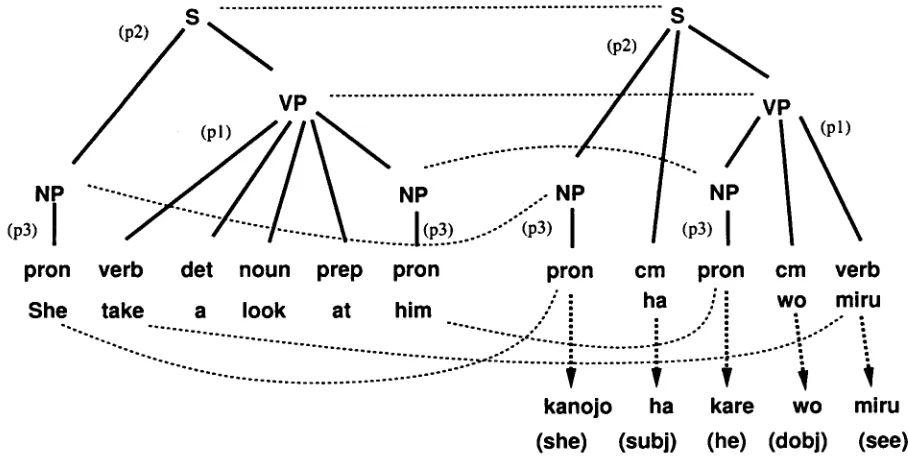
Figure 2 shows how an English sentence "She takes a look at him" is translated into Japanese.
S . . . S
[image:2.612.75.529.54.282.2]V P . . . V P
...
NP . . . .. -.. N P ... NP NP
pron verb det noun prep pron pron cm pron cm verb
: "
]
: . ha i wo miru
She take a look at him : .
. . . " . . . " . . . : : . : : . . . . - . . . " . . . - " i . . . . . . . "
...
.... :::: ... , : : : : i
....
.... ... i ... i
kanojo ha kare wo (she) (subj) (he) (dobj)
Figure 1: Translation Example by Pattern-based M T
miru (see)
In this figure, a dotted line represents the corre- spondence of terms in the source side and the tar- get side. T h e source part of (p3) matches "She" and "him," the source part of (pl) matches a seg- ment consisting "take a look at" and a N P ( " h i m " ) made from (p3), and finally the source part of (p2) matches a whole sentence. A target structure is constructed by combining target sides of ( p l ) , (p2), and (p3). Several terms without lexical forms are instantiated with translation words, and finally a translated Japanese sentence "kanojo(she) ha(sub j) kare(he) wo(dobj) miru(see)" will be generated.
3 P r u n i n g T e c h n i q u e s
As mentioned earlier, our basic principle is to use many lexical translation patterns for produc- ing natural translation. Therefore, we use more CFG rules t h a n usual systems. This causes the slow-down of the parsing process. We introduced the following pruning techniques for improving the performance.
3.1 L e x i c a l R u l e P r e f e r e n c e P r i n c i p l e
We call a CFG rule which has lexical terms in the right-hand side (RHS) a
lexical rule,
otherwisea normal rule.
T h elexical rule preference principle
(or LRPP}
invalidates arcs made from normal rules in a span in which there are arcs made from both normal rules and lexical rules.Further, lexical rules are assigned cost so that
lexical rules which has more lexical terms are pre- ferred.
For instance, for the span [take, map] of the fol- lowing input sentence,
He takes a look at a map.
if the following rules are matched,
(rl) take:verb a look at NP (r2) take:verb a NP at NP (r3) take:verb NP at NP (r4) V E R B NP P R E P NP
then, (r4) is invalidated, and (rl),(r2), and (r3) are preferred in this order.
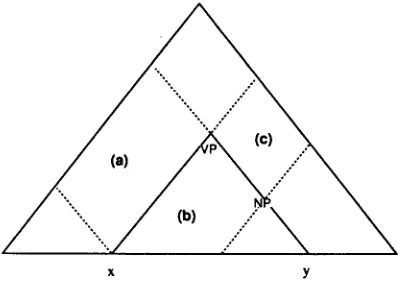
3.2 L e f t - B o u n d F i x e d E x c l u s i v e R u l e We generally use an exclusive rttle which invali- dates competitive arcs made from general rules for a very special expression. This is, however, limited in terms of the matching ability since it is usually implemented as b o t h ends of rules are lexical items. T h e r e are many expression such t h a t left-end part is fixed b u t right-end is open, but these expressions cannot be expressed as exclusive rules. Therefore, we introduce here a
left-bound fixed exclusive (or
LBFE) rule
which can deal with right-end open expressions.x y
Figure 2: T h e Effect of an L B F E Rule
* Rules other t h a n exclusive rules are not ap- plied, and
• Arcs m a d e from non-exclusive rules are inval- idated.
Fig.2 shows t h a t an L B F E rule "VP ~= V E R B NP ''3 matches an input. In spans of (a),(b), and (c), arcs m a d e from non-exclusive rules are inval- idated, and the application of non-exclusive rules are inhibited.
E x a m p l e s of L B F E rules are as follows:
NP ~ D E T own NP N O U N +-- as m a n y as NP NP ~ most of N P
3.3 Preproeessing
Preprocessing includes local bracketing of proper nouns, m o n e t a r y expressions, quoted expressions, Internet addresses, and so on. Conversion of nu- meric expressions and units, and decomposition of unknown h y p h e n a t e d words are also included in the preprocessing. A bracketed span works like an ex- clusive rule, t h a t is, we can ignore arcs crossing a bracketed span. Thus, accurate preprocessing not only improved the translation accuracy, but it vis- ibly improved the translation speed for longer sen- tences.
3.4 Experiments
To evaluate the above pruning techniques, we have tested the speed a n d the translation quality for three documents. Table 1 shows the speed to translate documents with and without the above pruning techniques. 4 T h e fourth row shows the
3 T h i s is n o t an L B F E r u l e in p r a c t i c e .
4 p l e a s e n o t e t h a t t h e t i m e s h o w n in t h i s t a b l e w a s r e c o r d e d a b o u t t w o y e a r s a g o a n d t h e l a t e s t v e r s i o n is m u c h faster.
n u m b e r of sentences tested with pruning which be- come worse t h a n sentences without pruning and sentences with pruning which become b e t t e r t h a n without pruning.
This shows the speed with pruning is a b o u t 2 times faster t h a n one without pruning at the same t i m e the translation quality with pruning is kept in the almost same level as one without pruning..
4 E x t e n s i o n b y E x a m p l e - b a s e d P r o - c e s s i n g
One drawback of our p a t t e r n - b a s e d formalism is to have to use m a n y rules in the parsing process. One of reasons to use such m a n y rules is t h a t the m a t c h i n g of rules and the input is performed by the exact-matching. It is a straightforward idea to ex- tend this e x a c t - m a t c h i n g to fuzzy-matching so t h a t we can reduce the n u m b e r of translation p a t t e r n s by merging some p a t t e r n s identical in t e r m s of the fuzzy-matching. We m a d e the following extensions to the p a t t e r n - b a s e d M T to achieve this example- based processing.
4.1
Example-based Parsing
If a t e r m in a RHS of source p a r t of a p a t t e r n has a lexical-form and a corresponding t e r m in the tar- get part, t h e n it is called a ]uzzy-match term, oth- erwise an exact-match term. A p a t t e r n writer can intentionally designate if a t e r m is a fuzzy-match t e r m or an e x a c t - m a t c h t e r m by using a double- quoted string (for fuzzy-match) or a single-quoted string (for exact-match).
For instance, in the following example, a word
make is usually a fuzzy-match t e r m since it has a corresponding t e r m in the t a r g e t side (ketsudan- suru), b u t it is a single-quoted string, so it is an e x a c t - m a t c h term. Words a and decision are exact- m a t c h t e r m s since they has no corresponding t e r m s in the target side.
' m a k e ' : V E R B : l a decision =v V P : I V P : I ~= ketsudan-suru:l
Thus, the example-based parsing extends the t e r m m a t c h i n g mechanism of a normal parsing as follows: A t e r m TB matches a n o t h e r m a t c h e d - t e r m
TA (LexA,POsB) s if one of the following conditions holds.
(1) W h e n a t e r m TB has b o t h LexB and POSB,
(1-1) LexB is the same as LeXA, and PosB is the same as PosA.
[image:3.612.77.280.53.197.2]Sample 1 Sample 2 Sample 3
Num of Sentences 13 41 50
Time with Pruning (sec.) 16 23 44
20 48 67
Time without Pruning (sec.)
Num of Changed Sentences (Worse/Better)
1/2
5/4 4/6Table 1: Result of peformance experiment of pruning techniques
(1-2) TB is a fuzzy-match term, the semantic distance of LexB and LexA is smaller t h a n a criterion, and PosB is the same
as ROSA.
(2) When a term TB has only LexB,
(2-1) LexB is the same as LeXA.
(2-2) LexB is a fuzzy-match term, the seman- tic distance of LexB and LexA is smaller than a criterion.
(3) When TB has only PosB, then PosB is the same as RosA.
4.2 P r i o r i t i z a t i o n o f R u l e s
Many ambiguous results are given in the pars- ing, and the preference of these results are usually determined by the cost value calculated as the sum of costs of used rules. This example-based process- ing adds fuzzy-matching cost to this base cost. T h e fuzzy-matching cost is determined to keep the fol- lowing order.
(1-1) < (1-2),(2-1) < (2-2) < (3)
T h e costs of (1-2) and (2-1) are determined by the fuzzy-match criterion value, since we cannot determine which one of (1-2) and (2-1) is preferable in general.
4.3 M o d i f i c a t i o n o f T a r g e t S i d e o f R u l e s Lexical-forms written in the target side may be different from translation words of matched input word, since the fuzzy-matching is used. Therefore, we must modify the target side before constructing a target structure.
Suppose t h a t a RHS term tt in the target side of a p a t t e r n has a lexical-form wt, tt has a corre- sponding term t, in the source side, and G matches an input word wi. If wt is not a translation word of wi, then wt is replaced with translation words of
wi.
4.4 T r a n s l a t i o n E x a m p l e
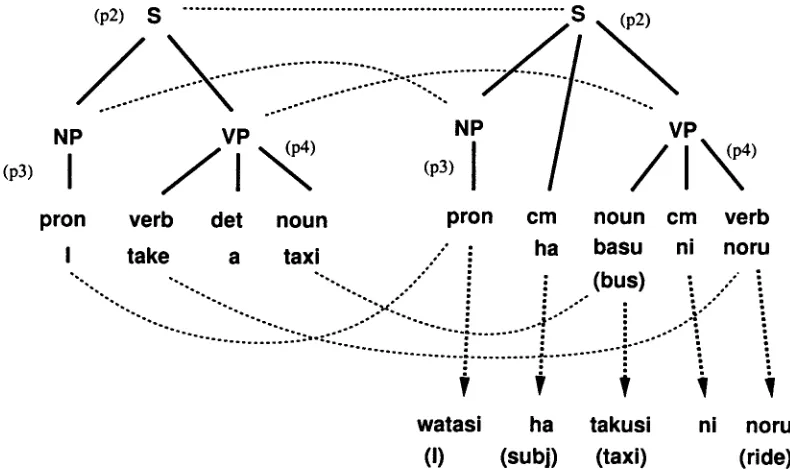
Figure 3 shows a translation example by using example-based processing described above.
In this example, the following translation pat- terns are used.
(p2) N P : I VP:2 =~ S:2 S:2 ¢= N P : I ha VP:2 (p3) P R O N : I =~ NP:I NP:I ¢: P R O N : I (p4) t a k e : V E R B : l a bus:2 =~ V P : I
V P : I ¢= basu:2 ni n o r u : V E R B : l
T h e p a t t e r n (p4) matches a phrase "take a taxi," since "taxi" and "bus" are semantically similar. By combining target parts of these translation pat- terns, a translation " P R O N ha basu ni noru" is generated. In this translation, since "basu(bus)" is not a correct translation of a corresponding source word "taxi," it is changed to a correct translation word "takusi(taxi)." Further, P R O N is instanti- ated by "watashi" which is a translation of "I." Then a correct translation "watashi ha takusi ni noru" is generated.
5 D i s c u s s i o n
Unlike most of existing M T approaches t h a t con- sist of three m a j o r components[I, 2] - analysis, transfer, and generation - the pattern-based M T is based on a synchronous model[5, 3] of transla- tion. T h a t is, the analysis of a source sentence is directly connected to the generation of a target sentence through the translation knowledge (i.e., patterns). This simple architecture makes it much easier to customize a system for improving trans- lation quality than the conventional MT, since the management of the ambiguities in 3-component ar- chitecture has to tackle the exponential combina- tion of overall ambiguities. In this simple model, we can concentrate on a single module (a parser with synchronous derivation), and manage most of translation knowledge in a uniform way as transla- tion patterns.
[image:4.612.123.489.49.115.2](p3)
(p2) S . . . S (p2)
/...-..X ...
:::::::::
:
...
"'" "'" " . . . " N P ... V P
N~
/ V [ , ~ ,
(P3' I/
/ i X 4 )p r o n v e r b d e t n o u n p r o n c m n o u n c m v e r b
• " : h a b a s u ni n o r u
I t a k e a t a x i ,o ." •
"" " : : ( b u s ) " :
. . . . - . . .
,
I
o.. , I . o ,. ° . ° o . . . . . o • • o . a ~o
°°°.. "--... ...- -. ....
_.
..j"!
..-'~V
V
t
w a t a s i h a t a k u s i ni
(I) ( s u b j ) ( t a x i )
Figure 3: Translation Example by Example-based Processing
n o r u
( r i d e )
etc. For instance, the following E-to-J simple pat- tern (a) is converted into a full-scale p a t t e r n (b) by the pattern compiler. 6
(a) [VP] hit a big shot = subarasii shotto wo utu (b) hit:verb:l a big shot =~ VP:I
VP:I ¢= subarsii shotto wo utu:verb:l
Shown in the above example, it is very easy for non- experts to write these simple patterns. Thus, this pattern compiler enable non-experts to customize a system. In conventional M T systems, an expert is usually needed for each component (analysis, trans- fer, and generation).
These advantages can reduce the cost of develop- ment and customization of a M T system, and can largely contribute to rapidly improve the transla- tion quality in a short time.
Further, we have shown the way to integrate example-based processing and pattern-based MT. In addition to reduce the total number of transla- tion patterns, this combination enables us to make a more robust and human-like M T system thanks to the easy addition of translation pattern.
6 C o n c l u s i o n
In this paper, we have described a pattern-based M T system called PalmTree. This system can break
6practically, some conditional features are attached into verb terms.
the current ceiling of M T technologies, and at the same time satisfy three essential requirements of the current market: efficiency, scalability, and ease- of-use.
We have described several pruning techniques for gaining b e t t e r performance. Further we de- scribed the integration of example-based processing and pattern-based MT, which enables us to make more robust and human-like translation system.
R e f e r e n c e s
[1] Nagao, M., Tsujii, J., and Nakamura, J., "The Japanese Government Project of Machine Translation," Compu- tational Linguistics, 11(2-3):91-110, 1985.
[2] Nirenberg, S. editor: M a c h i n e T r a n s l a t i o n - Theoretical a n d M e t h o d o l o g i c a l Issues, Cambridge University Press, Cambridge, 1987.
[3] Rambow, O., and Satta, S., "Synchronous Models of Language," Proc. of the 34th of ACL, pp. 116-123, June 1996.
[4] Sato, S., and Nagao, M. "Toward Memory-based Trans- lation," Proc. of 13th COLING, August 1990. [5] Shieber, S. M., and Schabes Y., "Synchronous Tree-
Adjoining Grammars," Proc. of the 13th COLING, pp. 253-258, August 1990.
[6] Takeda, K., "Pattern-Based Context-Free Grammars for Machine Translation," Proc. of 34th ACL, pp. 144- 151, June 1996.
[7] Takeda, K., "Pattern-Based Machine Translation," Proc. of 16th COLING, Vol. 2, pp. 1155-1158, August 1996.
[image:5.612.70.465.55.290.2]