A Graph-Based Approach to String Regeneration
Matic Horvat
Computer Laboratory University of Cambridge
15 JJ Thomson Avenue, CB3 0FD, U.K. [email protected]
William Byrne
Department of Engineering University of Cambridge Trumpington Street, CB2 1PZ, U.K.
Abstract
The string regeneration problem is the problem of generating a fluent sentence from a bag of words. We explore the N-gram language model approach to string regeneration. The approach computes the highest probability permutation of the in-put bag of words under an N-gram lan-guage model. We describe a graph-based approach for finding the optimal permuta-tion. The evaluation of the approach on a number of datasets yielded promising re-sults, which were confirmed by conduct-ing a manual evaluation study.
1 Introduction
The string regeneration problem can be stated as: given a bag of words taken from a fluent grammat-ical sentence, recover the original sentence. As it is often difficult to recover the exact original sen-tence based solely on a bag of words, the problem is relaxed to generating a fluent version of the orig-inal sentence (Zhang and Clark, 2011).
The string regeneration problem can generally be considered a difficult problem even for humans. Consider the following bag of words:
{Iraq, list, in, a, third, joins, the, ., of, Bush’s, of, critics, policy, senator, re-publican}
and try to recover the original sentence or at least a fluent grammatical sentence. The original sen-tence was:
a third republican senator joins the list of critics of Bush’s policy in Iraq.
The purpose of investigating and developing ap-proaches to solving the string regeneration prob-lem is grammaticality and fluency improvement
of machine generated text. The output of sys-tems generating text, including SMT, abstract-like text summarisation, question answering, and dia-logue systems, often lacks grammaticality and flu-ency (Knight, 2007; Soricut and Marcu, 2005). The string regeneration problem is used as an application-independent method of evaluating ap-proaches for improving grammaticality and flu-ency of such systems.
The string regeneration can also be viewed as a natural language realization problem. The basic task of all realization approaches is to take a mean-ing representation as input and generate human-readable output. The approaches differ on how much information is required from the meaning representation, ranging from semantically anno-tated dependency graphs to shallow syntactic de-pendency trees. A simple bag of words can then be considered as the least constrained input provided to a natural language realization system. The bag of words can be combined with partial constraints to form a more realistic meaning representation.
Wan et al. (2009) proposed an algorithm for grammaticality improvement based on depen-dency spanning trees and evaluated it on the string regeneration task. They compared its performance against a baseline N-gram language model genera-tor. They found that their approach performs better with regards to BLEU score. The latter approach does well at a local level but nonetheless often pro-duces ungrammatical sentences.
We argue that the authors have not fully ex-plored the N-gram language model approach to string regeneration. They used a Viterbi-like gen-erator with a 4-gram language model and beam pruning to find approximate solutions. Addition-ally, the 4-gram language model was trained on a relatively small dataset of around 20 million words.
The N-gram language model approach finds the highest probability permutation of the input bag
of words under an N-gram language model as the solution to the string regeneration problem. In this paper we describe a graph-based approach to computing the highest probability permutation of a bag of words. The graph-based approach models the problem as a set of vertices containing words and a set of edges between the vertices, whose cost equals language model probabilities. Finding the permutation with the highest probability in the graph formulation is equal to finding the shortest tour in the graph or, equally, solving the Travelling Salesman Problem (TSP). Despite the TSP being an NP-hard problem, state-of-the-art approaches exist to solving large problem instances. An in-troduction to TSP and its variants discussed in this paper can be found in Applegate et al. (2006b).
In contrast to the baseline N-gram approach by Wan et al. (2009), our approach finds optimal so-lutions. We built several models based on 2-gram, 3-gram, and 4-gram language models. We exper-imentally evaluated the graph-based approach on several datasets. The BLEU scores and example output indicated that our approach is successful in constructing a fairly fluent version of the orig-inal sentence. We confirmed the results of auto-matic evaluation by conducting a manual evalua-tion. The human judges were asked to compare the outputs of two systems and decide which is more fluent. The results are statistically significant and confirm the ranking of the systems obtained us-ing the BLEU scores. Additionally, we explored computing approximate solutions with time con-straints. We found that approximate solutions sig-nificantly decrease the quality of the output com-pared to optimal ones.
This paper describes work conducted in the MPhil thesis by Horvat (2013).
2 Graph-Based Approach to String Regeneration
The underlying idea of the approach discussed in this paper is to use an N-gram language model to compute the probabilities of permutations of a bag of words and pick the permutation with the highest probability as our solution.
The probability of a sequence of words under an N-gram language model is computed as:
logP(wn
1) =
n X
k=1
logP(wk|wkk−−N1+1) (1)
2.1 Naive Approach
A naive approach to finding the permutation with the highest probability is to enumerate all permu-tations, compute their probabilities using Equa-tion 1, and choose the permutaEqua-tion with the highest probability as the solution.
The time complexity of the naive approach is
O(n · n!) as we are enumerating all permuta-tions of n words and multiplying n conditional probabilities for each permutation. This means that the naive approach is not viable for sen-tences of even moderate length. For example, there are 3,628,800 permutations of 10 words and 355,687,428,096,000 of 17 words.
2.2 Bigram Graph-Based Approach
In this section we define the graph-based approach to finding the highest probability permutation and consequently our solution to the string regenera-tion problem. For a bag of wordsS we define a set of symbolsX,X =S∪ {<s>,</s>}, which contains all the words inS(with indexes appended to distinguish repeated words) and the start and end of sentence symbols. For a bigram language model, N = 2, we define a directed weighted graphG= (V, E), with the set of vertices defined asV = {wi|wi ∈ X}. Therefore, each symbol inXis represented by a single vertex. Let the set of edges E be a set of ordered pairs of vertices (wi, wj), such thatE = {(wi, wj)|wi, wj ∈ V}. The edge cost is then defined as:
cij =
0 ifwi =</s> andwj =<s>,
−logP(wj|wi) ifwi 6=wj,
∞ otherwise.
(2)
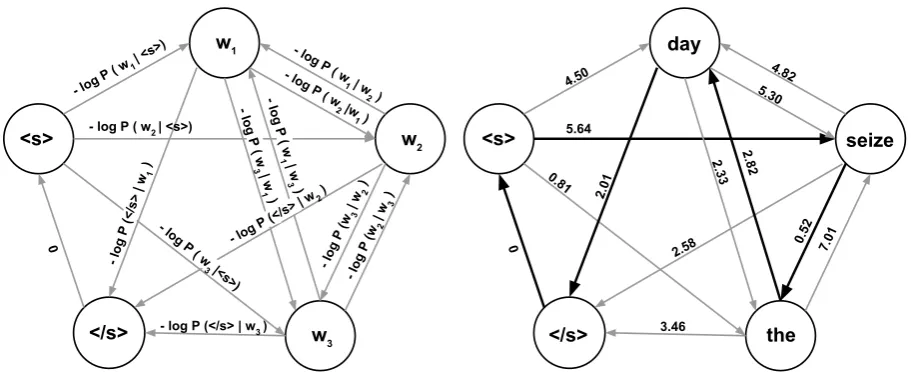
The conditional log probabilities of the form logP(wj|wi)are computed by a bigram language model. Consequently, finding the sentence permu-tation with the highest probability under the bi-gram language model equals finding the shortest tour in graphGor, equally, solving the Asymmet-ric Travelling Salesman Problem (ATSP). A gen-eral example graph for a sentence of length 3 is shown in Figure 1a.
- log P ( w
1 | <s>)
- log P (</s> | w3 ) - log P ( w
2 | <s>)
- log P ( w
1 | w 2 )
- log P ( w
2 |w 1 )
- log P (w
3
| w
2
)
- log P (w
2
| w
3
) - log P ( w
3 | w 1 )
- log P ( w
1 | w 3 )
- log P (</s> | w
1
)
- log P ( w
3 |<s>)
- log P (</s> | w
2 )
0
<s>
w1
w2
w3
</s>
(a) A general graph. The edge cost equals the negated bigram conditional log probability of the destination vertex given the origin vertex. Only edges with non-infinite edge cost are shown in the graph. Finding the shortest tour in the graph equals finding the sentence permutation with the highest prob-ability.
4.50
3.46 5.64
4.82 5.30
0.52 7.01 2.82
2.01 0.81
2.58 0
2.33
<s> seize
day
</s> the
(b) An example graph for the bag of words{day, seize, the
[image:3.595.73.529.61.247.2]}. The shortest tour is shown in bold and represents the word sequence<s>seize the day</s>with the log probability of −10.98. It is necessary to include the (</s> <s>) edge in order to complete the tour.
Figure 1: Graphs modelling a general (Figure 1a) and an example (Figure 1b) bag of words of size three under a bigram language model.
[image:3.595.311.532.423.464.2]finding the longest tour in graphGto the common problem of finding the shortest tour.
Figure 1b shows a graph for the example bag of words{ day, seize, the}. The shortest tour is shown in bold and represents the word sequence
<s>seize the day</s>. The shortest tour equals the sentence permutation with the highest proba-bility under the bigram language model.
The number of vertices and edges in the graph grows with the sizenof the bag of wordsS rep-resented by the graph G = (V, E). The size of the set of verticesV in the graph is|V|= n+ 2 and the size of the set of edgesEis|E|=|V|2 =
n2+ 4n+ 4.
We can draw several conclusions about the graph-based approach from its equality to the TSP. Firstly, we can observe that the problem of find-ing the highest probability permutation is an NP-hard problem. Secondly, modelling the problem as a TSP still presents a large improvement on the naive approach described in Section 2.1. The time complexity of the naive approach for a bag of words of sizenequalsO(n·n!). However, the al-gorithm for solving the TSP with the best-known running time guarantee has the time complexity of
O(n22n) (Held and Karp, 1962; Applegate et al., 2006b). Although the required time grows expo-nentially with the length of the sentence, it grows
significantly slower than with the factorial time complexity. This is illustrated in Table 1.
n 5 10 15
n22n 800 102,400 7,372,800
n·n! 600 36,288,000 19,615,115,520,000
Table 1: Illustration of problem size growth at in-creasing values ofnfor algorithms with time com-plexity ofO(n22n)andO(n·n!).
Finally, by modelling the problem as a TSP we are able to take advantage of the extensive re-search into the TSP and choose between hundreds of algorithms for solving it. Even though no al-gorithm with lower running time guarantee than
2.3 Higher N-gram Order Graph-Based Approach
Higher order N-gram language models use longer context compared to bigram language models when computing the conditional probability of the next word. This usually results in improved proba-bility estimates for sequences of words. Therefore, to improve our initial approach using bigrams, we extend it to higher order N-grams. We first ex-plain the intuition behind the approach and then continue with the formal definition.
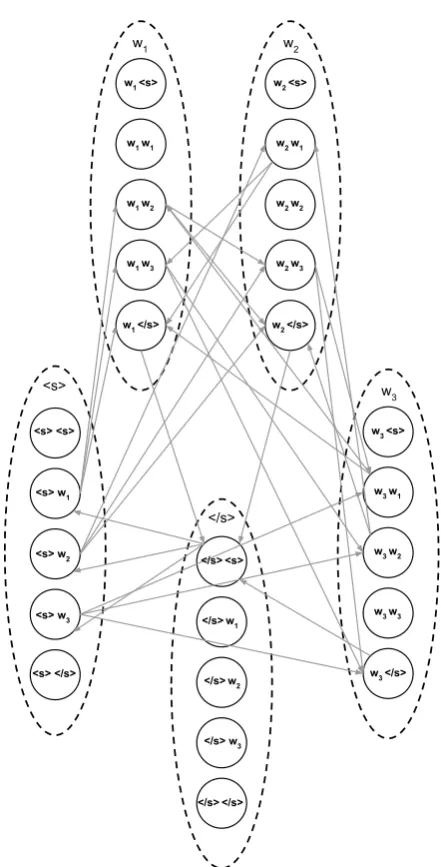
The higher N-gram Order Graph-Based Ap-proach can be modelled as a Generalized Asym-metric Travelling Salesman Problem (GATSP). GATSP is the directed (asymmetric) version of the Generalized Travelling Salesman Problem (GTSP). GTSP generalizes the TSP by grouping cities into sets called districts. GTSP can then be described as finding the shortest tour of lengths, visiting exactly one city in each of thesdistricts. In our formulation of the graphG, each vertex has a word sequence associated with it and the districts are defined by the first word in the sequence. This means that each word appears exactly once in the solution to the GATSP, ensuring that the solution is a valid permutation. A general example graph with districts for N = 3 and a bag of words of size 3 is shown in Figure 2.
This is formally defined as follows. For a bag of wordsS we define a set of symbolsX as before. For a general N-gram language model, N > 2, and a set of n symbolsX, |X| = n, we define ann-partite directed weighted graphG= (V, E), with the set of vertices defined as:
V ={wi|wi[j]∈Xfor1≤j≤N-1,
wi[j]6=wi[k]for1≤j < k < N} (3) Each vertex therefore represents a sequence of symbolswi[1..N-1]of lengthN −1from the set
X, and the symbols occurring in the sequence do not repeat themselves. The set of vertices V
is partitioned intondisjoint independent subsets,
Vi = {wj|wj ∈ V, wj[1] = i}, based on the first word in the word sequence,wj[1].
Let the set of edgesE be a set of ordered pairs of vertices(wi, wj), such that:
E ={(wi, wj)|wi ∈Vk, wj ∈Vl, k6=l,
wi[2..N-1] =wj[1..N-2],
wi[1]6=wj[N-1]}
(4)
w3 <s>
w3 w1
w3 w2
w3 w3
w3 </s> <s> <s>
<s> w1
<s> w2
<s> w3
<s> </s>
w1 <s>
w1 w1
w1 w2
w1 w3
w1 </s>
w2 <s>
w2 w1
w2 w2
w2 w3
w2 </s>
<s>
w1 w2
w3
</s><s>
</s>w1
</s>w2
</s> w3
</s></s>
[image:4.595.309.530.91.525.2]</s>
cij =
0 ifwi[N-1] =</s>andwj[N-1] =<s>,
−logP(wj[N-1]|wi[1..N-1]) ifandwi[wki[1]]∈S,6=2</s>≤k≤andNw-2
j[N-1]6=<s>,
−logP(wj[N-1]|wi[x..N-1]) ifandx≥wi[2xand-1] =wi[</s>x] =<s>
∞ otherwise.
(5)
An edge therefore exists between two vertices if they are parts of two different subsets ofV (have different first word in the sequence), have a ing subsequence, and the words outside the match-ing subsequence do not repeat between the two vertices. The edge cost is defined in Equation 5.
The conditional log probabilities of the form logP(wj[N-1]|wi[1..N-1]) are computed by an N-gram language model. Consequently, finding the highest probability permutation under an N-gram language model equals solving the Gener-alized Asymmetric Travelling Salesman Problem (GATSP) modelled by graph G.
An important condition for an edge to exist be-tween two vertices is that the word subsequences associated with the vertices match. If two vertices match, they form a word sequence of length N. The conditional log probability of the last word in the sequence given the previousN −1 words equals the cost of the edge between the vertices.
An additional condition for an edge to exist be-tween two vertices is that the words outside of the required matching subsequence do not repeat be-tween the vertices. For example, two sequences 1 2 3 4 and 2 3 4 1 match according to the condition described above, but outside the required match-ing subsequence (2 3 4), word 1 appears twice which produces an invalid permutation.
The size of the vertex and edge set of the graph
G = (V, E) grows with the sizenof the bag of wordsSand the orderN of theN-gram language model. The size of the set of vertices V in the graph is|V|= (n+2)N−1for all values ofN. The size of the set of edges E (including the infinite cost edges between the full set of vertices) is|E|=
|V|2 = (n+ 2)2N−2.
3 Implementation
The graph-based approach represents the problem of finding the sentence permutation with the high-est probability as an instance of the TSP. Using a bigram language model, the problem equals
solv-ing the Asymmetric TSP. Ussolv-ing a higher order N-gram language model, the problem equals solving the Generalized Asymmetric TSP.
Both variations of the TSP are not as widely studied as the basic TSP and fewer algorithms ex-ist for solving them. Transforming the variations of TSP to basic TSP is a solved problem that en-ables us to use state-of-the-art algorithms for solv-ing large problem instances of the TSP. We de-cided to use the Concorde TSP Solver (Applegate et al., 2006a), which is prominent for continuously increasing the size of the largest optimally solved TSP instance over the last two decades.
Alternatively, a heuristic algorithm for solving the TSP can be used. Heuristic algorithms do not guarantee finding the optimal solution, but attempt to find the best possible solution given a time con-straint. We used LKH as the heuristic TSP solver, which is an effective implementation of the Lin-Kernighan heuristic (Helsgaun, 2000). It currently holds the record for many large TSP instances with unknown optima.
[image:5.595.312.521.656.714.2]The use of a TSP solver makes it necessary to transform the instances of ATSP and GATSP into regular TSP instances. We applied two graph transformations as necessary: (1) GATSP to ATSP transformation described by Dimitrijevi´c and ˇSari´c (1997) and (2) ATSP to TSP transfor-mation described by Jonker and Volgenant (1983). These transformations allow application of the general TSP solver, although they each double the number of vertices in the graph.
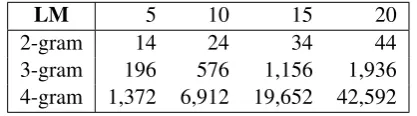
Table 2 shows the total size of the vertex set af-ter applying the transformations.
LM 5 10 15 20
2-gram 14 24 34 44
3-gram 196 576 1,156 1,936 4-gram 1,372 6,912 19,652 42,592
4 Evaluation
We evaluated three different versions of the graph-based approach graph-based on 2-gram, 3-gram, and 4-gram language models. We evaluated each version of the system on three datasets of news sentences by computing the dataset-wide BLEU scores.
4.1 Language models
For the experimental evaluation of our graph-based approach we used 2-gram, 3-gram, and 4-gram language models with interpolated modi-fied Kneser-Ney smoothing (Chen and Goodman, 1998). They were built using the SRI Language Modeling Toolkit (Stolcke, 2002) and KenLM Language Model Toolkit (Heafield, 2011).
The language models were estimated on the English Gigaword collection (V2, AFP and XIN parts) and the NIST OpenMT12 Evaluation Dataset (target sides of parallel data for Ar-Eng and Ch-Eng tasks).
The total size of the corpus for estimating the lan-guage models was 1.16 billion words.
4.2 Evaluation metric
The BLEU evaluation metric was developed by Papineni et al. (2002) as an inexpensive and fast method of measuring incremental progress of SMT systems. BLEU measures closeness of a candidate translation to a reference translation us-ing N-gram precision. Similarly, in the strus-ing re-generation problem we measure the closeness of the regenerated sentence to the original sentence. We used the case insensitive NIST BLEU script v13 against tokenized references to compute the BLEU scores.
Espinosa et al. (2010) have investigated the use of various automatic evaluation metrics to mea-sure the quality of NLG output. They found that BLEU correlates moderately well with human judgements of fluency and that it is useful for eval-uation of NLG output, but should be used with caution, especially when comparing different sys-tems. As the string regeneration problem is a basic form of NLG, BLEU is an appropriate measure of the system’s performance with regards to fluency of the output. We provide examples of output and conduct a manual evaluation to confirm that the BLEU scores of individual systems reflect actual changes in output quality.
4.3 Automatic Evaluation
We evaluated the graph-based approach on three datasets:
MT08 The target side of the Ar-Eng newswire part of the NIST OpenMT08.
MT09 The target side of the Ar-Eng newswire part of the NIST OpenMT09.
SR11 The plain text news dataset of the Surface Realisation Task at GenChal’11.
The MT08, MT09, and SR11 datasets contain 813, 586, and 2398 sentences respectively.
We have taken preprocessing steps to chop long sentences into manageable parts, which is a com-mon practice in translation. Based on prelimi-nary experiments we decided to limit the maxi-mum length of the chopped sentence to 20 words. N-gram models cannot be used to model sentences shorter than N words in this approach. In or-der to make the models comparable we ignored short sentences containing 4 or fewer words. Each chopped sentence was regenerated separately and the regenerated chopped sentences were concate-nated to form the original number of dataset sen-tences. We expect that the preprocessing steps in-creased the reported BLEU scores to a certain de-gree. However, all systems compared in the exper-imental evaluation were subject to the same condi-tions and their scores are therefore comparable.
The graphs constructed under a 4-gram lan-guage model are too large to solve optimally in reasonable time (i.e. under half an hour per sen-tence). Because of this, we employ two ap-proaches to regenerate long sentences with the 4-gram language model: (1) Use the LKH heuristic algorithm with a set time limit, and (2) back-off to the trigram language model. We refer the reader to Horvat (2013) for details.
LM Solver MT08 MT09 SR11
2g opt 44.4 45.1 40.6
3g opt 57.9 58.0 50.2
4g opt +heur 44.8 42.6 51.7 4g +3g opt 59.1 59.5 51.8
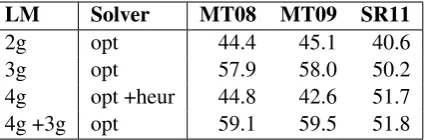
Table 3: BLEU scores for four versions of the graph-based approach, based on 2-gram, 3-gram, and 4-gram language models. We used the 4-gram approach on sentences of up to length 18. The re-maining sentences were computed using either a heuristic TSP solver (opt +heur) or by backing-off to a 3-gram approach (4g +3g).
sentences in MT08 and MT09 datasets are longer than 18 words. On the other hand, less than 1% of chopped sentences of the SR11 dataset are longer than 18 words. This means that significant parts of the MT08 and MT09 datasets were solved us-ing the heuristic approach, compared to a small part of the SR11 dataset. Using a heuristic TSP solver therefore clearly negatively affects the per-formance of the system. The 4-gram approach backing-off to the 3-gram approach achieved a higher BLEU score than the 3-gram approach over all datasets.
In Figure 3 we show examples of regenerated sentences for three versions of the system. In the first example, we can see the improvements in the output fluency with better versions of the system. The improvements are reflected by the BLEU scores. The 4-gram output can be consid-ered completely fluent. However, when compared to the original sentence, its BLEU score is not 100, due to the fact that the number of people killed and people injured are switched. In this regard, BLEU score is harsh and not an ideal evaluation metric for the task. In the second example, the origi-nal sentence contains complicated wording which is reflected in poor performance of all three ver-sions of the system, despite the high BLEU score of the 3-gram system. In the final example, we can observe the gradual improvement of fluency over the three versions of the system. This is reflected by the BLEU score, which reaches 100.0 for the 4-gram system, which produced an identical sen-tence to the original.
4.4 Manual Evaluation
We manually evaluated three versions of the graph-based approach: 2-gram, 3-gram, and
4-gram system using 3-4-gram as back-off. We con-ducted a pairwise comparison of the three sys-tems: for each evaluation sentence, we compared the output of a pair of systems and asked which output is more fluent.
We used the crowdsourcing website Crowd-Flower1to gather fluency judgments. Judges were
asked ‘Please read both sentences and compare the fluency of sentence 1 and sentence 2.’ They were given three options: ‘Sentence 1 is more fluent’, ‘Sentence 2 is more fluent’, ‘Sentence 1 and Sen-tence 2 are indistinguishable in fluency’. The or-der of presentation of the two systems was ran-domized for each sentence.
100 sentences of length between 5 and 18 words were chosen randomly from the combined MT08 and MT09 dataset. We gathered 5 judgements for each sentence of a single pairwise comparison of two systems. Each pairwise comparison of two systems is therefore based on 500 human judge-ments.
The platform measures the reliability of judges by randomly posing gold standard questions in between regular questions. If any judge incor-rectly answered a number of gold standard ques-tions, their judgements were deemed unreliable and were not used in the final result set. A thor-ough discussion of suitability and reliability of crowdsourcing for NLP and SMT tasks and re-lated ethical concerns can be found in: Snow et al. (2008), Zaidan and Callison-Burch (2011), and Fort et al. (2011).
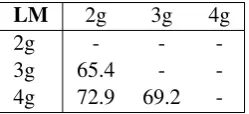
[image:7.595.76.289.62.132.2]The pairwise comparison results are shown in Table 4. Each number represents the proportion of the human judgements that rated the output of the row system as better than the column system. The raw numbers of pairwise comparison judgements in favor of each system are shown in Table 5. A one-sided sign test indicated that we can reject the null hypothesis of the two systems being equal in favor of the alternative hypothesis of the first tem being better than the second for all three sys-tem pairings: 3g and 2g, 4g and 2g, and 4g and 3g,
p < 0.001 for all three comparisons. The man-ual evaluation results therefore confirm the BLEU score differences between the three graph-based systems.
Interestingly, in automatic evaluation the differ-ence in BLEU scores between 2g and 3g systems was much bigger (around 10 BLEU points) than
Hypothesis BLEU
1. REF meanwhile , azim stated that 10 people were killed and 94 injured in yesterday ’s clashes .
(a) meanwhile , azim and 10 people were injured in clashes yesterday ’s stated that killed 94 . 21.4 (b) azim , meanwhile stated that 94 people were killed and 10 injured in yesterday ’s clashes . 50.4 (c) meanwhile , azim stated that 94 people were killed and 10 injured in yesterday ’s clashes . 66.3 2. REF zinni indicated in this regard that president mubarak wants egypt to work with the west .
(a) egypt wants zinni in this regard to work with president mubarak indicated that the west . 24.9 (b) zinni wants egypt to work with the west that president mubarak indicated in this regard . 63.4 (c) work with zinni indicated that president mubarak wants the west to egypt in this regard . 30.6 3. REF he stressed that this direction is taking place in all major cities of the world .
(a) he stressed that the world is taking place in this direction of all major cities . 33.9 (b) he stressed that all major cities of the world is taking place in this direction . 58.0 (c) he stressed that this direction is taking place in all major cities of the world . 100.0
Figure 3: Output examples of three versions of the graph-based approach: (a) 2-gram, (b) 3-gram, and (c) 4-gram with 3-gram back-off. The original sentence is given for each of the three examples. Sentence BLEU scores are shown for each regenerated sentence.
LM 2g 3g 4g
2g - -
-3g 65.4 -
-4g 72.9 69.2
-Table 4: Manual evaluation results of pairwise comparison between three versions of the system: 2-gram, gram, and the 4-gram system with 3-gram back-off. The numbers represent the per-centage of judgements in favor of the row system when paired with the column system.
the difference between 3g and 4g systems (around 1 BLEU point). However, in manual evaluation the difference between 3g and 4g systems is no-ticeably bigger (69.2%) than the difference be-tween 2g and 3g systems (65.4%).
sys1 sys2 sys1 equal sys2 Total
2g 3g 124 142 234 500
2g 4g 102 124 274 500
[image:8.595.88.517.59.204.2]3g 4g 92 201 207 500
Table 5: The raw numbers of pairwise compari-son judgements between the three systems. The columns give the number of judgements in favor of each of the three options.
5 Related Work
The basic task of all natural language realization approaches is to take a meaning representation as input and generate human-readable output. The approaches differ on how much information is re-quired from the meaning representation. Deep representation include dependency graphs
anno-tated with semantic labels and other syntactic in-formation (Belz et al., 2011). Shallow represen-tations include syntactic dependency trees anno-tated with POS tags and other syntactic informa-tion (Belz et al., 2011), IDL-expressions (Soricut and Marcu, 2005), and Abstract Meaning Repre-sentation (Langkilde and Knight, 1998).
Soricut and Marcu (2005) consider NLG in context of other popular natural language appli-cations, such as Machine Translation, Summa-rization, and Question Answering. They view these as text-to-text applications that produce tex-tual output from textex-tual input. Because of this, many natural language applications need to in-clude some form of natural language generation to produce the output text. However, the natu-ral language generation in these applications is of-ten handled in an application-specific way. They propose to use IDL-expressions as an application-independent representation language for text-to-text NLG. The IDL-expressions are created from strings using operators to combine them. The au-thors evaluate their approach on the string regen-eration task and achieve moderate BLEU scores.
[image:8.595.120.245.273.330.2]trees containing any choice and ordering of the in-put words. The CCG approach achieved higher BLEU scores compared to the approach proposed by Wan et al. (2009). Zhang et al. (2012) improve the CCG approach by Zhang and Clark (2011) by incorporating an N-gram language model. de Gis-pert et al. (2014) present a similar N-gram lan-guage model approach to ours with a different de-coder that does not guarantee optimal results. In their comparison with approach by Zhang et al. (2012) they report gains of more than 20 BLEU points.
The purpose of studying and building ap-proaches to solving the string regeneration prob-lem is to improve grammaticality and fluency of machine generated text. An approach using a TSP reordering model by Visweswariah et al. (2011) focused on the preordering task in SMT. In the preordering task the words of the source sentence are reordered to reflect the word order expected in the target sentence which helps improve the per-formance of the SMT system.
6 Conclusions and Future Work
In the paper we explored the N-gram language model approach to the string regeneration prob-lem of recovering a fluent version of the original sentence given a bag of words. The N-gram lan-guage model approach computes the highest prob-ability permutation of the input bag of words un-der an N-gram language model. We described a graph-based approach for finding the optimal per-mutation. Finding the permutation with the high-est probability in the graph formulation is equal to finding the shortest tour in the graph or, equally, solving the Travelling Salesman Problem.
We evaluated the proposed approach on three datasets. The BLEU scores and example output indicated that the graph-based approach is suc-cessful in constructing a fairly fluent version of the original sentence. The 2-gram based approach performed moderately well but was surpassed by the 3-gram based approach. The 4-gram based ap-proach offered an improvement on the 3-gram but is not of much practical use due to its long compu-tation times. Approximate solutions computed us-ing a heuristic TSP solver significantly reduced the quality of the output and resulting BLEU score. We confirmed the results of automatic evaluation by conducting a manual evaluation.
The BLEU scores of our approach and the
ap-proach by Wan et al. (2009) can’t be directly com-pared as we used different evaluation datasets and preprocessing procedures. Nonetheless, the differ-ence in BLEU scores is stark, our best system out-performing theirs by more than 20 BLEU points.
The work presented in this paper can be ex-tended in a number of ways. More extensive comparison between optimal and approximate ap-proaches would help draw stronger conclusions re-garding the need for optimality. A direct compar-ison between our N-gram language model based approach and approaches presented by Wan et al. (2009), Zhang et al. (2012), and others is needed to determine its performance relative to other ap-proaches.
The graph-based approach itself can be ex-tended in a number of ways. Emulating meth-ods from Statistical Machine Translation, the ap-proach could be extended to generate an N-best list of reorderings. A different method could then be used to rerank the N-best list to choose the best one. The methods can range from rescoring the outputs with a higher-order language model or a dependency language model, to using discrimina-tive machine learning. The approach could also be extended to handle additional constraints in the input, such as phrases instead of words, by modi-fying the edge weights of the graph.
Another interesting area of future research re-lating to the wider string regeneration problem is determining the human performance on the task. Based on a simple trial of trying to regenerate a long sentence by hand, it is clear that human per-formance on the task would not equal 100 BLEU points. It would therefore be interesting to deter-mine the human performance on the string regen-eration problem to provide a contrast and a point of comparison to the performance of machine sys-tems.
Acknowledgments
We thank Juan Pino for his help with language modeling and experiments. We thank Ann Copes-take and the anonymous reviewers for their discus-sions and suggestions.
Matic Horvat was supported by the Ad Futura Scholarship during his work on the MPhil thesis.
References
David L. Applegate, Robert E. Bixby, Vaˇsek Chv´atal, and William J. Cook. 2006a. Concorde TSP Solver. David L. Applegate, Robert E. Bixby, Vaˇsek Chv´atal,
and William J. Cook. 2006b. The Traveling
Sales-man Problem: A Computational Study. Princeton University Press.
David L. Applegate, Robert E. Bixby, Vaˇsek Chv´atal, William Cook, Daniel G. Espinoza, Marcos Goy-coolea, and Keld Helsgaun. 2009. Certification of
an optimal TSP tour through 85,900 cities.
Opera-tions Research Letters, 37(1):11–15, January. Anja Belz, Michael White, Dominic Espinosa, Eric
Kow, Deirdre Hogan, and Amanda Stent. 2011. The First Surface Realisation Shared Task : Overview
and Evaluation Results. InProceedings of the 13th
European Workshop on Natural Language Genera-tion (ENLG), volume 2, pages 217–226.
Stanley F. Chen and Joshua T. Goodman. 1998. An Empirical Study of Smoothing Techniques for Lan-guage Modeling. Technical report, Harvard Univer-sity.
Adri`a de Gispert, Marcus Tomalin, and William Byrne. 2014. Word Ordering with Phrase-Based
Gram-mars. In Proceedings of the European Chapter of
the Association for Computational Linguistics, num-ber 2009.
Vladimir Dimitrijevi´c and Zoran ˇSari´c. 1997. An Efficient Transformation of the Generalized Trav-eling Salesman Problem into the TravTrav-eling
Sales-man Problem on DIgraphs. Information Sciences,
102:105–110.
Dominic Espinosa, Rajakrishnan Rajkumar, Michael White, and Shoshana Berleant. 2010. Further Meta-Evaluation of Broad-Coverage Surface Realization. Proceedings of the 2010 Conference on Empirical Methods in Natural Language Processing, pages 564–574.
Kar¨en Fort, Adda Gilles, and K. Bretonnel Cohen. 2011. Amazon Mechanical Turk: Gold Mine or
Coal Mine? Computational Linguistics, 37(2):413–
420.
Kenneth Heafield. 2011. KenLM : Faster and Smaller
Language Model Queries. In Proceedings of the
Sixth Workshop on Statistical Machine Translation, number 2009, pages 187–197.
Michael Held and Richard M. Karp. 1962. A Dy-namic Programming Approach to Sequencing
Prob-lems. Society for Industrial and Applied
Mathemat-ics, 10(1):196–210.
Keld Helsgaun. 2000. An effective implementa-tion of the LinKernighan traveling salesman heuris-tic. European Journal of Operational Research, 126(1):106–130.
Matic Horvat. 2013. A Graph-Based Approach to
String Regeneration. Ph.D. thesis.
Roy Jonker and Ton Volgenant. 1983. Transform-ing Asymmetric into Symmetric TravelTransform-ing Salesman
Problems. Operations Research Letters, 2(4):161–
163.
Kevin Knight. 2007. Automatic language
transla-tion generatransla-tion help needs badly. InMT Summit XI
Work- shop on Using Corpora for NLG: Keynote Ad-dress, pages 5–8.
Irene Langkilde and Kevin Knight. 1998. Generation that Exploits Corpus-Based Statistical Knowledge. InProceedings of the 17th international conference on Computational linguistics, pages 704–710. Kishore Papineni, Salim Roukos, Todd Ward, and
Wei-jing Zhu. 2002. BLEU : a Method for Automatic
Evaluation of Machine Translation. In
Proceed-ings of the 40th Annual Meeting of the Association for Computational Linguistics (ACL), number July, pages 311–318, Philadelphia.
Rion Snow, Brendan O Connor, Daniel Jurafsky, and Andrew Y Ng. 2008. Cheap and Fast But is it Good ? Evaluating Non-Expert Annotations for Natural
Language Tasks. InProceedings of the 2008
Con-ference on Empirical Methods in Natural Language Processing, number October, pages 254–263. Radu Soricut and Daniel Marcu. 2005. Towards
Developing Generation Algorithms for Text-to-Text
Applications. In Proceedings of the 43rd Annual
Meeting of the ACL, number June, pages 66–74, Ann Arbor.
Andreas Stolcke. 2002. SRILM - an extensible lan-guage modeling toolkit. InProceedings of the Inter-national Conference on Spoken Language Process-ing, pages 901–904.
Karthik Visweswariah, Rajakrishnan Rajkumar, Ankur Gandhe, Ananthakrishnan Ramanathan, and Jiri Navratil. 2011. A Word Reordering Model for
Im-proved Machine Translation. InProceedings of the
Conference on Empirical Methods in Natural Lan-guage Processing, pages 486–496.
Omar F Zaidan and Chris Callison-Burch. 2011. Crowdsourcing translation: Professional quality
from non-professionals. InProceedings of the 49th
Annual Meeting of the Association for Computa-tional Linguistics: Human Language Technologies, pages 1220–1229.
Yue Zhang and Stephen Clark. 2011.
Syntax-Based Grammaticality Improvement using CCG and
Guided Search. InProceedings of the Conference on
Empirical Methods in Natural Language Process-ing, pages 1147–1157.
Yue Zhang, Graeme Blackwood, and Stephen Clark. 2012. Syntax-Based Word Ordering Incorporating a
Large-Scale Language Model. InProceedings of the