Sampling Alignment Structure under a Bayesian Translation Model
John DeNero, Alexandre Bouchard-Cˆot´e and Dan Klein Computer Science Department
University of California, Berkeley
{denero, bouchard, klein}@cs.berkeley.edu
Abstract
We describe the first tractable Gibbs sam-pling procedure for estimating phrase pair frequencies under a probabilistic model of phrase alignment. We propose and evalu-ate two nonparametric priors that successfully avoid the degenerate behavior noted in previ-ous work, where overly large phrases mem-orize the training data. Phrase table weights learned under our model yield an increase in BLEU score over the word-alignment based heuristic estimates used regularly in phrase-based translation systems.
1 Introduction
In phrase-based translation, statistical knowledge of translation equivalence is primarily captured by counts of how frequently various phrase pairs occur in training bitexts. Since bitexts do not come seg-mented and aligned into phrase pairs, these counts are typically gathered by fixing a word alignment and applying phrase extraction heuristics to this word-aligned training corpus. Alternatively, phrase pair frequencies can be learned via a probabilistic model of phrase alignment, but this approach has presented several practical challenges.
In this paper, we address the two most signifi-cant challenges in phrase alignment modeling. The first challenge is with inference: computing align-ment expectations under general phrase models is #P-hard (DeNero and Klein, 2008). Previous phrase alignment work has sacrificed consistency for effi-ciency, employing greedy hill-climbing algorithms and constraining inference with word alignments (Marcu and Wong, 2002; DeNero et al., 2006; Birch et al., 2006). We describe a Gibbs sampler that con-sistently and efficiently approximates expectations, using only polynomial-time computable operators. Despite the combinatorial complexity of the phrase
alignment space, our sampled phrase pair expecta-tions are guaranteed to converge to the true poste-rior distributions under the model (in theory) and do converge to effective values (in practice).
The second challenge in learning phrase align-ments is avoiding a degenerate behavior of the gen-eral model class: as with many models which can choose between large and small structures, the larger structures win out in maximum likelihood estima-tion. Indeed, the maximum likelihood estimate of a joint phrase alignment model analyzes each sen-tence pair as one large phrase with no internal struc-ture (Marcu and Wong, 2002). We describe two non-parametric priors that empirically avoid this degen-erate solution.
Fixed word alignments are used in virtually ev-ery statistical machine translation system, if not to extract phrase pairs or rules directly, then at least to constrain the inference procedure for higher-level models. We estimate phrase translation features consistently using an inference procedure that is not constrained by word alignments, or any other heuris-tic. Despite this substantial change in approach, we report translation improvements over the standard word-alignment-based heuristic estimates of phrase table weights. We view this result as an important step toward building fully model-based translation systems that rely on fewer procedural heuristics.
2 Phrase Alignment Model
While state-of-the-art phrase-based translation sys-tems include an increasing number of features, translation behavior is largely driven by the phrase pair count ratiosφ(e|f)andφ(f|e). These features are typically estimated heuristically using the counts
c(he, fi)of all phrase pairs in a training corpus that are licensed by word alignments:
φ(e|f) = Pc(he, fi)
e0c(he0, fi) .
Gracias , lo haré de muy buen grado .
you do so Thank , I shall gladly. you do so
Thank , I shall gladly. Gracias , lo haré de muy buen grado .
(a) example word alignment (b) example phrase alignment
Figure 1: In this corpus example, the phrase alignment model found the non-literal translation pair hgladly,de muy buen gradoi while heuristically-combined word alignment models did not. (a) is a
grow-diag-final-andcombined IBM Model 4 word alignment;
(b) is a phrase alignment under our model.
In contrast, a generative model that explicitly aligns pairs of phraseshe, figives us well-founded alternatives for estimating phrase pair scores. For instance, we could use the model’s parameters as translation features. In this paper, we compute the expected counts of phrase pairs in the training data according to our model, and derive features from these expected counts. This approach endows phrase pair scores with well-defined semantics relative to a probabilistic model. Practically, phrase models can discover high-quality phrase pairs that often elude heuristics, as in Figure 1. In addition, the model-based approach fits neatly into the framework of sta-tistical learning theory for unsupervised problems.
2.1 Generative Model Description
We first describe the symmetric joint model of Marcu and Wong (2002), which we will extend. A two-step generative process constructs an ordered set of English phrases e1:m, an ordered set of
for-eign phrasesf1:n, and a phrase-to-phrase alignment
between them,a ={(j, k)}indicating thathej, fki
is an aligned pair.
1. Choose a number of components`and generate each of`phrase pairs independently.
2. Choose an ordering for the phrases in the for-eign language; the ordering for English is fixed by the generation order.1
1
We choose the foreign to reorder without loss of generality.
In this process,m = n = |a|; all phrases in both sentences are aligned one-to-one.
We parameterize the choice of`using a geometric distribution, denotedPG, with stop parameterp$:
P(`) =PG(`;p$) =p$·(1−p$)`−1 .
Each aligned phrase pair he, fi is drawn from a multinomial distribution θJ which is unknown. We fix a simple distortion model, setting the probability of a permutation of the foreign phrases proportional to the product of position-based distortion penalties for each phrase:
P(a|{he, fi}) ∝ Y
a∈a
δ(a)
δ(a= (j, k)) = b|pos(ej)−pos(fk)·s| ,
wherepos(·)denotes the word position of the start of a phrase, andsthe ratio of the length of the En-glish to the length of the foreign sentence. This po-sitional distortion model was deemed to work best by Marcu and Wong (2002).
We can now state the joint probability for a phrase-aligned sentence consisting of`phrase pairs:
P({he, fi},a) =PG(`;p$)P(a|{he, fi}) Y
he,fi
θJ(he, fi).
While this model has several free parameters in ad-dition toθJ, we fix them to reasonable values to fo-cus learning on the phrase pair distribution.2
2.2 Unaligned Phrases
Sentence pairs do not always contain equal informa-tion on both sides, and so we revise the generative story to include unaligned phrases in both sentences. When generating each component of a sentence pair, we first decide whether to generate an aligned phrase pair or, with probability pø, an unaligned phrase.3
Then, we either generate an aligned phrase pair from
θJ or an unaligned phrase from θN, where θN is a multinomial over phrases. Now, when generating
e1:m, f1:n and alignmenta, the number of phrases
m+ncan be greater than2· |a|.
2
Parameters were chosen by hand during development on a small training corpus.p$= 0.1,b= 0.85in experiments.
3
To unify notation, we denote unaligned phrases as phrase pairs with one side equal tonull:he, nullior
hnull, fi. Then, the revised model takes the form:
P({he, fi},a) = PG(`;p$)P(a|{he, fi}) Y
he,fi
PM(he, fi)
PM(he, fi) = pøθN(he, fi) + (1−pø)θJ(he, fi).
In this definition, the distribution θN gives non-zero weight only to unaligned phrases of the form
he, nulli or hnull, fi, while θJ gives non-zero weight only to aligned phrase pairs.
3 Model Training and Expectations
Our model involves observed sentence pairs, which in aggregate we can callx, latent phrase segmenta-tions and alignments, which we can callz, and pa-rameters θJ and θN, which together we can call θ. A model such as ours could be used either for the learning of the key phrase pair parameters inθ, or to compute expected counts of phrase pairs in our data. These two uses are very closely related, but we focus on the computation of phrase pair expecta-tions. For exposition purposes, we describe a Gibbs sampling algorithm for computing expected counts of phrases under P(z|x, θ) for fixed θ. Such ex-pectations would be used, for example, to compute maximum likelihood estimates in the E-step of EM. In Section 4, we instead compute expectations under
P(z|x), withθmarginalized out entirely.
In a Gibbs sampler, we start with a complete
phrase segmentation and alignment, statez0, which
sets all latent variables to some initial configuration. We then produce a sequence of sample states zi,
each of which differs from the last by some small local change. The sampleszi are guaranteed (in the
limit) to consistently approximate the conditional distributionP(z|x, θ)(orP(z|x)later). Therefore, the average counts of phrase pairs in the samples converge to expected counts under the model. Nor-malizing these expected counts yields estimates for the featuresφ(e|f)andφ(f|e).
Gibbs sampling is not new to the natural language processing community (Teh, 2006; Johnson et al., 2007). However, it is usually used as a search pro-cedure akin to simulated annealing, rather than for approximating expectations (Goldwater et al., 2006; Finkel et al., 2007). Our application is also atypical
for an NLP application in that we use an approxi-mate sampler not only to include Bayesian prior in-formation (section 4), but also because computing phrase alignment expectations exactly is a #P-hard problem (DeNero and Klein, 2008). That is, we could not run EM exactly, even if we wanted maxi-mum likelihood estimates.
3.1 Related Work
Expected phrase pair counts under P(z|x, θ) have been approximated before in order to run EM. Marcu and Wong (2002) employed local search from a heuristic initialization and collected ment counts during a hill climb through the align-ment space. DeNero et al. (2006) instead proposed an exponential-time dynamic program pruned using word alignments. Subsequent work has relied heav-ily on word alignments to constrain inference, even under reordering models that admit polynomial-time E-steps (Cherry and Lin, 2007; Zhang et al., 2008).
None of these approximations are consistent, and they offer no method of measuring their biases. Gibbs sampling is not only consistent in the limit, but also allows us to add Bayesian priors conve-niently (section 4). Of course, sampling has liabili-ties as well: we do not know in advance how long we need to run the sampler to approximate the desired expectations “closely enough.”
Snyder and Barzilay (2008) describe a Gibbs sam-pler for a bilingual morphology model very similar in structure to ours. However, the basic sampling step they propose – resampling all segmentations and alignments for a sequence at once – requires a #P-hard computation. While this asymptotic com-plexity was apparently not prohibitive in the case of morphological alignment, where the sequences are short, it is prohibitive in phrase alignment, where the sentences are often very long.
3.2 Sampling with the SWAPOperator
Our Gibbs sampler repeatedly applies each of five operators to each position in each training sentence pair. Each operator freezes all of the current statezi
except a small local region, determines all the ways that region can be reconfigured, and then chooses a (possibly) slightly differentzi+1 from among those
frozen region of the state is called aMarkov blanket
(denotedm), and plays a critical role in proving the correctness of the sampler.
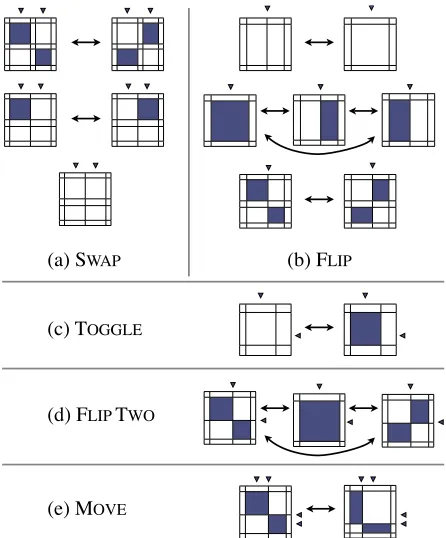
The first operator we consider is SWAP, which changes alignments but not segmentations. It freezes the set of phrases, then picks two English phrasese1
ande2 (or two foreign phrases, but we focus on the
English case). All alignments are frozen except the phrase pairshe1, f1iandhe2, f2i. SWAPchooses
be-tween keepinghe1, f1iandhe2, f2i aligned as they
are (outcome o0), or swapping their alignments to
createhe1, f2iandhe2, f1i(outcomeo1).
SWAP chooses stochastically in proportion to each outcome’s posterior probability:P(o0|m, x, θ)
and P(o1|m, x, θ). Each phrase pair in each
out-come contributes to these posteriors the probability of adding a new pair, deciding whether it is null, and generating the phrase pair along with its contribu-tion to the distorcontribu-tion probability. This is all captured in a succinct potential functionψ(he, fi) =
(
(1−p$) (1−pø)θJ(he, fi)δ(he, fi) e&fnon-null
(1−p$)·pø·θN(he, fi) otherwise
.
Thus, outcome o0 is chosen with probability P(o0|m, x, θ) =
ψ(he1, f1i)ψ(he2, f2i)
ψ(he1, f1i)ψ(he2, f2i) +ψ(he1, f2i)ψ(he2, f1i) .
Operators in a Gibbs sampler require certain con-ditions to guarantee the correctness of the sampler. First, they must choose amongall possible configu-rationsof the unfrozen local state. Second, imme-diately re-applying the operator from any outcome must yield the same set of outcome options as be-fore.4 If these conditions are not met, the sampler may no longer be guaranteed to yield consistent ap-proximations of the posterior distribution.
A subtle issue arises with SWAP as defined: should it also consider an outcomeo2 ofhe1, nulli
and he2, nulli that removes alignments? No part
of the frozen state is changed by removing these alignments, so the first Gibbs condition dictates that we must include o2. However, after choosing o2,
when we reapply the operator to positions e1 and
4These are two sufficient conditions to guarantee that the
Metropolis-Hastings acceptance ratio of the sampling step is 1.
(b) FLIP
(a) SWAP
(c) TOGGLE
(d) FLIP TWO
[image:4.612.315.538.55.324.2](e) MOVE
Figure 2: Each local operator manipulates a small portion of a single alignment. Relevant phrases are exaggerated for clarity. The outcome sets (depicted by arrows) of each possible configuration are fully connected. Certain con-figurations cannot be altered by certain operators, such as the final configuration in SWAP. Unalterable configura-tions for TOGGLEhave been omitted for space.
e2, we freeze all alignments except he1, nulli and he2, nulli, which prevents us from returning to o0.
Thus, we fail to satisfy the second condition. This point is worth emphasizing because some prior work has treated Gibbs sampling as randomized search and, intentionally or otherwise, proposed inconsis-tent operators.
Luckily, the problem is not with SWAP, but with our justification of it: we can salvage SWAPby aug-menting its Markov blanket. Given that we have se-lected he1, f1i andhe2, f2i, we not only freeze all
other alignments and phrase boundaries, but also the number of aligned phrase pairs. With this count held invariant,o2 is not among the possible outcomes of
SWAP given m. Moreover, regardless of the out-come chosen, SWAP can immediately be reapplied at the same location with the same set of outcomes.
The boys are
Ellos
comen
Current State
Includes segmentations and alignments for all sentence pairs
Markov Blanket
Freezes most of the segmentations and alignments, along with the alignment count
Outcomes
An exhaustive set of possibilities given the Markov blanket
eating
?
?
Apply the FLIP operatorto English position 1
1
Compute the conditional probability of each outcome
2
Finally, select a new state proportional to its conditional probability
3
[image:5.612.75.295.58.313.2]?
Figure 3: The three steps involved in applying the FLIP operator. The Markov blanket freezes all segmentations except English position 1 and all alignments except those forEllosandThe boys. The blanket also freezes the num-ber of alignments, which disallows the lower right out-come.
3.3 The FLIPoperator
SWAP can arbitrarily shuffle alignments, but we need a second operator to change the actual phrase boundaries. The FLIPoperator changes the status of a singlesegmentation position5to be either a phrase boundary or not. In this sense FLIP is a bilingual analog of the segmentation boundary flipping oper-ator of Goldwater et al. (2006).
Figure 3 diagrams the operator and its Markov blanket. First, FLIPchooses any between-word po-sition in either sentence. The outcome sets for FLIP
vary based on the current segmentation and adjacent alignments, and are depicted in Figure 2.
Again, for FLIP to satisfy the Gibbs conditions, we must augment its Markov blanket to freeze not only all other segmentation points and alignments, but also the number of aligned phrase pairs. Oth-erwise, we end up allowing outcomes from which
5
A segmentation position is a position between two words that is also potentially a boundary between two phrases in an aligned sentence pair.
we cannot return to the original state by reapply-ing FLIP. Consequently, when a position is already
segmented and both adjacent phrases are currently aligned, FLIP cannot unsegment the point because it can’t create two aligned phrase pairs with the one larger phrase that results (see bottom of Figure 2(b)).
3.4 The TOGGLEoperator
Both SWAP and FLIP freeze the number of align-ments in a sentence. The TOGGLEoperator, on the other hand, can add or remove individual alignment links. In TOGGLE, we first choose ane1 andf1. If he1, f1i ∈ a or both e1 and f1 are null, we freeze
all segmentations and the rest of the alignments, and choose between includinghe1, f1i in the alignment
or leaving bothe1 andf1 unaligned. If only one of e1andf1are aligned, or they are not aligned to each
other, then TOGGLEdoes nothing.
3.5 A Complete Sampler
Together, FLIP, SWAP and TOGGLE constitute a complete Gibbs sampler that consistently samples from the posterior P(z|x, θ). Not only are these operators valid Gibbs steps, but they also can form a path of positive probability from any source state to any target state in the space of phrase alignments (formally, the induced Markov chain isirreducible). Such a path can at worst be constructed by unalign-ing all phrases in the source state with TOGGLE, composing applications of FLIP to match the target phrase boundaries, then applying TOGGLEto match
the target alignments.
We include two more local operators to speed up the rate at which the sampler explores the hypothesis space. In short, FLIPTWO simultaneously flips an English and a foreign segmentation point (to make a large phrase out of two smaller ones or vice versa), while MOVE shifts an aligned phrase boundary to the left or right. We omit details for lack of space.
3.6 Phrase Pair Count Estimation
With our sampling procedure in place, we can now estimate the expected number of times a given phrase pair occurs in our data, for fixedθ, using a Monte-Carlo average,
1
N
N
X
i=1
counthe,fi(x, zi)
a.s. −→E
counthe,fi(x,·)
The left hand side is simple to compute; we count aligned phrase pairs in each sample we generate. In practice, we only count phrase pairs after apply-ing every operator to every position in every sen-tence (one iteration).6 Appropriate normalizations of these expected counts can be used either in an M-step as maximum likelihood estimates, or to com-pute values for featuresφ(f|e)andφ(e|f).
4 Nonparametric Bayesian Priors
The Gibbs sampler we presented addresses the infer-ence challenges of learning phrase alignment mod-els. With slight modifications, it also enables us to include prior information into the model. In this sec-tion, we treatθ as a random variable and shape its prior distribution in order to correct the well-known degenerate behavior of the model.
4.1 Model Degeneracy
The structure of our joint model penalizes explana-tions that use many small phrase pairs. Each phrase pair token incurs the additional expense of genera-tion and distorgenera-tion. In fact, the maximum likelihood estimate of the model puts mass onhe, fipairs that span entire sentences, explaining the training corpus with one phrase pair per sentence.
Previous phrase alignment work has primarily mitigated this tendency by constraining the in-ference procedure, for example with word align-ments and linguistic features (Birch et al., 2006), or by disallowing large phrase pairs using a non-compositional constraint (Cherry and Lin, 2007; Zhang et al., 2008). However, the problem lies with the model, and therefore should be corrected in the model, rather than the inference procedure.
Model-based solutions appear in the literature as well, though typically combined with word align-ment constraints on inference. A sparse Dirichlet prior coupled with variational EM was explored by Zhang et al. (2008), but it did not avoid the degen-erate solution. Moore and Quirk (2007) proposed a new conditional model structure that does not cause large and small phrases to compete for probabil-ity mass. May and Knight (2007) added additional model terms to balance the cost of long and short derivations in a syntactic alignment model.
6
For experiments, we ran the sampler for 100 iterations.
4.2 A Dirichlet Process Prior
We control this degenerate behavior by placing a Dirichlet process (DP) prior overθJ, the distribution over aligned phrase pairs (Ferguson, 1973).
If we were to assume a maximum number K of phrase pair types, a (finite) Dirichlet distribution would be an appropriate prior. A draw from aK -dimensional Dirichlet distribution is a list ofKreal numbers in[0,1]that sum to one, which can be in-terpreted as a distribution overKphrase pair types.
However, since the event space of possible phrase pairs is in principle unbounded, we instead use a Dirichlet process. A draw from a DP is acountably infinitelist of real numbers in[0,1]that sum to one, which we interpret as a distribution over a countably infinite list of phrase pair types.7
The Dirichlet distribution and the DP distribution have similar parameterizations. A K-dimensional Dirichlet can be parameterized with aconcentration parameter α > 0 and a base distribution M0 = (µ1, . . . , µK−1), withµi∈(0,1).8 This
parameteri-zation has an intuitive interpretation: under these pa-rameters, the average of independent samples from the Dirichlet will converge toM0. That is, the
aver-age of theith element of the samples will converge toµi. Hence, the base distributionM0 characterizes
the sample mean. The concentration parameter α
only affects the variance of the draws.
Similarly, we can parameterize the Dirichlet pro-cess with a concentration parameterα (that affects only the variance) and a base distributionM0 that
determines the mean of the samples. Just as in the finite Dirichlet case,M0is simply a probability
dis-tribution, but now with countably infinite support: all possible phrase pairs in our case. In practice, we can use an unnormalized M0 (a base measure) by
appropriately rescalingα.
In our model, we select a base measure that strongly prefers shorter phrases, encouraging the model to use large phrases only when it has suffi-cient evidence for them. We continue the model:
7
Technical note: to simplify exposition, we restrict the dis-cussion to settings such as ours where the base measure of the DP has countable support.
8This parametrization is equivalent to the standard
pseudo-counts parametrization ofK positive real numbers. The bi-jection is given byα = PK
i=1α˜i and µi = ˜αi/α, where
θJ ∼ DP(M0, α)
M0(he, fi) = [Pf(f)PWA(e|f)·Pe(e)PWA(f|e)]
1 2
Pf(f) = PG(|f|;ps)· 1
nf |f|
Pe(e) = PG(|e|;ps)· 1
ne |e|
.
.
PWAis the IBM model 1 likelihood of one phrase conditioned on the other (Brown et al., 1994). Pf
and Pe are uniform over types for each phrase
length: the constants nf andne denote the
vocab-ulary size of the foreign and English languages, re-spectively, andPGis a geometric distribution.
Above,θJis drawn from a DP centered on the ge-ometric mean of two joint distributions over phrase pairs, each of which is composed of a monolingual unigram model and a lexical translation component. This prior has two advantages. First, we pressure the model to use smaller phrases by increasing ps
(ps = 0.8 in experiments). Second, we
encour-age good phrase pairs by incorporating IBM Model 1 distributions. This use of word alignment distri-butions is notably different from lexical weighting or word alignment constraints: we are supplying prior knowledge that phrases will generally follow word alignments, though with enough corpus evi-dence they need not (and often do not) do so in the posterior samples. The model proved largely insen-sitive to changes in the sparsity parameterα, which we set to 100 for experiments.
4.3 Unaligned phrases and the DP Prior
Introducing unaligned phrases invites further degen-erate megaphrase behavior: a sentence pair can be generated cheaply as two unaligned phrases that each span an entire sentence. We attempted to place a similar DP prior over θN, but surprisingly, this modeling choice invoked yet another degenerate be-havior. The DP prior imposes arich-get-richer prop-erty over the phrase pair distribution, strongly en-couraging the model to reuse existing pairs rather than generate new ones. As a result, common words consistently aligned tonull, even while suit-able translations were present, simply because each null alignment reinforced the next. For instance,the
was always unaligned.
Instead, we fixθNto a simple unigram model that is uniform over word types. This way, we discour-age unaligned phrases while focusing learning onθJ. For simplicity, we reusePf(f) andPe(e)from the
prior overθJ.
θN(he, fi) =
(1
2·Pe(e) iff =null 1
2·Pf(f) ife=null .
The 12 represents a choice of whether the aligned phrase is in the foreign or English sentence.
4.4 Collapsed Sampling with a DP Prior
Our entire model now has the general form
P(x, z, θJ); all other model parameters have been fixed. Instead of searching for a suitable θJ,9 we sample from the posterior distributionP(z|x) with
θJmarginalized out.
To this end, we convert our Gibbs sampler into a collapsed Gibbs sampler10 using the Chinese Restaurant Process (CRP) representation of the DP (Aldous, 1985). With the CRP, we avoid the prob-lem of explicitely representing samples from the DP. CRP-based samplers have served the commu-nity well in related language tasks, such as word seg-mentation and coreference resolution (Goldwater et al., 2006; Haghighi and Klein, 2007).
Under this representation, the probability of each sampling outcome is a simple expression in terms of the state of the rest of the training corpus (the Markov blanket), rather than explicitly usingθJ.
Letzmbe the set of aligned phrase pair tokens
ob-served in the rest of the corpus. Then, whenhe, fiis aligned (that is, neitherenorf arenull), the condi-tional probability for a pairhe, fitakes the form:
τ(he, fi|zm) =
counthe,fi(zm) +α·M0(he, fi) |zm|+α
,
where counthe,fi(zm) is the number of times that
he, fiappears in zm. We can write this expression
thanks to the exchangeability of the model. For fur-ther exposition of this collapsed sampler posterior,
9For instance, using approximate MAP EM.
10A collapsed sampler is simply one in which the model
0 25 50 75 100
2007 2008
1 x 1 1 x 2, 2 x 1 2 x 2 2 x 3, 3 x 2 3+ x 3+
0 25 50 75 100
1x1 1x2 & 2x1 1x3 & 3x1 2x2 2x3 & 3x2 3x3 and up
Minimal extracted phrases Sampled phrases
[image:8.612.77.297.59.160.2]All extracted phrases
Figure 4: The distribution of phrase pair sizes (denoted
English lengthxforeign length) favors small phrases un-der the model.
see Goldwater et al. (2006).11
The sampler remains exactly the same as de-scribed in Section 3, except that the posterior con-ditional probability of each outcome uses a revised potential functionψDP(he, fi) =
(
(1−p$) (1−pø)τ(he, fi)δ(he, fi) e&f non-null (1−p$)·pø·θN(he, fi) otherwise .
ψDPis likeψ, but the fixedθJis replaced with the constantly-updatedτ function.
4.5 Degeneracy Analysis
Figure 4 shows a histogram of phrase pair sizes in the distribution of expected counts under the model. As reference, we show the size distribution of both
minimal and all phrase pairs extracted from word alignments using the standard heuristic. Our model tends to select minimal phrases, only using larger phrases when well motivated.12
This result alone is important: a model-based solution with no inference constraint has yielded a non-degenerate distribution over phrase lengths. Note that our sampler does find the degenerate solu-tion quickly under a uniform prior, confirming that the model, and not the inference procedure, is select-ing these small phrases.
11
Note that the expression forτ changes slightly under con-ditions where two phrase pairs being changed simultaneously coincidentally share the same lexical content. Details of these fringe conditions have been omitted for space, but were in-cluded in our implementation.
12The largest phrase pair found was 13 English words by 7
Spanish words.
4.6 A Hierarchical Dirichlet Process Prior
We also evaluate a hierarchical Dirichlet process (HDP) prior overθJ, which draws monolingual dis-tributions θE and θF from a DP and θJ from their cross-product:
θJ ∼ DP(M00, α)
M00(he, fi) = [θF(f)PWA(e|f)·θE(e)PWA(f|e)]
1 2
θF ∼ DP(Pf, α0)
θE ∼ DP(Pe, α0) .
This prior encourages novel phrase pairs to be com-posed of phrases that have been used before. In the sampler, we approximate table counts for θE and θF with their expectations, which can be computed from phrase pair counts (see the appendix of Gold-water et al. (2006) for details). The HDP prior gives a similar distribution over phrase sizes.
5 Translation Results
We evaluate our new estimates using the baseline translation pipeline from the 2007 Statistical Ma-chine Translation Workshop shared task.
5.1 Baseline System
We trained Moses on all Spanish-English Europarl sentences up to length 20 (177k sentences) using GIZA++ Model 4 word alignments and the grow-diag-final-and combination heuristic (Koehn et al., 2007; Och and Ney, 2003; Koehn, 2002), which performed better than any alternative combination heuristic.13 The baseline estimates (Heuristic) come from extracting phrases up to length 7 from the word alignment. We used a bidirectional lexicalized dis-tortion model that conditions on both foreign and English phrases, along with their orientations. Our 5-gram language model was trained on 38.3 million words of Europarl using Kneser-Ney smoothing. We report results with and without lexical weighting, denotedlex.
We tuned and tested on development corpora for the 2006 translation workshop. The parameters for each phrase table were tuned separately using min-imum error rate training (Och, 2003). Results are
13
Phrase Exact
Pair NIST Match
Estimate Count BLEU METEOR
Heuristic 4.4M 29.8 52.4
DP 0.6M 28.8 51.7
HDP 0.3M 29.1 52.0
DP-composed 3.7M 30.1 52.7
HDP-composed 3.1M 30.1 52.6
DP-smooth 4.8M 30.1 52.5
HDP-smooth 4.6M 30.2 52.7
Heuristic+lex 4.4M 30.5 52.9 DP-smooth+lex 4.8M 30.4 53.0 HDP-smooth+lex 4.6M 30.7 53.2
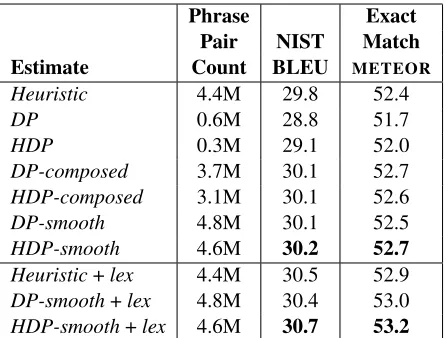
Table 1: BLEU results for learned distributions improve over a heuristic baseline. Estimate labels are described fully in section 5.3. The labellexindicates the addition of a lexical weighting feature.
scored with lowercased, tokenized NIST BLEU, and exact match METEOR (Papineni et al., 2002; Lavie and Agarwal, 2007).
The baseline system gives a BLEU score of 29.8, which increases to 30.5 withlex, as shown in Table 1. For reference, training on all sentences of length less than 40 (the shared task baseline default) gives 32.4 BLEU withlex.
5.2 Learned Distribution Performance
We initialized the sampler with a configuration de-rived from the word alignments generated by the baseline. We greedily constructed a phrase align-ment from the word alignalign-ment by identifying min-imal phrase pairs consistent with the word align-ment in each region of the sentence. We then ran the sampler for 100 iterations through the training data. Each iteration required 12 minutes under the DP prior, and 30 minutes under the HDP prior. Total running time for the HDP model neared two days on an eight-processor machine with 16 Gb of RAM.
Estimating phrase counts under the DP prior de-creases BLEU to 28.8, or 29.1 under the HDP prior. This gap is not surprising: heuristic extraction dis-covers many more phrase pairs than sampling. Note that sacrificing only 0.7 BLEU while shrinking the phrase table by 92% is an appealing trade-off in resource-constrained settings.
5.3 Increasing Phrase Pair Coverage
[image:9.612.75.298.57.226.2]The estimatesDP-composedandHDP-composedin Table 1 take expectations of a more liberal count function. While sampling, we count not only aligned phrase pairs, but also larger ones composed of two or more contiguous aligned pairs. This count function is similar to the phrase pair extraction heuristic, but never includes unaligned phrases in any way. Expec-tations of these composite phrases still have a proba-bilistic interpretation, but they are not the structures we are directly modeling. Notably, these estimates outperform the baseline by 0.3 BLEU without ever extracting phrases from word alignments, and per-formance increases despite a reduction in table size. We can instead increase coverage by smooth-ing the learned estimates with the heuristic counts. The estimates DP-smooth and HDP-smooth add counts extracted from word alignments to the sam-pler’s running totals, which improves performance by 0.4 BLEU over the baseline. This smoothing bal-ances the bias sampler counts with the lower-variance heuristics ones.
6 Conclusion
Our novel Gibbs sampler and nonparametric pri-ors together address two open problems in learn-ing phrase alignment models, approximatlearn-ing infer-ence consistently and efficiently while avoiding de-generate solutions. While improvements are mod-est relative to the highly developed word-alignment-centered baseline, we show for the first time com-petitive results from a system that uses word align-ments only for model initialization and smoothing, rather than inference and estimation. We view this milestone as critical to eventually developing a clean probabilistic approach to machine translation that unifies model structure across both estimation and decoding, and decreases the use of heuristics.
References
David Aldous. 1985. Exchangeability and related topics. InEcole d’´et´e de probabiliti´es de Saint-Flour´ , Berlin. Springer.
Con-ference for the Association for Machine Translation in the Americas.
Peter F. Brown, Stephen A. Della Pietra, Vincent J. Della Pietra, and Robert L. Mercer. 1994. The mathematics of statistical machine translation: Parameter estima-tion. Computational Linguistics, 19:263–311. Colin Cherry and Dekang Lin. 2007. Inversion
transduc-tion grammar for joint phrasal translatransduc-tion modeling. In
The Annual Conference of the North American Chap-ter of the Association for Computational Linguistics Workshop on Syntax and Structure in Statistical Trans-lation.
John DeNero and Dan Klein. 2008. The complexity of phrase alignment problems. In The Annual Confer-ence of the Association for Computational Linguistics: Short Paper Track.
John DeNero, Dan Gillick, James Zhang, and Dan Klein. 2006. Why generative phrase models underperform surface heuristics. In The Annual Conference of the North American Chapter of the Association for Com-putational Linguistics Workshop on Statistical Ma-chine Translation.
Thomas S Ferguson. 1973. A bayesian analysis of some nonparametric problems. InAnnals of Statistics. Jenny Rose Finkel, Trond Grenager, and Christopher D.
Manning. 2007. The infinite tree. InThe Annual Con-ference of the Association for Computational Linguis-tics.
Sharon Goldwater, Thomas L. Griffiths, and Mark John-son. 2006. Contextual dependencies in unsupervised word segmentation. InThe Annual Conference of the Association for Computational Linguistics.
Aria Haghighi and Dan Klein. 2007. Unsupervised coreference resolution in a nonparametric bayesian model. InThe Annual Conference of the Association for Computational Linguistics.
Mark Johnson, Thomas Griffiths, and Sharon Goldwa-ter. 2007. Bayesian inference for PCFGs via Markov chain Monte Carlo. InThe Annual Conference of the Association for Computational Linguistics.
Philipp Koehn, Hieu Hoang, Alexandra Birch, Chris Callison-Burch, Marcello Federico, Nicola Bertoldi, Brooke Cowan, Wade Shen, Christine Moran, Richard Zens, Chris Dyer, Ondrej Bojar, Alexandra Con-stantin, and Evan Herbst. 2007. Moses: Open source toolkit for statistical machine translation. InThe An-nual Conference of the Association for Computational Linguistics.
Philipp Koehn. 2002. Europarl: A multilingual corpus for evaluation of machine translation.
Alon Lavie and Abhaya Agarwal. 2007. Meteor: An automatic metric for mt evaluation with high levels of correlation with human judgments. InThe Annual Conference of the Association for Computational Lin-guistics Workshop on Statistical Machine Translation.
Daniel Marcu and Daniel Wong. 2002. A phrase-based, joint probability model for statistical machine trans-lation. InThe Conference on Empirical Methods in
Natural Language Processing.
Jonathan May and Kevin Knight. 2007. Syntactic re-alignment models for machine translation. In The Conference on Empirical Methods in Natural Lan-guage Processing.
Robert Moore and Chris Quirk. 2007. An iteratively-trained segmentation-free phrase translation model for statistical machine translation. InThe Annual Confer-ence of the Association for Computational Linguistics Workshop on Statistical Machine Translation. Franz Josef Och and Hermann Ney. 2003. A
system-atic comparison of various statistical alignment mod-els. Computational Linguistics, 29:19–51.
Franz Josef Och. 2003. Minimum error rate training in statistical machine translation. InThe Annual Confer-ence of the Association for Computational Linguistics. Kishore Papineni, Salim Roukos, Todd Ward, and Wei-Jing Zhu. 2002. Bleu: A method for automatic eval-uation of machine translation. InThe Annual Confer-ence of the Association for Computational Linguistics. Benjamin Snyder and Regina Barzilay. 2008. Unsuper-vised multilingual learning for morphological segmen-tation. InThe Annual Conference of the Association for Computational Linguistics.
Yee Whye Teh. 2006. A hierarchical Bayesian language model based on Pitman-Yor processes. InThe Annual Conference of the Association for Computational Lin-guistics.
Hao Zhang, Chris Quirk, Robert C. Moore, and Daniel Gildea. 2008. Bayesian learning of non-compositional phrases with synchronous parsing. In