An Empirical Study in Source Word Deletion
for Phrase-based Statistical Machine Translation
Chi-Ho Li, Dongdong Zhang, Mu Li, Ming Zhou Microsoft Research Asia
Beijing, China
chl, [email protected] muli, [email protected]
Hailei Zhang
Northeastern University of China Shenyang, China
Abstract
The treatment of ‘spurious’ words of source language is an important problem but often ignored in the discussion on phrase-based SMT. This paper explains why it is impor-tant and why it is not a trivial problem, and proposes three models to handle spurious source words. Experiments show that any source word deletion model can improve a phrase-based system by at least 1.6 BLEU points and the most sophisticated model improves by nearly 2 BLEU points. This paper also explores the impact of training data size and training data domain/genre on source word deletion.
1 Introduction
It is widely known that translation is by no means word-to-word conversion. Not only be-cause sometimes a word in some language trans-lates as more than one word in another language, also every language has some ‘spurious’ words which do not have any counterpart in other lan-guages. Consequently, an MT system should be able to identify the spurious words of the source language and not translate them, as well as to gen-erate the spurious words of the target language. This paper focuses on the first task and studies how it can be handled in phrase-based SMT.
An immediate reaction to the proposal of inves-tigating source word deletion (henceforth SWD) is: Is SWD itself worth our attention? Isn’t it a trivial task that can be handled easily by existing techniques? One of the reasons why we need to pay attention to SWD is its significant improve-ment to translation performance, which will be
shown by the experiments results in section 4.2. Another reason is that SWD is not a trivial task. While some researchers think that the spurious words of a language are merely function words or grammatical particles, which can be handled by some simple heuristics or statistical means, there are in fact some tricky cases of SWD which need sophisticated solution. Consider the follow-ing example in Chinese-to-English translation: in English we have the subordinate clause “accord-ing to NP”, where NP refers to some source of
information. The Chinese equivalent of this clause can sometimes be “ACCORDING-TO/dd NP EXPRESS/dd”; that is, in Chinese we could
have a clause rather than a noun phrase following the preposition ACCORDING-TO/dd.
There-fore, when translating Chinese into English, the content word EXPRESS/dd should be
consid-ered spurious and not to be translated. Of course, the verb EXPRESS/dd is not spurious in other
contexts. It is an example that SWD is not only about a few function words, and that the solu-tion to SWD has to take context-sensitive factors into account. Moreover, the solution needed for such tricky cases seems to be beyond the scope of current phrase-based SMT, unless we have a very large amount of training data which cov-ers all possible variations of the Chinese pattern “ACCORDING-TO/ddNPEXPRESS/dd”.
Despite the obvious need for handling spuri-ous source words, it is surprising that phrase-based SMT, which is a major approach to SMT, does not well address the problem. There are two possible ways for a phrase-based system to deal with SWD. The first one is to allow a source
language phrase to translate to nothing. How-ever, no existing literature has mentioned such a possibility and discussed the modifications re-quired by such an extension. The second way is to capture SWD within the phrase pairs in trans-lation table. That is, suppose there is a foreign phrase F˜ = (fAfBfC) and an English phrase
˜
E = (eAeC), where fAis aligned toeAandfC
toeC, then the phrase pair ( ˜F ,E˜)tacitly deletes the spurious wordfB. Such a SWD mechanism
fails when data sparseness becomes a problem. If the training data does not have any word sequence containingfB, then the spuriousfB cannot
asso-ciate with other words to form a phrase pair, and therefore cannot be deleted tacitly in some phrase pair. Rather, the decoder can only give a phrase segmentation that treatsfBitself as a phrase, and
this phrase cannot translate into nothing, as far as the SMT training and decoding procedure re-ported by existing literature are used. In sum, the current mechanism of phrase-based SMT is not capable of handling all cases of SWD.
In this paper, we will present, in section 3, three SWD models and elaborate how to apply each of them to phrase-based SMT. Experiment set-tings are described in section 4.1, followed by the report and analysis of experiment results, using BLEU as evaluation metric, in section 4.2, which also discusses the impact of training data size and training data domain on SWD models. Before making our conclusions, the effect of SWD on an-other evaluation metric, viz. METEOR, is exam-ined in section 5.
2 Literature Review
Research work in SMT seldom treats SWD as a problem separated from other factors in trans-lation. However, it can be found in differ-ent SMT paradigms the mechanism of handling SWD. As to the pioneering IBM word-based SMT models (Brown et al., 1990), IBM mod-els 3, 4 and 5 handle spurious source words by considering them as corresponding to a particular
EMPTYword token on the English side, and by the
fertility model which allows the English EMPTY
to generate a certain number of foreign words. As to the hierarchical phrase-based ap-proach (Chiang, 2007), its hierarchical rules are more powerful in SWD than the phrase pairs
in conventional phrase-based approach. For instance, the “ACCORDING-TO/dd NP EX -PRESS/dd” example in the last section can be
handled easily by the hierarchical rule
X→<ddXdd, according to X> .
In general, if the deletion of a source word depends on some context cues, then the hier-archical approach is, at least in principle, ca-pable of handling it correctly. However, it is still confronted by the same problem as the con-ventional phrase-based approach regarding those words whose ‘spuriousness’ does not depend on any context.
3 Source Word Deletion Models
This section presents a number of solutions to the problem of SWD. These solutions share the same property that a specific empty symbol²on the tar-get language side is posited and any source word is allowed to translate into². This symbol is in-visible in every module of the decoder except the translation model. That is,²is not counted when calculating language model score, word penalty and any other feature values, and it is omitted in the final output of the decoder. It is only used to delete spurious source words and refine transla-tion model scores accordingly.
It must be noted that in our approach phrases comprising more than one source word are not al-lowed to translate into². This constraint is based on our subjective evaluation of alignment matrix, which indicates that the un-alignment of a con-tinuous sequence of two or more source words is far less accurate than the un-alignment of a sin-gle source word lying within aligned neighbors. Consequently, in order to treat a source word as spurious, the decoder must give a phrase segmen-tation that treats the word itself as a phrase.
Model 1 P(²)
Model 2 P(²|f)
Model 3 PCRF(²|F~(f)
Table 1: Summary of the Three SWD Models
therefore the decoder has a bias towards shorter translations. Word penalty (in fact, it should be renamed as word reward) is used to neutralize this bias. Similarly, the more source words trans-late into ², the shorter the translation will be, and therefore the higher score the translation will have. The²-penalty is proposed to neutralize the bias towards shorter translations.
The core of the solutions is the SWD model, which calculatesP(²|f), the probability distribu-tion of translating some source wordf to². Three SWD models will be elaborated in the following subsections. They differ from each other by the conditions of the probability distribution, as sum-marized in Table 1. Model 1 is a uniform prob-ability distribution that does not take the source word f into account. Model 2 is a simple proba-bility distribution conditioned on the lexical form offonly. Model 3 is a more complicated distribu-tion condidistribu-tioned on a feature vector off, and the distribution is estimated by the method of Condi-tional Random Field.
3.1 Model 1: Uniform Probability
The first model assumes a uniform probability of translation to ². This model is inspired by the HMM-based alignment model (Och and Ney, 2000a), which posits a probability P0 for
align-ment of some source word to the empty word on the target language side, and weighs all other alignment probabilities by the factor 1−P0. In
the same style, SWD model 1 posits a probability
P(²) for the translation of any source word to². The probabilities of normal phrase pairs should be weighed accordingly. For a source phrase containing only one word, its weight is simply
P(¯²) = 1−P(²). As to a source phrase con-taining more than one word, it implies that every word in the phrase does not translate into ², and therefore the weighing factorP(¯²)should be mul-tiplied as many times as the number of words in the source phrase. In sum, for any phrase pair
<F ,˜ E >˜ , its probability is
P( ˜E|F˜) =
(
P(²) ifE˜ = (²)
P(¯²)|F˜|P
T( ˜E|F˜) otherwise
where PT( ˜E|F˜) is the probability of the phrase pair as registered in the translation table, and|F˜|
is the length of the phraseF˜. The estimation of
P(²)is done by MLE:
P(²) = number of unaligned source word tokens
number of source word tokens .
3.2 Model 2: EMPTYas Normal Word
Model 1 assumes that every word is as likely to be spurious as any other word. Definitely this is not a reasonable assumption, since certain function words and grammatical particles are more likely to be spurious than other words. Therefore, in our second SWD model the probability of translating a source wordf to²is conditioned onf itself.
This probability,P(²|f), is in the same form as the probability of a normal phrase pair,P( ˜E|F˜), if we consider²as some special phrase of the tar-get language and f as a source language phrase on its own. Thus P(²|f) can be estimated and recorded in the same way as the probability of normal phrase pairs. During the phase of phrase enumeration, in addition to enumerating all nor-mal phrase pairs, we also enumerate all unaligned source wordsf and add phrase pairs of the form
< (f),(²) >. These special phrase pairs, TO
-EMPTY phrase pairs, are fed to the module of
phrase scoring along with the normal phrase pairs. Both types of phrase pairs are then stored in the translation table with corresponding phrase trans-lation probabilities. It can be seen that, since the probabilities of normal phrase pairs are estimated in the same procedure as those of TO-EMPTY
phrase pairs, they do not need re-weighing as in the case of SWD model 1.
3.3 Model 3: Context-sensitive Model
model 2 is merely a unigram tagging model, and it uses only one feature template, viz. the lex-ical form of the source word in hand. Such a model can by no means encode any contextual information, and therefore it cannot handle the “ACCORDING-TO/dd NP EXPRESS/dd”
ex-ample in section 1.
An obvious solution to this limitation is a more powerful tagging model augmented with context-sensitive feature templates. Inspired by research work like (Lafferty et al., 2001) and (Sha and Pereira, 2003), our SWD model 3 uses first-order Conditional Random Field (CRF) to tackle the tagging task.1 The CRF model uses the
follow-ing feature templates:
1. the lexical form and the POS of the foreign wordf itself;
2. the lexical forms and the POSs off−2,f−1, f+1, andf+2, wheref−2andf−1are the two
words to the left of f, and f+1 andf+2 are
the two words to the right off;
3. the lexical form and the POS of the head
word off;
4. the lexical forms and the POSs of the depen-dentwords off.
The lexical forms are the major source of infor-mation whereas the POSs are employed to allevi-ate data sparseness. The neighboring words are used to capture local context information. For ex-ample, in Chinese there is often a comma after verbs like “said” or “stated”, and such a comma is not translated to any word or punctuation in English. These spurious commas are therefore identified by their immediate left neighbors. The head and dependent words are employed to cap-ture non-local context information found by some dependency parser. For the “ACCORDING-TO/d
d NP EXPRESS/dd” example in section 1,
the Chinese word ACCORDING-TO/dd is the
head word of EXPRESS/dd. The spurious
to-ken of EXPRESS/ddin this pattern can be
dis-tinguished from the non-spurious tokens through the feature template of head word.
1Maximum Entropy was also tried in our experiments but
its performance is not as good as CRF.
The training data for the CRF model comprises the alignment matrices of the bilingual training data for the MT system. A source word (token) in the training data is tagged as “non-spurious” if it is aligned to some target word(s), otherwise it is tagged as “spurious”. The sentences in the train-ing data are also POS-tagged and parsed by some dependency parser, so that each word can be as-signed values for the POS-based feature templates as well as the feature templates of head word and dependency words.
The trained CRF model can then be used to augment the decoder to tackle the SWD problem. An input source sentence should first be POS-tagged and parsed for assigning feature values. The probability forf being spurious, P(²|f), is then calculated by the trained CRF model as
PCRF(spurious|F~(f)).
The probability forf being non-spurious is sim-ply 1 − P(²|f). For a normal phrase pair
< F ,˜ E >˜ recorded in the translation table, its phrase translation probability and the lexical weight should be re-weighed by the probabilities of non-spuriousness. The weighing factor is
Y
fi²F˜
(1−P(²|fi)),
since the translation of F˜ into E˜ means the de-coder considers every word inF˜as non-spurious.
4 Experiments
4.1 Experiment Settings
A series of experiments were run to compare the performance of the three SWD models against the baseline, which is the standard phrase-based ap-proach to SMT as elaborated in (Koehn et al., 2003). The experiments are about Chinese-to-English translation. The bilingual training data is the one for NIST MT-2006. The GIGAWORD corpus is used for training language model. The development/test corpora are based on the test sets for NIST MT-2005/6.
in (Koehn et al., 2003). For SWD model 2, the phrase enumeration step is modified as de-scribed in section 3.2. We used the Stanford parser (Klein and Manning, 2003) with its default Chinese grammar for its POS-tagging as well as finding the head/dependent words of all source words. The CRF toolkit used for model 3 is
CRF++2. The training data for the CRF model
should be the same as that for translation table construction. However, since there are too many instances (every single word in the training data is an instance) with a huge feature space, no pub-licly available CRF toolkit can handle the entire training set of NIST MT-2006.3 Therefore, we
can use at most only about one-third of the NIST training set (comprising the FBIS, B1, and T10 sections) for CRF training.
The decoder in the experiments is our re-implementation of HIERO (Chiang, 2007),
aug-mented with a 5-gram language model and a re-ordering model based on (Zhang et al., 2007). Note that no hierarchical rule is used with the de-coder; the phrase pairs used are still those used in conventional phrase-based SMT. Note also that the decoder does not translate OOV at all even in the baseline case, and thus the SWD models do not improve performance simply by removing OOVs.
In order to test the effect of training data size on the performance of the SWD models, three varia-tions of training data were used:
FBIS Only the FBIS section of the NIST training set is used as training data (for both transla-tion table and the CRF model in model 3). This section constitutes about 10% of the en-tire NIST training set. The purpose of this variation is to test the performance of each model when very small amount of data are available.
BFT Only the B1, FBIS, and T10 sections of the NIST training set are used as training data. These sections are about one-third of the en-tire NIST training set. The purpose of this
2http://crfpp.sourceforge.net/ 3Apart from
CRF++, we also tried FLEX -CRF (http://flexcrfs.sourceforge.net) and MALLET (http://mallet.cs.umass.edu).
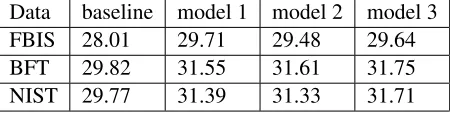
Data baseline model 1 model 2 model 3 FBIS 28.01 29.71 29.48 29.64 BFT 29.82 31.55 31.61 31.75 NIST 29.77 31.39 31.33 31.71
Table 2: BLEU scores in Experiment 1: NIST’05 as dev and NIST’06 as test
variation is to test each model when medium size of data are available.4
NIST All the sections of the NIST training set are used. The purpose of this variation is to test each model when a large amount of data are available.
(Case-insensitive) BLEU-4 (Papineni et al., 2002) is used as the evaluation metric. In each test in our experiments, maximum BLEU training were run 10 times, and thus there are 10 BLEU scores for the test set. In the following we will report the mean scores only.
4.2 Experiment Results and Analysis
Table 2 shows the results of the first experiment, which uses the NIST MT-2005 test set as develop-ment data and the NIST MT-2006 test set as test data. The most obvious observation is that any SWD model achieves much higher BLEU score than the baseline, as there is at least 1.6 BLEU point improvement in each case, and in some case the improvement of using SWD is nearly 2 BLEU points. This clearly proves the importance of SWD in phrase-based SMT.
The difference between the performance of the various SWD models is much smaller. Yet there are still some noticeable facts. The first one is that model 1 gives the best result in the case of using only FBIS as training data but it fails to do so when more training data is available. This phenomenon is not strange since model 2 and model 3 are conditioned on more information and therefore they need more training data.
The second observation is about the strength of SWD model 3, which achieves the best BLEU score in both the BFT and NIST cases. While its improvement over models 1 and 2 is marginal in the case of BFT, its performance in the NIST
4Note also that the BFT data set is the largest training
case is remarkable. A suspicion to the strength of model 3 is that in the NIST case both models 1 and 2 use the entire NIST training set for esti-mating P(²), while model 3 uses only the BFT sections to train its CRF model. It may be that the BFT sections are more consistent with the test data set than the other NIST sections, and there-fore a SWD model trained on BFT sections only is better than that trained on the entire NIST. This conjecture is supported by the fact that in all four settings the BLEU scores in the NIST case are lower than those in the BFT case, which suggests that other NIST sections are noisy. While it is im-possible to test model 3 with the entire NIST, it is possible to restrict the data for the estimation of
P(²|f) in model 1 to the BFT sections only and check if such a restriction helps.5 We estimated
the uniform probabilityP(²)from only the BFT sections and used it with the translation table con-structed from the complete NIST training set. The BLEU score thus obtained is 31.24, which is even lower than the score (31.39) of the original case of using the entire NIST for both translation table and P(²|f) estimation. In sum, the strength of model 3 is not simply due to the choice of train-ing data.
The test set used in Experiment 1 distinguishes itself from the development data and the training data by its characteristics of combining text from different genres. There are three sources of the NIST MT-2006 test set, viz. “newswire”, “news-group”, and “broadcast news”, while our devel-opment data and the NIST training set comprises only newswire text and text of similar style. It is an interesting question whether SWD only works for some genres (say, newswire) but not for other genres. In fact, it is dubious whether SWD fits the test set to the same extent as it fits the develop-ment set. That is, perhaps SWD contributes to the improvement in Experiment 1 simply by improv-ing the translation of the development set which is composed of newswire text only, and SWD may not benefit the translation of the test data at all. In order to test this conjecture, we ran Experi-ment 2, in which the SWD models were still ap-plied to the development data during training, but
5Unfortunately this way does not work for model 2 as
the estimation ofP(²|f)and the construction of translation table are tied together.
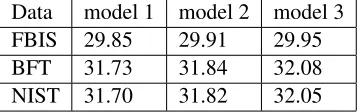
Data model 1 model 2 model 3 FBIS 29.85 29.91 29.95 BFT 31.73 31.84 32.08 NIST 31.70 31.82 32.05
Table 3: BLEU scores in Experiment 2, which is the same as Experiment 1 but no word is deleted for test corpus. Note: the baseline scores are the same as the baselines in Experiment 1 (Table 2).
all SWD models stopped working when translat-ing the test data with the trained parameters. The results are shown in Table 3. These results are very discouraging if we compare each cell in Ta-ble 3 against the corresponding cell in TaTa-ble 2: in all cases SWD seems harmful to the translation of the test data. It is tempting to accept the conclu-sion that SWD works for newswire text only.
To scrutinize the problem, we split up the test data set into two parts, viz. the newswire sec-tion and the non-newswire secsec-tion, and ran ex-periments separately. Table 4 shows the results of Experiment 3, in which the development data is still the NIST MT-2005 test set and the test data is the newswire section of NIST MT-2006 test set. It is confirmed that if test data shares the same genre as the training/development data, then SWD does improve translation performance a lot. It is also observed that more sophisticated SWD models perform better when provided with sufficient training data, and that model 3 exhibits remarkable improvement when it comes to the NIST case.
Of course, the figures in Table 5, which shows the results of Experiment 4 where the non-newswire section of NIST MT-2006 test set is used as test data, still leave us the doubt that SWD is useful for a particular genre only. After all, it is reasonable to assume that a model trained from data of a particular domain can give good perfor-mance only to data of the same domain. On the other hand, the language model is another cause of the poor performance, as the GIGAWORD cor-pus is also of the newswire style.
apply SWD for test set no SWD for test set Data model 1 model 2 model 3 model 1 model 2 model 3 FBIS 30.81 30.81 30.68 29.23 29.61 29.46 BFT 33.57 33.74 33.71 31.88 31.87 32.25 NIST 33.65 34.01 34.42 32.14 32.59 32.87
Table 4: BLEU scores in Experiment 3, which is the same as Experiments 1 and 2 but only thenewswiresection of NIST’06 test set is used. Note: the baseline scores are the same as the baselines in Experiment 1 (Table 2).
apply SWD for test set no SWD for test set Data model 1 model 2 model 3 model 1 model 2 model 3 FBIS 29.19 28.86 29.16 30.07 29.67 30.08 BFT 30.62 30.64 30.86 31.66 31.83 32.00 NIST 30.34 30.10 30.46 31.50 31.45 31.66
Table 5: BLEU scores in Experiment 4, which is the same as Experiments 1 and 2 but only thenon-newswire
section of NIST’06 test set is used. Note: the baseline scores are the same as the baselines in Experiment 1 (Table 2).
Data baseline model 1 model 2 model 3 FBIS 26.87 27.79 27.51 27.61 BFT 29.11 30.38 30.49 30.41 NIST 29.34 30.63 30.95 31.00
Table 6: BLEU scores in Experiment 5: which is the same as Experiment 1 but uses half of NIST’06 as de-velopment set and another half of NIST’06 as test set.
and non-newswire sections of NIST MT-2006 test set are combined to form the new development data, and the second halves of the two sections are combined to form the new test data. The new development data is therefore consistent with the new test data. If SWD, or at least a SWD model from newswire, is harmful to the non-newswire section, which constitutes about 60% of the de-velopment/test data, then it will be either that the parameter training process minimizes the impact of SWD, or that the SWD model will make the parameter training process fail to search for good parameter values. The consequence of either case is that the baseline setting should produce similar or even higher BLEU score than the settings that employ some SWD model. Experiment results, as shown in Table 6, illustrate that SWD is still very useful even when both development and test sets contain texts of different genres from the training text. It is also observed, however, that the three SWD models give rise to roughly the same BLEU
scores, indicating that the SWD training data do not fit the test/development data very well as even the more sophisticated models are not benefited from more data.
5 Experiments using METEOR
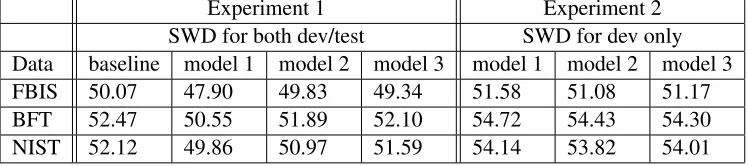
Experiment 1 Experiment 2 SWD for both dev/test SWD for dev only Data baseline model 1 model 2 model 3 model 1 model 2 model 3 FBIS 50.07 47.90 49.83 49.34 51.58 51.08 51.17 BFT 52.47 50.55 51.89 52.10 54.72 54.43 54.30 NIST 52.12 49.86 50.97 51.59 54.14 53.82 54.01
Table 7: METEOR scores in Experiments 1 and 2
6 Conclusion and Future Work
In this paper, we have explained why the han-dling of spurious source words is not a trivial problem and how important it is. Three solu-tions, with increasing sophistication, to the prob-lem of SWD are presented. Experiment results show that, in our setting of using NIST MT-2006 test set, any SWD model leads to an improvement of at least 1.6 BLEU points, and SWD model 3, which makes use of contextual information, can improve up to nearly 2 BLEU points. If only the newswire section of the test set is considered, SWD model 3 is even more superior to the other two SWD models.
The effect of training data size on SWD has also been examined, and it is found that more sophisticated SWD models do not outperform unless they are provided with sufficient amount of data. As to the effect of training data do-main/genre on SWD, it is clear that SWD models trained on text of certain genre perform the best when applied to text of the same genre. While it is infeasible for the time being to test if SWD works well for non-newswire style of training data, we managed to illustrate that SWD based on newswire text still to certain extent benefits the training and translation of non-newswire text.
In future, two extensions of our system are needed for further examination of SWD. The first one is already mentioned in the last section: max-imum METEOR training should be implemented in order to fully test the effect of SWD regard-ing METEOR. The second extension is about the weighing factor in models 1 and 3. The current implementation assumes that all source words in a normal phrase pair need to be weighed by
1−P(²). However, in fact some source words in a source phrase are tacitly deleted (as explained in the Introduction). Thus the word alignment
in-formation within phrase pairs need to be recorded and the weighing of a normal phrase pair should be done in accordance with such alignment infor-mation.
References
Brown, P., J. Cocke, S. Della Pietra, V. Della Pietra, F. Jelinek, J. Lafferty, R. Mercer, and P. Roossin. 1990. A Statistical Approach to Machine Transla-tion Computational Linguistics, 16(2).
Satanjeev Banerjee and Alon Lavie. 2005. METEOR: An Automatic Metric for MT Evaluation with Im-proved Correlation with Human Judgments. Pro-ceedings of Workshop on Evaluation Measures for MT and/or Summarization at ACL 2005.
David Chiang. 2007. Hierarchical Phrase-based Translation. Computational Linguistics, 33(2). Dan Klein and Christopher D. Manning. 2003.
Ac-curate Unlexicalized Parsing. Proceedings for ACL 2003.
Philipp Koehn, Franz J. Och, and Daniel Marcu. 2003. Statistical Phrase-based Translation. Proceedings for HLT-NAACL 2003.
John Lafferty, Andrew McCallum, and Fernando Pereira 2001. Conditional Random Fields: Prob-abilistic Models for Segmenting and Labeling Se-quence Data. Proceedings for 18th International Conf. on Machine Learning.
Franz J. Och, and Hermann Ney. 2000. A comparison of alignment models for statistical machine transla-tion. Proceedings of COLING 2000.
Franz J. Och, and Hermann Ney. 2000. Improved Statistical Alignment Models. Proceedings for ACL 2000.
Kishore Papineni, Salim Roukos, Todd Ward, and Wei-Jing Zhu. 2002. BLEU: a Method for Auto-matic Evaluation of Machine Translation. Proceed-ings for ACL 2002.
Fei Sha, Fernando Pereira. 2003. Shallow parsing with conditional random fields. Proceedings of NAACL 2003.