of semantic spaces
for word-sense discrimination and
collocation compositionality grading
Alfredo Maldonado Guerra
Doctor of Philosophy
The University of Dublin, Trinity College
I declare that this thesis has not been submitted as an exercise for a degree at this or any other university and it is entirely my own work. I agree to deposit this thesis in the University’s open access institutional repository or allow the library to do so on my behalf, subject to Irish Copyright Legislation and Trinity College Library conditions of use and acknowledgement.
Latent Semantic Analysis (LSA) and Word Space are two semantic models derived from the vector space model of distributional semantics that have been used successfully in word-sense disambiguation and discrimination. LSA can represent word types and word tokens in con-text by means of a single matrix factorised by Singular Value Decomposition (SVD). Word Space is able to represent types via word vectors and tokens through two separate kinds of context vectors: direct vectors that count first-order word co-occurrence and indirect vec-tors that capture second-order co-occurrence. Word Space objects are optionally reduced by SVD. Whilst being regarded as related, little has been discussed about the specific relation-ship between Word Space and LSA or the benefits of one model over the other, especially with regard to their capability of representing word tokens. This thesis aims to address this both theoretically and empirically.
Within the theoretical focus, the definitions of Word Space and LSA as presented in the literature are studied. A formalisation of these two semantic models is presented and their theoretical properties and relationships are discussed. A fundamental insight from this theor-etical analysis is that indirect (second-order) vectors can be computed from direct (first-order) vectors through a linear transformation involving a matrix of word vectors (a word matrix), an operation that can itself be seen as a method of dimensionality reduction alternative to SVD. Another finding is that in their unreduced form, LSA vectors and the Word Space dir-ect (first-order) context vdir-ectors define approximately the same objdir-ects and their difference can be exactly calculated. It is also found that the SVD spaces produced by LSA and the Word Space word vectors are also similar and their difference, which can also be precisely calculated, ultimately stems from the original difference between unreduced LSA vectors and Word Space direct vectors. It is also observed that the indirect “second-order” method of token representation from Word Space is also available to LSA, in a version of the representa-tion that has remained largely unexplored. And given the analysis of the SVD spaces produced by both models, it is hypothesised that, when exploited in comparable ways, Word Space and LSA should perform similarly in actual word-sense disambiguation and discrimination exper-iments.
The research presented in this thesis was supported by Science Foundation Ireland
(Grant 07/CE/I1142) as part of the Centre for Next Generation Localisation (www.cngl.ie) at Trinity College Dublin. Some calculations were performed on the Lonsdale cluster main-tained by the Trinity Centre for High Performance Computing. This cluster was also funded through grants from Science Foundation Ireland.
I would like to express my sincere thanks to my supervisor Dr Martin Emms, not just for his hands-on involvement in this research and for his support throughout the course of my studies, but for teaching me a whole new way of deep analytical thinking without which this thesis would have not taken shape. In fact, some of the most important contributions included herein, such as the linear transformation formulation in Chapter 4 and the difference between theR1andR2 SVD projections in Chapter 3, are based on original ideas by him. I
only followed up on his big good ideas with lots of little good ideas. Credit and gratitude are also owed to the examiners of this thesis, Dr Saturnino Luz and Dr Anna Korhonen, whose feedback and advice strengthened this work significantly.
I would also like to thank Dr Carl Vogel for his continued help and support during my studies as well as for initially having me admitted to the Ph.D. programme in Trinity. Simil-arly, I would like to thank Elda Quiroga from Tecnológico de Monterrey and Masaki Itagaki from Microsoft for their support in the preceding stages of my Ph.D. This thesis is in many ways the product of their guidance and support.
Many thanks also go to the other Ph.D. students and post-docs for the deep technical discussions and their spirit of camaraderie: Liliana, Héctor, Gerard, Martin, Erwan, Derek, Anne, Roman, Stephan, Francesca, Oscar, Baoli, Nikiforos and Ielka, as well as to the “new generation”: Akira, Grace, Kevin, Carmen, Arun and Shane. I would also like to thank the DU Archaeological Society for providing me with a space on campus for intellectual discus-sions that did not involve computers but dusty old bones, and in particular I wish to thank Mary, Ciarán, Jenny, Deirdre, Pablo, Karl, Aoife, Sean, Alice, Michael, Alex, Victoria and John Tighe for their friendship. Thank you guys, I had a blast!
Declaration 3
Abstract 5
Acknowledgements 7
Typographical conventions 13
1 Introduction 15
1.1 Motivation . . . 15
1.2 Operationalising context computationally . . . 20
1.3 Research questions and thesis structure . . . 24
2 Linguistic Background 31 2.1 What is a word? . . . 32
2.1.1 Word tokens and word types . . . 32
2.1.2 Multi-word expressions and collocations . . . 33
2.1.3 Ngrams . . . 36
2.2 What is a word sense? . . . 37
2.2.1 Structuralist lexical semantics . . . 39
2.2.2 Word senses and the role of context . . . 42
2.2.3 Characterising context . . . 46
2.2.4 The distributional hypothesis of lexical semantics . . . 49
2.2.5 Meaning beyond context . . . 52
3 Computational Background 57 3.1 Natural language processing tasks . . . 58
3.1.1 WSX: Word-sense disambiguation, discrimination and induction . . 60
3.1.1.1 Word-sense disambiguation . . . 61
3.1.1.2 Word-sense discrimination . . . 64
3.1.2 Measuring the compositionality of multi-word expressions . . . 65
3.2 The vector space model of information retrieval . . . 67
3.3 The VSM as a distributional lexical semantics model . . . 75
3.4.3 TheR1andR2 projections in the literature . . . 86
3.4.4 Semantic properties of LSA . . . 87
3.4.4.1 Semantic relations . . . 88
3.4.4.2 Polysemy . . . 93
3.4.4.3 Noise reduction . . . 95
3.5 Word Space . . . 95
3.5.1 The word matrix: representing word types . . . 96
3.5.2 Context vectors: representing word tokens . . . 97
3.6 Syntagmatic space and paradigmatic space . . . 102
4 Linear Transformations in Word Space and LSA 107 4.1 Was a linear map . . . 108
4.2 Direct and indirect token representations . . . 110
4.2.1 Token representations viaC . . . 111
4.2.1.1 D-C-UR: Unreduced direct context vectors . . . 112
4.2.1.2 D-C-R1/2: SVD-reduced direct context vectors . . . 112
4.2.1.3 I-C-UR: Unreduced indirect context vectors viaC . . . . 114
4.2.1.4 I-C-R1/2: SVD-reduced indirect context vectors viaC . . 115
4.2.2 Token representations viaW . . . 115
4.2.2.1 I-W-UR: Unreduced indirect context vectors viaW . . . 115
4.2.2.2 I-W-R1/2: SVD-reduced indirect context vectors viaW . 116 4.2.3 Token representations viaA . . . 117
4.2.3.1 D-A-UR: Unreduced segment vectors . . . 117
4.2.3.2 D-A-R1/2: SVD-reduced segment vectors . . . 117
4.2.3.3 I-A-UR: Unreduced indirect context vectors viaA . . . . 118
4.2.3.4 I-A-R1/2: SVD-reduced indirect context vectors viaA . . 118
4.2.4 A (toy) numerical comparison . . . 119
4.3 A comparison between LSA and Word Space . . . 122
4.3.1 A vs W: The difference and relationship between the unreduced spaces of LSA and Word Space . . . 123
4.3.2 Decomposition ofW . . . 126
4.4 Summary . . . 133
5 WSX experiments: direct vs. indirect Word Space token spaces 135 5.1 Corpora . . . 136
5.2 Geometric experiments . . . 137
5.3 Supervised disambiguation . . . 140
6 WSX experiments: unreduced vs. SVD-reduced token spaces 145
6.1 Background . . . 145
6.2 Methodology . . . 148
6.3 Experimental results . . . 149
6.3.1 General observations . . . 149
6.3.2 Direct vectors: D-A vs. D-C . . . 150
6.3.3 Indirect vectors: I-W vs. I-A and I-C . . . 151
6.4 Conclusions . . . 151
7 Word matrix consolidation as a dimensionality reduction method 153 7.1 Statistical word matrix . . . 154
7.2 Reduction by consolidation . . . 156
7.3 Experiments and conclusions . . . 157
8 Measuring MWE compositionality via Word Space 161 8.1 DISCO 2011 Shared Task . . . 162
8.1.1 The multi-word expressions . . . 163
8.1.2 Evaluation of systems’ output . . . 164
8.1.3 Issues regarding the human judgements . . . 165
8.2 Methodology . . . 166
8.3 Preliminary definitions . . . 167
8.4 Results and conclusion . . . 170
9 Conclusions and future work 175 9.1 Summary of contributions . . . 176
9.2 Future work . . . 178
Bibliography 181
• Bold will be used for important linguistic and technical terms when defined. E.g. a
word tokenis a specific instance of a particular word in a text.
• Italics will be used for lexical linguistic units such as words, multi-word expressions, ngrams, lexemes, morphemes, etc. when mentioned in the exposition of the text rather than when they are used in a linguistic example (unless the term is italicised for emphasis in the linguistic example). E.g. In the example,bankis used in its ‘financial institution’ sense.
• Small caps are used for lexemes (word roots) and as features in componential analysis examples and features of vector examples. E.g. Tiredis a word form of the lexeme tire. The dimensions of vectorware [money, account, river, water].
• Text surrounded in “double quotes” will usually be direct quotations or linguistic ex-amples embedded in the running text.
• Text surrounded in ‘single quotes’ will usually be senses or meanings of words. They will also be used as glosses for non-English language words. E.g. In the example,bank
is used in its ‘financial institution’ sense. The correct Spanish term is vino tinto ‘red wine’ rather than the more literal *vino rojo.
• Ungrammatical and semantically anomalous phrases and examples will be preceded by a star. E.g. “*He kicked the pail”, “*Colourless green ideas sleep furiously”, *vino rojo
(lit. ‘red wine’).
• Linguistic variables found in text will be represented by lower-case Greek letters. For example, word type variables will be commonly represented by the lettersτ (tau) and
υ (upsilon), word token variables will be represented by letters such asκ(kappa) and
λ(lambda) and sense variables (i.e. a variable holding the sense or “semantic value” of a word) byσ(sigma). Greek letters are not exclusively reserved for linguistic variables however, and so in a few instances Greek letters will be employed as numerical variables in conventional formulae (e.g. the usage ofλas a variable denoting an eigenvalue of a matrix).
Word Space approaches. Some of these word type vectors will be used in function form, taking a variable as an argument: e.g. w(τ)is the word (type) vector of typeτ.
• A context vector will be represented by a bold lower-case letterc, with its order indicated as a superscript. For example, a direct (first-order) context vector will be represented byc1 and an indirect (second-order) context vector by c2. In some cases, the matrix
from which a context vector is derived will be used as its superscript instead: e.g. cHis
an indirect context vector derived from matrixH. When discussing the context vector of a particular tokenκ, the vector will be used in function form: e.g. c1(κ)will be the
direct (first-order) context vector of a specific token κ in a corpus or document and
cH(κ)will be the indirect context vector, ofκ, derived from matrixH.
• Sense vectors are represented by a lower-case Gothicsand a superscript indicating their order. E.g.: s1,s2
• All matrices are represented with bold upper-case letters. For example, word matrices will be represented asWwhereas matrices consisting of context vectors will be repres-ented byC.
• Non-bold, subscripted, lower-case letters are used as scalars belonging to the vectors or matrices introduced above. For example,ci would be thei-th element in a context
vectorc1(κ) andw
ij would be the number of times the i-th word co-occurs with the
j-th word in word matrixW. An alternative index notation to refer to thei-th element in a vector will be[c1(κ)]
i.
1.1 Motivation
As most aspects of human life settle into an interconnected on-line world, the amount of textual information generated each day accumulates at an unprecedented speed. As a con-sequence, new computer tools are created daily in order to access such information (search engines), to channel the information into coherent categories (blogs, Twitter, news readers, email classifiers), to make the information available to people around the world (machine translation), etc. Whilst all of these tools might look very different from each other, they all handle the same type of data: human language manifesting in text form.
From a structuralist perspective (de Saussure, 1916), human language can be seen as a communication system based on signs consisting of a signifier (sounds, letters, words) that represent a signified (meaning, concept) and onrules (syntactic, semantic, etc.) that dictate how those signs are combined to form meaningful utterances. For example, in (1.1.1) below, the signifierflight signifies a journey made through air by means of aeroplanes whileRyanAir
refers to a commercial airline andDublinandLondonto two European cities:
(1.1.1) RyanAir provides flights between Dublin and London.
A syntactic rule tells us that the verbto providetakes one noun phrase as a subject and another noun phrase as a direct object, and therefore an English speaker will parse this sentence in this manner:
S
NP
RyanAir
VP
V
provides
NP
flights between Dublin and London
(1.1.2)
A problem with human language is ambiguity. Consider the following example:
The signifierfliesis a verb that normally means moving through space. However, most English speakers will interpret the sentence as a figure of speech, a simile, relating the speed of the passage of time with the speed in which an arrow flies (i.e. very fast). This figurative reading of the sentence produces parse tree (1.1.4):
S
NP
Time
VP
V
flies
NP
like an arrow
(1.1.4)
However, an alternative though improbable reading, interpretinglikeas the verb meaning to enjoy or to take pleasure from, forces the whole sentence to state that there is a particular type of fly, called “time flies”, that are fond of a particular arrow. The parse tree for this interpretation is (1.1.5):
S
NP
Time flies
VP
V
like
NP
an arrow
(1.1.5)
While contrived, this example illustrates that language can present ambiguities at different levels. In this case, the ability to perceive a figure of speech or not can cause two distinct parse structures (syntactic ambiguity), each assigning a different part of speech (morpho-syntactic ambiguity) and meaning (lexical semantic ambiguity) to the elementsfliesandlike. The fact that the interpretation depicted by (1.1.5) is easily perceived as forced or improbable, illus-trates that (human) language users are good at dealing with language ambiguity. If emerging software tools are to succeed in helping people make sense of the vast information on the Internet, they will also have to deal with these ambiguities. It is this type of lexical semantic ambiguity that this thesis is concerned with.
As a specific example of what is meant by lexical semantic ambiguity, consider the word
example, it has been estimated that any of the 121 most frequent nouns in English have 7.8 meanings on average (Ng and Beng Lee, 1996).
When confronted with this fact, most people agree that usually the context of a word will help in disambiguating its meaning. And in fact that is what people do in every day language since words do not occur in isolation, but in specific conversational or textual situations. So when dealing with lexical semantic ambiguity computationally, the attention usually shifts to the role of context as well. As an example of the power of context to disambiguate words, consider the two book titles in (1.1.6) and (1.1.7) below, illustrating how the correct sense ofrock can be easily determined by taking into account the other words in the title (i.e. the context to the ambiguous wordrock):
(1.1.6) Rockfractures in geological processes
(1.1.7) Rockand popular music in Ireland: before and after U2
as that word may modulate or adapt its sense depending on the nature, domain or register of the corpus (Kilgarriff, 1997). Sometimes it is easy to distinguish between the senses of a poly-semous word, but phenomena such as regular polysemy and metaphorical extension make the task of listing every single potential sense of a word a virtually impossible task. This has led to the development of unsupervisedmethods such asword-sense discrimination(WSDisc) orword-sense induction(WSI)1.
Word-sense discrimination (Schütze, 1998) is a relaxation of the original word-sense dis-ambiguation task that does not rely on a pre-defined list of word senses is available and instead seeks to automatically induce the senses of a word by clustering the contexts in which it ap-pears. The assumption is that each of such clusters represents a different sense of the word in question. The clusters are then used to classify new instances, as done in WSD. It is considered an unsupervised approach because of its lack of a sense list and because there is no need to manually tag any training corpus. However, it is very common during experimentation to use a manually sense-tagged test corpus for evaluation purposes. The termsword-sense induction
andword-sense discriminationare often used interchangeably. However, one could argue that the initial clustering step in word-sense discrimination could be described as a word-sense induction phase. This thesis takes this view and so will consider word-sense discrimination as a two-step process: a sense induction step in which context clustering takes place and a discrimination proper step in which individual contexts are assigned to the cluster deemed more appropriate by some classification algorithm.
There are also hybrid, semi-supervised approaches to WSD. One group of such approaches use an unsupervised algorithm to learn senses from untagged text based on a sense invent-ory. For example, in Buitelaar et al. (2001) co-occurrence statistics in untagged text of words that are represented in a WordNet-like taxonomy are computed first. Then, the occurrence of an ambiguous word is tagged with the WordNet sense that maximises a score computed by traversing the taxonomy of each candidate sense and by contrasting each transversal’s co-occurrence statistic average with the co-co-occurrence statistics of the ambiguous word and the words co-occurring with it. Another group of semi-supervised approaches are those that auto-matically annotate senses in untagged corpora based on a small set of sense-tagged examples. Yarowsky (1995) describes an example of these bootstrapping methods.
As we have seen, words convey meaning; a meaning that varies as a function of context. As words combine with other words in that context to form larger constructions such as phrases and sentences, a “larger” meaning emerges from such a construction. Language is a productive communication system as it allows the production and understanding of new combinations of units (such as words) that have never been experienced by language users (Lyons, 1981, Sec. 1.5). And whilst this productivity is not random but governed by the rules of grammar, language users are free to creatively produce utterances in a potentially
1A note on abbreviations: When discussing one of these word-sense-related tasks, the task full name or its
infinite number of ways without the need of ever breaking free from the constraints posed by these rules (Chomsky, 1972, p. 100). Despite the ability that human beings have to use language productively and creatively, there is strong evidence to suggest that language users often recycle prefabricated chunks of word combinations (Cowie, 1988; Sinclair, 1991) which Firth (1957) callscollocations. Such collocations range from idiomatic expressions like
saved by the bell andkick the bucket to multi-word terminological units likeweapons of mass destructionandoperating system, passing through clichés and simple recurring phrases like aat this moment in time,all that jazz,boys will be boys,at the speed of light,opposites attract,moving forward, etc.
There is a category of collocations that, in addition to showing frequent recurrence, seem to form a self-contained and opaque semantic unit. For example, the idiomatic expressionto throw in the towel cannot be correctly interpreted as ’to give up’ without recurring to know-ledge of boxing, from where the expression originated. These collocations are called non-compositional since they cannot be interpreted using the standard mechanisms of compos-ition of language, that is, by following the tradcompos-itional rules of syntax and semantics without recurring to knowledge outside the usual senses of each constituent word. Non-compositional collocations pose a significant problem in many natural language processing problems such as machine translation, where we do want to avoid providing literal translations to idiomatic expressions. This issue poses another layer of lexical ambiguity to consider. Notice however, that context can also help in disambiguating whether a collocation is compositional or not. When used in its metaphorical, idiomatic sense,to throw in the towelwill be likely surrounded by words and phrases suggesting competition and surrender, and will be unlikely surrounded by words suggesting the actual physical hurling of absorbent cloths to the floor.
Whilst the study of word senses and collocations is of great interest to lexical semantics and linguistics in general, they have practical implications for different natural language pro-cessing tasks. As already mentioned, WSD was first identified and defined within the context of machine translation. Indeed, explicit WSD is necessary in traditional, rule-based machine translation at least from a theoretical point of view. Many actual rule-based machine transla-tion systems however do not include an explicit WSD module, although the most successful commercial rule-based system, Systran, does include a WSD module (Resnik, 2007). Statist-ical machine translation systems generally do not include such a WSD module. Since these systems face a lexical choice comparable to the one faced by WSD components, it is often said that they perform their own implicit WSD as the source language context provides clues as to the correct translation of ambiguous words (Och, 2002, p. 53). Nevertheless, there have been efforts to integrate explicit WSD modules in statistical machine translation. Carpuat and Wu (2007) is a successful example that showed a consistent improvement of phrase-based statistical machine translation from Chinese to English by disambiguating ambiguous source words and phrases by assigning them their corresponding target translation directly, instead of assigning their dictionary or WordNet sense to such ambiguous word and phrases.
ex-traction, named-entity classification, co-reference determination, acronym expansion, among others (Agirre and Edmonds, 2005, p. 11).
Unsupervised WSDisc methods have also been applied to NLP tasks such as information retrieval. For instance, Véronis (2004) developed a system that produced graphs of word co-occurrences from text corpora that was able to discriminate the linguistic usages (senses) of highly ambiguous search queries, whilst Navigli and Crisafulli (2010) performed clustering of the results returned by the Yahoo! web search engine based on the induced senses of the words contained in the search result snippets.
WSDisc and compositionality measurement of MWEs can be used in lexicography and terminography (terminology management). For example, WSDisc can be used in a concord-ancing system that attempts to induce the senses of the word being searched and clusters the concordances based on these word senses and presents them as distinct groups to the lexicographer or terminologist. A MWE compositionality measuring tool could help a ter-minologist determine whether a multi-word term can be split into smaller sub terms or not (presumably a low compositional multi-word term will be more atomic and will not tend to have sub terms). A low compositionality grade on a multi-word term can also indicate translators not to translate such a term literally and to instead look for a suitable equivalent idiomatic expression in their target language.
1.2 Operationalising context computationally
Lexical ambiguity can manifest in at least two ways: in the way that words can acquire different senses depending on use and in the way that some words will form partnerships that have non-transparent or idiomatic meanings. Context provides language users with clues as to how to resolve such ambiguities. But if we are to use context to help computers resolve lexical ambiguities we need a way to operationalise our intuitions computationally.
First, let us take a closer look the notion of context. At one level, context can be understood as the situation in which a linguistic expression is uttered. This notion of situational context
mean-ing of the word cowscan be deduced from the words it collocates with in expressions such as “they are milking the cows” or “cows give milk”. The words co-occurring with a word of interest are indicative of its properties. This intuition can be extended to help in the resol-ution of word-sense ambiguities. For example, contexts using the wordbank in its financial sense would likely involve words such asaccount, balance, money, deposit,steal, etc. whereas contexts using the same word in its ‘edge of body of water’ sense will likely include words such asriver,sand,water,canal,fish, and so on (Stubbs, 2002, p. 15). Each sense of the wordbank
are likely to produce mutually exclusive (or nearly mutually exclusive) sets of context words. The theoretical underpinnings of this intuition is Harris’ (1954)distributional hypothesis, which states that words occurring in similar contexts will tend to have similar meanings. The assumption is that a difference in distribution entails a difference in meaning.
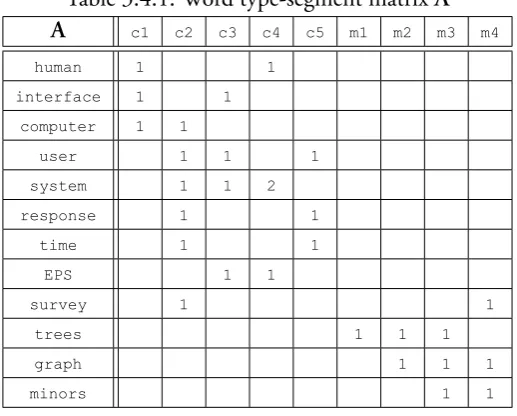
This is the basic intuition behind most methods of word-sense disambiguation and discrim-ination. In fact, Lesk’s algorithm directly operationalises the distributional hypothesis. As we shall see in Section 3.2 (p. 67) this intuition can be formalised and eventually expanded into what is now known as thevector space model(VSM) (Salton, 1971; Salton et al., 1975) used in information retrieval and eventually adopted in distributional lexical semantics. The VSM encodes a context of an ambiguous word as an occurrence vector, i.e. a multidimensional array in which each dimension represents a word in some pre-defined vocabulary and keeps count of the number of times that each word occurs in the context. The core component of the VSM is a word-document or word-context matrixA. The rows of such a matrix represent
word typesand the columnsdocumentsor shorter textsegmentssuch as paragraphs or sen-tences. An elementaijin this matrix, in its most basic form, effectively counts occurrences of
a word typeτi in a document or segment (context)δj.
developed by Turney (2006) was tested on the multiple-choice analogy section of the SAT exam and achieved a score of 56%, similar to what human test-takers achieve who on average score 57%.
The link between the VSM and lexical semantics is so strong that, some variants of the VSM, such as LSA, are often seen as plausible models of a major component of human lexical semantic learning (Bullinaria and Levy, 2007; Landauer, 2007). But VSMs are also applied in language tasks beyond semantics. For example, within information retrieval itself, VSMs find applications beyond the traditional ranking of documents based on queries. An extension of this basic application is cross-lingual information retrieval, in which documents written in one language are returned for queries written in another language (Dumais et al., 1997). Another information retrieval area where VSMs have been applied to are text categorisation (Sebastiani, 2001) and document clustering (Manning et al., 2008), important tasks in organising large text collections. Automatic essay grading, document segmentation by subtopics, question answering and call routing are some of the other natural language processing tasks where the VSM has found application (Turney and Pantel, 2010).
Given its success in lexical semantics and other areas of natural language processing, it is not surprising to find that many, if not most, WSX methods are based on a variant of the VSM (Agirre and Stevenson, 2007). This thesis focuses on the VSM in part because of this success and in part because it is virtually language independent as it requires very little linguistic pre-processing, making it available to languages for which computational language resources (such as parsers or part-of-speech taggers) are not available or underdeveloped. This language neutrality property can, in addition, help shed some light on how far we can get with as little resources as possible and by only deriving statistics from the text itself. In particular, this thesis focuses on two instances of the VSM: Latent Semantic Analysis (Deerwester et al., 1990; Landauer and Dumais, 1997) and Word Space (Schütze, 1992, 1998).
Latent Semantic Analysis(LSA) is a direct adaptation of Salton’s VSM, which usesAto rep-resent word types and text segments. The characteristic that distinguishes LSA from Salton’s VSM is the usage of Singular Value Decomposition (SVD) (Golub and Van Loan, 1989; Berry, 1992) in order to project the word type and segment vectors inA to a lower dimen-sionality space. Levin et al. (2006) applied LSA to WSD with a view to applying it to WSDisc at a future stage. They used the text segments containing occurrences of the ambiguous word as proxies for token representations of that ambiguous word.
Word Spaceconstructs aword-word co-occurrence matrix(orword matrix), denoted here asW, in which an elementwij counts the instances of word typeτi occurring in the vicinity
of word type τj. The rows and columns in W are word vectors that represent word types
order to obtain reduced context vectors. Strictly speaking, context vectors computed from SVD-reduced word vectors do not count second-order co-occurrence per se since they are aggregating vectors in a different (orthogonal) vector space that do not hold word frequencies as such any more. Also, Kontostathis and Pottenger (2006) demonstrated that SVD-reduced spaces potentially capture co-occurrence information of an order higher than second-order. Because of this, we shall prefer the termindirect context vectorswhen discussing second-order context vectors in general. There is also a first-order context vector variant (Pedersen and Bruce, 1997), which represents an instance of a target word in context by counting the words that co-occur directly with the target word within the word window. To contrast them with their indirect (second-order) counterparts, we shall refer to them asdirect context vectors. While not traditionally included within the Word Space framework, direct context vectors are related to word vectors and in consequence to indirect context vectors: the word vector of a word type τ can be computed by summing the direct context vectors for every token
κ of τ in the corpus (see Def. 3.5.3, p. 101; Maldonado-Guerra and Emms, 2012). For our purposes, we shall consider Word Space to have three inter-related components: a word matrix of word vectors representing types and two token representations: direct (first-order) and indirect (second-order) context vectors. Contrast this three-component system with LSA’s matrixAwhich is able to simultaneously represent word types and tokens in the same matrix. This thesis is concerned primarily with the competing token representations given by Word Space and LSA. In spite of the attention given by the WSX literature to these two specific representations, very few works have attempted to compare one with the other. And those few works that attempt this comparison usually do not fully analyse their properties or the exact mathematical relationship between the two models. For example, Pedersen (2010) compares the performance of variants of LSA and Word Space in WSDisc experiments, but he assumes a straightforward relationship between LSA and Word Space which he does not test (see Section 4.3, p. 122). Sahlgren (2006), Utsumi and Suzuki (2006) and Utsumi (2010) also performed empirical comparisons between LSA and Word Space based on identifying semantic relations (such as synonymy, hyponymy, collocation, etc.) but again did not perform an analytical comparison between the spaces represented by both models. This thesis aims to fill this gap in a systematic manner by first analysing the mathematical relationships between Word Space and LSA analytically and then by performing WSX benchmarks in order to attempt to establish which model is best suited for WSX.
Whilst the main focus of the thesis is the study of the spaces produced by LSA and Word Space and their impact on the disambiguation and discrimination of word senses, the thesis also explores, as a secondary topic, the problem of automatically assessing the compositionality of multi-word expressions (see Section 2.1.2, p. 33 and Chapter 8). This topic is included in this thesis as the method presented to perform this assessment is based on Word Space.
1.3 Research questions and thesis structure
The topic of research for this thesis centres on vector space representations useful for resolving lexical ambiguities in an unsupervised way. The primary vector space representation studied is Schütze’s Word Space, with LSA as a secondary model to compare it against. Both models represent the same objects (types and tokens) in their own way. Since both models are based on word counts, use SVD but construct different matrices, it seems reasonable to ask whether the two models are equivalent, approximate or completely different. Little has been discussed about their exact relationship or the benefits of one model over the other for word senses. This is one of the questions that this thesis seeks to address. Also, Word Space itself has two sep-arate token representations (direct or first-order context vectors and indirect or second-order context vectors), so another valid question to pursue is whether they are similar or different, and whether they perform similarly or differently in WSX. This leads to the following research questions:
1. What is the relationship between type representations in LSA’s matrix A and Word Space matrixW?
2. What is the relationship between the token vectors defined in LSA’sAand Word Space first-order context vectors and second-order context vectors?
3. Are the SVD-projected type and token representations in LSA and Word Space equi-valent, similar or different?
4. For WSX experiments, which token representations are better? LSA-based or Word Space-based representations?
5. What is the relationship between the two token representations (direct/first-order and indirect/second-order) offered by Word Space? Are they both approximations of each other or are they different?
6. Which Word Space token representation is better for WSX?
During the analysis of Word Space token representations (Chapter 4), it is observed that second-order context vectors can be computed from first-order context vectors via a matrix multiplication by the word matrix. It is shown that this operation can be regarded as a linear transformation or projection not unlike the projections usually performed via SVD as a means of dimensionality reduction. As a consequence, dimensionality reductions based on this linear transformation are explored. In order to be used as a dimensionality-reducing linear map,
W ∈ Rm×n must meetn < m(see Sec. 4.1, p. 108). That is, Wmust map vectors inRm
toRn, withRn being a lower dimensional (and potentially denser) vector space. This means
that the features selected for the “output” dimensionalityRnmust be different to the “input”
the columns of a word matrix are merged and summed together (or consolidated) based on syntagmatic similarity. An algorithm is proposed to perform these consolidations and several criteria for consolidation are explored. This brings us to the next research questions:
7. Is word matrix consolidation a viable method of dimensionality reduction?
8. Do indirect (second-order) context vectors computed from consolidated matrices per-form better than from non-consolidated matrices in WSX experiments? That is, does the consolidation process produce better performing vectors?
9. Is the word matrix consolidation of dimensionality reduction better, the same or worse than SVD for WSX?
The questions presented so far explore only one type of lexical ambiguity: word sense ambi-guity. The other type of lexical ambiguity explored by this thesis is the compositionality of multi-word expressions such as collocations. The distributional hypothesis implies that the syntagmatic distribution of semantically unrelated words will be different (i.e. words with unrelated meanings will co-occur with different words) whereas the syntagmatic distribution of semantically related words will be similar (i.e. words with related meanings will co-occur with more or less the same words). A non-compositional collocation such asred tape in its bureaucratic sense will co-occur with words relating to government, bureaucracy, politics, etc., whereas the predominant senses of the individual wordsred andtape will perhaps have little to do with government, bureaucracy or politics. This intuition is operationalised via the computation of cosines between Word Space word vectors computed from instances of the collocation and word vectors computed from instances of the collocation’s individual words. A low cosine value is interpreted to indicate non- or low-compositionality whereas as higher values as medium- or even high-compositionality. This brings us to the last research question of the thesis:
10. Can cosine measures between collocation vectors and individual word vectors be used as a reliable and unsupervised method of collocation compositionality measure?
The overall thesis structure and the main outcomes can be outlined as follows.
Chapter 1 is this introductory chapter.
Chapter 3 fleshes out some of the concepts studied in Chapter 2 in computational terms. For example, it defines word types and word tokens in terms of the Word Space and LSA vector models. The chapter serves mostly as a background and literature review for the comparisons and experiments that will be presented in subsequent chapters. The chapter also makes lin-guistic interpretations from the syntagmatic and paradigmatic point of views of methods of semantic similarity computation via cosine. Some aspects of this chapter were published in Maldonado-Guerra and Emms (2012) and Emms and Maldonado-Guerra (2013).
Chapter 4 is in some ways a continuation of Chapter 3 (e.g. it describes how SVD can be applied to Word Space objects) but also makes the main theoretical contributions of the thesis, the most fundamental of which is an equivalent formulation of Word Space indirect (second-order) context vectors as the product of a linear transformation of direct (first-order) context vectors via the word matrix (question 5). The case is made to view indirect (second-order) context vectors as projections in an alternative vector space that could also be used for dimensionality reduction in a way reminiscent of the application of SVD to project vectors in lower dimensionality spaces. This linear transformation view also makes the application of SVD to Word Space objects more transparent and comparable to the way it is applied in LSA. The chapter also makes analytical and numerical comparisons between Word Space and LSA (questions 1, 2, 3) and finds that the token and type representations offered by both models, as normally formulated in the literature, are approximations of each other and that their difference can be exactly calculated. This chapter also shows that the same mechanism of indirect context vector construction available to Word Space is also available to LSA, a mechanism that has not been widely exploited or studied. Some aspects of this chapter were published in Maldonado-Guerra and Emms (2012).
(like Rocchio, K-Means, Expectation-Maximisation for Gaussian mixtures, etc.) will be able to discriminate senses of a word more easily and therefore achieve good performance. Con-versely, it is assumed that a high cosine average will make it more difficult for a classification or clustering algorithm to distinguish among the sense of a particular word token, translating in poorer performance. The angular spread, therefore can be a performance predictor for each kind of token vector. In these experiments, pairwise cosine comparisons between direct sense vectors of a target word for different senses are computed and the resulting cosine measures are averaged. This number is taken to be the angular spread for direct context vectors for that particular target word. The same exercise is repeated for indirect sense vectors, and the resulting average of pairwise cosine measures is taken to be the angular spread for the indir-ect context vindir-ectors. It is found that dirindir-ect context vindir-ectors have a lower cosine average (are more spread) and that indirect context vectors have a higher cosine average (are less spread), so the prediction is that direct context vectors will perform better than indirect context vec-tors. After the geometric experiment results are analysed, supervised WSD and unsupervised WSDisc experiments are performed. For the supervised WSD experiments, the direct context vectors comfortably outperform the indirect context vectors, largely reflecting the predictions from the angular spread experiments. However, for the unsupervised WSDisc experiments, no clear winner emerges, with the difference in performance between both vector types com-ing much closer together. However, it has to be stressed that the overall performance scores of the unsupervised experiments are much lower (between 12% and 25% lower) than the su-pervised experiments, which is congruent with other results in the literature highlighting that unsupervised methods generally perform worse than supervised methods (Pedersen, 2007). The experimental results in this chapter were published in Maldonado-Guerra and Emms (2012).
(called “R2 projections”) direct Word Space vectors based onConly perform similarly to the
same variant of SVD-reduction to direct LSA vectors based onAin supervised experiments, whilst all other dimensionalities (R1projections and unreduced) and supervised experiments
perform differently across the two kinds of direct token vectors. Also, indirect Word Space token representations based on W perform differently to both indirect Word Space token representations based on C and indirect LSA vectors based on A. So, in sum, despite the approximations found in Chapter 4, not all LSA vector configurations will perform similarly to their Word Space counterparts in all circumstances. It can be seen that these configura-tions somewhat offset the performance that they will achieve in supervised or unsupervised experiments. Other interesting observations made by this chapter include that for most con-figurations SVD-reduction does not help performance, and that the best trade-off between computational expense and performance in the supervised case is given by unreduced direct Word Space context vectors, and in the unsupervised case by unreduced indirect Word Space context vectors, although other unreduced context vectors perform similarly, a result some-what echoing Chapter 5, where no clear winner was found for the unsupervised experiments.
Chapter 7 goes back to the definition of indirect context vectors as a transformation of direct context vectors via a word matrix introduced in Chapter 4 and attempts to use this insight as an alternative method of dimensionality reduction. The specific method used is word matrix consolidation (question 7). Matrix consolidation is compared with unreduced and SVD-reduced direct and indirect Word Space vectors in supervised and unsupervised experiments (questions 8, 9). Whilst word matrix consolidation can perform similarly and sometimes slightly better to SVD, it still does not provide an increase in performance when compared to unreduced vectors. An advantage over SVD though is that matrix consolidation does not require the user to provide the number of dimensions to keep in advance. While not being an overwhelmingly better alternative to dimensionality reduction, matrix consol-idation does show that viewing the indirect context vector construction method as a linear transformation opens the door to the exploration of novel methods of token representation.
based on “how literal” each bigram sounded to them. These judgements were then averaged and converted to a scale between 0 and 100, where 0 means non-compositional and 100 is fully compositional. Systems were evaluated on their ability to predict this average numeric score and to classify bigrams as either low compositional, medium compositional or highly compositional. The shared task organisers refer to this categorisation as the “coarse” predic-tion task. One of the variapredic-tions of the system reported in this thesis achieved a fifth place (out of 15) in the overall numerical prediction task, whereas another of the variations also achieved fifth place in the overall coarse prediction task. However, it achieved first place in the coarse verb-object subset of bigrams. The system description and the experimental results were published in Maldonado-Guerra and Emms (2011).
Chapter 9 presents the main concluding points of the thesis and discusses areas for future work.
This chapter introduces and defines several aspects of linguistic theory used or referred to throughout this thesis. In doing so, relevant literature on the topic is also reviewed or referred to. The interpretation of linguistic terminology often depends on the linguistic school or branch one chooses to use as a reference. This chapter discusses several of these terms, some-times considering differing philosophical views, and defines the terms as they pertain to the scope of this thesis. The aim of this process is to reduce ambiguity and increase the precision of the interpretation of the different linguistic terms and concepts employed. Since the thesis subject matter is word-sense disambiguation and discrimination, it seems appropriate to focus the discussion with what we understand by the concepts ofword andword sense.
Thewordcan be considered to be the smallest linguistic unit that carries meaning. It is from the way in which words combine in larger linguistic units, such as phrases or sentences, that the larger unit’s overall meaning emerge. Given its importance, most empirical research in word-sense disambiguation and discrimination use some computational representation of words as features in their systems (Navigli, 2009). Section 2.1 attempts to define the concept of word mostly from a written language perspective, since the experimental work reported in this thesis is done on written language corpora. It also defines the linguistic concept of collocations, recurring multi-word partnerships that often carry a special or non-literal meaning. This section also introduces the concept of ngrams, which have resulted convenient and practical from a computational point of view even if they do not necessarily emerge from any theoretical linguistic tradition.
2.1 What is a word?
2.1.1 Word tokens and word types
When dealing with written text, it is convenient to conceive words as clusters of contiguous characters bound by white space or punctuation marks, such as full stops, commas, quotation marks, etc. From a computational point of view, this definition is quite useful as it enables the employment of simple regular expressions for identifying words automatically. However, this definition is somewhat problematic. For example, many Asian languages such as Chinese and Japanese do not use white space as a word boundary. Instead all words appear contiguously in the text making it difficult to determine where a word starts and where a word ends without knowledge of the language in question. Another problem is that many languages, including English, also employ the full stop to indicate an abbreviation. Different tokenisation solutions have been proposed and their discussion is beyond the focus of this thesis, so the interested reader is directed to Manning and Schütze (1999, sec. 4.2.2) for a comprehensive discussion. Assuming that there is a mechanism to correctly split a string of text into separate words, we come to the question of what to count as a word. Consider this famous quote by Samuel Johnson:
(2.1.1) When a man is tired of London, he is tired of life, for there is in London all that life can afford.
In total there are 22 words, of which 17 are distinct words. In lexicography, a word token
is a specific instance of a particular word in a text, whilst a word type can be seen as the class to which a word token belongs to. In Example (2.1.1), the word type is has 3 word tokens and the word typestired,of andLondonhave 2 word tokens each. We are starting to see that the term word is slightly imprecise as it could be used to mean word type or word token, depending on context. And as we shall see in Section 3.5, this distinction will be very important in the mathematical definitions of context vectors (word tokens) and word vectors (word types).
A further way to conceive a word is by considering its canonical or “dictionary” form. For instance, it is possible to remark that this quote is an example of the usage of the wordsbe
andtire even if they do not appear in their canonical form at all, but in their inflected forms
isandtired, respectively. More specifically, we say that the wordsisandtired areword forms
orrealisationsof thelexemesbe and tire, respectively. This shows again that there are some more precise terms for different conceptions of the term word and this thesis will prefer to use these when this precision is important but will freely use the less technical termword as an umbrella term covering word forms and lexemes or when this precise distinction is not needed.
Based on their meaning, words can be classified into two major groups: content words
(also known asopen-class words,full wordsorlexical words) andfunction words(also called
words are considered to carry most of the meaning (semantic content) in any given sentence or phrase. Verbs, nouns, adverbs and adjectives are usually considered to be content words. They are so-called open class because new words in these part of speech categories are regularly added as new inventions, discoveries and definitions are made. London,affordandmanare examples of content words in (2.1.1). By contrast, function words are words like articles, prepositions and pronouns, to which new members are rarely added and whose purpose is mostly to interact with content words and other function words in order to form grammatical and meaningful phrases and sentences. Function words are often perceived to carry little semantic content. In (2.1.1)of, inandthat are examples of function words. In natural language systems (notably in information retrieval), function words are specifically called stop words and are usually filtered out or ignored during processing due to the belief in their low semantic currency and in order to make savings on technical aspects such as storage requirements, and in order to reduce potential noise. In fact, there are some content words that sometimes are included in stop word lists, such as forms of the verb be (is, are, was, etc.) and auxiliaries1 (can, do,
would, etc.) As a consequence, this thesis will prefer the term stop word to refer to those words usually included in a typical information retrieval system’s stop word list and the term
content wordfor any word not belonging to this list.
2.1.2 Multi-word expressions and collocations
The concept ofword can be further expanded if we consider so-calledmulti-word expressions
orunits, i.e. recurring sequences of individual words that form a unit, such as prime minis-ter, public house orRepublic of Ireland. These word combinations form a whole unit and yet each member in the combination can be seen as unit in itself: primeandminister,publicand
house,Republic,of andIreland. The notion of the usage of recurring multi-word expressions is termedcollocationin the linguistics literature (Firth, 1951; Halliday, 1961; McIntosh, 1966; Lyons, 1966; Sinclair, 1966). There is a wide range of collocation types. Idioms such asonce in a blue moon, red tape or red herring are the ones that more readily come to mind. But other types of collocations include figurative expressions and clichés (talking to a brick wall,
the crack of dawn, strike a balance, safe and sound, law and order, to be honest), multi-word terminology (collateral damage,support vector machine, machine readable passport), named en-tities (United Nations, European Economic Area, Barack Obama), phrasal verbs and complex verbal expressions (look for, make up someone’s mind), etc. Unfortunately there is no single definition for the concept of collocation and there tends to be a slightly different treatment of the term between computational linguistics and general linguistics. For example, many natural language processing works often assume collocations are contiguous strings of words,
1Notice that the set of verbs that are considered auxiliaries in English is quite small and rarely new members
whereas linguistic works will also investigate collocations that are not consecutive but whose components co-occur within a short distance between each other (see e.g. Sinclair, 1991). For instance,makeandremarkcan collocate in phrases such asmake a remark, make an inap-propriate remark, make an unhelpful and distasteful remark, etc. Apart from the requirement of frequent and near co-occurrence, Manning and Schütze (1999, p. 184) enumerate three other typical requirements or characteristics of collocations2:
• Non-substitutability– A word making up a collocation often cannot be substituted by another word, not even by a similar word or even a synonym. For example, inonce in a blue moonthe adjectivebluecannot be substituted by a similar word likegreenorred, as the idiom is fixed and cannot be changed. Similarly, translating literally red wine
into Spanish would render the anomalous*vino rojowhich, while being an accurate de-scription of the wine’s colour, is not the usualvino tintothat any native speaker would instantly recognise. The non-substitutability characteristic is not an absolute require-ment however, as some collocations do allow it in a limited manner. For example,heavy smokercan take the formchain smokerandto know one’s onionsis equivalent toto know one’s stuff.
• Non-modifiability– Collocations cannot be modified by adding words or by changing grammatical characteristics. For example to get a frog in one’s throat cannot become
*to get an ugly frog in one’s throat. This is especially important in idioms such as kick the bucket. English speakers would find anomalous the sentence*she was about to kick her bucket, even if there is nothing ungrammatical about the substitution of a definite article with a possessive determiner. The non-modifiability criterion is also optional, however, as some collocations do allow a limited degree of modification. For example
seeing is believing can becomeseeing really is believing.
• Non-compositionality– A collocation is not necessarily the “sum of its parts”, that is, it cannot always be interpreted as a literal composition of its constituents. The mean-ing ofx kicked the bucket cannot be understood from a standard open-choice analysis as this would arrive at interpreting thatxkicked an actual bucket, rather than interpreting thatxdied. Similarly,red tapein its government bureaucracy sense require the language user to have knowledge additional to the language’s grammar in order to correctly in-terpret the phrase. The property of non-compositionality is not confined to idiomatic expressions: public house (from which the word pub is derived) which usually desig-nates an establishment that provides patrons with alcoholic drinks to be consumed on the premises, is somewhat compositional. And again, not all collocations are non-compositional: orange juice, apple juice and many technical terms (machine readable passport,internet service provider) are rather compositional common collocations.
Not all these three characteristics are required for every single collocation and perhaps we should consider as a collocation any recurrent word combination that fulfils at least one of these three characteristics. From a lexicographical perspective, Benson (1989) puts forward a similar argument even if he does not employ the same terminology. He considers that fre-quent word combinations should be listed as lexical entries in a dictionary when they fulfil at least one of the following two criteria: 1) have “peculiar semantics” and 2) be arbitrary. A word combination has peculiar semantics when its meaning cannot be understood by literally interpreting the combination, i.e. when it is non-compositional. If a word combination can be interpreted literally, then it should not be listed as a lexical entry, i.e. it should not be considered a collocation. For example, the following adjectives should not be considered col-locates of evidence: absolute, additional, certain, considerable, conspicuous, gratifying, hopeful, even if they frequently modify this noun. This is because they are compositional, i.e. they form normal and literal “adjective plus noun” combinations that any (competent) speaker of English would understand by just applying this grammar rule without recurring to any external knowledge. The inclusion of such compositional combinations will rarely if ever be consulted by the dictionary’s potential users, making the dictionary bigger and not necessar-ily more useful. By contrast, a combination with peculiar semantics such as heavy smoker, which of course does not literally describe a smoker who is overweight or simply physically heavier than the average smoker, would be more useful, for example to an L2 learner of Eng-lish, to be listed in a dictionary as an entry. The criterion of arbitrariness is a combination of the non-substitutability and non-modifiability characteristics. For example, Benson considers thatmake an estimateshould be a dictionary entry because it is not a free word combination as it is not possible to say *make an estimation. Similarly, he considers commit treason (not
*commit treachery) andwarmest greetings(not*hot greetings) to also be arbitrary non-free word combinations. Benson’s arguments are grounded in good lexicographic practice: the ultimate decision on what constitutes a lexical entry in a dictionary is based on a trade-off between its potential usefulness for a dictionary user and the cost of making the dictionary bigger by adding that entry. It is more of an engineering principle than a linguistic insight, even if the requirements he lists are based on interesting linguistic properties. A similar pragmatic view is usually also taken in computational linguistics and so the study on non-compositional multi-word expressions is increasing in the field. As an example of the importance of pro-cessing multi-word expressions, consider a machine translation engine. It would be desirable for such an engine to be able to translate the French prendre une décisionasmake a decision
and not literally as*take a decisionwhile there is no reason to stop it from translatingpreuve supplémentaireliterally asadditional evidence.
smoker lies somewhere in between: it does describe a type of smoker, one who smokes too much but not an overweight one as we have seen. So, we could say that heavy smoker has some sort of medium-to-low compositionality but it is by no means fully non-compositional.
Red light is a collocation that, depending on meaning or use, will have a different degree of compositionality. Consider these three sentences:
(2.1.2) Many LEDs emit red light.
(2.1.3) The car stopped at a red light.
(2.1.4) Disappointingly, the project got the red light.
It is clear that (2.1.2) is clearly compositional since it literally describes light that is red in colour. Whilst (2.1.3) describes a scenario in which a light that is red in colour is involved, it can be argued thatred lighthas acquired the more abstract meaning of a traffic control device signalling the car to stop. This usage involves some literal usage (the signal is in the form of a light that is red in colour) but it also carries other meanings associated to traffic conventions as well as electronic devices designed to enforce these conventions in actual streets. Since (2.1.4) involves decoding a metaphor by exploiting additional knowledge (i.e. a notion of traffic conventions mapped into a business situation), this usage ofred lightexhibits very low compositionality.
The present discussion on collocations has touched informally on some aspects of semantics, especially when describing non-compositionality. This informal introduction to semantic no-tions should suffice for the purposes of this discussion. However, Section 2.2 addresses in general the topic of lexical semantics more rigorously within a structuralist and distribution-alist setting and, in particular, Section 2.2.5 revisits some aspects of the semantic notions of collocations discussed here, against the same structuralist and distributionalist backdrop.
2.1.3 Ngrams
not a consequence of literacy and therefore we need not base our definitions in terms of the written form. However, it can be difficult to operationalise such human intuitions in a natural language processing system that deals primarily or exclusively with text and so a theoretical compromise must be reached. While crude, these definitions are useful for computational operationalisation and because they are divorced of any particular linguistic or philosophical consideration of what a word or a lexical unit is, they can work inside more complex linguistic concepts. For example, certain ngrams are collocations (e.g. public house, machine readable passport). This thesis will therefore make extensive use of the termsunigram,bigram,trigram,
ngram, etc. as defined so far. Furthermore, it extends the concepts of word token and word types to ngrams. That is, it is possible to consider a particular instance of an ngram a token, and that ngram a lexicographic type in its own right.
2.2 What is a word sense?
At the core of any discussion about word senses resides the question of how is it that a word carries meaning. The link between linguistic form and meaning has been discussed since antiquity. Perhaps its oldest incarnation is Plato’s Cratylus dialogue between Hermogenes, Cratylus and Socrates3. This dialogue discusses whether there is an inherent correctness in the
names given to things or whether names are given to things by convention. Cratylus believes the names things receive are natural and therefore come from the things themselves. Socrates explains that the sounds (phonemes) used in a word should be appropriate to the thing they are the subject of. Hermogenes opposes this view stating that the naming of things follows custom and convention, that words are not related in any way to the essence of the things they name. Socrates rejects this idea explaining that words have one true meaning, even if sometimes the meaning of a word changes. Socrates cites a few etymological examples but also struggles to find the origin of some words, blaming the difficulty on what we today would call the processes of language change: “Saying, if there is a word we do not know about, that it is of foreign origin. Now this may be true of some of them, and also on account of the lapse of time it may be impossible to find out about the earliest words; for since words get twisted in all sorts of ways, it would not be in the least wonderful if the ancient Greek word should be identical with the modern foreign one.” (Plat. Crat. 421e-d). The discussion is not conclusive but the idea that words have a true and natural meaning was extremely influential until the end of the 18th Century, when serious objective research gave birth to the discipline of historical linguistics. Up until that point, etymologies were constructed based on whatever ideas of word purity were in vogue at any given time. By contrast, based on objective formal and semantic analysis of cognates, i.e. versions of semantically-related words in different languages, historical linguistics was able to reconstruct the historical relationships between languages and the reconstruction of theorised ancient languages such as Proto-Germanic or
Proto-Indo-3An English translation by Fowler (1921) is freely available on-line at
CONCEPT (REFERENCE)
SYMBOL (e.g. WORD)
[image:38.595.137.402.72.187.2]REAL WORLD PHENOMENON (REFERENT)
Figure 2.2.1: The semiotic triangle – A mental concept can be seen as a pointer to a phe-nomenon in the real world and a linguistic symbol, in turn, as a pointer to the mental concept, producing an indirect association between the linguistic symbol and the real world phenomenon, represented here as a dotted line.
European (Geeraerts, 2010, ch. 1).
By the early 20th Century, this shift towards an analytical framework in linguistics began favouring Hermogenes’ idea of meaning by custom and convention against Socrates’ ideals of true meaning. An influential conceptualisation of this notion is the denotational or referential mechanism between words and real world entities. Through their famous semiotic triangle, adapted in Figure 2.2.1, Ogden and Richards (1936, p. 11) posit that a linguistic symbol like a word or phrase is linked to a concept (a reference) which itself is some mental representation of a real world phenomenon (a referent) such as an object, an animal, a place, an action, an abstract entity, etc. The only connection between the symbol and the actual real world phenomenon is indirect, via its mental representation (the concept)4.
This model presents several shortcomings. First, it does not account for situations in which more than one word or expression is associated with the same meaning (synonymy) as well as cases where one word or expression is associated with more than one meaning (homonymy or polysemy). Furthermore, not all words are easily associated to real world phenomena. Function words likeand, if andthat as well as expressions relating to mythological entities (tooth fairy, unicorn, etc.) clearly illustrate this issue. These words do not have a real world referent, however we can agree that they all have a meaning (in the case of the function words this would be some sort of grammatical, functional meaning). Likewise, there could be one single real world phenomenon having several meanings, as in the commonly cited case of the
morning star and theevening star: both relate to the physical planet Venus, but the two stars are considered to have different meaning because they appear in the sky at different times of the day.
4Notice, however that in some cases such as that of onomatopoeic words likecuckoo,meowandcrash, there