Abstract—Reuse is a technology which more accept in industry. This system does not only reduce production cost but also reduce pollution of environment. The research is done in order to study and design reused system in electroplate industry by design reused chromium plating solution and rinsed water. On the process, optimize working condition in making chromium plating solution and rinsed water is important factor that it needs to formulate mathematical model by collect data from real experiment.
Keywords—electroplating, chromium plating, rinse water, reuse system, optimization
I. INTRODUCTION
Nowadays, Reuse is a technology which more accept in industry. It brings used resources but remain quality to process in reuse system. This system does not only reduce operation cost but also reduce pollution of environment.
According to estimated electroplating plants, it found that most of them still have not reused rinse water. Some electroplating plants have already implemented reused process but still low standard quality. Most of waste water occurs in rinsing process since they lack of concentration examination and moreover they drain rinse water without reuse it again.
As above mention, the research was done in order to study and design reused system in electroplating industry. This chapter divides into three parts. First, collect the data from real experiment in electroplating plant. Second, formulate mathematical model and compare with real data. Finally, find optimize working condition of chromium plating solution and rinse water.
II. ELECTROPLATING PROCESS
The research is done in order to study system in nickel - chromium electroplates industry that will electroplated machine part by automatically working.
The electroplating process falls into the following step. First step is preparation and cleaning a part; such as polishing, cleaning plated by various chemical; before electroplates process. Second step is nickel electroplates it
Author is with the Control and Systems Engineering Laboratory, Department of Chemical Engineering, Chulalongkorn University, Bangkok 10330, Thailand; e-mail: J.Chuensakul@ hotmail.com and [email protected]).
can maintain and protect surface metal. Third step is chromium electroplates. This step will do a part stand for scrape and decay. The last step is drying process.
III. CHROMIUM PLATING
The research is done in order to part dipping part with chromium and rinsing water. By collecting data from electroplate industry to get the result of primary parameter and then compare the result with mathematic model.
A. Data Collection
Chromium electroplating condition will be as following below ; chromic Acid 215-275 g⋅L-1, temperature 40-45 C. Time for chromium electroplating 2 minute. Volume of chromium electroplating tank 1320 L. and rinsing water tank 1100 L.
The working process has electroplated 7200 parts per day. It has to fill deionization water back into electroplate tank every 2 days. It is necessary to has chemical solution overwhelm a part. Because the volume of chemical has decrease after electroplated process by stick it on part and drag out. Then some area of a part cannot electroplate.
Collecting data will take 2 working cycles. A working cycle is 24 working days. This research will collect the data every 2 days. There are collecting chemical solution and measure capacity after electroplated process at chromium electroplating tank. Other wise it also collecting chemical solution after fill deionization water up by respectively. About abandoned tank also collect chemical solution and measure capacity of electroplating tank after wash out process.
B. Modeling for electroplating process
Formulate mathematical model of original chromium plating in electroplate industry, reused chromium plating chemical mathematical model and mathematical model of rinsed water. To understand the process, the quality of chemical solution from doing material balances model.
Since the process is non-reaction, well-mixed, volume of rinsing water is constant, drag in and drag out are constant and rate of evaporation is very less. The initial condition of process and parameter values has see table 1.
Original for electroplating process. The original chromium plating mathematical model in electroplate industry and mathematical model of rinsing water can explain by following equation.
J. Chuensakul, and P. Kittisupakorn
Devise of the Reuse System of Chromium
Plating Solution and Rinse Water in Chromium
Fig 1. Original for electroplating process.
Electroplating tank
DI
e
D
W
dt
dV
=
−
+
(1)
(
)
m
DZ
dt
Z
V
d
e e
e
=
−
−
(2)
a
t
I
c
m
=
⋅
⋅
e⋅
;
Rinsing tank
1 1 1
1
r r e r
r
Z
V
D
Z
V
D
dt
dZ
−
=
(3)2 2 1 2 2
r r r r
r
Z
V
D
Z
V
D
dt
dZ
=
−
(4)
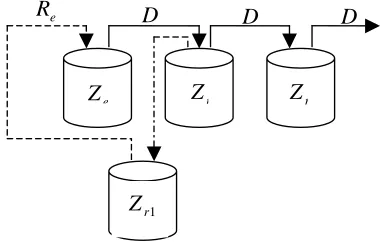
Reuse for electroplating process. The reused chromium plating mathematical model will do not fill deionization water to chromium electroplate tank. But take chemical solution to reuse from first rinsed tank using for instead. The process can explain by following equation.
Fig 2. Reuse for electroplating process.
Electroplating tank
e e
R
D
dt
dV
+
−
=
(5)(
)
f r e e
e e
Z
R
m
DZ
dt
Z
V
d
1
+
−
−
=
(6) [image:2.612.91.282.418.539.2]The part of mathematical model of rinsing water can use equation ( 3) and (4).
Table 1.
Initial condition and process parameter values.
____________________________________________ Ze(0) = 270.70 g⋅L-1
Zr1(0) = 0 g⋅L -1
Zr2(0) = 0 g⋅L-1
Ve(0) = 1320 L
Vr1 = 1100 L
Vr2 = 1100 L
D = 13.28 L⋅day-1 WDI = 26.56 L⋅day-1
Re = 26.56 L⋅day-1
________________________________________________
IV. RESULTS AND DISCUSSIONS
The result of comparing among collecting data from industry, original chromium plating mathematical model, reused chromium plating mathematical model and rinsed water mathematical model.
Fig 3. Concentration of chromic acid in electroplating tank.
Fig 4. Concentration of chromic acid in first rinsing water.
D
W
D
D
D
e
Z
Z
rZ
re
R
D
D
D
e
Z
Z
rZ
rr
Fig 5. Concentration of chromic acid in second rinsing water.
From Fig 3 has found that concentration of chromic acid will decrease when more working time. More decreasing when fills deionization water or chemical solution from first rinsed tank. The result from original chromium plating mathematical model has result similar to data that collect from industry. From comparing with reused chromium plating mathematical model has found that the concentration of chromic acid will decreases less than original chromium plating mathematical because reusing of chemical solution.
From Fig 4 and 5 has found that the concentration of chromic acid in first rising water and second rising water under original chromium plating mathematical model and reused chromium plating mathematical model will increase when working time increase.While the result of first rinsing water and second rinsing water under original chromium plating mathematical model has result similar to data the collect from industry. From comparing of first rinsing water and second rinsing water under reused chromium plating mathematical model has found that the concentration of chromic acid first rinsing water and second rinsing water under reused chromium plating mathematical model will increase than first rinsing water and second rinsing water under original chromium plating mathematical model. According to concentration of chromic acid in reused chromium electroplating is higher than original chromium electroplating.
[image:3.612.84.294.53.181.2]And from economics analyzed, reused chemical solution in chromium electroplating can decrease operation cost to 28,170.78 THB per year when compare with original chromium electroplating, see table 2.
Table 2.
Economics analyzed operation cost
____________________________________________ Electroplating process ______________________ Original Reuse
________________________________________________ Deionization water a (L⋅year-1) 3,823.72 0.00
Chromic acid b(kg⋅year-1) 929.16 742.20 Total operation cost (TH⋅year-1) 117, 234.78 89,064.00 ________________________________________________ a, b
Deionization water is cost 1.50 THB⋅L-1
and chromic acid is cost 120 THB⋅kg-1
V. OPTIMIZATION
From the study in electroplates plant, it found that high concentration chromic acid of electroplating tank stick it on drag out occurring the most amount. It makes concentration of chromic acid is high unnecessarily so optimizing method will be used in finding optimize working process.
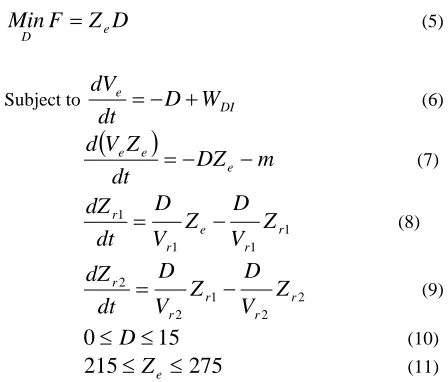
The objective function is formulated to minimize concentration chromic acid to lost stick it on drag out. The drag out, D, is the decision variable.
The optimization have been processing under mathematical model constrains and limitations of minimum, maximum concentration.
D
Z
F
Min
eD
=
(5)Subject to e
D
W
DIdt
dV
+
−
=
(6)(
)
m
DZ
dt
Z
V
d
e e
e
=
−
−
(7)
1 1 1
1
r r e r
r
Z
V
D
Z
V
D
dt
dZ
=
−
(8)
2 2 1 2 2
r r r r
r
Z
V
D
Z
V
D
dt
dZ
=
−
(9)
15
0
≤
D
≤
(10)275
215
≤
Z
e≤
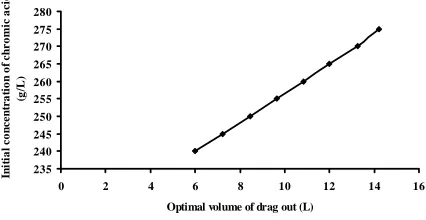
(11)Working process will take in 1 cycle working. By finding optimal volume of drag out when vary initial concentration of chromic acid in electroplating tank.
[image:3.612.320.544.203.394.2]Fig 7. Comparing concentration of chromic acid in first rinsing water.
Fig 8. Comparing concentration of chromic acid in second rinsing water.
From Fig 6, 7 and 8 the result of comparing among original chromium plating mathematical model, optimum volume of drag out chromium plating and rinsed water. It found that to decrease amount concentration chromic acid stick it on drag out and concentration chromic acid of rinsing water. Which optimal volume of drag out 13.1139 L and initial concentration chromic acid 269.970 g⋅L-1
235 240 245 250 255 260 265 270 275 280
0 2 4 6 8 10 12 14 16 Optimal volume of drag out (L)
In
it
ia
l c
o
n
cen
tr
a
ti
o
n
o
f ch
r
o
mi
c a
c
id
(g
/L
[image:4.612.79.292.499.609.2])
Fig 9. Optimum volume of drag out.
From Fig 9 the optimum volume of drag out is limited in feasible areas. The optimum volume of drag out directly varies with initial concentration chromic acid the same proportion. And electroplates plant can working process initial concentration chromic acid range 269.97-275.00 g⋅L-1. Because limit time of fill chromic acid.
VI. CONCLUSION
This paper is done to study electroplating plant working by formulating mathematical model, designing working process and finding optimize condition that conclude as following.
This mathematical model is acceptable because its result similar to experiment from electroplating plant.
To design reused chemical solution in chromium electroplating can decrease operation cost in part chromic acid and deionization water.
Working operation in electroplating plant will be initial concentration chromic acid 269.970 g⋅L-1 and drag out
13.1139 L.
APPENDIX
Ze concentration of chromic acid in electroplating tank
(g⋅L-1)
Zr1 concentration of chromic acid in rinsing water tank 1
(g⋅L-1)
Zr2 concentration of chromic acid in rinsing water tank 2
(g⋅L-1)
Zr1f final concentration of chromic acid in rinsing water tank
1 (g⋅L-1)
Ve volume of chromium electroplating tank (L)
Vr1 volume of rinsing water tank 1 (L)
Vr2 volume of rinsing water tank 2 (L)
D drag out volume (L⋅day-1)
WDI volume of deionization water to fill into electroplating
tank (L⋅day-1)
Re volume of solution in rinsing water 1 to reuse into
electroplating tank (L⋅day-1)
m amount of chromium deposited at the cathode (g⋅day-1) c faraday constant of chromium (0.3234 g⋅A-1⋅hr-1) I current that flows through the electroplating tank (A⋅day-1)
a current efficiency (%)
te time of soaking electroplating tank (hr)
ACKNOWLEDGMENT
The financial support to this work through local graduate scholarship from the Thailand research fund (TRF) is gratefully acknowledged.
REFERENCES
[1] H. L. Pinkerton, “Electroplating Engineering Handbook,” Pennsylvania Chemical Society, New York, 1995.
[2] E. Langford, “Analysis of Electroplating and Related Solution,” Birmingham, 1971.
[3] A. Laitinen, “Chemical Analysis,” University of Illinois, 1960. [4] S.L. Lo, and Y.C. Tsao. “Economic Analysis of waste Minimization for
Electroplating Plants,” Water Sci, 1997, p. 383.
[5] M. Schlesinger, and M. Paunovic. “Modern Electroplating,” Wiley, New York, 2000.
[6] R. Arun, F. Robert, and A. Jody. Cadmium and Chromium recovery
from electroplating Rinsewater. Research and development, United
Stated Environment Protection Agency, 1994.
[7] K. Kiptoo, J. Ngila, and M. Sawula . Speciation studies of nickel and
chromium in wastewater from an electroplating plant. University of
Botswana, Botswana, 2004.
[8] Y.H. Yang, H.H. Lou, and Y.L. Huang. Synthesis of an optimal
[9] K.Q. Luo, and Y.L. Huang. Intelligent Decision Support for Waste
Minimization in Electroplating Plants. Wayne State University, USA,
1997.
[10] Z. Buczko. The modeling of a rinsing process in electroplating. The chemical Engineering Journal, vol. 49, 1992, p. 161–166.
[11] B. Goers, J. Mey, and G. Wozny. Optimised product and water recovery from batch – production rinsing waters. Technical University of Berlin, Germany, 2000.
[12] Q. Xu, A. Telukdarie, H. Lou, and Y. Huang. Integrated electroplating system modeling and simulation for near zero discharge of chemicals