Cipher Type Detection
Malte Nuhn
Human Language Technology and Pattern Recognition Group Computer Science Department
RWTH Aachen University
Kevin Knight
Information Sciences Institute University of Southern California
Abstract
Manual analysis and decryption of enci-phered documents is a tedious and error prone work. Often—even after spend-ing large amounts of time on a par-ticular cipher—no decipherment can be found. Automating the decryption of var-ious types of ciphers makes it possible to sift through the large number of en-crypted messages found in libraries and archives, and to focus human effort only on a small but potentially interesting sub-set of them. In this work, we train a clas-sifier that is able to predict which enci-pherment method has been used to gener-ate a given ciphertext. We are able to dis-tinguish 50 different cipher types (speci-fied by the American Cryptogram Associ-ation) with an accuracy of58.5%. This is a
11.2%absolute improvement over the best previously published classifier.
1 Introduction
Libraries and archives contain a large number of encrypted messages created throughout the cen-turies using various encryption methods. For the great majority of the ciphers an analysis has not yet been conducted, simply because it takes too much time to analyze each cipher individually, or because it is too hard to decipher them. Automatic methods for analyzing and classifying given ci-phers makes it possible to sift interesting messages and by that focus the limited amount of human re-sources to a promising subset of ciphers.
For specific types of ciphers, there exist au-tomated tools to decipher encrypted messages. However, the publicly available tools often de-pend on a more or less educated guess which type of encipherment has been used. Furthermore,
they often still need human interaction and are only restricted to analyzing very few types of ci-phers. In practice however, there are many differ-ent types of ciphers which we would like to an-alyze in a fully automatic fashion: Bauer (2010) gives a good overview over historical methods that have been used to encipher messages in the past. Similarly, the American Cryptogram Association (ACA) specifies a set of56 different methods for enciphering a given plaintext:
Each encipherment method Mi can be seen as
a function that transforms a given plaintext into a ciphertext using a given key, or short:
cipher=Mi(plain,key)
When analyzing an unknown ciphertext, we are interested in the original plaintext that was used to generate the ciphertext, i.e. the opposite direction:
plain=M−1
i (cipher,key)
Obtaining the plaintext from an enciphered mes-sage is a difficult problem. We assume that the decipherment of a message can be separated into solving three different subproblems:
1. Find the encipherment method Mi that was
used to create the cipher cipher → Mi
.
2. Find the key that was used together with the methodMito encipher the plaintext to obtain
cipher=Mi(plain, key).
3. Decode the message usingMiandkey
cipher → M−1
i (cipher,key)
Thus, an intermediate step to deciphering an un-known ciphertext is to find out which encryption method was used. In this paper, we present a clas-sifier that is able to predict just that: Given an un-known ciphertext, it can predict what kind of en-cryption method was most likely used to generate
• Type:CMBIFID
• Plaintext:
WOMEN NSFOO TBALL ISGAI NINGI NPOPU LARIT YANDT HETOU RNAME
• Key:
LEFTKEY=’IACERATIONS’ RIGHTKEY=’KNORKOPPING’ PERIOD=3, LROUTE=1 RROUTE=1, USE6X6=0
• Ciphertext:
[image:2.595.73.289.60.256.2]WTQNG GEEBQ BPNQP VANEN KDAOD GAHQS PKNVI PTAAP DGMGR PCSGN
Figure 1: Example “CMBIFID” cipher: Text is grouped in five character chunks for readability.
it. The results of our classifier are a valuable input to human decipherers to make a first categoriza-tion of an unknown ciphertext.
2 Related Work
Central to this work is the list of encryption meth-ods provided by the American Cipher Associa-tion1. This list contains detailed descriptions and
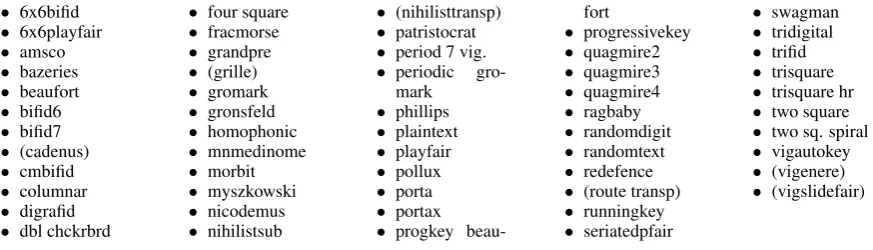
examples of each of the cipher types, allowing us to implement them. Figure 3 lists these methods.
We compare our work to the only previously published cipher type classifier for classical ci-phers2. This classifier is trained on16,800
cipher-texts and is implemented in javascript to run in the web browser: The user can provide the ciphertext as input to a web page that returns the classifier’s predictions. The source code of the classifier is available online. Our work includes a reimple-mentation of the features used in that classifier.
As examples for work that deals with the auto-mated decipherment of cipher texts, we point to (Ravi and Knight, 2011), and (Nuhn et al., 2013). These publications develop specialized algorithms for solving simple and homophonic substitution ciphers, which are just two out of the 56 cipher types defined by the ACA. We also want to men-tion (de Souza et al., 2013), which presents a ci-pher type classifier for the finalist algorithms of the Advanced Encryption Standard (AES) contest.
1http://cryptogram.org/cipher_types.html
2See http://bionsgadgets.appspot.com/gadget_forms/
refscore_extended.html and https://sites.google.com/site/ bionspot/cipher-id-tests
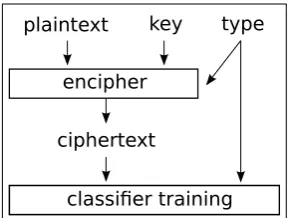
plaintext key
encipher
ciphertext
[image:2.595.344.489.61.170.2]classifier training type
Figure 2: Overview over the data generation and training of the classifier presented in this work.
3 General Approach
Given a ciphertext, the task is to find the right en-cryption method. Our test set covers 50 out of 56 cipher types specified by ACA, as listed in Fig-ure 3. We are going to take a machine learning ap-proach which is based on the observation that we can generate an infinite amount of training data.
3.1 Data Flow
The training procedure is depicted in Figure 2: Based upon a large English corpus, we first choose possible plaintext messages. Then, for each enci-pherment method, we choose a random key and encipher each of the plaintext messages using the encipherment method and key. By doing this, we can obtain (a theoretically infinite) amount of la-beled data of the form(type, ciphertext). We can then train a classifier on this data and evaluate it on some held out data.
Figure 1 shows that in general the key can con-sist of more than just a codeword: In this case, the method uses two codewords, a period length, two different permutation parameters, and a gen-eral decision whether to use a special “6×6” vari-ant of the cipher or not. If not defined otherwise, we choose random settings for these parameters. If the parameters are integers, we choose random values from a uniform distribution (in a sensible range). In case of codewords, we choose the450k most frequent words from an English dictionary. We train on cipher texts of random length.
3.2 Classifiers
The previous state-of-the-art classifier by BION
ran-• 6x6bifid • 6x6playfair • amsco • bazeries • beaufort • bifid6 • bifid7 • (cadenus) • cmbifid • columnar • digrafid • dbl chckrbrd
• four square • fracmorse • grandpre • (grille) • gromark • gronsfeld • homophonic • mnmedinome • morbit • myszkowski • nicodemus • nihilistsub • (nihilisttransp) • patristocrat • period 7 vig. • periodic
gro-mark • phillips • plaintext • playfair • pollux • porta • portax • progkey
[image:3.595.84.521.65.190.2]beau-fort • progressivekey • quagmire2 • quagmire3 • quagmire4 • ragbaby • randomdigit • randomtext • redefence • (route transp) • runningkey • seriatedpfair • swagman • tridigital • trifid • trisquare • trisquare hr • two square • two sq. spiral • vigautokey • (vigenere) • (vigslidefair)
Figure 3: Cipher types specified by ACA. Our classifier is able to recognize 50 out of these 56 ciphers. The braced cipher types are not covered in this work.
dom decision trees. The features used by this clas-sifier are described in Section 4.
Further, we train a support vector machine using the libSVM toolkit (Chang and Lin, 2011). This is feasible for up to100k training examples. Be-yond this point, training times become too large. We perform multi class classification usingν-SVC and a polynomial kernel. Multi class classification is performed using one-against-one binary classifi-cation. We select the SVM’s free parameters using a small development set of1k training examples.
We also use Vowpal Wabbit (Langford et al., 2007) to train a linear classifier using stochastic gradient descent. Compared to training SVMs, Vowpal Wabbit is extremely fast and allows using a lot of training examples. We use a squared loss function, adaptive learning rates and don’t employ any regularization. We train our classifier with up to1M training examples. The best performing set-tings use one-against-all classification, 20 passes over the training data and the default learning rate. Quadratic features resulted in much slower train-ing, while not providing any gains in accuracy.
4 Features
We reimplemented all of the features used in the BION classifier, and add three newly developed
sets of features, resulting in a total of58features. In order to further structure these features, we group these features as follows: We call the set of features that relate to the length of the cipher LEN. This set contains binary features firing when the cipher length is a multiple of 2, 3, 5, 25, any of 4-15, and any of 4-30. We call the set of fea-tures that are based on the fact that the cipher-text contains a specific symbolHAS. This set tains binary features firing when the cipher
con-tains a digit, a letter (A-Z), the “#” symbol, the letter “j”, the digit “0”. We also introduce an-other set of features calledDGTthat contains two features, firing when the cipher is starting or end-ing with a digit. The setVIGcontains 5 features: The feature score is based on the best possible bi-gram LM perplexity of a decipherment compatible with the decipherment process of the cipher types Autokey, Beaufort, Porta, Slidefair and Vigenere. Further, we also include the features IC, MIC, MKA,DIC,EDI,LR,RODandLDI,DBL,NOMOR, RDI,PTX,NIC,PHIC,BDI,CDD,SSTD,MPIC, SERP, which were introduced in the BION
classi-fier3. Thus, the first22data points in Figure 4 are
based on previously known features by BION. We
further present the following additional features.
4.1 Repetition Feature (REP)
This set of features is based on how often the ci-phertext contains symbols that are repeated ex-actly n times in a row: For example the cipher-text shown in Figure 1 contains two positions with repetitions of length n = 2, because the cipher-text containsEE, as well asAA. Beyond length
2, there are no repeats. These numbers are then normalized by dividing them by the total number of repeats of length2≤n≤5.
4.2 Amsco Feature (AMSC)
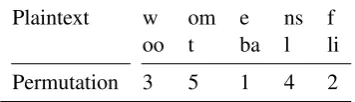
The idea of the AMSCO cipher is to fill consec-utive chunks of one and two plaintext characters into n columns of a grid (see Table 1). Then a permutation of the columns is performed, and the resulting permuted plaintext is read of line by line and forms the final ciphertext. This feature reads the ciphertext into a similar grid of up to5columns
Plaintext w om e ns f oo t ba l li Permutation 3 5 1 4 2
Table 1: Example grid used for AMSCO ciphers.
and then tries all possible permutations to retain the original plaintext. The result of this opera-tion is then scored with a bigram language model. Depending on whether the difference in perplexity between ciphertext and deciphered text exceeds a given threshold, this binary feature fires.
4.3 Variant Feature (VAR)
In the variant cipher, the plaintext is written into a block under a key word. All letters in the first column are enciphered by shifting them using the first key letter of the key word, the second column uses the second key letter, etc. For different pe-riods (i.e. lengths of key words), the ciphertext is structured into n columns and unigram statis-tics for each column are calculated. The frequency profile of each column is compared to the unigram frequency profile using a perplexity measure. This binary feature fires when the resulting perplexities are lower than a specific threshold.
[image:4.595.76.526.545.699.2]5 Results
Figure 4 shows the classification accuracy for the BIONbaseline, as well as our SVM and VW based
classifiers for a test set of 305 ciphers that have been published in the ACA. The classifiers shown in this figure are trained on cipher texts of
ran-dom length. We show the contribution of all the features we used in the classifier on the x-axis. Furthermore we also vary the amount of training data we use to train the classifiers from10k to1M training examples. It can be seen that when using the same features as BION, our prediction
accu-racy is compatible with the BION classifier. The
main improvement of our classifier stems from the REP, AMSC and VAR features. Our best classi-fier is more than11%more accurate than previous state-of-the-art BIONclassifier.
We identified the best classifier on a held-out set of 1000 ciphers, i.e. 20 ciphers for each ci-pher type. Here the three new features improve the VW-1M classifier from50.9%accuracy to56.0%
accuracy, and the VW-100k classifier from48.9%
to54.6%. Note that this held-out set is based on the exact same generator that we used to create the training data with. However, we also report the results of our method on the completely indepen-dently created ACA test set in Figure 4.
6 Conclusion
We presented a state-of-the art classifier for cipher type detection. The approach we present is easily extensible to cover more cipher types and allows incorporating new features.
Acknowledgements
We thank Taylor Berg-Kirkpatrick, Shu Cai, Bill Mason, Be´ata Megyesi, Julian Schamper, and Megha Srivastava for their support and ideas. This work was supported by ARL/ARO (W911NF-10-1-0533) and DARPA (HR0011-12-C-0014).
10 20 30 40 50 60
HAS LEN VIG IC MIC MKA DIC EDI LR ROD LDI DBL
NMOR RDI PTX NIC PHIC BDI CDD SSTD MPIC SERP REP AMSC VAR
Features
Accurac
y
(%)
BION SVM 10k SVM100k VW 100k VW 1M
References
F.L. Bauer. 2010. Decrypted Secrets: Methods and Maxims of Cryptology. Springer.
Leo Breiman. 2001. Random forests. Machine Learn-ing, 45(1):5–32, October.
Chih-Chung Chang and Chih-Jen Lin. 2011. LIB-SVM: A library for support vector machines. ACM Transactions on Intelligent Systems and Technol-ogy, 2:27:1–27:27. Software available athttp:// www.csie.ntu.edu.tw/˜cjlin/libsvm. William AR de Souza, Allan Tomlinson, and Luiz MS
de Figueiredo. 2013. Cipher identification with a neural network.
John Langford, Lihong Li, and Alex Strehl. 2007. Vowpal Wabbit. https://github.com/ JohnLangford/vowpal_wabbit/wiki. Malte Nuhn, Julian Schamper, and Hermann Ney.
2013. Beam search for solving substitution ciphers. InACL (1), pages 1568–1576.