745
Sub-Event Detection from Twitter Streams as
a Sequence Labeling Problem
Giannis Bekoulis Johannes Deleu Thomas Demeester Chris Develder
Ghent University - imec, IDLab Department of Information Technology [email protected]
Abstract
This paper introduces improved methods for sub-event detection in social media streams, by applying neural sequence models not only on the level of individual posts, but also di-rectly on the stream level. Current approaches to identify sub-events within a given event, such as a goal during a soccer match, essen-tially do not exploit the sequential nature of so-cial media streams. We address this shortcom-ing by framshortcom-ing the sub-event detection prob-lem in social media streams as a sequence la-beling task and adopt a neural sequence archi-tecture that explicitly accounts for the chrono-logical order of posts. Specifically, we (i) es-tablish a neural baseline that outperforms a graph-based state-of-the-art method for binary sub-event detection (2.7% micro-F1
improve-ment), as well as (ii) demonstrate superior-ity of a recurrent neural network model on the posts sequence level for labeled sub-events (2.4% bin-level F1 improvement over
non-se-quential models).
1 Introduction
Social media allow users to communicate via real-time postings and interactions, with Twitter as a notable example. Twitter user posts, i.e., tweets, are often related to events. These can be so-cial events (concerts, research conferences, sports events, etc.), emergency situations (e.g., terrorist attacks) (Castillo,2016), etc. For a single event, multiple tweets are posted, by people with vari-ous personalities and social behavior. Hence, even more so than (typically more neutral) traditional media, this implies many different perspectives, offering an interesting aggregated description.
Given this continuous and large stream of (likely duplicated) information in Twitter streams, and their noisy nature, it is challenging to keep track of the main parts of an event, such as a soc-cer match. Automating such extraction of
differ-ent sub-evdiffer-ents within an evolving evdiffer-ent is known as sub-event detection (Nichols et al.,2012). For tracking each of the sub-events, the timing aspect is an important concept (i.e., consecutive tweets in time). Thus, a sequential model could successfully exploit chronological relations between the tweets in a Twitter stream as an informative feature for sub-event detection.
Several methods have been proposed for sub-event detection: clustering methods (Pohl et al., 2012), graph-based approaches (Meladianos et al., 2015), topic models (Xing et al.,2016) and neural network architectures (Wang and Zhang, 2017). None of these studies exploits the chronological relation between consecutive tweets. In contrast, our work does take into account that chronolog-ical order and we predict the presence and the type of a sub-event exploiting information from previous tweets. Specifically, we (i) propose a new neural baseline model that outperforms the state-of-the-art performance on the binary classi-fication problem of detecting the presence/absence of sub-events in a sports stream, (ii) establish a new reasonable baseline for predicting also the sub-event types, (iii) explicitly take into account chronological information, i.e., the relation among consecutive tweets, by framing sub-event detec-tion as a sequence labeling problem on top of our baseline model, and (iv) perform an experimental study, indicating the benefit of sequence labeling for sub-event detection in sports Twitter streams.
2 Related Work
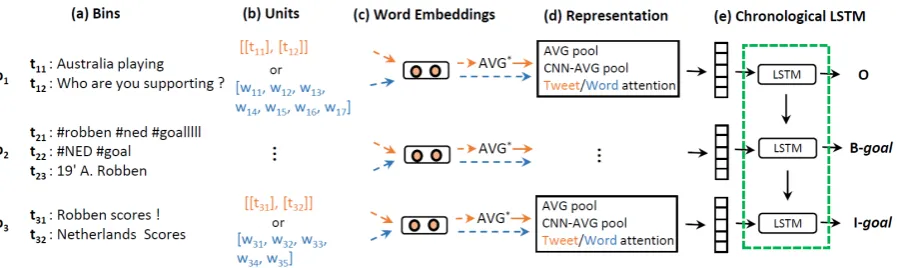
Figure 1: Our sub-event detection model comprises: (a) a bin layer, (b) a unit layer, (c) a word embeddings layer, (d) a representation layer and (e) achronological LSTMlayer to model the natural flow of the sub-events within the event. We represent each bin using either (i) atweet- or (ii) aword-level representation. The AVG∗represents an average pool operation, performed either directly on the embeddings or on the tweet’s LSTM representation.
have been tried. Unsupervised methods such as clustering aim to group similar tweets to detect specific sub-events (Pohl et al.,2012;Abhik and Toshniwal, 2013) and use simple representations such as tf-idf weighting combined with a similar-ity measure. Other unsupervised algorithms use topic modeling approaches, based on assumptions about the tweets’ generation process (Xing et al., 2016;Srijith et al.,2017). Several methods (Zhao et al., 2011; Zubiaga et al., 2012; Nichols et al., 2012) assume that a sub-event happens when there is a ‘burst’, i.e., a sudden increase in the rate of tweets on the considered event, with many people commenting on it. Recently, neural net-work methods have used more complicated repre-sentations (Wang and Zhang, 2017; Chen et al., 2018). Also supervised methods have been ap-plied (Sakaki et al.,2010;Meladianos et al.,2018) for the sub-event detection task. These meth-ods usually exploit graph-based structures or tf-idf weighting schemes. We believe to be the first to (i) exploit the chronological order of the Twitter stream and take into account its sequential nature, and (ii) frame the sub-event detection problem as a sequence labeling task.
3 Model
3.1 Task Definition
The goal is, given a main event (i.e., soccer match), to identify its core sub-events (e.g., goals, kick-off, yellow cards) from Twitter streams. Specifically, we consider asupervised setting, re-lying on annotated data (Meladianos et al.,2018).
3.2 Word- vs Tweet-Level Representations
Similar to previous works, we split a data stream into time periods (Meladianos et al., 2018): we form bins of tweets posted during consecutive time intervals. E.g., for a soccer game, one-minute intervals (bins) lead to more than 90 bins, de-pending on the content before and after the game, halftime, stoppage time, and possibly some pre-game and post-pre-game buffer. Thus, for each bin, we predict either the presence/absence of a sub-event (Section3.3) or the most probable sub-event type (Section 3.4), depending on the evaluation scenario.
We consider representing the content of each bin either on (i) a word-level or (ii) a tweet-level (see Fig.1). Formally, we assume that we have a set ofnbinsb1, ..., bn, where each binbiconsists
ofmitweets andkiwords (i.e., all words of tweets
in binbi). Then, thetweet-level representationof
binbi is symbolized asti1, ..., timi, wheretimi is
themthi tweet of binbi. In theword-level
represen-tation, we chronologically concatenate the words from the tweets in the bin:wi1, .., wiki, wherewiki
is thekthi word of binbi.
3.3 Binary Classification Baseline
sub-event. Note that we experimented with pre-trained embeddings as well as max-pooling, but those early experiments led to performance de-crease compared to the presented baseline model. We found that training based on average bin rep-resentations works substantially better than with max-pooling, and we hypothesize that this is re-lated to the noisy nature of the Twitter stream.
3.4 Sequence Labeling Approach
Building on the baseline above, we establish a new architecture that is able to capture the sub-event types as well as their duration. We phrase sub-event detection in Twitter streams as a sequence labeling problem. This means we assume that the label of a bin is not independent of neighboring bin labels, given the chronological order of bins of the Twitter stream, as opposed to independent prediction for each bin in the binary classification baseline above. For instance, when agoalis pre-dicted as a label for binbi, then it is probable that
the label of the next binbi+1will also begoal. Al-though a sub-event may occur instantly, an identi-fied sub-event in a Twitter stream can span con-secutive bins, i.e., minutes: users may continue tweeting on a particular sub-event for relatively long time intervals. For this reason, we apply the well-known BIO tagging scheme (Ramshaw and Marcus, 1995) for the sub-event detection prob-lem. For example, the beginning of a goal sub-event is defined as B-goal, while I-goal (inside) is assigned to every consecutive bin within the same sub-event, and the O tag (outside) to every bin that is not part of any sub-event. To prop-agate chronological information among bins, we adopt an LSTM on the sequence of bins as illus-trated in Fig. 1, layer (e). Note that this tagging approach assumes that sub-events do not overlap in time, i.e., only at most one is ongoing in the Twitter stream at any point in time.
4 Experimental Setup
We evaluated our system1 on the dataset from Meladianos et al. (2018), with tweets on 20 soc-cer matches from the 2010 and 2014 FIFA World Cups, totalling over 2M pre-processed tweets fil-tered from 6.1M collected ones, comprising 185 events. The dataset includes a set of sub-events, such asgoal, kick-off,half-time, etc. To compare
1https://github.com/bekou/subevent_
sequence_labeling
our binary classificationbaseline systemto previ-ous methods (Table1), we use the same train/test splits asMeladianos et al.(2018), where 3 matches are used for training and 17 matches as test set. In this setting, we predict only the presence/ab-sence of a sub-event. Similar to previous work, we count a sub-event as correct if at least one of its comprising bins has been classified as a sub-event. For the experimental study of our proposed
sequence labeling approach for sub-event detec-tion, where sub-event types are predicted, we have randomly split the test set into test (10 matches) and development (7 matches) sets. We use the de-velopment set to optimize the F1 score for tuning of the model parameters, i.e., the word/tweet em-bedding representation size, LSTM hidden state size, dropout probability. We adopt 2 evaluation strategies. The first one, referred to as relaxed
evaluation, is commonly used in entity classifi-cation tasks (Adel and Sch¨utze, 2017; Bekoulis et al., 2018a,c) and similar to the binary classifi-cation baseline system evaluation: score a multi-bin sub-event as correct if at least one of its com-prising bin types (e.g., goal) is correct, assuming that the boundaries are given. The second evalu-ation strategy,bin-level, is stricter: we count each bin individually, and check whether its sub-event type has been predicted correctly, similar to the token-based evaluation followed inBekoulis et al. (2018b).
5 Results
5.1 Baseline Results
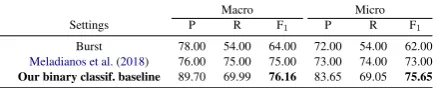
Table1shows the experimental results of our base-line model. The Burst basebase-line system is based on the tweeting rate in a specific time window (i.e., bin) and if a threshold is exceed, the system iden-tifies that a sub-event has occurred. We report evaluation scores as presented inMeladianos et al. (2018). The second approach is the graph-based method ofMeladianos et al.(2018). We observe that our baseline system (Section3.3) has a 1.2% improvement in terms of macro-F1 and 2.7% im-provement in terms of micro-F1, compared to the graph-based model fromMeladianos et al.(2018), mainly due to increased precision, and despite the recall loss.
5.2 Sequence Labeling Results
LSTM) compared to models making independent predictions per bin. The upper part of Table 2 contains models without the chronological LSTM. Our experiments study bothword-leveland tweet-levelbin representations (see Fig.1), as reflected in the ‘Word’ vs. ‘Tweet’ prefix, respectively, in the Model column of Table2.
The simplestword-levelrepresentation uses the tf-idf weighting scheme (as inPohl et al.(2012)) followed by an MLP classifier. For the other word-level models, we exploit several architec-tures: AVG pooling (Iyyer et al., 2015), a CNN followed by AVG pooling (Kim,2014) and hierar-chical word-level attention (Yang et al.,2016).
For tweet-levelrepresentations, we adopt sim-ilar architectures, where the AVG, CNNs and at-tention are performed on sentence level rather than on the word-level representation of the bin. In this scenario, we have also exploited the usage of se-quential LSTMs to represent the tweets. When comparing models with and without tweet-level LSTMs, we report the strategy that yields the best results, indicated by 3 and 7 in the tweet-level LSTM (TL) columns of Table2. We do not present results for applying sequential LSTMs on the word-level bin representation, because of slow training on the long word sequences.
Benefit of Chronological LSTM: The bottom part of Table 2 presents the results of the same models followed by a chronological LSTM to cap-ture the natural flow of the stream as illustrated in Fig. 1. We report results as described in Sec-tion4, using the micro F1 score with the two eval-uation strategies (bin-level andrelaxed). We ob-serve that when using the chronological LSTM, the performance in terms ofbin-level F1 score is substantially improved for almost every model. Note that the best model using the chronologi-cal LSTM (Tweet-AVG) achieves 2.4% better F1 than the best performing model without the use of chronological LSTM (Word-CNN-AVG). In most cases there is also a consistent improvement for both the precision and the recall metrics, which is
Macro Micro
Settings P R F1 P R F1
Burst 78.00 54.00 64.00 72.00 54.00 62.00 Meladianos et al.(2018) 76.00 75.00 75.00 73.00 74.00 73.00
[image:4.595.308.526.62.181.2]Our binary classif. baseline 89.70 69.99 76.16 83.65 69.05 75.65
Table 1: Comparing our neural network binary classifi-cation baseline model to state-of-the-art (P = precision, R = recall).
Bin-level Relaxed
Model TL P R F1 TL P R F1
without
chronol.
LSTM
Word-tf-idf - 49.40 52.06 50.69 - 56.10 56.10 56.10 Word-AVG - 51.40 45.96 48.53 - 56.10 56.10 56.10 Word-CNN-AVG - 56.93 56.01 56.47 - 75.60 75.60 75.60 Word-attention - 52.92 58.71 55.66 - 86.59 86.59 86.59
Tweet-AVG 3 49.04 45.96 47.45 3 62.19 62.19 62.19 Tweet-attention 3 51.99 42.37 46.68 7 80.48 80.48 80.48 Tweet-CNN 7 58.88 51.17 54.75 7 70.73 70.73 70.73
with
chronol.
LSTM
[image:4.595.72.291.673.717.2]Word-AVG - 58.14 58.35 58.24 - 71.95 71.95 71.95 Word-CNN-AVG - 60.89 56.19 58.45 - 60.97 60.97 60.97 Word-attention - 52.99 42.90 47.42 - 60.97 60.97 60.97 Tweet-AVG 7 57.43 60.32 58.84 7 64.63 64.63 64.63 Tweet-attention 3 48.26 52.24 50.17 7 67.07 67.07 67.07 Tweet-CNN 7 65.33 49.73 56.47 7 60.97 60.97 60.97
Table 2: Comparison of our baseline methods in terms of microbin-levelandrelaxedF1score with and
with-out chronological LSTM (see Fig.1). The3and7 indi-cate whether the model uses a tweet-level LSTM (TL).
thanks to the sequential nature of the upper level LSTM capturing the flow of the text.
Limitations ofRelaxedEvaluation:On the other hand, using the relaxed evaluation strategy, we observe that the best models are those without the chronological LSTM layer. Yet, we consider therelaxedevaluation strategy flawed for our sce-nario, despite the fact that it has been used for entity classification tasks (Bekoulis et al., 2018a; Adel and Sch¨utze,2017). Indeed, it is not able to properly capture sub-events which are character-ized by duration: e.g., if a model assigns a differ-ent label to each of the bins that together constitute a single sub-event, then this sub-event counts as a true positive based on therelaxedevaluation strat-egy (similar to the evaluation proposed by Meladi-anos et al.(2018) and followed in Table1). Thus, in this work, we propose to use thebin-level evalu-ation, since it is a more natural way to measure the duration of a sub-event in a supervised sequence labeling setting. Note that due to the noisy nature of Twitter streams, a tweet sequence span-ning a particular sub-event is likely to contain also tweets that are not related to the given sub-event: a given bin inside the event may contain only a mi-nority of tweets discussing the event. Therefore, we consider the standard sequence labeling eval-uation (requiring to have types as well as bound-aries correct) to be not applicable in sub-event de-tection.
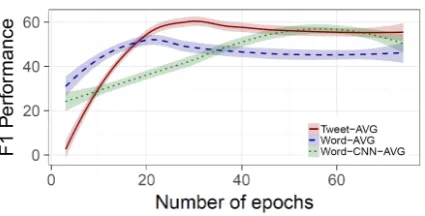
Figure 2: Bin-levelF1 performance of the three best
performing models on the validation set with respect to the number of epochs. The smoothed lines (obtained by LOWESS smoothing) model the trends and the 95% confidence intervals.
from the first epochs, showing similar behavior to the Tweet-AVG model. This can be explained by the similar nature of the two models. The word-level CNN model attains maximum performance compared to the other two models in later epochs. Overall, we propose the use of the chronologi-cal LSTM with the Tweet-AVG model since this model does not rely on complex architectures and it gives consistent results.
6 Conclusion
In this work, we frame the problem of sub-event detection in Twitter streams as a sequence label-ing task. Specifically, we (i) propose a binary classification baseline model that outperforms state-of-the-art approaches for sub-event detection (presence/absence), (ii) establish a strong baseline that additionally predicts sub-eventtypes, and then (iii) extend this baseline model with the idea of ex-changing chronological information between se-quential posts, and (iv) prove it to be beneficial in almost all examined architectures.
Acknowledgements
We would like to thank the anonymous review-ers for their constructive feedback. Moreover, we would like to thank Christos Xypolopoulos and Giannis Nikolentzos for providing (i) the Twitter dataset (tweet ids) and (ii) instructions to repro-duce the results of their graph-based approach.
References
Dhekar Abhik and Durga Toshniwal. 2013. Sub-event detection during natural hazards using features of social media data. InProceedings of the 22nd
In-ternational Conference on World Wide Web, pages 783–788, New York, NY, USA. ACM.
Heike Adel and Hinrich Sch¨utze. 2017. Global nor-malization of convolutional neural networks for joint entity and relation classification. InProceedings of the 2017 Conference on Empirical Methods in Nat-ural Language Processing, pages 1723–1729. Asso-ciation for Computational Linguistics.
Giannis Bekoulis, Johannes Deleu, Thomas Demeester, and Chris Develder. 2018a. Adversarial training for multi-context joint entity and relation extraction. In Proceedings of the 2018 Conference on Empiri-cal Methods in Natural Language Processing, pages 2830–2836. Association for Computational Linguis-tics.
Giannis Bekoulis, Johannes Deleu, Thomas Demeester, and Chris Develder. 2018b. An attentive neural ar-chitecture for joint segmentation and parsing and its application to real estate ads. Expert Systems with Applications, 102:100 – 112.
Giannis Bekoulis, Johannes Deleu, Thomas Demeester, and Chris Develder. 2018c. Joint entity recogni-tion and relarecogni-tion extracrecogni-tion as a multi-head selecrecogni-tion problem. Expert Systems with Applications, 114:34 – 45.
Carlos Castillo. 2016. Big Crisis Data: Social Me-dia in Disasters and Time-Critical Situations. Cam-bridge University Press.
Guandan Chen, Nan Xu, and Weiji Mao. 2018. An encoder-memory-decoder framework for sub-event detection in social media. InProceedings of the 27th ACM International Conference on Information and Knowledge Management, pages 1575–1578, New York, NY, USA. ACM.
Eleonora D’Andrea, Pietro Ducange, Beatrice Lazzerini, and Francesco Marcelloni. 2015. Real-time detection of traffic from Twitter stream analysis. IEEE Transactions on Intelligent Trans-portation Systems, 16(4):2269–2283.
Mohit Iyyer, Varun Manjunatha, Jordan Boyd-Graber, and Hal Daum´e III. 2015. Deep unordered compo-sition rivals syntactic methods for text classification. In Proceedings of the 53rd Annual Meeting of the Association for Computational Linguistics and the 7th International Joint Conference on Natural Lan-guage Processing (Volume 1: Long Papers), pages 1681–1691. Association for Computational Linguis-tics.
Yoon Kim. 2014. Convolutional neural networks for sentence classification. In Proceedings of the 2014 Conference on Empirical Methods in Natural Lan-guage Processing (EMNLP), pages 1746–1751. As-sociation for Computational Linguistics.
the bad and the omg! InProceedings of the Fifth In-ternational AAAI conference on weblogs and social media, pages 538–541.
Polykarpos Meladianos, Giannis Nikolentzos, Franois Rousseau, Yannis Stavrakas, and Michalis Vazir-giannis. 2015. Degeneracy-based real-time sub-event detection in Twitter stream. InProceedings of the 9th International AAAI Conference on Web and Social Media, pages 248–257. AAAI Press.
Polykarpos Meladianos, Christos Xypolopoulos, Gian-nis Nikolentzos, and Michalis VazirgianGian-nis. 2018. An optimization approach for sub-event detection and summarization in Twitter. InProceedings of the 40th European Conference in Information Retrieval, pages 481–493. Springer International Publishing.
Thien Hai Nguyen and Kiyoaki Shirai. 2015. Topic modeling based sentiment analysis on social media for stock market prediction. InProceedings of the 53rd Annual Meeting of the Association for Compu-tational Linguistics and the 7th International Joint Conference on Natural Language Processing (Vol-ume 1: Long Papers), pages 1354–1364. Associa-tion for ComputaAssocia-tional Linguistics.
Jeffrey Nichols, Jalal Mahmud, and Clemens Drews. 2012. Summarizing sporting events using Twitter. InProceedings of the 2012 ACM International Con-ference on Intelligent User Interfaces, pages 189– 198, New York, NY, USA. ACM.
Daniela Pohl, Abdelhamid Bouchachia, and Hermann Hellwagner. 2012. Automatic sub-event detection in emergency management using social media. In Proceedings of the 21st International Conference on World Wide Web, pages 683–686, New York, NY, USA. ACM.
Lance Ramshaw and Mitch Marcus. 1995. Text chunk-ing uschunk-ing transformation-based learnchunk-ing. In Third Workshop on Very Large Corpora.
Takeshi Sakaki, Makoto Okazaki, and Yutaka Matsuo. 2010. Earthquake shakes Twitter users: real-time event detection by social sensors. In Proceedings of the 19th international conference on World wide web, pages 851–860. ACM.
P.K. Srijith, Mark Hepple, Kalina Bontcheva, and Daniel Preotiuc-Pietro. 2017. Sub-story detection in Twitter with hierarchical Dirichlet processes. In-formation Processing & Management, 53(4):989 – 1003.
Zhongqing Wang and Yue Zhang. 2017. A neural model for joint event detection and summarization. InProceedings of the 26th International Joint Con-ference on Artificial Intelligence, pages 4158–4164. AAAI Press.
Chen Xing, Yuan Wang, Jie Liu, Yalou Huang, and Wei-Ying Ma. 2016. Hashtag-based sub-event dis-covery using mutually generative LDA in Twitter. In Proceedings of the Thirtieth AAAI Conference
on Artificial Intelligence, pages 2666–2672. AAAI Press.
Zichao Yang, Diyi Yang, Chris Dyer, Xiaodong He, Alex Smola, and Eduard Hovy. 2016. Hierarchi-cal attention networks for document classification. InProceedings of the 2016 Conference of the North American Chapter of the Association for Compu-tational Linguistics: Human Language Technolo-gies, pages 1480–1489. Association for Computa-tional Linguistics.
Siqi Zhao, Lin Zhong, Jehan Wickramasuriya, and Venu Vasudevan. 2011. Human as real-time sen-sors of social and physical events: A case study of Twitter and sports games. arXiv preprint arXiv:1106.4300.