Some Properties on the Error-Sum Function of
Alternating Sylvester Series
Huiping Jing, Luming Shen*
Science College of Hunan Agricultural University, Changsha, China Email: [email protected], *[email protected]
Received July 11, 2012; revised September 21, 2012; acceptedSeptember 29, 2012
ABSTRACT
The error-sum function of alternating Sylvester series is introduced. Some elementary properties of this function are studied. Also, the hausdorff dimension of the graph of such function is determined.
Keywords: Alternating Sylvester Series; Error-Sum Function; Hausdorff Dimension
1. Introduction
For any x
0,1
, let d1:d1
x N and
: x 0,1
T T be defined as
x T,
0 : 0.x
1
1
1 , : 1
d x x
x d
(1)
where
denote the integer part. And we define the sequence
dn
x ,n2
as follows:
1
1 ,
n
d T x
n
T T T
0Id0,1
n
d x (2)
where denotes the nth iterate of .
It is well known that from the algorithm (1), all
0,1 x
can be developped uniquely into an infinite or finite series
1 1 1
where
i i
i i
x
x d
1
1 ,
1 .
i
i
d x
x d x
, ,d x ,
(3)
In the literature [2], (3) is called the Alternating
Balkema-Oppenheim expansion of x and denoted by
n
for short. From the algorithm,
one can see that T maps irrational element into irrational element, and the series is infinite. While for rational numbers, in fact, we have
1 x d x
0,1 x
1 , ,
d x
is rational if and
only if its sequence of digits is terminate or
periodic, see [1-3].
For any x 0,1
and n1, define
i
1i 1 1
.n i
p x
q x d x
=1
n n
From the algorithm of (1), it is clear that
1n
n n
n p x
x T x .
q x
(4)
For any x 0,1 , let x=d1
x , , dn
x , beits Alternating Sylvester expansion, then we have
1 1
j j j
d x d x d x for any j1. On the other
hand, any
dj,j1
of integer sequence satisfying
1
dj1 x dj x dj x for all j1 is a Sylvester
admissible sequence, that is, there exists a unique
0,1
=x such that j j
The behaviors of the sequence n are of interest and the metric and ergodic properties of the sequence
d x d j1
d x
for all , see [9].
dn
x ,n1
and T have been investigated by anumber of authors, see [1-3].
0,1 x
, define For any
1
: n ,
n n
p x
S x x
q x
(5)
and we call S x
the error-sum function of Alternating
Sylvester series. By (4), since n1 n
n
for all , then
1 d x d x d x 1
n S x
1 and S x is well defined.In this paper, we shall discuss some basic nature of
S x , also the Hausdorff dimension of the graph of
S x
is determined.S
2. Some Basic Properties of
x
1 n
In what follows, we shall often make use of the symbolic space.
For any , let
1, 2, , : 1 1
for all1 .
n
n n k k k
D N
k n
Define
0
, : .
n D
, , ,n
Dn
0
n
D D
For any 1 2 , write
1 11 n ,
n
1 2
1 1
A
(6)
1 11
1 n
n B
1 2
1 1
. (7)
We use J to denote the following subset of (0,1],
2 2
0,1 : , ,
J x d
d x
1 1,
.
n n
x
d x
(8)
From theorem 4.14 of [8], we have J
A B,
when is even, and
n J
B,A
when is odd.Finally, define
n
D nn, 1.
, ,
I A B (9)
Lemma 1. For any n1 and x 0,1
0 0;
,
1) limS x
(10)x
2) 17S x
0;
30 (11)
3)
1
.n
n n
p x
S T x
1 1
j j
d x d x d x
1
d x
1
2 2
1 2 ,
n
d
1 2 2
2 2
1
> n 1 n .
d
21
2> n n
d a x 1
i
i i
S x x
q x
(12)Proof. 1) Since j and
, so when , we can get
1 n3> >
n n
d d
accordingly
2 1
n
d d d
2
a x d x d x
we write 1 1 , so
.
Now
1n
d x n1 T x
implies
1 1
n n
1 n 1 ,
d x
0Tn
x 1.
1 T x
d x for
Thus
2 1
2 2
1 2
1
n n n
n
n n
T x
a x
1 1
2 2
2
1 1
1 1
1
1 1
, 1
n n
n
S x T x
d x d x
a x a x
0
x d1
x a x
let , we have and ,
thus
0S x
1
2 2
1 > > 2 ,
n
n n
d d d
2) From 1) we know that
from the definition of d xi
we also know that d11,so d2 d d1
1 1
2,1
2 1
1 2 4 ,
n n
n
d d
thus
2 2
1 2 2
1 1 1 17
1 .
2 4n 30
n n n
S x
d x
nm
3) Since as ,
1 .m n m m
n m
m
n m n m
p T x
p x p x
q x q x q T x
Thus
1
1 1
1 1
1 1
1 1
1
i
i i
n
i n n i
i i i n n n i
n n
i n
n n
i n
n
i i i n i n
n n
i n
i n
n
i i i i
p x
S x x
q x
p x p x p x p x
x x
q x q x q x q x
p T x
p x
x T x
q x q T x
p T x p x
x T x
q x q T x
1
1 .
n
n
i n
i i
p x
x S T x
q x
= \ 1 . I I
Let
I
, if
Proposition 2. For any x
, ,
1 2k 1
xd x d x
, then S x is left continuous but not right continuous. If x d1 x , , d2k
x , then
S x
1
n D
is right continuous but not left continuous. Proof. For any and n, write x1A ,
2
x B, where A, B are given by (6) and (7).
= 2 1
n k
Case I, , then
1
1 2 2 1
1 1 1
k x
(13)
2
1 2 2 1
1 1 1
1
k x
(14)
and J = B,A . For any x1 J , since when
2k 1= 2k 2k 1 ,
1 2 2
1 2 2
1 2 2
1 1 1
1 1 1
1 1 1
k
2 1
2 2
1
1 1
. 1 k k
k k k
2 2
> 1
k k k
2This situation is included in Case II, so we can take 1 and
2k1 2k1 .
1 1
1 for some
x x
i.e.
1 1, ,
x 2k,2k1,
2 1
1 1 1
1 2 1
1
1 1
2 2
2 1
k
i k
i
i i
p x
S x S x x x
q x
p x
x S
q x
k
T x
1 2 2 1
1
1 2 2 1
2 2
1 1
2 2
1 1
i k
i k
k
k k
p x
q x
T x
S T x
By (2),
n
0Tn
x 1,1 1
1 1
, for
1 1
n n
T x
d x d x
which implies
1
1 1
1 1
1 1
1
1
n n
n n
n n
T x T x
d x d x
d x d x
1
1 1
n
d x
and
2 2 1
k
T x 1
0 .
1
Let 2 2
1 0
k
2 2
1 0
k
x
1 1 ,
S x 1
, we get T x and
, thus
S T
m S x S x
1 1
li
xx
and this implies is left continuous at x .
Let
1 1
2 1 2 1 2 1
1for som
k k
x x
2 1
e
1 k 1 k 1 ,
1 1 2 2 1 2 1
. , , k, k 1, k
i e 12k1, ,,
then
1 1
2
1 2 1 1
1 11
1 1 2 1 1
2 2 1 2 3 1 2 3
1 1 1
2 2 1 2 3 1
2
1 2 1 1
1 1
1 1 2 1 1
k
i k
i i k
k k k
k k
k
i k
i i k
S x S x
p x p x
x x
q x q x
p x p x
x x S T x
q x q x
p x p x
x x
q x q x
2 3 1
2 3 1
2 1 2 1
2 2 1 .
1
k k
k k
k
T x S T x
Let
, we have
1 1
1 1
2 1 2 1
1 lim
1
x x
k k
S x S x
S x is not right continuous at 1
and this implies x .
For
2
1 2 2 1
1 1 1
, 1
k x
(15)
following the same line as above, we have
2 2
2 2
2 1 2 1
1
lim .
1
x x
k k
S x S x
2
n k
Case II Let
1
1 2 2
1 1 1
k y
(16)
2
1 2 2
1 1 1
1
k y
(17)
Following the same line as above, we have
1 1 1 1 2 2
1
lim ,
1
y y
k k
S y S y
2 2
2 1
2 2
1
lim ,
1
y y
k k
S y S y
,S y S y
1
n D
and 1 2
Corollary 3. For any and n
is right continuous.
, write
1 max A B,
, 2 min
A B,
. Then for any xJ, if n= 2k1, then
*
2 1 ,
S S x S
where *
2 2
2 1 2
1 1
k k
S S
n
D
.
From the corollary, for any
,
sup
1
x y J
n n
n
S x S y n J
here
J Jw is the Lebesgue measure of .
Theorem 4. S x
is continuous on
0,1 \
I. Proof: For any x
0,1 \
I and x1,x x r at y
let
n ing vestern
n d
d1 x , ,d ,
be its Alte S l
1
, it
n
d x1 , ,
ex
pansion. For anyn . By (Corollary 3), for any e
n
y J
, we have
wr
x
n 0, as .S y J
S x n
0Write I C , where
1 2
2 1
1 1 1
k C
Theorem 5. If a < <S b
, then t S c
y.0 < < < 1,a b S there exists c
a b, \
I0 , such tha
y
Proof. Set g x
S x y, then g x
has the samecontinuity as S x
. Write
0, ,
, sup .E x g x x a b x0 E
trivially, aE, then the set is well defined.
If
1, 2, ,2k1
, then by the left continuity ofve
x
1> 0 b
ha
S b , we
lim
x b
g
g b
0,As a result, there exists a ch that for any
, ,b
.su
> 0g x
1
x b
If b
1, 2, ,2k
, since g b
en 2
is not left con- tinuous, th > 0 such that for any x
b 2,b
,
0g x , that is x0b
sam .
Following the e line as above, we can prove
0> x a.
Now we shall prove that g x
0 0. We can choosen
x E such that xn x0, if 0
1 2 2k 1
th
m 0,
, , , x ,
en
0
n x
g x0
li g xn
x
if x0
1, 2, ,2k
, then
0
m 0
n
n x x
k k
g x g x
0 0g x . Following the sam line as
0 0g x , and
0
2 2
1
li 1
In both case above, we can
e prove
0 1, 2, ,
Therefore, there e
a b, \
I0 , such that
= .S c y
2 1 xists
k
x .
c
Theorem 6.
2 1
0 0
9 π
d d ,
S x x
x
111 k k 6
k S x
0.1250.
Proof.
and 1
0S x dx
1 1 1 1
1
1 1 1
1 1 1 1 1 1
1 1
1
1 1
1 1
1 1 1
1
1 1 1
1 1 1
1 1 1 1 1 1 1
d d
1
d
1
d d d
d d d
d d d
d d d
d d d d d d
S x x S x
x S T x x
d
0 x
x x x S T x x
d
Let
1
1
Tx u x
d x
, then du dx thus
1
1 1
1 1
1 1 1
2 2
1
1 1
2 0
1 1 1 1 1 1
1 1
d
2 1
1 1 d
1
d
d d
d d d
x
d d
S u u d d
d
thus,
1 0
1
S x
1
2 1
1
1
2 0
1 1 1
3 1 9 π
d d .
2 6
k k
k d
S x x S x x
d
Through the MATLAB program we can get the de- finite integration
1
3. Hausdorff Dimension of Graph for
0
0S x dx 0.1250.
S x
Write
,
,
0,1 .
Gr S x S x x
Theorem 7. dimHGr S
1.Proof. For any n1,
JS J
,Dn
is acovering of Gr S
. From (Cor 3), J S J
can becovered by n squares with side f length o
J . Forany > 0,
1
1 1
1
liminf 2 2 2
liminf 2 2 0.
n
n n
D n n
S
n n
n
1
1 liminf 2
n
n D
H Gr n J
Thus,
dimHGr S 1
Since
,
,
,
,( ,
Proj x S x Proj y S y d x S x y S y ,
th
en
1 1 1
1 0,1 H 0,1 H Proj G Sr G Sr ,
mHGr S 1
di .
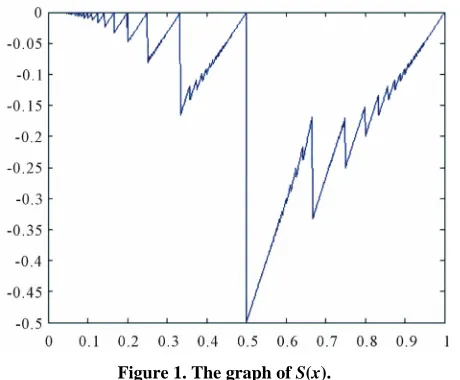
Figure 1. The graph of S(x).
4. Acknowledgements
This work is s ion De
[1] S. Kalpazidou, A. Knopfmacher and J. Knopfmacher, “Lü roth-Type Alt entations for Real Numbers,” Ac , No. 4, 1990, pp.
No. 3, 1991, pp. 319-325.
p. 311-
ol. 8, No. 2, 1996, pp. 331-346. B44, 1992, pp. 17-28.
[3] S. Kalpazidou, A. Knopfmacher and J. Knopfmacher, “Me- tric Properties of Alternating Lüroth Series,” Potugaliae Mathematica, Vol. 48,
[4] J. Barrionuevo, M. Burton-Robert, Dajani-Karma and C. Kraaikamp, “Ergodic Properties of Generalized Lüroth Series,” Acta Arithmetica, Vol. 74, No. 4, 1996, p
327.
[5] K. Dajani and C. Kraaikamp, “On Approximation by Lü- roth Series,” Journal de Théorie des Nombres de Borde- aux, V
doi:10.5802/jtnb.172
[6] K. J. Falconer, “Fractal Geometry, Mathematical Founda- tions and Applications,” Wiley, Hoboken, 1990.
06, pp. 223-232. [7] K. J. Falconer, “Techniques in Fractal Geometry,” Wiley,
Hoboken, 1997.
[8] J. Galambos, “Reprentations of Real Numbers by Infinite Series,” Lecture Notes in Math, Springer, Berlin, 1976. [9] L. M. Shen and J. Wu, “On the Error-Sum Function of
Lüroth Series,” Mathematics Analysis and Applications,
Vol. 329, No. 2, 2007, pp. 1440-1445.
upported by the Hunan Educat part-
ment Fund (11C671).
[10] L. M. Shen, C. Ma and J. H. Zhang, “On the Error-Sum Function of Alternating Lüroth Series,” Analysis in The- ory and Applications, Vol. 22, No. 3, 20
REFERENCES
doi:10.1007/s10496-006-0223-x
[11] T. Sálat and S. Znám, “On the Sums of Prime Powers,”
Acta Universitatis Palackianae Olomucensisof Mathema-tica, Vol. 21, 1968, pp. 21-25.
- ernating Series Repres
ta Arithmetica, Vol. 55
311-322.