Master Thesis
Runtime assertion checking of
multithreaded Java programs
An extension of the STROBE framework
Author:
Jorne Kandziora
Supervisors:
dr. M. Huisman
dr. C.M. Bockisch
M. Zaharieva-Stojanovski, MSc
A thesis submitted in fulfilment of the requirements for the degree of Master of Science
in the
Formal Methods and Tools group, Department of Computer Science,
Faculty of Electrical Engineering, Mathematics and Computer Science.
Abstract
It is important that software is correct, and there are many different techniques to guarantee the correctness of a program. One such technique is runtime assertion checking: a technique that evaluates properties of a program during execution. This particular technique scales well, and can therefore be used to check the behaviour of large pieces of software.
Many runtime assertion checkers are only built for sequential programs and do not guarantee correct behaviour if they are used in a multithreaded environment. We will show that runtime assertion checkers in a multithreaded environment can sometimes report errors that do not exist in the program or fail to detect problems that exist, both of which is problematic.
To solve this problem, we build an extension to the STROBE framework. STROBE is built to accelerate runtime assertion checking with the use of asynchronous assertions: checks that are executed in parallel to the program itself. This framework performs this checking correctly with the use of snapshots, that efficiently save the previous states of a program. We extend the STROBE framework into the e-STROBE framework, that uses these snapshots in a multithreaded program, to protect the program from unwanted interference during runtime assertion checking.
Contents
Abstract 3
1 Introduction 7
1.1 Runtime assertion checking . . . 7
1.2 Multithreaded programs . . . 8
1.3 Contribution . . . 8
1.4 Outline . . . 9
2 Problem analysis 11 2.1 Faults and failures . . . 11
2.2 Assertions . . . 11
2.3 Multithreaded programs . . . 12
2.4 Problem statement . . . 13
2.5 Related work . . . 14
3 The STROBE framework 15 3.1 Introducing the STROBE framework . . . 16
3.2 Using the STROBE framework . . . 17
3.3 Semantics of snapshots . . . 20
3.4 Implementation . . . 23
3.5 Limitations . . . 24
3.6 Conclusion . . . 27
4 The Extended STROBE framework 31 4.1 Exposing snapshots to the program . . . 31
4.2 Using snapshots in multithreaded programs . . . 33
4.3 State transitions . . . 36
4.4 Extended semantics of snapshots . . . 40
4.5 Implementation . . . 43
4.6 Testing snapshots in multithreaded programs . . . 44
4.7 Limitations . . . 48
4.8 Conclusion . . . 49
5 OpenJML 51 5.1 The Java Modeling Language . . . 51
5.2 Writing a JML specification . . . 52
5.3 Translating a JML specification with OpenJML . . . 55
5.5 Implementation of the runtime checker . . . 59
5.6 Conclusion . . . 61
6 Multithreaded OpenJML 63 6.1 Protecting OpenJML with snapshots . . . 63
6.2 Implementation . . . 67
6.3 Testing the implementation . . . 69
6.4 Conclusion . . . 70
7 Conclusion 73 7.1 Summary . . . 73
7.2 Evaluation . . . 73
7.3 Future work . . . 74
A Compiling and installing the e-STROBE framework 77 A.1 Installing from source . . . 77
A.2 Using the framework . . . 78
B Compiling and using OpenJML 79 B.1 Building OpenJML with STROBE extensions . . . 79
B.2 Running OpenJML with STROBE extension . . . 79
Chapter 1
Introduction
We want our software to behave correctly, but it is often hard to describe what correct be-haviour of a program exactly means, and when a program behaves as it should. Therefore, many techniques have been designed to describe, check and verify correct behaviour, including unit testing, static checking and the technique that we will explore in this thesis: runtime assertion checking. All these techniques have their different uses: unit testing tests the different modules of a program with a pre-defined set of test cases, static checking proves that the software be-haves correctly for all possible inputs and runtime assertion checking tests the program during a specific execution.
All these techniques require a description of the correct behaviour of a program, and provide a means to check if the program behaves in a way that meets this description. We will call such a description thespecification of a program.
1.1
Runtime assertion checking
A simple way to check if the program executes correctly according to its specification is by adding extra code to a program to check this. This technique is called runtime assertion checking. Programming languages often have some native support for assertion checking. Furthermore, standalone systems exist to aid the user in the writing and checking of assertions.
Runtime assertion checking only checks the correct behaviour of a program during a particular execution of the program, and, unlike static checking, does not guarantee the overall correctness of the program. Therefore, a different execution of the same program might not behave correctly according to its specification. A runtime assertion checker will only detect such an error if the incorrect behaviour actually occurs during an execution of the program.
However, runtime assertion checking is scalable and easy to implement. Therefore, this technique is widely used, and can quickly be used to test large pieces of software.
1.1.1
OpenJML
1.2
Multithreaded programs
Nowadays, programs no longer execute one task at the time, but run several independent tasks concurrently. Programs that do so, are calledmultithreaded programs. However, tasks that are executed in parallel can interfere with each other. Therefore, incorrect behaviour of a program is no longer solely caused by the task that is executed, but can also be caused by the incorrect behaviour of another task of the program.
1.2.1
Runtime assertion checking in multithreaded programs
The specification of a program changes if we have to account for multiple threads that influence each other. We can no longer just check the current state of the program, but we have to account for all ways in which the program can influence a specific task of the program. However, the principles of runtime assertion checking remain mostly the same: instead of executing checks during the execution of one task, we now have to insert checks for all the tasks that we perform, and check that all tasks have thus far behaved correctly. A runtime checker will still only check a particular execution of the program.
A multithreaded program can also influence the results of the runtime assertion checker code itself. This can lead to a situation where the runtime assertion checker does not detect a problem that it should have detected, or reports a problem that is not present in the program. If this happens, we can no longer trust the results of the runtime assertion checker: the reporting of a problem does not necessarily mean that the behaviour of the program is incorrect. Likewise, interference during runtime checking might cause the runtime assertion checker to miss an error in the program, that could have been detected. We will show an example of both in Section 4.2 and 5.4.
1.2.2
Asynchronous assertions in the STROBE framework
Runtime assertion checking is performed during the execution of the program, and thus slows down the program. The STROBE framework [7] uses an alternative checking mechanism called asynchronous assertions, that executes these checks in parallel, minimizing the time that is spent on assertion checking.
Asynchronous assertions are executed as independent tasks in a program, and the outcome of the checks can thus be influenced by the program itself when it continues its execution. The STROBE framework prevents this from happening by executing asynchronous assertions against a copy of the memory, called asnapshot. These snapshots ensure that an assertion is evaluated against a state of the memory that does not change during the evaluation. In this way, the asynchronous assertion can safely check the behaviour of the program, while the execution itself continues.
The STROBE framework focuses on the efficient execution of checks. The behaviour of asyn-chronous assertions is primarily checked for the execution of single-threaded programs. However, the framework can be used to perform checks in multithreaded programs. We will examine the behaviour of asynchronous assertions in such programs in Chapter 3.
1.3
Contribution
framework. The e-STROBE framework will not only support snapshots in asynchronous asser-tions, but will also provide an interface to use snapshots during the synchronous assertion check-ing of programs. Supportcheck-ing synchronous assertions will ease the integration of the e-STROBE framework in existing runtime assertion checking.
We will show that the e-STROBE framework can be used to write checks in multithreaded programs, and execute them safely against a copy of the memory. We will also show how the checks that are performed with snapshots can be moved around, allowing a runtime assertion checker to perform checks on state transitions that could previously not be checked. We will provide examples of snapshots in both single-threaded and multithreaded programs, and test that the e-STROBE framework provides the specified protection to assertions in Java.
We will show that some of the checks in OpenJML can not be trusted in multithreaded programs. We will provide a solution to this problem using the snapshots in the e-STROBE framework, and modify OpenJML in such a way that the checks that are performed by this runtime assertion checker automatically use snapshots. We will give examples of single-threaded and multithreaded programs in OpenJML, and show how the e-STROBE framework is integrated in OpenJML to ensure the correct behaviour of checks in these examples. We will test the provided solution, both through decompilation and by means of a multithreaded program that will deterministically trigger failures in assertions if the e-STROBE framework is not used in OpenJML.
1.4
Outline
The work that is performed in this project consists of two main contributions: the extension of the STROBE framework and the modification of OpenJML. Both contributions require an introduction to the original piece of software, followed by a discussion of the changes that are made in this project. Before we discuss these tools, we will give an exact description of the problem at hand, and provide the necessary terminology in Chapter 2.
Chapter 3 will introduce the STROBE framework. We will explain how this framework im-plements assertion checking, and show that there are some limitations to the use of the STROBE framework in multithreaded programs.
We will introduce the e-STROBE framework in Chapter 4. We will describe a snapshot interface that can be used without asynchronous assertions, and show how this interface can be used to overcome the limitations that we discussed in Chapter 3.
Chapter 5 will discuss the current state of OpenJML. We will describe the use of the Java Modeling Language to create specifications, and explain how OpenJML uses these specifications to create checks for a program. Finally, we will show how OpenJML checks in a multithreaded program can sometimes have an unexpected result.
Chapter 6 discusses our changes to the OpenJML runtime assertion checker, allowing Open-JML to use the e-STROBE framework to ensure the expected result of its checks in multithreaded programs. We will give examples of this integration, and test that our implementation behaves as intended.
Chapter 2
Problem analysis
This chapter will give a detailed analysis of the problem that is solved in this thesis. It explains the different programming concepts that are used and introduces the terminology that is used in the rest of the thesis. We will end this chapter with the research question, that defines the goal for this research.
2.1
Faults and failures
Programming a piece of software will seldomly be flawless. Faults will be introduced during the programming of software: program statements that contribute to the incorrect behaviour of a program. If these faults are not found during the testing of a program, they will eventually lead to afailure: undesired behaviour of the program, visible to the user. A faulty program often runs for a long time before a failure manifests. This makes it hard to detect the fault that eventually leads to the failure of the program.
2.2
Assertions
One way to pinpoint the location of a fault in a program is to annotate it with expectations about the state at a certain point in the program. Satisfying these expectations increases the confidence in the correctness of the program up to that point. Expectations can be written in the form ofassertions: boolean expressions that we expect to be true at a certain point in the program.
Assertions are originally designed as a means to reason about the correctness of the pro-gram. [19, 28] The original proposals were to use assertions as a form of documentation and to aid in the construction of a deductive proof of the correctness of a program. Modern lan-guages have often incorporated assertions in the language, to monitor the correct behaviour of the program during execution. Java uses theassert statement for this purpose.
2.2.1
Specification of a program
Programs are structured in blocks of statements, that are built to perform a certain task, e.g. executing sequentially or conditionally using respectively if and while statements. Many pro-gramming languages offer some form of procedures: blocks of statements that can be invoked repetitively. Object-oriented languages offermethodsandclassesto add even more structure to a program. Assertions are often used to reason about the task performed by a block of statements. Assertions that are used to reason about the state of a program before a block of code is executed are calledpreconditions. Assertions that reason about the state of a program after the execution of a block are called postconditions. When an assertion should hold in every state of a program, we call this assertion an invariant of the program. Loop invariants are used to describe properties that should hold before and after every iteration of the loop body andclass invariants hold whenever the instance of a class is used in the program.
We can use assertions to construct a full description of the behaviour of an entire program. Such a description is called thespecification of a program. Specifying a program using precon-ditions, postconditions and invariants is better known as theDesign by Contract method [23]. This method was originally developed for the Eiffel programming language and later adopted by other programming languages and runtime assertion checkers.
2.2.2
Assertion violations
When an assertion is false during a certain execution of a program, we call this an assertion violation. The reporting of an assertion violation by a runtime assertion checker will often be caused by code that behaves incorrectly according to its specification. Sometimes, the specifica-tion itself is incorrect. We call an asserspecifica-tion violaspecifica-tion that is caused by an incorrect specificaspecifica-tion afalse positive.
A badly written runtime assertion checker might incorrectly report an assertion violation assertion while the assertion itself is true. The programmer cannot solve such a problem, as the program behaves correctly according to its specification. Burdy et al. [14] define that we expect a runtime assertion checker to betrustworthy: “every assertion violation must be a report of an assertion that is false.”
2.2.3
Transparency
Burdy et al. also state that a runtime assertion checker should betransparent: the execution of a program without assertions must behave exactly the same as the execution of the same program with assertions enabled, apart from timing and space consumption. To ensure this transparency, we require assertions to bepure: the execution of an assertion must not have any side-effects on the execution of the program.
2.2.4
Further reading
While the previous introduction to assertions gives the reader a sufficient understanding of the concepts that are used in this thesis, the interested reader is encouraged to learn more on the subject in the work of Clarke et al. [15] on the history of runtime assertion checking.
2.3
Multithreaded programs
The execution of a single-threaded program is deterministic: the result of the program de-pends only on the external input of the program. The state of a multithreaded program is not only affected by its input, but also by the timing of the program: the statements of threadAcan be executed before the statements of thread B during one execution of the program, while the statements of threadsAandB alternate, or even execute simultaneously, in another execution. Threads can share the resources of a program, such as files on the file system or objects that are created in the same program. Threads in Java have shared access to the heap: a section of the memory that contains all objects that are created by the program.
2.3.1
Interference
Concurrent modification of the same resource can lead to unpredictable behaviour in a program. Consider thread A changing a field of an object, and thread B making a change immediately afterwards. Thread A might expect its own value in the field, while it is actually the value written byB, which might lead to a failure in the program. Such unwanted interaction between program threads is calledinterference.
We can assign a direction to the interference of two threads. Interference will always be caused by a thread (e.g. B) writing to the heap, while the results of an unexpected change of the heap will be seen by a thread (e.g. A) reading this value. A thread will besubject to interference
if the heap modification of another thread causes unexpected behaviour to the thread. A thread iscausing interference if its actions result in another thread behaving unexpectedly.
An operation in a multithreaded program isatomic if the rest of the program can consider the execution of the operation as if it happens instantaneously. Interference can occur before or after, but not during the execution of an atomic operation. Most statements and expressions in Java are not executed atomically. The programmer should therefore be aware that a thread accessing the heap can be subject to interference and a thread modifying the heap can cause interference with another thread of the program.
2.3.2
Assertion interference
Assertions are often written in the form of expressions that are executed by the program. These expressions can be subject to interference if they are executed in a multithreaded program: heap modification in thread B can occur during the execution of an assertion in threadA, possibly causing a false assertion violation. The execution of an assertion should never cause interference: the evaluation of assertions should be transparent, and should therefore never modify parts of the heap that are visible to the rest of the program.
We defineprogram interference as the interference in a multithreaded program that causes unexpected behaviour in a thread that is currently executing normal program statements. Asser-tion interference is defined as the interference during the evaluation of an assertion, that causes an assertion to behave unexpectedly.
2.4
Problem statement
Can we create an environment in which we can perform runtime assertion checking in multithreaded programs without the risk of assertion interference?
This research will focus on a solution in the Java programming language. We will search for a way to stop assertion interference. Chapters 3 and 4 will discuss the possibility to execute assertions as if they happen atomically. Chapters 5 and 6 will use the results of these chapters to modify OpenJML, an existing runtime assertion checker for Java.
2.5
Related work
A lot of research on multithreaded runtime assertion checking is focused on the prevention of both program interference and assertion interference.
Rodr´ıguez et al. [27] define a syntax to specify locks and other non-interference properties in the Java Modeling Language. Aurujo et al. [9] discuss the use of safepoints in a program: specific points where the program itself must guarantee protection against assertion interference. A program can acquire the locks that it needs to ensure this protection before it enters this safe point.
Chapter 3
The STROBE framework
Assertion interference occurs when threads in a multithreaded program concurrently modify the shared heap. An obvious solution for this problem would be to temporarily stop all threads of the program during the evaluation of an assertion, except for the thread that executes the assertion itself. If all threads wait for the assertion to finish, they can not modify the shared heap and thus cannot change the outcome of the assertion. Such a solution requires an assertion to communicate with all other threads and request them to pause their work. This will change the timing of the program considerably. Furthermore, threads will finish their current operation before pausing, possibly preventing program interference that would normally occur in the program.
An alternative would be to hook the runtime assertion checker into the Java virtual machine and use this environment to suspend the threads of the program. Java has deprecated this thread functionality and marks the suspension and stopping of threads unsafe [4]:
“Thread.suspendis inherently deadlock-prone. If the target thread holds a lock on the monitor protecting a critical system resource when it is suspended, no thread can ac-cess this resource until the target thread is resumed. If the thread that would resume the target thread attempts to lock this monitor prior to calling resume, deadlock results. Such deadlocks typically manifest themselves as ”frozen” processes.”
Deadlocks certainly change the behaviour of the program, breaking the transparency of the runtime assertion checker.
Instead of suspending the threads, we can try to prevent the program from making modifica-tions to the shared heap of the program while it is being used by the assertion. We could supply a copy of the entire heap to the assertion and perform our checks on this copy, while the other threads work on the “live” version of the heap.
The challenge in this solution is making the actual copy of the heap. This has to be done atomically: it is impossible to guarantee safety from assertion interference if a thread modifies the heap during the copying process. Making such a copy is a costly process: almost the entire state of a Java program is saved on the heap. Making a copy would double the memory consumption of the program. Heap writes from other threads will temporarily lock while this copy is being made, potentially freezing the program for some time.
reflect a certain state of the program. The concurrently executed assertions in this framework are calledasynchronous assertions.
The regularprogram threads in the STROBE framework will continue their execution while asynchronous assertions are executed on the checker threads. This will potentially expose asyn-chronous assertions to assertion interference from the program threads. The STROBE framework does not make a full copy of the heap to prevent this. Instead, it uses acopy-on-write strategy to preserve a certain state of the program: the framework only makes a copy of objects for the assertion if a program thread modifies the objects on the heap. These copies are saved in a
snapshot: a special part of the heap, designed to keep track of the copies of an object that are needed to preserve a certain state of the heap.
The STROBE framework seems to provide a good solution for the prevention of assertion interference. We need to have a good understanding of the framework to evaluate if the framework can be used to modify existing runtime assertion checkers for the safe evaluation of assertions in multithreaded programs. This chapter will give a description of the STROBE framework and the underlying principles that ensure the correct evaluation of asynchronous assertions. We will discuss the possibilities and the limitations of the current framework, in order to determine what work needs to be done to use the framework for the interference free evaluation of assertions in multithreaded programs.
3.1
Introducing the STROBE framework
The STROBE framework provides a platform, designed on top of JikesRVM [8], to execute the assertions of a program on separate threads. JikesRVM is a Java Virtual Machine (JVM) that is almost completely written in Java. JikesRVM is designed for the research community, to aid in the experimentation with new language designs and implementation techniques. The virtual machine is extensible and is, among other things, used for the development of new garbage collection policies [11] and runtime optimization strategies [24]. STROBE uses the extensibility of JikesRVM to implement snapshots of the heap.
Asynchronous assertions in STROBE are wrapped infutures to schedule them on a separate thread. The framework uses snapshots to ensure a consistent state for these futures during the parallel execution of the assertions.
3.1.1
Futures
When a program starts the evaluation of an asynchronous assertion, the STROBE framework immediately returns a handle (often called afuture). This future will eventually hold the result of the assertion. The assertion itself is scheduled for parallel execution. The program can use the future to request the result of its assertion execution. The future will return this result if the evaluation of the assertion is finished, and block until it has if this is not the case. In this way, a program can continue its normal execution as long as the results are not needed. We define the execution of the program between the start of the future and the joining point between the program thread and the future as thecontinuation of the future.
in Java: the observed result of a sequential assertion As is equal to the observed result of an
asynchronous assertionAa that is scheduled in its place.
Welc et al. [30] formalized a safety property for futures in Java, that allows for the execution of futures in place of their sequential counterpart, based on the Bernstein conditions [10]:
“(1) an access to a locationl (either a read or a write) performed by a future should not witness a write tolperformed earlier by its continuation, and (2) a write operation to some locationl performed by a future should be visible to the first access (either a read or a write) made tol by its continuation.”
They propose a solution to maintain this safety property by keeping track of changes in the memory. A future is executed on a separate process. It can be restarted if it reads a location that is later modified by the continuation. The continuation can similarly be re-evaluated if a future modifies the shared state.
The pureness of assertions eases the safety properties of the futures that are needed to check asynchronous assertions. Futures should still provide safety property (1), but property (2) is automatically ensured by the fact that assertions will never change the state of the program. We therefore never need to restart the evaluation of the continuation: assertions will not modify any part of the state that is visible to the continuation.
3.1.2
Snapshots
The STROBE framework introduces a versioning system to objects on the heap. Every mutation of an object is seen as a new “version” of that object. The STROBE framework keeps track of the multiple versions of an object.
Asynchronous assertions are implemented using this versioning system. The STROBE frame-work keeps track of a global version number for the entire heap. It will save a snapshot of the program when an asynchronous assertion is scheduled. This will save the current version number of the heap.
When a snapshot is active, the STROBE framework saves the old version of an object as soon as the program tries to modify it (copy on write). Asynchronous assertions will use the version of this object that was present on the heap when the future was scheduled.
An asynchronous assertion uses snapshots to witnesses the state of the program at the time it was scheduled. We will call this state the snapshot projection of an asynchronous assertion. Every object access will be transparently rerouted to an access to the snapshot version of the object that belongs to the asynchronous assertion. In this way, asynchronous assertions satisfy part (1) of the safety property described in the previous section.
3.2
Using the STROBE framework
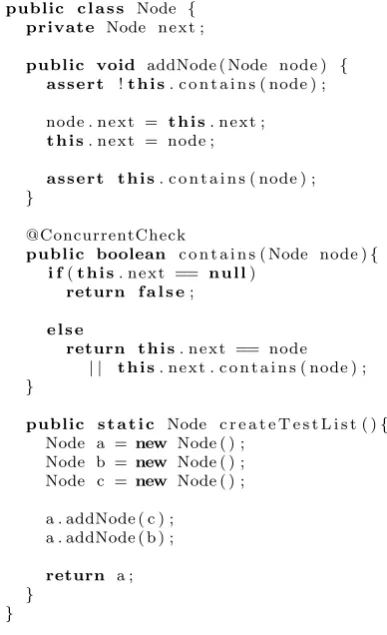
We will demonstrate the asynchronous assertions using the Node class of a linked list with an
addNode method, as shown in Figure 3.1. TheaddNode method inserts the given node as a new successor of the current node and attaches the current successor to the given node. The list in this example is not allowed to contain the same node twice: this will create a cycle.
1 public c l a s s Node {
2 private Node n e x t ; 3
4 public void addNode ( Node node ) {
5 a s s e r t !t h i s. c o n t a i n s ( node ) ; 6
7 node . n e x t = t h i s. n e x t ; 8 t h i s. n e x t = node ; 9
10 a s s e r t t h i s. c o n t a i n s ( node ) ; 11 }
12
13 @ConcurrentCheck
14 public boolean c o n t a i n s ( Node node ){
15 i f(t h i s. n e x t == n u l l)
16 return f a l s e;
17
18 e l s e
19 return t h i s. n e x t == node 20 | | t h i s. n e x t . c o n t a i n s ( node ) ; 21 }
22
23 public s t a t i c Node c r e a t e T e s t L i s t ( ){
24 Node a =new Node ( ) ; 25 Node b =new Node ( ) ; 26 Node c =new Node ( ) ; 27
28 a . addNode ( c ) ; 29 a . addNode ( b ) ; 30
31 return a ;
32 }
[image:18.595.105.299.228.546.2]33 }
1 public void addNode ( Node node ) {
2 CHAFuture p r e c o n t a i n s =
3 new CHAFuture (new C o n t a i n s A s s e r t ( node ) ) ; 4 p r e c o n t a i n s . go ( ) ;
5
6 node . n e x t = t h i s. n e x t ; 7 t h i s. n e x t = node ; 8
9 CHAFuture p o s t c o n t a i n s =
10 new CHAFuture (new C o n t a i n s A s s e r t ( node ) ) ; 11 p o s t c o n t a i n s . go ( ) ;
12
13 a s s e r t ! p r e c o n t a i n s . g e t ( ) ; 14 a s s e r t p o s t c o n t a i n s . g e t ( ) ; 15 }
16
17 private c l a s s C o n t a i n s A s s e r t
18 implements CHATask {
19
20 private Node appendNode ;
21
22 public C o n t a i n s A s s e r t ( Node node ){
23 appendNode = node ; 24 }
25
26 @ConcurrentCheck
27 public boolean compute ( ) {
28 return c o n t a i n s ( appendNode ) ; 29 }
30 }
a
b
c
(a) Start state
a
b
c
next
(b)a.addNode(c)
a
nextb
nextc
[image:20.595.127.497.100.154.2](c)a.addNode(b)
Figure 3.3: Building a list using createTestList
in this method are expensive. The insertion itself executes in constant time, but the assertions recursively check every node in the list to check if the list contains the given node.
The createTestList method creates a list with 3 elements: a, b and c (in that order). The creation of this list is shown in Figure 3.3.
Figure 3.2 shows how we can check the preconditions and postconditions of the addNode
method with the use of asynchronous assertions. We replace the assert statement at line 5 of Figure 3.1 with a future on line 2-4. This future will notify a checker thread of the asynchronous assertion that needs to be checked and schedules it for parallel execution. The asynchronous assertion itself is defined in the compute method of the CHATask class, at line 27 of Figure 3.2. The future immediately returns a handle and an asynchronous checker thread is used to calculate the requested result while the method continues its execution. Finally, the handle is used on line 13 to query the future for the result of the asynchronous assertion.
Figure 3.4 shows the states of the list during the execution of thecreateTestList method, with asynchronous assertions enabled. States 3.4a, 3.4c and 3.4e correspond to the states of the memory, as observed in the method body of createTestList. These states are equal to the states observed during the execution ofcreateTestList with synchronous assertions.
States 3.4b and 3.4d correspond to the state of the memory after the execution of line 7 of
addNodein Figure 3.2. At this point, theaddNodemethod has added the given node as its successor, while a snapshot of the previous version of the object is preserved for the asynchronous assertion. In state 3.4b, the asynchronous assertion (Figure 3.2, lines 2-4) will observe nodes (a0, b0, c0) as the state of the program, while the program thread itself will observe the states (a1, b0, c0). In this way, the asynchronous assertion observes that the program is in state 3.4a, while the program itself is operating on state 3.4c. The snapshots are marked for garbage collection when the execution of the asynchronous assertion is completed. State 3.4d is similar to state 3.4b: the assertion uses state 3.4c, while the program itself operates on 3.4e.
3.3
Semantics of snapshots
The introduction of snapshots changes the heap layout used by a program. This section will provide the semantics needed to reason about a heap with snapshots.
3.3.1
Single snapshot
The goal of a snapshot is to preserve the state of the heap as it was when the snapshot was taken. We first consider a program with a single snapshot. We look at the heap after a snapshot was taken, but before any modifications have taken place. The live state of the program will be equal to the snapshot state of the heap as long as this is the case. Therefore, no object needs to be copied.
a
0b
0c
0(a) Start state
a
0a
1b
0c
0snapshot next
(b)a.addNode(c)
a
1b
0c
0next
(c)snapshot cleanup
a
1a
2b
0c
0b
2next
snapshot snapshot
next next
(d)a.addNode(b)
a
2 nextb
2 nextc
0 [image:21.595.87.465.95.285.2](e)snapshot cleanup
Figure 3.4: Building a list using createTestList
When an asynchronous assertion attempts to read the value of an object field in a snapshot, the STROBE framework will check if a copy of the object has been made for this snapshot. The STROBE framework will return this copy if it exists. Otherwise, the live state is not modified and is used.
3.3.2
Multiple snapshots
A program can have multiple asynchronous assertions, which can run simultaneously. In this case, the STROBE framework maintains a snapshot for each asynchronous assertion. Consider a program with an active snapshot (snapshot 1), when another snapshot (snapshot 2) is taken.
At this moment, the STROBE framework will contain a copy of all objects that were modified after snapshot 1 was taken, associated with snapshot 1. When the program tries to modify an object to the heap, the STROBE framework will now check both snapshots to see if the snapshot already contains a copy of this object, and otherwise save a copy.
3.3.3
Global versioning
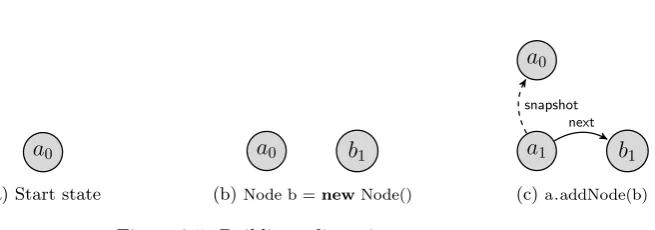
The heap modification strategy described above will quickly become expensive when many snap-shots are active: the framework needs to check for every snapshot if it either needs or already has a copy of an object. A global epoch counterE is used to solve this problem. The counter will be initialized to 0 when the program is started and increments for every snapshot that is taken.
For every object on the heap, the STROBE framework saves the epoch in which the object is last modified. Object access in a snapshot can now check this epoch to see if it needs to access the live version of an object, or its snapshot: if the epoch of the live snapshot is equal to the epoch of the snapshot, the live version can safely be used.
a
0(a) Start state
a
0b
1(b)Node b =newNode()
a
0a
1b
1snapshot next
[image:22.595.159.487.81.196.2](c)a.addNode(b)
Figure 3.5: Building a list using createTestList
equal to the current epoch of the program. Figure 3.4 shows the epoch counters for the nodes in the linked list.
3.3.4
Guarantees
The snapshot strategy described above guarantees that a snapshot will always see the heap in the state that was present when the snapshot was made, while objects are only copied when necessary. Object copies are made atomically: when an object is read by a snapshot, it cannot be written, and when an object is written, an asynchronous assertion has to wait before the object can be read.
Snapshots will have the same object reference as the live version of the object. This means that the program is unaware of the use of snapshots: it treats every object in a snapshot as if it is a normal object. As a result, the references to an object do not need to be changed when a snapshot is taken for the object: the framework transparently reroutes object access to the snapshot.
3.3.5
Creating new objects
A program thread can create new objects after a snapshot has been taken. These new objects can not be reached by the snapshot: they were not part of the heap when the snapshot was taken. This reachability property can be verified by looking at the reachability of a newly created object. Consider the following program, that uses the linked list of Figure 3.1:
Node a = new Node ( ) ;
CHAFuture c o n t a i n s = new CHAFuture (new C o n t a i n s A s s e r t ( node ) ) ; c o n t a i n s . go ( ) ;
Node b = new Node ( ) ; a . addNode ( b ) ;
Figure 3.5 shows the different states of this example. The object b on the heap can only be reached if another object refers to it. As soon as the program tries to store a reference to this newly created object in an object a, a copy a0 will be made of the objecta. The checker threads work with this snapshot copy, that does not contain the reference between a and the newly created objectb. Therefore,b can not be reached in the snapshot.
The heap separation works both ways. An asynchronous assertion can create new objects, to save its intermediate results. These objects are completely separated from the reachable heap of the program thread, as the live heap does not contain any reference to this newly created object.
3.4
Implementation
3.4.1
Barriers
The STROBE framework monitors for write actions when a snapshot is active. It uses object barriers in JikesRVM to do so. These barriers are special blocks of code that are used to perform extra work when the virtual machine reads from or writes to the heap [12]. Barriers can either be
substituting or non-substituting. Substituting barriers are compiled in place of the heap action, and are therefore responsible for the correct execution of the heap operation. Non-substituting barriers are compiled before and/or after the heap operations, wrapping the operation with barrier code, but not replacing the operation itself. Write barriers are always substituting, while read barriers can be either substituting or non-substituting. STROBE only uses substituting barriers.
The STROBE framework uses write barriers to create a copy of an object, if a snapshot needs such a copy to maintain its state. This can result in multiple copies of an object: the STROBE framework creates a copy for every available checker thread, if necessary. Copies are shared between snapshots if the snapshot state is the same for that object.
A method annotated with the@ConcurrentCheckannotation will be compiled with substituting read barriers. Object access in such a method is preceded by a snapshot lookup. If the current thread is operating on a snapshot, the snapshot copy of the object is returned instead of the object itself.
The STROBE framework will only compile the read barriers into methods that are annotated with a @ConcurrentCheck annotation. This means that the containscall on line 28 of Figure 3.2 will actually fail to produce the correct result. This bug in our example is fixed by annotating the contains method on line 14 of Figure 3.1 with a @ConcurrentCheck annotation. The need to explicitly annotate every method used in assertions limits the usefulness of assertions: we can not use built-in Java classes, such as java . util . ArrayList, as these classes can not be annotated with the@ConcurrentCheckannotation.
3.4.2
Object headers
Every object in the JikesRVM consists of an object header and a set of fields. The object header contains meta information about the object, such as an identifier, type information and the lock state of the object. This object header can be extended with custom fields, that can be accessed from the virtual machine. The STROBE framework creates a custom field that is used to maintain a forwarding array of snapshot copies of the object. This forwarding array contains references to the snapshots that are made for this object. The write barriers update this forwarding array if snapshots are active. The read barriers in turn use the array to return a reference to a snapshot version instead of the object itself, as described in Section 3.3.
3.4.3
Checker threads
can be configured when the virtual machine is started. Each checker thread has its ownchecker identifier, saved in an instance of theCheckerThreadclass.
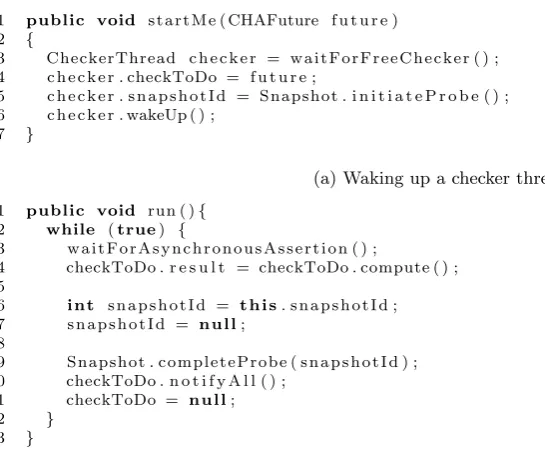
When an asynchronous assertion is scheduled, it searches for a free checker thread, or waits until a thread is finished with its work. The checker identifier of the selected checker thread is then used to create the snapshot for the assertion. The future that contains the asynchronous assertion is saved in theCheckerThreadinstance of the checker thread, and the thread is activated. Figure 3.6a shows the process of waking up a checker thread in pseudo-code.
The checker thread will start the execution of the assertion when it wakes up, by calling the compute() method of the asynchronous assertion. The STROBE framework will recognize the @ConcurrentCheck annotation of this method and executes this method against a snapshot projection of the heap. The result of the assertion (success or failure) is then saved in the associated CHAFuture, giving the program access to this result. Afterwards, the checker thread switches back to the live state of the heap, wakes up any program threads that are waiting for the result, and waits for the next asynchronous assertion to execute. Figure 3.6b shows the pseudo-code for this checking process.
3.5
Limitations
3.5.1
Native and reference types
The current implementation only enables barriers for object reference types. The framework does not place barriers around the access of native typed fields. While this is inconvenient, a program using native types can be easily modified to use object references, by explicitly using the boxed version (e.g. Integer) of a native type. This only needs to be changed at the declaration of a variable. Java will automatically box any native values that will be assigned to this variable.
3.5.2
Static fields
Every class in a Java program can containinstance fields, that are associated with an instance of the class, andstatic fields that are associated with the class itself. The amount of memory that is needed for these static fields is known at the start of the execution of program. Therefore, JikesRVM saves these fields in a special part of the memory, called the JTOC register. The current implementation of the STROBE framework does not enable snapshot barriers for static fields. Creating these static barriers would require a strategy that differs from copying objects: either the entire JTOC register needs to be copied for the snapshot, or each static field needs to have its own forwarding array to keep track of the copies.
3.5.3
Assertion interference in multithreaded programs
Figure 3.7b shows an asynchronous assertion that checks if two nodes are equal. This asyn-chronous assertion is used in the equalsTest method in Figure 3.7a to compare the result of
getNext()with itself. This assertion in this method will always pass in a single-threaded program: thegetNext() method returns the same result twice and the asynchronous assertion will report that these nodes are equal to each other.
In a multithreaded program, a second program thread may be able to access theNode, while theequalsTestmethod is executed. This second program thread can change the Node, to let the
1 public void s t a r t M e ( CHAFuture f u t u r e ) 2 {
3 // w a i t f o r a c h e c k e r t o become a v a i l a b l e ; 4 CheckerThread c h e c k e r =
5 w a i t F o r F r e e C h e c k e r ( ) ; 6
7 // a s s i g n a s y n c h r o n o u s a s s e r t i o n 8 c h e c k e r . checkToDo = f u t u r e ; 9
10 // i n i t i a t e a s s e r t i o n
11 S n a p s h o t . i n i t i a t e P r o b e ( c h e c k e r . c h e c k e r I d ) ; 12
13 // wake up c h e c k e r t h r e a d 14 c h e c k e r . wakeUp ( ) ;
15 }
(a) Waking up a checker thread
1 public void run ( ){
2 while (true) {
3 // w a i t f o r t h e n e x t t a s k 4 w a i t F o r A s y n c h r o n o u s A s s e r t i o n ( ) ; 5
6 // compute a s s e r t i o n
7 checkToDo . r e s u l t = checkToDo . compute ( ) ; 8
9 // c l e a n up s n a p s h o t
10 S n a p s h o t . c o m p l e t e P r o b e ( c h e c k e r I d ) ; 11
12 // n o t i f y w a i t i n g program t h r e a d s 13 checkToDo . n o t i f y A l l ( ) ;
14
15 // p r e p a r e f o r t h e n e x t a s s e r t i o n 16 checkToDo = n u l l;
17 }
18 }
(b) Executing an asynchronous assertion
1 public c l a s s Node {
2 private Node n e x t ; 3
4 private Node g e t N e x t ( ){
5 return n e x t ;
6 }
7
8 public void e q u a l s T e s t ( ){
9 CHAFuture e q u a l s F u t u r e =
10 new CHAFuture (new E q u a l s A s s e r t ( 11 t h i s. g e t N e x t ( ) , t h i s. g e t N e x t ( ) 12 ) ) ;
13 e q u a l s F u t u r e . go ( ) ;
14 a s s e r t e q u a l s F u t u r e . g e t ( ) ; 15 }
16 }
(a) Skeleton of the Node class
1 private c l a s s E q u a l s A s s e r t
2 implements CHATask {
3
4 private Node a ;
5 private Node b ;
6
7 public E q u a l s A s s e r t ( Node a , Node b ){
8 t h i s. a = a ;
9 t h i s. b = b ;
10 }
11
12 @ConcurrentCheck
13 public boolean compute ( ) {
14 return a == b ;
15 }
16 }
(b) Asynchronous assertion
1 public c l a s s Timer {
2
3 private I n t e g e r t i m e = 0 ; 4
5 public i n t getTime ( ){ return t i m e ; }
6
7 public void i n c r e a s e ( ){
8 I n t e g e r oldTime = t h i s. getTime ( ) ; 9
10 t i m e = t i m e + 1 ; 11
12 a s s e r t t h i s. getTime ( ) > oldTime ; 13 }
14 }
Figure 3.8: Assertions on state transitions
initialization of the CHATask that will execute the assertion. The framework only protects the execution of the asynchronous assertion, not its creation. The programmer is responsible for the prevention of assertion interference during the creation of futures.
3.5.4
State transitions
Assertions can check state transitions by comparing two different states of the program with each other. Typically, the program state before the execution of program code (pre-state) is compared to the program state after the execution. Runtime assertion checkers normally only have access to the current state of the program, and will therefore pre-calculate the parts of the pre-state that are required to execute such an assertion. The assertion itself is placed in the postcondition, and uses the pre-calculated information instead of the actual pre-state of the program.
The Timer class in Figure 3.8 gives an example of an assertion on a state transition. The timer has the property that its value will only increase during program execution. The increase
method checks this property. The method pre-calculates the timer value in the pre-state at line 8. The assertion itself, on line 12, reads the current value of the timer and compares it with the pre-calculated value.
Asynchronous assertions are executed on a single state of the program. It is therefore not possible to protect both the pre-state and the post-state against assertion interference. Figure 3.9 shows an implementation of theTimerclass with an asynchronous assertion. The pre-state is still pre-calculated, and passed to the asynchronous assertion at initialization. The assertion itself is evaluated after this initialization. This kind of pre-calculation is therefore still subject to assertion interference, as we have shown in the previous section.
3.6
Conclusion
The STROBE framework allows us to evaluate asynchronous assertions on a specific state of a program. The framework protects assertions against interference: the STROBE framework provides the statements of an assertion with a projection of the heap as it was when the assertion was scheduled.
1 public c l a s s Timer {
2 private I n t e g e r t i m e = 0 ; 3
4 @ConcurrentCheck
5 public i n t getTime ( ){ return t i m e ; }
6
7 public void i n c r e a s e ( ){
8 CHAFuture i n c r e a s i n g F u t u r e =
9 new CHAFuture (new I n c r e a s i n g A s s e r t (t h i s. getTime ( ) ) ) ; 10
11 t i m e = t i m e + 1 ; 12
13 i n c r e a s i n g F u t u r e . go ( ) ;
14 a s s e r t i n c r e a s i n g F u t u r e . g e t ( ) ; 15 }
16
17 private c l a s s I n c r e a s i n g A s s e r t implements CHATask {
18 private I n t e g e r oldTime ; 19
20 public I n c r e a s i n g A s s e r t ( I n t e g e r oldTime ){
21 t h i s. oldTime = oldTime ;
22 }
23
24 @ConcurrentCheck
25 public boolean compute ( ) {
26 return getTime ( ) > oldTime ;
27 }
28 }
29 }
In this research, we search for a solution to safely perform runtime assertion checking for mul-tithreaded programs. Such a solution requires protection from assertion interference during the complete evaluation of assertions. In the case of asynchronous assertions, this means protection during both the creation and the execution of asynchronous assertions.
Chapter 4
The Extended STROBE framework
The STROBE framework will prevent assertion interference during the execution of the assertion. The framework does not prevent assertion interference during the initialization: initialization of an asynchronous assertion is done before the snapshot for the assertion is taken. A multithreaded program is therefore not completely protected against assertion interference.
We can prevent assertion interference during the complete evaluation of assertions if the statements for both the initialization and the execution of the asynchronous assertion use the same snapshot projection of the heap for their execution.
The current STROBE framework encapsulates the creation of snapshots in the CHAFu-ture.go() method call, which is used to schedule the asynchronous assertion. This disables the possibility to switch to a snapshot projection of the heap during the initialization of the asyn-chronous assertions. Exposing the snapshot creation and modification to the programmer would allow us to switch to a snapshot earlier, and perform the initialization of an asynchronous asser-tion on the snapshot projecasser-tion of the heap.
This chapter will discuss theExtended STROBE framework (e-STROBE): our extension to the STROBE framework that exposes the snapshots directly to the program. Programmers will get the ability to choose whether statements in a program are executed on the live state of the program or on a snapshot projection of the heap. We will show how this ability can be used to completely protect assertions against assertion interference.
The e-STROBE framework enables programs to protect both synchronous and asynchronous assertions from assertion interference. The focus in this research will be on the use of snapshots for the protection of synchronous assertions, but the e-STROBE framework will still support asynchronous assertions. This allows us to run the benchmarks of the STROBE framework against our e-STROBE framework, and allows programmers to choose between the simplicity of synchronous assertions and the performance gains of asynchronous assertions.
Build and usage instructions for the e-STROBE framework can be found in Appendix A. This appendix also contains the location to the source code and binaries for this framework.
4.1
Exposing snapshots to the program
The e-STROBE framework decouples the snapshots from checker threads, allowing program threads to create and use snapshots in their own code. The framework usessnapshot identifiers
to keep track of the snapshots that are active in the program. The framework will associate a free snapshot identifier with the snapshot upon creation, and return this identifier to the caller. A snapshot can be initialized using the following statement:
s n a p s h o t I d = S n a p s h o t . i n i t i a t e P r o b e ( ) ;
The checker threads in the STROBE framework use the checker identifier of theirCheckerThread
instance, in conjunction with the@ConcurrentCheck annotation of the computemethod, to decide that heap access should reflect the snapshot projection of the heap. This strategy limits the use of snapshots to checker threads.
The e-STROBE framework has a snapshot identifier field in theRVMThread class: a class in JikesRVM that is used to save extra information for the thread of the program. Every thread has anRVMThread associated with it. A thread in a program can gain access to its RVMThread
instance using theRVMThread.getCurrentThread()method. The snapshot identifier in theRVMThread
is public. Changing this identifier allows a thread to switch to the execution of statements on a snapshot projection of the heap:
RVMThread c u r r e n t T h r e a d = RVMThread . g e t C u r r e n t T h r e a d ( ) ; c u r r e n t T h r e a d . s n a p s h o t I d = s n a p s h o t I d ;
Changing the snapshot identifier to the value−1 changes the thread back to normal execution, against the live state of the heap:
c u r r e n t T h r e a d . s n a p s h o t I d = −1;
Programs in the e-STROBE framework have the responsibility to destroy their own snapshots. Destroying a snapshot will trigger the cleanup of all snapshot copies that were made for the snapshot projection of the heap, and recycles the snapshot identifier for future use. A program can destroy a snapshot using the following statement:
S n a p s h o t . c o m p l e t e P r o b e ( s n a p s h o t I d ) ;
Figure 4.1 shows how the snapshot interface described above can be used to protect the pre-conditions and postpre-conditions of theaddNodemethod in Figure 3.1 against assertion interference. The assertions at pointAandC of the method will both be executed against a snapshot of the program, taken at respectively line 4 and line 16.
The example shows that a thread can create multiple snapshots, but it can use only one snapshot projection at the time. The explicit switching between snapshots allows us to identify regions of the program that are executed against a snapshot projection of the heap. We define statements in these regions within the scope of the associated snapshot. Statements outside a snapshot scope are in the live scope of the program. Figure 4.1 shows statements that are executed in 3 different scopes: assertions A and C executed in the scope of their respective snapshot and the normal method bodyB executed in the live scope of the program.
1 @ConcurrentCheck
2 public void addNode ( Node node ) {
3
4 i n t p r e c o n d i t i o n I d = S n a p s h o t . i n i t i a t e P r o b e ( ) ;
5 RVMThread c u r r e n t T h r e a d = RVMThread . g e t C u r r e n t T h r e a d ( ) ; 6 c u r r e n t T h r e a d . s n a p s h o t I d = p r e c o n d i t i o n I d ;
7
8 a s s e r t !t h i s. c o n t a i n s ( node ) ; // A 9
10 c u r r e n t T h r e a d . s n a p s h o t I d = −1;
11 S n a p s h o t . c o m p l e t e P r o b e ( p r e c o n d i t i o n I d ) ; 12
13 node . n e x t = t h i s. n e x t ; // B 14 t h i s. n e x t = node ; // B 15
16 i n t p o s t c o n d i t i o n I d = S n a p s h o t . i n i t i a t e P r o b e ( ) ; 17 c u r r e n t T h r e a d . s n a p s h o t I d = p o s t c o n d i t i o n I d ; 18
19 a s s e r t t h i s. c o n t a i n s ( node ) ; // C 20
21 c u r r e n t T h r e a d . s n a p s h o t I d = −1;
22 S n a p s h o t . c o m p l e t e P r o b e ( p o s t c o n d i t i o n I d ) ; 23 }
Figure 4.1: Assertion checking with the e-STROBE framework
4.2
Using snapshots in multithreaded programs
We have stated in Section 2.4 that assertion interference can cause a runtime assertion checker to report an assertion violation in a program while the behaviour of the program is correct according to its specification. We will give an example of a correct program that triggers such behaviour using aTimerandDisplayclass, shown in Figure 4.2. TheTimerclass simulates a timer, counting
from 1 to 10,000. The display class uses this timer to return the current value of the timer to the user. A single timer is tied to two displays in thetestDisplaymethod. The timer is started in a separate thread. ThetestDisplaymethod will then assert that both displays will always display the same value.
In a single-threaded program, the assertion on line 35 of Figure 4.2 will always be true: both displays return the time from the same timer. This result can change in a multithreaded program, as the assertion is not executed atomically. The timer can increment its value between the method callsd1.getTime() andd2.getTime(), leading to the report of an assertion violation by the runtime assertion checker. This is a false report, caused by assertion interference: the two displays will reflect the same timer state in every state of the program.
Figure 4.3 shows the use of snapshots in thetestDisplaymethod of theDisplayclass to eliminate this interference. The method will now execute the assertion on line 15 in a snapshot scope, causing both thed1.getTime() andd2.getTime()method calls to be executed on the same state of theTimer. Therefore, the incrementing value of the timer in the live state of the program can no longer cause an assertion violation.
1 public c l a s s Timer extends Thread {
2
3 private I n t e g e r t i m e = 0 ; 4
5 @ConcurrentCheck
6 public i n t getTime ( ){ return t i m e ; }
7
8 @Override
9 public void run ( ){
10 f o r(i n t i = 0 ; i < 1 0 0 0 0 ; i ++){
11 t h i s. t i m e = t h i s. t i m e + 1 ;
12 }
13 }
14 }
15
16 public c l a s s D i s p l a y {
17 private Timer t i m e r ; 18
19 public D i s p l a y ( Timer t i m e r ){
20 t h i s. t i m e r = t i m e r ; 21 }
22
23 @ConcurrentCheck 24 public i n t getTime ( ){
25 return t i m e r . getTime ( ) ; 26 }
27
28 public s t a t i c void t e s t D i s p l a y ( ){
29 Timer t = new Timer ( b a r r i e r ) ; 30 t . s t a r t ( ) ;
31
32 D i s p l a y d1 = new D i s p l a y ( t ) ; 33 D i s p l a y d2 = new D i s p l a y ( t ) ; 34
35 a s s e r t d1 . getTime ( ) == d2 . getTime ( ) ; 36 }
37 }
1
2 @ConcurrentCheck
3 public s t a t i c void t e s t D i s p l a y ( ){
4 Timer t = new Timer ( ) ; 5 t . s t a r t ( ) ;
6
7 D i s p l a y d1 = new D i s p l a y ( t ) ; 8 D i s p l a y d2 = new D i s p l a y ( t ) ; 9
10 RVMThread c u r r e n t T h r e a d = RVMThread . g e t C u r r e n t T h r e a d ( ) ; 11
12 i n t s n a p s h o t I d = S n a p s h o t . i n i t i a t e P r o b e ( ) ; 13 c u r r e n t T h r e a d . s n a p s h o t I d = s n a p s h o t I d ; 14
15 a s s e r t d1 . getTime ( ) == d2 . getTime ( ) ; 16
17 c u r r e n t T h r e a d . s n a p s h o t I d = −1; 18 S n a p s h o t . c o m p l e t e P r o b e ( s n a p s h o t I d ) ; 19 }
Figure 4.3: Using snapshots for assertions
1 public c l a s s B r o k e n D i s p l a y extends D i s p l a y{
2 public B r o k e n D i s p l a y ( Timer t i m e r ){ super( t i m e r ) ; }
3
4 // @ConcurrentCheck 5 public i n t getTime ( ){
6 return super. getTime ( ) − 1 ;
7 }
8
9 public s t a t i c void t e s t D i s p l a y ( ){
10 Timer t = new Timer ( ) ; 11 t . s t a r t ( ) ;
12
13 D i s p l a y d1 = new D i s p l a y ( t ) ; 14 D i s p l a y d2 = new B r o k e n D i s p l a y ( t ) ; 15
16 a s s e r t d1 . getTime ( ) == d2 . getTime ( ) ; 17 }
18 }
1 public c l a s s Timer extends Thread {
2 private I n t e g e r t i m e = 0 ; 3
4 @ConcurrentCheck
5 public i n t getTime ( ){ return t i m e ; }
6
7 @ConcurrentCheck
8 public void i n c r e a s e ( ){
9 RVMThread c u r r e n t T h r e a d = RVMThread . g e t C u r r e n t T h r e a d ( ) ; 10
11 i n t p r e I d = S n a p s h o t . i n i t i a t e P r o b e ( ) ; 12 c u r r e n t T h r e a d . s n a p s h o t I d = p r e I d ; 13
14 I n t e g e r oldTime = t h i s. getTime ( ) ; // A 15
16 c u r r e n t T h r e a d . s n a p s h o t I d = −1; 17 S n a p s h o t . c o m p l e t e P r o b e ( p r e I d ) ; 18
19 t i m e = t i m e + 1 ; 20
21 i n t p o s t I d = S n a p s h o t . i n i t i a t e P r o b e ( ) ; 22 c u r r e n t T h r e a d . s n a p s h o t I d = p o s t I d ; 23
24 a s s e r t t h i s. getTime ( ) > oldTime ; // B 25
26 c u r r e n t T h r e a d . s n a p s h o t I d = −1; 27 S n a p s h o t . c o m p l e t e P r o b e ( p o s t I d ) ; 28 }
29 }
Figure 4.5: Pre-calculation before execution
4.3
State transitions
4.3.1
Pre-state calculation
We will revisit theTimer example that was used in Figure 3.8. The STROBE framework could protect the assertion in this example from assertion interference with the use of asynchronous assertions, but we were unable to provide the same protection to the pre-calculation of the timer value.
The e-STROBE framework allows for the use of multiple snapshot scopes in the same method. This allows us to use the local variables of a method to transfer intermediate results between snapshots. The e-STROBE framework will not create snapshot copies for these local variables: they can only be used by the method itself, and will not be shared between threads.
Figure 4.5 shows an implementation of theTimerwith snapshots to protect the state transition assertion. The value of the timer is calculated in the snapshot scope atAand saved in the local
oldTimer variable. The assertion itself is executed in the snapshot scope at B, after the timer
has been incremented. The value of the oldTimervariable is still available in this scope and is compared to the value of the post-state copy of the timer.
1 public c l a s s Timer extends Thread {
2 private I n t e g e r t i m e = 0 ; 3
4 @ConcurrentCheck
5 public i n t getTime ( ){ return t i m e ; }
6
7 @ConcurrentCheck
8 public void i n c r e a s e ( ){
9 RVMThread c u r r e n t T h r e a d = RVMThread . g e t C u r r e n t T h r e a d ( ) ; 10
11 i n t p r e I d = S n a p s h o t . i n i t i a t e P r o b e ( ) ; 12
13 t i m e = t i m e + 1 ; 14
15 i n t p o s t I d = S n a p s h o t . i n i t i a t e P r o b e ( ) ; 16
17 c u r r e n t T h r e a d . s n a p s h o t I d = p r e I d ; 18 I n t e g e r o l d T i m e r = t h i s. getTime ( ) ; // A 19
20 c u r r e n t T h r e a d . s n a p s h o t I d = p o s t I d ;
21 a s s e r t t h i s. getTime ( ) > o l d T i m e r . getTime ( ) ; // B 22
23 c u r r e n t T h r e a d . s n a p s h o t I d = −1; 24 S n a p s h o t . c o m p l e t e P r o b e ( p r e I d ) ; 25 S n a p s h o t . c o m p l e t e P r o b e ( p o s t I d ) ; 26 }
27 }
Figure 4.6: Pre-calculation after execution
assertion will therefore still be evaluated correctly.
It is important to pay attention to the types of local variables that are used to transfer state between snapshot scopes. We can safely use native typed local variables: their values will be directly associated with the variable. However, we have to be careful if a local variable contains an object reference.
Figure 4.7 shows an implementation of the increase method that does not pre-calculate the value of the timer at point A. Instead, the oldTimervariable contains a reference to the Timer
object itself. This reference is used in the snapshot scope at B, but the timer that is referenced is an object on the heap. In fact, thisand oldTimerwill point to the same timer object on the heap, and the evaluation of this assertion will lead to an assertion violation. In this case, the program could have made a copy of the timer in the pre-state, manually saving the state ofTimer
object for use in the post-state.
4.3.2
Evaluating the result of a method
Snapshots allow us to evaluate of statements against a previous state. This allows us to write a new type of assertion, that we could previously not evaluate with a runtime assertion checker.
Figure 4.8 extends the Node class in Figure 3.1 with a removeNode method and a getNode
1 public c l a s s Timer extends Thread {
2 private I n t e g e r t i m e = 0 ; 3
4 @ConcurrentCheck
5 public i n t getTime ( ){ return t i m e ; }
6
7 @ConcurrentCheck
8 public void i n c r e a s e ( ){
9 RVMThread c u r r e n t T h r e a d = RVMThread . g e t C u r r e n t T h r e a d ( ) ; 10 i n t p r e I d = S n a p s h o t . i n i t i a t e P r o b e ( ) ;
11 t i m e = t i m e + 1 ; 12
13 i n t p o s t I d = S n a p s h o t . i n i t i a t e P r o b e ( ) ; 14 c u r r e n t T h r e a d . s n a p s h o t I d = p r e I d ; 15 Timer o l d T i m e r = t h i s; // A 16
17 c u r r e n t T h r e a d . s n a p s h o t I d = p o s t I d ;
18 a s s e r t t h i s. getTime ( ) > o l d T i m e r . getTime ; // B 19
20 c u r r e n t T h r e a d . s n a p s h o t I d = −1; 21 S n a p s h o t . c o m p l e t e P r o b e ( p r e I d ) ; 22 S n a p s h o t . c o m p l e t e P r o b e ( p o s t I d ) ; 23 }
24 }
Figure 4.7: Incorrect use of object references in state transitions
1 // Removes a node from t h e l i s t 2 // and r e t u r n s t h e i n d e x
3 public i n t removeNode ( Node node ) {
4 a s s e r t t h i s. c o n t a i n s ( node ) ; 5
6 i n t i n d e x = 1 ;
7 Node nodeToCheck = t h i s;
8 while( nodeToCheck . n e x t != node ){
9 nodeToCheck = nodeToCheck . n e x t ; 10 i n d e x = i n d e x + 1 ;
11 }
12 nodeToCheck . n e x t = nodeToCheck . n e x t . n e x t ; 13 node . n e x t = n u l l;
14
15 a s s e r t !t h i s. c o n t a i n s ( node ) ; 16
17 return i n d e x ; 18 }
19
20 // r e t u r n s t h e n t h e n t r y i n t h e l i s t 21 @ConcurrentCheck
22 public Node getNode (i n t i n d e x ){
23 i f( i n d e x == 1 ) 24 return t h i s. n e x t ; 25 e l s e
26 return t h i s. n e x t . getNode ( i n d e x − 1 ) ; 27 }
1 // Removes a node from t h e l i s t 2 // and r e t u r n s t h e i n d e x
3 @ConcurrentCheck
4 public i n t removeNode ( Node node ) {
5 a s s e r t t h i s. c o n t a i n s ( node ) ; 6
7 i n t s n a p s h o t I d = S n a p s h o t . i n i t i a t e P r o b e ( ) ; 8
9 i n t i n d e x = 1 ;
10 Node nodeToCheck = t h i s;
11 while( nodeToCheck . n e x t != node ){
12 nodeToCheck = nodeToCheck . n e x t ; 13 i n d e x = i n d e x + 1 ;
14 }
15 nodeToCheck . n e x t = nodeToCheck . n e x t . n e x t ; 16 node . n e x t = n u l l;
17
18 a s s e r t !t h i s. c o n t a i n s ( node ) ; 19
20 RVMThread c u r r e n t T h r e a d = 21 RVMThread . g e t C u r r e n t T h r e a d ( ) ;
22 c u r r e n t T h r e a d . s n a p s h o t I d = s n a p s h o t I d ; 23
24 a s s e r t t h i s. getNode ( i n d e x ) == node ; 25
26 c u r r e n t T h r e a d . s n a p s h o t I d = −1; 27 S n a p s h o t . c o m p l e t e P r o b e ( s n a p s h o t I d ) ; 28
29 return i n d e x ; 30 }
1 RVMThread c u r r e n t T h r e a d = RVMThread . g e t C u r r e n t T h r e a d ( ) ; 2
3 i n t snapshotA = S n a p s h o t . i n i t i a t e P r o b e ( ) ; 4 c u r r e n t T h r e a d . s n a p s h o t I d = snapshotA ; 5
6 i n t s n a p s h o t B = S n a p s h o t . i n i t i a t e P r o b e ( ) ; 7
8 c u r r e n t T h r e a d . s n a p s h o t I d = −1; 9
10 S n a p s h o t . c o m p l e t e P r o b e ( snapshotA ) ; 11 S n a p s h o t . c o m p l e t e P r o b e ( s n a p s h o t B ) ;
Figure 4.10: Nested initialization of snapshots
node removal for single-threaded programs, as this is sufficient to demonstrate this new type of assertion.
We want to write an assertion that checks if the value that we return at the end of this method pointed to the index of the removed node. We should examine this index in the preconditions of the method, as the execution of the method will ensure that the node is no longer in the list. The index, however, is only available after the execution of the method.
Figure 4.9 shows a version of theremoveNode method that uses a snapshot to delay the
eval-uation of the assertion until the index that we need is available. The program takes a snapshot at line 7, and then performs the deletion. The desired assertion on the index of the executed
Nodeis performed on line 24, inside the snapshot scope of the pre-state. The index of the deleted object is available at this point, and is used by the assertion.
4.4
Extended semantics of snapshots
The snapshots in the e-STROBE framework will inherit the semantics of the STROBE frame-work, described in Section 3.3. However, the snapshot interface introduced in Section 4.1 makes it possible to break the isolation of the execution of snapshots, that is present during the exe-cution of asynchronous assertions. This section describes the extended semantics of snapshots with a description of our new snapshot interface, and describe the behaviour of a program that accidentally accesses object in snapshots scope that are not in the associated snapshot projection.
4.4.1
Initializing snapshots
Initializing a snapshot will trigger the e-STROBE framework to begin with the incremental preservation of the state of the heap at the moment of creation. The initialization of a snapshot is atomic, and happens transparently: the observed behaviour of the heap outside of snapshot scopes of this snapshot before the initialization of the snapshot is identical to the observed behaviour after the initialization.