THE ROLE OF GENDER AND AGE IN TEACHERS’ TRAINING WITHIN THE FRAMEWORK OF
*
Loukas Moustakas and Georgia
Department of Preschool Education
ARTICLE INFO ABSTRACT
The aim of this study is to inquire issues related to teachers’ education within the scope of Lifelong learning. At the same time, it inquires issues of
participation in training programmes. Sp
boundaries of the prefecture of Karditsa, in central Greece, and was based on the completion of 130 questionnaires by teachers who teach in secondary, general, public schools under any worki
by the teachers, focused on investigating the extent to which teachers agree with certain parameters related to the organization and conduct of educational programmes. More analytically, these parameters were relate thematic topics as well as the reasons for participating in such programmes, the factors taken into consideration and the preventive ones, the methodological techniques and teachers’ views regarding distance education through the use of e
programmes as well as questions concerning their duration, the implementation model, the place and the time they can be carried out. The final part of the questi
which can be seen as training
the factors that act either as barriers or as facilitators when it comes to their partici
the results of the empirical analysis that was followed, it can be stated that the majority of teachers participate in educational programmes mainly conducted by P.E.K (peripheral educational centers) and the School advisors, nevertheless academic teachers of higher educational institutions and qualified school teachers are considered to be more suitable to carry out such programmes. The teachers who participated in the research also think that educational and training programme
their interest in their job. Moreover, they are interested in educational innovation, prefer working in groups and believe that postgraduate studies along with their participa
communities, networks etc.), can cover their educational and training needs. As far as the European programmes are concerned, they know little about them but they wish to learn more and think that the i
language prevents their participation. On the other hand, the strengthening of their linguistic skills and the prospect of establishing networks with other European colleagues are confronted as positive factors that facilitate their participation. Finally, teachers wish to be engaged in short
sessions per week, on afternoons of working days. The establishment sheltering the programme seems to be on no special significance to them but
Copyright © 2018, Loukas Moustakas and Georgia Karagianni
permits unrestricted use, distribution, and reproduction
INTRODUCTION
The field of pedagogy is undoubtedly among the most rapidly evolved fields of science in the last years. Having children and consequently the human nature in the core of its interests, it is obvious that it follows all the changes taking place on social and financial level, since they form and reform reality and reframe each era’s priorities. It would be abnormal if the role of teachers was left the same notwithstanding all these changes.
*Corresponding author: Loukas Moustakas,
Department of Preschool Education and Educational Design, Faculty of Humanities, University of the Aegean – Greece
ISSN: 0975-833X
Vol. 10, Issue, 09,
Article History:
Received 10th June, 2018 Received in revised form 17th July, 2018
Accepted 20th August, 2018
Published online 30th September, 2018
Citation: Loukas Moustakas and Georgia Karagianni
International Journal of Current Research, 10, (09), 73926
Key Words:
Teacher education, Lifelong learning,
professional development and strengthening, Adult learning, European Educational policy.
RESEARCH ARTICLE
THE ROLE OF GENDER AND AGE IN TEACHERS’ TRAINING WITHIN THE FRAMEWORK OF
LIFELONG LEARNING
Loukas Moustakas and Georgia Karagianni
Department of Preschool Education and Educational Design, Faculty of Humanities,
University of the Aegean – Greece
ABSTRACT
aim of this study is to inquire issues related to teachers’ education within the scope of Lifelong learning. At me time, it inquires issues of teachers’ professional development and strengthening through their participation in training programmes. Specifically, this research was carried out within the geographical boundaries of the prefecture of Karditsa, in central Greece, and was based on the completion of 130 questionnaires by teachers who teach in secondary, general, public schools under any worki
by the teachers, focused on investigating the extent to which teachers agree with certain parameters related to the organization and conduct of educational programmes. More analytically, these parameters were relate thematic topics as well as the reasons for participating in such programmes, the factors taken into consideration and the preventive ones, the methodological techniques and teachers’ views regarding distance education through the use of e-learning. There were also questions related to the appropriateness of the providers of the training programmes as well as questions concerning their duration, the implementation model, the place and the time they can be carried out. The final part of the questionnaire focused on European programmes such as Erasmus+ ch can be seen as training providers and aimed at measuring their knowledge about them and at investigating the factors that act either as barriers or as facilitators when it comes to their partici
the results of the empirical analysis that was followed, it can be stated that the majority of teachers participate in educational programmes mainly conducted by P.E.K (peripheral educational centers) and the School advisors, evertheless academic teachers of higher educational institutions and qualified school teachers are considered to be more suitable to carry out such programmes. The teachers who participated in the research also think that educational and training programmes ameliorates their daily classroom routine, boosts their efficacy and refreshes their interest in their job. Moreover, they are interested in educational innovation, prefer working in groups and believe that postgraduate studies along with their participation in non formal educational schemes (peer learning communities, networks etc.), can cover their educational and training needs. As far as the European programmes are concerned, they know little about them but they wish to learn more and think that the i
language prevents their participation. On the other hand, the strengthening of their linguistic skills and the prospect of establishing networks with other European colleagues are confronted as positive factors that facilitate their participation. Finally, teachers wish to be engaged in short-term programmes (no more than one month) with two sessions per week, on afternoons of working days. The establishment sheltering the programme seems to be on no special significance to them but their own school setting seems to be their second most prevalent option.
Loukas Moustakas and Georgia Karagianni. This is an open access article distributed under the Creative in any medium, provided the original work is properly cited.
The field of pedagogy is undoubtedly among the most rapidly evolved fields of science in the last years. Having children and consequently the human nature in the core of its interests, it is obvious that it follows all the changes taking place on social nd financial level, since they form and reform reality and reframe each era’s priorities. It would be abnormal if the role of teachers was left the same notwithstanding all these
Education and Educational Design, Faculty Greece.
Many years ago, knowledge on the subject they taught would suffice since the educational process was teacher
the educational goals were common for all students. It was taken for granted that there was a common way of learning for everyone, common material, no differentiation existed and discipline was imposed even with the use of corporal punishment. It was not until Piaget, Bandura, Vygotsky, Skinner and other great psychologists and epistemologies talked about the importance of students’ invo
learning and the creation of a positive pedagogical climate that things started to change in the field of education. Students were placed in the centre of the educational design and teachers were gradually taking on the role of the facilitators knowledge, marking the cognitive paths for students allowing International Journal of Current Research
Vol. 10, Issue, 09, pp.73926-73930, September, 2018
DOI: https://doi.org/10.24941/ijcr.32269.09.2018
Loukas Moustakas and Georgia Karagianni. 2018. “The role of gender and age in teachers’ training within the framework of lifelong learning 73926-73930.
THE ROLE OF GENDER AND AGE IN TEACHERS’ TRAINING WITHIN THE FRAMEWORK OF
Educational Design, Faculty of Humanities,
aim of this study is to inquire issues related to teachers’ education within the scope of Lifelong learning. At teachers’ professional development and strengthening through their ecifically, this research was carried out within the geographical boundaries of the prefecture of Karditsa, in central Greece, and was based on the completion of 130 questionnaires by teachers who teach in secondary, general, public schools under any working status. The questionnaire, filled in by the teachers, focused on investigating the extent to which teachers agree with certain parameters related to the organization and conduct of educational programmes. More analytically, these parameters were related to the thematic topics as well as the reasons for participating in such programmes, the factors taken into consideration and the preventive ones, the methodological techniques and teachers’ views regarding distance education through g. There were also questions related to the appropriateness of the providers of the training programmes as well as questions concerning their duration, the implementation model, the place and the time onnaire focused on European programmes such as Erasmus+ providers and aimed at measuring their knowledge about them and at investigating the factors that act either as barriers or as facilitators when it comes to their participation in them. Drawing upon the results of the empirical analysis that was followed, it can be stated that the majority of teachers participate in educational programmes mainly conducted by P.E.K (peripheral educational centers) and the School advisors, evertheless academic teachers of higher educational institutions and qualified school teachers are considered to be more suitable to carry out such programmes. The teachers who participated in the research also think that s ameliorates their daily classroom routine, boosts their efficacy and refreshes their interest in their job. Moreover, they are interested in educational innovation, prefer working in groups and tion in non formal educational schemes (peer learning communities, networks etc.), can cover their educational and training needs. As far as the European programmes are concerned, they know little about them but they wish to learn more and think that the inadequacy in a foreign language prevents their participation. On the other hand, the strengthening of their linguistic skills and the prospect of establishing networks with other European colleagues are confronted as positive factors that facilitate their term programmes (no more than one month) with two sessions per week, on afternoons of working days. The establishment sheltering the programme seems to be on no
their own school setting seems to be their second most prevalent option.
Creative Commons Attribution License, which
Many years ago, knowledge on the subject they taught would suffice since the educational process was teacher-centered and the educational goals were common for all students. It was taken for granted that there was a common way of learning for mon material, no differentiation existed and discipline was imposed even with the use of corporal punishment. It was not until Piaget, Bandura, Vygotsky, Skinner and other great psychologists and epistemologies talked about the importance of students’ involvement in learning and the creation of a positive pedagogical climate that things started to change in the field of education. Students were placed in the centre of the educational design and teachers were gradually taking on the role of the facilitators of knowledge, marking the cognitive paths for students allowing
INTERNATIONAL JOURNAL OF CURRENT RESEARCH
them to be autonomous, without showing them how to cross these paths. Nowadays, in the era of technology and automatization, in the era of the easy access to knowledge and virtual reality, the contemporary teachers seem like ‘’superheroes’’ since they are expected to respond successfully to their new, multileveled role. In the light of all these, teachers’ training or perhaps re-training is considered a necessity and a response to the need of updating their knowledge and of professional strengthening. This study (which is partly presented in this article) aimed at conducting a quantitative research on teachers’ training needs and their attitude and beliefs towards training and certain dimensions of it. Gender and age seemed to be among the variables that produced significant statistical differences worth-mentioning and further analyzing.
Current Methodology
Research Model: This quantitative research was conducted
using questionnaires which are considered to be the most appropriate research means to gather data from a large portion of population within a short period of time (Paraskevopoulos, 1993). The questionnaire consisted of questions regarding the beliefs and attitudes of teachers towards their training, according to gender, age, specialty, further studies, knowledge of I.T, years of service, etc. The sample constitutes of 130 secondary education teachers of various subjects, who teach at junior high schools and senior high schools in the municipality of Karditsa in Thessaly, Greece.
The hypotheses
The hypotheses based on which this study was conducted are the following:
H1: Teachers’ choices regarding the thematic axons of their
training courses are not differentiated according to factors such as gender and age.
H2: The reasons for choosing a training course are not
differentiated according to factors such as gender and age.
H3: The grading of agreement in relation to the factors which
impede teachers’ participation in their training courses is not differentiated according to factors such as gender and age.
H4: There is no differentiation in relation to the
methodological techniques and forms of training teachers choose according to such as factors gender and age.
H5: The grading of agreement in relation to factors that either
impede or facilitate teachers’ participation in Erasmus European projects is not differentiated according to factors such as gender, age, specialty, years of service etc.
Population and Sample: The sample constitutes of 130
secondary education teachers of various subjects, who teach at junior high schools and senior high schools in the municipality of Karditsa in Thessaly, Greece. The questionnaires were originally distributed in 250 teachers, however 130 of them were engaged in participating in this survey (52% on average which is considered satisfactory).
Collection of Data: The data collection tool used in this study
consisted of 3 parts.
The first part included questions related to the demographic characteristics of the participants (age, gender, specialty, years of service, etc.). The second part involved questions regarding teachers’ beliefs and attitudes towards their training and education. A 5-point Likert Type grading scale was used. The questions involved the phrase ‘’to what extent..’’ and the options given for each question were 1: ‘’Not at all’’, 2: ‘’A little’’, 3: ‘’enough’’, 4: ‘’Much’’, 5: ‘’Very much’’. The third part contained questions relevant to attitudes towards the training and professional development of teachers in the frame of Erasmus European projects, following the same 5-point Likert Type grading scale used in the second part.
Analysis of Data: The data collected were analyzed using the
‘’SPSS 23’’ package software. Statistical analysis was based on descriptive statistics with a view to collecting and presenting means, standard deviations and frequencies. Due to the fact that the variables do not follow normal distribution, non-parametric criteria were applied such as Mann –Whitney U Test and Kruskal Wallis. T-test for independent sample and one- way Anova were also used to gather information about
means and standard deviation as well as x2 to check the
cohesion of categorical variables and categorical
demographics. The internal consistency of the questionnaire was checked using Cronbach’s Alpha Coefficient and the result was α>0,70 which confirms the reliability of the questionnaire (Field, 2005∙Kline, 1999).
RESULTS
The present article is concerned with the results in relation to only two variables, age and gender. As far as the variable of age is concerned, there was classification in four age groups: the first group includes teachers under the age of 37 (<37), the second group includes teachers aged 37-45, the third includes the age range of 45-53 and the fourth group includes teachers older than 53 (>53). As for the variable of gender, the percentage of women that participated in this survey is 61,5% whereas that of men is 38,5% which comes to confirm a widely held belief that women teach whereas men manage.
Inductive analysis in relation to gender variable: Applying
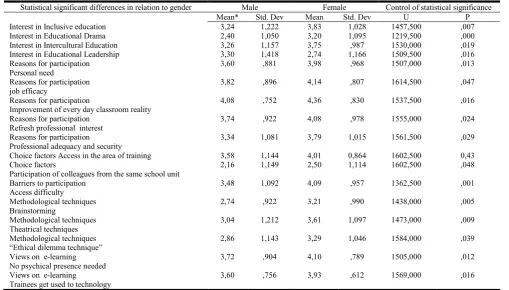
With regard to the reasons why teachers choose a training course over another, women, more than men, seem to do it out of personal need (m=3,98 vs m=3,60, U=1507,000 and p=.013).
[image:3.595.43.553.82.372.2]As far as professional efficacy is concerned, women consider it to be an important factor while men do not share the same view in the same degree (m=4,14 vs m=3,82,U=1614,500 and p=047) and the same seems to apply in the case of improvement of classroom routine (m=4,36 vs m=4,08,
Table 1. Statistically significant differences in relation to gender
Statistical significant differences in relation to gender Male Female Control of statistical significance
Mean* Std. Dev Mean Std. Dev U P
Interest in Inclusive education 3,24 1,222 3,83 1,028 1457,500 ,007
Interest in Educational Drama 2,40 1,050 3,20 1,095 1219,500 ,000
Interest in Intercultural Education 3,26 1,157 3,75 ,987 1530,000 ,019 Interest in Educational Leadership 3,30 1,418 2,74 1,166 1509,500 ,016 Reasons for participation
Personal need
3,60 ,881 3,98 ,968 1507,000 ,013
Reasons for participation job efficacy
3,82 ,896 4,14 ,807 1614,500 ,047
Reasons for participation
Improvement of every day classroom reality
4,08 ,752 4,36 ,830 1537,500 ,016
Reasons for participation Refresh professional interest
3,74 ,922 4,08 ,978 1555,000 ,024
Reasons for participation
Professional adequacy and security
3,34 1,081 3,79 1,015 1561,500 ,029
Choice factors Access in the area of training 3,58 1,144 4,01 0,864 1602,500 0,43 Choice factors
Participation of colleagues from the same school unit
2,16 1,149 2,50 1,114 1602,500 ,048
Barriers to participation Access difficulty
3,48 1,092 4,09 ,957 1362,500 ,001
Methodological techniques Brainstorming
2,74 ,922 3,21 ,990 1438,000 ,005
Methodological techniques Theatrical techniques
3,04 1,212 3,61 1,097 1473,000 ,009
Methodological techniques “Ethical dilemma technique”
2,86 1,143 3,29 1,046 1584,000 ,039
Views on e-learning No psychical presence needed
3,72 ,904 4,10 ,789 1505,000 ,012
Views on e-learning
Trainees get used to technology
3,60 ,756 3,93 ,612 1569,000 ,016
[image:3.595.51.544.417.497.2]* We use average and standard deviation as indicators of central tendency and variability form corresponding statistical criterion “Independent samples t-test”.
Table 2. Statistically significant differences in relation to age
Statistical significant differences in relation to age <37 37-45 46-53 >53 Control of statistical significance
Choice “yes” Χ2 df P
Participation in training courses of R.T.C (Regional Training Centers)
31,6% 84,3% 95,1% 78,9% 33,311 3 ,000
Participation in seminars delivered by school advisors 36,8% 76,5% 82,9% 78,9% 15,333 3 ,002
Participation in training courses of C.A.T. (Centers of Adult Training).
31,6% 29,4% 29,3% 2,0% 7,612 3 ,050
Table 3. Statistically significant differences in relation to age
Statistical significant differences in relation to age
<37 37-45 46-53 >53 Control of statistical
significance Mean* Std. dev. mean Std. dev. mean Std. dev. mean Std. dev. H df P Reasons for participating
Refreshment of professional interest
3,42 1,121 3,84 1,027 4,15 ,760 4,32 ,820 9,532 3 ,023
Factors for choosing the course Participation of colleagues from the same school
2,84 1,344 2,02 1,029 2,56 1,119 2,42 1,017 9,306 3 ,025
Hindering factors Absence of suitable educational structures
3,00 1,000 3,61 ,850 3,66 ,990 4,00 ,816 10,656 3 ,014
Hindering factors Difficulty in access
3,16 1,119 4,18 1,034 3,76 ,969 3,89 ,875 14,236 3 ,003
Methodological techniques Group work
4,05 ,848 3,69 ,707 4,10 ,735 4,11 ,809 8,491 3 ,037
Views on e-learning
Creates impersonal communication
2,32 ,946 3,02 ,948 3,12 1,100 3,42 1,017 10,713 3 ,013
Views on e-learning
Restricts participants’ interaction
2,68 ,946 2,98 ,707 3,17 1,022 3,53 ,964 8,489 3 ,037
Views on e-learning
Requires from trainers and trainees specific digital skills
3,05 ,780 3,86 ,800 3,85 ,691 4,11 ,658 17,522 3 ,01
[image:3.595.46.549.529.728.2]U=1537,500 vs p=.016). Women also consider refreshment of professional interest to be a strong factor for their participation in a training course while men do not share this perception to such an extent(m= 4,08 έναντι m= 3,74,U=1555,000 vs p=.024 ) and the same seems to apply as far as professional adequacy and security are concerned(m=3,79 vs m=3,34, U=1561,500 and p=.029). Taking all these into consideration, it should be safe to conclude that women value as important reasons to participate in a training course those that are immediately connected to the amelioration and /or strengthening of their emotions and to the improvement of their professional efficacy and everyday routine in the classroom. Among the reasons that lead teachers to choose a training course, access to the area where it takes place is taken into consideration by women more than by men (m=4,01 έναντι m=3,58, U=1602,500 vs p=043). The participation of colleagues of the same school unit does not seem to be important for either sex but it seems than women may think about it a bit more than men (m= 2,50 έναντι m= 2,16, U=1602,500 and p=.048). Difficulty in accessing the area where the training course takes place seems to be a hindering factor for both sexes with women considering it a greater obstacle than men do (m= 4,09 vs m=3,48, U=1362,500 and p=.001). As far as the methodological techniques teachers prefer in their training courses, statistically significant
differences were depicted in techniques such as
‘’brainstorming’’, ‘’theatrical techniques’’ and the ‘’technique of ethical dilemma’’. More specifically, women seem to prefer the technique of brainstorming more than men do (m=3,21 vs m=2,74,U=1438,000 and p=.005) and the same applies in the ‘’theatrical techniques’’ (m=3,61 vs m=3,04, U=1473,000 and p=.009) as well as in the technique of ‘’ethical dilemma’’ (m=3,29 vs m=2,86,U=1584,000 and p=.039 ).
Inductive analysis in relation to age variable: In order to
depict statistically significant differences with regard to the age of the teachers who participated in the survey, the
non-parametric criterion chi square (x2) was implemented and then
the non-parametric criterion of Kruskal-Wallis due to the fact that there was an independent variable with more than two levels. There were statistically significant differences with regard to the participation in training courses and seminars of teachers belonging to different age groups. More specifically, the 95,1% of teachers of the age group 45-53 attended the training courses organized by P.E.K (Peripheral Educational Centers) with the 84,3% of the age group 37-45 to have attended the same courses. The same seminars were attended by the 78,9% of the teachers above 53 years old and only the 31,6% of teachers under 37 years old participated in the above
courses (x2(2)=33,311 and p=.000). The relatively small
percentage of the younger teachers might be attributed to the fact that the centers that organized these courses and were obligatory for all teachers, started to weaken since the mid 2000’s onwards. With regard to seminars organized by the school advisors, the teachers of the 45-53 age group had the highest percentage of participation (82,9%), with teachers over 53 years old to follow (78,9%). The teachers of the age group 37-45 have participated in the percentage of 76,5% and the smallest percentage was that of the teachers under 37 years old
(36,8%), (x2(2)=15,333 and p=.002). As far as participation in
the courses organized by C.A.T (Centers of Adult Education) is concerned, teachers under the age of 37 have participated more than the teachers of the other age groups, reaching the percentage of 31,6%. Teachers of the 37-45 group have attended the courses at the percentage of 29,4 % while there
was not even one of the teachers over 53 years old to have
attended this kind of courses (x2(2)=7,612 and p=.050). It
could be maintained that younger teachers, who are mostly substitute teachers, are not always allowed to attend the seminars delivered by school advisors or the Peripheral Educational Centers, therefore they resort to courses offered by private institutions such as C.A.T. There is always a number of teachers (either substitute or not) that choose to attend seminars and courses in private institutions in order to strengthen their professional profile and raise their employability. Applying the criterion Kruskal Wallis many statistically significant differences were depicted in relation to teachers’ age. Teachers over the age of 53 believe that the refreshment of their professional interest constitutes a very important reason to participate in a training course (m=4,32, H=9,532 and p=.023). This seems to decrease as the age average decreases as well since teachers younger than 37 years old do not find it that important (m=3,42). Among the reasons why teachers choose a training course, the participation of fellow colleagues seems to be more important for teachers under the age of 37 (m=2,84) but significantly less important for teachers in the age group 37-45 (m 2,02), (H=9,306 and p=.025 ). As for the hindering factors, the absence of suitable educational structures seems to be under serious consideration for educators over 53 years old (m=4,00) while the teachers under the age of 37 seem to be less concerned about it (m=3,00), (Η=10,656 and p=014). Difficulty in accessing the area where the training takes place is a serious hindering factor for teachers of the age group 37-45 (m=4,18) and a less important one for those under the age of 37 (m=3,16), (H=14,236 and p=.003).
As far as the methodological techniques are concerned, group work seems much more preferable for teachers over 53 years old (m=4,11) and less preferable for teachers of the age group 37-45 (m= 3,69), (H=8,491 and p=037). This could be due to feelings of security, learning autonomy and adequacy younger teachers have since they are more familiar with technology and social media. Finally, statistically significant differences were depicted with regard to teachers’ views on distance education and the method of e-learning. More analytically, with regard to whether it creates impersonal interaction, it seems that younger teachers (under 37) think this is not true 37 (m=2,32) while teachers over 53 believe it holds some truth (m=3,42), (H=10,713 και p=.013).This confirms the belief that older teachers perceive as impersonal anything that does not happen in person due to lack of familiarity with technology. The question regarding the extent to which distance learning and e-learning restrict participants’ interaction, receives responses in the same spirit as the one mentioned previously. Teachers over 53 years old think interaction is indeed restricted (m=3,53) while teachers under 37 think it is not restricted that much (m=2,68), (H=8,489 and p=.037). As far as the question whether distance learning requires certain digital skills, teachers over 53 years old strongly believe this is so (m 4,11) in contrast with teachers under 37 who believe it is true up to a point (m=3,05), (H=17,522 and p=0,01).
Conclusion
The overall conclusion lies in the positive attitude of teachers towards their continuous training and lifelong learning with the
view to their professional and personal strengthening (Lieberman, 1996).Gender seems to play a crucial role in the
training programmes, based on the findings of the inductive statistics outlined above. Women state that it is mainly ‘’inner’’ reasons that drive them to participate in those programmes, relating them to the improvement of classroom routine and classroom management, areas where men traditionally feel more confident. It is the collective
stereotypical perception of masculine firmness and
determination which perpetuates the model of the paternalistic structure of society and the ‘’internalisations’’ of their gender (Maragkoudaki, 1997a).The same ideological framework could account for the preference and selection of the thematic fields in the training programmes. Women opt for topics such as inclusive education and drama while men seem to be more interested in educational leadership and management confirming the stereotypical perception according to which men are more competent in administrative issues while women are more sensitive therefore more suitable for teaching rather than leading a school unit. Age is also considered an influential factor as to the lifelong learning and training of teachers. Older teachers (over 53) seem to be more reluctant to participate in training courses delivered by private Centers of Adult Education while younger teachers opt for those without excluding others. Training programmes and seminars organized and conducted by school advisors and R.T.C (Regional Training Centers) have a long tradition and seem to create feelings of security to older teachers since they are more familiar with them. This category of teachers enters training courses with the aim of refreshing their professional interest while younger teachers choose to participate in order to strengthen their professional profile and raise their employability status. Age seems to influence teachers’ attitude towards distance learning and especially e-learning. They believe that this new form of learning restricts participants’ interaction and requires certain digital skills which they often lack.
Contrary to that, younger teachers feel more digitally competent therefore they eagerly participate in e-learning courses since they additionally believe that this form of training does not render participants’ interaction impersonal.
Conflict of Interest Statement: The author declares that there
is no conflict of interest.
Funding Statement: This research received no specific grant
from any funding agency in the public, commercial, or not-for-profit sectors.
REFERENCES
Field, A. 2005. Discovering statistics using SPSS. (3rd
ed.). London: SAGE
Kline, P. 1999. The handbook of psychological testing (2nd
ed.). London: Routledge.
Lieberman, A. (1996). Practices that support teacher development: Transforming conceptions of professional learning. In M. W. McLaughlin & I. Oberman (eds.),
Teacher Learning: New Policies, New Practices. New York: Teachers College Press.
Maragkoudaki, E. 1997a. ‘The composition of the teaching staff of Secondary Education regarding the gender factor in the last twenty years in Greece: an interpretative
approach’’. Material for the teachers’ seminar on raising
awareness with regard to gender equality in Education. Ioannina: K.E.Θ.Ι
Maragkoudaki, Ε. 1997β ‘’Women teach and men lead’’ in
Deligianni, B. and Ziogou, S.(eds.) Gender and school
process. Collection of proposals. Thessaloniki: Vanias, p. 258-292.
Paraskevopoulos, I.N. 1993. Methodology of scientific
research, Athens.