An Enhanced Privacy Policy Implication over the Socially
Shared Images
Gandham Sandhya
M.Tech, Computer Science &Engineering
Jj Institute Of Information Technology M.Omprakash
Associate Professor & Hod, Department Of Cse
Jj Institute Of Information Technology
ABSTRACT:With the expanding volume of imageclient’s offer through social destinations, keeping up protection has turned into a noteworthy issue. In light of these episodes, the need of instruments to offer clients control access to their common substance some assistance with being exceedingly key. To offer security for the data, we set forward this paper involving Adaptive Privacy Policy Prediction (A3P) structure to offer clients some assistance with creating efforts to establish safety for their images. The part of images and its metadata are investigated as a measure of client's protection inclinations. The Structure decides the best protection approach for the transferred images. It incorporates animage grouping system for relationship of image’s with comparable to strategies and a strategy expectation method to naturally deliver a security approach for client transferred images.
Keywords:Online information services, web-based services
I. INTRODUCTION
Millions of images are being uploaded to a largenumber of social networking websites and photosharing portals every day. As an illustration, inFacebook, 60 million users upload more than 14million images per day [5]. People are postingimages of their social events, gatherings,vacations, graduation ceremonies etc. withoutany fear towards their privacy. These images notjust include them and their families, but otherpeople on the network too, and tagging them onthese social networking websites is an unwanteddisclosure and privacy violations. Above all,these images not only reveal the personalrelationships and attitudes of the uploaded, but ofother individuals in the images as well. Publiclyvisible images sometimes showed people incompromising situations without the consent orknowledge of individuals in those images
[6].From security and privacy point of view, this ispractically an alarming threat.
Most of thecontent sharing websites have a set of privacysettings for the user to manage, but,unfortunately, these privacy system settings arenot just adequate, especially with images. Thereason is mostly the amount of information thatis being carried by an image [7], essentiallybecause of the unknown fact that if the image iseven authentic or processed using some of theimage processing software’s. Vast research [1-2]has been done to detect the traces ofmanipulation of images using different digitalforensic techniques using resampling, regionduplication, lighting of camera, sensor noise,statistical methods etc. In this paper, wepropose and describe how the details of the Jpegformat and the digital camera can be used forfinding forged images and preserving privacy onthe social networks.
II. LITERATURE SURVEY
Some previous systems shows different studies onautomatically assign the privacy settings. One suchsystem which Bonneau et al. [8] proposed shows theconcept of privacy suites. The privacy ‘suites’recommends the user’s privacy setting with the helpof expert users. The expert users are trusted friendswho already set the settings for the users. Similarly, Danesiz [9] proposed an automatic privacyextraction system with a machine learning approachfrom the data produced from the images. Based onthe concept of “social circles” i.e. forming clusters offriends was proposed by Adu-Oppong et al.[3]Prediction of the users privacy preferences forlocation-based data (i.e., share the location or no) wasstudied by Ravichandran et. Al[10]. This was done onthe basis of time of the day and location. The study ofwhether the keywords and captions used for taggingthe users photos can be used more efficiently tocreate and maintain access control policies was doneby Klemperer et al.
III. SYSTEM MODEL
Protection Strategies are security inclinations communicated by the client about their substance revelation inclinations with their socially associated clients. We characterize the protection approaches as takes after:
Definition: A Protection strategy P can be portrayed for client U by Subject(S): An Arrangement of clients socially associated with client U.
Information (D): An arrangement of information things shared by U.
Activity (An): An arrangement of activities allowed by U to S on D. Condition (C): A Boolean expression which should be fulfilled keeping in mind the end goal to perform the allowed activities. In the above definition, Subject(S) can be client's characters, relations, for example, family, companion, associates, and so forth and associations. Information (D) comprises of the considerable number of pictures in the client's profile. Activity (A) considers four components: View, Remark, labels and Download. Ultimately the Condition(C) indicates whether the activities are viable or not.
Case 1. Joe needs to permit her loved ones to view and remark on pictures in the collection named "birthday_album" and the picture named "cake.jpg" before year 2015.The approach for her protection inclination will be P: [{friend, family}, {birthday_album, cake.jpg},{view ,comment}, (date< 2015)].
A3P Architecture: A3P stands for Adaptive Privacy Policy Predictionsystem which helps users to derive the privacysettings for their images The A3P Architectureconsists of followings blocks: A3P Core.
1. Metadata based Image classification. 2. Adaptive policy prediction.
3. Look-Up Privacy Policies 4. Database
A3P Core classifies the images with the help of the Metadata and also predicts the policies depending upon the behavior of the user. The Look-up Privacy Policy looks if the image or similar type of image already exists which can be given with similar privacy policies. If similar type of image doesn’t exist then it looks for all the policies and lets user choose the policies.
A3P Core: The A3P Core consists of two major blocks of theframework.
1. Metadata based Image Classification 2. Adaptive Policy Prediction
andclassification and policy prediction would enhancethe system’s dependency.
Metadata Based Image Classification
As stated, the metadata based Imageclassification groups the images into sub-categorieswith the aid of following three steps.
Step 1 of this process obtains the keywords from themetadata of the image. Tags, Comments andCaptions are included in our metadata through whichthe keywords are obtained. After obtaining thekeywords our task is to identify all nouns, verbs andadjectives and store them into a metadata vector suchasTnoun={t1,t2,t3,…..,tk},
Tverb={t1,t2,t3,…..,tj},Tadjective={ t1,t2,t3,…..,tl}
where k,j and l are thetotal number ofnouns, verbs and adjectives respectively.
Step 2 of this process is to attain a typical hypernymfrom each metadata vector. The hypernym is denotedby h and first retrieved for every ti. This hypernymcan be represented as h=
{(v1, f1), (v2, f2),….}.Here vdenotes as the
hypernym and f denotes its frequency.
For example, consider a metadata vector T= {,”Job”,”Promotion”,”Party”}.With the help of this set wecan say that Job and Promotion have the samehypernym work whereas Party has a hypernymActivity. Hence, we can show the hypernm list ash= {(work, 2), (Activity, 1)}.From this list we select thehypernym with the highest frequency.
Step 3 of this process is to obtain the subcategory inwhich the image fits in. This step is an incrementalprocedure in which the first image forms asubcategory and the hypernyms of the image are alsoallotted to their respective subcategory. For everynew incoming image, the distance between thesehypernyms and each category is computed and theclosest subcategory for that image is discovered.
Adaptive Policy Prediction
This part deals with the privacy concerns of the userby deriving the privacy policies for the images. TheAdaptive Policy Prediction consists of two followingsub-parts:
1. Policy Mining
2. Policy Prediction
Policy mining deals with data mining of policies forsimilar categorized images and Policy predictionapplies prediction algorithm to predict the policies.
Policy Mining: The privacy policies are the privacypreferences expressed by the users. Policy miningdeals with mining of these policies by applyingdifferent association rules and steps. It follows theorder in which a user defines a policy and decideswhat rights must be given to the images. Thishierarchical mining approach starts by looking thepopular subjects and their popular actions in thepolicies and finally for conditions. It can bethoroughly reviewed with the help of following steps.
Step 1 of this process applies association rule miningon the subject components of the policies of the newimage. With the association rule mining we select thebest rules according to one of theinterestingnessmeasure i.e., support and confidence which gives themost popular subjects in policies.
Step 2 of this process applies association rule miningon the action components. Similar to the first step wewill select the best rules which will give most popularcombinations of action in policies.
Step 3 of this process mine the condition componentin each policy set. The best rules are selected whichgives us a set of attributes which often appear inpolicies.
Policy Prediction: The policy mining phase may giveus many policies but our system needs to show thebest one to the user. Thus, this approach is used tochoose the best policy for the user by obtaining thestrictness level. The Strictness level decides how“strict” a policy is by returning an integer value. Thisvalue should be minimum to attain high strictness.
multiplecombinations we will select the lowest one. Coveragerate provides a fine-grained strictness level whichadjusts the obtained major level. For example a userhas to 5 friends and two of them are females. Henceif he specifies policy as “friends”=male, then thecoverage rate can be calculated as (3/5) =0.6. Hence,the image is less restricted if the coverage rate valueis high.
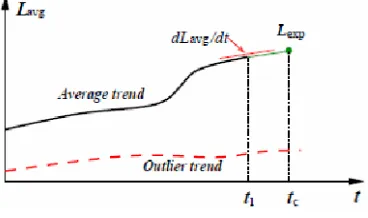
As time advances, the normal strictness levels in every classification frame a bend as appeared in Fig.3, where estimations of strictness levels are inserted in the middle of any back to back approach redesigns. Essentially, the exception strategies might frame their own particular bends as indicated in the fig.3
Fig. 3. Average Strictness Level Curve
A3P-SOCIAL
The A3P-social works a multi-criteria induction instrument that makes delegate approaches by utilizing key data related to the client's social setting and his general state of mind toward security. As expressed past, A3Psocial will be bid by the A3P-center in two situations. One is the point at which the client is an amateur of a site, and does not have enough pictures put away for the A3P-center to surmise important and modified arrangements. The other is the point at which the framework sees critical changes of security pattern in the client's social circle, which might be of enthusiasm for the client to perhaps alter his/her protection settings appropriately.
Modeling Social Context
We identify that clients with related foundation have a tendency to have comparative protection worries, as seen in past examination thinks about furthermore affirmed by our gathered information. This perception moves us to build up a social setting demonstrating calculation that can catch the
regular social components of clients and distinguish groups framed by the clients with comparable security concerns. The distinguished groups who have a rich arrangement of pictures can then serve as the base of succeeding approach proposal.
Identifying Social Group
We identify that clients with related foundation have a tendency to have comparative protection worries, as seen in past examination thinks about furthermore affirmed by our gathered information. This perception moves us to build up a social setting demonstrating calculation that can catch the regular social components of clients and distinguish groups framed by the clients with comparable security concerns. The distinguished groups who have a rich arrangement of pictures can then serve as the base of succeeding approach proposal.
IV. CONCLUSION
We have proposed a Versatile Protection Strategy Forecast (A3P) framework that aids clients systematize the security approach settings for their transferred pictures.The A3P system affords anall-inclusive framework to infer privacy preferences foundedon the information available for a given user.This system also offers a framework which comprehends privacy preference based on the history ofthe user’s proclivity that help user to set stress freeand flexible policy selection.
REFERENCES
[1] E. Kee, M. K. Johnson, H. Farid, Digital image authentication from jpeg headers, IEEE transactions on information forensics and security, vol.6,No.3,pages 1066-1095, September 2011. [2] Z. Li, A. Y. C. Nee, S. K. Ong, W. Gong, Tampered image detection using image matching, Fifth international conference on computer graphics, imaging and visualization, pages 174-179, 26-28 August,2008.
[4] J. Bonneau, J. Anderson, and G. Danezis, “Prying data out of a social network,” in Proc. Int. Conf. Adv. Soc. Netw. Anal. Mining.2009, pp.249–254.
[5] Web-Strategist,
http://www.webstrategist.com/blog/2008/01/09/soc
ial-networkstats-facebook-myspace-reunion-jan-2008/#comment-274904, 2008.
[6] T. Burghardt, A. Walter, E. Buchmann, K.Bohm, PRIMO- Towards privacy aware imagesharing, IEEE/WIC/ACM internationalconference on web intelligence and intelligentagent technology.9-12 Dec, 2008, pages 21-24.
[7] A. C. Squicciarini, D. Lin, S.Sundareswaran, J. Wede, Privacy policyinference of the user-uploaded images oncontent sharing sites, IEEE transactions onknowledge and data engineering, April 2014.
[8] J. Bonneau, J. Anderson, and L. Church, “Privacysuites: Shared privacy for social networks,” in Proc.Symp. Usable Privacy Security, 2009.
[9] A. Kapadia, F. Adu-Oppong, C. K. Gardiner, and P.P. Tsang, “Social circles: Tackling privacy in socialnetworks,” in Proc. Symp. Usable Privacy Security,2008.
[10] R. Ravichandran, M. Benisch, P. Kelley, and N.Sadeh, “Capturing social networking privacypreferences,” in Proc. Symp. Usable Privacy Security,2009.
Authors:
GANDHAM SANDHYA pursing M.Tech in Computer Science Engineering from JJ
INSTITUTE OF INFORMATION
TECHNOLOGY