BORON DOPED GRAPHENE OXIDE: SYNTHESIS AND APPLICATION TO GLUCOSE
*1,2
Md. Abdul Mannan,
2Yudai Hirano,
1
Department of Chemistry, Faculty of Science, Rajshahi University, Bangladesh
2
Graduate School of Science and Technology, Kumamoto University, 2
ARTICLE INFO ABSTRACT
In this present research, we have synthesized graphene oxide (GO) by modified Hummer’s method using graphite flake as starting material. Boron atoms were succ
framework with an atomic percentage of 1.64 as a precursor. The presence of B
analyses. Shifting of XRD peak from 10
incorporation of boron atoms. The crystalline defect was further confirmed by the Raman spectroscopy. Finally, the C=C, C
environments were preci reduced graphene oxide (B
significant glucose adsorption reactivity of 65 towards oxygen atoms of the glucose molecules.
Copyright © 2018, Abdul Mannan et al. This is an open use, distribution, and reproduction in any medium, provided
INTRODUCTION
Numerous researches have been conducted on graphene oxide (GO) since its first invention by Brodie (Brodie 1859). The GO, a mono-layered material having sp2-hybridized carbon along with sp3-domain and different oxygen functionalities such as hydroxyl, carboxyl, and carbonyl groups
distinctive mechanical, electrical and opto
properties (Geim 2007 and McAllister 2007). The outstanding physical properties of GO makes it an attractive material for fabrication of various nanocomposites, polym
performances microelectronic devices, energy storage materials, and for biomedical applications (Lightcap 2014, Huang 2012 and Zhu 2010). Moreover, due to the hydrophilicity character of GO, it could be easily dispersed in water. The oxygen functionalities in GO caused a severe decline in electrical properties, thermo mechanical stability and carrier mobility of carbon-based materials (Dreyer 2010). To minimize these problems, incorporation of non metalic elements such as boron, nitrogen, sulfur fluorine, and phosphorous into the GO layer have been developed to improve the electrochemical properties (Stephan 1994, Ekimov 2004). Nitrogen-doped GO by chemical vapor deposition, thermal annealing, plasma irradiation methods have been
*Corresponding author: Abdul Mannan
ISSN: 0975-833X
Vol. 10, Issue,
Article History:
Received 03rd August, 2018 Received in revised form 29th September, 2018
Accepted 04th October, 2018
Published online 30th November, 2018
Citation: Md. Abdul Mannan, Yudai Hirano, Armando Quitain, application to glucose responsive reactivity”, International
Key Words:
B-rGO, hydrothermal reaction, Boric acid, X-ray photoelectron spectroscopy, Glucose adsorption.
RESEARCH ARTICLE
BORON DOPED GRAPHENE OXIDE: SYNTHESIS AND APPLICATION TO GLUCOSE
RESPONSIVE REACTIVITY
Yudai Hirano,
2Armando Quitain,
2Koinuma, M.
Department of Chemistry, Faculty of Science, Rajshahi University, Bangladesh
Graduate School of Science and Technology, Kumamoto University, 2-39-1 Kurokami, Chuo
8555, Japan
ABSTRACT
In this present research, we have synthesized graphene oxide (GO) by modified Hummer’s method using graphite flake as starting material. Boron atoms were succ
framework with an atomic percentage of 1.641.89 at. % by hydrothermal reduction using boric acid
as a precursor. The presence of B–O, B–C and C–O bonds was predicted from the FT
analyses. Shifting of XRD peak from 10 to 26 presumably indicated the reduction of GO by the
incorporation of boron atoms. The crystalline defect was further confirmed by the Raman
spectroscopy. Finally, the C=C, C–O, -BC3, -BC2O, -BCO2, -COO
environments were precisely predicted by the XPS peak fitting analyses. The boron functionalized reduced graphene oxide (B-rGO) was subjected to the glucose adsorption reaction that showed
significant glucose adsorption reactivity of 6570% due to the high adsorption affinity of
towards oxygen atoms of the glucose molecules.
open access article distributed under the Creative Commons Attribution provided the original work is properly cited.
Numerous researches have been conducted on graphene oxide (GO) since its first invention by Brodie (Brodie 1859). The hybridized carbon domain and different oxygen functionalities oxyl, and carbonyl groups showed distinctive mechanical, electrical and opto-electronical properties (Geim 2007 and McAllister 2007). The outstanding physical properties of GO makes it an attractive material for fabrication of various nanocomposites, polymer materials, high performances microelectronic devices, energy storage materials, and for biomedical applications (Lightcap 2014, Huang 2012 and Zhu 2010). Moreover, due to the hydrophilicity character of GO, it could be easily dispersed in gen functionalities in GO caused a severe decline in electrical properties, thermo mechanical stability and based materials (Dreyer et al., 2010). To minimize these problems, incorporation of
non-itrogen, sulfur fluorine, and phosphorous into the GO layer have been developed to improve the electrochemical properties (Stephan 1994, Ekimov doped GO by chemical vapor deposition, thermal annealing, plasma irradiation methods have been
reported for the application of electrical, enhancement of surface energy, increment of n
polarization energy (Czerw 2001, Xia 2004, Wei 2009, Wang 2013, Li 2009 and Kumar 2013).
incomplete purification and excessive amount of by products were remaining in the resulting GO materials and post treatment requires high temperature (800
cause structural degradation and morphological defects (Wei
al. 2015). Boron and boron-nitrogen co
thermal anneling and microwave assisted method have been reported for the application of supercapacitor, high performance anode material in Li ion battery, electromagnetic radiation in Ku-band etc. (Li 2016,
2015). In this research, we report a novel approach for synthesizing boron doped reduced graphene oxide (B through treating a mixture of graphene oxide (GO) and boric acid solution by simple hydrothermal condition in
vessel reaction chamber. The B
different techniques, and its application to glucose adsorption reactivity was evaluated. The B
other applications such as sensor and/or energy storage devices.
EXPERIMENTAL METHODS AND MATERIALS
Chemicals and reagents: The required materials such as sulfuric acid (H2SO4), hydrochloric acid (HCl), sodium nitrate
International Journal of Current Research
Vol. 10, Issue, 11, pp.75335-75340, November, 2018
DOI: https://doi.org/10.24941/ijcr.33162.11.2018
Abdul Mannan, Yudai Hirano, Armando Quitain, Koinuma, M. and Tetsuya Kida, 2018. “Boron doped graphene oxide: synthesis and
International Journal of Current Research, 10, (11), 75335-75340. Available online at http://www.journalcra.com
z
BORON DOPED GRAPHENE OXIDE: SYNTHESIS AND APPLICATION TO GLUCOSE
M. and
2Tetsuya Kida
Department of Chemistry, Faculty of Science, Rajshahi University, Bangladesh
1 Kurokami, Chuo-ku, Kumamoto
860-In this present research, we have synthesized graphene oxide (GO) by modified Hummer’s method using graphite flake as starting material. Boron atoms were successfully doped into the GO 1.89 at. % by hydrothermal reduction using boric acid O bonds was predicted from the FT-IR spectral presumably indicated the reduction of GO by the incorporation of boron atoms. The crystalline defect was further confirmed by the Raman
COO-, B2O3, and C–OH chemical
sely predicted by the XPS peak fitting analyses. The boron functionalized rGO) was subjected to the glucose adsorption reaction that showed 70% due to the high adsorption affinity of boron
ribution License, which permits unrestricted
reported for the application of electrical, enhancement of surface energy, increment of n-type carrier concentration and polarization energy (Czerw 2001, Xia 2004, Wei 2009, Wang 2013, Li 2009 and Kumar 2013). However, drawbacks like incomplete purification and excessive amount of by products were remaining in the resulting GO materials and post treatment requires high temperature (8001200C) which may cause structural degradation and morphological defects (Wei et
nitrogen co-doped GO by simple thermal anneling and microwave assisted method have been reported for the application of supercapacitor, high performance anode material in Li ion battery, electromagnetic tc. (Li 2016, Yeom 2015 and Umrao 2015). In this research, we report a novel approach for synthesizing boron doped reduced graphene oxide (B-rGO) through treating a mixture of graphene oxide (GO) and boric acid solution by simple hydrothermal condition in a closed vessel reaction chamber. The B-rGO was characterized using different techniques, and its application to glucose adsorption reactivity was evaluated. The B-rGO could be investigated for other applications such as sensor and/or energy storage
EXPERIMENTAL METHODS AND MATERIALS
The required materials such as ), hydrochloric acid (HCl), sodium nitrate
INTERNATIONAL JOURNAL OF CURRENT RESEARCH
(NaNO3), potassium permanganate (KMnO4), hydrogen
peroxide (H2O2), boric acid (H3BO3), glucose,
3,5-dintrosalicylic acid (DNS), sodium potassium tartrate, sodium hydroxide (NaOH) etc. all were purchased from Wako Pure Chemical Industries, Ltd., Japan.
Synthesis of B-rGO: Graphene oxide (GO) was synthesized by modified Hummerʼs method in which graphite flake was used as the starting material (Allahbakhsh 2014). In a 1L beaker, 4.0 g of NaNO3 weigh out and concentrated H2SO4
(148 mL) were added and stirred for 30 minutes in an ice bath. Thereafter, KMnO4 (20.0 g) was added slowly to the solution
and stirred for 40 minutes at 35C. Then, distilled water (184 mL) was added while mixing for 15 minutes at 95C. All the steps are done in an oil bath. Further, 400 mL of H2O and
about 25 mL of hydrogen peroxide (H2O2) were added and
stirred at 4000 rpm for 10 minutes. Subsequently, the mixture was washed with 5% HCl and centrifuged at 4000 rpm for 30 minutes. The next step was exfoliation by sonication for 46 hrs. After that centrifuged the mixture at 10,000 rpm for 30 minutes and the resulting supernatant was GO. Finally, it was dried for 3 to 4 days in an oven at 60C.
The obtained GO was functionalized by simple hydrothermal reaction method in which the reactor was equipped with an 8.8 mL inconel batch. A schematic of the synthesis and functionalization process of GO with inconel batch reactor is shown in Fig.1. Typical 0.25g of GO and 5.0 mL aqueous solution of boric acid with different concentrations were loaded into the reactor. Thereafter, desired reaction conditions such as temperature, pressure and time were set in the reaction period and are shown in Table-1. The resulting samples were referred as functionalized reduced graphene oxide (B-rGO),which were collected, washed, filtered and dried overnight in an oven at 60C. Finally, the samples were characterized by using different instrumental techniques such as FT-IR, XRD, Raman, XPS, UV-vis, HPLC etc.
Characterization of B-rGO: Fourier transform infrared spectroscopy (JASCO, FTIR-4100) was used to determine different functional groups present in GO and functionalized B-rGO. The measurements were carried out in the wavelength range of 4000 to 400 cm–1. X-ray photoelectron spectroscopy (Perkin Elmer Phi 1600 ESCA) was used to determine the elemental compositions. The XPS was performed at Kumamoto University Instrumental Centre, Japan in which the AlKα was used as the X-ray source for irradiation of the sample
surface. Solid state crystallographic structure was determined by X-ray diffractometer (Rigaku, MiniFlex600) using CuKα
radiation source. Diffraction data were taken at 2= 5 to 90 with step energy 0.02 eV. Raman spectroscopy was used to evaluate the microstructure using JASCO NRS-3100 Laser Raman spectrophotometer. The Raman shift was recorded at 500–4000 cm–1 wavelength region.
Determination of glucose adsorption capacity of B-rGO:
Glucose adsorption capacity of B-rGO was determined by HPLC and UV-vis spectroscopic methods. In this experiment, a typical reagent DNS (3,5-dinitrosalicylic acid) was used. It reacts with reducing sugar, forming 3-amino-5-nitrosalicylic acid, which strongly absorbs light at 540 nm wavelength region (Miller 1959). About 1.5 g DNS and 45.0 g sodium potassium tartrate were dissolved in 75.0 mL of distilled water and 30.0 mL of 2M NaOH, respectively. Then the sodium potassium tartrate and DNS solutions were mixed together and the volume was made up to 150 mL with distilled water and
named it as DNS reagent. 50.0 mg glucose was taken into 45.0 mL centrifuge tube and 12.0 mL deionized water was added then the tube was vortexed vigorously. Thereafter, 100.0 mg of the B-rGO was loaded into different five test tubes and the contents were mixed well. All the test tubes were kept at room temperature and vortexed (MIXER UZUSIO, VTX-3000L) for 2 minutes after every 5 minutes. One test tube was taken after 20 minutes and centrifuged (speed and time). In this way, all the five test tubes were centrifuged at each of the following reaction times: 20, 30, 40, 60 and 120 minutes. 1.0 mL of the supernatant, 2.0 mL distilled water and 3.0 mL of the freshly prepared DNS solution were mixed together. Light yellow colored solution of the reaction mixture was put into boiling water bath for the period of about 5 minutes and then it was cooled by flowing cool tap water. The absorbance was taken by UV-vis spectrophotometer (JASCO, V-660 spectrophotometer) at 540 nm. A standard curve of D(+) glucose was made with five different concentrations such as 1, 2, 3, 4, and 5 ppm. Unknown concentration was determined from the standard curve. Concentration of the unknown sample solution was also determined via high performance liquid chromatography (JASCO, UV-970). In this case, a standard curve was also plotted and the glucose adsorption capacity was calculated by using the following equation. The following equation (1) was used in both the UV-vis and HPLC measurements:
Where, IInitial and IFinal are the initial and final concentration of
the glucose in solution.
RESULTS AND DISCUSSION
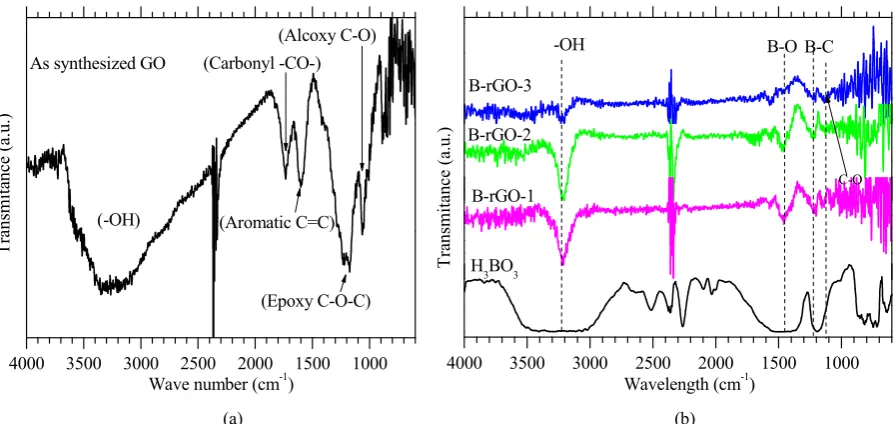
FT-IR analyses: Different functional groups present in the synthesized GO and B-rGO were assessed by FT-IR spectroscopic measurement. The FT-IR spectra of GO and B-rGO are shown in Fig. 2 (a-b). It is observed that at least five distinctive peaks characteristics of GO are seen in the spectrum (Fig. 2a). The peaks at 3300 cm–1, 1736, 1620, 1232, and 1060 cm–1, are assigned for GO by the stretching vibration of hydroxyl (–OH), carbonyl (C–O), aromatic (C=C), epoxy (C– O–C) and alkoxy (C–O) bonds, respectively, (Song 2014 and Zhang 2013). In the spectra of the B-rGO (Fig. 2b), the hydroxyl peak became sharp and observed at around 3250 cm–
1
due to incorporation of boron atoms and consequently the reduction of GO. There are three new peaks observed additionally at 1450 cm–1, 1200 and 1120 cm–1, respectively. These new peaks could be assigned for the stretching vibration of B–O, B–C and C–O bonds (Ram 1989, Jacox 2000 and Gago 2000). From the spectral analyses, therefore, we can suggest that the B–O and B–C bonds have been created in the GO network after boron functionalities.
with boron functionalities (Panchakarla et. al. 2009). A significant decrease in the interlayer spacing distance from
d=0.44 to d=0.170.19 nm also support incorporation of boron atom into the GO layer. The absence of the peaks associated with oxygen functionalities in the FT-IR spectra (Fig. 2a) agrees well with XRD results. This findings has also been coincided with the XPS analyses, since, the atomic concentration of boron was found to be 1.641.89 at % (Table-1) expressed in the following section.
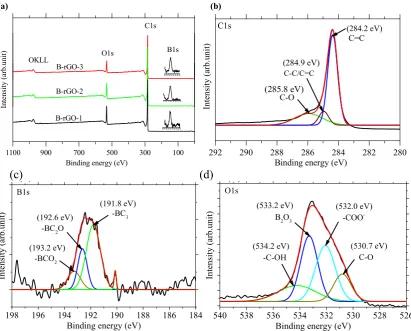
[image:3.595.63.529.188.531.2]XPS analyses: X-ray photoelectron spectroscopy (XPS) measurements were carried out in order to further investigate the chemical composition and chemical environment around carbon, oxygen and boron atoms for B-rGO samples. The XPS survey scan spectra showed the evidence of C, O, and B elements and are shown in Fig. 4a. The elemental compositions (at. %) were calculated from the XPS peak intensities and are shown in Table 1.
Table 1. Reaction condition of hydrothermal doping of boron into GO lattice and their corresponding elemental composition
Sample Reaction Temp.
(C)
Reaction Pressure (MPa)
Reaction period
(h)
Conc. of boric acid
(M)
Solution pH Elemental composition (at.%)
C H O B
GO - - - 55.470.015 1.830.05 42.700.11 -
[image:3.595.72.520.566.778.2]B-rGO-1 250 22 2 0.5 4.4 82.600.015 1.400.05 14.360.11 1.640.01 B-rGO-2 250 22 2 1.0 4.5 84.900.015 1.460.05 11.880.11 1.760.01 B-rGO-3 300 22 3 2.0 4.6 84.000.015 1.790.05 12.320.11 1.890.01
Fig. 1. Schematic of the synthesis process of graphene oxide and boron doping by hydrothermal reaction using boric acid as the precursor
(a) (b)
Fig. 2. FT-IR spectra: (a) as-synthesized GO: (b) B-rGO
C OH C C
O O O
HO O
HO
C
OH O
OH C
O
O
C
O O
HO
O OH
O HO
HO
O O
OH
OH O
O OH
OH OH
Boric acid Graphite
Modified Hummers
method
Graphite oxide
Sonication and drying
Hydrothermal reduction
Inconel reactor
Furnace GO holder
Graphene oxide Boric acid Graphene oxide
Boron functionalized graphene oxide Inconel batch reactor
B-O
B-rGO-3
-OH B-C
C-O
B-rGO-2
T
ra
nsmitan
ce
(
a.u.)
Wavelength (cm-1)
B-rGO-1
4000 3500 3000 2500 2000 1500 1000
H3BO3
4000 3500 3000 2500 2000 1500 1000
(Alcoxy C-O)
(Epoxy C-O-C) (Aromatic C=C) (Carbonyl -CO-)
Tr
ansmita
nce (a.u
.)
Wave number (cm-1)
(-OH) As synthesized GO
It is seen that boron incorporation is increased up to 1.89 at.% with the increase of reaction temperature and the concentration of boric acid. High resolution core shell XPS spectra of C1s, O1s and B1s are carried out in order to explain the chemical environment around the C, O and B atoms of the B-rGO after boron doping. The deconvoluted C1s, B1s and O1s spectra are shown in Fig. 4 (b-d). The C1s spectra could be deconvoluted into three peaks. The main peak located at the binding energy 284.2 eV is due to the sp2-C=C chemical environment and the peak located at the binding energy region of 284.9 eV could be suggested for the C-C/C=C bonds. The shoulder peak at 285.8 eV is due to the carbonyl C–O chemical environments (Sahoo 2015, Duan 20015 and Li 2015). The B1s could be deconvoluted into three component peaks Fig. 4c.
The peaks at 191.8, 192.6 and 193.2 eV are assigned for the – BC3, –BC2O and –BCO2 chemical environment, respectively,
since the results are very good agreement with the reported value (Sahoo 2015 and Fang 2014). From the deconvolution of O1s spectrum, correspondingly, four components peaks at 530.7 532.0, 533.2 and 534.2 eV were found which could be suggested for the carbonyl C–O, carboxylic –COO–, –B2O3 and
hydroxyl –C–OH chemical environments, respectively (Sahoo 2015). These results are in good agreement with the FT-IR analyses (Fig. 2b).
[image:4.595.194.395.227.415.2]
Raman analyses: Raman spectroscopy was used for indentifying the crystalline structure and quality of the as-received GO as well as B-rGO.
Fig. 3. XRD patterns of the as-synthesized GO and B-rGO
(a) (b) [image:4.595.93.505.440.771.2]
(c) (d)
Fig. 4. XPS spectra: (a) survey scan XPS spectra of B-rGO, (b) High resolution core shell C1s, (c) B1s and (d) O1s XPS spectra of B-rGO. The spectra were taken at the step energy of 0.02 eV
B-rGO-3
OKLL O1s
C1s
198 196 194 192 190 188 186 184
In
ten
sity (arb
.un
it) B1s
B-rGO-2
198 196 194 192 190 188 186 184
1100 900 700 500 300 100
B-rGO-1
200198 196 194 192 190 188 186184182
Binding energy (eV)
292 290 288 286 284 282 280
Inte
nsity (ar
b.
u
ni
t)
Binding energy (eV)
C1s (284.2 eV)
(284.9 eV)
(285.8 eV)
C=C
C-C/C=C
C-O
(a)
(b)
198 196 194 192 190 188 186 184
B1s
-BCO2 -BC2O
-BC3
(193.2 eV) (192.6 eV)
In
te
nsity (arb.
uni
t)
Binding energy (eV)
(191.8 eV)
540 538 536 534 532 530 528 526
-COO
-C-O O1s
-C-OH B2O3
(534.2 eV) (533.2 eV)
In
te
ns
ity (arb.unit)
Binding energy (eV)
(532.0 eV)
(530.7 eV)
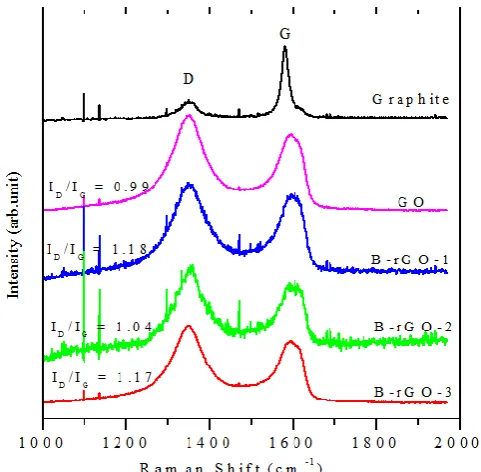
The measurements have been done in the spectral region of 1000–2000 cm–1 using same laser power (632 nm laser excitation) for all the samples. The Raman spectra of the samples are shown in Fig. 5. It is seen that the D band intensity is increased while the G band intensity is decreased for the as-synthesized GO and the B-rGO in comparison to that of the pristine graphite flake. The increase in intensity and broadening of both the D and G band confirmed the assimilation of oxygen containing functional groups as well as the assimilation of boron elements in the GO framework. This functionality caused the loss of crystalline structure of both the GO and B-rGO.
Fig. 5. Raman spectra of pristine graphite (top spectrum), as-received GO, and B-rGO
Fig. 6. Graphical presentation of glucose adsorption reactivity of graphite, GO and B-rGO
Forward shifting of the G band position from 1595 to 1600 cm–1 B-rGO suggesting the inclusion of boron atoms in the GO lattice leading to increase the disordered structure (Hishiyama 2001). The increment in the ID/IG ratio clearly demonstrates the
[image:5.595.43.284.205.441.2]formation of defects in the graphene sheets by boron doping that might leads to considerable changes in the structural properties, electrical and other physicochemical properties.
Fig. 7. The possible mechanism of the glucose binding site with boron atoms of B-rGO
Glucose adsorption analyses by UV-vis and HPLC analyses: Glucose responsive adsorption reactivity of the B-rGO was compared with those of the synthesized GO and with the pristine graphite flake. The results are shown graphically in Fig. 6. It was found that the adsorption reactivity of graphite and GO were found to be almost comparable. The highest adsorption was observed (6570%) for B-rGO in the reaction period of 40 minutes and then the reactivity was declined with reaction time. The adsorption mechanism could be initially presumed that the boron atoms of B-rGO could bind to the C-1/C-2 diol and C-4/C-6 diol of glucose in its hexopyranose form (Ferrier 1965). Another possibility is that the binding between the boron atoms of B-rGO and the oxygen atoms of the furanoside form of free hexoses (Eggert 1999). The plausible mechanism of the binding site is shown in Fig. 7. From the results, it could be acclaimed that the B-rGO could be used as the blood glucose biosensing receptors. However, more researches have to be done to confirm the bio-sensing reactivity of the B-rGO.
Conclusions
We have synthesized GO by modified Hummer’s method using graphite flake as the starting material and boron doping was successfully achieved by hydrothermal reaction using boric acid as precursor. FT-IR confirmed the presence of different functional groups in the GO and B–C and B–O bonds in B-rGO. The crystalline defect structural was confirmed by XRD and Raman spectroscopic analyses. This method gives about 1.641.89 at.% of boron doping onto the GO lattice which was confirmed by XPS. The B-rGO exhibited significant glucose responsive reactivity with the adsorption percentage of 6570%. The B-rGO could be used as glucose adsorption bio-sensing applications.
Acknowledgements
The author gratefully acknowledged The President of JASSO for providing financial support under JASSO Fellowship Program. Special thanks go to the students of Prof. Kida’s laboratory for giving their continuous help in completing of the research work.
Conflicts of Interest: The authors declare no conflict of interest.
REFERENCES
Allahbakhsh, A., Sharif, F., Mazinani, S., Kalaee, M.R. 2014. Synthesis and characterization of graphene oxide in
[image:5.595.39.288.484.663.2]suspension and powder forms by chemical exfoliation method.
Int. J. Nano Dimen., 5:11-20.
Brodie, B.C. 1859. On the atomic weight of graphite. Philos.
Trans. R. Soc. London 149:249-259.
Czerw, R., Terrones, M., Charlier, J.C., Blasé, X., Foley, B., Kamakalaran, R., Grobert, N., Terrones, H., Tekleab, D., Ajayan, P.M., Blau, W., Ruhle, M., Caroll, D.L. 2001. Identification of electron donor states in N-doped carbon nanotubes. Nano Lett., 1:457-460.
Chen, W., Yan, L., Bangal, P.R. 2010. Preparation of graphene by the rapid and mild thermal reduction of graphene oxide induced by microwaves. Carbon, 48:1146–1152.
Duan, X., Ao, Z., Sun, H., Indrawirawan, S., Wang, Y., Kang, J., Liang, F., Zhu, Z.H., Wang, S. 2015. Nitrogen-doped graphene for generation and evolution of reactive radicals by metal-free catalysis. ACS Appl. Mater. Interfaces, 7:4169– 4178.
Dreyer, D.R., Park, S., Bielawaski, C.W., Ruoff, R.S. 2010. The chemistry of graphene oxide. Chem. Soc. Rev., 39:228-240. Ekimov, E.A., Sidorov, V.A., Bauer, E.D., Melʼnik, N.N., Curro,
N.J., Thompson, J.D., Stishov, S.M. 2004. Superconductivity in diamond. Nature, 428:542-545.
Eda, G., Fanchini, G., Chhowalla, M. 2008. Large-area ultrathin films of reduced graphene oxide as a transparent and flexible electronic material. Nat. Nanotech., 3:270–274.
Eggert, H., Frederiksen, J., Morin, C., Norrild, J.C. 1999. A new glucose-selective fluorescent bisboronic acid. First report of strong alpha-furanose complexation in aqueous solution at physiological pH. J. Org. Chem.,64:3846-3852.
Ferrier, R.J., Prasad, R. 1965. Boric acid derivatives as reagents in carbohydrate chemistry. 6. phenylboronic acid as a protecting group in disaccharide synthesis. J. Chem. Soc., 7429.
Fang, H., Yu, C., Ma, T., Qiu, J. 2014. Boron-doped graphene as a high-e ciency counter electrode for dye-sensitized solar cells.
Chem. Commun., 50:3328–3330.
Gago, R., Jimenez, I., Agullo-Rueda, F., Albella, J.M., Czigany, L.Z., Hultman, J. 2000.
Transition from amorphous boron carbide to hexagonal boron carbon nitride thin films induced by nitrogen ion assistance.
Appl. Phys., 92:5177-5182.
Geim, A.K., Novoselov, K.S. 2007. The rise of graphene. Nat.
Mater., 6:183-191.
Huang X, Qi X, Boey F, Zhang H (2012) Graphene-based composites. Chem Soc Rev 41:666-686.
Hishiyama, Y., Irumano, H., Kaburagi, Y., Soneda, Y. 2001. Structure, Raman scattering, and transport properties of boron-doped graphite. Phys. Rev. B, 63:245406.
Jacox, M.E., Irikura, K.K., Thompson, W.E. 2000. The reaction of BF3 with H2O:Infrared spectrum of BF2OH trapped in solid
neon. J. Chem. Phys., 113:5705-5710.
Kumar, N.A., Nolan, H., McEvoy, N., Rezani, E., Doyle, R.L., Lyons, M.E., Duesberg, G.S. 2013. Plasma-assisted simultaneous reduction and nitrogen doping of graphene oxide nanosheets. J. Mat. Chem. A., 1:4431-4435.
Lightcap I, Kamat PV (2013) Graphitic design; prospects of graphene-based nanocomposites for solar energy conversion, storage, and sensing. Acc Chem Res 46:2235-2243.
Li, X., Wang, H., Robinson, J.T., Sanchez, H., Diankov, G., Dai, H. 2009. Simultaneous nitrogen doping and reduction of graphene oxide. J. Am. Chem. Soc., 131:15939-15944. Li, S., Wang, Z., Jiang, H., Zhang, L., Ren, J., Zheng, M., Dong,
L., Sun, L. 2016. Plasma-induced highly e cient synthesis of boron doped reduced graphene oxide for supercapacitors.
Chem. Commun., 52:10988-10991.
Li, X., Cheng, Y., Zhang, H., Wang, S., Jiang, Z., Guo, R., Wu, H. 2015. Efficient CO2 capture by functionalized graphene oxide
nanosheets as fillers to fabricate multi-permselective mixed matrix membranes. ACS Appl. Mater. Interfaces, 7:5528– 5537.
Miller, G.L. 1959. Use of dinitrosalicylic acid reagent for determination of reducing Sugar. Anal. Chem., 31:426–428. McAllister, M.J., Li, J.L., Adamson, D.H., Schniepp, H.C.,
Abdala, A.A., Liu, J., Alonso, M.H., Milius, D.L., Car, R., Rrud’homme, R.K., Aksay, I.A. 2007. Single sheet functionalized graphene by graphite. Chem. Mater., 19:4396-4404.
Panchakarla, L.S., Subrahmanyam, K.S., Saha, S.K., Govindaraj, A., Krishnamurthy, H.R., Waghmare, U.V., Rao, C.N.R. 2009. Synthesis, structure, and properties of boron- and nitrogen-doped graphene. Adv. Mater., 21:4726–4730.
Ram, S., Ram, K. 1989. IR and Raman studies and effect of γ radiation on crystallization of some lead borate glasses containing Al2O3.J. Mater. Sci., 23:4541-4546.
Stephan, O., Ajayan, P.M., Colliex, C., Redllich, P., Lambert, J.M., Bernier, P., Lefin, P. 1994. Doping graphite and carbon nanotube structures with boron and nitrogen. Science, 266:1683.
Song, J., Wang, X., Chang, C.T. 2014. Preparation and characterization of graphene oxide. J. Nanomat., Article ID 276143.
Sahoo, M., Sreena, K.P., Vinayan, B.P., Ramaprabhu, S. 2015. Green synthesis of boron doped graphene and its application as high performance anode material in Li ion battery. Mat.
Res. Bull., 61:383–390.
Umrao, S., Gupta, T.K., Kumar, S., Singh, V.K., Sultania, M.K., Jung, J.H., Oh, I.I.K., Srivastava, A. 2015. Microwave-assisted synthesis of boron and nitrogen co-doped reduced graphene oxide for the protection of electromagnetic radiation in Ku-Band. ACS Appl. Mater. Inter., 7:19831-19842.
Wei, D., Liu, Y., Wang, Y., Zhang, H., Huang, L., Yu, G. 2009. Synthesis of N-doped graphene by chemical vapor deposition and its electrical properties. Nano Lett., 9:1752-1758.
Wang, C.D., Zhou, Y.A., He, L.F., Ng, T.W., Hong, G., Wu, Q.H., Gao, G., Lee, C.S., Zhang, W.J. 2013. In situ nitrogen-doped graphene grown from polydimethylsiloxane by plasma enhanced chemical vapor deposition. Nanoscale, 5:600-605. Wei, Q., Tong, X., Zhang, G., Qiao, J., Gong, Q., Sun, S. 2015.
Nitrogen-doped carbon nanotube and graphene materials for oxygen reduction reactions. Catalysts, 5:1574-1602.
Xia, Y., Mokaya, R. 2004. Synthesis of ordered mesoporous carbon and nitrogen-doped carbon materials with graphitic pore walls via a simple chemical vapor deposition method.
Adv Mat., 16:1553-1558.
Yeom, D.Y., Jeon, W., Tu, N.D.K., Yeo, S.Y., Lee, S.S., Sung, B.J., Chang, H., Lim, J.A., Kim, H. 2015. High-concentration boron doping of graphene nanoplatelets by simple thermal annealing and their supercapacitive properties. Sci. Rep., 5:09817.
Zhang, C., Hao, R., Liao, H., Hou, Y. 2013. Synthesis of aminofunctionalized graphene as metal-free catalyst and exploration of the roles of various nitrogen states in oxygen reduction reaction. Nano Energy, 2:88-97.
Zhu Y, Murali S, Cai W, Li X, Suk JW, Potts JR, Ruoff RS 2010. Graphene and graphene oxide: synthesis, properties, and applications. Adv Mat 22:3906-3924.