doi:10.4236/jep.2010.12020 Published Online June 2010 (http://www.SciRP.org/journal/jep)
Analysis of Mean Monthly Rainfall Runoff Data of Indian
Catchments Using Dimensionless Variables by Neural Network
Manish Kumar Goyal*, Chandra Shekhar Prasad Ojha
Department of Civil Engineering, Indian Institute of Technology, Roorkee, India. Email: [email protected]
Received April 2nd, 2010; revised May 4th, 2010; accepted May 5th, 2010.
ABSTRACT
This paper focuses on a concept of using dimensionless variables as input and output to Artificial Neural Network
(ANN) and discusses the improvement in the results in terms of various performance criteria as well as simplification of ANN structure for modeling rainfall-runoff process in certain Indian catchments. In the present work, runoff is taken as the response (output) variable while rainfall, slope, area of catchment and forest cover are taken as input parameters. The data used in this study are taken from six drainage basins in the Indian provinces of Madhya Pradesh, Bihar, Ra-jasthan, West Bengal and Tamil Nadu, located in the different hydro-climatic zones. A standard statistical performance evaluation measures such as root mean square (RMSE), Nash–Sutcliffe efficiency and Correlation coefficient were em-ployed to evaluate the performances of various models developed. The results obtained in this study indicate that ANN model using dimensionless variables were able to provide a better representation of rainfall–runoff process in com-parison with the ANN models using process variables investigated in this study.
Keywords:Dimensional Variables, Artificial Neural Networks, Rainfall–Runoff
1. Introduction
The rainfall-runoff relationship is one the most complex hydrological phenomenon due to the tremendous spatial and temporal variability of watershed characteristics and rainfall patterns as well as a number of variables in-volved in the physical processes. Also, this process is non-linear in nature and thus difficult to arrive at explicit solutions [1,2]. The runoff needs to be estimated for effi-cient utilization of water resources. The rainfall-runoff models play a significant role in water resource man-agement planning and hydraulic design. Several attempts have been made to model the non-linearity of the rain-fall–runoff process, arising from intrinsic non-linearity of the rainfall–runoff process and from seasonality These rainfall-runoff models generally fall into these broad categories; namely, black box or system theoretical mod-els, conceptual models and physically-based models [3-5]. Black box models normally contain no physi-cally-based input and output transfer functions and therefore, are considered to be purely empirical models. Conceptual rainfall-runoff models usually incorporate interconnected physical elements with simplified forms, and each element is used to represent a significant or dominant constituent hydrologic process of the rain-fall-runoff transformation [6,7]. A dimensional analysis
technique has also been developed and used to obtain mean annual flood estimation in several Indian catch-ments [8].
In recent year, applications of Artificial Neural Net-work (ANN) has become increasing popular in water resources and have been used in various fields for the prediction and forecasting of complex nonlinear proc-esses, including the rainfall runoff phenomenon. Many studies have demonstrated that the ANNs are excellent tools to model the complex rainfall–runoff process and can perform better than the conventional modeling tech-niques [1,9-12] However, many a times, less attention is given to simplify the ANN structure.
The use of dimensionless variables as input and output to ANN in rainfall-runoff modeling has not been found in the literature as of our best knowledge. Although, some evidences of using dimensionless variables in ANN are known in application of estimation of scour downstream [13] and for heat problems [14]. Swamee used the di-mensionless variables to compute annual flood estima-tion and hence, the same dimensionless variables are used in this present study in the context of rainfall-runoff process [8].
ANNs using process variables as well as dimensionless variables for modeling the complex rainfall–runoff proc-ess; and 3) to achieve simplifications in ANN structure. The paper begins with a brief introduction of the com-puting techniques of ANN and study area followed by the details of the model development before discussing the results and making concluding remarks. The tech-niques are applied on all river basin data used in the pre-sent study and Damodar river basin is used as an exam-ple of individual river basin to examine the effects on individual catchment.
2. Artificial Neural Network
[image:2.595.315.533.406.703.2] [image:2.595.62.273.573.710.2]The Artificial Neural Network represents an alternative computational paradigm where the solution to a problem is learned from a set of samples. An artificial neural network consists of simple synchronous element, called neurons, which are analogous to the biological neurons in the human brain [7,15]. These neurons are arranged in layers in a network. The neurons in one layer are con-nected to those in the adjacent layers and strength of connection between the two neurons in adjacent layers is called “weight”. There are weights on each of the inter-connections and it is these weights that are altered during the training process to ensure that the inputs produce an output that is close to the desired value with an appropri-ate training rule being used to adjust the weights in ac-cordance with the data that are presented to the network. An ANN normally consists of three layers, an input layer, a hidden layer, and an output layer. In a feed-forward network, the weighted connections feed activations only in the forward direction from an input layer to the output layer. Each node in a layer receives and processes weighted input from a previous layer and transmits its output to nodes in the following layer through links. A typical three layer feed-forward network is shown in Figure 1. There are many optimization techniques for neural networks training using the backpropagation algo- rithm. Recently, Levenberg–Marquardt learning algo-rithms are used increasingly due to the better perform-ance and learning speed with a simple structure [15,16].
Figure 1. Three layer feed-forward neural network
This learning algorithm is discussed here briefly as fol-lows:
The Levenberg–Marquardt algorithm is based on ap-proaching second-order training speeds without having the computation of Hessian matrix [17]. The Leven-berg–Marquardt algorithm uses an approximation to the Hessian matrix in the following Newton-like update: when μ is large, this becomes gradient descent with a small step size, and when μ is small, the algorithm ap-proximates the Newton’s method.
The Levenberg-Marquardt algorithm uses this ap-proximation to obtain the revised weight in the following form:
Xk + 1 = Xk – [J JT I]1JTe (1) where J is the Jacobian matrix that contains first deriva-tives of the network errors with respect to the weights and biases; e is a vector of network errors and I is an identity matrix [15,18,19].
Study Area
The data used in this study are from 31 sub-catchments of six large drainage basins in the Indian provinces of Madhya Pradesh, Bihar, Rajasthan, West Bengal and Tamil Nadu. Locations of the various catchments and sub-catchments taken for the analysis are shown in Fig-ure 2. The sub-catchments were grouped under six major river basins namely Damodar, Barkar, Chambal, May-urakshi, Lower Bhawani and Ram Ganga.
16
75
84 91
4
39
69 The values of monthly runoff were determined by
summing up the daily observed discharges for the month. The monthly rainfall for each catchment was averaged using the Theissen polygon method. The hydrological data for use in the present study is taken from Pooja Jain and Rama Raju [20,21]. These data were originally taken from the reports of Soil and Water Conservation Division, (1984, 1987) published by Water Conservation Division
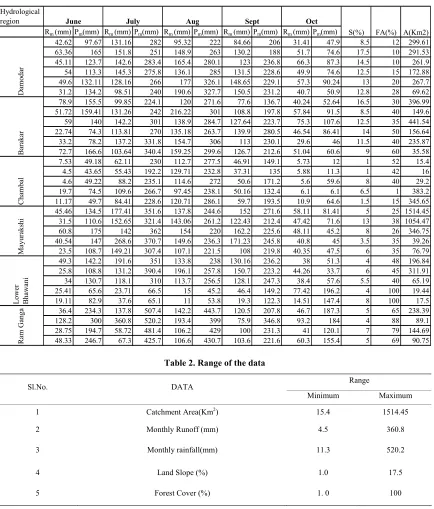
[image:3.595.83.517.199.708.2]of the Ministry of Agriculture, Government of India. The periods for which data is available vary from 10 to 17 years. Some data points were excluded from published hydrological data where runoff was more than precipita-tion, which is practically not possible. Mean values of several years of data are given in Table 1 and ranges of the above mentioned data used in the present study are given in Table 2.
Table 1. Mean value of data used
Hydrological region
Rm (mm) Pm(mm) Rm (mm) Pm(mm) Rm (mm) Pm(mm) Rm (mm) Pm(mm) Rm (mm) Pm(mm)
42.62 97.67 131.16 282 95.32 222 84.66 206 31.41 47.9 8.5 12 299.61
63.36 165 151.8 251 148.9 263 130.2 188 51.7 74.6 17.5 10 291.53
45.11 123.7 142.6 283.4 165.4 280.1 123 236.8 66.3 87.3 14.5 10 261.9
54 113.3 145.3 275.8 136.1 285 131.5 228.6 49.9 74.6 12.5 15 172.88
49.6 132.11 128.16 266 177 326.1 148.65 229.1 57.3 90.24 13 20 267.7
31.2 134.2 98.51 240 190.6 327.7 150.5 231.2 40.7 50.9 12.8 28 69.62
78.9 155.5 99.85 224.1 120 271.6 77.6 136.7 40.24 52.64 16.5 30 396.99
51.72 159.41 131.26 242 216.22 301 108.8 197.8 57.84 91.5 8.5 40 149.6
59 140 142.2 301 138.9 284.7 127.64 223.7 75.3 107.6 12.5 35 441.54
22.74 74.3 113.81 270 135.18 263.7 139.9 280.5 46.54 86.41 14 50 156.64
33.2 78.2 137.2 331.8 154.7 306 113 230.1 29.6 46 11.5 40 235.87
72.7 166.6 103.64 340.4 159.25 299.6 126.7 212.6 51.04 60.6 9 60 35.58
7.53 49.18 62.11 230 112.7 277.5 46.91 149.1 5.73 12 1 52 15.4
4.5 43.65 55.43 192.2 129.71 232.8 37.31 135 5.88 11.3 1 42
4.6 49.22 88.2 235.1 114.6 272 50.6 171.2 5.6 59.6 8 40 29.2
19.7 74.5 109.6 266.7 97.45 238.1 50.16 132.4 6.1 6.1 6.5 1 383.2
11.17 49.7 84.41 228.6 120.71 286.1 59.7 193.5 10.9 64.6 1.5 15 345.65
45.46 134.5 177.41 351.6 137.8 244.6 152 271.6 58.11 81.41 5 25 1514.45
31.5 110.6 152.65 321.4 143.06 261.2 122.43 212.4 47.42 71.6 13 38 1054.47
60.8 175 142 362 154 220 162.2 225.6 48.11 45.2 8 26 346.
40.54 147 268.6 370.7 149.6 236.3 171.23 245.8 40.8 45 3.5 35 39.26
23.5 108.7 149.21 307.4 107.1 221.5 108 219.8 40.35 47.5 6 35 76.79
49.3 142.2 191.6 351 133.8 238 130.16 236.2 38 51.3 4 48 196.
25.8 108.8 131.2 390.4 196.1 257.8 150.7 223.2 44.26 33.7 6 45 311.
34 130.7 118.1 310 113.7 256.5 128.1 247.3 38.4 57.6 5.5 40 65.19
25.41 65.6 23.71 66.5 15 45.2 46.4 149.2 77.42 196.2 4 100 19.4
19.11 82.9 37.6 65.1 11 53.8 19.3 122.3 14.51 147.4 8 100 17.5
36.4 234.3 137.8 507.4 142.2 443.7 120.5 207.8 46.7 187.3 5 65 238.
128.2 300 360.8 520.2 193.4 399 75.9 346.8 93.2 184 4 88 89.1
28.75 194.7 58.72 481.4 106.2 429 100 231.3 41 120.1 7 79 144.
48.33 246.7 67.3 425.7 106.6 430.7 103.6 221.6 60.3 155.4 5 69 90.75
R
am G
anga
Mayur
akshi
Lo
we
r
Bh
awa
ni
FA(%) A(Km2)
D
am
odar
Baraka
r
Cham
bal
June July Aug Sept Oct
S(%)
Table 2. Range of the data
Range Sl.No. DATA
Minimum Maximum
1 Catchment Area(Km2) 15.4 1514.45
2 Monthly Runoff (mm) 4.5 360.8
3 Monthly rainfall(mm) 11.3 520.2
4 Land Slope (%) 1.0 17.5
3. Methods
3.1 Dimensional Analysis
For dimensional analysis, Buckingham’s π theorem can be used to obtain the various dimensionless groups [8]. Swamee has investigated the influence of inclusion of 4 dimensionless groups in mean flood flow estimation. These dimensionless groups were formed using variables such as discharge Q, Area A, average rainfall p, of dura-tion D and recurrence interval T, Slope S and forest cover
FA[8].
Based on available data for Indian catchments, fol-lowing variables were identified: rainfall (P), runoff (R), slope (S) and forest cover (FA). Adopting A as the
re-peated variable, following nondimensional groups were formed:
R* = A-0.5R (2)
P* = A-0.5P (3)
where R is the runoff in mm, P is the rainfall in mm and
A is the drainage area in km2.
Using the above dimensionless group, the following empirical equation was proposed:
3 1
* 0 * ( 2) ( 4)
a a
A
R a P S a F a a5
5
)a
(4) Here a0-a5 are empirical constants, S is the slope
(per-cent) and FA is the forest cover.
The computed value for R* for ith data set R*ci was
ob-tained as
3 1
* 0 * ( 2) ( 4
a a
ci i i Ai
R a P S a F a (5)
Here suffix i stand for ith data set and a0-a5 are fitted
coefficients.
Using Equation (5), the observed value R* for ith data
set R*oi was obtained. To calibrate the model, the error
criterion was set to minimize the average percentage er-ror Ea, defined as
* * 1 * 100 n oi ci i oi R R Ea
n R
(6)3.2 ANN Model Development Using Process Variables
Before the data presented to the ANN training, it must be standardized in order to restrict its range to the interval [0, 1]. The actual observed outputs of the network being outside this bounded range of neuron transfer function; need to be normalized such that they fall within the
bounded output range. To develop a model, it is impor-tant to establish a correlation between the dependent variable with the independent variables. For this purpose, correlation matrix has been made and is given in Table 3. Using the information drawn from the correlation matrix analysis, runoff models have been decided as a function of different input variables. However, rainfall has been considered as a common input variable among all.
1: ( ) { ( ) }
ANNPAM R t f P t (7)
2 : ( ) { ( ), }
ANNPAM R t f P t S (8)
3 : ( ) { ( ), , A }
ANNPAM R t f P t S F (9)
4 : ( ) { ( ), , A, }
ANNPAM R t f P t S F A (10)
5 : ( ) { ( 1), ( ), , A, }
ANNPAM R t f P t P t S F A
Here ANNPAM represents Artificial Neural Network
Process variables All river basins Model.
The development of rainfall–runoff models using ANNs, involves the following steps: 1) selection of data set for training, cross-validation and validation of the model, 2) identification of the input and output variables, 3) normalization of the data, 4) selection of the network architecture, 5) determining the number of neurons in the hidden layer, 6) training of the ANN models, and 7) validation and cross-validation of ANN model using the selected performance evaluation statistics.
Back Propagation Learning Network (BPLN) has been first calibrated using about 60 percent of data and 20 percent of data have been used in the validation of model. The remaining 20 percent have been used for cross vali-dation of the model. The momentum coefficient is ada- pted to 0.9 and learning rate is fixed to 0.05 for neural network training. The number of epochs has been set to 3000. Log sigmoid is used as transfer function. The set of inputs combination which produced desired results cor-responding to minimum RMSE were adopted for further analysis.
3.3 ANN Model Development Using Dimensionless Variables
Following model ANNDAM1 has been developed using
dimensionless variables of rainfall (P*), slope (S), forest cover (FA) and runoff (R*). These dimensionless
vari-ables are discussed previously. Here ANNDAM
[image:4.595.74.517.658.719.2]repre-sents Artificial Neural Network Dimensionless All river basin Model.
Table 3. Correlation matrix of the variables
Runoff Rainfall Slope Forest cover Area
Runoff 1.0000
Rainfall 0.7769 1.0000
Slope 0.1333 –0.0114 1.0000
Forest cover –0.1315 0.0891 –0.3675 1.0000
1: *( ) { *( ), , A }
ANNDAM R t f P t S F (11)
2 : *( ) { *( 1), *( ), , A }
ANNDAM R t f P t P t S F
(12) Model-Performance Criteria
For identification of best combination of input vari-ables, different models are tested using various perform-ance criteria [22]. Root mean square error (RMSE) has been calculated for training, validation and testing data of these models. The RMSE is defined as follows.
2 1 ( ) N c i N Y Y RMSE N
(13)In addition, the Nash–Sutcliffe efficiency (η) is also widely used in water resources sector to assessthe per-formance of a model [23].
2 1 2 1 ( ) 1 ( ) N i c i N i i Y Y Y Y
(14)Also the correlation coefficient (CC) was also used a performance criteria and is computed by using the fol-lowing relationship [22].
1
1 n ( )(
i c
i
yc yi
Y Y Y Yc N CC
) (15)where Y is observed output, Yc is computed output,
Y
is the mean of observed output , Ycis the mean of computed output, is the standard deviation and N is total no. of samples.4. Training and Validation and
Cross-Validation of Data
4.1 Training, Validation and Cross-Validation of All River Basins Data
Data have been analyzed in this section using dimen-sional analysis and ANN using process variables as well as using dimensionless variables.
Using Dimensional Analysis Model
The dimension analysis model DAAM1 was developed and fitted coefficients a0-a5 were calculated by
minimiz-ing Ea by usminimiz-ing steepest descent technique. DAAM
represents Dimensional Analysis All river basins Model. The optimum value of a0-a5 was obtained for which Ea
was 39.74. This yielded the following form of (5):
DAAM1: R* = 0.41P*0.89(S + 0.052)0.112(FA+ 0.049)-0.001 (16)
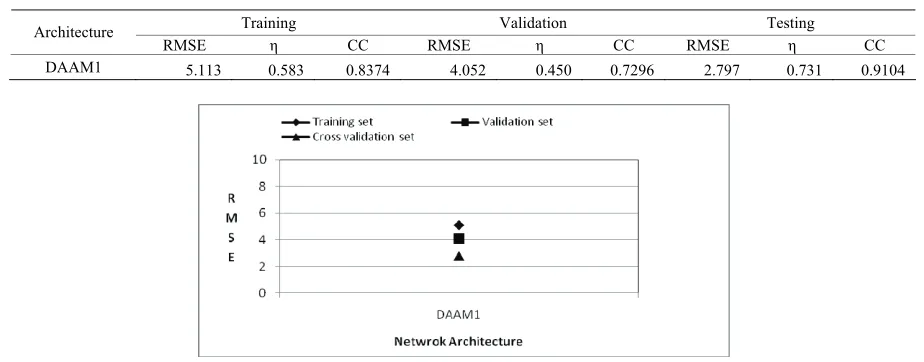
By using above expression, for model DAAM1, RMSE was 5.11, 4.05, 2.79 and Nash-Sutcliffe efficiency was 0.58, 0.45, and 0.73 as well as CC was 0.837, 0.729, and 0.910 for training, validation and cross validation set respectively for. The performance statistics in terms of RMSE, Nash-Sutcliffe efficiency and CC of the results for this model have been summarized in Table 4. The trends of the RMSE for different models have been shown in Figure 3.
Using ANN with BPLVM Using Process Variables Using the same input process variables defined as the
models (i.e. ANNPAM1 through ANNPAM5), the ANN
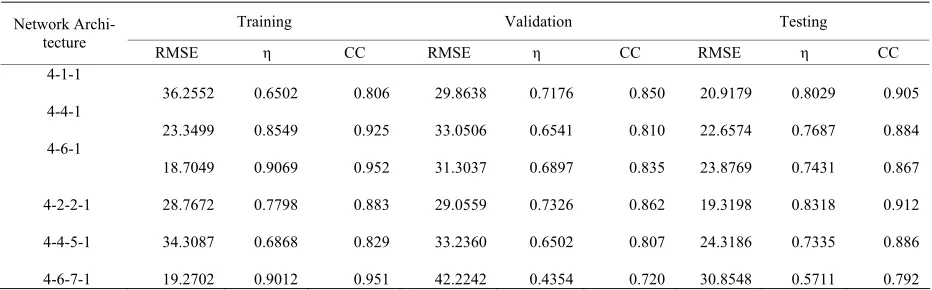
[image:5.595.66.528.524.705.2]models have been trained using Levenberg-Marquardt algorithm (BPLVM) for different ANN architectures. The performance statistics of the results for all the models used with different architectures have been summarized in Tables 5(a)-(d). The trends of the RMSE for different architectures have been shown in Figures 4(a)-(d).
Table 4.Summary of dimensional analysis to Model DAAM1
Training Validation Testing Architecture
RMSE η CC RMSE η CC RMSE η CC
DAAM1 5.113 0.583 0.8374 4.052 0.450 0.7296 2.797 0.731 0.9104
Table 5(a). Summary of ANN application to ANNPAM1 using BPLVM process variables
Training Validation Testing Network
Archi-tecture RMSE η CC RMSE η CC RMSE η CC
1-1-1
37.178 0.632 0.795 30.584 0.704 0.841 22.761 0.767 0.886
1-4-1
29.302 0.772 0.878 30.981 0.696 0.840 21.792 0.786 0.890
1-6-1
28.936 0.777 0.882 28.929 0.735 0.868 23.117 0.759 0.879
1-2-2-1
32.783 0.714 0.845 29.653 0.722 0.855 21.844 0.785 0.888
1-4-5-1
30.546 0.752 0.867 29.820 0.718 0.854 21.179 0.798 0.896
1-6-7-1
26.367 0.815 0.903 29.982 0.715 0.847 25.961 0.696 0.861
Table 5(b). Summary of ANN application to ANNPAM2 using BPLVM with process variables
Training Validation Testing Network
Ar-chitecture RMSE η CC RMSE η CC RMSE η CC
2-1-1
36.4981 0.6455 0.803 30.6828 0.7019 0.844 19.9987 0.8198 0.911
2-4-1
35.7986 0.6590 0.812 30.7923 0.6997 0.841 21.6273 0.7893 0.900
2-6-1
26.7166 0.8101 0.900 30.0352 0.7143 0.855 36.0875 0.4132 0.772
2-2-2-1
29.1566 0.7738 0.880 29.5681 0.7231 0.854 24.7052 0.7250 0.863
2-4-5-1
28.1872 0.7886 0.888 30.5316 0.7048 0.846 28.8788 0.6242 0.828
2-6-7-1
24.4513 0.8409 0.917 31.0585 0.6945 0.835 26.5795 0.6817 0.844
Table 5(c). Summary of ANN application to ANNPAM3 using BPLVM with process variables
Training Validation Testing Network
Archi-tecture RMSE η CC RMSE η CC RMSE η CC
3-1-1
36.266 0.650 0.806 29.997 0.715 0.848 21.070 0.800 0.903
3-4-1
20.904 0.884 0.940 33.943 0.635 0.803 27.726 0.654 0.841
3-6-1
19.254 0.901 0.949 35.637 0.598 0.802 33.779 0.486 0.761
3-2-2-1
35.287 0.669 0.818 30.390 0.708 0.847 21.872 0.784 0.905
3-4-5-1
23.231 0.856 0.925 27.429 0.762 0.878 18.896 0.839 0.917
3-6-7-1
23.650 0.851 0.923 32.890 0.657 0.813 24.946 0.720 0.876
Table 5(d). Summary of ANN application to ANNPAM4 using BPLVM with process variables
Training Validation Testing Network
Archi-tecture
RMSE η CC RMSE η CC RMSE η CC
4-1-1
36.2552 0.6502 0.806 29.8638 0.7176 0.850 20.9179 0.8029 0.905
4-4-1
23.3499 0.8549 0.925 33.0506 0.6541 0.810 22.6574 0.7687 0.884
4-6-1
18.7049 0.9069 0.952 31.3037 0.6897 0.835 23.8769 0.7431 0.867
4-2-2-1 28.7672 0.7798 0.883 29.0559 0.7326 0.862 19.3198 0.8318 0.912
4-4-5-1 34.3087 0.6868 0.829 33.2360 0.6502 0.807 24.3186 0.7335 0.886
[image:6.595.63.531.99.230.2] [image:6.595.66.529.255.379.2] [image:6.595.66.531.407.538.2] [image:6.595.65.531.564.709.2]Table 5(e). Summary of ANN application to ANNPAM5 using BPLVM with process variables
Training Validation Testing Network
Archi-tecture RMSE η CC RMSE η CC RMSE η CC
5-1-1
37.6870 0.4522 0.67 29.5260 0.5706 0.78 17.7127 0.3662 0.66
5-4-1
32.8048 0.5849 0.76 56.1951 –0.5553 0.28 64.1959 –7.3250 0.36
5-6-1
8.6947 0.9708 0.99 127.3057 –6.9822 –0.61 142.9043 –40.253 –0.16
5-2-2-1 28.6140 0.6842 0.83 27.9018 0.6166 0.81 19.4920 0.2325 0.63
5-4-5-1 18.1824 0.8725 0.93 44.7818 0.0123 0.61 75.2239 –10.430 0.13
5-6-7-1 9.9741 0.9616 0.98 96.0710 –3.5458 0.51 147.6428 –43.034 0.05
1) Model ANNPAM1: The performance of this model
has been presented in Table 5(a) and RMSE of the re-sults for training, validation and cross-validation are shown in Figure 4(a). For this model, RMSE was in the range of 21.17-37.17 and Nash-Sutcliffe efficiency was in the range of 0.632-0.815 for different NN architecture. The best identified NN architecture was 1-4-5-1 for which RMSE was in the range of 21.17-30.54 and Nash-Sutcliffe efficiency was in the range of 0.718-0.798. The NN architecture performed 1-1-1 the worst for which RMSE was in the range of 22.76-37.17 and Nash- Sutcliffe efficiency was in the range of 0.632-0.767.
2) Model ANNPAM2: The performance of this model
has been presented in Table 5(b) and RMSE of the re-sults for training, validation and cross-validation are shown in Figure 4(b). For this model, RMSE was in the range of 19.99-36.49 and Nash-Sutcliffe efficiency was in the range of 0.413-0.840 for different NN architecture. The best identified NN architecture was 2-1-1 for which RMSE was in the range of 19.99-36.49 and Nash- Sutcliffe efficiency was in the range of 0.645-0.819. The NN architecture 2-6-7-1 performed the worst for which RMSE was in the range of 24.45-31.05 and Nash- Sutcliffe efficiency was in the range of 0.694-0.840.
3) Model ANNPAM3: The performance of this model
has been presented in Table 5(c) and RMSE of the re-sults for training, validation and cross-validation are shown in Figure 4(c). RMSE was in the range of 18.89- 36.26 for different NN architecture for this model. The best identified NN architecture was 3-4-5-1 for which RMSE was in the range of 18.89-27.42 and Nash-Sut-cliffe efficiency was in the range of 0.762-0.856.The NN architecture 3-1-1 performed the worst for which RMSE was in the range of 21.07-36.26 and Nash-Sutcliffe effi-ciency was in the range of 0.650-0.800.
4) Model ANNPAM4: The performance of this model
has been presented in Table 5(d) and RMSE of the re-sults for training, validation and cross-validation are
shown in Figure 4(d). RMSE was in the range of
18.70-36.25 for different NN architecture for this model.
The best identified NN architecture was 4-6-1 for which RMSE was in the range of was 18.70-31.30 and Nash- Sutcliffe efficiency was in the range of 0.689-0.907.The NN architecture performed 4-1-1 the worst for which RMSE was in the range of 20.19-36.25 and Nash-Sut-cliffe efficiency was in the range of 0.650-0.803.
5) Model ANNPAM5: The performance of this model
has been presented in Table 5(e) and RMSE of the re-sults for training, validation and cross-validation are
shown in Figure 4(e). RMSE was in the range of
8.69-147.64 for different NN architecture for this model. The best identified NN architecture was 5-2-2-1 for which RMSE was in the range of was19.40-28.61 and Nash-Sutcliffe efficiency was in the range of 0.23-0.68.
Based on these results, it can be inferred that NN ar-chitecture 4-6-1 performs the best for which RMSE was 18.70, 31.30, 23.87, Nash-Sutcliffe efficiency was 0.907, 0.689, 0.743 and CC was 0.95, 0.83, 0.86 for training, validation and cross validation set respectively.
ANN with BPLVM Using Dimensionless Variable Using the input dimensionless variables defined in the
model ANNDAM1 and ANNDAM2; the ANN models
have been trained using Levenberg-Marquardt algorithm (BPLVM) for different ANN architectures. The per-formance statistics of the results for all the models used with different architectures have been summarized in Tables 6(a) and (b). The trends of the RMSE for different architectures have been shown in Figures 5(a) and (b).
1) Model ANNDAM1: The performance of this model
(a)
(b)
(c)
(e)
Figure 4. (a) RMSE of different ANN architecture using BPLVM for ANNPAM1; (b) RMSE of different ANN architecture using BPLVM for ANNPAM2; (c) RMSE of different ANN architecture using BPLVM for ANNPAM3; (d) RMSE of differ-ent ANN architecture using BPLVM for ANNPAM4; (e) RMSE of differdiffer-ent ANN architecture using BPLVM for ANNPAM5
(a)
(b)
[image:9.595.155.440.85.255.2] [image:9.595.159.441.307.673.2]Table 6(a).Summary of ANN application to ANNDAM1 using BPLVM with dimensionless variables
Training Validation Testing Network
Archi-tecture RMSE η CC RMSE η CC RMSE η CC
3-1-1
2.8679 0.7620 0.873 4.8603 0.2089 0.645 3.8523 0.4890 0.905
3-3-1 3.1098 0.8458 0.920 6.6037 –0.4604 0.618 6.9372 –0.6571 0.873
3-5-1
2.1393 0.9270 0.963 5.0977 0.1297 0.697 6.8841 –0.6318 0.869
Table 6(b).Summary of ANN application to ANNDAM2 using BPLVM with dimensionless variables
Training Validation Testing Network
Archi-tecture RMSE η CC RMSE η CC RMSE η CC
4-1-1
4.1198 0.7223 0.850 4.5203 0.3047 0.686 2.9293 0.3388 0.77 4-3-1
2.6301 0.8868 0.942 5.3015 0.0437 0.6393 3.7672 –0.0936 0.55 4-5-1
2.9652 0.8562 0.925 4.1604 0.4110 0.7385 3.7473 –0.0820 0.59
cross validation set respectively. For NN architecture 3-5-1, RMSE was 2.13, 5.09 and 6.88 and Nash-Sutcliffe efficiency was 0.927, 0.129 and –0.632 for training, vali-dation and cross valivali-dation set respectively.
2) Model ANNDAM2: The performance of this model
has been presented in Table 6(b) and RMSE of the re-sults for training, validation and cross-validation are shown in Figure 5(b). For this model ANNDAM2, RMSE was in the range of 2.63-5.30 and Nash-Sutcliffe effi-ciency was in the range of (–0.08)-0.88 for different NN architecture. For NN architecture 4-1-1, RMSE was 4.11, 4.52 and 2.92 and Nash-Sutcliffe efficiency was 0.722, 0.304 and 0.338 for training, validation and cross valida-tion set respectively. For NN architecture 4-3-1, RMSE was 2.63, 5.30 and 3.76 and Nash-Sutcliffe efficiency was 0.88, 0.043 and –0.0.093 for training, validation and cross validation set respectively. For NN architecture 3-5-1, RMSE was 2.96, 4.16 and 3.74 and Nash-Sutcliffe efficiency was 0.856, 0.411 and –0.082 for training, vali-dation and cross valivali-dation set respectively.
Based on these overall results, it can be inferred that
model ANNDAM1 with NN architecture 3-1-1 performs
the best for which RMSE was 2.86, 4.86, 3.85, Nash- Sutcliffe efficiency was 0.762, 0.209,0.489 and CC was 0.873,0.645,0.905 for training, validation and cross vali-dation set respectively.
4.2 Training, Validation and Cross Validation of Damodar River Basin Data
Data of Damodar river basin has been analyzed in this section using dimensional analysis, ANN models using process variables and ANN models using dimensionless variables.
Using Dimensional Analysis Model
The dimension analysis model DAINM1 was
devel-oped and fitted coefficients a0-a5 were calculated by
minimizing Ea by using steepest descent technique.
DAINM represents Dimensional Analysis Individual river basin Model. The optimum value of a0-a5 was obtained
for which Ea was 20.54. This yielded the following form of (5):
DAINM1: R* = 0.42P*0.95(S + 0.052)0.112(FA + 0.049)-0.001
(17)
By using above expression, for model DAINM1,
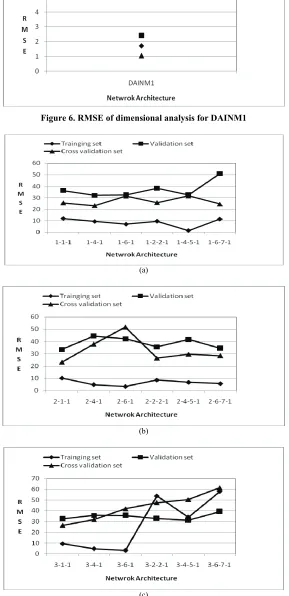
RMSE was 1.72, 2.43 and 1.044; Nash-Sutcliffe effi-ciency was 0.85, 0.65 and –0.21 and CR was 0.950, 0.970, 0.945 for training, validation and cross validation set respectively for. The performance statistics in terms of RMSE, Nash-Sutcliffe efficiency and CC of the results for this model have been summarized in Table 7. The trends of the RMSE for different models have been shown in Figure 6.
Using ANN with BPLVM Using Process Variables Using the input process variables defined as the
mod-els (i.e. ANNPAM1 through ANNPAM4), the ANN
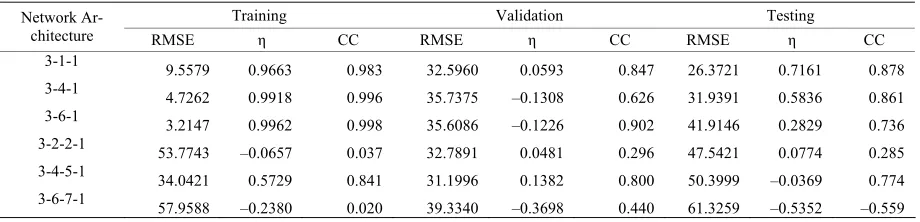
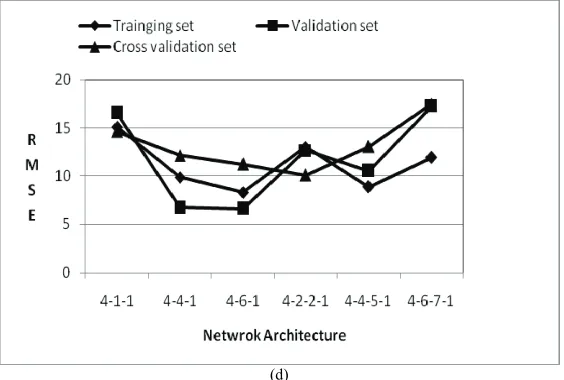
models (ANNINPM1 to ANNINPM4) have been trained using Levenberg-Marquardt algorithm (BPLVM) for different ANN architectures for Damodar river basin. ANNINPM represents Artificial Neural Network Indi-vidual river basin Process variables Model. The per-formance statistics of the results for all the models used with different architectures have been summarized in Tables 8(a)-(d). The trends of the RMSE for different architectures have been shown in Figures 7(a)-(d).
[image:10.595.57.541.101.179.2] [image:10.595.57.539.205.282.2]Table 7.Summary of dimensional analysis to Model DAINM1
Training Validation Testing Network
Archi-tecture RMSE η CC RMSE η CC RMSE η CC
DAINM1 1.72 0.852 0.950 2.43 0.650 0.970 1.04 –0.210 0.945
Table 8(a). Summary of ANN application to ANNINPM1 using BPLVM with process variables
Training Validation Testing Network
Ar-chitecture RMSE η CC RMSE η CC RMSE η CC
1-1-1 11.9073 0.9477 0.974 36.2359 –0.1625 0.784 25.5472 0.7336 0.907
1-4-1 9.4568 0.9670 0.983 32.2651 0.0783 0.817 23.2351 0.7796 0.913
1-6-1 7.0183 0.9818 0.991 32.5733 0.0606 0.531 31.4172 0.5971 0.817
1-2-2-1 9.5547 0.9664 0.983 38.1784 –0.2905 0.763 25.7522 0.7293 0.943
1-4-5-1 1.3961 0.9993 1.000 32.5750 0.0605 0.819 31.6387 0.5914 0.853
1-6-7-1 11.4890 0.9514 0.975 51.1218 –1.3139 0.406 24.6394 0.7522 0.919
Table 8(b). Summary of ANN application to ANNINPM2 using BPLVM with process variables
Training Validation Testing Network
Ar-chitecture RMSE η CC RMSE η CC RMSE η CC
2-1-1 10.224 0.961 0.981 33.556 0.003 0.871 23.205 0.780 0.911
2-4-1 4.919 0.991 0.996 44.444 –0.749 –0.362 37.777 0.417 0.667
2-6-1 3.367 0.996 0.998 42.190 –0.576 0.346 51.692 –0.091 0.425
2-2-2-1 8.617 0.973 0.986 35.593 –0.122 0.829 26.514 0.713 0.890
2-4-5-1 6.836 0.983 0.991 41.678 –0.538 0.686 29.581 0.643 0.864
2-6-7-1 5.796 0.988 0.994 34.436 –0.050 0.736 28.463 0.669 0.868
Table 8(c). Summary of ANN application to ANNINPM3 using BPLVM with process variables
Training Validation Testing Network
Ar-chitecture RMSE η CC RMSE η CC RMSE η CC
3-1-1 9.5579 0.9663 0.983 32.5960 0.0593 0.847 26.3721 0.7161 0.878
3-4-1 4.7262 0.9918 0.996 35.7375 –0.1308 0.626 31.9391 0.5836 0.861
3-6-1 3.2147 0.9962 0.998 35.6086 –0.1226 0.902 41.9146 0.2829 0.736
3-2-2-1 53.7743 –0.0657 0.037 32.7891 0.0481 0.296 47.5421 0.0774 0.285
3-4-5-1 34.0421 0.5729 0.841 31.1996 0.1382 0.800 50.3999 –0.0369 0.774
3-6-7-1 57.9588 –0.2380 0.020 39.3340 –0.3698 0.440 61.3259 –0.5352 –0.559
Table 8(d). Summary of ANN application to ANNINPM4 using BPLVM with process variables
Training Validation Testing Network
Ar-chitecture RMSE η CC RMSE η CC RMSE η CC
4-1-1 15.1078 0.9159 0.962 16.5611 0.7572 0.945 14.6386 0.9125 0.957
4-4-1 9.8741 0.9641 0.983 6.7022 0.9602 0.984 12.1456 0.9398 0.973
4-6-1 8.3123 0.9745 0.988 6.6095 0.9613 0.989 11.2242 0.9486 0.976
4-2-2-1 12.9961 0.9378 0.970 12.6738 0.8578 0.940 10.0796 0.9585 0.989
4-4-5-1 8.8720 0.9710 0.986 10.5189 0.9020 0.954 13.0449 0.9305 0.975
[image:11.595.67.530.188.310.2] [image:11.595.69.526.337.447.2] [image:11.595.69.529.474.585.2] [image:11.595.68.528.611.714.2]Figure 6. RMSE of dimensional analysis for DAINM1
(a)
(b)
(d)
Figure 7. (a) RMSE of different ANN architecture using BPLVM for ANNINPM1; (b) RMSE of different ANN architecture using BPLVM for ANNINPM2; (c) RMSE of different ANN architecture using BPLVM for ANNINPM3; (d) RMSE of dif-ferent ANN architecture using BPLVM for ANNINPM4
efficiency was in the range of 0.06-0.981. The NN archi-tecture performed 1-6-7-1 the worst for which RMSE was in the range of 11.48-51.12 and Nash-Sutcliffe effi-ciency was in the range of (–1.31)-0.951.
2) Model ANNINPM2: The performance of this model has been presented in Table 8(b) and RMSE of the re-sults for training, validation and cross-validation are shown in Figure 7(b). For this model, RMSE was in the range of 3.36-51.69 and Nash-Sutcliffe efficiency was in the range of (-0.749)-0.988 for different NN architecture. The best identified NN architecture was 2-6-7-1 for which RMSE was in the range of 5.79-34.43 and Nash-Sutcliffe efficiency was in the range of (–0.05) -0.988. The NN architecture 2-1-1 performed the worst for which RMSE was in the range of 10.22-33.55 and Nash-Sutcliffe efficiency was in the range of 0.003- 0.961.
3) Model ANNINPM3: The performance of this model has been presented in Table 8(c) and RMSE of the re-sults for training, validation and cross-validation are shown in Figure 7(c). RMSE was in the range of 3.21- 61.32 for different NN architecture for this model. The best identified NN architecture was 3-6-1 for which RMSE was in the range of 3.21-41.91 and Nash-Sutcliffe efficiency was in the range of (–0.122)-0.996. The NN architecture 3-1-1 performed the worst for which RMSE was in the range of 39.3-61.32 and Nash-Sutcliffe effi-ciency was in the range of 0.059-0.966.
4) Model ANNINPM4: The performance of this model has been presented in Table 8(d) and RMSE of the re-sults for training, validation and cross-validation are shown in Figure 7(d). RMSE was in the range of 6.60- 17.43 for different NN architecture for this model. The best identified NN architecture was 4-6-1 for which
RMSE was in the range of was 6.6-11.22. The NN archi-tecture performed 4-1-1 the worst for which RMSE was in the range of 14.63-16.56.
Based on these results, it can be inferred that NN ar-chitecture 4-6-1 performs the best for which RMSE was 8.31, 6.60, 11.22, Nash-Sutcliffe efficiency was 0.974, 0.961, 0.948 and CC was 0.988, 0.989, 0.976 for training, validation and cross validation set respectively.
ANN with BPLVM Using Dimensionless Variable Using the dimensionless variables as input defined in
the model ANNDAMI, the ANN model ANNINDM1 have
been trained using Levenberg-Marquardt algorithm (BPLVM) for different ANN architectures. ANNINDM represents Artificial Neural Network Individual river basin Dimen-sionless variables Model. The performance statistics of the results for all the models used with different archi-tectures have been summarized in Table 9. The trends of the RMSE for different architectures have been shown in Figure 8.
For this model ANNINDM1, RMSE was in the range
of 0.344-3.36; Nash-Sutcliffe efficiency was in the range of 0.198-0.995 and CC was in the range of 0.73-0.99 for different NN architecture.
For NN architecture 3-1-1, RMSE was 1.16, 1.95 and 2.5 and Nash-Sutcliffe efficiency was 0.943, 0.198 and 0.786 for training, validation and cross validation set respectively.
For NN architecture 3-3-1, RMSE was 0.815, 1.81 and 3.04 and Nash-Sutcliffe efficiency was 0.972, 0.314 and 0.683 for training, validation and cross validation set respectively.
[image:13.595.158.440.86.276.2]Figure 8. RMSE of different ANN architecture using BPLVM for ANNINDM1
Table 9.Summary of ANN application to ANNINDM1 using BPLVM with dimensionless variables
Training Validation Testing
Network
Archi-tecture RMSE η CC RMSE η CC RMSE η CC
3-1-1 1.1645 0.9435 0.971 1.9570 0.1982 0.737 2.5000 0.7869 0.946
3-3-1 0.8154 0.9723 0.986 1.8101 0.3141 0.894 3.0480 0.6833 0.881
3-5-1 0.3446 0.995048 0.998 1.6557 0.4261 0.818 3.3638 0.6143 0.830
respectively.
Based on these results, it can be inferred that NN ar-chitecture 3-1-1 performs the best for which RMSE was 1.16, 1.95 and 2.5; Nash-Sutcliffe efficiency was 0.943, 0.198 and 0.786 and CC was 0.971, 0.737 ,0.946 for training, validation and cross validation set respectively.
5. Results and Discussion
Here is summary of results for all river basins data as well as Damodar river basin data using different tech-niques.
All River Basins
ANN models using process variables have been de-veloped using all river basin data and the best identified
NN architecture was 4-6-1 of model ANNPAM4 for
whichRMSE was in the range of 18.70-31.30 and Nash- Sutcliffe efficiency was in the range of 0.689-0.907 while RMSE was in the range of 2.79-5.11, Nash-Sut-cliffe efficiency was 0.45-0.73 and CC was in the range
of 0.729-0.910 for model DAAM1 using dimensional
analysis technique. Hence, it can be concluded that di-mensional analysis technique performed better than ANN models using process variables for all river basins data.
Based on the performance evaluation of ANN models
using dimensionless variables, ANNDAM1 performed
better than model ANNPAM4 using all river basin data in terms of performance criteria. For this model ANNDAM1, RMSE was in the range of 2.13-6.88 while RMSE was in
the range of 18.70-31.30 for ANNPAM4 using ANN
models with process variables. For best identified
struc-ture 3-1-1 with model ANNDAM1, RMSE was in range
of 2.86-4.86, Nash-Sutcliffe efficiency was in the range of 0.20-0.90 and CC was in the range of 0.64-090. Hence, it can be concluded that ANN models using dimen-sionless variables performed better than Ann models us-ing process variables for all river basins data. The com-parison of observed and computed runoff for models
ANNPAM4and ANNDAM1have been shown in Figure 9 and Figure 10 respectively.
It is important to note here that the ANN architecture of best identified model ANNPAM4using process vari-ables was 4-6-1 while ANN architecture of best
identi-fied model ANNDAM1 using dimensionless variables
was 3-1-1. Hence it can be concluded that ANN structure can be simplified using dimensionless variables.
In this analysis of given data set, it has been found that there was not much improvement in performance criteria by using input process variable as P(t-1). For best identi-fied model ANNPAM5 with NN architecture 5-2-2-1 us-ing P(t-1) as one of input variables, RMSE was the range of 19.40-28.61 while RMSE was in range of 18.70-31.30 for the best identified model ANNPAM4with NN archi-tecture 4-6-1without using P(t-1) as a one of input proc-ess variable. Similarly, for ANN model ANNDAM2 with NN architecture 4-1-1 using P(t-1) as one of input di-mensionless variables, RMSE was in the range of
2.92-4.52 while for ANN model ANNDAM1 with NN
[image:14.595.56.541.278.353.2]Damodar River Basin
ANN models using process variables have been de-veloped using Damodar river basin data and NN archi-tecture 4-6-1 of model ANNINPM4 using process vari-ables performs the best for which RMSE was in the range of 6.6-11.22 and Nash-Sutcliffe efficiency was in the range of 0.948-0.974 while RMSE was in the range of 1.044-2.43 and Nash-Sutcliffe efficiency was in the range of (–0.21)-0.85 for the dimensional analysis tech-nique for this basin.Hence, it can be concluded that di-mensional analysis technique performed better than ANN models using process variables for individual river basins data.
For this model ANNINDM1, RMSE was in the range
of 0.344-3.36 and Nash-Sutcliffe efficiency was in the range of 0.198-0.995 while RMSE was in the range of
6.6-11.22 and Nash-Sutcliffe efficiency was in the range
of 0.948-0.974 for model ANNINPM4using ANN
mod-els with process variables. Hence, ANN model ANNINDM1 using dimensionless variables performed better than ANN model ANNINPM4 using process variables.
The best identified structure for ANN model ANNINDM1 using dimensionless variables was 3-1-1 for which RMSE was in the range of 1.16-2.50, Nash-Sutcliffe ef-ficiency was in the range of 0.19-0.97 and CC was in the range of 0.73-0.97. Hence it can be concluded that ANN structure can be simplified using dimensionless variables.
6. Conclusions
[image:15.595.151.446.293.479.2]This paper presents the findings of a study of comparison of the using process variables and dimensionless vari-ables with dimensional analysis and ANN for rainfall–
Figure 9. Comparison of observed and computed runoff using ANNPAM4 model
[image:15.595.150.447.513.706.2]runoff modeling in certain Indian catchments for a group of river basins as well as individual basin. The perform-ance of each model structure was evaluated using com-mon performance criteria. The salient findings of this study are presented as follows: 1) ANN models using dimensionless variables performed better than ANN models using process variables for all river basin data as well as individual river basin data; 2) ANN models using dimensionless variables simplified ANN architecture for all river basins as well as individual river basin; 3) Di-mensional analysis approach can be effectively used in rainfall-runoff modeling.
REFERENCES
[1] M. N. French, W. F. Krajewski and R. R. Cuykendall, “Rainfall Forecasting in Space and Time Using a Neural Network,” Journal of Hydrology, Vol. 137, No. 1-4, Au-gust 1992, pp. 1-31.
[2] N. Karunanithi, W. J. Grenney, D. Whitley and K. Bovee, “Neural Networks for River Flow Prediction,” Journal of Computing in Civil Engineering, Vol. 8, No. 2, April 1994, pp. 201-220.
[3] J. C. I. Dooge, “Problems and Methods of Rainfall-Run- off Modeling,” Mathematical Models for Surface Water Hydrology: The Workshop Held at the IBM Scientific Center, Pisa, 9-12 December 1977, pp. 71-108.
[4] S. Harun, N. I. Nor and A. H. M. Kassim, “Artificial Neural Network Model for Rainfall-Runoff Relationship,”
Jurnal Teknologi B, Vol. 37, 2002, pp. 1-12.
[5] M. P. Rajurkar, U. C. Kothyari and U. C. Chaube, “Mod-eling of the daily rainfall-runoff relationship with artifi-cial neural network,” Journal of Hydrology, Vol. 285, No. 1-4, 2004, pp. 96-113.
[6] K. M. O’Connor, “Applied Hydrology Deterministic,”
Unpublished Lecture Notes, Department of Engineering Hydrology, National University of Ireland, Galway, 1997. [7] S. Sanagaand A. Jain, “A Comparative Analysis of
Train-ing Methods for Artificial Neural Network Rainfall– Runoff Models,” Applied Soft Computing, Vol.6, No. 3, 2006, pp. 295-306.
[8] P. K. Swamee, C. S. P. Ojha and A. Abbas, “Mean An-nual Flood Estimation,” Journal of Water Resources Plan-ning and Management, Vol. 121, No. 6, 1995, pp. 403-407. [9] M. Campolo, P. Andreussi and A. Soldati, “River Flood
Forecasting with Neural Network Model,” Water Re-source Research, Vol. 35, No. 4, 1999, pp.1191-1197. [10] B. Zhang and R. S. Govindaraju, “Prediction of
Water-shed Runoff Using Bayesian Concepts and Modular Neu-ral Networks,” Water Resource Research, Vol. 36, No. 3, 2000, pp. 753-762.
[11] A. Jain and S. Srinivasulu, “Development of Effective and Efficient Rainfall–Runoff Models Using Integration
of Deterministic, Real-Coded Genetic Algorithms, and Artificial Neural Network Techniques,” Water Resource Research, Vol. 40, No. 4, 2004, p. 12.
[12] D. N. Kumar, M. J. Reddy and R. Maity, “Regional Rain-fall Forecasting Using Large Scale Climate Teleconnec-tions and Artificial Intelligence Techniques,” Journal of Intelligent Systems, Vol. 16, No. 4, 2007, pp. 307-322. [13] H. M. Azmathullah, M. C. Deo and P. B. Deolalikar,
“Neu-ral Networks for Estimation of Scour Downstream of a Ski-Jump Bucket,” Journal of Hydraulic Engineering, Vol. 131, No. 10, 2005, pp. 898-908.
[14] L. M. Tam, A. J. Ghajar and H. K. Tam, “Contribution Analysis of Dimensionless Variables for Laminar and Turbulent Flow Convection Heat Transfer in a Horizontal Tube Using Artificial Neural Network,” Heat Transfer Engineering, Vol. 29, No. 9, 2008 , pp. 793-804 . [15] M. Aqil, I. Kita, A. Yano and S. Nishiyama,
“Compara-tive Study of Artificial Neural Networks and Neuro- Fuzzy in Continuous Modeling of the Daily and Hourly Behaviour of Runoff,” Journal of Hydrology, Vol. 337, No. 1-2, 2007, pp. 22-34.
[16] S. M. A. Burney, T. A. Jilani and C. Ardil, “Levenberg- Marquardt Algorithm for Karachi Stock Exchange Share Rates Forecasting,” Proceedings of World Academy of Science, Engineering and Technology, Vol. 3, 2005, pp. 171-176.
[17] H. Demuth and M. Beale, “Neural Network Toolbox for Use with MATLAB, Users Guide,” Version 3, The Math-Works, Inc., Natick, 1998.
[18] M. T. Hagan and M. B. Menhaj, “Training Feedforward Networks with the Marquardt Algorithm,” IEEE Trans-actions on Neural Networks, Vol. 5, No. 6, 1994, pp. 989- 993.
[19] K. Özgur, “Multi-Layer Perceptrons with Levenberg-Mar- quardt Training Algorithm for Suspended Sediment Con-centration Prediction and Estimation,” Hydrological Sci-ences Journal, Vol. 49, No. 6, 2004, pp. 1025-1040. [20] P. Jain, “Modeling of Monthly Rainfall-Runoff Process
Using ANN,” Master of Technology Dissertation, De-partment of Civil Engineering, Indian Institute of Tech-nology, Roorkee, 2004.
[21] V. R. Raju, “Estimation of Monthly Runoff,” Master of Technology Dissertation, Department of Civil Engineer-ing, University of Roorkee, Roorkee, 1998.
[22] S. K. Jain, P. C. Nayak and K. P. Sudheer, “Models for Estimating Evapotranspiration Using Artificial Neural Net-works, and their Physical Interpretation,” Hydrological Processes,Vol. 22, No. 13, 2008, pp. 2225-2234.
Appendices
I. Weights and Biases for BPLVM for modelANNPAM4of network 4-6-1
Weights h11 h12 h13 h14 h15 h16
i1 –8.3602 –7.0334 8.6534 14.8352 1.5456 –0.6111
i2 –0.8806 17.6871 –17.5475 0.4825 –16.341 –6.7221
i3 0.331 0.3924 –0.375 –1.788 0.8711 –5.5499
i4 1.6462 5.0854 –5.5293 –8.3826 0.4748 –1.7737
Biases b11 b12 b13 b14 b15 b16 2.6117 1.2753 –1.7664 –1.1091 –2.5924 11.2949
II. Weights and Biases for BPLVM for model ANNDAM1of network 3-1-1
Weights h11 i1 2.3092 i2 0.4151 i3 0.2383
Biases b11 8.9379
Biases bo1
1.0063e+003
Input layer 3nodes
Hidden layer 1nodes
Output layer 1 node
Weights O1
h21 –0.7559
h22 –4.2063 h23 –3.1118 h24 –0.3359 h25 –4.7739 h26 1.1961
Input layer 4nodes
Hidden layer 6 nodes
Output layer 1 node
Biases bo1
–3.855
Weights O1