AMERICAN MATHEMATICAL SOCIETY S 0002-9947(2014)06110-2
Article electronically published on November 18, 2014
MAXIMAL SUBSEMIGROUPS OF THE SEMIGROUP OF ALL MAPPINGS ON AN INFINITE SET
J. EAST, J. D. MITCHELL, AND Y. P ´ERESSE
Abstract. In this paper we classify the maximal subsemigroups of thefull
transformation semigroupΩΩ, which consists of all mappings on the infinite set Ω, containing certain subgroups of the symmetric group Sym(Ω) on Ω. In 1965 Gavrilov showed that there are five maximal subsemigroups of ΩΩcontaining Sym(Ω) when Ω is countable, and in 2005 Pinsker extended Gavrilov’s result to sets of arbitrary cardinality.
We classify the maximal subsemigroups of ΩΩon a set Ω of arbitrary infinite cardinality containing one of the following subgroups of Sym(Ω): the pointwise stabiliser of a non-empty finite subset of Ω, the stabiliser of an ultrafilter on Ω, or the stabiliser of a partition of Ω into finitely many subsets of equal cardinality. IfGis any of these subgroups, then we deduce a characterisation of the mappingsf, g∈ΩΩ such that the semigroup generated byG∪ {f, g} equals ΩΩ.
1. Introduction
A subgroupH of a group Gis amaximal subgroup ifH =Gand the subgroup generated by H and g equals G for all g ∈ G\H. The definition of a maximal subsemigroup of a semigroup is analogous: a subsemigroup T of a semigroup (or group)Sis amaximal subsemigroupifT =Sand the subsemigroupT, sgenerated byT andsequalsS for alls∈S\T.
Let Ω denote an arbitrary (finite or infinite) set, let ΩΩdenote the semigroup of mappings from Ω to itself, and let Sym(Ω) denote the symmetric group on Ω. In this paper we are interested in those maximal subsemigroups of ΩΩ that contain certain subgroups of Sym(Ω). The maximal subgroups of finite symmetric groups, having been investigated by O’Nan and Scott [28], Aschbacher and Scott [1], and Liebeck, Praeger and Saxl [18], are, in some sense, known. When Ω is finite, it is easy to see that a maximal subsemigroup of ΩΩ is either the union of a maximal subgroup of the symmetric group and ΩΩ\Sym(Ω) or it is the union of Sym(Ω) and the mappings with at most|Ω| −2 points in their images. In general, the maximal subsemigroups of an arbitrary finite semigroup are determined, roughly speaking, by their maximal subgroups; see Graham, Graham, and Rhodes [12].
Maximal subgroups of Sym(Ω) have also been extensively studied when Ω is infinite; see [2–4, 6–8, 19, 20, 22, 27] and the references therein. It seems extremely unlikely that a complete description, in any sense, of maximal subgroups of Sym(Ω) exists for infinite Ω. Maximal subsemigroups of ΩΩ when Ω is infinite have been considered to a lesser degree. The maximal subsemigroups of ΩΩ containing the symmetric group were classified by Gavrilov in [11] for countable Ω and by Pinsker
Received by the editors September 18, 2012 and, in revised form, February 11, 2013. 2010Mathematics Subject Classification. Primary 20B30, 20B35, 20M20.
c
2014 American Mathematical Society Reverts to public domain 28 years from publication
[24, Theorem 1.4] for arbitrary infinite Ω; these are the only results regarding maximal subsemigroups of ΩΩ when Ω is infinite of which we are aware. We state and prove Gavrilov and Pinsker’s theorem (Theorem A) since elements of the proof are required later on, for the sake of completeness, and for the convenience of the reader. Maximal subsemigroups of other infinite semigroups of mappings have been considered. For example, Levi and Wood [17] and Hotzel [13] considered maximal subsemigroups of Baer-Levi semigroups, and Shneperman [29] considered the maximal subsemigroups of the endomorphism monoid of a finite dimensional complex vector space that are maximal with respect to being compact.
The subsemigroups of ΩΩ form an algebraic lattice with 2|Ω| compact elements under inclusion. The study of maximal subsemigroups of ΩΩbelongs to the wider study of this lattice. Pinsker and Shelah [26] prove that every algebraic lattice with at most 2|Ω|compact elements can be embedded into the subsemigroup lattice of ΩΩ. There are 22|Ω| distinct subsemigroups of ΩΩ. There are even 22κ
sub-semigroups between Sym(Ω) and any maximal subsemigroup of ΩΩ that contains Sym(Ω) where|Ω| =ℵα andκ= max{α,ℵ0}; for further details see Pinsker [25]. We show, as a consequence of Theorem C, that there are also 22|Ω|maximal subsemi-groups of ΩΩ. The maximal subsemigroups of the maximal subsemigroups described by Gavrilov [11] are classified in [10]; perhaps surprisingly there are only countably many such semigroups. In further contrast to Pinsker and Shelah’s result [26], there are only 38 subsemigroups between the intersectionS1∩S2∩S3(ℵ0)∩S4(ℵ0)∩S5 of the maximal subsemigroups described by Gavrilov [11] and ΩΩ; see Mitchell and Jonuˇsas [16].
Another natural question to ask about the subsemigroup lattice of ΩΩis whether or not every subsemigroup is contained in a maximal one. In [4] it is shown that under certain set theoretic assumptions there exists a subgroup of Sym(Ω) that is not contained in a maximal subgroup; it seems likely that the analogous result holds for ΩΩ. There are several results in the literature concerning sufficient conditions for a subgroup of Sym(Ω) to lie in a maximal subgroup; see [20] and [21]. In Section 3 we explore the analogous problem for subsemigroups of ΩΩ.
In this paper we classify the maximal subsemigroups of ΩΩ, where Ω is any infinite set, containing certain subgroups of Sym(Ω), which we define in the next section. In particular, we classify the maximal subsemigroups of ΩΩcontaining one of the following groups: the symmetric group Sym(Ω) (Theorem A), the pointwise stabiliser of a non-empty finite subset of Ω (Theorem B), the stabiliser of an ultra-filter on Ω (Theorem C), or the stabiliser of a finite partition of Ω (Theorem D). For each of these subgroups, we obtain a characterisation of those pairs of elements that, together with the subgroup, generate ΩΩ; see Corollaries 4.2, 4.3, 4.4 and 4.5. Such a classification in the case thatG= Sym(Ω) and|Ω|is a regular cardinal was originally given in [14, Theorem 3.3]. As previously mentioned, the classification of maximal subsemigroup of ΩΩcontaining Sym(Ω) is originally due to Gavrilov [11] and Pinsker [24].
technical results which underpin the proofs of the main results in the paper. In Sections 6, 7, 8, and 9, we give the respective proofs of the four main theorems from Section 2. In Section 10, we show that the setwise stabiliser of a non-empty finite set, the almost stabiliser of a finite partition, and the stabiliser of an ultrafilter are maximal subsemigroups (and not just maximal subgroups as is already well-known) of the symmetric group.
We end this section by asking the three most interesting questions, in our eyes at least, arising from our consideration of maximal subsemigroups of ΩΩ.
Question 1.1. LetG be a maximal subsemigroup of Sym(Ω). Then does there
exist a maximal subsemigroupM of ΩΩsuch thatM ∩Sym(Ω) =G?
The intersection of every known example of a maximal subsemigroup of ΩΩ with Sym(Ω) is either a maximal subsemigroup of Sym(Ω) or Sym(Ω) itself, which prompts the following question.
Question 1.2. Does there exist a maximal subsemigroup of ΩΩ that does not
contain a maximal subsemigroup of Sym(Ω)?
We suspect that the answer to Question 1.2 is yes. A step in the other direction would, perhaps, be a positive answer to the following question.
Question 1.3. Does every maximal subsemigroup of ΩΩhave non-trivial intersec-tion with Sym(Ω)?
2. Statements of the main theorems
Throughout the paper we write functions to the right of their argument and compose from left to right. If α∈Ω, f ∈ΩΩ and Σ ⊆Ω, then αf−1 ={β ∈Ω : βf=α}, Σf ={αf:α∈Σ}, andf|Σdenotes therestriction off to Σ. We denote {f ∈ΩΩ:|Ωf|<|Ω|}byF. SinceF is an ideal of ΩΩ, ifS is any subsemigroup of ΩΩ, then so isS∪F. Hence ifSis maximal, then eitherF⊆SorS∪F= ΩΩ. In the latter case, ΩΩ\Fis a subset ofS. But ΩΩ\Fis also a generating set for ΩΩand so S = ΩΩ, which contradicts the assumption that S is a maximal subsemigroup. HenceF is contained in every maximal subsemigroup of ΩΩ.
Let Σ be any subset of Ω and letf : Σ→Ω be arbitrary. If Γ⊆Σ such thatf|Γ is injective and Γf = Σf, then we will refer to Γ as atransversal off. We require the following parameters off to state our main theorems:
d(f) = |Ω\Σf|
c(f) = |Σ\Γ|, where Γ is any transversal off k(f, μ) = |{α∈Ω :|αf−1| ≥μ}|, whereμ≤ |Ω|.
The parametersd(f), c(f), andk(f,|Ω|) were termed thedefect,collapse, and infi-nite contraction index, respectively, off in [14].
As usual, we will think of a cardinalκas the set of all ordinals strictly less than κ. Recall that a cardinalκissingular if there exists a cardinalλ < κand a family of sets Σμ(μ∈λ) such that|Σμ|< κfor eachμ < λ, yetμ<λΣμ=κ; otherwise, κisregular. We denote the successor to any cardinalκbyκ+.
2.1. The symmetric group.
Theorem A (Gavrilov [11], Pinsker [24]). Let Ω be any infinite set. If |Ω| is a regular cardinal, then the maximal subsemigroups ofΩΩcontainingSym(Ω) are:
S1={f ∈ΩΩ:c(f) = 0 ord(f)>0}, S2={f ∈ΩΩ:c(f)>0 ord(f) = 0},
S3(μ) ={f ∈ΩΩ:c(f)< μor d(f)≥μ}, S4(μ) ={f ∈ΩΩ:c(f)≥μor d(f)< μ},
S5={f ∈ΩΩ:k(f,|Ω|)<|Ω|},
whereμ is any infinite cardinal not greater than|Ω|.
If |Ω| is a singular cardinal, then the maximal subsemigroups of ΩΩ containing Sym(Ω)areS1,S2,S3(μ),S4(μ), whereμ is any infinite cardinal not greater than |Ω|, and
S5 ={f ∈Ω Ω
: (∃ν <|Ω|) (k(f, ν)<|Ω|)}.
The countable case of Theorem A was first proved by Gavrilov [11]. The full version of Theorem A given above was first proved by Pinsker [24, Theorem 1.4]. We independently proved Theorem A whilst unaware of the work of Gavrilov and Pinsker. We thank Martin Goldstern and Lutz Heindorf for bringing these refer-ences to our attention. A full proof of Theorem A is included in Section 6 for the convenience of the reader and for the sake of completeness.
2.2. The pointwise stabiliser of a finite set. If Gis a group acting on a set
Ω and Σ is any subset of Ω, then we denote thepointwise stabiliser of Σ underG byG(Σ) and the setwise stabiliser of Σ underG byG{Σ}. In [2], it is shown that if Σ is a non-empty finite subset of Ω, then Sym(Ω){Σ} is a maximal subgroup of Sym(Ω).
Theorem B. Let Ω be any infinite set and let Σ be a non-empty finite subset
of Ω. Then the maximal subsemigroups of ΩΩ containing the pointwise stabiliser Sym(Ω)(Σ) but not Sym(Ω)are:
F1(Γ, μ) ={f ∈ΩΩ:d(f)≥μor Γ⊆Ωf or(Γf−1⊆Γ andc(f)< μ)} ∪F,
F2(Γ, ν) ={f ∈ΩΩ:c(f)≥ν or |Γf|<|Γ| or(Γf= Γ andd(f)< ν)} ∪F,
whereΓis a non-empty subset ofΣandμandν are infinite cardinals withμ≤ |Ω|+
and either |Γ|= 1 andν =|Ω|+ or|Γ| ≥2andν ≤ |Ω|+.
Ifμ ≤ |Ω| and f ∈F, then d(f) =|Ω|=c(f), and so “∪F” could be omitted from the definition ofF1(Γ, μ) andF2(Γ, μ) in these cases.
If |Γ| = 1, then F2(Γ, ν) is properly contained in S4(ν) for all ν ≤ |Ω|. In particular, F2(Γ, ν) is not maximal in this case. When μ or ν equals |Ω|+, we obtain the following simpler definitions of the semigroups in Theorem B:
In particular, if Γ ={γ}, then
F1(Γ,|Ω|+) ={f ∈ΩΩ:γ∈Ωf orγf−1={γ}} ∪F, F2(Γ,|Ω|+) ={f ∈ΩΩ:γf =γ} ∪F.
If Γ is any finite subset of Ω, then the intersection of F1(Γ, μ) or F2(Γ, μ) with Sym(Ω) is the setwise stabiliser Sym(Ω){Γ}. Thus every maximal subsemigroup of ΩΩ containing the pointwise stabiliser of a finite subset Σ of Ω also contains the setwise stabiliser of some subset Γ of Σ. Since Sym(Ω){Σ}is a maximal subgroup of Sym(Ω), it follows that the maximal subsemigroups of ΩΩ containing Sym(Ω)
{Σ} but not Sym(Ω) are those listed in Theorem B where Γ = Σ.
2.3. The stabiliser of an ultrafilter. A set of subsetsF of Ω is called afilter if: (i) ∅ ∈ F;
(ii) if Σ∈ F and Σ⊆Γ⊆Ω, then Γ∈ F; (iii) if Σ,Γ∈ F, then Σ∩Γ∈ F.
A filter is called an ultrafilter if it is maximal with respect to containment among filters on Ω. Equivalently, a filter F is an ultrafilter if, for every Σ ⊆ Ω, either Σ∈ F or Ω\Σ∈ F. An ultrafilterF on Ω isprincipal if there existsα∈Ω such that F={Σ⊆Ω :α∈Σ}. An ultrafilterF is uniform if|Σ|=|Ω| for all Σ∈ F. Thestabiliser of a filterF in Sym(Ω) is defined to be
{f ∈Sym(Ω) : (∀Σ⊆Ω)(Σ∈ F ↔Σf ∈ F)}
and is denoted by Sym(Ω){F}. The stabiliser of an ultrafilter is the union of the pointwise stabilisers of the sets in the filter, i.e.
Sym(Ω){F}= Σ∈F
Sym(Ω)(Σ);
see [20, Theorem 6.4]. It is shown in [20, Theorem 6.4] and [27] that the stabiliser Sym(Ω){F} of any ultrafilter is a maximal subgroup of the symmetric group.
LetF be any filter on Ω and letμ be an infinite cardinal. Then we define the following subsemigroups of ΩΩ:
U1(F, μ) ={f ∈ΩΩ: (d(f)≥μ) or (Ωf ∈ F)
or (c(f)< μand (∀Σ∈ F)(Σf ∈ F))} ∪F;
U2(F, μ) ={f ∈ΩΩ: (c(f)≥μ) or (∀Σ∈ F)(c(f|Σ)>0)
or (d(f)< μand (∀Σ∈ F)(Σf ∈ F))} ∪F.
Ifμ≤ |Ω|andf ∈F, thend(f) =|Ω|=c(f), and so “∪F” could be omitted from the definition ofU1(F, μ) andU2(F, μ) in these cases.
If Γ is any subset of Ω, then the collectionF of subsets of Ω containing Γ is a filter. In this case, the stabiliser ofF in Sym(Ω) and the setwise stabiliser of Γ in Sym(Ω) coincide. In the following lemma, we show thatU1(F, μ) andU2(F, μ) are the generalisations of the semigroups in Theorem B to arbitrary filters.
Lemma 2.1. Let Γ be a non-empty finite subset of Ω and let F be the filter
Proof. Suppose thatf ∈ΩΩ. Clearly, Ωf ∈ F if and only if Γ⊆Ωf. Also Σf ∈ F for all Σ∈ F if and only if Γ⊆Σf for all Σ⊆Ω such that Γ ⊆Σ if and only if Γf−1⊆Γ. ThereforeF1(Γ, μ) =U1(F, μ).
It is straightforward to show that c(f|Σ) > 0 for all Σ ∈ F if and only if no transversal off belongs toF if and only if Γ is not a subset of any transversal of f if and only if|Γf|<|Γ|. Suppose that|Γf|=|Γ|. Then Σf ∈ F for all Σ∈ F if and only if Γ⊆Σf for all Σ⊆Ω such that Γ⊆Σ if and only if Γf ⊆Γ if and only
if Γf = Γ. ThusF2(Γ, ν) =U2(F, ν), as required.
The semigroups in Theorem B contain not only the pointwise stabiliser, but the setwise stabiliser of a finite set. It follows that the maximal subsemigroups of ΩΩ containing the stabiliser of a filter generated by a finite set, in particular principal ultrafilters, have already been classified in Theorem B. For the sake of convenience, we state the analogue of Theorem B in terms of filters.
Corollary 2.2. Let Ω be any infinite set, let Γ be a non-empty finite subset of
Ω, and let F be the filter consisting of subsets ofΩ containingΓ. Then the max-imal subsemigroups of ΩΩ containingSym(Ω){F} but not Sym(Ω) are F1(Γ, μ) = U1(F, μ) andF2(Γ, ν) =U2(F, ν), where μ and ν are infinite cardinals with μ≤ |Ω|+ and either |Γ|= 1andν =|Ω|+ or|Γ| ≥2 andν≤ |Ω|+.
If |Γ| = 1, then F in Corollary 2.2 is a principal ultrafilter. Replacing this principal ultrafilter by a non-principal ultrafilter yields the following theorem, which is similar to Corollary 2.2, the main difference being the possible values that the cardinalsμandν can have.
Theorem C. Let Ω be any infinite set, let F be a non-principal ultrafilter on Ω, and let κ(≥ ℵ0) be the least cardinality of a subset of Ω in F. Then the maxi-mal subsemigroups ofΩΩcontainingSym(Ω)
{F}but not Sym(Ω)areU1(F, μ)and
U2(F, μ)whereμis an infinite cardinal such that κ < μ≤ |Ω|+.
Suppose thatF is a non-principal ultrafilter. Iff ∈ΩΩsuch that Ωf ∈ F, then Ω\Ωf ∈ F and so d(f) =|Ω\Ωf| ≥κ.Hence ifμ≤κ, then
U1(F, μ) ={f ∈ΩΩ: (d(f)≥μ) or (c(f)< μand (∀Σ∈ F)(Σf ∈ F))}S3(μ),
and U1(F, μ) is not maximal in this case. If f ∈ ΩΩ is such that c(f|Σ)> 0 for all Σ ∈ F, then no transversal of f belongs toF. Hence the complement of any transversal off belongs toF, and soc(f)≥κ. In particular, ifμ≤κ, then
U2(F, μ) ={f ∈ΩΩ: (c(f)≥μ) or (d(f)< μand (∀Σ∈ F)(Σf ∈ F)))}S4(μ),
and soU2(F, μ) is also not maximal in this case.
If F in Theorem C is a uniform ultrafilter, then κ = |Ω| and so there is only one possible value for μ, namely |Ω|+, and the conditions on U1(F,|Ω|+) and U2(F,|Ω|+) become much simpler:
U1(F,|Ω|+) ={f ∈ΩΩ: (∀Σ∈ F)(Σf ∈ F)} ∪F,
U2(F,|Ω|+) ={f ∈ΩΩ: (∀Σ∈ F)(c(f|Σ)>0) or (∀Σ∈ F)(Σf ∈ F)} ∪F.
While the semigroups in Corollary 2.2 and Theorem C have the same definitions in terms of their respective filters, neither result appears to be a corollary of the other. We were unable to formulate a more general theorem having Corollary 2.2 and Theorem C, let alone Theorem B, as special cases.
2.4. The stabiliser of a finite partition. Letn ≥2 and letP ={Σ0,Σ1, . . . , Σn−1} be a partition of Ω such that|Σ0| =· · · =|Σn−1| =|Ω|. We will refer to such a partition P as a finite partition of Ω. The stabiliser of a finite partition P ={Σ0,Σ1, . . . ,Σn−1} is defined by
Stab(P) ={f ∈Sym(Ω) : (∀i)(∃j)(Σif = Σj)},
and thealmost stabiliser ofP is defined by
AStab(P) ={f ∈Sym(Ω) : (∀i)(∃j)(|Σif \Σj|+|Σj\Σif|<|Ω|)}.
Of course, Stab(P) is a subgroup of AStab(P) and so Stab(P) is not a maximal sub-group of Sym(Ω). On the other hand, it was shown in [27] (and [20] independently) that AStab(P) is a maximal subgroup of Sym(Ω).
Letf ∈ΩΩ. Then define the binary relationρ
f on{0,1, . . . , n−1}by
(1) ρf ={(i, j) :|Σif∩Σj|=|Ω|}.
Ifσis a binary relation on a set Ω, then σ−1={(i, j) : (j, i)∈σ}andσ istotal if for allα∈Ω there existsβ∈Ω such that (α, β)∈σ. We will write Sym(n) for the symmetric group on the setn={0,1, . . . , n−1}.
Theorem D. LetΩ be any infinite set and letP ={Σ0,Σ1, . . . ,Σn−1},n≥2, be
a finite partition ofΩ. Then the maximal subsemigroups ofΩΩcontainingStab(P)
but not Sym(Ω)are:
A1(P) ={f ∈ΩΩ:ρf ∈Sym(n) orρf is not total}, A2(P) ={f ∈ΩΩ:ρf ∈Sym(n) orρ−f1 is not total}.
IfP is any finite partition of Ω, then the intersection ofA1(P) andA2(P) with Sym(Ω) is the almost stabiliser AStab(P) ofP. Thus every maximal subsemigroup of ΩΩcontaining the stabiliser ofP also contains the almost stabiliser ofP.
3. Containment
In this section we consider the question of when a subsemigroup of ΩΩ is con-tained in a maximal subsemigroup. The analogous question has been considered for subgroups of the symmetric group; see, for example, [4, 20, 21]. The proposition below is of particular interest here. In [4] it is shown that under certain set theoretic assumptions there exists a subgroup of Sym(Ω) that is not contained in a maximal subgroup. However, such examples are difficult to find, and, roughly speaking, if a subgroup of Sym(Ω) is large or small enough, then it is contained in a maximal subgroup.
It will be convenient to use the following notion: ifS is a semigroup and T is a subset of S, then therelative rank ofT in S is the least cardinality of a subsetU ofS such thatT, U=S.
Proposition 3.1. Let Gbe a subgroup ofSym(Ω) satisfying any of the following:
(i) Ghas finite relative rank inSym(Ω);
(ii) |G| ≤ |Ω|;
(iii) |Ω| is countable and there exists t ∈ N such that G has infinitely many orbits onΩt.
ThenGis contained in a maximal subgroup of Sym(Ω).
Proposition 3.2 (Bergman-Shelah, Section 5 in [5]). Let Ωbe countably infinite and letGbe a subgroup ofSym(Ω)such thatG(Σ) has an infinite orbit for all finite Σ ⊆ Ω. Then G has finite relative rank in Sym(Ω) and hence is contained in a maximal subgroup.
We give an analogue of Proposition 3.1(i) and (ii) for subsemigroups of ΩΩ.
Proposition 3.3. LetS be a subsemigroup ofΩΩsatisfying either of the following:
(i) S has finite relative rank inΩΩ; (ii) |S| ≤ |Ω|.
ThenS is contained in a maximal subsemigroup ofΩΩ.
Proof. (i) This is a straightforward consequence of Zorn’s Lemma, analogous to the proof of Proposition 3.1(i).
(ii)Letιbe the cardinality of the set of injective elements ofSand let{fα:α < ι} be those injective elements. Using transfinite induction for all ordinalsα < ιwe may define
xα, yα∈Ωfα\ {xβ, yβ:β < α}
such that xα = yα. Let T = {f ∈ ΩΩ : xαf = yαf (∀α < ι)}. Then S, T is
a proper subsemigroup of ΩΩ, since every injective function in S, T belongs to S and |S| ≤ |Ω|. Also if Σ is a transversal of any f ∈ T such that |Ωf| = |Ω|, then {g|Σ : g ∈ T} = ΩΣ. Hence if h is any injective function in ΩΩ such that Ωh= Σ, thenS, T, h= ΩΩ. HenceS, T, and soS, are contained in a maximal
subsemigroup of ΩΩby part (i).
A subgroupGof Sym(Ω) ishighly transitiveif for alln∈Nand for all (α1, α2, . . . , αn),(β1, β2, . . . , βn)∈Ωn, there existsg∈Gsuch that
(α1g, α2g, . . . , αng) = (β1, β2, . . . , βn).
We give a new proof of the next theorem using Propositions 3.1 and 3.2.
Theorem 3.4 (Macpherson & Praeger [21]). Let Ω be countably infinite and let
Gbe a subgroup of Sym(Ω)that is not highly transitive. Then Gis contained in a maximal subgroup ofSym(Ω).
Proof. IfGis any subgroup of Sym(Ω), thenGsatisfies one of the following condi-tions:
(a) G(Σ)has an infinite orbit for all finite Σ⊆Ω;
(b) there exists finite Σ⊆Ω such that every orbit ofG(Σ) is finite.
Suppose that G is a subgroup of Sym(Ω) that is not highly transitive. If G satisfies (a), then, by Proposition 3.2,Gis contained in a maximal subgroup.
But there are infinitely many such tuples and so Ghas infinitely many orbits on Ωm+1. Thus Proposition 3.1(iii) implies thatGis contained in a maximal subgroup
of Sym(Ω).
4. Generating pairs
In [14, Theorem 3.3] it is shown that Sym(Ω) has relative rank 2 in ΩΩ; that is, there exist f, g ∈ ΩΩ such that Sym(Ω), f, g = ΩΩ. Those pairs f, g ∈ ΩΩ satisfying this property are completely classified in the case that |Ω| is a regular cardinal; see [14, Theorem 4.1]. In this section, we recover this classification as a corollary to Theorem A and extend it to sets of arbitrary cardinality. Furthermore, we obtain analogous results where Sym(Ω) is replaced by the stabiliser of a finite set, an ultrafilter, or a finite partition. We require the following straightforward lemma to obtain the corollaries in this section.
Lemma 4.1. LetGbe a subgroup ofSym(Ω)containingSym(Ω)(Σ)for someΣ⊆Ω
such that|Ω\Σ|=|Ω| and let H be any subset of ΩΩ. Then G, H= ΩΩ if and
only ifH is not contained in any maximal subsemigroup ofΩΩthat contains G.
Proof. IfHis a subset of a maximal subsemigroup of ΩΩcontainingG, thenG, H is contained in that semigroup, and soG, H = ΩΩ. For the converse, [20, Lemma 2.4] states that if U is any subgroup of Sym(Ω) containing Sym(Ω)(Γ) for some moiety Γ of Ω, then there exists x∈Sym(Ω) such that U, x, x−1= Sym(Ω). It follows thatG has finite relative rank in Sym(Ω). Hence, since Sym(Ω) has finite relative rank in ΩΩ(by [14, Theorem 3.3] as stated above), any subsemigroup of ΩΩ containingGhas finite relative rank in ΩΩ. It follows by Proposition 3.3(i) that any proper subsemigroup of ΩΩ containingGis contained in a maximal subsemigroup of ΩΩ. Therefore if H is not contained in any maximal subsemigroup containing
G, thenG, H= ΩΩ.
The following corollary of Theorem A and Lemma 4.1 extends [14, Theorem 4.1].
Corollary 4.2. LetΩbe any infinite set and letf, g∈ΩΩ. ThenSym(Ω), f, g= ΩΩif and only if (up to renamingf andg)f is injective,d(f) =|Ω|,gis surjective,
and either:
(i) |Ω|is regular and k(g,|Ω|) =|Ω|; or
(ii) |Ω|is singular and k(g, ν) =|Ω|for all ν <|Ω|.
Proof. By Lemma 4.1, it suffices to show that none of the maximal subsemigroups in Theorem A contains bothf and g if and only if (up to renamingf andg)f is injective,d(f) =|Ω|,g is surjective, and either:
(i) |Ω|is regular andk(g,|Ω|) =|Ω|; or
(ii) |Ω|is singular andk(g, ν) =|Ω|for allν <|Ω|.
For the direct implication, if {f, g} is not contained in S1 ∪S2, then (up to renaming f and g) f is injective and g is surjective. Hence g ∈ S4(μ) and so f ∈ S4(μ) for all μ. It follows that d(f) = |Ω|. Regardless of the cardinality of Ω, f belongs to S5 ⊆ S5. So, if |Ω| is regular, then S5 is maximal, g ∈ S5, and k(g,|Ω|) =|Ω|. Similarly, if|Ω|is singular, thenk(g, ν) =|Ω| for allν <|Ω|.
For the converse implication, it is easy to verify that f ∈ S2∪S4(μ) and g ∈ S1∪S3(μ) for all infinite cardinals μ not greater than|Ω|. If |Ω|is regular, then
Analogous to Corollary 4.2, we can deduce from Theorem B a characterisation of thosef, g∈ΩΩthat together with the pointwise stabiliser of a finite set generate ΩΩ.
Corollary 4.3. Let Ωbe any infinite set, let Σbe a non-empty finite subset ofΩ, and letf, g∈ΩΩ. Then the following are equivalent:
(I) Sym(Ω)(Σ), f, g= ΩΩ;
(II) Sym(Ω){Γ}, f, g= ΩΩfor all Γ⊆Σ;
(III) f andgsatisfy the conditions of Corollary4.2and for all non-emptyΓ⊆Σ
one of the following holds:
(i) Γf ⊆ΓandΓg−1⊆Γ;
(ii) Γg⊆Γ,Γg−1⊆Γ, and|Γg|=|Γ|;
(iii) Γf ⊆Γ,Γf−1⊆Γ, andΓ⊆Ωf.
Proof. (I)⇒(II) This implication follows immediately since Sym(Ω)(Σ)⊆Sym(Ω){Γ} for all Γ⊆Σ.
(II) ⇒ (III) Let Γ be any non-empty subset of Σ. Since Sym(Ω), f, g ⊇ Sym(Ω){Γ}, f, g= ΩΩ, clearlyf andgsatisfy the conditions of Corollary 4.2, and {f, g} is not contained in any proper subsemigroup of ΩΩ containing Sym(Ω){Γ}. In particular,{f, g}is not a subset ofF1(Γ,|Ω|+) orF2(Γ,|Ω|+). Iff ∈F2(Γ,|Ω|+) andg∈F1(Γ,|Ω|+), then Γf ⊆Γ and Γg−1⊆Γ and so (i) holds. Ifg∈F2(Γ,|Ω|+), then|Γg|=|Γ|and Γg⊆Γ. Butg is surjective and so Γg−1⊆Γ, and so (ii) holds. Iff ∈F1(Γ,|Ω|+), then Γ⊆Ωf and Γf−1⊆Γ. Hence, sincef is injective, Γf ⊆Γ and (iii) holds.
(III) ⇒(I) Again by Lemma 4.1 it suffices to show that none of the maximal subsemigroups in Theorems A and B contain bothf andg.
Since f and g satisfy the conditions of Corollary 4.2, it follows that they are not contained in any of the semigroups from Theorem A. Moreover, the same conditions imply thatf ∈F2(Γ, μ) andg∈F1(Γ, μ) for allμ≤ |Ω|. If (i) holds, then f ∈F2(Γ,|Ω|+) andg∈F1(Γ,|Ω|+). If (ii) holds, theng∈F1(Γ,|Ω|+)∪F2(Γ,|Ω|+), and if (iii) holds, thenf ∈F1(Γ,|Ω|+)∪F2(Γ,|Ω|+).
In the next corollary we characterise the pairs of functions that together with the stabiliser of an ultrafilter generate ΩΩ. The statement of this result is similar to that of Corollary 4.3.
Corollary 4.4. Let Ω be any infinite set, let F be an ultrafilter on Ω, and let
f, g∈ΩΩ. ThenSym(Ω)
{F}, f, g= ΩΩif and only iffandgsatisfy the conditions of Corollary 4.2 and there exist Σ∈ F and Γ∈ F such that one of the following holds:
(i) Σf ∈ F andΓg∈ F;
(ii) Σg∈ F,c(g|Σ) = 0, andΓg∈ F;
(iii) Σf ∈ F andΓf ∈ F.
Proof. If F is a principal ultrafilter, say generated by {α}, then Sym(Ω){F} = Sym(Ω)({α})and the result follows by Corollary 4.3.
|Ω\Σ| < κ, which is a contradiction). In either case, it follows that Sym(Ω){F} contains the pointwise stabiliser of some Σ∈ F such that |Ω\Σ|=|Ω|.
Therefore by Lemma 4.1 and Theorem C, it follows thatSym(Ω){F}, f, g= ΩΩ if and only if{f, g} is not a subset ofU1(F, μ)∪U2(F, μ) for any cardinalμsuch thatκ < μ≤ |Ω|+.
(⇒) SinceSym(Ω), f, g ⊇ Sym(Ω){F}, f, g= ΩΩ, clearlyf andg satisfy the conditions of Corollary 4.2. From the discussion above, it follows that, in particular, {f, g} ⊆U1(F,|Ω|+)∪U2(F,|Ω|+). Ifg ∈U1(F,|Ω|+) and f ∈U2(F,|Ω|+), then there exists Σ ∈ F and Γ ∈ F such that Σf ∈ F and Γg ∈ F, in which case (i) holds. If f ∈U1(F,|Ω|+), then there exists Γ ∈ F such that Γf ∈ F. It follows that Ω\Γ∈ F and (Ω\Γ)f ⊆(Ω\Γf)∈ F, and so (Ω\Γ)f ∈ F, which implies (iii) holds. If g ∈ U2(F,|Ω|+), then there exists Σ ∈ F such that Σg ∈ F and c(g|Σ) = 0. Butg is surjective and so (Ω\Σ)g⊇Ω\(Σg)∈ F. Thus Ω\Σ∈ F but (Ω\Σ)g∈ F and so (ii) holds.
(⇐) If μ ≤ |Ω|, then, since f and g satisfy the conditions of Corollary 4.2, it follows that f ∈ U2(F, μ) and g ∈ U1(F, μ). Hence it suffices to show that {f, g} ⊆ U1(F,|Ω|+)∪U2(F,|Ω|+) if one of (i), (ii), or (iii) holds. It is easy to verify that if (i) holds, then f ∈ U2(F,|Ω|+) and g ∈ U1(F,|Ω|+); and if (ii) or (iii) holds, then g ∈ U1(F,|Ω|+)∪U2(F,|Ω|+) orf ∈U1(F,|Ω|+)∪U2(F,|Ω|+),
respectively.
As above, Theorem D can be used to characterise thosef, g∈ΩΩthat together with either Stab(P) or AStab(P) generate ΩΩ.
Corollary 4.5. Let Ωbe any infinite set, letP ={Σ0,Σ1, . . . ,Σn−1},n≥2, be a
finite partition ofΩ, and letf, g∈ΩΩ. Then the following are equivalent: (I) Stab(P), f, g= ΩΩ;
(II) AStab(P), f, g= ΩΩ;
(III) f and g satisfy the conditions of Corollary 4.2 and one of the following holds:
(i) ρf, ρg∈Sym(n);
(ii) ρf ∈Sym(n)andρ−f1 is total;
(iii) ρg∈Sym(n)andρg is total.
Proof. (I)⇒(II) This implication follows immediately since Stab(P) is a subgroup of AStab(P).
(II)⇒(III) If Σ = Σ1∪· · ·∪Σn−1, then Stab(P), and hence AStab(P), contains
the pointwise stabiliser of Σ in Sym(Ω). Hence by Lemma 4.1,AStab(P), f, g= ΩΩ implies that {f, g} is not a subset of A1(P) or A2(P). If f ∈ A1(P) and g ∈A2(P), thenρf, ρg ∈Sym(n) and (i) holds. Iff ∈A2(P), thenρf ∈Sym(n)
andρ−f1is total and (ii) holds. Ifg∈A1(P), thenρg∈Sym(n) andρg is total and
we are in case (iii).
(III)⇒(I) Again by Lemma 4.1, to prove thatStab(P), f, g= ΩΩ, it suffices to show that none of the maximal subsemigroups in Theorems A and D contain bothf andg.
Since f and g satisfy the conditions of Corollary 4.2, it follows that they are not contained in any of the semigroups from Theorem A. If (i) holds, then f ∈ A1(P) and g ∈ A2(P); if (ii) holds, then, since f is injective, ρf is total and so f ∈A1(P)∪A2(P); and if (iii) holds, then, sinceg is surjective, ρ−1
g is total and
5. Inverses and parameters of mappings
In this section we present several technical results which we will use repeatedly throughout the paper.
We begin by considering the semigroup theoretic inverses of mappings in ΩΩ. Roughly speaking, the proofs of the main theorems are in two parts and Corol-lary 5.3 will imply that one part is a corolCorol-lary of the other. More precisely, the majority of the proof of, say, Theorem B consists of showing the following. If U is a subsemigroup of ΩΩ that is not contained in any of the semigroups listed in Theorems A or B but that does contain the stabiliser of a non-empty finite subset of Ω, then U = ΩΩ. The stabiliser contains the symmetric group on an infinite subset Σ of Ω. The two parts of the proof, referred to above, are to construct an injective mapping inU with image contained in Σ and a surjective mapping inU mapping Σ onto Ω. Using Corollary 5.3, the existence of the surjective mapping is a consequence of the existence of the injective mapping. The proofs of Theorems A, C, and D follow a similar strategy.
IfSis a semigroup ands∈S, thent∈Sis aninverse ofsifsts=sandtst=t. Clearly,t is an inverse fors if and only ifsis an inverse for t. Iff, f ∈ΩΩ, then f is an inverse forf if and only if Ωf is a transversal off andf f is the identity on Ωf. Note that iff, f ∈ΩΩare inverses, thenc(f) =d(f).
In general, the composition gf of inverses of g and f is not an inverse of the compositef g. However, for certain compositesgf is an inverse off g.
Lemma 5.1. Letu0, u1, . . . , un∈ΩΩbe arbitrary and letuibe an inverse ofuifor
alli∈ {0,1, . . . , n}.If Ωu0u1· · ·ui−1⊆Ωui for alli∈ {1, . . . , n}, thenu0u1· · ·un
andun· · ·u1u0 are inverses.
Proof. We show that un· · ·u1u0 is an inverse of u0u1· · ·un by showing that
Ωun· · ·u1u0is a transversal ofu0u1· · ·unandu0u1· · ·unun· · ·u1u0is the identity on Ωun· · ·u1u0.
Since Ωu0u1· · ·ui−1is contained in the transversal Ωuiofuifor alli∈ {1, . . . , n},
it follows thatu1· · ·un is injective on Ωu0. Hence the transversal Ωu0 ofu0is also a transversal ofu0u1· · ·un.
If x ∈ Ω, then xu0u1· · ·ui−1 ∈ Ωui for all i ∈ {1, . . . , n}. Since uiui is the
identity on Ωui, it follows that xu0u1 · · ·ui−1uiui=xu0u1· · ·ui−1for allx∈Ω. Applying thisntimes we obtain
xu0u1· · ·unun· · ·u1u0=xu0u0
for allx∈Ω. In particular, if x∈Ωu0, then xu0u1 · · ·unun· · ·u1u0=x.
Certainly, Ωun· · ·u0 ⊆Ωu0 and since u0u1· · ·unun· · ·u1u0 is the identity on Ωu0, it follows that Ωun· · ·u0⊇Ωu0u1· · ·unun· · ·u1u0⊇Ωu0.
Definition 5.2. LetV ⊆ΩΩand let Λ :V → P(Ω) be such that Λ(v) is a transver-sal ofv for allv∈V. We refer to such a Λ as anassignment of transversals forV. Then the set of productsv0v1· · ·vn∈ Vsuch thatvi ∈V and Ωv0· · ·vi−1⊆Λ(vi)
for alli∈ {1, . . . , n} is denoted byC(V,Λ).
Proof. Let u0u1· · · , un ∈ C(U,Λ). Then Ωu0u1· · ·ui−1 ⊆ Λ(ui) = Ωui for all i∈ {1, . . . , n}. Thus, by Lemma 5.1,un· · ·u0∈ Uis an inverse of u0· · ·un.
We will make repeated use of the following lemma, which is similar to Lemma 2.1 in [14].
Lemma 5.4. Let Ω be any infinite set, let μ be an infinite cardinal such that
μ≤ |Ω|, and letf, g∈ΩΩ. Then the following hold:
(i) ifμ is a regular cardinal, thenk(f g, μ)≤k(f, μ) +k(g, μ);
(ii) d(g)≤d(f g)≤d(f) +d(g);
(iii) ifg is injective (i.e. c(g) = 0), then d(f g) =d(f) +d(g);
(iv) c(f)≤c(f g)≤c(f) +c(g);
(v) iff is surjective (i.e. d(f) = 0), thenc(f g) =c(f) +c(g);
(vi) if c(g)< μ≤d(f), then d(f g)≥μ;
(vii) if d(f)< μ≤c(g), then c(f g)≥μ.
Proof. (i)Letα∈Ω. Then
α(f g)−1=
β∈αg−1 βf−1.
If|αg−1|< μand|βf−1|< μfor allβ∈αg−1, then, sinceμis regular,|α(f g)−1|< μ. Hence
k(f g, μ) =|{α∈Ω :|α(f g)−1| ≥μ}|
≤ |{α∈Ω : (∃β∈αg−1) (|βf−1| ≥μ)}|+|{α∈Ω :|αg−1| ≥μ}| ≤k(f, μ) +k(g, μ),
as required.
(ii)It is straightforward to see that
Ω\Ωg⊆Ω\Ωf g⊆(Ω\Ωf)g∪(Ω\Ωg),
and sod(g)≤d(f g)≤ |(Ω\Ωf)g|+d(g)≤d(f) +d(g). (iii)Ifc(g) = 0, then
Ω\Ωf g= (Ω\Ωg)∪(Ωg\Ωf g) = (Ω\Ωf)g∪(Ω\Ωg)
and|(Ω\Ωf)g|=|Ω\Ωf|=d(f). Henced(f g) =d(f) +d(g), as required. (iv)Let Σ⊆Ω be a transversal off. Then there exists Σ ⊆Σ such that Σ is a transversal off g. Hencec(f)≤c(f g). Alsoc(f g) =|Ω\Σ|=|Ω\Σ|+|Σ\Σ|= c(f) +|Σ\Σ|, and so it suffices to show that |Σ\Σ| ≤ c(g). Let Γ be any transversal ofg such that Σf ⊆Γ. If α∈Σ\Σ, then there exists β ∈ Σ such that (α)f g= (β)f g. Sincef is injective on Σ,αf=βf. Butβf ∈Σf ⊆Γ and so αf ∈Γ. Thus (Σ\Σ)f ⊆Ω\Γ and so|Σ\Σ|=|(Σ\Σ)f| ≤ |Ω\Γ|=c(g), as required.
(v)Let Σ,Σ, and Γ be as in part (iv). Ifd(f) = 0, then Σf = Ω. But we saw in part (iv) that (Σ\Σ)f ⊆Ω\Γ and Σf ⊆Γ, and so in this case (Σ\Σ)f = Ω\Γ and Σf = Γ. Thereforec(f g) =|Ω\Σ|=|Ω\Σ|+|Σ\Σ|=|Ω\Σ|+|Ω\Γ|=c(f)+c(g). (vi) If Σ is any transversal of g, then, by assumption, |Ω\Σ|=c(g)< μ and |Ω\Ωf|=d(f)≥μ. Hence|Σ∩(Ω\Ωf)| ≥μ. Ifα∈Σ∩(Ω\Ωf) is such that αg∈Ωf g, then there existsβ∈Ωf such thatαg=βg. So, sincec(g)< μ,
Therefore|{α∈Σ∩(Ω\Ωf) :αg∈Ωf g}| ≥μ, and so
|Ω\Ωf g| ≥ |{α∈Σ∩(Ω\Ωf) :αg∈Ωf g}g|=|{α∈Σ∩(Ω\Ωf) :αg∈Ωf g}| ≥μ, as required.
(vii) As in the proof of (iv), let Σ be a transversal of f, let Σ ⊆ Σ be a transversal off g, and let Γ be a transversal ofgsuch that Σf ⊆Γ. By assumption, |Ω\Σf|=|Ω\Ωf|=d(f)< μand|Ω\Γ|=c(g)≥μ. Hence|Σf ∩(Ω\Γ)| ≥μ. Since Σf ⊆Γ and, again as in the proof of (iv), (Σ\Σ)f ⊆Ω\Γ, it follows that Σf∩(Ω\Γ) = (Σ\Σ)f. Thus
μ≤ |Σf ∩(Ω\Γ)|=|(Σ\Σ)f|=|Σ\Σ| ≤ |Ω\Σ|=c(f g),
as required.
6. The symmetric group – The proof of Theorem A
In this section, we give the proof of Theorem A. We require the following result from [14, Theorem 3.3].
Theorem 6.1. LetΩbe an infinite set and letf, g∈ΩΩbe such thatf is injective,
g is surjective, andd(f) =k(g,|Ω|) =|Ω|. ThenSym(Ω), f, g= ΩΩ.
Recall that a subset Σ of an infinite set Γ is a moiety of Γ if|Σ|=|Γ\Σ|=|Γ|.
Lemma 6.2. Let Ω be any set of singular cardinality and let g∈ΩΩ be such that
k(g, μ) =|Ω|for allμ <|Ω|. Then there existsa∈Sym(Ω) such thatk(gag,|Ω|) = |Ω|.
Proof. Since|Ω| is singular, there existκ <|Ω| and Ωμ ⊆Ω such that|Ωμ|<|Ω|
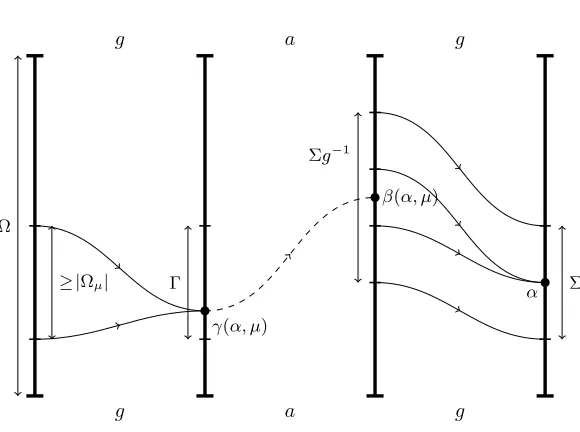
for all μ < κand Ω = μ<κΩμ. Let Σ be a moiety of {α∈Ω : |αg−1| ≥κ}, let {β(α, μ)∈Ω :μ < κ} ⊆αg−1for allα∈Σ, whereβ(α, μ)=β(α, ν) if μ=ν, and let Σ =α∈Σ{β(α, μ)∈Ω :μ < κ}.
We next show that there exists a moiety Γ of Ω such that |{α∈Γ : |αg−1| ≥ μ}|= |Ω| for allμ < |Ω|. In fact, if Ω is arbitrarily partitioned into moieties Γ1 and Γ2, then one or the other of these sets has the required property. To see this, suppose that there existsν <|Ω| such that|{α∈Γ1:|αg−1| ≥ν}|<|Ω|. Ifμ is a cardinal such thatν ≤μ <|Ω|, thenk(g, μ) =|{α∈Ω :|αg−1| ≥μ}|=|Ω|.But
{α∈Ω :|αg−1| ≥μ}={α∈Γ1:|αg−1| ≥μ} ∪ {α∈Γ2:|αg−1| ≥μ} and so|{α∈Γ2:|αg−1| ≥μ}|=|Ω|. So we now fix Γ with the above property.
Assume that Σ×κis well-ordered. We define, by transfinite recursion, distinct γ(α, μ) ∈ Γ such that |γ(α, μ)g−1| ≥ |Ω
μ| for all (α, μ) ∈ Σ×κ as follows. Let
(α, μ)∈Σ×κand let
Γ ={γ(β, ν) : (β, ν)<(α, μ)}.
Then |{γ ∈ Γ : |γg−1| ≥ |Ω
μ|}| = |Ω| and |Γ| < |Σ×κ| = |Ω|. So, we may
chooseγ(α, μ) to be any element in the set{γ∈Γ\Γ:|γg−1| ≥ |Ω
μ|}which is of
cardinality|Ω|.
Since Γ and Σ are moieties, there existsa∈Sym(Ω) such that
(γ(α, μ))a=β(α, μ)
for all (α, μ)∈Σ×κ. Therefore, for anyα∈Σ,
α(gag)−1⊇
μ<κ
β(α, μ)a−1g−1=
μ<κ
Ω
≥|Ωμ| Γ
Σg−1
Σ
g g
a a
g g
γ(α, μ)
β(α, μ)
[image:15.612.161.451.106.322.2]α
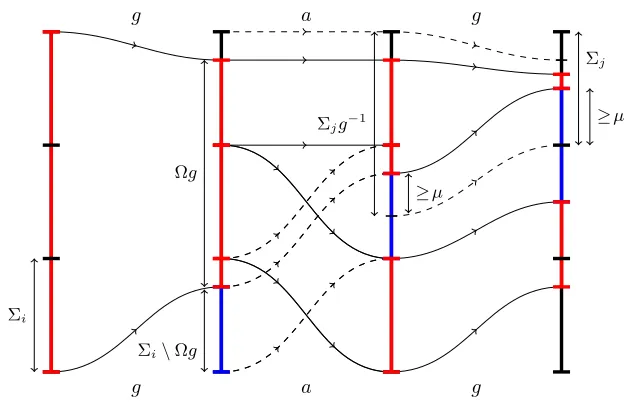
Figure 1. The compositegagin the proof of Lemma 6.2.
and so|α(gag)−1| ≥ |
μ<κΩμ|=|Ω|; see Figure 1. Since|Σ|=|Ω|, it follows that
k(gag,|Ω|) =|Ω|, as required.
Theorem A (Gavrilov [11], Pinsker [24]). Let Ω be any infinite set. If |Ω| is a regular cardinal, then the maximal subsemigroups ofΩΩcontainingSym(Ω) are:
S1={f ∈ΩΩ:c(f) = 0 ord(f)>0}, S2={f ∈ΩΩ:c(f)>0 ord(f) = 0},
S3(μ) ={f ∈ΩΩ:c(f)< μor d(f)≥μ}, S4(μ) ={f ∈ΩΩ:c(f)≥μor d(f)< μ},
S5={f ∈ΩΩ:k(f,|Ω|)<|Ω|},
whereμ is any infinite cardinal not greater than|Ω|.
If |Ω| is a singular cardinal, then the maximal subsemigroups of ΩΩ containing Sym(Ω) areS1,S2,S3(μ),S4(μ) whereμ is any infinite cardinal not greater than |Ω|, and
S5 ={f ∈Ω Ω
: (∃ν <|Ω|) (k(f, ν)<|Ω|)}.
If Ω is any infinite set, then Lemma 5.4 can be used to show thatS1,S2,S3(μ), andS4(μ) are semigroups for all infiniteμ≤ |Ω|. In particular, parts (ii), (iii), and (iv) show this for S1; (ii), (iv), (v) show this for S2; (ii), (iv), (vi) show this for S3(μ); and (ii), (iv), (vii) show this forS4(μ). It is also straightforward to verify that none ofS1,S2, S3(μ), S4(ν), withμ, ν ≤ |Ω|infinite cardinals, are contained in any of the others.
To show that S5 is a semigroup in the case that |Ω| is a singular cardinal, let f, g∈S5. Then there exists μ, ν <|Ω|such thatk(f, μ)<|Ω|andk(g, ν)<|Ω|. Let κ= max{μ, ν}. Ifκ+denotes the successor ofκ, thenκ+<|Ω|since|Ω|is singular. Sincek(f, κ+), k(g, κ+)<|Ω| andκ+ is regular, it follows, by Lemma 5.4(i), that k(f g, κ+)≤k(f, κ+) +k(g, κ+)<|Ω|. Hencef g∈S
5 andS5 is a semigroup. We require Lemmas 6.3 and 6.4 below to complete the proof of Theorem A. They are stated in far greater generality than required in this section because we will use them again in later sections.
Ifa∈Sym(Ω), then we denote the set {α∈Ω :αa=α} by supp(a) and refer to this set as thesupport ofa.
Lemma 6.3. Let U be a subset ofΩΩ, which is not contained in S
2 orS4(μ)for
any infinite μ≤ |Ω|, let Λ be any assignment of transversals for U (as defined in Definition 5.2), and let κ be any cardinal such that ℵ0 ≤κ ≤ |Ω|. If U contains
an injectivef and every a∈Sym(Ω)with supp(a)⊆Ωf and |supp(a)|< κ, then there exists an injective f∗∈ C(U,Λ) such thatd(f∗)≥κandΩf∗⊆Ωf.
Proof. We prove by transfinite induction that for each cardinalμ≤κ, (2)
there existsfμ∈ C(U,Λ) such thatfμ is injective,d(fμ)≥μ, and Ωfμ ⊆Ωf.
If there existsfμ ∈ C(U,Λ) such thatfμ is injective andd(fμ)≥μ, then, since fμ
and f are injective, fμf ∈ C(U,Λ), fμf is injective, d(fμf) = d(fμ) +d(f) ≥ μ
and Ωfμ ⊆Ωf; i.e. (2) holds for fμf. Hence it suffices to show that there exists fμ ∈ C(U,Λ) such thatfμ is injective andd(fμ)≥μ.
Since U ⊆S2, there exists an injectiveh0 ∈U ⊆ C(U,Λ) such that d(h0)>0. Sinceh0 is injective,hn0 belongs toC(U,Λ) and, by Lemma 5.4(iii),d(hn0)≥nfor alln∈N. Thus (2) holds for all finiteμ.
Let μ be any cardinal such that ℵ0 ≤ μ ≤ κ and assume that (2) holds for every cardinal strictly less than μ. Since U ⊆ S4(μ), there exists h1 ∈ U such that c(h1) < μ ≤ d(h1). By our inductive hypothesis, there exists an injective fc(h1) ∈ C(U,Λ) such that d(fc(h1)) ≥ c(h1) and Ωfc(h1) ⊆ Ωf. Since fc(h1) is
injective,|(Ω\Ωfc(h1))fc(h1)|=|Ω\Ωfc(h1)|and so
|Ω\Ωfc(h1)|=|(Ω\Ωfc(h1))fc(h1)|=|Ωfc(h1)\Ωf
2
c(h1)| ≤ |Ωf \Ωf
2
c(h1)|.
It follows that
|Ωfc2(h1)\Λ(h1)| ≤ |Ω\Λ(h1)|=c(h1)≤d(fc(h1)) =|Ω\Ωfc(h1)| ≤ |Ωf\Ωf
2
c(h1)|.
Thus there isa∈Sym(Ω) such that
Ωfc2(h1)\Λ(h1)a⊆Ωf \Ωfc2(h1)
and supp(a) ⊆Ωfc2(h1)\Λ(h1)∪Ωfc2(h1)\Λ(h1)a; see Figure 2. Hence, since Ωfc(h1)⊆Ωf, it follows that supp(a)⊆ Ωf and
|supp(a)| ≤2|Ωfc2(h1)\Λ(h1)| ≤2|Ω\Λ(h1)|< μ≤κ.
In particular,a, a−1∈U.
From the definition ofa, it follows that
Ωfc2(h1)\Λ(h1)⊆
Ωf\Ωfc2(h1)
Ω
Ωfc(h2 1) Ωfc(h2 1)
c(h1)≤
c(h1)
Λ(h1)
≥μ
Ωh1
Ωf
f2
c(h1)
f2
c(h1)
a−1 a−1
[image:17.612.156.457.120.327.2]h1 h1
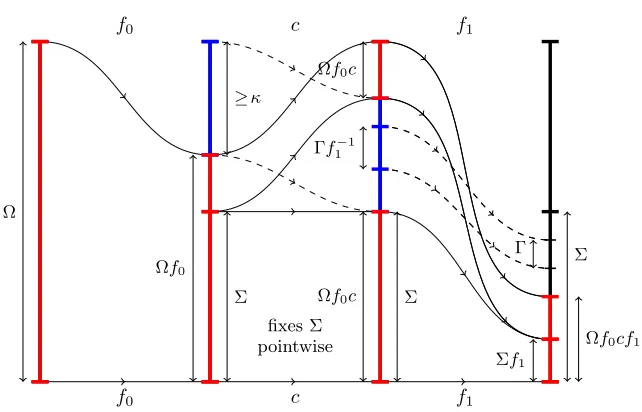
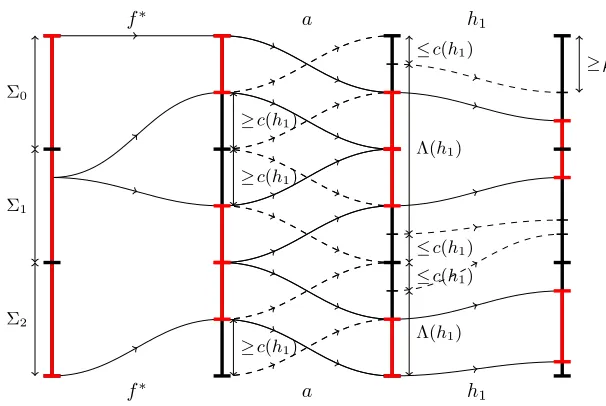
Figure 2. The compositionf2
c(h1)a
−1
h1 from the proof of Lemma 6.3.
and so Ωfc2(h1)a−1 ⊆Λ(h1); see Figure 2. This shows that fc2(h1)a−1h1 ∈ C(U,Λ) is injective, and d(fc2(h1)a−1h1) ≥ d(h1) ≥ μ by Lemma 5.4(ii). It follows that fμ :=fc2(h1)a−1h1∈ C(U,Λ), and so (2) holds forμ.
Lemma 6.4. Let U be a subset ofΩΩ which is not contained in S1 or S3(μ)for
any infiniteμ≤ |Ω|, and letκbe any cardinal such thatℵ0≤κ≤ |Ω|. If there exist
a surjectiveg∈U and a transversalΓof gsuch thatU contains everya∈Sym(Ω)
withsupp(a)⊆Γand|supp(a)|< κ, then there existsg∗∈ Usuch thatc(g∗)≥κ
andΓg∗= Ω.
Proof. Letg ∈ΩΩ be any inverse for g such that Ωg = Γ and let u ∈ΩΩbe an arbitrary inverse for ufor all u∈ U \ {g}. We denote {u ∈ΩΩ : u∈ U} by U and we set Λ :U → P(Ω) to be the assignment of transversals for U defined by Λ(u) = Ωu. Recall thatc(u) =d(u) andd(u) =c(u) for allu∈U.
We prove that U, g, and Λ satisfy the conditions of Lemma 6.3. Since U ⊆ S1, U ⊆ S3(μ), it follows that U ⊆ S2 and U ⊆ S4(μ) for all infinite μ ≤ κ. Since g is surjective, g is injective and by assumption Ωg = Γ. In particular, U contains every a = a−1 ∈ Sym(Ω) where supp(a) ⊆ Ωg and |supp(a)| ≤ κ. Thus by Lemma 6.3 there exists an injective f∗ ∈ C(U,Λ) such that d(f∗) ≥κ and Ωf∗ ⊆ Ωg. By Corollary 5.3, U contains an inverse g∗ of f∗. Therefore c(g∗) =d(f∗)≥κand Ωf∗⊆Γ is a transversal ofg∗, and in particular Γg∗= Ω.
|Ω|
|Ω|
|Ω|
Γ
Γa Σ
h0 h0
a a
g g
[image:18.612.165.451.120.321.2].. .
Figure 3. The compositeh0agin the proof of Theorem A.
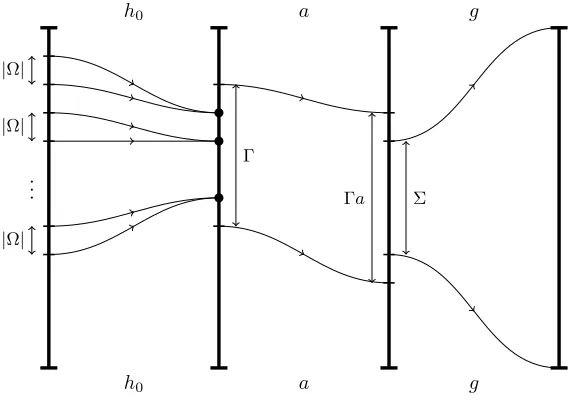
k(h,|Ω|) =|Ω|. SinceM ⊆S5, there existsh0∈M such thatk(h0,|Ω|) =|Ω|. Let Γ ={α∈Ω :|αh−01|=|Ω|}. Then|Γ|=|Ω|. Leta∈Sym(Ω) be any element such that Γa contains a transversal Σ ofg. So, ifα∈Ω, then there exists β ∈Σ such that βg =αand soα(h0ag)−1 =αg−1a−1h−01 ⊇βa−1h−
1
0 . Butβa−1∈Γ and so |βa−1
h−01|=|Ω|. Thus|α(h0ag)−1|=|Ω|and, sinceα∈Ω was arbitrary, it follows thath0ag is surjective andk(h0ag,|Ω|) =|Ω|. So the proof is concluded by setting h=h0ag; see Figure 3.
If|Ω|is regular, then from the above eitherM is contained in one ofS1,S2,S3(μ), S4(μ), orS5 or M = ΩΩ. It then follows that if M is a maximal subsemigroup of ΩΩcontaining Sym(Ω), then M equals one ofS1,S2, S3(μ), S4(μ), or S5. On the other hand, ifM is one of the semigroupsS1,S2, S3(μ), S4(μ), orS5, then, since none of these semigroups are contained in any other, it follows thatM is a maximal subsemigroup of ΩΩ.
Suppose that|Ω|is singular. IfM is not contained in any of the semigroupsS1, S2,S3(μ),S4(μ), orS5, then, by Lemma 6.2,M is also not contained inS5and so, from the above, M = ΩΩ. Hence as in the case that |Ω| is regular, it follows that M is a maximal subsemigroup of ΩΩif and only if M equals one ofS1,S2,S3(μ),
S4(μ), orS5.
7. Pointwise stabilisers of finite sets – The proof of Theorem B
In this section we prove Theorem B.
Theorem B. Let Ω be any infinite set and let Σ be a non-empty finite subset
of Ω. Then the maximal subsemigroups of ΩΩ containing the pointwise stabiliser
Sym(Ω)(Σ) but not Sym(Ω)are: