Two Key Steps in the Evolution of
Human Cooperation
The Interdependence Hypothesis
by Michael Tomasello, Alicia P. Melis, Claudio Tennie,
Emily Wyman, and Esther Herrmann
Modern theories of the evolution of human cooperation focus mainly on altruism. In contrast, we propose that humans’ species-unique forms of cooperation—as well as their species-unique forms of cognition, communication, and social life—all derive from mutualistic collaboration (with social selection against cheaters). In a first step, humans became obligate collaborative foragers such that individuals were interdependent with one another and so had a direct interest in the well-being of their partners. In this context, they evolved new skills and motivations for collaboration not possessed by other great apes (joint intentionality), and they helped their potential partners (and avoided cheaters). In a second step, these new collaborative skills and motivations were scaled up to group life in general, as modern humans faced competition from other groups. As part of this new group-mindedness, they created cultural conventions, norms, and institutions (all characterized by collective intentionality), with knowledge of a specific set of these marking individuals as members of a particular cultural group. Human cognition and sociality thus became ever more collaborative and altruistic as human individuals became ever more interdependent.
As compared with other primates, human beings are inor-dinately cooperative, especially with nonrelatives. As is well known since Darwin, this creates challenges for evolutionary explanation, since in modern evolutionary theory, cooperative behavior must always be grounded in the individual and in-clusive fitness of the cooperator.
In this modern context, there are two main theories of the evolution of human cooperation, both of which focus on the most difficult theoretical problem from the point of view of evolutionary theory: altruism. The first theory comes from evolutionary psychology and is often called the Big Mistake Hypothesis (e.g., Burnham and Johnson 2005). The basic idea is that human altruistic tendencies evolved at a time when humans lived in small groups, comprised mostly of kin. In this setting, altruistic acts would either (a) benefit kin, and so evolve due to kin selection, or else (b) benefit the altruist by enhancing in some way her chances for reciprocity, which is especially critical in small groups in which reputational assessment among familiar interactants is constant. In the modern world, even in the midst of strangers or even when not being observed by others at all, humans nevertheless have
Michael Tomasello is Codirector and Alicia Melis, Claudio Tennie, Emily Wyman, and Esther Herrmann are postdoctoral associates at the Max Planck Institute for Evolutionary Anthropology (Deutscher Platz 6, D-04103 Leipzig, Germany [[email protected]]). This paper was submitted 9 II 11 and accepted 3 IX 11.
some tendency toward altruism (and antipathy toward cheat-ers) because the proximate mechanism operates as if the an-cient, small-group conditions still held.
The second theory is the Cultural Group Selection Hy-pothesis (e.g., Henrich and Henrich 2007; Richerson and Boyd 2005), and it focuses on a later stage in human evolution characterized by larger social groups. The basic idea is that social groups with more altruists will, for various reasons, outcompete other groups. The difference from previous group selection hypotheses is that the main transmission across gen-erations takes place not genetically but culturally. For other reasons, modern humans are built to imitate others (e.g., successful others or the majority), and so if a group has al-truists, others will often imitate them, and that will lead to group success. As groups become larger in scale, those that create social norms and institutions that better promote al-truism will again thrive relative to others. No biological ad-aptations for altruism are necessarily involved here, but the theory does allow for later gene-culture coevolution in which individuals biologically adapt to life in a culture characterized by conformist social transmission, group punishment and norms, and group competition.
some point humans created lifeways in which collaborating with others was necessary for survival and procreation (and cheating was controlled by partner choice). This situation of interdependence led inevitably to altruism, as individuals nat-urally wanted to help the collaborative partners on whom they depended for, for example, foraging success. Moreover, interdependent collaboration also helps to explain humans’ unique forms of cognition and social organization, since it is collaboration, not altruism, that creates the many coordina-tion problems that arise as individuals attempt to put their heads together in acts of shared intentionality1to create and
maintain the complex technologies, symbol systems, and cul-tural institutions of modern human societies.
Our evolutionary story comprises two distinct steps, the first focusing on small-scale contexts (though we focus on aspects different from the Big Mistake Hypothesis) and the second focusing on group-level contexts (though we focus on aspects different from the Cultural Group Selection Hypoth-esis). First, small-scale collaboration involving cognitively complex coordination problems took place initially, we will argue, in the context of collaborative foraging. Although hu-mans’ more stable reproductive bonds (Chapais 2008) and cooperative breeding (Hrdy 2009) clearly played an important role in establishing the motivational and emotional founda-tions, the cognitive dimension of human cooperation evolved in contexts in which, in order to acquire food, individuals had to create together various coordination strategies (often involving technologies), which they then could communicate cooperatively to others within and across generations (Ster-elny 2012). Second, group-level collaboration followed as the entire social group needed to work together interdependently in order to compete with other social groups, leading to such things as group-created conventions, norms, and institutions. This step was undoubtedly followed by something like cultural group selection, but cultural group selection explains why the particular social norms and institutions of particular cultural groups have prevailed, and this assumes species-universal skills and motivations—such as those we will posit—for cre-ating social norms and institutions in the first place.
In support of our hypotheses, we focus on two sources of evidence not common in anthropology. First, we invoke ex-perimental studies, many from our own laboratory, that com-pare the cognitive and motivational skills of humans, mostly young children, and their nearest great ape relatives (as rep-resentative, in a very general way, of the last common an-cestor). We show that even young children are adapted for collaborative activities in a way that other great apes are not. Second, we also in some cases invoke human ontogenetic
1. Here we use the term “shared intentionality” to refer to collaborative phenomena in general. We use the term “joint intentionality” for the ad hoc, temporary collaborations characteristic of, e.g., foraging parties (step 1 of our story) and the term “collective intentionality” for the more impersonal yet permanent group-minded practices and modes of col-laboration that characterize cultural groups as a whole (step 2 of our story).
sequences as suggestive of potential phylogenetic sequences, for example, that young children in fact (and possibly of logical necessity) learn to collaborate with other individuals in concrete situations before they construct more abstract group-level phenomena such as social norms and institutions. We invoke observations of modern foragers and some paleo-anthropological data, as is more customary in evolutionary theorizing, in a few places as well.
First Step: Obligate Collaborative Foraging
The central challenge of social life is often presented as a Prisoner’s Dilemma in which the individual must choose be-tween its own well-being and that of the group. But the Pris-oner’s Dilemma arises only in very special circumstances, and it does indeed tend to block cooperation. A better model for real-life cooperation is the Stag Hunt (Skyrms 2004). Stag Hunt situations are those in which (i) individuals must col-laborate with others to benefit, (ii) the benefits of the collab-oration are greater than those of any solo alternatives, and (iii) all solo alternatives must be forsaken (risked) in order to collaborate. In the classic parable, I am hunting alone for hares when I spy a stag—which is much better food but which I cannot capture alone. You are in exactly the same situation, and so it is in both our interests to drop our pursuit of hares and collaborate to capture the stag and then share the spoils. (This general scenario can easily be extended to other foraging activities, including many gathering activities such as pro-curing honey collaboratively.)
Human collaborative foraging first occurred, we hypoth-esize, in Stag Hunt–type situations in which all participants had alternatives but anticipated an even greater benefit from successful capturing of the stag (see Alvard 2012). Although much of the foraging of contemporary hunter-gatherers is only loosely collaborative, this is very likely because modern foragers have the kinds of projectile weapons that enable in-dividuals to be successful (from a safe distance) where pre-viously only small groups of individuals working together could attain foraging success (and contemporary foragers also see themselves as part of a group, as in our step 2 [see below], and so bring the bounty back to the home base for sharing). In stark contrast, nonhuman great apes—and so, by hypoth-esis, the last common ancestor—were and are almost exclu-sively individual foragers. Chimpanzees and bonobos may search for food in small social groups, but when they find food, each individual procures and consumes it on its own (with sharing only under special circumstances). They do not extract or otherwise obtain food by working collaboratively with others, nor do they, as humans do, bring food back to some central location to provision others.
a red colobus monkey somewhat separated from its group, and they proceed to surround and capture it (normally one individual begins the chase and others scramble to the mon-key’s possible escape routes). One individual actually captures the monkey, but all participants usually end up getting at least some meat. Chimpanzee group hunting can be reasonably modeled as a Stag Hunt situation, since it is difficult for individuals to capture monkeys on their own, and they always have other, less exciting alternative foods potentially available. If the many collaborative foraging activities of humans and the one collaborative foraging activity of great apes represent Stag Hunt–type situations, we may compare humans and their nearest great ape relatives in terms of their proximate mech-anisms, both cognitive and motivational, for operating in such situations. We may best do this by telling a very general evo-lutionary story (supported by comparative experimental data) about how humans developed new strategies to meet the three main challenges to Stag Hunt collaboration as an evolution-arily stable subsistence strategy:
a) Sharing the spoils: individuals had to find some way to
divide the spoils at the end of the collaboration such that there was no destructive fighting and such that everyone was incentivized for future stag hunting.
b) Coordination: individuals had to find some way to make
a confidence-inspiring “group decision” about whether to go for the stag, given that each of them had to relinquish their “hare in the hand” to do so.
c) Temptations to free ride: individuals had to solve the
problem that if there were more people present than were needed to capture the stag (but all could eat), then everyone had an incentive to let the others do the hard and risky work of stag killing—resulting in inaction from everyone.
In their group hunting of monkeys, chimpanzees have ways of meeting all three of these challenges. But humans have come to meet them in some demonstrably different ways, using species-unique proximate mechanisms.
Sharing the Spoils
Chimpanzees, like most primates, are mostly herbivorous (and insectivorous). They forage in small social parties mainly for ripe fruit and some insects, consuming other vegetation as backup. When the party finds a patch of fruit, typically everyone gets some by scrambling, which works well because the fruit is at least moderately spread out in the tree or on the ground. If they encounter monopolizable food, the en-suing contest-competition will go to the dominant individual in typical mammalian fashion.
The consequences of this way of doing business for col-laboration may be clearly seen in a recent experiment. Melis, Hare, and Tomasello (2006b) presented pairs of chimpanzees with out-of-reach food on a platform that could be obtained only if both individuals pulled simultaneously on the two ends of a rope. When there were two piles of food, one in front of each individual, the pair often collaborated
success-fully. However, when there was only one pile of food in the middle of the platform, pulling it in often resulted in the dominant individual monopolizing all of the food. This nat-urally demotivated the subordinate for future collaboration with this individual, and so cooperation fell apart over trials. Chimpanzees’ predominant solution to food competition in general, namely, dominance, tends to destabilize collaborative foraging over time.
So why does not dominance undermine chimpanzees’ group hunting of monkeys? The answer is twofold. First, dom-inant chimpanzees do not normally take small parcels of food away from subordinates who already have it in their grasp. So if the captor of the monkey is subordinate, he nevertheless is typically able to eat his fill. Second, even if the captor is dominant, he cannot monopolize the carcass himself because it is too big. As with social carnivores like lions and wolves, trying to protect a large carcass with other hungry individuals approaching is a losing battle. After the kill, noncaptors harass the captor (no matter his dominance) and obtain pieces of meat from the too-big-to-monopolize carcass, with those who harass most getting the most meat (Gilby 2006). Although there is some favoritism in “meat sharing” toward coalitionary partners (Mitani and Watts 2001), the most important factor in noncaptors’ obtaining of meat is, not surprisingly, domi-nance (Boesch 1994).
Humans share their spoils differently. Contemporary hunter-gatherers routinely share the spoils of their collabo-rative foraging on the scene, without harassment, and large packets of food are almost always brought back to some cen-tral location and shared with nonparticipants (Gurven 2004). Different cultural groups may do this differently, and it may work differently with particular resources, but there are no human groups who behave like other great apes in simply scrambling for food competitively in most situations, with dominants taking all that they can regardless of others. And unlike great apes, humans actively provision their children with food for many years, with human children being well into their teens in most cases before they actually pull their own weight (Hill 1993).
But it is not until the second step of our account (in the section “Second Step: Group-Mindedness”) that we include such things as group-wide social norms of fairness and the like, and so for now, a better representative of the human species would be children—before they have become fully normative beings. Nevertheless, even without internalized norms, human children are more generous with valued re-sources than are their great ape relatives. In one fairly direct comparison, both Silk et al. (2005) and Jensen et al. (2006) found that when pulling in food for themselves, chimpanzees did not care whether this also resulted in a companion getting food. In contrast, Brownell, Svetlova, and Nichols (2009) found that even 2-year-old children—well before they self-govern through social norms—chose to pull food to them-selves more often when that also meant food for their com-panion. Chimpanzees will in some situations help others gain access to food (Melis et al. 2011b; Warneken et al. 2007), but only if the helper has no possibility of obtaining the food herself.
Perhaps of most importance for the current account, hu-man children share the spoils after collaboration in species-unique ways. Thus, Warneken et al. (2011) presented pairs of 3-year-old children with the same task presented to chim-panzees by Melis, Hare, and Tomasello (2006b): a board they had to pull in together, with food either (i) predivided on the two ends of the board or (ii) clumped in the middle. Unlike the apes, children collaborated readily in both of these situations. Even more striking, in a direct comparison of spe-cies, Hamann, Warneken, and Tomasello (2011) found that 3-year-old children shared resources more equitably if those resources resulted from their collaborative efforts, rather than from parallel work or no work at all, whereas chimpanzees “shared” (allowed the other to take) to the same degree (and infrequently) no matter how the spoils were produced (see also Melis, Schneider, and Tomasello 2011a).
How might we account for an evolutionary transition from the way that other great apes treat food to the way that hu-mans treat food—especially after a collaboration? One es-pecially plausible transitional context is scavenging. Thus, as the genus Homo was emerging some 2 million years ago, a global cooling and drying trend created an expansion of open environments and a radiation in terrestrial monkeys, who would have competed with Homo for many plant foods. Scav-enging large carcasses killed by other animals would have been one possible response. Such scavenging would have required multiple participants, as other carnivores would be competing for those carcasses as well.
Individuals would be especially well suited for scavenging if they were tolerant of conspecifics cofeeding on a carcass with them. An important finding in this regard is that when experimenters pair together chimpanzee individuals who are especially tolerant with one another in the context of food (established by an independent food tolerance test), they are much more likely to collaborate successfully and share the spoils at the end than are intolerant partners (Melis, Hare,
and Tomasello 2006b). And bonobos show both more tol-erance around food and more cooperation in obtaining and sharing monopolizable food than do chimpanzees (Hare et al. 2007). These findings suggest that variation in tolerance around food among individuals of the last common ancestor to Homo and Pan might have served as the raw material on which natural selection worked on the way to a species that actively shared the spoils of collaboration (Hare and Toma-sello 2005).
It is also likely that at some point, individuals who at-tempted to hog all of the food at a scavenged carcass would be actively repelled by others and perhaps shunned in other ways as well—a first step toward what Boehm (2001) calls “counter-dominance.” Chimpanzees already engage in social selection of collaborative partners, preferentially choosing a partner with whom they have had success over one with whom they have previously had difficulties (Melis, Hare, and Tomasello 2006a). Scavenging Homo would thus have already had a tendency to avoid dominants who tried to monopolize the carcass. Moreover, a small coalition attacking a greedy dominant to drive him away would have been a simple ex-tension from driving other species away from the carcass (and of course chimpanzees already form small social coalitions in intragroup conflicts). The outcome of socially selecting against dominants is of course that good cooperators get se-lected “for” by being chosen more often as collaborative part-ners.
As humans became ever more dependent on collaborative foraging—and so ever more interdependent with others in the social group—additional factors contributed to their ten-dency to share resources with others relatively generously and even fairly. But for now, we are interested only in the early steps (perhaps in combination with cooperative breeding), and our proposal is that in the context of scavenging, the individuals who did best were those who (1) were tolerant of others peacefully cofeeding on the same carcass and (2) did not attempt to hog the spoils and so be socially selected against by others for selfish behavior.
Coordination
some meat), and then the others go to places where they expect to maximize their chances of capturing the fleeing monkey, which also increases the group’s chances as an un-intentional by-product (Tomasello 2008; Tomasello et al. 2005).
It is not that each chimpanzee is scrambling for the monkey on its own, ignoring the others. In deciding what to do, each participant takes into account the position of the others and their behavior and how these might influence the monkey’s flight. The coordination is therefore an emergent property generated by individual decision making not aimed at that coordination. Thus, Melis, Hare, and Tomasello (2006a) found that in situations in which a chimpanzee could pull in a board with food by itself, that is what it did (in preference to opening a door for a potential partner). But if pulling in the board required two individuals, then they would either wait for their partner or even open a door for the other to join. The chimpanzees were mainly interested in their own acquisition of food, but they understood when they needed a partner for success. Similarly, Bullinger, Melis, and Toma-sello (2011a) and Rekers, Haun, and TomaToma-sello (2011) found that when chimpanzees were given the choice to obtain food by collaborating with a partner or acting alone, they most often chose to act alone, whereas human children most often chose to collaborate.
Nevertheless, even though chimpanzees will go and open a door for a necessary partner, they do not actively com-municate about the collaboration much or at all. In the wild, chimpanzees do vocalize their excitement at various points throughout the hunt. But chimpanzee vocalizations, as vir-tually all primate vocalizations, are mostly hardwired to par-ticular stimulus and motivational states, so what is being ex-pressed is general excitement (with the same vocalizations used when excited about other things) and not anything about the content of what is happening or what the vocalizer wants to happen. There are no reported vocalizations (or gestures) specifically associated with hunting or coordination. Indeed, in the laboratory, several investigators have reported a striking lack of communication among chimpanzees as they engage in collaborative tasks (e.g., Melis, Hare, and Tomasello 2009; Povinelli and O’Neil 2000), including in tasks in which they had previously communicated with humans (Hirata and Fuwa 2007).
This overall picture may be clearly seen in a recent exper-iment constructed as a Stag Hunt for pairs of chimpanzees (Bullinger et al. 2011b). Each individual had access to a less preferred “hare” food, which she would lose for good if she left it. Then a highly preferred “stag” food appeared that required the pair to work together for access (which they knew from previous experience). Because of the risk involved, communicating with the partner, or at least checking on the partner before forsaking the hare in hand, would seem to be called for. But what chimpanzees did in this situation was almost always bolt for the stag (90% of the time when a partner was present) without communicating or checking,
presumably optimistic that the partner would be coming also (leader-follower strategy). They did this even in a condition in which they could not see what the partner was doing unless they looked around a barrier (which they did not do). If an individual arrived at the stag first, she sometimes banged on things to induce the other to join her, but there was no com-munication or systematic checking of the partner ahead of time as a way of coordinating their decisions.
Humans, in contrast, coordinate and communicate about their decision making in such situations to form a joint goal. To form a joint goal, we must know together that each of us has the goal of working with the other (Bratman 1992). Know-ing together means engagKnow-ing in some form of recursive mind reading (we each know that the other knows, etc.), which is the basic cognitive ability that enables humans to engage in all forms of joint and collective intentionality (Tomasello 2008, 2009), including joint attention, common conceptual ground, and all “public” knowledge and activities. And once they have formed a joint goal, humans are committed to it. Thus, when their collaborative partner stops interacting with them, even 18-month-old infants expect her to be committed, and so they attempt in various ways to reengage her—as opposed to human-raised chimpanzees, who do not (War-neken, Chen, and Tomasello 2006). Slightly older children understand and respect their own commitment, such that they keep pursuing the joint goal until both partners have received their reward even if they have already received theirs (Ha-mann, Warneken, and Tomasello 2012)—which, again, is not true of chimpanzees (Greenberg et al. 2010). And when 3-year-olds need to break away from a joint commitment with a partner, they even “take leave” through some form of im-plicit or exim-plicit communication—as a way of acknowledging and asking to be excused for breaking the commitment (Gra¨-fenhain et al. 2009).
institutions with their publicly created joint goals and indi-vidual roles that can in principle be filled by anyone.
This brings us again to the evolutionary question. How did early humans move from a chimpanzee mode of initiating and coordinating Stag Hunt activities—based either on a leader-follower strategy or on a kind of naive optimism about the other’s actions—to the modern human mode in which individuals coordinate their decision making through some kind of implicit or explicit communication, resulting in a joint commitment to follow through until everyone gets their re-ward, with a coordination of interchangeable, agent-neutral roles?
The main thing to note is that, given the normal feeding ecology of chimpanzees, their approach to Stag Hunt situa-tions makes immanently good sense—and indeed is success-ful. Their main food sources are fruits and other vegetation, and monkeys are an addition. A chimpanzee on its way to a fig tree is sacrificing only a small amount of time and energy to participate in an unsuccessful monkey hunt.2With humans,
the hypothesis is that at some point their scavenging turned into active collaborative hunting and gathering (perhaps with the emergence of Homo heidelbergensis some 800 kya (thou-sand years ago; Dubreuil 2010), with evidence for bringing large prey back to a home base from at least 400–200 kya (Stiner, Barkai, and Gopher 2009). The key point in the tran-sition from chimpanzees, from a psychological point of view, would have been when the decision making became more challenging, in particular when the risk became such that just optimistically leaving the hare in hand (as chimpanzees seem-ingly do) was no longer an effective strategy. That is to say, the situation was such that giving up the hare was no longer so cheap that one should just go for the stag without at-tempting to coordinate decisions with other potential hunters. As in the case of sharing the spoils, social selection based on reputation almost certainly played a role in all of this as well—but in this case, not for individuals who were tolerant around food and fair at sharing the spoils but rather for competent coordinators and communicators who would in-crease the likelihood of success. Clearly, humans’ skills of coordination and communication increased continuously af-ter their initial emergence—from pointing and pantomiming to conventional languages—and the hypothesis is simply that better coordinators and communicators were chosen as col-laborative partners more often. In general, as humans went from more passive scavenging to more active collaborative foraging, they were faced with ever more challenging coor-dination situations and decisions, and this provided the se-lective context for the evolution of ever greater skills of co-ordination and communication.
2. This may help to explain the surprising fact that chimpanzees hunt more frequently for monkeys in the rainy season, when their fruit and other options are actually more plentiful (perhaps because the cost of unsuccessful monkey hunting is lower; Watts and Mitani 2002).
Temptations to Free Ride
In Stag Hunt situations with no excess of labor available (all individuals present are needed for success), free riding is not possible: if I do not participate, then I (and everyone else) get nothing. The proposal is thus that the earliest manifes-tations of human collaborative foraging were not so vulner-able to free riding because they involved very small numbers of collaborators, each of whom believed their participation to be necessary. Interestingly, contemporary children seem to have virtually no interest in free riding, as participating in collaborations seems to be rewarding in itself (Gra¨fenhain et al. 2009).
So how does it work in chimpanzee hunting of monkeys, when there are often excess participants around? As noted above, the main factor in acquiring meat in chimpanzee hunts is being the captor. But, in addition, Boesch (1994) reports that individuals get more meat when they are actually in the hunt than if they are either bystanders or latecomers to the party—suggesting the possibility that meat is divided based on participation. But bystanders still get plenty of meat (83% of bystanders in Taı¨ get at least some meat), and they get more than latecomers. This suggests that the main variable in obtaining meat is proximity to the kill at the key moment, with the captor getting most, those in the immediate vicinity getting next most, and latecomers getting least—a hypothesis receiving strong support from a recent experiment (Melis et al. 2011b). Boesch also reports that of the hunters who are not captors, the one who obtains the most meat is the one who best anticipates the monkey’s escape route—but they tend to be both close to the kill site and also older individuals who command more meat in general. Interestingly, in Boesch’s (1994) similar analysis of the hunting of the Gombe chimpanzees, bystanders actually get more meat than hunters. So, overall, hunting chimpanzees would seem to have either no, or very poor, mechanisms for controlling free riders, lead-ing Boesch (1994:660) to ask: “Why do so many individuals cheat, and why are they so readily accepted by hunters?”
this, and so lag a bit). But it also might be because youngsters are typically more impulsive, impatient, and risk prone than are adults.
So what do humans do about free riders? The answer is, of course, social selection by means of reputation. Humans have evolved extremely sensitive cheater-detection mecha-nisms of a type never observed in chimpanzees or other great apes (no studies have investigated apes’ partner choice with respect to free riders)—which lead them not only to shun free riders but sometimes even to punish them (Cosmides 1989). Because everyone knows this to be the case, individuals are very concerned that others not think them to be laggards, and so they have developed a concern for self-reputation, something also never observed in other great apes. Many experiments clearly demonstrate that humans’ concern for their own reputation is an important incentive for coopera-tion in many situacoopera-tions in which free riding would otherwise be beneficial (Milinski, Semmann, and Krambeck 2002). In general, to the degree that collaborative foraging becomes obligate for survival, a reputation as a good collaborative partner becomes obligate as well.
A mechanism related to reputation and self-reputation is punishment. So far we have simply assumed that individuals choose partners with good reputations and avoid those with bad reputations. But there is also the possibility of punishing those who do not cooperate (or rewarding those who do), presumably both to encourage their cooperation on the spot and also to improve their behavior for future collaborations— and indeed such punishment has been shown to be effective in helping to enforce cooperation in various economic games (Boyd 2006). Humans sometimes even mete out third-party punishment against those harming others (when they them-selves are not being harmed), whereas chimpanzees—even though they retaliate against those who harm them directly (Jensen, Call, and Tomasello 2007b)—do not (Riedl et al. 2012).3 When humans are punishing a noncooperator, they
typically experience resentment or moral anger, which goes beyond normal anger because it seems justified.
And so, lagging or free riding would not have been much of a problem for early humans foraging together in pairs or trios, where the participation of all is necessary for success and where lack of participation would be easily noted and count against reputation. When the collaboration is obligate, the stakes are raised to the degree that there may be even competition for partners, and in this case a concern for self-reputation would be especially important. Note that by this point, reputation means both (i) a more motivated collabo-rator who will not cheat either by monopolizing the food or by lagging and (ii) a more skillful collaborator who is better able to form joint goals and coordinate roles. What enables
3. Chimpanzees sometimes intervene in the fights of others (so-called policing; Flack et al. 2006). However, they are not in these interventions punishing particular individuals for bad behavior, but only attempting to keep a dangerous (for them) situation of conflict from escalating.
good collaborators to find one another is thus not reputation for altruism or anything else external, but simply reputation for being a good collaborator—which is, with actual partners and direct observers, impossible to fake.
Interdependence and Altruistic Helping
Helping one’s partner during a mutualistic collaborative ac-tivity pays direct dividends. If my partner has dropped or broken his spear, it is in my interest to help him to find or repair it, as this will improve our chances for success toward our joint goal (and he has no incentive to now suddenly defect, as the mutualistic situation is still operative). Mutu-alistic collaboration thus provides a safe context within which basic tendencies to help others could evolve (see Silk 2009). It is thus not surprising that when Ache foragers are hunting, they do such things for their partners as give them weapons, clear trails for them, carry their child, repair their weapon, instruct them in best techniques, and so on (Hill 2002). In-terestingly, young children, but not chimpanzees, help others more readily in the context of collaborative activities than outside of such activities (Greenberg et al. 2010; Hamann, Warneken, and Tomasello 2012).
But humans help one another outside of collaborative ac-tivities as well. Indeed, in experimental settings, infants as young as 14 months of age will help adults with all kinds of problems, from fetching out-of-reach objects to opening doors to stacking books (Warneken and Tomasello 2006, 2007). Perhaps surprisingly, chimpanzees also help conspe-cifics with their problems in some similar ways (Melis et al. 2011b; Warneken et al. 2007). But humans would seem to do it much more frequently and in a much wider array of con-texts, including actively sharing resources and information more freely (e.g., informing others of things helpfully and even teaching them things; see Warneken and Tomasello 2009 for a review). Why might this be the case?
Our proposal is that obligate collaborative foraging pro-duces interdependence among members of a group, and this interdependence makes it in my direct interest to help others who might be my future partners. If I can acquire food only with the help of a partner, then when potential partners are in trouble, I should help them—even outside of any collab-orative activity. The logic is exactly the same as Hamilton’s equation for kin, as worked out by Roberts (2005) in his Stakeholder model: I should sacrifice to help potential part-ners when
sB1C.
with me in the future.4 To be a bit fanciful, if a particular
individual’s survival will lead to me to be successful in for-aging to the tune of 1.3 more offspring in the future (e.g., because it will help me to live longer), then it will pay for me to sacrifice for her to the tune of 1.2 fewer offspring for me in the future. The same logic holds for many other be-haviors in social groups, of course, so that if an alarm caller benefits my reproductive fitness, I should help her when needed. Clutton-Brock (2002) proposes a generalized version of this mechanism called group augmentation: if my pros-perity depends on my social group (for defense against pred-ators, etc.), then it is in my interest to keep them alive and prosperous as well.
The process is, then, a form of social selection: I help others who do things that benefit me (more than my help costs me). But the scenario we are proposing here is special. It is special because if I have a stake in an alarm caller and so help her, then what I am socially selecting for is better alarm callers (who have keen perception, loud vocalizations, etc.). But when the target domain is collaboration, then what is being socially selected for is good collaborators—who are tolerant of others in cofeeding situations, skillful at coordination and communication, have a tendency to shun or punish free rid-ers, help their partnrid-ers, and so on.
Of course, this account still has a problem of free riding because one can lag on the helping: my highest preference is that someone else help my potential collaborative partner or alarm-calling groupmate so that I do not have to bear the costs. But as Zahavi (2003) points out, the same is true of kin selection: it is in my interest to help my sibling because he shares my genes, but my first preference is that someone else help him so that I do not have to bear the costs. The point is not that interdependence as described by the Stake-holder model solves the problem of altruism but that, using the same logic as kin selection, it changes the math because my selfish benefits depend on the well-being of selected others. Obligate collaborative foraging thus creates a logic of in-terdependence, which leads to the selective helping of those who will be needed as collaborative partners in the future. It is noteworthy that whereas almost all other accounts of the evolution of human altruism rest on one or another form of reciprocity, reciprocity cannot explain uncontingent acts of altruistic helping. The current account, in contrast, does not depend on reciprocity because I am repaid for my altruistic acts not by reciprocated altruistic acts from others, but rather by their later mutualistic collaboration, which costs them nothing (actually benefits them). Indeed, it has recently been demonstrated experimentally that humans will actually com-pete with one another to be more altruistic so that observers
4. The process is thus similar to what has been called pseudoreciprocity (e.g., Bshary and Bergmu¨ller 2008), in which one individual “invests” in another, who does nothing contingent in return but just what she nor-mally would do in such circumstances.
will later choose them to engage in a mutualistic collaboration (Sylwester and Roberts 2010).5
Summary
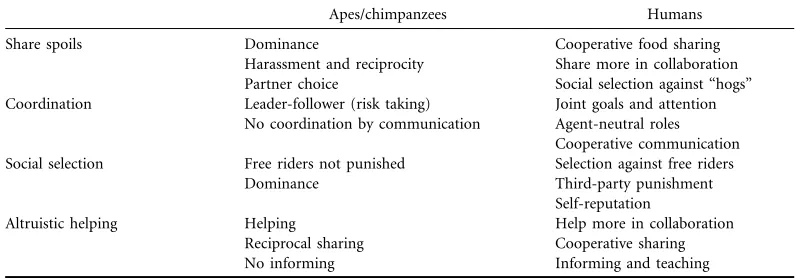
Bonobos, gorillas, and orangutans do not collaboratively for-age at all. Only some chimpanzees do so and then in only one of their many foraging activities. And the data we have presented suggest that when chimpanzees do hunt in small groups for monkeys, they do this with cognitive and moti-vational mechanisms not specifically evolved for the task, that is, they somehow manage to be successful quite often in spite of their tendencies toward dominance in solving food dis-putes. In contrast, humans, as already evident in young chil-dren, have evolved a suite of cognitive and motivational mech-anisms for sharing food cooperatively, coordinating and communicating toward joint goals with complementary roles, and engaging in various kinds of reputation-based social se-lection (including a concern for self-reputation as a coop-erator)—what we have called skills and motivations for joint intentionality. They seem evolved for the task. Table 1 sum-marizes the basic mechanisms involved.
Our evolutionary story so far has been highly selective. As noted at the outset, we have backgrounded the important role of kinship, as humans evolved more stable reproductive bonds (resulting in an increase in male tolerance), which obviously played an important role in the attitudes of individuals toward one another in small groups (Chapais 2008). Further in this context, humans also became cooperative breeders, regularly providing child care for offspring who were not their own, and this clearly would have affected emotions and motivations for collaboration and altruism as well (Hrdy 2009). Most likely, both of these processes played a key role in the earliest stages of the story we are telling here, as humans were be-coming more tolerant with one another around food. But, as also argued at the outset, these kinds of processes, important as they are, would not help us to explain the more cognitive aspects of coordinating and communicating toward joint goals, nor would they explain humans’ tendency to socially select others with regard to their cooperative behaviors. To explain these, we need not just prosocial tendencies, but joint intentional skills and motivations for various kinds of col-laboration.
And so a big first step in the evolution of uniquely human cooperation is one in which the usual suspects—kin selection, sexual selection, direct reciprocity, and indirect reciprocity— play only minor roles. The heroes of our story are (1) mu-tualistic collaboration and the logic of interdependence and (2) social selection based on reputation as a good collaborator.
Table 1. Basic mechanisms used by great apes and humans to solve the main problems of Stag Hunt foraging (step 1)
Apes/chimpanzees Humans Share spoils Dominance Cooperative food sharing
Harassment and reciprocity Share more in collaboration Partner choice Social selection against “hogs” Coordination Leader-follower (risk taking) Joint goals and attention
No coordination by communication Agent-neutral roles Cooperative communication Social selection Free riders not punished Selection against free riders
Dominance Third-party punishment Self-reputation
Altruistic helping Helping Help more in collaboration Reciprocal sharing Cooperative sharing No informing Informing and teaching
But still, the collaboration we are talking about here was only small scale and ad hoc, in the sense that it existed only during the collaboration itself; when the foraging trip was over, so was the special “we” it had engendered. There was still some way to go to get to human large-group cooperation and its complex conventions, norms, and institutions.
Second Step: Group-Mindedness
Small-scale obligate collaborative foraging would seem to be a stable form of cooperation: it is in the enlightened self-interest of individuals to collaborate well with others and to help their collaborative partners. But, apparently, at some point it was not stable, as evidenced by the fact that contem-porary humans possess a whole other level of mechanisms for cooperation, including social conventions, norms (inter-nalized into guilt and shame), and institutions, along with a strong in-group bias. Why did these become necessary?
We think there were two, essentially demographic, factors: population growth within groups, and competition between groups. These factors probably began playing a role with the emergence of behaviorally modern humans. Thus, Foley and Gamble (2009) argue and present evidence (mostly from paleo- and modern genetics) that in the Middle Pleistocene, hominin groups (characteristic of the first step of our story) had relatively small effective population sizes. In contrast, Hill and Hurtado (2009) argue and present evidence that a tran-sition to larger social groups with central-place foraging— and comprising a hierarchical structure in which “bands” coalesce into “tribes” or “societies”—took place basically with modern humans and the advent of behavioral modernity (i.e., at the time of our second step). The result was two new sets of challenges to human cooperators:
Large-group coordination: as groups became larger, at least
partly in competition with other groups, individuals needed to be able to coordinate with relative strangers—while still knowing that they were from within the group (and so had the requisite skills and trustworthiness).
Large-group social selection: as groups became larger, again
due partly to competition with other groups, incentives for cooperation diminished (each individual was less needed, and reputational information was more difficult to obtain; Olson 1965), so free riding—and even active cheating—proliferated and needed to be controlled.
With these large-group processes, we have pretty much left the domain of factors important in the lives of nonhuman great apes. But still, a comparison of humans’ and great apes’ proximate mechanisms for meeting these two challenges is instructive for the question of origins. Also instructive is the fact that human children do not participate in group-minded things such as social norms and institutions until some time after they have learned to collaborate effectively with others in concrete tasks—giving at least some indirect support to our hypothesized evolutionary sequence of collaboration be-fore group-mindedness.
Large-Group Coordination: Cultural Practices and Group Identification
If collaboration is the horizontal dimension of human culture, as adults interact with one another for mutual benefit, then cultural transmission is its vertical dimension, as adults pass along things to children across generations. Cultural trans-mission was very likely an important part of human social life from the beginning of the genus Homo, as subsistence activities became more complex and the use of tools became more important. Being a good social learner was thus good for individual fitness and, indeed, even chimpanzees and orangutans socially learn from others in ways that create be-havioral traditions that persist across generations (van Schaik et al. 2003; Whiten et al. 1999).
individuals displaying various markers of group identity that indicate to all that they grew up in this tribe and share its cultural practices and values. Contemporary humans have many diverse ways of doing this, but one can imagine that the original ways were mainly behavioral: people who talk like me, prepare food like me, and net fish in the conventional way—that is, those who share my cultural practices—are very likely members of my society. And I know that others are scrutinizing my cultural practices in this same manner.
Cultural practices are different from behavioral traditions because their practitioners understand them as “shared” in the group; that is, they understand them as conventional. We have all “agreed” to do them in a particular way, even though we all know that there are other ways we could do them. It is thus common ground in the society that everyone expects everyone else both to behave in the conventional way and to expect others to behave in the conventional way (Lewis 1969). Conventions thus require some kind of recursive mindreading or common ground as the basis of the agreement, and this basic ability evolved initially, as argued above, as a skill for forming joint goals and joint attention in collaborative activ-ities.6 Our hypothesis is that because of this cognitive
re-quirement, other great apes do not have human-like conven-tions or cultural practices as such (only behavioral tradiconven-tions; Tomasello 2008, 2011).
Conventions generate the conformity characteristic of cul-tural practices because it is in the individual’s interest to do things the way that others do them so that they can effectively coordinate—and this is especially important if one wishes to be able to coordinate with anyone in the larger society, in-cluding strangers. I can immediately net fish effectively and efficiently with an in-group stranger if we both do it in the conventional way and can expect the partner to do it in the conventional way as well. In this connection, it is interesting that human children are much more conformist than are other great apes. Thus, two decades of experimental research have shown that human children have a much stronger ten-dency than do other apes to copy the actual actions they observe (Tennie, Call, and Tomasello 2009a). This tendency is so strong that both adults and children conform to others even when they know better themselves (Asch 1956; Haun and Tomasello 2011; see also Lyons, Young, and Keil 2007, on children’s tendency to overimitate). Most directly, when individuals solve some task on their own and then see other individuals demonstrating a different solution, apes tend to go with their own experience over the demonstration (Hru-besch, Preuschoft, and van Schaik 2009; Marshall-Pescini and
6. Problems with the proper formulation of mutual knowledge and similar constructs are well known. Here we simply adopt the terminology of Clark (1996), “common ground,” to indicate the various forms of joint attention, mutual expectations, mutual knowledge, etc.
Whiten 2008),7whereas human children follow the
demon-stration.
In addition to pressure from growing population sizes to conform to cultural practices, competition with other groups helped to engender group identification. In the face of group competition, group life in general becomes one big collabo-rative activity, both directly for agonistic conflicts with com-petitor groups and indirectly in competing for resources with competitors in the same geographical area. To compete, the society as a whole—especially as population increased and there was increasing division of labor—had to scale up its small-scale collaboration to form collective, society-wide goals, plans, and collective knowledge of things in the face of outside threats. And individuals again had to help their col-laborative partners for these group enterprises—who at this point comprised essentially everyone in the society, including some strangers.
Under these conditions—within-group population growth and between-group competition—group identification thus became critical. Group identification may seem a fuzzy con-cept, but many phenomena confirm its reality, most especially, the many in-group biases that modern humans show (helping in-group more than out-group members, caring more about reputation with in-group than with out-group members, etc.). Even more striking, people feel collective guilt, pride, or shame when some member of their group does something especially praiseworthy or blameworthy—as if they them-selves had done it (see Bennet and Sani 2008 for this phe-nomenon in young children). Although the process may not be so well understood, the idea is that group identification is a scaled-up version of the “we” intentionality that small-scale groups of foragers might have experienced previously as they hunted or gathered collaboratively toward a joint goal. “We” are all in this together and are interdependent with one an-other, as we compete for food with the barbarians from across the river. This psychological attitude may be called group-mindedness—underlain by skills and motivations not just of joint intentionality with other individuals in the moment, but of collective intentionality with the society as a whole (Tom-asello and Rakoczy 2003).8
As far as we know, great apes do not have this same kind of group identity or group-mindedness. Chimpanzees live in spatially segregated groups and are hostile toward chimpanzee strangers they meet on their borders. But this hostility is not,
7. Whiten, Horner, and de Waal (2005) claimed that in their study, individuals of a chimpanzee group shifted their problem-solving strategy as a result of observing demonstrators. A close inspection of the data, however, shows that this was true of only one individual. Moreover, a subsequent study with a different chimpanzee group failed to replicate this result (Hopper et al. 2007).
as far as we know, directed at other groups qua groups, based on their different appearance or behavioral practices.
Large-Group Social Selection: Social Norms and Institutions
Cultural practices are thus conventionalizations (standardi-zations) of the small-scale collaborative (and other) activities of step 1 humans. Similarly, the acts of social selection by step 1 humans were also conventionalized, leading, at step 2, to social norms. Social norms are conventionalizations (stan-dardizations) of the specific acts of social judgment that step 1 individuals meted out to collaborative partners. Social norms are mutual expectations in common ground that peo-ple behave in certain ways, where the expectations are not just statistical but rather normative, as in you are expected to do your part (or else!).
Social norms have two key aspects. First is their force. Social norms have force over human behavior because, first of all, individuals know that to participate effectively in the collab-orative activities of the group, they must conform to the group’s ways of doing things. Even young children enter new situations in their culture looking for “What am I supposed to do here? How do I do it?” (Kalish 1998). In addition, of course, individuals do not want to suffer the consequences of norm violations in the form of shunning or punishment. These punitive aspects of social selection were already a part of collaborative activities at step 1 of our story, but now, with their conventionalization, everyone knows with everyone else in common ground that conforming to cultural practices and social norms is necessary for group coordination—so that group members may view nonconformity in general as po-tentially harmful to group life in general. Moreover, if con-forming to social norms also displays my group identity (which, again, we all know in common ground), my non-conformity expresses my disdain for the opinion of this group and for being considered a member of this group—which makes me potentially dangerous.
Social norms can thus channel human behavior quite strongly in certain directions. The theoretical problem is that social norms can, in principle, channel human behavior in any direction, including group-detrimental directions (Boyd 2006). But this potential multidirectionality is only a problem if we envision social norms emerging in a vacuum. In our view, because of humans’ already existing cooperative lifeways and interdependence as evolved in step 1, social norms could not have emerged as directionally arbitrary, but only as en-couraging collaboration and helping and as disen-couraging their opposites—since, to repeat, social norms are nothing more than conventionalizations of the more particular acts of social selection for cooperative behavior (and against uncooperative behavior) of step 1 individuals. Under conditions of group competition, social norms may be scaled up to the level of societal life in general.
The second key aspect of social norms is their generality. They are general, first, because they imply an objective
stan-dard against which an individual’s behavior is evaluated and judged. These objective standards come from the fact that we all know in common ground how the different roles in par-ticular cultural practices need to be performed for everyone to reap the anticipated benefit. Thus, if it is common ground in the group that when collecting honey, the person smoking out the bees must do it in this particular way and that if she does not, we will all go home empty-handed, then everyone’s behavior may be evaluated relative to this mutually known behavioral standard. Social norms are general, second, because they emanate not from individual opinion but from group opinion. Thus, if dominance is not an important part of the social interaction of the beings we are talking about here, then the punishment of the laggard needs to be by the group as a whole—so that when an individual enforces a social norm, she is doing so, in effect, as an emissary of the group as a whole (with even further objectification of the norm coming if the enforcer is supposedly a representative of a deity). The third source of generality of social norms is that the group disapproval involved is aimed in an agent-neutral way at, in principle, all individuals equally (including the self), that is, all who know with us in common ground the social norm and identify with our group’s lifeways. Social norms are thus group expectations and judgments, with respect to group-known standards, that all group members mutually expect one another to respect.9
It is thus easy to see why people follow social norms— following social norms coordinates their behavior with the normative expectations of the group so as to collaborate better and avoid punishment and/or shunning. But the reason why people enforce social norms is not as straightforward. One reason is again a natural tendency to want to help and protect one’s collaborative partners and, in the spirit of group-mind-edness, the smooth functioning of the group. When we enter into a joint commitment to a social norm, group-minded thinking means that we commit not only to follow it but to see that others do too—for the benefit of both ourselves and those with whom we are interdependent (Gilbert 1989). Thus, when 3-year-old children observe someone doing something that violates a previously established conventional norm, they often object, using normative language about what people should or ought to be doing (Rakoczy, Warneken, and Tom-asello 2008). Nonconformists are not doing things the way that “we” in this group do them, and this is, in a sense, a threat to our group.
Nevertheless, there is still the problem that punishing others on behalf of the group is costly and risky, and so there is the problem of free riding: why not let someone else do it? One solution would be to punish those who do not punish others as they should. This, of course, leads to an infinite regress if followed to its logical conclusion: individuals punishing
punishers of nonpunishers, and so forth. And this is where social norms help: recent mathematical models show that when it is a group that is punishing, costs to the individual punisher may be negligible (Boyd, Gintis, and Bowles 2010). Another part of the solution is that we do not sanction people who fail to enforce norms in the same way that we sanction norm violators themselves. If you see me trying to steal some honey, you will either try to stop me or punish me. But if a third person watches you not trying to stop me or punish me, her attitude toward you, the nonenforcer, while negative, is not nearly so severe—and may not call for punishment at all. In the model of Ellickson (2001), we punish norm vio-lators, but we simply avoid or shun nonpunishers, which is potentially cost free (a mathematical treatment of the problem that goes in this general direction is presented by Pancha-nathan and Boyd 2004).
Moreover, in practice, enforcing social norms is mostly not necessary because individuals have already internalized them and naturally want to conform to them. And if individuals do violate a norm, they often punish themselves. Thus, if, in a moment of weakness, I take some honey that is needed by others, I will very likely feel guilty. The feeling of guilt is a kind of self-punishment that functions to prevent me from doing it again in the future, lessening the chances of actual punishment (or shunning) from others. In addition, display-ing guilt to others, if caught, signals that I know the norm, that I know I should have followed it, and that I am punishing myself for its violation already (hopefully evoking your em-pathy)—which all means that I am indeed a cooperative group member and norm-follower who just had a momentary lapse (see Vaish, Carpenter, and Tomasello 2011 for evidence that even young children prefer individuals who display guilt for their transgressions). Shame is not bound up with harm in the same way as guilt, but it is also a form of self-punishment (Fessler 2004 emphasizes its appeasement function). I am ashamed that I wore the wrong clothing to the wedding, and my blushing displays that I know the norm and that I should have followed it, so you don’t have to shun or punish me, and you can trust me to do better in the future.
Guilt, shame, and pride are thus internalized versions of the kind of moral indignation and approbation that humans mete out to others who violate social norms. These norm-related emotions thus demonstrate with special clarity that the judg-ment being made is not my personal feeling about things but rather the group’s. I am sanctioning myself or praising myself as an emissary of the group. I stole the honey because I wanted it, and I still like having it, but I feel guilty. I, as a representative of the group’s values, am judging myself, as an individual, negatively. It is almost certainly the case that the individuals of no other animal species judge and evaluate themselves in this way. And, as noted above, collective guilt and pride for the group (based on the behavior of individuals as representatives of the group) are perforce uniquely human as well.
Pretty much all of the cooperative mechanisms character-istic of humans at this second step in our evolutionary story
come together in the creation of social institutions. Social institutions are collaborative cultural practices with joint goals and standardized roles, with social norms governing how re-wards are dispensed, how cheaters and free riders are treated, and so on. What is new about institutions is that they create new statuses for individuals playing particular roles that ev-eryone must respect; for example, we give individuals the rights and obligations to be group “chief,” and we give “po-lice” the rights and obligations necessary to keep within-group peace. These new statuses exist because and only because everyone agrees in common ground that they do; because institutions are especially clearly public, no one may ignore the new statuses by pleading ignorance of them (Chwe 2003). These status functions (as Searle 1995 calls them) are essen-tially entitlements: the group has, in essence, agreed that an individual can and indeed should do certain specified things immune from punishment via “normal” social norms. These statuses are typically symbolically marked with all kinds of official markers, and their ontological status is prefigured on-togenetically in young children pretending socially that, for example, this stick is a bird that can fly through the air as it pleases (Rakoczy and Tomasello 2007).
Summary
Table 2. Basic mechanisms used by humans (plus ape precursors) to solve the main problems of cooperative social life in large cultural groups (step 2)
Apes/chimpanzees Humans Large-group coordination Behavioral traditions Cultural practices
Social learning Teaching and conformity Hostility to strangers Group markers/identification
Institutions Large-group social selection Retaliation, intervention Self-reputation
General social emotions for affiliation, retaliation, etc. Social norms
Norm-related emotions
Cultural group selection Conformity not strong enough for coherent cultural groups Selection of best-functioning (most cooperative) groups
practices, norms, and institutions that enabled them to col-laborate better among themselves and so to outcompete other groups. But, as noted at the outset, cultural group selection explains why the particular social norms and institutions of particular cultural groups prevailed, and this assumes species-universal skills and motivations for creating social norms and institutions in the first place. We thus view cultural group selection as a critically important component in the process leading to modern human cooperation in large-scale societies, but only fairly late in the process, that is, after our second step, in which human groups began their truly cultural life in larger societies. In any case, a summary of the specific proximate mechanisms and group processes involved in step 2 of our account, and some of their possible evolutionary precursors in other great apes, is presented in table 2.
Conclusion
Modern theories of the evolution of human cooperation tend to focus either on small-scale cooperation early in human evolution or on group-level cooperation later in the process with the advent of modern humans (or even later, with ag-riculture). We believe, however, that the full story will require an account that incorporates both of these levels and evo-lutionary periods.
Small-group collaboration, in our account, is not solely about kinship and reciprocity, as in most accounts, though these undoubtedly played some role. Kinship and reciprocity are important in the lives of almost all primates, so if they were the whole story, it would be hard to see how humans came to their distinctive lifeways and social organization. Kin-ship and reciprocity do not get you culture. Instead, we have hypothesized a change of ecology that led humans to an in-terdependent lifestyle, especially collaborative foraging, which resulted in the evolution of new skills and motivations for collaborating with others (joint intentionality) and gave in-dividuals special incentives for helping their partners altru-istically as well. The emergence of more stable reproductive bonds and cooperative breeding undoubtedly played impor-tant roles in the emotional-motivational side of things at this early period as well, but contrary to what is implied by Burkart and van Schaik (2010), we do not believe that if chimpanzees became cooperative breeders that human-like social-cognitive
skills and shared intentionality would automatically result. What is needed, in addition, is new cognitive challenges such as those presented by collaborative foraging: the need to co-ordinate with others toward joint goals, the need to master with others complex skills and technologies, and the need to communicate these skills and technologies to others within and across generations. In our view, cooperative child care fits in very well with a lifestyle of collaborative foraging, so the cooperative breeding and cooperative foraging accounts go very well together.
Group-level cooperation was then built upon the cognitive and motivational foundations of small-scale collaboration. Creating cultural conventions, norms, and institutions at the level of the social group as a whole requires a new way of thinking in which there is a “we” that constitutes not just my current partners in a collaborative enterprise but all of us in this society. This new way of thinking—that we are a “we”— very likely evolved in response to group competition, as each group had to “circle its wagons.” Group-mindedness thus relies on a kind of collective intentionality in which all mem-bers of the group participate, both following and enforcing the norms that define the group and stabilize its cooperative activities. At this point, cultural group selection undoubtedly played an important role as well. But it could play that role only after humans had evolved the kind of group-mindedness that is the mark of human cultural organization in the first place. Thus, cultural group selection cannot help us much with the cognitive dimension of human collaboration—which at this level means the creation of cultural conventions, norms, and institutions—which is the target of cultural group selection, not its creation.
to suppress selfishness resulted, we would argue, from another aspect of the logic of interdependence, social selection, in which there arises a kind of market for collaborative partners such that anyone with a poor reputation will be avoided. In order to be chosen, one needs to appear to others to be a good partner, and the best way to do that is to actually be a good partner—which means good cognitive skills for coor-dination and communication, sharing the spoils peacefully with others, shunning and punishing noncooperators, con-cerns for self-reputation as a cooperator, and so forth. This logic of interdependence and resulting social selection scales up to the level of the whole society if all of its members are interdependent because they are in competition with other groups and so have become group-minded.
This account is, of course, speculative. Ethnographies of modern-day foragers may not be representative of the earlier periods in human evolution in which we are interested, and the paleo-anthropological record is far from definitive on any of the important issues. We have thus supplemented these tra-ditional anthropological forms of evidence with comparative experimental data on similarities and differences in the skills and motivations for cooperation between contemporary hu-man children and other great apes. Here the data are quite clear that contemporary humans have some specific skills and motivations for collaboration and cooperative communication not possessed by other great apes, at least not in the same way. And, importantly, these can be theoretically connected to the specific challenges presented by collaborative foraging—as rep-resented by the Stag Hunt from game theory—which provides further evidence for collaborative foraging as a key context for the evolution of uniquely human skills and motivations for cooperation and shared intentionality.
In any case, what the current account makes abundantly clear is just how difficult it is to establish and maintain co-operation in complex social organisms. Humans have all kinds of species-unique skills and motivations specifically designed to support cooperation, but still we are very, very far from perfect cooperators. Cooperation is really difficult.
Acknowledgment
We thank Anna-Claire Schneider for her help with this paper.
Comments
Ian C. Gilby
Department of Evolutionary Anthropology, Duke University, Box 90383, Durham, North Carolina 27708, U.S.A. (ian.gilby@duke .edu). 16 V 12
I applaud Tomasello et al. for highlighting the role of mu-tualism in the evolution of human cooperation. In chimpan-zees and bonobos, which often serve as models of the last
common ancestor of apes and humans, the importance of mutualism is often overlooked in favor of altruism-based mechanisms common in the genus Homo. Mutualism explains the majority of non-kin cooperation in the animal kingdom (Dugatkin 1997); therefore, it is critical to understand its role in the development of the uniquely high levels of cooperation in humans. With this said, I must make it clear that I am not arguing that altruism-based cooperation is entirely absent in nonhuman primates. Indeed, several studies have provided experimental and correlational evidence for reciprocal ex-change, albeit typically characterized by short delays and low costs (Clutton-Brock 2009). However, I feel that mutualistic explanations for cooperation in chimpanzees and bonobos have not received research attention in proportion to their biological importance.
I study hunting and meat-sharing among wild chimpanzees in two East African communities—Kasekela (Gombe National Park, Tanzania) and Kanyawara (Kibale National Park, Uganda), and I would like to echo the authors’ emphasis on the mutualistic nature of group hunts of red colobus monkeys at these sites. In fact, I argue that group hunting by chim-panzees may be even simpler than Tomasello et al. claim. They use the game-theoretical model of the Stag Hunt as a tool for understanding chimpanzee hunting. In the most im-portant respect, this is a valid approach—as the number of hunters increases, each individual has a greater chance of obtaining meat. Thus, there is selection on the individual to participate, as long as others are already doing so. However, Tomasello et al. point out that the Stag Hunt hinges on the assumption that “all solo alternatives must be forsaken (risked) in order to collaborate,” which is clearly not the case in a chimpanzee hunt. The alternative prey (vegetation) re-mains a viable option if a hunt fails. In fact, the existence of a high-quality alternative food source (ripe drupe fruits) in-creases hunting probability at Kanyawara, even after the con-comitant occurrence of large groups is controlled for (Gilby and Wrangham 2007). Thus, it would seem that the costs of hunting (at least with regard to missed alternative foraging opportunities) are negligible.