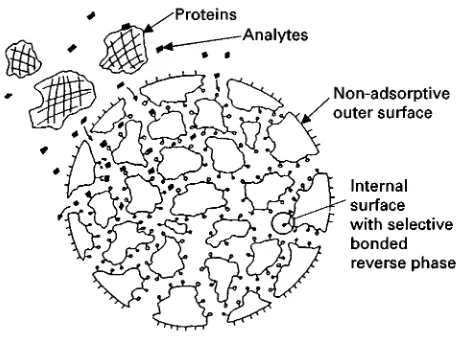
Figure 1 Schematic representation of an internal-surface reversed-phase (ISRP) material. Proteins do not adsorb on the hydrophilic exterior surfaces and do not penetrate into the hydro-phobic interior surfaces, while analytes can reach the interior surfaces and be separated. (Reproduced with permission from Perry JA (1991) The internal surface reversed phase. Concept and applications. Journal of Liquid Chromatography 13: 1047}1074.)
Gelfferich F (1962)Ion-exchange. New York: McGraw-Hill. Graf H, Rabaud JN and Egly UM (1994) Ion-exchange resins for the puriRcation of monoclonal antibodies from animal cell culture.Bioseparation4: 7}20. Greig JA (ed.) (1996)Ion-exchange Developments and
Ap-plications. Proceedings of IEX ’96. Cambridge: Royal Society of Chemistry.
Levison PR (1993) Process scale liquid chromatography. In: Kennedy JF, Philips GO and Williams PA (eds) Cellu-losics: Materials for Selective Separation and Other Technologies. Chichester: Ellis-Horwood.
Pirotta M (1991) Ion-exchangers in pharmacy, medicine and biochemistry. In: Dorfner K (ed.)Ion Exchangers. New York.
Rossomando EF (1990) Ion-exchange chromatography. In: Deutscher MP (ed.)Methods in Enzymology, vol. 182, Guide to Protein PuriTcation, pp. 309, 409. New York: Academic Press.
Streat M and Cloete FLD (1987) Ion exchange. In: Rousseau RW (ed.)Handbook of Separation Process Technology. New York: Wiley.
RESTRICTED-ACCESS MEDIA:
SOLID-PHASE EXTRACTION
J. Haginaka, Mukogawa Women’s University,
Nishinomiya, Japan
Copyright^ 2000 Academic Press
Introduction
For the determination of drugs and their metabolites in serum or plasma by high performance liquid chromatography (HPLC), tedious and time-consum-ing pretreatment procedures such as liquid}liquid ex-traction, solid-phase extraction (SPE) or membrane-based extraction are often required. Among those pretreatment procedures, SPE is the most widely used for extraction of target compounds in biological Suids. However, direct injection of serum or plasma samples onto HPLC or SPE materials causes protein denaturation with accumulation of materials on the sorbent, resulting in undesired loss in the capacity and selectivity of the sorbent. Thus, it is essential to remove serum or plasma proteins before loading the samples onto the HPLC or SPE sorbents. Recently, restricted access media (RAM) materials were intro-duced for direct injection of proteinaceous samples onto the HPLC or SPE materials. With RAM mate-rials large molecules such as proteins are eluted in the void volume without destructive accumulation be-cause of restricted access to some surfaces, while allowing small molecules such as drugs and their metabolities to reach the hydrophobic, ion-exchange or afRnity sites and be separated. One approach uses an internal-surface reversed-phase (ISRP) material, produced from porous silica gels, which has hydro-phobic interior and hydrophilic exterior surfaces, as shown in Figure 1. The ISRP}GFF material (GFF"glycine-L-phenylalanine-L-phenylalanine)
was prepared from covalently modiRed
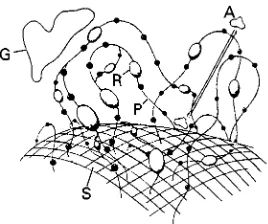
Figure 2 Schematic representation of a shielded hydrophobic phase (SHP) material. S"silica gel matrix; R"hydrophobic pocket; P"hydrophilic network; G"large unretained protein; A"small retained analyte. (Reproduced with permission from Gisch DJ, Hunter BT and Feibush B (1988) Shielded hydrophobic phase: a new concept for direct injection analysis of biological fluids by high-performance liquid chromatography. Journal of Chromatography 433: 264}268.)
Figure 3 Schematic representation of a polymer-based RAM material modified in pore-size selective fashion using a polymer catalyst. (Reproduced with permission from Smigol V, Svec F and FreHchet JMJ (1994) Novel uniformly sized polymeric stationary phase with hydrophilized large pores for direct injection HPLC determination of drugs in biological fluids. Journal of Liquid Chromatography 17: 891}911.)
hydrophilic polyoxyethylene network embedded with phenyl groups, bonded to both the external and inter-nal surfaces of the particles (Figure 2). Other RAM materials based on silica gels include semipermeable surface, dual zone and mixed function phase materials. RAM materials based on polymer beads have also been developed. For example, one polymer-based RAM material was prepared from porous uniformly sized poly(glycidyl methacrylate-co-ethylene dimethac-rylate) beads. Hydrolysis of the epoxide groups to diols can be carried out exclusively within the large pores of the medium through the use of a polymeric catalyst, polystyrenesulfonic acid (average molecular weight, 141 000 Da). The epoxide groups remaining in the small pores after hydrophilization of the large pores were then reacted with either hydrophobic
C18 or phenyl groups, or more polar diethylamino groups. The pore-size selective modiRcation of por-ous materials provided the RAM materials as shown inFigure 3.
RAM materials could be used for direct serum injection assays of drugs as HPLC or SPE materials. The former materials have been designed and used preferentially as packings for large-size (150; 4.6 mm i.d.), i.e. analytical columns. In this case the extraction and separation of analytes take place simultaneously. For SPE RAM, sorbents were packed into a small (typically 5}30 mm;3}4.6 mm i.d.) precolumns connected to an analytical column via a six-port valve, i.e. switching valve. In the coupled-column mode this is a sequential process. The two approaches for the extraction and analysis of the target compounds in biologicalSuids by HPLC are compared inTable 1.
Single-column Mode
When using the RAM materials, the ionic strength and pH of an eluent, and the content of organic modiRer are limited in order to prevent precipitation of serum proteins. For the ISRP}GFF materials, the recommended eluent pH range was 6.0}7.5. The re-covery of serum proteins was low at acidic pH. This is due to the electrostatic attractions of the serum pro-teins having a net positive charge (isoelectric point, pI of serum albumin, 4.7) and the external glycine resi-dues having a negative charge. Taking into account the pKavalues of the bound glycine (between 2.3 and 3.0), the recovery of serum proteins might be higher with an eluent pH below 2. However, chemically bonded columns cannot be used for long periods at this pH because of the hydrolysis of the bonded phase. However, for RAM materials such as SHP, whose external surface has no charges, there is no eluent pH limitation. These materials can be used at any pH suitable for siloxane-bonded silicas (pH 2}8). These results demonstrated that external uncharged surfaces should be suitable for the external layers of RAM materials. With regard to the eluent, an ionic strength of 0.05}0.2 was used. The preferred organic modiRers are acetonitrile, 2-propanol, tetrahyd-rofuran and methanol because they can afford a wide selectivity in controlling solute retention on the ac-cessible hydrophobic surfaces. The content of the organic modiRer should be(20%.
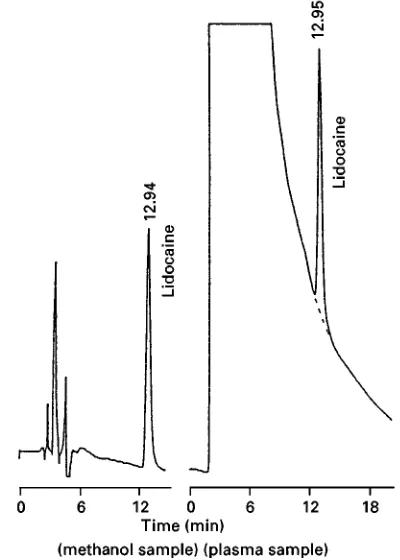
Direct serum injection assays of drugs were carried out on the ISRP}GFF materials. The chromatograms of plasma spiked with probenecid or lidocaine at clinical levels (50g mL\1 for probenecid, 5.94g mL\1 for lidocaine) are shown inFigures 4and5, respectively, together with those for methanolic solutions of the
[image:2.568.53.279.477.632.2]Table 1 On line sample extraction and analysis: comparison of single-column and coupled-column modes. (Reproduced with permission from Boos K-S and Grim C-H (1999) High-performance liquid chromatography integrated solid-phase extraction in bioanalysis using restricted access precolumn packings.Trends in Analytical Chemistry 18: 175}180)
Parameter Single-column mode Coupled-column mode
Matrix elimination and analyte separation Simultaneous Sequential
Peak capacity Low High
Selectivity Low High
Incidence of interferences High Low
Sample volume (100L 100L
Analyte enrichment No Yes
Limit of quantification Increased Decreased
Mobile-phase composition Restricted (pH, additives) Variable
Detection UV'240 nm No limitation
Fluorescence detection}yes Electrochemical detection}no
Column lifetime Short Long
Cost/analysis High Low
Figure 4 Separation of probenecid from human plasma. Mobile phase, 0.1 M potassium phosphate bufferItetrahydrofuran (95 : 5), pH 7.0; flow rate, 1.0 mL min\1; stationary phase,
[image:3.568.302.502.332.612.2]ISRPIGFF column, 150 mm;4.6 mm i.d.; detection, UV (254 nm); injection volume, 10L. (Reproduced with permission from Nakagawa T, Shibukawa A, Shimono Net al. (1987) Reten-tion properties of internal-surface reversed-phase silica packing and recovery of drugs from human plasma. Journal of Chromatography 420: 297}311.)
Figure 5 Separation of lidocaine from human plasma. Mobile phase, 0.1 M potassium phosphate bufferItetrahydrofuran (9 : 1), pH 7.2; flow rate, 0.8 mL min\1; stationary phase, ISRPIGFF
column, 150 mm;4.6 mm i.d.; detection, UV (220 nm); injection volume, 10L. (Reproduced with permission from Nakagawa T, Shibukawa A, Shimono Net al. (1987) Retention properties of internal-surface reversed-phase silica packing and recovery of drugs from human plasma. Journal of Chromatography 420: 297}311.)
same concentration. The recovery was calculated from the peak}area ratio of a given concentration of the drug dissolved in plasma and methanol. Despite the differences in the bound fractions (83}94% for probenecid and 65}77% for lidocaine), both drugs were almost completely recovered from plasma sam-ples. The large difference in the intensities of the background peaks in these chromatograms is due to
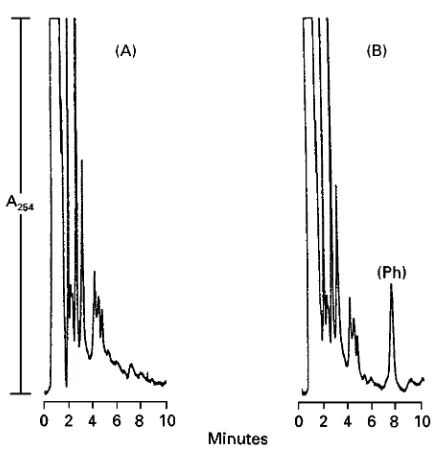
[image:3.568.92.246.380.609.2]Figure 6 Chromatograms of fetal bovine serum (A) and phenytoin (Ph)-spiked fetal bovine serum (B) at pH 2.5. Chromato-graphic conditions: column, SHP column (150 mm;4.6 mm i.d.); mobile phase, acetonitrileI50 mM KH2PO4(pH 2.5) (15 : 85); flow
rate, 2.0 mL min\1; temperature, ambient; detection, UV at 254 nm,
0.008 aufs; injection volume, 25L. (Reproduced with permission from Gisch DJ, Feibush B, Hunter BTet al. (1989) A new HPLC concept for direct analysis of drugs in biological matrices: shiel-ded hydrophobic phase.BioChromatography 4: 206}215.)
Figure 7 Determination of unbound and bound concentrations of carbamazepine (CBZ) in human plasma. Total concentration of CBZ is 8g mL\1. Stationary phase: ISRPIGFF column
(150 mm;4.6 mm i.d.). Mobile phase: potassium phosphate buf-fer (pH 7.4, I"0.17). Flow rate: 1.2 mL min\1. Detection: UV
300 nm. Column temperature: 373C. Injection volume: 1.8 mL. (Reproduced with permission from Shibukawa A, Nakagawa T, Nishimura Net al. (1989) Determination of free drug in protein binding equilibrium by high-performance frontal analysis using internal-surface reversed-phase silica support.Chemical & Phar-maceutical Bulletin 37: 702}706.)
both cases the eluent pH was about 7. However, phenytoin was not eluted under the neutral condi-tions on the SHP materials, but when the eluent pH was adjusted to 2.5, it was eluted and resolved from serum matrix components (Figure 6). Because of the presence of secondary amines on phenytoin, the re-tention factor of phenytoin was decreased by reduc-ing the eluent pH. Since the SHP materials had no charged groups on the external surface as described above, they could be used at eluent pH 2.5.
In the above applications, less than 100L of serum sample was injected. At higher sample vol-umes, analyte peaks were broadened and a plateau peak was observed. The plateau peak is dependent on the unbound fraction of analyte. Whether the broadened or plateau peak appears; that is, when the unbound drug fraction is higher, we can inject a lar-ger sample volume for direct serum injection assays of the drug without peak-broadening.
On the other hand, both free and total drug con-centrations could be simultaneously determined by injecting such a larger sample volume that the plateau peak of a drug appears.Figure 7shows the chromato-gram of 8.00g mL\1 carbamazepin (CBZ) in hu-man plasma. CBZ was well separated from the blank peak and gave a clear and wide plateau. The CBZ concentration calculated from this plateau height was
1.97g mL\1, which agreed with the free CBZ con-centration determined by means of ultraRltration (2.08g mL\1). Furthermore, it is interesting that the CBZ concentration calculated from the area of this plateau was 8.06g mL\1, in agreement with the total CBZ concentration of this plasma sample. This implies that both free and total drug concentrations can be determined simultaneously by a single analysis based on the height and area of the drug plateau, respectively. However, it is required to inject a large sample volume (in this case, 1.8 mL plasma sample) in order to observe the plateau peak. Further, the plateau peak cannot always be separated from blank peak, dependent on the drug separated.
Coupled-column Mode
[image:4.568.330.475.431.596.2]As shown inTable 1, the advantages of a coupled-column mode include separation selectivity (ability to couple precolumns and analytical columns of differ-ent selectivity), detection sensitivity (analyte enrich-ment due to larger sample volumes and reduced number of interfering peaks), and higher variability of mobile phases and detection modes. In recent times RAM materials have mainly been used in the coupled-column mode.
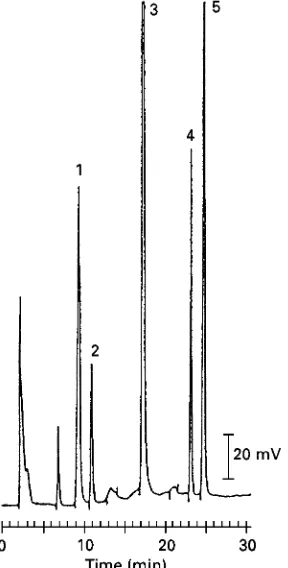
Figure 8 shows a representative chromatogram
obtained after the direct injection of an untreated human serum sample onto a RAM precolumn. The injection was followed by fully automated online extraction and subsequent separation of antiepileptic
Figure 8 Coupled-column analysis of antiepileptic drugs in serum. Precolumn: 25 mm;4 mm i.d., LiChrospher RP-18 ADS (particle size, 25m); analytical column: 250 mm;4 mm i.d., LiChrospher 60 RP-Select B (particle size, 5m); loading mobile phase: 0.5 M monobasic sodium phosphate (pH 4.0) for 0 min at 0.5 mL min\1; transfer mobile phase: 5 : 95 (v/v)
aceto-nitrileIwater for 5 min at 0.5 mL min\1; separation mobile phase:
acetonitrileIwater with a linear acetonitrile gradient from 5%to 34% in 34 min at 0.5 mL min\1; detection: UV absorbance at
205 nm; sample: 100L of analyte-spiked serum. Peaks: 1"ethosuximide (10.3 nmol), 2"primidone (1.8 nmol), 3"phenobarbital (6.6 nmol), 4"carbamazepine (1.3 nmol), 5"phenytoin (2.5 nmol). (Reproduced with permission from Boos K-S and Rudolphi A (1997) The use of restricted-access media in HPLC. Part I. Classification and review. LCIGC 15: 602}611.)
drugs on a conventional analytical reversed-phase HPLC column. The precolumn (25 mm;4 mm i.d.) packed with one of ISRP materials (particle size, 25m) can tolerate 2000 injections or more of 50L of human plasma.
Future Trends
Since the invention of the ISRP}GFF materials, vari-ous RAM materials have been developed for direct serum injection assays of drugs with single- and coupled-column modes. However, they are lacking in selectivity because hydrophobic or ion-exchange ligands are used as the analyte binding ligands. In the future, more selective ligands such as immuno-afRnity or chemoafRnity ligands or molecularly printed polymers have the potential to further im-prove selectivity and sensitivity in bioanalysis.
Further Reading
Boos K-S and Grim C-H (1999) High-performance liquid chromatography integrated solid-phase extraction in bioanalysis using restricted access precolumn packings. Trends in Analytical Chemistry18: 175}180.
Boos K-S and Rudolphi A (1997) The use of restricted-access media in HPLC. Part I. ClassiRcation and review. LC}GC15: 602}611.
Haginaka J (1991) Drug determination in serum by liquid chromatography with restricted access stationary phases.Trends in Analytical Chemistry10: 17}22. Rudolphi A and Boos K-S (1997) The use of
restricted-access media in HPLC. Part II. Applications.LC}GC15: 814}823.
Shibukawa A, Kuroda Y and Nakagawa T (1999) High-performance frontal analysis for drug}protein binding study.Journal of Pharmaceutical and Biomedical Analy-sis18: 1047}1055.
Thurman EM and Mills MS (1998)Solid-phase Extraction: Principles and Practice. New York: Wiley-Interscience.
REVERSED-FLOW GAS
CHROMATOGRAPHY
N. A. Katsanos, University of Patras, Patras,Greece
F. Roubani-Kalantzopoulou, National Technical
University of Athens, Zografou, Greece
Copyright^ 2000 Academic Press