ABSTRACT—Construction safety has been a great public concern due to its high incident rate in Hong Kong. Meanwhile, risk-taking propensity is associated with safety performance and high levels can generate addictive behaviour and negative habituation at work. Although the first partner who should be aware of a worker’s significant addictive inclination should be his/her site safety officer, the exploration of preliminary treatment for site-level operatives to cope with addictive risk-taking is extremely rare. This paper aims to review and summarise the possible ways by which site safety officers can implement preliminary treatment with chronological assistance. Using a proper academic search-engine application, a review of relevant literature was conducted to determine the therapeutic approaches proposed for treating addictive risk-taking behaviour. Among eight therapeutic approaches for the treatment of addictive risk-taking, seven of these are found to be suitable for use in site environment with slight modifications. A proposed safety scheme for addictive risk-taking behaviour (S2-ARTB) amongst construction workers is newly summarised, which is worthy of further intervention studies.
Index Terms— risk-taking behavior, construction safety, site environment, addictive therapy
I. INTRODUCTION
HE construction industry contributed around 4.4% to the entire GDP of Hong Kong in 2014 [1]. However, the industry has stagnated in terms of improvements in construction safety performance. The situation worsens when the construction accident rates of Hong Kong are compared with those of other countries and regions. The figure for Hong Kong in 2016 was alarming at 11.33 accidents per 1000 workers. This figure ranks the highest in the region when compared with figures from Japan (5.07 in 2016), Korea (7.5 in 2015), and Singapore (4.67 in 2016). In relation to the above, risk-taking propensity plays an essential role in determining the safety behavior amongst construction workers, and the high complexity of a site environment serves as the main catalyst behind the occurrence of accidents in Hong Kong for the past decades [2]. Particularly, negative behavioural habits can lead to problems with site safety performance because it lowers workers’ risk perception and
Manuscript received January 8th, 2019 and accepted January 12th, 2019. Banus K. L. Low was with the Department of Systems Engineering and Engineering Management, City University of Hong Kong. Tat Chee Avenue, Kowloon, Hong Kong. (corresponding author to provide phone: 852-6772 5774; e-mail: [email protected]).
adjusts their risk attitudes [3]. Meanwhile, risk perceptions and attitudes are important factors that influence construction workers’ risk-taking propensity [4], [5]. In addition, Wasmuth et al. (2014) [6] reported that habits are highly correlated with addiction even in an occupational environment. In this regard, eliminating the factors that induce risk-taking propensity can be an effective approach in alleviating risk-taking propensity in site level primary care. Nevertheless, only a few studies have explored information about brief counseling regarding the alleviation of addictive risk-taking in site condition. Therefore, this paper aims to elicit an initial understanding on this domain to provide a base for further research.
A. Risk Taking and Addiction
Recently, some behavioral scholars have identified the risk-taking propensity of individuals as an addiction problem [7], [8] that involves repetitive substance abuse [9], obsessions, and compulsions [10]. Risk taking alone is not a sufficient condition for addiction but can be aggravated with repeated occurrence of factors considered to decrease suffering, substitute satisfaction, and insensitivity of misery are obtained [11]. Some addictive risk-taking behaviors can be categorized as a psychiatric issue, and this is exacerbated in people who have problems with impulsiveness [12]. Unfortunately, these factors are often found at construction sites. For instance, taking shortcuts can decrease workers’ suffering in their work; some workers work faster to earn a higher income and satisfy their financial needs. As a result, they become insensitive to the risks involved in the construction industry. These findings show the close relationship between risk taking and behavioral addiction among construction workers and provide recommendations for dealing with individual factors.
B. Aims and Objective
With regards the correlation between risk-taking and addiction, the aim of this paper is to initiate an exploration of possible initial therapies to help risk-takers cope with addictive risk-taking behaviour. Such strategies should be easy to implement within specific on-site environments. In this regard, in-depth selection of literature was adopted to acquire the required information.
II. METHOD
A review of the literature published in the last thirty years (between 1987 and 2018) was made on ScienceDirect and PMC. The search included the following keywords: “therapy,” “addiction,” “intervention,” “risk-taking,”
Addictive Risk Taking in Construction Workers
– A Brief Summary of Preliminary Treatment
Banus K. L. Low
“substance use disorder,” and “obsession.” The flow chart of the selection criteria for these studies is shown in Annex 1 (it
can be downloaded from
https://figshare.com/s/8d4aef14b3c26ed75103). The
therapeutic approaches selected were the most discussed ones
in the literature. In addition, we grouped those findings with related concepts in therapeutic approaches for addiction in terms of risk-taking, risk-taking propensity in mental health, international instruments, behavioural treatments and psychiatry throughout many countries.
III. RESULTS
A total of 1074 studies were searched and a final group of 18 studies were selected for detailed analysis. These studies are highly related to intervention therapy for addictive behaviours. Moreover, these therapeutic treatments should be easily performed by site safety officers after undergoing proper training. A summary of these selected studies is
presented in Annex 2 (it can be downloaded:
https://figshare.com/s/f24f7208c3b197be3bba). The
following content will delineate the findings obtained in Appendix 2 with in-depth discussion.
IV. DISCUSSION
A. Brief Intervention and Follow-up Interviews
As early as the 1990s, brief intervention has been employed to change unhealthy and/or risk behavior (RB) as well as to treat several forms of pathogenic addiction, such as at-risk alcoholism [13] and smoking addiction [14]. This approach is particularly effective in alleviating addiction. Pilot counselling studies reveal brief interventions can serve as stand-alone first-step treatment that provides short-term assistance to patients with addiction and substance abuse problems [15]. Conducting brief interventions along with follow-up interviews, particularly motivational interviews (MI), can contribute considerably to behavioral correction [16]. The industry must implement brief intervention and follow-up interviews separately to address resource concerns. By using brief intervention as initial training or cognitive behavioral workshop, some individuals in need can participate in secondary interviews.
B. Cognitive Behavioral Treatment and Workshop
A cognitive behavioral workshop provides a platform for individuals to reduce their subclinical risk-taking symptoms, such as lack of persistent or significant improvements in safety performance through a series of cognitive behavioral treatments/trainings (CBT) [17]. Recent studies suggest that a cognitive behavioral workshop can be combined with EBP, which will be discussed in another section. As mentioned, CBT can act as a foundation for cognitive behavioral workshop and has been defined as a psychosocial intervention for treating mental disorders [18] and alleviating RB [19]. CBT employs mainly coping strategies to address addictive problems in cognition (e.g., thoughts, beliefs and attitudes),
behavior, and emotional regulation [20]. Cognition consists of thoughts and emotions and indicates that people can view the same thing differently. Safety professionals aim to understand construction safety issues further to change the attitudes, thoughts, and beliefs of workers. To address the RB of construction workers, the industry can launch safety workshops, safety awareness events, and conferences and joint meetings to build teamwork spirit and encourage cooperation. They can also build a safety knowledge sharing platform to cultivate a safety culture, apply behavioral-based approaches during safety training and organize safety stand-down talks.
C. Evidence-based Practice
Over 82% of relevant clinical participants have agreed that substance abuse treatment studies must focus more on practice [21]. By adopting the findings of previous research to improve mental therapy, EBP is designed to bridge the gap between clinical/safety expertise and the research participants [22]. In this way, EBP provides an excellent therapeutic method that helps patients cope with substance abuse [23] and receive mental help [24]. Therefore, EBP is suitable for mitigating RB. This approach also concerns the preferences and values of patients/workers regarding the process of therapy. Rakovshik and McManus (2010) [25] suggest that implementing EBP along with CBT can improve substance abuse therapy significantly. Therefore, when organizing a cognitive behavioral workshop, the construction industry should adopt EBP according to the particular steps. The current practices, such as identifying and communicating risks/hazards, enriching safety courses, enriching toolbox talks, and conducting trainings on the proper use of PPE and other equipment can provide workers with new evidence-based information. These existing measures must be practiced continuously in the industry. Periodical and follow-up studies on the risk-taking tendency of construction workers must also be conducted to strengthen existing findings and evidence. The suggested method in coping with addictive risk-taking behavior that combines CBT and workshop with EBT is shown in Annex 3 (It can be
downloaded from
https://figshare.com/s/0db2ef7339d6f1c0896b).
D. Acceptance and Commitment Therapy
accept an alternative to experiential avoidance. For instance, stressed patients may be encouraged to feel it without defense. Fusion is a by-product of language, and some people may accept self-defeating responses when their thoughts are taken too literally [26]. ‘Cognitive diffusion’ alters the undesirable functions of thoughts instead of changing their forms, situational sensitivity or frequency. For example, think of a young construction worker who wanted to go on a date with a pretty lady but was ultimately rejected. In response, he used cognitive diffusion and imagined that she rejected his offer because she had to attend a dance practice. Based on this example, cognitive diffusion stops people from focusing too much on literal wording/language by allowing them to interpret a situation differently, thereby preventing them from forming negative memories, emotions, and thoughts. The ‘present moment’ method promotes ongoing non-judgmental contact with psychological issues in the environment as they occur. The patient must be persuaded that learning from the past may result in depression, whereas preparing for the future may induce anxiety. Therefore, the present moment method leads to joy and happiness. ‘Self as context’ can be viewed as a sense-of-self process that provides individuals with a consistent perspective from which they can observe and accept their changing experiences. This process suggests deictic frames (i.e., I–You and Here–There) can be treated as some form of transcendent human language that provides people with a sense of self and a locus or perspective [27]. In simple terms, self as context or the transcendent sense of self can help patients understand that their being can be changed. A person’s life is just like the sky: sometimes the clouds are dark and gloomy with some rainfall. However, despite the change in weather, the sky is still the sky. Therapists use this method to teach their patients a certain experience, such as anxiety. However, such experience is only a felt experience of self and can change just like the weather and sky [28]. ‘Value’ refers to chosen qualities of purposive action and intentional qualities of action that join together a string of moments into a meaningful path. ACT therapists use this approach to help their clients search for their life direction. For example, in the construction industry, a worker can be blamed for working on a building intended for other people to use. Nevertheless, a positive-valued worker may think he is building a part of human civilization. ‘Committed action’ is a concrete action that is taken in accordance with the value that is established in the previous stage. In ACT, committed action encourages the development of large patterns of effective action regarding certain values. Several therapeutic methods, including goal setting, shaping methods and skills acquisition, have been suggested. However, the methods adopted for the clients must result in short-, medium- and long-term changes in their behavior. In this regard, committed action defines the clinically relevant responses of clients that put their lives back on track [28].
ACT began to attract researchers’ attention in 2005 after Steven Hayes examined people’s minds and lives based on relational frame theory, which focuses on how human minds work [29]. Although ACT has its own psychological background, this approach differs significantly from CBT (or second-wave CBT) because ACT aims mainly to change the functions of people’s experiences (e.g., thoughts, feelings,
memories and behavioral responses) so as not to entangle the individual and allow him/her to become more flexible psychologically flexible. By contrast, the traditional CBT aims to change and/or correct the thoughts of an individual. Understanding the difference between ACT and CBT can improve site safety training to mitigate effectively the risk-taking propensity of construction workers by subjecting them into different levels of therapy. Annex 4 (it can be
downloaded from
https://figshare.com/s/3fac3e06edc0baf76bc6) describes the key concepts of ACT and the related applications of these concepts in construction site situations to strengthen the extant therapeutic measures for alleviating negative RB.
E. Computer/Internet-based Therapy
One of the most important concerns in psychological therapy is the interaction between the therapists and their clients. The face-to-face approach may reduce the efficacy of communication because of the embarrassment and discomfort that the patient feels during the therapeutic process. A computer-mediated communication channel deals with the limitations of face-to-face interviews [30] by providing patients with privacy, anonymity, 24-hour availability [31], intervention, and long-term follow up [32]. Computer-based therapy is an interactive computer-delivered therapy for treating addictive disorders [33]. This method can deliver therapeutic contexts effectively to construction workers through mobile applications with audio-visual instructions in consideration of their low education level and high mobility. Therefore, a computer-based intervention equipped with Internet services can effectively help these workers cope with their addictive behavior [34]. Carroll et al. (2011) [35] recently conducted a systematic treatment to help patients cope with their addictive RB. In pursuit of the core ideal shown in Annex 5 (It can be downloaded from
https://figshare.com/s/90e352831de7087151a8), a movie
Following the requirements of CBT4CBT (computer-based training in CBT) proposed by Carroll et al. (2008) [36], each module requires approximately 45 minutes to complete and the patient may take over a few hours to finish the entire computer-based training as shown in Appendix 5. The computer program must be operated inside a private room within a clinic in accordance with the CBT manual published by the National Institute on Drug Abuse [37]. However, implementing CBT4CBT as required in the construction site with such long period seems unrealistic. This system must be modified to develop a CBT4CBT that caters specifically to construction workers.
F. Art Therapy Approach
Some workers with serious addiction have a pathological relationship with compulsive/risky behavior because taking risks is akin to taking a mood-altering substance that affects their psychological adjustment and family relationship [38]. Such behavior can bring an individual closer to such substance whilst isolating him/her from the society. In this regard, some scholars adopt art therapy along with creativity development to alleviate addictive behavior via shame reduction [39]. Art therapy aims to rebuild the interpersonal relationship of an individual by helping him/her express himself/herself in order for his/her substance abuse to be replaced permanently. Many proximate measures, such as designing slogans and safety posters, have been implemented continuously in Hong Kong. Such activities must be implemented throughout the construction industry because allowing the workers to express their feelings can help them communicate with the society, show empathy to their fellow workers, and improve their mental health [40]. Music therapy presents another approach worth exploring, but such approach remains controversial because rock and loud music can trigger RB, particularly among people who work with machines such as drivers [41], by changing their mood [42]. However, listening to soft music can moderate the risk-taking preference of individuals [43]. Accordingly, not listening to rock music during work, particularly inside the driving chambers of construction plants, can alleviate the RB of construction workers. Nevertheless, all of these interventions can effectively cultivate a safety culture for these workers.
G. Motivational Interview
Motivational interview (MI) presents another effective way for changing the addictive behavior of individuals through interpersonal processes [44]. MI is widely employed in psychological counselling because of its client-centered therapeutic style in strengthening an individual’s readiness to change by helping him/her explore and resolve the ambivalence that often leads to procrastination. Given its counselling function, MI can be employed in follow-up interviews when implementing a safety scheme for reducing the risk-taking tendency of workers.
The therapeutic goals of MI include acceptance, expressing, empathy, and being non-judgmental. These requirements can help safety officers select a highly amiable method to communicate with pathogenic construction
workers and/or teams with a significant risk-taking tendency. To address this concern, safety officers and/or safety professionals must receive suitable training for MI operation because it requires them to change their attitudes. The existing safety measures, such as an informal feedback channel, provide a platform that can help safety officers identify those workers that require a brief follow-up interview and serve them with due pertinence.
H. Dialectical Behavior Therapy and Further Treatment
Dialectical behavior therapy (DBT) is an effective method for treating patients who have severe psychosocial disorders, including chronic substance abuse [45]. DBT aims mainly to enhance the ability of patients to learn, envision, articulate, pursue and sustain their goals with regard to their out-of-control behavior. With the aim of creating a life worth living, DBT must be conducted by certified DBT therapists and clinical psychologists who have professional experience in conducting DBT as a comprehensive cognitive-behavioral treatment particularly for patients suffering from mental disorders that are difficult to treat. In this regard, safety officers must refer workers with serious pathogenic RB to relevant professionals for further treatment.
V. SUMMARY AND CONCLUSION
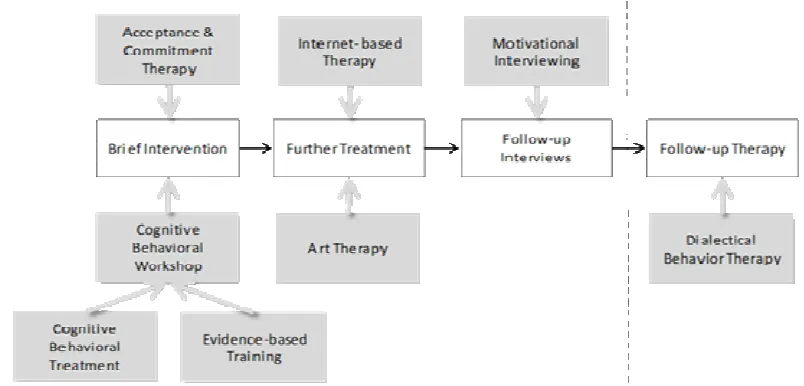
In sum, the treatments for addictive behavior can be divided into different phases according to the availability of resources and the involvement of safety professionals. Given the essential role of individual factors in the formation of risk-taking propensity among construction workers, the construction industry must adopt a systematic safety scheme to help construction workers mitigate and cope with addictive risk behavior during the initial stage of development. This scheme is termed in this paper as S2-ARTB and the white-colored boxes in Fig. 1 represent the major phases that are operated in tandem. First, a series of brief interventions, including CBT and EBT, is conducted to promote safety. Both CBT and EBT can provide a foundation for a cognitive behavioral workshop. Simultaneously, a reciprocal treatment can be conducted through ACT. Such intervention must be open to all construction workers in order to introduce behavioral corrections in the initial stage.
Fig. 1 Recommended safety scheme for addictive risk-taking behavior (S2-ARTB) amongst construction workers as preliminary treatment. The white-colored boxes represent the phases of the scheme, whilst the grey-coloured boxes represent the therapeutic treatments for alleviating the addictive risk-taking behaviour of construction workers.
With regard to addictive behavioral therapy, MI can be conducted to help workers achieve interpersonal improvement and ameliorate their addictive RB. Some workers may be referred to psychological therapists for follow-up therapy when their cases are beyond the ability of safety professionals. The dotted line in Fig. 1 represents the follow-up therapy supported by DBT or other interventions. Conclusively, this study innovatively provides a brief summary of the preliminary treatment for addictive risk-taking behavior in construction workers and reveals the increasing demand for safety officers to be trained in providing mental health support, such as handling workers’ emotions and their addictive risk-taking. Thus, these officers must undertake continuous training in the future.
REFERENCES
[1] CSD, H 2016, National Income, viewed 2017, [online]. Available: http://www.censtatd.gov.hk/hkstat/sub/sp250.jsp?tableID=036&ID=0 &productType=8.
[2] Low, Banus K. L, Man, S. S. and Chan, Alan H. S., 'The Risk-Taking Propensity of Construction Workers—An Application of Quasi-Expert Interview', International Journal of Environmental Research and
Public Health,2018, vol. 15, no. 2250, pp. 1 - 11.
[3] Shin, M, Lee, H-S, Park, M, Moon, M and Han, S 'A system dynamics approach for modeling construction workers’ safety attitudes and behaviors', Accident Analysis and Prevention, vol. 68, no. July 2014, pp. 95 - 105.
[4] Low, Banus K.L. and Chan, Alan H.S. “Questionnaire for Construction Worker Risk Taking (Q-CWRT) in Hong Kong”, The Japanese
Journal of Ergonomics, Vol. 53, 2017, Supplement, D6-4, pp. 584 –
587.
[5] Man, S. S., Chan, Alan H. S. & Wong, H. M. 2017, 'Risk-taking behaviors of Hong Kong construction workers – A thematic study', Safety Science, vol. 98, 2017, pp. 25 - 36.
[6] Wasmuth, S., Crabtree J.J., and Scott P. “Exploring addiction-as-occupation” British Journal of Occupational Therapy, vol. 77, Dec 2014, No. 12, pp. 605 – 613.
[7] Kreek, M. J., Nielsen, D. A., Butelman, E. R. & LaForge, K. S., “ Genetic influences on impulsivity, risk taking, stress responsivity and vulerability to drugs abuse and addiction”. Nature Neuroscience, vol. 8, 2005, no. 11, pp. 1450 - 1457.
[8] Carroll, K. M. et al., “Cognitive Function and Treatment Response in a Randomized Clinical Trial of Computer-Based Training in Cognitive-Behavioral Therapy”. Substance Use & Misuse, vol. 46 no. 1, 2011, pp. 23 - 34.
[9] Wagner, M. K., “Behavioral characteristics related to substance abuse and risk-taking, sensation-seeking, anxiety sensitivity, and
self-reinforcement”. Addictive Behaviors, vol. 26, 2001, pp. 115 - 120.
[10] Cicolini, T. & Rees, C. S., “MEASURING RISK-TAKING IN OBSESSIVE-COMPULSIVE DISORDER: AN EXTENSION OF THE EVERYDAY RISK INVENTORY WITH AN AUSTRALIAN SAMPLE”. Behavioural and Cognitive Psychotherapy, vol. 31, 2003, pp. 247 - 259.
[11] Dayan, J. et al., “Adolescent brain development, risk-taking and vulnerability to addiction”. Journal of Physiology - Paris, vol. 104, 2010, pp. 279 - 286.
[12] Holmes M.K., Bearden C.E., Barguil Marcela, Fonseca Manoela, Monkul E.S., Nery Fabiano G., Soare J.C., Mintz J., and Glahn D.C. “Conceptualizing impulsivity and risk taking in bipolar disorder: importance of history of alcohol abuse”. Bipolar Disorder vol. 11 no. 1, 2009, pp. 30 – 40.
[13] Bien, T. H., Miller, W. R. & Tonigan, J. S., 1993. Brief interventions for alcohol problems: a review. Addiction, Volume 88, pp. 315 - 336. [14] Rollnick, S., Butler, C. C. & Scott, N., “Helping smokers make
decisions: the enhancement of brief intervention for general medical practice”. Patient Education and Counseling, vol. 31, 1997, pp. 191 - 203.
[15] Breslin, C. et al., “Brief Treatment for Young Substance Abusers: A Pilot Study in an Addiction Treatment Setting”. Psychology of
Addictive Behaviors, vol. 16, no. 1, 2002, pp. 10 - 16.
[16] Borsari, B. & Carey, K. B., “Effects of a Brief Motivational Intervention with College Student Drinkers”. Journal of Consulting
and Clinical Psychology, vol. 68, no. 4, 2000, pp. 728 - 733.
[17] Zucker, B. G., Craske, M. G., Blackmore, M. A. & Nitz, A., “A cognitive behavioral workshop for subclinical obsessions and compulsions”. Behaviour Research and Therapy, vol. 44, 2006, pp. 289 - 304.
[18] Beck, J. S., 2011. Cognitive behavior therapy: Basics and beyond. New York, NY The Guilford Press.
[19] Castellanos, N. & Conrod, P., “Brief interventions targeting personality risk factors for adolescent substance misuse reduce depression, panic and risk-taking behaviours”. Journal of Mental
Health, vol. 15no. 6, 2006, pp. 645 - 658.
[20] Benjamin, C. L., Puleo, C. M. & Settipani, C. A., “History of Cognitive-Behavioral Therapy (CBT) in Youth. Child & Adolescent “.
Psychiatric Clinics of North America, vol. 20 no. 2, 2011, pp. 179 -
189.
[21] Forman, R. F., Bovasso, G. & Woody, G., “Staff beliefs about addiction treatment”. Journal of Substance Abuse Treatment, vol. 21, 2001, pp. 1 - 9.
[22] Webb, S. A., “Some Considerations on the Validity of Evidence-based Practice in Social Work”. British Journal of Social Work, vol. 31, 2001, pp. P. 57- 79.
[24] Bellamy, J. L., Bledsoe, S. E. & Traube, D. E., “The Current State of Evidence-Based Practice in Social Work: A Review of the Literature and Qualitative Analysis of Expert Interviews”. Journal of Evidence
Based Social Work, vol. 3, no. 1, 2006, pp. P. 23 - 48.
[25] Rakovshik, S. G. & McManus, F., “Establishing evidence-based training in cognitive behavioral therapy: A review of current empirical findings and theoretical guidance”. Clinical Psychology Review, vol. 30, 2010, pp. 496 - 516.
[26] Hayes, S. C., Strosahl, K. D. & Wilson, K. G., Acceptance and
commitment therapy. s.l.:American Psychological Association, 1999.
[27] Hayes, S. C. et al., “Acceptance and Commitment Therapy: Model,
process and outcomes”. Psychology Faculty Publications, Georgia
State University, Paper 101, 2006, pp. 1 – 31.
[28] Bach, P. A. & Moran, D. J., “Chapter 1 - An Orientation to ACT”. In: ACT in Practice - Case Conceptualization in Acceptance & Commitment Therapy. Oakland, CA: New Harbinger Publications, Inc., 2008, pp. 3 - 15
[29] Hayes, S. C. & Smith, S., “Conclusion - The Choice to Live a Vital Life with David Chantry”. In: Get Out of Your Mind & Into Your Life. Oakland: New Harbinger Publications, Inc., 2005, pp. 195 – 198. [30] Lee, C. F. C., “Face-to-face Versus Computer-mediated
Communication: Exploring Employees’ Preference of Effective Employee Communication Channel”. International Journal for the Advancement of Science & Arts, vol. 1, no. 2, 2010, pp. 38 – 48. [31] Han, H.-R. & Belcher, A. E., “Computer-Mediated Support Group Use
Among Parents of Children with Cancer-An Exploratory Study”.
Computers in Nursing, vol. 19, no. 1, 2001, pp. 27 – 33.
[32] Gainsbury, S. & Blaszczynski, A., “A systematic review of Internet –based therapy for the treatment of addictions”. Clinical Psychology
Review, vol. 31, 2011, pp. 490 - 498.
[33] Moore, B. A. et al., “Computer-based interventions for drug use disorders: A systematic review”. Journal of Substance Abuse
Treatment, vol., 40, no. 3, 2011, pp. 215 -223.
[34] Tait, R. J., Spijkerman, R. & Riper, H., “Internet and computer based interventions for cannabis use: A meta-analysis”. Drug and Alcohol
Dependence, vol. 133, no. 2, 2013, pp. 295 - 304.
[35] Carroll, K. M. et al., “Cognitive Function and Treatment Response in a Randomized Clinical Trial of Computer-Based Training in Cognitive-Behavioral Therapy”. Substance Use & Misuse, vol. 46, no. 1, 2011, pp. 23 – 34.
[36] Carroll, K. M. et al., “Computer-Assisted Delivery of Cognitive-Behavioral Therapy for Addiction: A Randomized Trial of CBT4CBT”. American Journal of Psychiatry, vol. 165, no. 7, 2008, pp. 881 – 888.
[37] Carroll, K. M., “A cognitive behavioural approach: treating cocaine
addiction”. 1998, Rockville, M.D.: National Institute on Drug Abuse.
[38] Kinney, J. & Leaton, G., “Loosening the grip: A handbook of alcohol
information”. St. Louis, M.O.: Mosby - Year Book, 1995.
[39] Wilson, M., “Chapter 22 - Art Therapy in Addictions Treatment:
Creativity and Shame Reduction. In: Handbook of Art Therapy”. New
York, London: The Guilford Press, 2003, pp. 281 – 293.
[40] Heenan, D., “Art as therapy: an effective way of promoting positive mental health?” Disability & Society, vol. 21, no. 2, 2006, pp. 179 – 191.
[41] Steinberg, L., “Risk Taking in Adolescence: What Changes, and Why?” Annals of the New York Academy of Sciences, vol. 1021, 2004, pp. 51 – 58.
[42] Yuen, K. S. L. & Lee, T. M. C., “Could mood state affect risk-taking decisions?” Journal of Affective Disorders, vol. 75, 2003, pp. 11 – 18. [43] Sweeting, H. & West, P., “Young people's leisure and risk-taking behaviours: changes in gender patterning in the West of Scotland during the 1990s”. Journal of Youth Studies, vol. 6, no. 4, 2003, pp. 391 – 412.
[44] Miller, W. R. & Rose, G. S., “Toward a Theory of Motivational Interviewing”. American Psychology, vol. 64, no. 6, 2009, pp. 527 – 537.
[45] Dimeff, L. A. & Linehan, M. M., “Dialectical Behavior Therapy for Substance Abusers”. Addiction Science & Clinical Practice, vol. Jun 2008, pp. 39 - 47.
[46] Salehyan M., and Aghabeiki, A. “The effectiveness of cognitive-behavioural group therapy on the enhancement of the self- esteem of women with husbands affected by substance dependency disorder”, Procedia - Social and Behavioral Sciences, vol. 30, 2011, pp. 1698 – 1702.
[47] Freeston M.H., Lêger E., and Ladouceur,R. “Cognitive Therapy of Obsessive Thoughts” Cognitive and Behavioral Practice, vol. 8, 2001, pp. 61 – 78.
[48] Santos, V.A., Freire R., Zugliani, M., Cirillo, P., Santos, H.H., Nardi, A. E., King A.L. “Treatment of Internet Addiction with Anxiety Disorders: Treatment Protocol and Preliminary Before-After Results Involving Pharmacotherapy and Modified Cognitive Behavioral Therapy”, JMIR Research Protocols, vol. 5, no. 1, 2016, e46. [49] O'Neill, J., Gorbis, E., Feusner, J.D., Yip J.C., Chang, S., Maidment,
K.M., Levitt, J.G., Salamon, N., Ringman, J.M. “Effects of intensive cognitive-behavioral therapy on cingulate neurochemistry in obsessive–compulsive disorder”, Journal of Psychiatry Research, vol. 47, no. 4, 2013, pp. 494 – 504.
[50] Brooks, S.J. , Burth, K.H., Maiorana, S.A., Cocolas, E., Schioth, H.B., Nilsson, E.K., Kamaloodien, K., and Stein D.J. “Psychological intervention with working memory training increases basal ganglia volume: A VBM study of inpatient treatment for methamphetamine use”, NeuroImage: Clinical, vol. 12, 2016, pp. 478 – 491.
[51] Dindo, L., Liew J.R.V., and Arch, J.J. “Acceptance and Commitment Therapy: A Transdiagnostic Behavioral Intervention for Mental Health and Medical Conditions”, Neurotherapeutics, vol. 14, 2017, pp. 546 – 553.
[52] Twohig., M., Shoenberger, D., and Hayes, S.C. “A Preliminary Investigation of Acceptance and Commitment Therapy as a Treatment for Marijuana Dependence in Adults”, Journal of Applied Behavior Analysis, vol. 40, 2007, pp. 619 – 632.
[53] Witlox M., Kraaij V., Garnefski, N., Waal M.W.M. de, Smit F., Hoencamp E., Gussekloo, J., Bohlmeijer E.T., and Spinhoven P. “An Internet-based Acceptance and Commitment Therapy intervention for older adults with anxiety complaints: study protocol for a cluster randomized controlled trial” Trials, vol. 19 – 502, 2016, pp. 1 – 14. [54] Christ C., Waal M.W.M. de, Schaik D.J.F., Kikkert, M.J., Blankers M.,
Bockting, C.L.H., Beekman, A.T.F., and Dekker J.J.M. “Prevention of violent revictimization in depressed patients with an add-on internet-based emotion regulation training (iERT): study protocol for a multicenter randomized controlled trial” BMC Psychiatry, vol. 18:29, 2018, pp. 1 -14.
[55] Feuerstein S., Hodges S.E., Keenaghan B., Bessette, A., Forselius, E., and Morgan, P.T. “Computerized Cognitive Behavioral Therapy for Insomnia in a Community Health Setting” Journal of Clinical Sleep Medicine, vol. 13, no. 2, 2017, pp. 267 – 274.
[56] Hartnett D., Murphy E., Kehoe, E., Agyapong, V., McLoughlin D.M., and Farren C. “Supportive text messages for patients with alcohol use disorder and a comorbid depression: a protocol for a single-blind randomised controlled aftercare trial” BMJ Open, 2017, doi:10.1136/bmjopen-2016-013587.
[57] Lim J.A., Lee J.Y., Jung H.Y., Sohn B.K., Choi S.W., Kim Y.J, Kim D.J., and Choi J.S. “Changes of quality of life and cognitive function in individuals with Internet gaming disorder” Medicine, vol. 95: 50, 2016, pp. 1 – 8.
[58] Elwafi H.M., Witkiewitz K., Mallik S., Thornhill IV T.A., and Brewer J.A. “Mindfulness training for smoking cessation: moderation of the relationship between craving and cigarette use” Drug Alcohol
Dependence, vol. 130, June 2013, pp. 222 – 239.
[59] Iwanicka K., Gerhant A., and Olajossy M. “Psychopathological symptoms, defense mechanisms and time perspectives among subjects with alcohol dependence (AD) presenting different patterns of coping with stress” PeerJ vol. 5, 2017, e3576; DOI 10.7717/peerj.3576 [60] Hohmann L., Bradt J., Stegemann T., and Koelsch S. “Effects of music
therapy and music-based interventions in the treatment of substance use disorders: A systematic review” PLoS ONE, vol. 12, Nov 2017, https://doi.org/10.1371/journal.pone.0187363.
[61] Yau Y.H.C., and Potenza M.N. “Gambling Disorder and Other Behavioral Addictions: Recognition and Treatment” Harvard Review of Psychiatry, vol. 23, no.2, 2015, pp. 134 – 146.
[62] Krampe H., Salz AL., Kerper L.F., Krannich A., Schnell T., Wernecke K.D., and Spies C.D. “Readiness to change and therapy outcomes of an innovative psychotherapy program for surgical patients: results from a randomized controlled trial” BMC Psychiatry, vol. 17:417, 2017, pp. 1 – 16.