Experimental Study on Enhancing Durability &
Compressive Strength of Concrete by using Nano
Silica
Nayan Shingare1, V.C. Patil 2 1
PG Research Scholar, 2Assistant Professor, Civil Engineering Department, JSPM‘s ICOER, Wagholi, Pune, Maharashtra, India
Abstract: The draw on of nano material in concrete is in advance growing interest in the construction industry. Studies have shown that concrete containing nano particles has established enlarged strength, durability and reduction of pore in the concrete due to the pour filling properties of the nano materials. This also concludes in better confrontation to deterioration of the steel reinforcements. Hence, the nano materials are cooperative to recover the life of the building. The utilize of bulky amount of cement produce ever-increasing CO2 emissions and also consequents the conservatory effect. The nano resources are use in order to condense the cement content in the concrete mix. Nano material represents one of the most exceptional advances in concrete technology during the most recent decade. Due to its precise properties, nano materials may include the important growth of the quality of the concrete structure and open up new fields for the application of concrete. Nano material is spread all more than the world with a steady amplifies in number of function. Nano materials are deliberately shaped and designed with very exact properties related to outline, size and exterior properties. The main use of nano materials in concrete is to enlarge the strength. Nano Silica produces high compressive strength concrete. It also provides high workability with compact water cement ratio.
Keywords: Nanomaterial, Concrete, Nano Silica (NS), Compressive strength.
I. INTRODUCTION
Nano technology is largely energetic investigate areas that contain a numeral of control including civil engineering and construction materials. Nanotechnology is the considerate, manage, and reorganization of matter on the command of nanometers (i.e., less than 100 nm) to generate materials with essentially new properties and function. There are many likely areas where nanotechnology can profit construction engineering like its application in concrete, structural composite, covering materials and in nano-sensors, etc. Nanotechnology goods can be used for aim and construction processes in a lot of areas. The nanotechnology generate goods have unique quality, and can considerably fix current construction problems, and may change the obligation and organization of construction procedure. The recent developments in the study and direction of materials and process at the nanoscale tender the great view of producing new macro materials, properties and goods. But till date, nanotechnology application and advance in the construction and building materials field have been jagged.
II. LITERATUREREVIEW
P.Vasanthi (2017) [1] The employ of nano materials in concrete is acquisition growing thought in the construction industry. Studies
have exposed that concrete contain nano particles has established improved strength, durability and decrease of pores in the concrete due to the pour filling property of the nano materials.
Nishant Sharma (2017) [2] The progression of appropriate nano technology and its essentialness in structural building exercise is
shown in this paper for growing idea. Nanotechnology manages considerate, domineering and domineering matter at the level of individual atoms in the scope of 0.1–100 nm (10-9 m).
Hasan Biricik, Nihal Sarier (2014) [3] The structural description of cement mortars, impregnate with nano silica (NS), silica fume
(SF) and fly ash (FA), were moderately considered using Fourier change infrared spectrometer (FTIR), thermo gravimeter-differential thermo gravimeter (TG-DTG) and scanning electron microscope (SEM). The automatic strengths of the specimen were resolute at early (7th day) and standard (28th day) curing ages.
Davoud Tavakoli, Ali Heidari (2013) [4] The nearby study investigate the concurrent use of nano-SiO2 and silica fume in concrete.
the grades showed that using such materials improve the merits of concrete. Using both 10% silica fume and 1% nano SiO2, as a cement replacement, resulted in 42.2% increase in compressive strength in comparison to control sample. Also, it was understood that the concurrent use of these materials is more powerful than their single use.
Yuvaraj Shanmuga Sundaram, Dr. Sujimohankumar (2013)[5] This paper deal with the revise of Nanotechnology testing in Civil
Engineering which include the growth, compensation and boundaries of Nano concreting technology. For falling carbon production during cement urbanized fly ash is used as a substitute in ordinary Portland cement which is term as Portland pozzolana cement(PPC), this inclusion relatively increase the workability and the deterioration resisting capacity in concrete, but this substitute of fly ash in the ordinary Portland cement deviate the concrete strength subsequently.
Patel Abhiyan S., Rathod Hiren A.,Neeraj Sharma D (2013)[6] The paper focus on question like: What is nanotechnology? What can
nanotechnology denote for the construction industry? Are there currently any commercialized goods in construction that make utilize of nanotechnology? Construction can be distinct as a procedure of converting the essential civil engineering raw materials to the final civil engineering creation.
III. MATERIALS
[image:2.612.38.514.229.718.2]A. Cement
Figure 1: OPC 53 Grade Cement
[image:2.612.236.372.268.390.2]B. Fine Aggregae
Figure 2: Crush Sand C. Course Aggregate
D. Nano Silica
Figure 4: Nano Silica
IV. METHODOLOGY
A. Slump Test
[image:3.612.253.389.332.457.2]Concrete slump test is to conclude the workability or uniformity of concrete mix organized at the laboratory or the construction site during the improvement of the work. Concrete slump test is accepted out from collection of the consistent value of concrete during construction. Slump is a measure of the consistency of fresh concrete. The slump test is a very simple test. The slump cone is a right circular cone that is 30 cm high. The base of the cone is 20 cm in diameter and the top of the cone is 10 cm in diameter.
Figure 5: Slump Test
B. Compressive Test
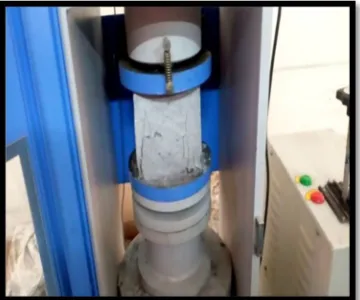
The clause 2.1 of IS 516:1959 specifies the process for manufacture and curing compression test specimen of concrete in the laboratory where exact organize of the quantity of resources and test circumstances are likely and where the most supposed size of aggregate does not go above 38 mm. The system is particularly appropriate to the making of initial compression tests to determine the fittingness of the available resources or to determine suitable mix proportions.
[image:3.612.215.395.555.705.2]Table 1: Details of Cubes under Compressive Test
Sr. No. Cube ID Description Grade of
Concrete
Curing Period
1 1,2,3 Conventional M50 7 Days
2 4,5,6 1% NS M50 7 Days
3 7,8,9 3% NS M50 7 Days
4 10,11,12 Conventional M50 14 Days
5 13,14,15 1% NS M50 14 Days
6 16,17,18 3% NS M50 14 Days
7 19,20,21 Conventional M50 28 Days
8 22,23,24 1% NS M50 28 Days
9 25,26,27 3% NS M50 28 Days
C. Durability Test
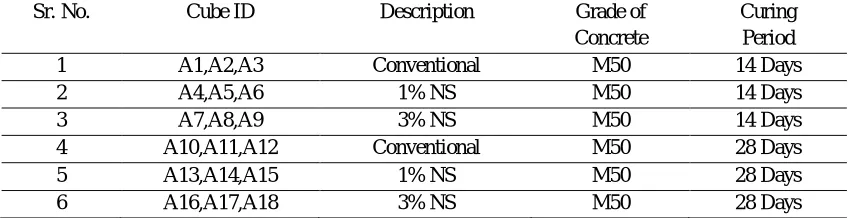
[image:4.612.202.415.308.440.2]Durability and strength are two mainly significant criterion for the design of reinforced concrete structures. The cubes after 28 days of curing in water are immersed in 5% HCL of the total volume of water; separately for 14 and 28 days to evaluate the decrement in the strength as compared to normal condition.
Figure 7: Acid Curing
Table 2: Details of Cubes under Acid Test
Sr. No. Cube ID Description Grade of
Concrete
Curing Period
1 A1,A2,A3 Conventional M50 14 Days
2 A4,A5,A6 1% NS M50 14 Days
3 A7,A8,A9 3% NS M50 14 Days
4 A10,A11,A12 Conventional M50 28 Days
5 A13,A14,A15 1% NS M50 28 Days
6 A16,A17,A18 3% NS M50 28 Days
D. Results & Analysis Testing of the Specimens
1) Compression Test (Water Curing)
a) The 7 days compression strength of the concrete cubes with no nano silica show the value of 34.27 N/mm2, concrete with 1% of
nano silica shows the value of 35.86 N/mm2, concrete with 3% of nano silica show the value of 36.69 N/mm2. The comparison
of the 7 days strength results shows that concrete with 1% of nano silica shows an increase of 5% & 3% of nano silica an increase of 8% with respect to the nominal concrete.
b) The 14 days compression strength of the concrete cubes with no nano silica show the value of 47.17 N/mm2, concrete with 1%
of nano silica show the value of 49.77 N/mm2, concrete with 3% of nano silica show the value of 52.48 N/mm2. The
[image:4.612.94.520.468.577.2]c) The 28 days compression strength of the concrete cubes without nano silica shows the value of 56.69 N/mm2, concrete with 1%
of nano silica shows the value of 59.27 N/mm2, concrete with 3% of nano silica shows the value of 65.61 N/mm2. The
comparison of the 28 days strength outcome shows that concrete with 1% of nano silica shows an increase of 5% & 3% of nano silica an increase of 15% with respect to the nominal concrete.
[image:5.612.81.529.164.456.2]d) The results of the compression test are shown in the below Table 3.
Table 3: Testing Details for Cubes under Compressive Test Percent of
NS Used
Compressive strength
of cubes at 7th day
(N/mm2)
Compressive strength
of cubes at 14th day
(N/mm2)
Compressive strength
of cubes at 28th day
(N/mm2)
0 34.27 47.17 56.69
1% 35.86 49.77 59.27
3% 36.69 52.48 65.61
Graph 1: Compressive Test for Water Curing
2) Compression Test on Acid Curing (using HCL)
a) The 14 days compression strength of the concrete cube with no nano silica show the value of 44.26 N/mm2, concrete with 1%
of nano silica show the value of 49.39 N/mm2, concrete with 3% of nano silica show the value of 51.87 N/mm2. The
comparison of the 14 days strength results show that concrete with 1% of nano silica show an increase of 12% & 3% of nano silica an increase of 18% with respect to the nominal concrete.
b) The 28 days compression strength of the concrete cube with no nano silica show the value of 54.33 N/mm2, concrete with 1%
of nano silica show the value of 59.79 N/mm2, concrete with 3% of nano silica show the value of 64.75 N/mm2. The
comparison of the 28 days strength results show that concrete with 1% of nano silica show an enlarge of 10% & 3% of nano silica an enlarge of 20% with respect to the convectional concrete.
c) The outcome of the compression test on Acid Curing are shown in the below Table 4.
Table 4: Testing Details for Cubes under Acid Test Percent of
NS Used
Compressive strength of
cubes at 14th day
(N/mm2)
Compressive strength of
cubes at 28th day
(N/mm2)
0 44.26 54.33
1% 49.39 59.79
3% 51.87 64.75
34.27 47.17 56.69 35.86 49.77 59.27 36.69 52.48 65.61 0 10 20 30 40 50 60 70
7th day 14 th day 28th day
Compressive strength for water curing
0% 1% 3%
A vg . C o m p re ss iv e S tr en gt h in N /m m 2
[image:5.612.134.481.640.720.2]V. CONCLUSION
A. The reason of this test was to find out the effects of totaling of nano silica to the concrete mix.
B. The compressive strength of concrete containing 1% & 3% of Nano Silica (NS) has been studies by using water curing.
C. The durability of the concrete containing 1% & 3% of Nano silica has been studied by using the acid attack.
D. The test results have shown that the M50 grade of concrete mixed with 1% & 3% of Nano silica shows a 10% & 20% increase
in strength when compare to the normal M50 grade concrete absorbed in intense HCL solution correspondingly.
E. Hence it has been confirmed that totaling of Nano silica to the concrete mix results in an enlarge in the compressive strength
and durability when compare to the normal concrete mix.
REFERENCES
[1] Balaguru, P. N. (2005), “Nanotechnology and Concrete: Background, Opportunities and Challenges.” Proceedings of the International Conference application of Technology in Concrete Design.
[2] Boresi, Arthur P.; Chong, Ken P.; Saigal, Sunil. Approximate Solution Methods in Engineering Mechanics, John Wiley, New York, 2002, 280 pp. [3] Balaguru, P.; and Shah, S.P. Fiber Reinforced Cement Composites, McGraw-Hill, New York, 1992, 530 pp.
[4] “Concrete”, Wikipedia, http://en.wikipedia.org/wiki/Concrete.
[5] Srivastava D.; Wei, C.; and Cho, K. “Nanomechanics of carbon nanotubes and composites.” Applied Mechanics Review, 56, 2003, 215-230. [6] LI, G. Properties of high-volume fly ash concrete incorporating nano-SiO2. Cement and Concrete Research. 34. 2004. P. 1043 – 1049. [7] P.Vasanthi et al /International Journal of ChemTech Research, 2017,10(3): 693-698.
[8] Condit, P.M., Performance, process, and value; Commercial Aircraft Design in the 21st century ,wright bros lecture in aeronautics world aviation congress, 1996.
[9] Mc Carty, J.E., and Roeseler, W.G.; Durability and damage tolerance of large composite primary aircraft structure; NASA CR 3797; 1984 [10] McCarthy, M.J. & DHIR, R.K. Development of high volume fly ash cement,2005