Calc Guide
Using Spreadsheets in OpenOffice.org
This PDF is designed to be read onscreen, two pages at a time. If you want to print a copy, your PDF viewer should have an option for printing two pages on one sheet of paper, but you may need to start with page 2 to get it to print facing pages correctly. (Print this cover page
separately.)
Copyright
This document is Copyright © 2005–2010 by its contributors as listed in the section titled Authors. You may distribute it and/or modify it under the terms of either the GNU General Public License, version 3 or later, or the Creative Commons Attribution License, version 3.0 or
later. All trademarks within this guide belong to their legitimate owners.
Authors
Rick Barnes Peter Kupfer
James Andrew Krishna Aradhi
Andy Brown Stephen Buck
Bruce Byfield Martin J. Fox
T. J. Frazier Stigant Fyrwitful
Spencer E. Harpe Regina Henschel
Peter Hillier-Brook John Kane
Kirk Emma Kirsopp
Jared Kobos Sigrid Kronenberger
Shelagh Manton Alexandre Martins
Kashmira Patel Anthony Petrillo
Andrew Pitonyak Iain Roberts
Hazel Russman Gary Schnabl
Rob Scott Sowbhagya Sundaresan
Nikita Telang Barbara M Tobias
John Viestenz Jean Hollis Weber
Stefan Weigel Sharon Whiston
Claire Wood Linda Worthington
Michele Zarri Magnus Adielsson
Sandeep Samuel Medikonda
Feedback
Please direct any comments or suggestions about this document to:
Publication date and software version
Published 24 June 2010. Based on OpenOffice.org 3.2.
You can download an editable version of this document from
http://oooauthors.org/english/userguide3/published/
Contents
Chapter 1Introducing Calc...9
What is Calc?...10
Spreadsheets, sheets, and cells...10
Parts of the main Calc window...11
Starting new spreadsheets...16
Opening existing spreadsheets...17
Opening CSV files...18
Saving spreadsheets...19
Navigating within spreadsheets...23
Selecting items in a sheet or spreadsheet...27
Working with columns and rows...30
Working with sheets...32
Viewing Calc...33
Using the Navigator...38
Chapter 2 Entering, Editing, and Formatting Data...41
Introduction...42
Entering data using the keyboard...42
Speeding up data entry...45
Sharing content between sheets...48
Validating cell contents...49
Editing data...51
Formatting data...53
Autoformatting cells and sheets...59
Formatting spreadsheets using themes...60
Using conditional formatting...61
Hiding and showing data...63
Sorting records...65
Finding and replacing in Calc...67
Chapter 3
Creating Charts and Graphs...72
Introduction...73
Creating a chart...73
Editing charts...78
Formatting charts...84
Formatting 3D charts...87
Formatting the chart elements...91
Resizing and moving the chart...93
Gallery of chart types...95
Chapter 4 Using Styles and Templates in Calc...105
What is a template?...106
What are styles?...106
Types of styles in Calc...107
Accessing styles...108
Applying cell styles...109
Applying page styles...111
Modifying styles...111
Creating new (custom) styles...116
Copying and moving styles...117
Deleting styles...119
Creating a spreadsheet from a template...119
Creating a template...120
Editing a template... 121
Adding templates using the Extension Manager...123
Setting a default template...124
Associating a spreadsheet with a different template...125
Organizing templates...126
Chapter 5 Using Graphics in Calc...129
Graphics in Calc...130
Adding graphics (images)...130
Modifying images...136
Using the picture context menu...142
Using Calc’s drawing tools...145
Positioning graphics...148
Creating an image map...151
Chapter 6 Printing, Exporting, and E-mailing...154
Quick printing...155
Controlling printing...155
Using print ranges...159
Page breaks... 163
Headers and footers...164
Exporting to PDF...167
Exporting to XHTML...173
Saving as Web pages (HTML)...174
E-mailing spreadsheets...174
Digital signing of documents...175
Removing personal data...176
Chapter 7 Using Formulas and Functions...177
Introduction...178
Setting up a spreadsheet...178
Creating formulas...180
Understanding functions...197
Strategies for creating formulas and functions...203
Finding and fixing errors...205
Examples of functions...210
Using regular expressions in functions...215
Advanced functions...217
Chapter 8 Using the DataPilot...218
Introduction...219
Examples with step by step instructions...219
DataPilot functions in detail...241
Function GETPIVOTDATA...267
Chapter 9 Data Analysis...271
Introduction...272
Consolidating data...272
Creating subtotals...275
Using “what if” scenarios...277
Using other “what if” tools...281
Working backwards using Goal Seek...288
Using the Solver...290
Chapter 10 Linking Calc Data...294
Why use multiple sheets?...295
Setting up multiple sheets...295
Referencing other sheets...299
Referencing other documents...301
Hyperlinks and URLs...303
Linking to external data...307
Linking to registered data sources...312
Embedding spreadsheets...316
Chapter 11 Sharing and Reviewing Documents...322
Introduction...323
Sharing documents (collaboration)...323
Recording changes...326
Adding comments to changes...329
Adding other comments...330
Reviewing changes...332
Merging documents...335
Comparing documents...337
Saving versions...337
Chapter 12
Calc Macros...340
Introduction...341
Using the macro recorder...341
Write your own functions...345
Accessing cells directly...353
Sorting... 354
Conclusion...356
Chapter 13 Calc as a Simple Database...357
Introduction...358
Associating a range with a name...359
Sorting... 365
Filters...367
Calc functions similar to database functions...375
Database-specific functions...387
Conclusion...388
Chapter 14 Setting up and Customizing Calc...389
Introduction...390
Choosing options that affect all of OOo...390
Choosing options for loading and saving documents...396
Choosing options for Calc...400
Controlling Calc’s AutoCorrect functions...409
Customizing the user interface...410
Adding functionality with extensions...420
Appendix A Keyboard Shortcuts...422
Introduction...423
Navigation and selection shortcuts...423
Function and arrow key shortcuts...425
Cell formatting shortcuts...426
DataPilot shortcuts...427
Appendix B
Description of Functions...428
Functions available in Calc...429
Mathematical functions...430
Financial analysis functions...435
Statistical analysis functions...449
Date and time functions...458
Logical functions...462
Informational functions...463
Database functions...466
Array functions...468
Spreadsheet functions...470
Text functions... 475
Add-in functions...479
Appendix C Calc Error Codes...484
Introduction to Calc error codes...485
Error codes displayed within cells...486
General error codes...487
Index...490
Chapter
1
Introducing Calc
Using Spreadsheets in OpenOffice.org
What is Calc?
Calc is the spreadsheet component of OpenOffice.org (OOo). You can enter data (usually numerical) in a spreadsheet and then manipulate this data to produce certain results.
Alternatively, you can enter data and then use Calc in a ‘What if...’ manner by changing some of the data and observing the results without having to retype the entire spreadsheet or sheet.
Other features provided by Calc include:
• Functions, which can be used to create formulas to perform complex calculations on data
• Database functions, to arrange, store, and filter data
• Dynamic charts; two new types of charts—Bubble Charts and
Filled Net Charts—have been introduced in OOo 3.2
• Macros, for recording and executing repetitive tasks; scripting
languages supported include OpenOffice.org Basic, Python, BeanShell, and JavaScript
• Ability to open, edit, and save Microsoft Excel spreadsheets
• Import and export of spreadsheets in multiple formats, including
HTML, CSV, PDF, and PostScript
Note If you want to use macros written in Microsoft Excel using the VBA macro code in OOo, you must first edit the code in the OOo Basic IDE editor.
Spreadsheets, sheets, and cells
Calc works with elements called spreadsheets. Spreadsheets consist of a number of individual sheets, each sheet containing cells arranged in rows and columns. A particular cell is identified by its row number and column letter.
Cells hold the individual elements—text, numbers, formulas, and so on —that make up the data to display and manipulate.
Each spreadsheet can have many sheets, and each sheet can have many individual cells. In Calc 3.x, each sheet can have a maximum of 65,536 rows and a maximum of 1024 columns, for a total of over 67 million cells.
Parts of the main Calc window
[image:11.595.27.530.112.384.2]When Calc is started, the main window looks similar to Figure 1.
Figure 1: Parts of the Calc window
Note
If any part of the Calc window in Figure 1 is not shown, you can display it using the View menu. For example, View > Status Bar will toggle (show or hide) the Status Bar. It is not always necessary to display all the parts, as shown; show or hide any of them, as desired.
Title bar
The Title bar, located at the top, shows the name of the current spreadsheet. When the spreadsheet is newly created, its name is
Untitled X, where X is a number. When you save a spreadsheet for the first time, you are prompted to enter a name of your choice.
Menu bar
Under the Title bar is the Menu bar. When you choose one of the menus, a submenu appears with other options. You can modify the Menu bar, as discussed in Chapter 14 (Setting up and Customizing Calc).
• File contains commands that apply to the entire document such
as Open, Save, Wizards, Export as PDF, and Digital Signatures.
• Edit contains commands for editing the document such as Undo,
Changes, Compare Document, and Find and Replace.
• View contains commands for modifying how the Calc user interface looks such as Toolbars, Full Screen, and Zoom.
• Insert contains commands for inserting elements such as cells,
rows, columns, sheets, and pictures into a spreadsheet.
• Format contains commands for modifying the layout of a
spreadsheet such as Styles and Formatting, Paragraph, and
Merge Cells.
• Tools contains functions such as Spelling, Share Document,
Cell Contents, Gallery, and Macros.
• Data contains commands for manipulating data in your
spreadsheet such as Define Range, Sort, Filter, and DataPilot.
• Window contains commands for the display window such as New
Window, Split, and Freeze.
• Help contains links to the Help file bundled with the software,
What's This?, Support, Registration, and Check for Updates.
Toolbars
Three toolbars are located under the Menu bar by default: the Standard toolbar, the Formatting toolbar, and the Formula Bar.
The icons (buttons) on these toolbars provide a wide range of common commands and functions. You can also modify these toolbars, as
discussed in Chapter 14 (Setting up and Customizing Calc).
Placing the mouse pointer over any of the icons displays a small box, called a tooltip. It gives a brief explanation of the icon’s function. For a more detailed explanation, choose Help > What’s This? and hover the mouse pointer over the icon. To turn this feature off again, click once or press the Esc key twice. Tips and extended tips can be turned on or off from Tools > Options > OpenOffice.org > General.
In the Formatting toolbar, the three boxes on the left are the Apply Style, Font Name, and Font Size lists (see Figure 2). They show the current settings for the selected cell or area. (The Apply Style list may not be visible by default.) Click the down-arrow to the right of each box to open the list.
Figure 2: Apply Style, Font Name and Font Size lists
Note
If any of the icons (buttons) in Figure 2 is not shown, you can display it by clicking the small triangle at the right end of the
Formatting toolbar, selecting Visible Buttons in the drop-down menu, and selecting the desired icon (for example, Apply Style) in the drop-down list. It is not always necessary to display all the toolbar buttons, as shown; show or hide any of them, as desired.
Formula Bar
On the left hand side of the Formula Bar is a small text box, called the
Name Box, with a letter and number combination in it, such as D7. This combination, called the cell reference, is the column letter and row number of the selected cell.
Figure 3: Formula Bar
To the right of the Name Box are the the Function Wizard, Sum, and
Function buttons.
Clicking the Function Wizard button opens a dialog from which you can search through a list of available functions. This can be very useful because it also shows how the functions are formatted.
In a spreadsheet the term function covers much more than just mathematical functions. See Chapter 7 for more details.
Clicking the Sum button inserts a formula into the current cell that totals the numbers in the cells above the current cell. If there are no numbers above the current cell, then the cells to the left are placed in the Sum formula.
Clicking the Function button inserts an equals (=) sign into the selected cell and the Input line, thereby enabling the cell to accept a formula.
When you enter new data into a cell, the Sum and Equals buttons change to Cancel and Accept buttons .
The contents of the current cell (data, formula, or function) are
displayed in the Input line, which is the remainder of the Formula Bar. You can either edit the cell contents of the current cell there, or you can do that in the current cell. To edit inside the Input line area, click in the area, then type your changes.To edit within the current cell, just double-click the cell.
Individual cells
The main section of the screen displays the cells in the form of a grid, with each cell being at the intersection of a column and a row.
At the top of the columns and at the left end of the rows are a series of gray boxes containing letters and numbers. These are the column and row headers. The columns start at A and go on to the right, and the rows start at 1 and go down.
These column and row headers form the cell references that appear in the Name Box on the Formula Bar (see Figure 3). You can turn these headers off by selecting View > Column & Row Headers.
Sheet tabs
At the bottom of the grid of cells are the sheet tabs. These tabs enable access to each individual sheet, with the visible (active) sheet having a white tab. Clicking on another sheet tab displays that sheet, and its tab turns white. You can also select multiple sheet tabs at once by holding down the Control key while you click the names.
Status bar
The Calc status bar provides information about the spreadsheet and convenient ways to quickly change some of its features.
Figure 4: Left end of Calc status bar
Figure 5: Right end of Calc status bar
Sheet sequence number ( )
Shows the sequence number of the current sheet and the total
number of sheets in the spreadsheet. The sequence number may not correspond with the name on the sheet tab.
Page style ( )
Shows the page style of the current sheet. To edit the page style, double-click on this field. The Page Style dialog opens.
Insert mode ( )
Click to toggle between INSRT (Insert) and OVER (Overwrite)
modes when typing. This field is blank when the spreadsheet is not in a typing mode (for example, when selecting cells).
Selection mode ( )
Click to toggle between STD (Standard), EXT (Extend), and ADD (Add) selection. EXT is an alternative to Shift+click when selecting cells. See page 27 for more information.
Unsaved changes ( )
An asterisk (*) appears here if changes to the spreadsheet have not been saved.
Digital signature ( )
If the document has not been digitally signed, double-clicking in this area opens the Digital Signatures dialog, where you can sign the document. See Chapter 6 (Printing, Exporting, and E-mailing) for more about digital signatures.
If the document has been digitally signed, an icon shows in this area. You can double-click the icon to view the certificate. A
document can be digitally signed only after it has been saved.
Cell or object information ( )
Displays information about the selected items. When a group of cells is selected, the sum of the contents is displayed by default; you can right-click on this field and select other functions, such as the
average value, maximum value, minimum value, or count (number of items selected).
When the cursor is on an object such as a picture or chart, the information shown includes the size of the object and its location.
Zoom ( )—new in OOo 3.1
To change the view magnification, drag the Zoom slider or click on the + and – signs. You can also right-click on the zoom level
percentage to select a magnification value or double-click to open the Zoom & View Layout dialog.
Starting new spreadsheets
You can create a new, blank spreadsheet from the Start Center (Welcome to OpenOffice.org), from within Calc, or from any other component of OOo such as from Writer or Draw.
From the Start Center
Click the Spreadsheet icon.
From the Menu bar
Choose File > New > Spreadsheet.
From a toolbar
If a document is open in any component of OOo (for example, Writer), you can use the New Document icon on the Standard toolbar. If you already have a spreadsheet open, clicking this button opens a new spreadsheet in a new window. From any other
component of OOo (for example, Writer), click the down-arrow and choose spreadsheet.
From the keyboard
If you already have a spreadsheet open, you can press Control+N to open a new spreadsheet in a new window.
From a template
Calc documents can also be created from templates. Follow the above procedures, but instead of choosing Spreadsheet, choose the
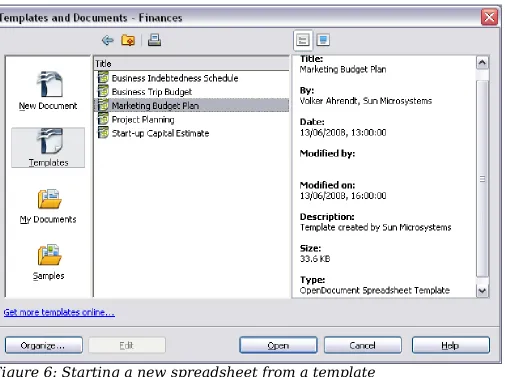
Templates icon from the Start Center or File > New >Templates and Documents from the Menu bar or toolbar. On the Templates and Documents window, navigate to the appropriate folder and
double-click on the required template. A new spreadsheet, based on the selected template, opens.
A new OpenOffice.org installation does not contain many templates, but you can add more by downloading them from
http://extensions.services.openoffice.org/ and installing them as described in Chapter 14 (Customizing Calc).
Figure 6: Starting a new spreadsheet from a template
Opening existing spreadsheets
You can open an existing spreadsheet from the Start Center or from any component of OOo. Calc can open spreadsheets in a wide range of file formats, including Microsoft Excel (*.xls and *.xlsx).
From the Start Center
Click the Open a document icon.
From the Menu bar
Choose File > Open.
From a toolbar
Click the Open icon on the Standard toolbar.
From the keyboard
Press the key combination Control+O.
Each of these options displays the Open dialog, where you can locate the spreadsheet that you want to open.
Tip
You can also use the Recent Documents list to open a spreadsheet. This list is located on the File menu, directly below Open. The list displays the last 10 files that were opened in any of the OOo components.
Opening CSV files
Comma-separated-values (CSV) files are text files that contain the cell contents of a single sheet. Each line in a CSV file represents a row in a spreadsheet. Commas, semicolons, or other characters are used to separate the cells. Text is put in quotation marks; numbers are written without quotation marks.
To open a CSV file in Calc: 1) Choose File > Open.
2) Locate the CSV file that you want to open.
3) If the file has a *.csv extension, select the file and click Open. 4) If the file has another extension (for example, *.txt), select the
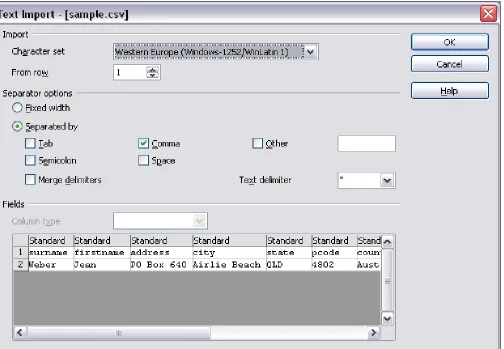
file, select Text CSV (*csv;*txt;*xls) in the File type box (scroll down into the spreadsheet section to find it) and then click Open. 5) On the Text Import dialog (Figure 7), select the Separator options
to divide the text in the file into columns.
You can preview the layout of the imported data at the bottom of the dialog. Right-click a column in the preview to set the format or to hide the column.
If the CSV file uses a text delimiter character that is not in the Text delimiter list, click in the box, and type the character.
6) Click OK to open the file.
Caution If you do not select Text CSV (*csv;*txt;*xls) as the file type when opening the file, the document opens in Writer, not Calc.
Figure 7: Text Import dialog, with Comma (,) selected as the separator and double quotation mark (“) as the text delimiter.
Saving spreadsheets
Spreadsheets can be saved in three ways.
From the Menu bar
Choose File > Save (or Save All or Save As).
From the toolbar
Click the Save button on the Standard toolbar. If the file has been saved and no subsequent changes have been made, this button is grayed-out and not clickable.
From the keyboard
Press the key combination Control+S.
If the spreadsheet has not been saved previously, then each of these actions will open the Save As dialog. There you can specify the
spreadsheet name and the location in which to save it.
Note
If the spreadsheet has been previously saved, then saving it using the Save (or Save All) command will overwrite an existing copy. However, you can save the spreadsheet in a different location or with a different name by selecting File > Save As.
Password protection
To protect an entire document from being viewable without a
password, use the option on the Save As dialog to enter a password. This option is only available for files saved in OpenDocument formats or the older OpenOffice.org 1.x formats.
On the Save As dialog, select the Save with password option, and then click Save. You will be prompted to type the same password in two fields. If the passwords match, the OK button becomes active. Click OK to save the document as password-protected. If the
passwords do not match, you will be prompted to type the password again.
OOo uses a very strong encryption mechanism that makes it almost impossible to recover the contents of a document in case you lose the password.
Saving a document automatically
You can choose to have Calc save your spreadsheet automatically at regular intervals. Automatic saving, like manual saving, overwrites the last saved state of the file. To set up automatic file saving:
1) Choose Tools > Options > Load/Save > General.
2) Click on Save AutoRecovery information every. This enables the box to set the interval. The default value is 15 minutes. Enter the value you want by typing it or by pressing the up or down arrow keys.
Saving as a Microsoft Excel document
If you need to exchange files with users of Microsoft Excel, they may not know how to open and save *.ods files. Only Microsoft Excel 2007 with Service Pack 2 (SP2) can do this. Users of Microsoft Excel 2007, 2003, XP, and 2000 can also download and install a free
OpenDocument Format (ODF) plugin from Sun Microsystems.
Some users of Microsoft Excel may be unwilling or unable to receive *.ods files. (Perhaps their employer does not allow them to install the plug-in.) In this case, you can save a document as a Excel file (*.xls or *.xlsx).
1) Important—First save your spreadsheet in the file format used by OpenOffice.org, *.ods. If you do not, any changes you may have made since the last time you saved it will only appear in the
Microsoft Excel version of the document. 2) Then choose File > Save As.
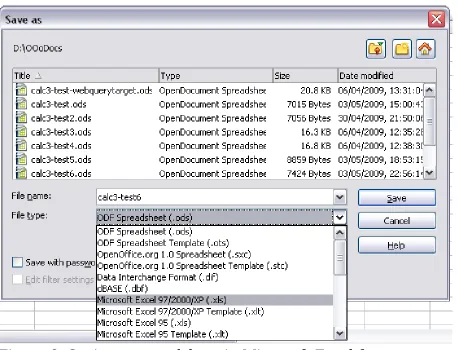
[image:21.595.50.508.267.617.2]3) On the Save As dialog (Figure 8), in the File type (or Save as type) drop-down menu, select the type of Excel format you need. Click Save.
Figure 8. Saving a spreadsheet in Microsoft Excel format
Caution From this point on, all changes you make to the spreadsheet will occur only in the Microsoft Excel document. You have actually changed the name of your document. If you want to go back to working with the *.ods version of your spreadsheet, you must open it again.
Tip
To have Calc save documents by default in a Microsoft Excel file format, go to Tools > Options > Load/Save > General. In the section named Default file format and ODF settings, under Document type, select Spreadsheet, then under Always save as, select your preferred file format.
Saving as a CSV file
To save a spreadsheet as a comma separate value (CSV) file: 1) Choose File > Save As.
2) In the File name box, type a name for the file.
3) In the File type list, select Text CSV (*.csv;*.txt;*.xls) and click
Save.
You may see the message box shown below. Click Keep Current Format.
4) In the Export of text files dialog (Figure 9), select the options you want and then click OK.
Figure 9: Choosing options when exporting to Text CSV
Saving in other formats
Calc can save spreadsheets in a range of formats, including HTML (Web pages), through the Save As dialog. Calc can also export spreadsheets to the PDF and XHTML file formats. See Chapter 6 (Printing, Exporting, and E-mailing) for more information.
Navigating within spreadsheets
Calc provides many ways to navigate within a spreadsheet from cell to cell and sheet to sheet. You can generally use whatever method you prefer.
Going to a particular cell
Using the mouse
Place the mouse pointer over the cell and click.
Using a cell reference
Click on the little inverted black triangle just to the right of the
Name Box (Figure 3). The existing cell reference will be highlighted. Type the cell reference of the cell you want to go to and press Enter. Cell references are case insensitive: a3 or A3, for example, are the same.Or just click into the Name Box, backspace over the existing cell reference, and type in the cell reference you want and press
Enter.
Using the Navigator
Click on the Navigator button in the Standard toolbar (or press F5) to display the Navigator.Type the cell reference into the top two fields, labeled Column and Row, and press Enter. In Figure 22 on page 39, the Navigator would select cell A7. For more about using the Navigator, see page 38.
Moving from cell to cell
In the spreadsheet, one cell normally has a darker black border. This black border indicates where the focus is (see Figure 10). The focus indicates which cell is enabled to receive input. If a group of cells is selected, they have a highlight color (usually gray), with the focus cell having a dark border.
Figure 10. (left) One selected cell and (right) a group of selected cells
Using the mouse
To move the focus using the mouse, simply move the mouse pointer to the cell where you want the focus to be and click the left mouse button. This action changes the focus to the new cell. This method is most useful when the two cells are a large distance apart.
Using the Tab and Enter keys
• Pressing Enter or Shift+Enter moves the focus down or up,
respectively.
• Pressing Tab or Shift+Tab moves the focus to the right or to the left, respectively.
Using the arrow keys
Pressing the arrow keys on the keyboard moves the focus in the direction of the arrows.
Using Home, End, Page Up and Page Down
• Home moves the focus to the start of a row.
• End moves the focus to the column furthest to the right that contains data.
• Page Down moves the display down one complete screen and
Page Up moves the display up one complete screen.
• Combinations of Control (often represented on keyboards as Ctrl)
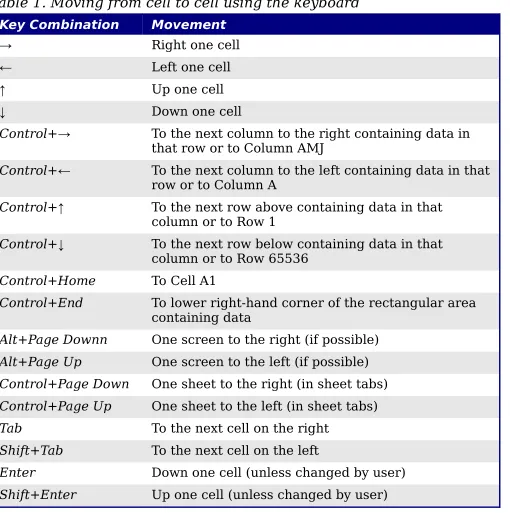
and Alt with Home, End, Page Down (PgDn), Page Up (PgUp), and the arrow keys move the focus of the current cell in other ways. Table 1 describes the keyboard shortcuts for moving about a spreadsheet.
Tip Use one of the four Alt+Arrow key combinations to resize the height or width of a cell. (For example: Alt+↓ increases the height of a cell.)
Table 1. Moving from cell to cell using the keyboard
Key Combination Movement
→ Right one cell
← Left one cell
↑ Up one cell
↓ Down one cell
Control+→ To the next column to the right containing data in that row or to Column AMJ
Control+← To the next column to the left containing data in that row or to Column A
Control+↑ To the next row above containing data in that column or to Row 1
Control+↓ To the next row below containing data in that column or to Row 65536
Control+Home To Cell A1
Control+End To lower right-hand corner of the rectangular area containing data
Alt+Page Downn One screen to the right (if possible) Alt+Page Up One screen to the left (if possible) Control+Page Down One sheet to the right (in sheet tabs) Control+Page Up One sheet to the left (in sheet tabs)
Tab To the next cell on the right
Shift+Tab To the next cell on the left
Enter Down one cell (unless changed by user) Shift+Enter Up one cell (unless changed by user)
Customizing the effects of the Enter key
You can customize the direction in which the Enter key moves the focus, by selecting Tools > Options > OpenOffice.org Calc > General.
The four choices for the direction of the Enter key are shown on the right hand side of Figure 11. It can move the focus down, right, up, or left. Depending on the file being used or on the type of data being entered, setting a different direction can be useful.
Figure 11: Customizing the effect of the Enter key
The Enter key can also be used to switch into and out of the editing mode. Use the first two options under Input settings in Figure 11 to change the Enter key settings.
Moving from sheet to sheet
Each sheet in a spreadsheet is independent of the others, though they can be linked with references from one sheet to another. There are three ways to navigate between different sheets in a spreadsheet.
Using the keyboard
Pressing Control+Page Down moves one sheet to the right and pressing Control+Page Up moves one sheet to the left.
Using the mouse
Clicking on one of the sheet tabs at the bottom of the spreadsheet selects that sheet.
If you have a lot of sheets, then some of the sheet tabs may be
hidden behind the horizontal scroll bar at the bottom of the screen. If this is the case, then the four buttons at the left of the sheet tabs can move the tabs into view. Figure 12 shows how to do this.
Figure 12. Sheet tab arrows
Notice that the sheets here are not numbered in order. Sheet numbering is arbitrary; you can name a sheet as you wish.
Note
The sheet tab arrows that appear in Figure 12 only appear if you have some sheet tabs that can not be seen. Otherwise, they appear faded as in Figure 1.
Selecting items in a sheet or spreadsheet
Selecting cells
Cells can be selected in a variety of combinations and quantities.
Single cell
Left-click in the cell. The result will look like the left side of Figure 10. You can verify your selection by looking in the Name Box.
Range of contiguous cells
A range of cells can be selected using the keyboard or the mouse. To select a range of cells by dragging the mouse:
1) Click in a cell.
2) Press and hold down the left mouse button. 3) Move the mouse around the screen.
4) Once the desired block of cells is highlighted, release the left mouse button.
To select a range of cells without dragging the mouse:
1) Click in the cell which is to be one corner of the range of cells. 2) Move the mouse to the opposite corner of the range of cells.
Chapter 1 Introducing Calc 27
Move to the first sheet
Move left one sheet
Move right one sheet
Move to the last sheet
Sheet tabs
3) Hold down the Shift key and click.
Tip
You can also select a contiguous range of cells by first clicking in the STD field on the status bar and changing it to EXT,
before clicking in the opposite corner of the range of cells in step 3 above. If you use this method, be sure to change EXT back to STD or you may find yourself extending the selection unintentionally.
To select a range of cells without using the mouse:
1) Select the cell that will be one of the corners in the range of cells. 2) While holding down the Shift key, use the cursor arrows to select
the rest of the range.
The result of any of these methods looks like the right side of Figure 10.
Tip
You can also directly select a range of cells using the Name Box. Click into the Name Box as described in “Using a cell reference” on page 23. To select a range of cells, enter the cell reference for the upper left-hand cell, followed by a colon (:), and then the lower right-hand cell reference. For example, to select the range that would go from A3 to C6, you would enter A3:C6.
Range of noncontiguous cells
1) Select the cell or range of cells using one of the methods above. 2) Move the mouse pointer to the start of the next range or single
cell.
3) Hold down the Control key and click or click-and-drag to select another range of cells to add to the first range.
4) Repeat as necessary.
Tip
You can also select a noncontiguous range of cells by first clicking twice in the STD field on the status bar to change it to ADD, before clicking on a cell that you want to add to the
range of cells in step 3 above. This method works best when adding single cells to a range. If you use this method, be sure to change ADD back to STD or you may find yourself adding more selections unintentionally.
Selecting columns and rows
Entire columns and rows can be selected very quickly in OOo.
Single column or row
To select a single column, click on the column identifier letter (see Figure 1).
To select a single row, click on the row identifier number.
Multiple columns or rows
To select multiple columns or rows that are contiguous: 1) Click on the first column or row in the group.
2) Hold down the Shift key.
3) Click the last column or row in the group.
To select multiple columns or rows that are not contiguous: 1) Click on the first column or row in the group.
2) Hold down the Control key.
3) Click on all of the subsequent columns or rows while holding down the Control key.
Entire sheet
To select the entire sheet, click on the small box between the A column header and the 1 row header.
Figure 13. Select All box
You can also press Control+A to select the entire sheet.
Selecting sheets
You can select either one or multiple sheets. It can be advantageous to select multiple sheets at times when you want to make changes to many sheets at once.
Single sheet
Click on the sheet tab for the sheet you want to select. The active sheet becomes white (see Figure 12).
Chapter 1 Introducing Calc 29
Select All
Multiple contiguous sheets
To select multiple contiguous sheets:
1) Click on the sheet tab for the first desired sheet.
2) Move the mouse pointer over the sheet tab for the last desired sheet.
3) Hold down the Shift key and click on the sheet tab.
All the tabs between these two sheets will turn white. Any actions that you perform will now affect all highlighted sheets.
Multiple noncontiguous sheets
To select multiple noncontiguous sheets:
1) Click on the sheet tab for the first desired sheet.
2) Move the mouse pointer over the sheet tab for the second desired sheet.
3) Hold down the Control key and click on the sheet tab. 4) Repeat as necessary.
The selected tabs will turn white. Any actions that you perform will now affect all highlighted sheets.
All sheets
Right-click any one of the sheet tabs and choose Select All Sheets
from the pop-up menu.
Working with columns and rows
Inserting columns and rows
Columns and rows can be inserted individually or in groups.
Note
When you insert a single new column, it is inserted to the left of the highlighted column. When you insert a single new row, it is inserted above the highlighted row.
Cells in the new columns or rows are formatted like the
corresponding cells in the column or row before (or to the left of) which the new column or row is inserted.
Single column or row
Using the Insert menu:
1) Select the cell, column, or row where you want the new column or row inserted.
2) Choose either Insert > Columns or Insert > Rows. Using the mouse:
1) Select the cell, column, or row where you want the new column or row inserted.
2) Right-click the header of the column or row. 3) Choose Insert Rows or Insert Columns.
Multiple columns or rows
Multiple columns or rows can be inserted at once rather than inserting them one at a time.
1) Highlight the required number of columns or rows by holding down the left mouse button on the first one and then dragging across the required number of identifiers.
2) Proceed as for inserting a single column or row above.
Deleting columns and rows
Columns and rows can be deleted individually or in groups.
Single column or row
A single column or row can be deleted by using the mouse: 1) Select the column or row to be deleted.
2) Choose Edit > Delete Cells from the menu bar. Or,
1) Right-click on the column or row header.
2) Choose Delete Columns or Delete Rows from the pop-up menu.
Multiple columns or rows
Multiple columns or rows can be deleted at once rather than deleting them one at a time.
1) Highlight the required columns or rows by holding down the left mouse button on the first one and then dragging across the
required number of identifiers.
2) Proceed as for deleting a single column or row above.
Tip
Instead of deleting a row or column, you may wish to delete the contents of the cells but keep the empty row or column. See Chapter 2 (Entering, Editing, and Formatting Data) for instructions.
Working with sheets
Like any other Calc element, sheets can be inserted, deleted, and renamed.
Inserting new sheets
There are several ways to insert a new sheet. The first step for all of the methods is to select the sheets that the new sheet will be inserted next to. Then any of the following options can be used.
• Choose Insert > Sheet from the menu bar.
• Right-click on the sheet tab and choose Insert Sheet.
• Click in an empty space at the end of the line of sheet tabs.
Figure 14. Creating a new sheet
Each method will open the Insert Sheet dialog. Here you can select whether the new sheet is to go before or after the selected sheet and how many sheets you want to insert. If you are inserting only one sheet, there is the opportunity to give the sheet a name.
Figure 15: Insert Sheet dialog
32 OpenOffice.org 3.x Calc Guide
Click here to insert a new sheet
Deleting sheets
Sheets can be deleted individually or in groups.
Single sheet
Right-click on the tab of the sheet you want to delete and choose
Delete Sheet from the pop-up menu, or choose Edit > Sheet > Delete from the Menu bar. Either way, an alert will ask if you want to delete the sheet permanently. Click Yes.
Multiple sheets
To delete multiple sheets, select them as described earlier, then either right-click over one of the tabs and choose Delete Sheet
from the pop-up menu, or choose Edit > Sheet > Delete from the Menu bar.
Renaming sheets
The default name for the a new sheet is SheetX, where X is a number. While this works for a small spreadsheet with only a few sheets, it becomes awkward when there are many sheets.
To give a sheet a more meaningful name, you can:
• Enter the name in the Name box when you create the sheet, or • Right-click on a sheet tab and choose Rename Sheet from the
pop-up menu; replace the existing name with a different one.
• (New in OOo3.1) Double-click on a sheet tab to pop up the
Rename Sheet dialog.
Note
Sheet names must start with either a letter or a number; other characters including spaces are not allowed. Apart from the first character of the sheet name, allowed characters are letters, numbers, spaces, and the underscore character. Attempting to rename a sheet with an invalid name will produce an error message.
Viewing Calc
Using zoom
Use the zoom function to change the view to show more or fewer cells in the window.
In addition to using the Zoom slider (new in OOo 3.1) on the Status bar (see page 16), you can open the Zoom dialog and make a selection on the left-hand side.
• Choose View > Zoom from the Menu bar, or
• Double-click on the percentage figure in the Status bar at the bottom of the window.
Figure 16. Zoom dialog
Optimal
Resizes the display to fit the width of the selected cells. To use this option, you must first highlight a range of cells.
Fit Width and Height
Displays the entire page on your screen.
Fit Width
Displays the complete width of the document page. The top and bottom edges of the page may not be visible.
100%
Displays the document at its actual size.
Variable
Enter a zoom percentage of your choice.
Freezing rows and columns
Freezing locks a number of rows at the top of a spreadsheet or a number of columns on the left of a spreadsheet or both.Then when scrolling around within the sheet, any frozen columns and rows remain in view.
Figure 17 shows some frozen rows and columns.The heavier horizontal line between rows 3 and 14 and the heavier vertical line between
columns C and H denote the frozen areas.Rows 4 through 13 and columns D through G have been scrolled off the page.The first three rows and columns remained because they are frozen into place.
Figure 17. Frozen rows and columns
You can set the freeze point at one row, one column, or both a row and a column as in Figure 17.
Freezing single rows or columns
1) Click on the header for the row below where you want the freeze or for the column to the right of where you want the freeze.
2) Choose Window > Freeze.
A dark line appears, indicating where the freeze is put.
Freezing a row and a column
1) Click into the cell that is immediately below the row you want frozen and immediately to the right of the column you want frozen.
2) Choose Window > Freeze.
Two lines appear on the screen, a horizontal line above this cell and a vertical line to the left of this cell. Now as you scroll around the screen, everything above and to the left of these lines will remain in view.
Unfreezing
To unfreeze rows or columns, choose Window > Freeze. The check mark by Freeze will vanish.
Splitting the screen
Another way to change the view is by splitting the window, also known as splitting the screen.The screen can be split horizontally, vertically, or both. You can therefore have up to four portions of the spreadsheet in view at any one time.
Figure 18. Split screen example
Why would you want to do this? Imagine you have a large spreadsheet and one of the cells has a number in it that is used by three formulas in other cells. Using the split-screen technique, you can position the cell containing the number in one section and each of the cells with
formulas in the other sections. Then you can change the number in the cell and watch how it affects each of the formulas.
Splitting the screen horizontally
To split the screen horizontally:
1) Move the mouse pointer into the vertical scroll bar, on the right-hand side of the screen, and place it over the small button at the top with the black triangle.
Figure 19. Split screen bar on vertical scroll bar
36 OpenOffice.org 3.x Calc Guide
Split screen bar
2) Immediately above this button, you will see a thick black line (Figure 19). Move the mouse pointer over this line, and it turns into a line with two arrows (Figure 20).
Figure 20. Split-screen bar on vertical scroll bar with cursor
3) Hold down the left mouse button. A gray line appears, running across the page. Drag the mouse downwards and this line follows. 4) Release the mouse button and the screen splits into two views,
each with its own vertical scroll bar.You can scroll the upper and lower parts independently.
Notice in Figure 18, the Beta and the A0 values are in the upper part of the window and other calculations are in the lower part.Thus, you can make changes to the Beta and A0 values and watch their effects on the calculations in the lower half of the window.
Tip
You can also split the screen using a menu command. Click in a cell immediately below and to the right of where you wish the screen to be split, and choose Window > Split.
Splitting the screen vertically
To split the screen vertically:
1) Move the mouse pointer into the horizontal scroll bar at the bottom of the screen and place it over the small button on the right with the black triangle.
Figure 21: Split bar on horizontal scroll bar
2) Immediately to the right of this button is a thick black line (Figure 21). Move the mouse pointer over this line and it turns into a line with two arrows.
Chapter 1 Introducing Calc 37
Split screen bar
3) Hold down the left mouse button, and a gray line appears, running up the page. Drag the mouse to the left and this line follows.
4) Release the mouse button, and the screen is split into two views, each with its own horizontal scroll bar. You can scroll the left and right parts of the window independently.
Removing split views
To remove a split view, do any of the following:
• Double-click on each split line.
• Click on and drag the split lines back to their places at the ends of
the scroll bars.
• Choose Window > Split to remove all split lines at the same time.
Using the Navigator
In addition to the cell reference boxes (labeled Column and Row), the Navigator provides several other ways to move quickly through a spreadsheet and find specific items.
To open the Navigator, click its icon on the Standard toolbar, or press F5, or choose View > Navigator on the Menu bar, or double-click on the Sheet Sequence Number in the Status Bar. You can dock the Navigator to either side of the main Calc window or leave it floating. (To dock or float the Navigator, hold down the Control key and double-click in an empty area near the icons at the top.)
The Navigator displays lists of all the objects in a spreadsheet
document, grouped into categories. If an indicator (plus sign or arrow) appears next to a category, at least one object of this kind exists. To open a category and see the list of items, click on the indicator.
To hide the list of categories and show only the icons at the top, click
the Contents icon . Click this icon again to show the list. Table 2 summarizes the functions of the icons at the top of the Navigator.
Figure 22: The Navigator in Calc Table 2: Function of icons in the Navigator
Icon Action
Data Range. Specifies the current data range denoted by the position of the cell cursor.
Start/End. Moves to the cell at the beginning or end of the current data range, which you can highlight using the Data Range button.
Contents. Shows or hides the list of categories.
Toggle. Switches between showing all categories and showing only the selected category.
Displays all available scenarios. Double-click a name to apply that scenario. See Chapter 7 (Data Analysis) for more information. Drag Mode. Choose hyperlink, link, or copy. See “Choosing a drag mode” for details.
Moving quickly through a document
The Navigator provides several convenient ways to move around a document and find items in it:
• To jump to a specific cell in the current sheet, type its cell
reference in the Column and Row boxes at the top of the
Navigator and press the Enter key; for example, in Figure 22 the cell reference is A7.
• When a category is showing the list of objects in it, double-click
on an object to jump directly to that object’s location in the document.
• To see the content in only one category, highlight that category and click the Toggle icon. Click the icon again to display all the categories.
• Use the Start and End icons to jump to the first or last cell in the
selected data range.
Tip
Ranges, scenarios, pictures, and other objects are much easier to find if you have given them informative names when creating them, instead of keeping Calc’s default Graphics 1, Graphics 2, Object 1, and so on, which may not correspond to the position of the object in the document.
Choosing a drag mode
Sets the drag and drop options for inserting items into a document using the Navigator.
Insert as Hyperlink
Creates a hyperlink when you drag and drop an item into the current document.
Insert as Link
Inserts the selected item as a link where you drag and drop an object into the current document.
Insert as Copy
Inserts a copy of the selected item where you drag and drop in the current document. You cannot drag and drop copies of graphics, OLE objects, or indexes.
Chapter
2
Entering, Editing, and
Formatting Data
Introduction
You can enter data into Calc in several ways: using the keyboard, the mouse (dragging and dropping), the Fill tool, and selection lists. Calc also provides the ability to enter information into multiple sheets of the same document at the same time.
After entering data, you can format and display it in various ways.
Entering data using the keyboard
Most data entry in Calc can be accomplished using the keyboard.
Entering numbers
Click in the cell and type in the number using the number keys on either the main keyboard or the numeric keypad.
To enter a negative number, either type a minus (–) sign in front of it or enclose it in parentheses (brackets), like this: (1234).
By default, numbers are right-aligned and negative numbers have a leading minus symbol.
Entering text
Click in the cell and type the text. Text is left-aligned by default.
Entering numbers as text
If a number is entered in the format 01481, Calc will drop the leading 0. (Exception: see Tip below.)To preserve the leading zero, for example for telephone area codes, type an apostrophe before the number, like this: '01481.
The data is now treated as text and displayed exactly as entered. Typically, formulas will treat the entry as a zero and functions will ignore it.
Tip
Numbers can have leading zeros and still be regarded as numbers (as opposed to text) if the cell is formatted
appropriately. Right-click on the cell and chose Format Cells > Numbers. Adjust the leading zeros setting to add leading zeros to numbers.
Note
When a plain apostrophe is used to allow a leading 0 to be displayed, it is not visible in the cell after the Enter key is pressed. If “smart quotes” are used for apostrophes, the apostrophe remains visible in the cell.
To choose the type of apostrophe, use Tools > AutoCorrect Options > Custom Quotes. The selection of the apostrophe type affects both Calc and Writer.
Caution When a number is formatted as text, take care that the cell containing the number is not used in a formula because Calc will ignore the value.
Entering dates and times
Select the cell and type the date or time. You can separate the date elements with a slash (/) or a hyphen (–) or use text such as 10 Oct 03. Calc recognizes a variety of date formats.You can separate time
elements with colons such as 10:43:45.
Entering special characters
A “special” character is one not found on a standard English keyboard. For example, © ¾ æ ç ñ ö ø ¢ are all special characters. To insert a special character:
1) Place the cursor in your document where you want the character to appear.
2) Click Insert > Special Character to open the Special Characters dialog (Figure 23).
3) Select the characters (from any font or mixture of fonts) you wish to insert, in order; then click OK. The selected characters are shown in the bottom left of the dialog. As you select each
character, it is shown alone at the bottom right, along with the numerical code for that character.
Note Different fonts include different special characters. If you do not find a particular special character you want, try changing the Font selection.
Figure 23: The Special Characters dialog
Inserting dashes
To enter en and em dashes, you can use the Replace dashes option under Tools > AutoCorrect Options. This option replaces two hyphens, under certain conditions, with the corresponding dash.
In the following table, the A and B represent text consisting of letters A to z or digits 0 to 9.
Text that you type: Result
A - B (A, space, minus, space, B) A – B (A, space, en-dash, space, B) A -- B (A, space, minus, minus, space, B) A – B (A, space, en-dash, space, B)
A--B (A, minus, minus, B) A—B (A, em-dash, B)
A-B (A, minus, B) A-B (unchanged)
A -B (A, space, minus, B) A -B (unchanged)
A --B (A, space, minus, minus, B) A –B (A, space, en-dash, B)
Deactivating automatic changes
Calc automatically applies many changes during data input, unless you deactivate those changes. You can also immediately undo any
automatic changes with Ctrl+Z.
AutoCorrect changes
Automatic correction of typing errors, replacement of straight
quotation marks by curly (custom) quotes, and starting cell content with an uppercase (capital) letter are controlled by Tools >
AutoCorrect Options. Go to the Custom Quotes, Options, or
Replace tabs to deactivate any of the features that you do not want.
On the Replace tab, you can also delete unwanted word pairs and add new ones as required.
AutoInput
When you are typing in a cell, Calc automatically suggests matching input found in the same column. To turn the AutoInput on and off, set or remove the check mark in front of Tools > Cell Contents > AutoInput.
Automatic date conversion
Calc automatically converts certain entries to dates. To ensure that an entry that looks like a date is interpreted as text, type an
apostrophe at the beginning of the entry. The apostrophe is not displayed in the cell.
Speeding up data entry
Entering data into a spreadsheet can be very labor-intensive, but Calc provides several tools for removing some of the drudgery from input. The most basic ability is to drop and drag the contents of one cell to another with a mouse. Many people also find AutoInput helpful. Calc also includes several other tools for automating input, especially of repetitive material. They include the Fill tool, selection lists, and the ability to input information into multiple sheets of the same document.
Using the Fill tool on cells
At its simplest, the Fill tool is a way to duplicate existing content. Start by selecting the cell to copy, then drag the mouse in any direction (or hold down the Shift key and click in the last cell you want to fill), and then choose Edit > Fill and the direction in which you want to copy: Up, Down, Left or Right.
Caution Choices that are not available are grayed out, but you can still choose the opposite direction from what you intend, which could cause you to overwrite cells accidentally.
Tip
A shortcut way to fill cells is to grab the “handle” in the lower right-hand corner of the cell and drag it in the direction you want to fill. If the cell contains a number, the number will fill in series. If the cell contains text, the same text will fill in the direction you chose.
Figure 24: Using the Fill tool
Using a fill series
A more complex use of the Fill tool is to use a fill series. The default lists are for the full and abbreviated days of the week and the months of the year, but you can create your own lists as well.
To add a fill series to a spreadsheet, select the cells to fill, choose Edit > Fill > Series. In the Fill Series dialog, select AutoFill as the Series type, and enter as the Start value an item from any defined series. The selected cells then fill in the other items on the list sequentially,
repeating from the top of the list when they reach the end of the list.
Figure 25: Specifying the start of a fill series (result is in Figure 26)
Figure 26: Result of fill series selection shown in Figure 25
You can also use Edit > Fill > Series to create a one-time fill series for numbers by entering the start and end values and the increment. For example, if you entered start and end values of 1 and 7 with an increment of 2, you would get the sequence of 1, 3, 5, 7.
In all these cases, the Fill tool creates only a momentary connection between the cells. Once they are filled, the cells have no further connection with one another.
Defining a fill series
To define your own fill series, go to Tools > Options >
OpenOffice.org Calc > Sort Lists. This dialog shows the previously-defined series in the Lists box on the left, and the contents of the highlighted list in the Entries box.
Figure 27: Predefined fill series
Click New. The Entries box is cleared. Type the series for the new list in the Entries box (one entry per line), and then click Add.
Figure 28: Defining a new fill series
Using selection lists
Selection lists are available only for text, and are
limited to using only text that has already been entered in the same column.
To use a selection list, select a blank cell and press
Ctrl+D. A drop-down list appears of any cell in the same column that either has at least one text character or whose format is defined as Text. Click on the entry you require.
Sharing content between sheets
You might want to enter the same information in the same cell on multiple sheets, for example to set up standard listings for a group of individuals or organizations. Instead of entering the list on each sheet individually, you can enter it in all the sheets at once. To do this, select all the sheets (Edit > Sheet > Select), then enter the information in the current one.
Caution
This technique overwrites any information that is already in the cells on the other sheets—without any warning. For this reason, when you are finished, be sure to deselect all the sheets except the one you want to edit. (Ctrl+click on a sheet tab to select or deselect the sheet.)
Validating cell contents
When creating spreadsheets for other people to use, you may want to make sure they enter data that is valid or appropriate for the cell. You can also use validation in your own work as a guide to entering data that is either complex or rarely used.
Fill series and selection lists can handle some types of data, but they are limited to predefined information. To validate new data entered by a user, select a cell and use Data > Validity to define the type of
contents that can be entered in that cell. For example, a cell might require a date or a whole number, with no alphabetic characters or decimal points; or a cell may not be left empty.
Depending on how validation is set up, the tool can also define the range of values that can be entered and provide help messages that explain the content rules you have set up for the cell and what users should do when they enter invalid content. You can also set the cell to refuse invalid content, accept it with a warning, or—if you are
especially well-organized—start a macro when an error is entered. Validation is most useful for cells containing functions. If cells are set to accept invalid content with a warning, rather than refusing it, you can use Tools > Detective > Mark Invalid Data to find the cells with invalid data. The Detective marks with a circle any cells containing invalid data.
Note that a validity rule is considered part of a cell’s format. If you select Format or Delete All from the Delete Contents window, then it is removed. (Repeating the Detective’s Mark Invalid Data command then removes the invalid data circle, because the data is no longer invalid.) If you want to copy a validity rule with the rest of the cell, use
Edit > Paste Special > Paste Formats or Paste All.
Figure 29 shows the choices for a typical validity test. Note the Allow blank cells option under the Allow list.
Figure 29: Typical validity test choices.
The validity test options vary with the type of data selected from the
Allow list. For example, Figure 30 shows the choices when a cell must contain a cell range.
Figure 30: Validity choices for a cell range.
To provide input help for a cell, use the Input Help page of the Validity dialog (Figure 31). To show an error message when an invalid value is entered, use the Error Alert page (Figure 32). Be sure to write
something helpful, explaining what a valid entry should contain—not just “Invalid data—try again” or something similar.
Figure 31: Defining input help for a cell
Figure 32: Defining an error message for a cell with invalid data
Editing data
Editing data is done is in much the same way as entering it. The first step is to select the cell containing the data to be edited.
Removing data from a cell
Data can be removed (deleted) from a cell in several ways.
Removing data only
The data alone can be removed from a cell without removing any of the formatting of the cell. Click in the cell to select it, and then press the Backspace key.
Removing data and formatting
The data and the formatting can be removed from a cell at the same time. Press the Delete key (or right-click and choose Delete
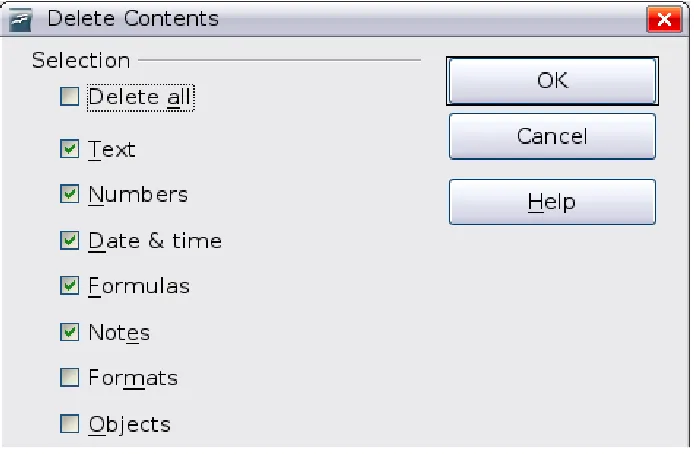
Contents, or use Edit > Delete Contents) to open the Delete Contents dialog (Figure 33). From this dialog, different aspects of
the cell can be deleted. To delete everything in a cell (contents and format), check Delete all.
Figure 33: Delete Contents dialog
Replacing all the data in a cell
To remove data and insert new data, simply type over the old data. The new data will retain the original formatting.
Changing part of the data in a cell
Sometimes it is necessary to change the contents of cell without
removing all of the contents, for example if the phrase “See Dick run” is in a cell and it needs to be changed to “See Dick run fast.” It is often useful to do this without deleting the old cell contents first.
The process is the similar to the one described above, but you need to place the cursor inside the cell. You can do this in two ways.
Using the keyboard
After selecting the appropriate cell, press the F2 key and the cursor is placed at the end of the cell. Then use the keyboard arrow keys to move the cursor through the text in the cell.
Using the mouse
Using the mouse, either double-click on the appropriate cell (to select it and place the cursor in it for editing), or single-click to select the cell and then move the mouse pointer up to the input line and click into it to place the cursor for editing.
Formatting data
The data in Calc can be formatted in several ways. It can either be edited as part of a cell style so that it is automatically applied, or it can be applied manually to the cell. Some manual formatting can be
applied using toolbar icons. For more control and extra options, select the appropriate cell or cells range, right-click on it, and select Format Cells. All of the format options are discussed below.
Note All the settings discussed in this section can also be set as a part of the cell style. See Chapter 4 (Using Styles and Templates) for more information.
Formatting multiple lines of text
Multiple lines of text can be entered into a single cell using automatic wrapping or manual line breaks. Each method is useful for different situations.
Using automatic wrapping
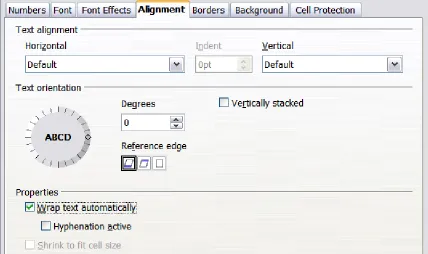
[image:53.595.59.487.475.729.2]To set text to wrap at the end of the cell, right-click on the cell and select Format Cells (or choose Format > Cells from the menu bar, or press Ctrl+1). On the Alignment tab (Figure 34), under Properties, select Wrap text automatically. The results are shown in Figure 35.
Figure 34: Format Cells > Alignment dialog
Figure 35: Automatic text wrap
Using manual line breaks
To insert a manual line break while typing in a cell, press Ctrl+Enter. This method does not work with the cursor in the input line. When editing text, first double-click the cell, then single-click at the position where you want the line break.
When a manual line break is entered, the cell width does not change. Figure 36 shows the results of using two manual line breaks after the first line of text.
Figure 36: Cell with manual line breaks
Shrinking text to fit the cell
The font size of the data in a cell can automatically adjust to fit in a cell. To do this, select the Shrink to fit cell option in the Format Cells dialog (Figure 34). Figure 37 shows the results.
Figure 37: Shrinking font size to fit cells
Formatting numbers
Several different number formats can be applied to cells by using icons on the Formatting toolbar. Select the cell, then click the relevant icon. Some icons may not be visible in a default setup; click the down-arrow at the end of the Formatting