Study of Concrete by Replacement of Lateritic
Soil as a Partial Replacement in the Fine
Aggregate
Gara Saichand1, Mallavarapu Rama Harshitha2
1
Assistant Professor, Department of Civil Engineering, PACE ITS, Vallur, Andhrapradesh- 523002,India. 2
Assistant Professor, Department of Civil Engineering, PACE ITS, Vallur, Andhrapradesh- 523002,India
Abstract: Concrete producing trade is one in all the carbon emitting sources besides deforestation and burning of fossil fuels the world cement trade contributes regarding seven-membered green house gases emissions to earths atmosphere..so as to handle environmental effects related to cement producing and perpetually depleting natural resources,theres a need to develop different binders to form concrete trade property.sand is the main component in the concrete.due to different environmental issues like river erosion,or any other windforces scarcity of river sand is happening. So as to preserve these type of river sand etc., alternative need for sand is searched and laterite soil which is available as local saoil will helps to replace the sand portion thereby to control the scarcity of sand. this work examines the chance of utilization of lateritic soil was partly replaced as 5%-25% of fine aggregate in concrete for M25 grade and tested for its compressive strength,durability,water absorption and dry density up to twenty-eight days and compared with typical concrete.from the results obtained,its found that lateritic soil may be used as fine aggregate replacement upto 10% by weight..
Keywords: Compressive strength, Durability, Dry density, Lateritic soil, split tensile strength, water absorption, workability.
I. INTRODUCTION
Construction activities are taking place on huge scale all over the world and demand of construction materials are increasing day by day. Production of concrete and utilization of concrete has rapidly increased, which results in increased consumption of natural aggregates and sand. Aggregate is one of the main ingredients in producing concrete which covers 75% of the total for any concrete mix. Strength of concrete produced is dependent on the properties of aggregates used conventionally concrete is mixture of cement, sand and aggregates since all the ingredients of the concrete are of geological origin, the construction industries are in stress to identify alternative materials to replace the demand achieving a strong, durable concrete rests in the careful proportioning, mixing and compacting of the ingredients. Lateritic is a soil and rock type rich in iron and aluminum and is commonly considered to have formed in hot and wet tropical areas. Nearly all laterities are rusty-red coloration because of high iron oxide content.They develop by intensive and prolonged weathering (linearization) is a prolonged process of chemical weathering which produces a wide variety in the thickness,grade, chemistry and ore mineralogy of the resulting soils.Laterities are formed from the leaching of parent sedimentary rocks(sandstone, clays,limestone) This project is mainly to know the importance of lateritic soil replacement in concrete.
II.OBJECTIVE A. The objectives of this Paper Is
1) To study the influence of partial replacement of sand with lateritic soil and fine aggregates to compare it with the compressive and tensile strength of ordinary M25 concrete.
2) We are also trying to find the percentage of lateritic soil by sand replaced in concrete that makes the strength of the concrete maximum.
III. MATERIALS USED AND METHODOLOGY
A. Cement and Aggregates
B. Lateritic Soil
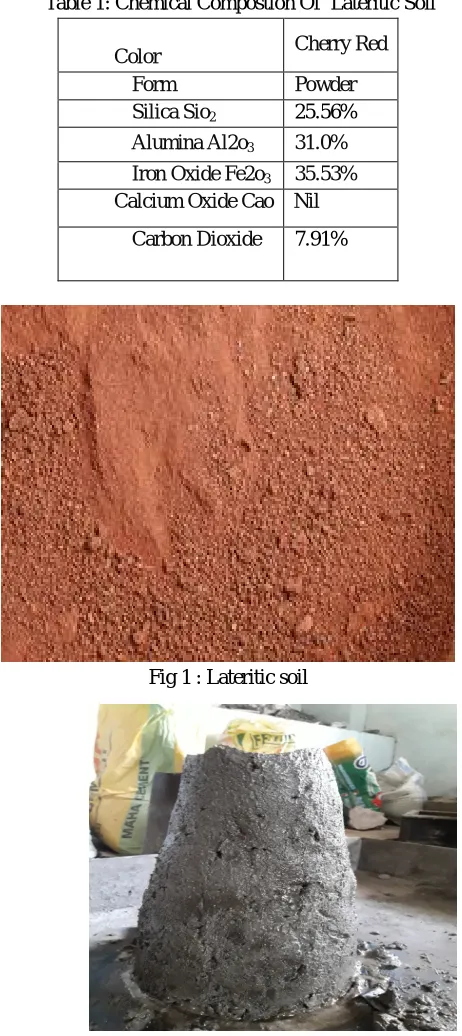
[image:2.612.192.423.186.704.2]Literate soil was first studied by F. Buchanan in 1905. The name was derived from the Latin word ‘Later’ meaning brick. Literate is a soil and rock type rich in iron and aluminum and is commonly considered to have formed in hot and wet tropical areas. This soil is rusty red color because of high iron oxide content. These are formed from the weathering of parent rock. Chemical composition of literate soil/gravel varies widely based on genesis, climate conditions, and age of laterization. Lateritic soil contains more than 60% Fe203 and little of Al203. The chemical analysis of Indian soils shows that soils rich in iron and aluminum but poor in nitrogen, potassium, lime and organic matter
Table 1: Chemical Compostion Of Lateritic Soil
Color Cherry Red
Form Powder
Silica Sio2 25.56%
Alumina Al2o3 31.0%
Iron Oxide Fe2o3 35.53%
Calcium Oxide Cao Nil
Carbon Dioxide 7.91%
Fig 1 : Lateritic soil
IV. EXPERIMENTAL INVESTIGATION
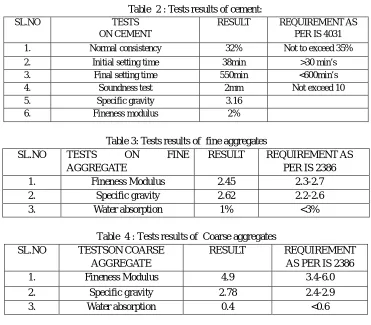
Table 2 : Tests results of cement:
SL.NO TESTS
ON CEMENT
RESULT REQUIREMENT AS
PER IS 4031
1. Normal consistency 32% Not to exceed 35%
2. Initial setting time 38min >30 min’s
3. Final setting time 550min <600min’s
4. Soundness test 2mm Not exceed 10
5. Specific gravity 3.16
6. Fineness modulus 2%
Table 3: Tests results of fine aggregates
SL.NO TESTS ON FINE
AGGREGATE
RESULT REQUIREMENT AS
PER IS 2386
1. Fineness Modulus 2.45 2.3-2.7
2. Specific gravity 2.62 2.2-2.6
3. Water absorption 1% <3%
Table 4 : Tests results of Coarse aggregates
SL.NO TESTSON COARSE
AGGREGATE
RESULT REQUIREMENT
AS PER IS 2386
1. Fineness Modulus 4.9 3.4-6.0
2. Specific gravity 2.78 2.4-2.9
3. Water absorption 0.4 <0.6
V.MIX PROPORTIONS
The concrete mix design of M25 grade concrete by using IS 10262-2009 with water cement ratio of 0.45.
Table 5: Mix Proportions LATERITE
SOIL %
W/C RATIO
CEMENT kg/m3
LATERITE SOIL kg/m3
FINE AGGRGATE kg/m3
COARSE AGGREGATE kg/m3
WATER kg/m3
0% 0.45 3.28 0 3.28 4.36 3.15
5% 0.45 3.28 0.164 3.16 4.36 3.16
10% 0.45 3.28 0.328 2.95 4.36 3.17
15% 0.45 3.28 0.492 2.78 4.36 3.19
20% 0.45 3.28 0.656 1.96 4.36 3.11
Table 6: Tests Results Of Workability Tests
LATERITIC SOIL % SLUMP VALUE
(MM)
COMPACTION VALUE (MM)
0% 24 0.94
5% 23 0.84
10% 22 0.85
15% 18 0.94
20% 14 0.82
Table 7: Compressive test results(N/mm²):
M1,M2.., M4 = Mix trail 0,Mix1,Mix2..,
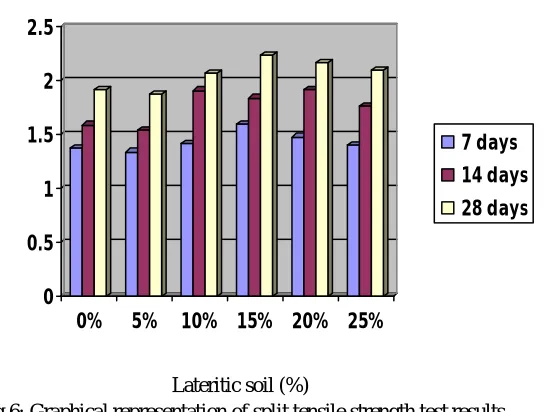
Table 8: Split tensile test results(N/mm²):
MIX DESIGNATION PERCENTAGE OF
LATERITIC SOIL %
7 DAYS 14 DAYS 28 DAYS
M0 0 1.38 1.59 1.92
M1 5 1.34 1.54 1.88
M2 10 1.42 1.91 2.07
M3 15 1.60 1.84 2.24
M4 20 1.48 1.92 2.17
M5 25 1.40 1.76 2.10
VI. RESULTS AND DISCUSSION
[image:4.612.57.546.270.694.2]
Lateritic soil (%)
Fig 5: Graphical representation of compressive strength test results
MIX DESIGNATION PERCENTAGE OF
LATERITIC SOIL %
7 DAYS 14 DAYS 28 DAYS
M0 0 20.72 22.01 26.55
M1 5 20.14 23.02 26.62
M2 10 20.44 24.54 28.14
M3 15 21.59 22.03 30.37
M4 20 19.20 21..02 28.88
M5 25 19.05 19.57 27.22
C
om
p
re
ss
ive
s
tr
e
n
gth
N
/m
m
²
0 5 10 15 20 25 30 35
0% 5% 10% 15% 20% 25%
[image:5.612.186.459.115.321.2]
Lateritic soil (%)
Fig 6: Graphical representation of split tensile strength test results
Mechanical behaviour of concrete cubes prepared without chemical admixtures was studied by compressive tests (Grade M25and curing time of 7,14 and 28 days. It can be noticed that 10% replacement of sand with lateritic soil in mild condition, are showing increase in compressive strength.
VII. CONCLUSION From the results obtained , the following conclusions are taken as:
A. Reflection of lateritic beam is more than deflection of ordinary beam but within the limit.
B. Hence it is recommended for structural concrete up to 10% replacement of fine aggregate with lateritic soil and save 25% in cost of fine aggregates
C. The load deflection behaviour of lateritic beam under flexure is found to be bilinear.
D. From the result it can be seen that the maximum tensile strength is obtained at 10% replacement of lateritic soil.
REFERENCES
[1] S.K. Jain, P.G. Patil, N.J. Thakor, Engineering properties of laterite stone scrap blocks, Agricultural Engineering International: CIGR Journal. Vol.13, No.3, 2011. No.1738.
[2] S.K. Jain, P.G. Patil, N.J. Thakor, Engineering properties of laterite stone scrap blocks, Agricultural Engineering International: CIGR Journal. Vol.13, No.3, 2011. No.1738.
[3] K.Muthusamy and N.W.Kamaruzamanm, Assessment of Malaysian Laterite Aggregate in Concrete, International Journal of Civil & Environmental Engineering Vol:12 No:04 PP 83-86, ISSN:1213804-5757
[4] IS: 383-1970, Indian standard specification for coarse and fine aggregate from natural sources for concrete, Bureau of Indian Standards, New Delhi, India. [5] Wikipedia, 2012 b, About lateritic formation in Karnataka .< http://en.wikipedia.org/wiki/ Geography _of_ Karnataka
S
p
li
t
te
n
si
le
st
r
e
n
gth
N
/m
m
²
0 0.5 1 1.5 2 2.5
0% 5% 10% 15% 20% 25%