Flexible Optical Waveguide Bent Loss Attenuation Effects
Analysis and Modeling Application to an Intrinsic Optical
Fiber Temperature Sensor
Mustapha Remouche, Francis Georges, Patrick Meyrueis
Laboratoire des Systèmes Photoniques, École Nationale Supérieure de Physique de Strasbourg, Université de Strasbourg, Strasbourg, France
Email: [email protected]
Received November 29, 2011; revised December 20, 2011; accepted January 12, 2012
ABSTRACT
The temperature dependence of the bending loss light energy in multimode optical fibers is reported and analyzed. The work described in this paper aims to extend an initial previous analysis concerning planar optical waveguides, light en-ergy loss, to circular optical waveguides. The paper also presents a novel intrinsic fiber optic sensing device base on this study allowing to measure temperatures parameters. The simulation results are validated theoretically in the case of sil-ica/silicone optical fiber. A comparison is done between results obtained with an optical fiber and the results obtained from the previous curved optical planar waveguide study. It is showed that the bending losses and the temperature measurement range depend on the curvature radius of an optical fiber or waveguide and the kind of the optical wave- guide on which the sensing process is implemented.
Keywords: Optical Fiber; Losses; Curvature; Sensor; Temperature; Micro Technology
1. Introduction
A curvature effect is easily reached with optical fibers; therefore many laboratories have investigated the effects of curvatures on optical fiber measuring responses. Grat- ings implemented in optical fibers provide measuring performances related to bending that were also investi- gated [1-12]. Therefore, the power attenuation coefficient of bent fibers is one of the parameters that must be de-termined for using the fiber as a transducer.
In previous paper [1], we described a geometrical me- thod to determine the local numerical aperture and the light output power attenuation with the bending of an optical waveguide. We showed that this method can be applied only when the optical waveguide is curved dur- ing the manufacturing at a temperature close to glass melting. In this case, the core and the cladding refractive index are modified by temperature effects independently of the curvature radius.
In this a previous work [1], we described a set of methods for using a flat optical waveguide as a trans-ducer for measuring temperature by bending, in which only some transmitted light intensity effects are involved. We also investigated previously some photonic effects allowing using a multimode integrated optical waveguide as an intrinsic temperature sensor operating by light
in-tensity modulation at the output of the sensor.
The purpose of this new work is to extend the analysis of the planar optical waveguide response to the tempera-ture [1], to a circular optical waveguide.
An optical fiber is a good example of cylindrical opti-cal waveguide. The optiopti-cal fiber bending loss phenomena is used as a transduction effect in some types of intrinsic optical fiber sensors (temperature, displacement, strain…) [1,2,13-20].
The step-index optical fiber that we use is curved dur-ing its manufacturdur-ing at a high temperature. A geometri-cal modeling is used to describe the light propagation in the optical fiber and to determine the light power at-tenuation at the output of the fiber due to the fiber bend-ing. In this case the geometrical approach is similar to the one presented for the planar waveguide sensing model-ing.
2. Analysis If the Power Attenuation with the
Bending of an Optical Fiber
The guidance of the core rays in a straigth step-index optical fiber is achieved by ensuring that the propagation angle , satisfies the condition: 0 c, where the
critical angle, c, and the critical angle, c, are given re-
1 2 1 cos
c n n
and 1
2 1 sin
c n n
. The numeri-cal aperture (NA) is given at T0 by:
2 2
1 2 1sin 1 2NAn n n . n1 and n2 are the core and the cladding refractive index respectively [1].
When the optical fiber is bent with a curvature radius
R (Figure 1), the local numerical aperture at a given lo-cation of the optical fiber curved part will be changed. In a meridional-plane of the optical fiber, when the position angle at the beginning of the bend is = 0˚ or 180˚, the optical fiber behavior becomes iden al to the one an optical planar waveguide [1], and the local numerical aperture NA1 is given, at T0, by:
tic
1 2 2 2
2 2
0 1 1 2
0 1
, sin 1
l
n R
NA R n n
R n
(1)
where is the fiber core radius and r
R 0
perture wheris the abscissa on the input optical fiber a e the origin is “O”. “0” will satisfy the relation: 0. However, in all others optical fiber planes, when 0
e cal-and 180˚, the local numerical aperture, NAl, can
culated by using Equation (1), where the quantity
R 0 cos
b
replaces
R0
and “0” to satisfy 00
the relation: , the local numerical aperture of a cu ndex optical fiber is given by:
. Finally -i
rved step
1 2 2 2
2 2
0 1 2
0 1
, , 1
cos l
n R
NA R n
R n
(2)
where is required to satisfy the relation: 0 2π. Equation (2) becomes identical to equation:
2 2
1 2A n n when R is infinite (straight o
omes identical to Equation (1) when = 0˚ or 180˚ (bent step-index optical planar waveguide case). We used the silica/silicone step-index optical fiber with the following characteristics at T0, for a wavelength
= 633 nm: n1 = 1.4570, n2 = 1401, 2 = 200 µm and A = 0.4000.
In Figure 2, we pl 1 2
N ptical fi-
ber case) and bec
N
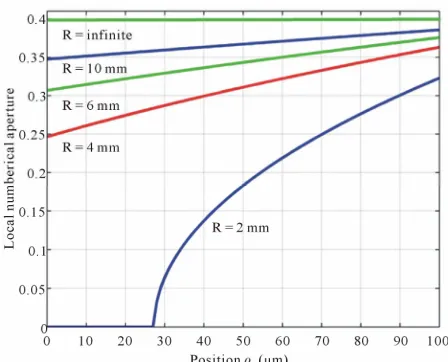
ot the local numerical aperture, at T0 for various values of R, as a function of the position “0” with a value of . It is clearly seen that the local numeri-cal aperture increase with the increase of the values of R
X Y
P
0
ρ
C
y
x
Z
[image:2.595.310.534.84.265.2]R
Figure 2. Local numerical aperture according to the pos tion “” for several values of R with = 135˚.
l aperture is btained when the angle is equal to 180˚.
lines,
the optical fiber from the cr
i-0
and 0. The maximum of the local numerica o
3. An Approach of the Description of the
Light Propagation in a Bent Optical Fiber
The ray paths in the core of a step index fiber are straightbut the geometrical description is more compli-cated than in a planar waveguide, that we analyzed pre- viously [1], due to the presence of the skew rays and of the depending on when the optical fiber is curved. In the bent planar waveguide [1], the angle of incidence of a ray on the outer core-cladding interface remains the same along a given ray path, and this property is true for all the ray paths. However, in the bent optical fiber, only the rays entering the bent part of the fiber in the meridional- plane containing this bent part behave in this manner. For the skew rays entering this plane, the subsequent reflec- tions within the core do not follow a simple repeatable pattern because of the asymmetry introduced by bending the fiber. The complicated form of the ray invariants [3] and the differential equations describing the ray path offer no possibility of a simplification. We therefore pro- pose a numerical technique for tracing each ray sepa- rately along the bent fiber.
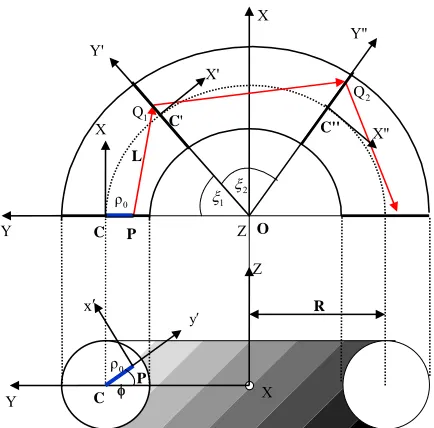
In the Figure 3, we consider an arbitrary incident ray entering the bent section of
oss section X'X at point “P” at the beginning of the bent
part ( = 0). The bent part of optical fiber forms a torus portion by the revolution of the circular cross section about the origin “O” with a radius R. The axis system OXYZ has an axis OX pointing directly into the paper. A
local coordinate system ox'y'z' with oz' pointing into the
paper is also indicated at P. An arbitrary ray, incident at
“P”, has its direction cosines
(cosx,cos cos ,cos cosi z) relative to ox'y'z'. The
Figure 1. Schematic presentation of a section of a fiber ben with an arc of radius R.
[image:2.595.59.285.617.709.2]From the point of the first reflection “Q1” on the opti-cal fiber torus, the optiopti-cal ray is reflected to another point on the surface of the torus (core-cladding interface) around the bend.
X Y Y X X C
C' C''
Y'' Y' X' X'' 2 Q 1 Q O 1
2
P P 0 ρ 0 ρ
After the first reflection all solutions for the distance “L” to the next reflection are given as solutions of the
cubic problem. For obtaining the cubic equation, we must replace 0 by in the quadratic equation.
L
Some simple coordinates rotations and translations simplify the calculation of the incident and the reflected ray angles at each reflection point [2]. The reflected ray direction cosines at “Q1” are given by multiplying a ma-trix transformation “M” by the direction cosines a “P”
[image:3.595.63.280.84.298.2]where: C y x Z Z R
1 Direction cos cosines cos at cos x i z M Q (7)Figure 3. Schematic presentation of a section of a fiber bent with the curvature following an arc having a radius R.
With: (see Equation (8)).
vector OP is given by:
0,R 0cos , 0sin
OP (3)
where the distance of the point “P” from th
is 0, if we let r be a point along the ray dis
Y(4) If the ray meets the torus at “ ” then we can write
e fiber center tant “L” from
A rotation around “ 1” will bring the local x-axis tan-gential to the surface of the torus at 1. This rotation is
. All the others parameters were defined previously. Q
Q
Having determined the geometry of the ray path, we can then calculate the fractional power loss at each re-flection point along a given path by using the following equation:
“P” then:
ˆ cos cos
L X
r P
P
0 exp
(9)
0
0
ˆ cos cos cos sin cos cos
ˆ sin cos cos sin
z x i i R L L Z
where is the attenuation coefficient of each ray, which varies from one reflection to the next one along the bent optical fiber, it is given by:
1 1Δ
N N
i
i T i i
(10) 1Q
1 PQ
L , where ” is the position of the first ref
tio
“Q1 lec- where Δ is the angular separation between two suc-cessive reflections and N is the total number of reflec-tions. We can then use the Generalized Fresnel’s Law to calculate the transmission coefficient at each reflec-tion point along a given path. i
T
n. At “Q1”, we have:
ˆ ˆ
sin cos
R X R Y
r (5)
And this gives the angular distance ar of the bent optical fiber curvature:
ound the axis
An algebraic expression for the transmission coeffi-cient of the refracted rays (V 1), is given by [3,11,12]: ˆ ˆ
tan rX rY (6)
1 1 22
2 4 i y y y y K K T K K
(11)
1
POQ
1 corresponds to angl we deduce an equation which wil
of he in
e. From Equation (6), l provide, as a function the position “L”, t tersection of the optical ray
with the bent optical fiber core-cladding interface. The smallest real positive solution of the equation represents the distance “L1”.
where Ky1 and Ky2 are given by: Ky1 k1cosi and
2
1 2
2 2
1 sin c sin i y
K k and: k12πn1 .
cos cos sin cos sin sin cos sin cos cos sin sin sin cos cos cos sin sin cos cos cos cos sin cos
sin sin sin coss cos
For tunneling rays when , the transmission coef-ficient at a reflection poi dius
1 V
nt of the ra c is given by:
Ky11Ky22
3 where the parameter “V” is given by: 3 2 2
4 4
exp
y y i
K K
T V (12)
2 2 2
1 2
sin 2 sin
1
2 sin
c c
c i
k
V i
(13)
The parameter c is the radius of curvature of the
core-cladding in in the incidence plane at “0”. It is defined by the normal to the interface and
ray direction. It is given by [3,11,12]: terface
the incident
2
2 2
sin
cos cos
x z i
c
x z z x
(14)
where x and z R cos.
When , the transmission coefficient is given by:
0 V
2
1
cos 1
3.18
i 2 2π sin
c
T
n
c c
(15)
re are s
dence angles close to
But the ome optical rays that reach the interface
with inci c.
at the Finally, the total intensity end length “
of the angular
” of the bent part of the optical waveguide is fo
f
und by a quadruple summation of Equation (9) across the cross-sectional area (r,) o the optical fiber at X'X
and the distribution of the ray angle (,) [3,11,12]:
2π 2π
0 0 d 0 d 0 cos sin d 0 d exp
c s
P P
r r
(16) We plot in Figure 4 the normalized power attenuation against the normalized distance (z/) along the bent fib
axis for a step index optical fiber. Where “z” is the cur-
vature length (z = R·). Each curve shows the same
ac
th
er
char- teristics. Initially, there is the transition region, having a rapid power loss. This region dominated by the re- fracted rays and tunnel rays with the largest attenuation coefficient. The behavior of the bent part of the fiber is similar to the planar waveguide bent part [1], but the loss of power in the transition region is not as important, since only a few rays close the meridional plane have large losses.
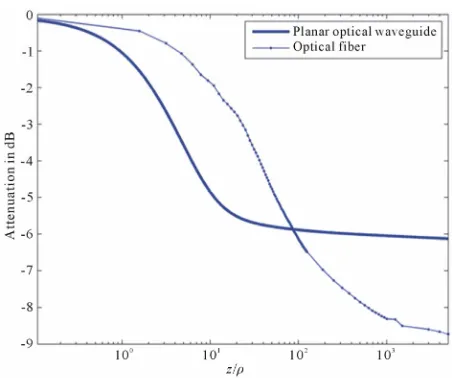
In Figure 5, we plot the normalized power attenuation against normalized distance (z/) along the bent planar
waveguide and along the bent optical fiber for the same curvature radius (R = 2 mm). Beyond the transient region,
[image:4.595.309.535.84.267.2]the loss of power for a bent optical fiber case is higher an for the bent planar waveguide. This is because the
Figure 4. Intensity attenuation according to the ratio (z/) in the step profile optical fiber for several values of R.
Figure 5. Intensity attenuation comparison between a bent planar waveguide and the bent optical fiber for the same curvature radius (R = 2 mm).
skews rays can pass through the regions of high attenua- tion, although they may initially have a low attenuation.
4. Temperatures Measurements Principle by
Using a Bent Optical Fiber as a
Transducer
itive element is the curved art of the fiber (Figure 6). This sensor principle is based
light energy losses induced by the bending effect of the
eff ty is
modu-lat mperature variations.
The optical fiber sensor that we propose is an intrinsic optical fiber sensor; the sens
p
on the variations of the sensing fiber output light inten-sity according to the fiber temperature variations. The
fiber will be compensated dynamically by the thermal ect; consequently, the output signal intensi
[image:4.595.55.285.96.213.2] [image:4.595.310.536.308.497.2]LED
Photodiode Optical fiber
Core in Silica
R
Buckled fiber (sensor sensitive part)
[image:5.595.151.449.88.199.2]Cladding in Silicone
Figure 6. Temperature sensor general diagram.
5. The Temperature Effect on a Local
Numerical Aperture inside a Bent Optical
Fiber
or a given radius (R = R0) of the op
in-pe
F tical fiber curvature
and from Equation (2), the local numerical aperture side this bent portion of the fiber according to the
tem-rature is written in the following way:
0 0
1 2 2 2
2 0
2 0
1 0 2
0 0 1 0
, , ,
, , 1
cos ,
l
NA R T
n R T R
n R T
R
n R T
(17)
where the core refractive index and the cladding refrac-tive index are written according to the temperature the following way [1].
,(T) in
1 0, 1 0 1 0
n R T n T K TT
2 0, 2 0 2 0
n R T n T K TT (18) The coefficient K1dn1 dT and K2dn2 dT are respectively the thermo-optic coefficient of core the re-fractive index and the thermo-optic coeff
ding the refractive index. K1 = –3.78 × 10 1.7744 × 10⁻⁵/˚C.
lymers poss ique set of p
s [22-26].
icient of
clad-−4/˚C and K2 = Silicone-based po ess a un rop-erties that makes them highly suitable for optical applica-tions. The excellent thermal stability (−115˚C to 260˚C) allows this material to be useful for high temperature sensing application
In this optical fiber the small positive thermo-optic coefficient effect in inorganic glass waveguides used as the core is canceled out by using the negative thermo- optic coefficient of polymers used to constitute the clad-ding.
For an applied temperature T, we plot in Figure 7 the local numerical apertures in an optical fiber according to the value of “0”. We observe that the local numerical aperture increases when the applied temperature in-creases. Consequently, an optical ray unguided at room
6. Bent Optical Fiber Temperature Response
as a Sensor
alyze the effect of the temperature propagation in a curved optical en
out end of the transducer bent part of the
temperature becomes guided at temperature greater than
T0.
fiber. We pres t the effects of the curvature radius on the optical fiber temperature response. For this analysis, the curvature radius R and the length of the bent part of the optical fiber () are given. The refractive index of the core and the cladding of the optical fiber depend on the In this section, we an
variations on the light
temperature. The geometrical model is used to evaluate the light output power according to the temperature. The
put power at the fiber is given by:
2π
0 0 0 0 0
π
0 2
0
, d d co
s s
in d
d exp ,
c s
P R T P r r
R T
(19)
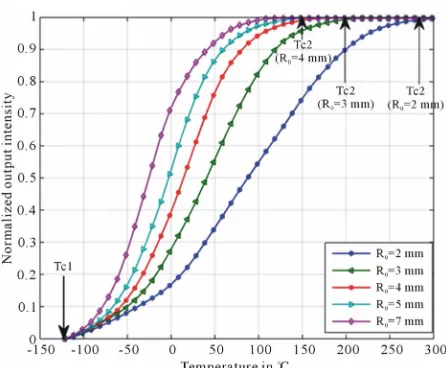
For a given curvature length ( = 2R0), we plot in Figure 8 the normalized output light intensity response of the sensor to the temperature variations for several values of R0.
The response curve of the optical fiber operating as a
[image:5.595.311.535.520.691.2]Figure 8. Transmission rate according to the temperature for various curvature radiuses.
temperature sensor that we propose in Figure 8 is similar to the one of a planar waveguide temperature sensor [1]. For this first approach we have not considered errors measuring protocols. We note that the transmission rate (P/P0) increases when the local numerical aperture is increasing up to a saturation level. Each curve is corre-sponding to the recovery of the losses induced by the refracted optical rays and the recovery of the losses in-duced by the tunnel effect, up to saturation. We can say that the temperature sensing range of the temperature optical fiber that we propose depends on the curvature radius of the optical fiber.
We deduce from Figure 8 the following statements:
The part of the response curve between Tc1 and T0 is corresponding to intensity losses caused only by the
rve between T0 and Tc2 is corresponding to intensity losses caused only by the temperature effect.
The part of the response cu
optical fiber curvature.
The linear region of the optical fiber temperature sen- sor response is increasing when the curvature radius of the bent fiber is decreasing.
The sensor sensitivity is given by:
0
d ,
d
P R T S
T
(20)
[image:6.595.309.535.86.271.2]where P(R0,T) is the output intensity. We deduce from Figure 8 that the sensitivity of the temperature sensor is inversely proportional to the curvature radius.
Figure 9 shows the temperature response curve fitting
for R0 = 2 mm. In the liner zone between 20˚C and 180˚C, this sensor has a sensitivity of 0.004˚C−1.
7. Conclusion
The response to temperature variations on the bending
Figure 9. The temperature response curvefittingfor R0 = 2
light power loss of a multimode optical fiber with differ-ent bdiffer-ent fiber curvature radii have been analyzed. It has been found that the bending losses due to the internal optical fiber numerical aperture variations increase when the fiber bending angle increase. The more important losses are caused by refraction and tunnel effects. We have shown that a bent optical fiber can be used as a temperature transducer. The use of an optical fiber curved during its manufacturing at high temperature allows to minimize some residual mechanical effects, and allows to use rigorously the geometrical approach to describe the light propagation, to evaluate the losses in light power output values and to calibrate the temperature sen- sor. We have shown that if we use, for example a silica/ silicone fiber as a transducer, we can obtain good per-
ermo-optic effect value on mm between 20˚C and 180˚C.
formances with an excellent sensitivity and an excellent linearity associated to a large temperature measurement
ange, mainly because the th r
the silicone is negative and important.
REFERENCES
[1] M. Remouche, R. Mokdad and A. Chakari, “Intrinsic Integrated Optical Temperature Sensor Based on Wave- guide Bend Loss,” Optics & Laser Technology, Vol. 39, No. 7, 2007, pp. 1454-1460.
doi:10.1016/j.optlastec.2006.09.015
[2] M. Remouche, R. Mokdad and M. Lahrashe, “Intrinsic Optical Fiber Temperature Sensor Operating by Modula-tion of the Local Numerical Aperture,” Optical Engi-neering, Vol. 46, No. 2, 2007, p. 024401.
doi:10.1117/1.2709854
[3] A. W. Snyder and J. D. Love, “Optical Waveguide The-ory,” Chapman & Hall, Upper Saddle River, 1983. [4] A. Zendehnam, M. Mirzaei1 and A. Farashiani,
ickhoff, “Be Induced Birefringence in Single-Mode Fibers,” Optics Letters, Vol. 5,
doi:10.1364/O
Pramana Journal of Physics-Indian Academy of Sciences, Vol. 74, No. 4, 2010, pp. 591-603.
[5] R. Ulrich, S. C. Rashleigh and W. E nding-
No. 6, 1980, pp. 273-275. L.5.000273
[6] E. A. J. Marcatilli, “Bends in Optical Dielectric Guides,” Bell System Technical Journal, Vol. 48, No. 7, 1969, pp. 2103-2132.
[7] D. Gloge, “Bending Loss in Graded and Upgraded Core Index,”
Multimodes Fibers with Applied Optics, Vol. 11, No. 11, 1972, pp. 2187-2506.
doi:10.1364/AO.11.002506
[8] D. Marcuse, “Influence of Curvature on the Losses of Doubly Clad Fibers,” Applied Optics, Vo
1982, pp. 4208-4213. doi:10.1364/AO.21.004208l. 21, No. 23, [9] M. Semenkoff, “Bending Effect on Light Propagation in
an Optical Fiber: Application to a Temperature Sensor,” Optics and Lasers in Engineering, Vol. 17, No. 3-5, 1992, pp. 179-186. doi:10.1016/0143-8166(92)90035-6
[10] D. Marcuse, “Bending Losses of the Asymmetric Slab Waveguide,” Bell System Technical Journal, Vol. 50, No.
al Wave-c StruWave-ctures,” Optik, V
ptical Fibers,” Electron Letter, Vol. 10, No. 8, 1969, pp. 2551-2563.
[11] A. W. Snyder and D. J. Mitchell, “Generalized Fresnel’s Laws for Determining Radiation Loss from Optic
guides and Curved Dielectri ol. 40, No. 4, 1974, pp. 438-459.
[12] A. W. Snyder and D. J. Mitchell, “Bending Losses of Multimode O
1, 1974, pp. 11-13. doi:10.1049/el:19740008
[13] J. Dakin, “Optical Fiber Sensors,” Artech House, Nor-wood, 1988.
[14] T. S. Yu Francis, “Fiber Optical Sensors,” Marcel Dekker
Reso-, Inc.,New York, 2002.
[15] F. Pang; W. Liang and W. Xiang, “Temperature-Insensi- tivity Bending Sensor Based on Cladding-Mode nance of Special Optical Fiber,” IEEE Photonics Tech- nology Letters, Vol. 21, No. 2, 2009, pp. 76-78.
doi:10.1109/LPT.2008.2008657
[16] R. P. Hu and X. G. Huang, “A Simple Fiber-Optic
Flow-, 2009Flow-, pp. 1952-1955.
meter Based on Bending Loss,” IEEE Sensors Journal, Vol. 9, No. 12
doi:10.1109/JSEN.2009.2031845
[17] R. M. Gavalis, P. Y. Wong and J. A. Eisenstein, “Local- ized Active-Cladding Optical Fiber Bend Sensor,” Opti- cal Engineering, Vol. 49, No. 6, 2010, p. 064401. doi:10.1117/1.3449110
[18] X. Chen, C. Zhang and D. J. Webb, “Bragg Grat Polymer Optical Fibre for Strain
ing in a , Bend and Temperature
n, “Plastic Optical on Dual Cycling Bend- Sensing,” Measurement Science and Technology, Vol. 21, No. 9, 2010, p. 094005.
[19] J. H. Kuang, P. C. Chen and Y. C. Che Fiber Displacement Sensor Based
ing,” Sensors, Vol. 10, 2010, pp. 10198-10210. doi:10.3390/s101110198
[20] J. Zhang, H. Liu and X. Wu, “Curvature Optical Fib Sensor by Using Bend
er Enhanced Method,” Frontiers of Optoelectronics in China, Vol. 2, No. 2, 2009, pp. 204- 209. doi:10.1007/s12200-009-0032-x
[21] N. singgh, V. Mishra and S. C. Jain, “Enhanced Sensitiv- ity Refractive Index Sensor Based on Segmented Fiber
Guide- ariable Optical Attenuator with Bending,” Indian Journal of Pure & Applied Physics, Vol. 47, No. 9, 2009, pp. 655-657.
[22] Z. Zhang, G. Z. Xiao and P. Zhao, “Planar Wave Based Silica-Polymer Hybrid V
and Its Associated Polymers,” Applied Optics, Vol. 44, No. 20, 2005, pp. 2402-2408. doi:10.1364/AO.44.002402 [23] H. Ma, A. K.-Y. Jen and L. R. Dalton, “Polymer-Based
Optical Waveguides: Material, Processing, and Devices,”
02, pp. 1631-1643. Adv Mater, Vol. 14, No. 19, 2002, pp. 1339-1365. [24] M. Zhou, “Low-Loss Polymeric Material for Waveguide
Components in Fiber Optical Telecommunication,” Op- tical Engineering, Vol. 41, No. 7, 20
doi:10.1117/1.1481895
[25] L. Eldada, “Advance in Polymer Integrated Optics,” IEEE Journal of Selected Topics in Quantum Electronics, Vol. 6, No. 1, 2000, pp. 54-68.