DEVELOPMENT AND OPTIMIZATION OF VALUE ADDED BREAD
Puranik Vinita, *Mishra Neetu, Kumari
Centre of Food Technology, University of Allahabad, Allahabad, 211002
ARTICLE INFO ABSTRACT
Natural antioxidants or phytochemical antioxidants are secondary metabolites of plants. Ginger (Zingiber
carotene, ascorbic acid, terpenoids, alkaloids, and polyphenols such as flavonoids, flavones glycosides, rutin etc. It is an important commercial crop which is
its therapeutic benefits of ginger are mainly due to the presence of volatile oils. Consumption of bakery products in the country is increasing day by day and bread is a staple food having several attractive features. In the view of health
of incorporating ginger extract in wheat flour for the development of bread to provide a convenient food to supplement the diet
formulation for the development of value added bread. To optimize the quantity of sugar and ginger extract to be added, Response Surface Methodology (RSM) was used, while rest of the ingredient level was kept constant. The lower and upper limits
and 10 thirteen
scale. From the study, it was found that the bread having composition 17.93 g sugar, and 15 ml ginger extract per 100 g of bread was found optimum and the said formulation was acceptable and recommended for value added bread. The optimized bread was found to be s
minerals, calcium and iron as compared to control bread. Since, the bread was a good source of calcium and iron, hence it can be recommended for consumption for children and old age people. addition of ginger extract, also gave an e
control.
Copyright©2017, Puranik Vinita et al. This is an open access article distributed under the Creative Commons Att distribution, and reproduction in any medium, provided the original work is properly cited.
INTRODUCTION
Ginger (Zingiber officinale) is an important commercial crop belonging to the family Zingiberaceae grown for its aromatic rhizomes, which are used both as spice and medicine (Badreldin et al., 2008). It can be used fresh, dried and powdered, or as a juice or oil. Ayurvedic medicine u
for the treatment of arthritis (Thomson et al
traditional uses of ginger include colic, colds, fever, menstrual cramps and appetite stimulant (Chrubasik et al
supplements are widely available and include liquid extract, syrup, tea and capsules. The herbal therapeutic benefits of ginger are mainly due to the presence of volatile oils and the high oleoresin content. A compound known as gingerol (Bhattarai et al., 2001) is an acrid chemical constituent of the ginger, and this chemical compound is the agent responsible
*Corresponding author: Mishra Neetu,
Centre of Food Technology, University of Allahabad, Allahabad, 211002
ISSN: 0975-833X
Article History:
Received 15th October, 2016
Received in revised form 28th November, 2016 Accepted 18th December, 2016
Published online 31st January,2017
Citation: Puranik Vinita, Mishra Neetu, Kumari Archana and Tripathi Renu
surface methodology”, International Journal of Current Research
Key words:
Zingiber officinale,
Bread, Volatile oils, Oleoresin, Gingerol.
RESEARCH ARTICLE
DEVELOPMENT AND OPTIMIZATION OF VALUE ADDED BREAD USING RESPONSE SURFACE
METHODOLOGY
Mishra Neetu, Kumari Archana and Tripathi
Food Technology, University of Allahabad, Allahabad, 211002
ABSTRACT
Natural antioxidants or phytochemical antioxidants are secondary metabolites of plants. Ginger
Zingiber officinale) can be a major source of natural or phytochemical antioxidants such as beta carotene, ascorbic acid, terpenoids, alkaloids, and polyphenols such as flavonoids, flavones glycosides, rutin etc. It is an important commercial crop which is,
its therapeutic benefits of ginger are mainly due to the presence of volatile oils. Consumption of bakery products in the country is increasing day by day and bread is a staple food having several attractive features. In the view of health benefit of ginger it may be worthwhile to explore possibility of incorporating ginger extract in wheat flour for the development of bread to provide a convenient food to supplement the diet.. Present study was an effort to standardize the level of ginger
formulation for the development of value added bread. To optimize the quantity of sugar and ginger extract to be added, Response Surface Methodology (RSM) was used, while rest of the ingredient level was kept constant. The lower and upper limits for sugar and ginger extract were taken as 20 and 10-20 ml, respectively. Control treatment was prepared without ginger extract addition.
irteen combinations and control were subjected for sensory quality evaluation on a 9 point hedonic From the study, it was found that the bread having composition 17.93 g sugar, and 15 ml ginger extract per 100 g of bread was found optimum and the said formulation was acceptable and recommended for value added bread. The optimized bread was found to be s
minerals, calcium and iron as compared to control bread. Since, the bread was a good source of calcium and iron, hence it can be recommended for consumption for children and old age people. addition of ginger extract, also gave an excellent antioxidant effect on the bread compared with control. It can be recommended as one of the value added products.
is an open access article distributed under the Creative Commons Attribution License, which distribution, and reproduction in any medium, provided the original work is properly cited.
is an important commercial crop belonging to the family Zingiberaceae grown for its aromatic which are used both as spice and medicine It can be used fresh, dried and powdered, or as a juice or oil. Ayurvedic medicine utilizes it et al., 2002). Other traditional uses of ginger include colic, colds, fever, menstrual et al., 2005). Ginger supplements are widely available and include liquid extract, syrup, tea and capsules. The herbal therapeutic benefits of ginger are mainly due to the presence of volatile oils and the high oleoresin content. A compound known as gingerol is an acrid chemical constituent of the ginger, and this chemical compound is the agent responsible
Centre of Food Technology, University of Allahabad, Allahabad,
for the hot taste of ginger and is also one of the reasons that ginger possesses stimulating properties on the body
al., 2003). The aroma of ginger is pleasant and spicy and its flavor is penetrating, slightly biting due to antiseptic or pungent compounds present in it, which make it indispensable in the manufacture of a number of food products like ginger bread, confectionery, ginger ale, curry powder, certain soft drinks like cordials, ginger cocktail, carbonated drinks, bitters, etc. Ginger is also used for the manufacture of ginger oil, oleoresin, essences, tinctures, etc
Bakery products are an important source of nutrients viz. energy, protein, iron, calcium and several vitamins. Most bakery products can easily be enriche
cost with proteins and various vitamins and minerals to meet the specific needs of the target groups and vulnerable sections of the population, who are undernourished and malnourished. Since fortification and enrichment can be easi
is very important that more nutritious products should be produced in future (Sharma et al
having several attractive features mentioned above and these International Journal of Current Research
Vol. 9, Issue, 01, pp.45314-45319, January, 2017
INTERNATIONAL
OF CURRENT RESEARCH
Puranik Vinita, Mishra Neetu, Kumari Archana and Tripathi Renu, 2017. “Development and optimization o
International Journal of Current Research, 9, (01), 45314-45319.
USING RESPONSE SURFACE
Archana and Tripathi Renu
Food Technology, University of Allahabad, Allahabad, 211002
Natural antioxidants or phytochemical antioxidants are secondary metabolites of plants. Ginger can be a major source of natural or phytochemical antioxidants such as beta-carotene, ascorbic acid, terpenoids, alkaloids, and polyphenols such as flavonoids, flavones
used both as spice and medicine and its therapeutic benefits of ginger are mainly due to the presence of volatile oils. Consumption of bakery products in the country is increasing day by day and bread is a staple food having several benefit of ginger it may be worthwhile to explore possibility of incorporating ginger extract in wheat flour for the development of bread to provide a convenient . Present study was an effort to standardize the level of ginger extract in formulation for the development of value added bread. To optimize the quantity of sugar and ginger extract to be added, Response Surface Methodology (RSM) was used, while rest of the ingredient for sugar and ginger extract were taken as 20-30 g Control treatment was prepared without ginger extract addition. All combinations and control were subjected for sensory quality evaluation on a 9 point hedonic From the study, it was found that the bread having composition 17.93 g sugar, and 15 ml ginger extract per 100 g of bread was found optimum and the said formulation was acceptable and recommended for value added bread. The optimized bread was found to be superior in terms of minerals, calcium and iron as compared to control bread. Since, the bread was a good source of calcium and iron, hence it can be recommended for consumption for children and old age people. The xcellent antioxidant effect on the bread compared with It can be recommended as one of the value added products.
ribution License, which permits unrestricted use,
the hot taste of ginger and is also one of the reasons that ginger possesses stimulating properties on the body (Wang et . The aroma of ginger is pleasant and spicy and its flavor is penetrating, slightly biting due to antiseptic or ounds present in it, which make it indispensable in the manufacture of a number of food products like ginger bread, confectionery, ginger ale, curry powder, certain soft drinks like cordials, ginger cocktail, carbonated drinks, bitters, used for the manufacture of ginger oil, oleoresin, essences, tinctures, etc (Francisco et al., 2008). Bakery products are an important source of nutrients viz. energy, protein, iron, calcium and several vitamins. Most bakery products can easily be enriched and fortified at a low cost with proteins and various vitamins and minerals to meet the specific needs of the target groups and vulnerable sections of the population, who are undernourished and malnourished. Since fortification and enrichment can be easily carried out, it is very important that more nutritious products should be et al., 2013). Bread is a staple food having several attractive features mentioned above and these
INTERNATIONAL JOURNAL OF CURRENT RESEARCH
features enhance the value of producing bread from composite flours for organoleptic, economic and nutritional reasons. In places where soft wheat flour is not available or too expensive, it becomes economically necessary to produce bread from composite flours. Nutritionally, bread can be easily fortified with ginger extract to provide a convenient food to supplement the diet for better nutrition. Since consumption of bakery products in the country is increasing day by day and in the view of above health benefit of ginger, it may be worthwhile to explore possibility of incorporating ginger extract in wheat flour. Present study was an effort to standardize the level of ginger extract in formulation for the development of value added bread.
MATERIALS AND METHODS
Ginger used for this investigation were purchased from the local market. All required ingredients like as sugar, refined white flour, dry yeast, water and common salt and refined oil for greasing agent were purchased from local market of Allahabad. India. All the chemicals used in analysis were of AR (analytical reagent) grade. This work was carried out at Centre of Food Technology, University of Allahabad, Allahabad, U.P., India.
Preparation of aqueous ginger extract
The ginger was washed, drained and then grated with the help of grater and then the aqueous extract was prepared (Puranik et al., 2013) to incorporate it in the bread preparation.
Development and Optimization of value added bread
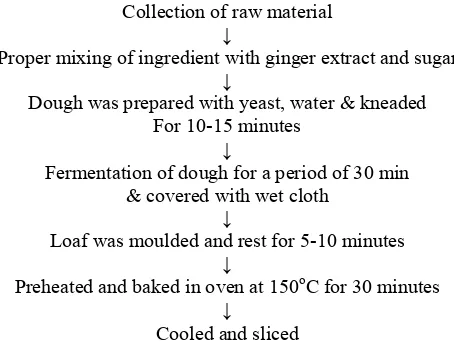
Bread was prepared as per the slightly modified method (Nazni and Gracia, 2014). The ingredients such as refined wheat flour, sugar and salt were mixed for 1-2min. Then, yeast dissolved in lukewarm water (30-35ºC), which is the optimum temperature for the yeast cells to be activated, and finally the extracts was added to the dry ingredients. All the ingredients were again mixed for 2min and during mixing, water was added to the mixture. After mixing, the dough was kept for fermentation for 30 min. After that, the dough was placed in aluminium baking pan for proofing at an incubation chamber at 35 ºC and 80% relative humidity for 30 min. Then, the samples were ready for baking. Baking of sample was conducted in a laboratory oven with air circulation at (150 ºC) for 30 min. The loaves were removed from the pans and cooled at room temperature. To optimize the quantity of sugar and ginger extract to be added, Response Surface Methodology (RSM) was used while rest of the ingredient like refined white flour, dry yeast, water and common salt (Girdhari Lal et al., 2010) level was kept constant on the basis of hit and trial method using 9-point hedonicscale. Response Surface Methodology (RSM) is a collection of statistical and mathematical technique useful for developing, improving and optimization process (Mugwiza Telesphore and He, 2009), for statistical and graphical analysis of the experimental data and also for monitoring the combined effects of variables (Philip John Kanu et al., 2007). The sugar (17.93 g) and ginger extract (15ml) was repeated 5 times as central points. The lower and upper limits for sugar and ginger extract were taken as 20-30g and 10-20ml, respectively. Control treatment was prepared without ginger extract addition. All 13combinations and control were subjected for sensory quality evaluation by 15 trained panelists. The process flow chart is adopted for the preparation of bread by using various
ingredients like refined white flour, dry yeast, water, refined oil and common salt. The process flow chart for the preparation of bread is given in Fig. 1.
Collection of raw material ↓
Proper mixing of ingredient with ginger extract and sugar ↓
Dough was prepared with yeast, water & kneaded For 10-15 minutes
↓
Fermentation of dough for a period of 30 min & covered with wet cloth
↓
Loaf was moulded and rest for 5-10 minutes ↓
Preheated and baked in oven at 150oC for 30 minutes ↓
[image:2.595.319.546.100.274.2]Cooled and sliced
Fig. 1. Process flow chart in the preparation of value added bread
Proximate and Mineral content analysis
The moisture, crude fat, fibre and protein content of the samples were determined as per AOAC (2005) procedures; whereas minerals (Ca and Fe) were estimated as per the AOAC (1990) procedures.
Sensory Analysis
To carry out initial optimization of the ingredients of RSM design, thirteen combinations were judged by a trained panel of 15-members using a 9 point hedonic scale (9-like extremely and 1-dislike extremely) (Murray et al., 2001) for color, flavor, texture and mouth feel.
Determination of antioxidant activity
The antioxidant activities of native and processed raw materials were also measured by the DPPH radical scavenging method (De - Ancos et al., 2002). An aliquot (0.10ml) of sample extract in methanol was mixed with 2 ml of methanolic 0.1 mM DPPH solution and the volume was made up to 5 ml with distilled water. The mixture was thoroughly vortex-mixed and kept in dark for 30 min. The absorbance was measured at 515 nm. The result was expressed as percentage of inhibition of the DPPH radical. The percentage of inhibition of the DPPH radical was calculated according to the following equation:
% inhibition of DPPH = ((Abs control-Abs sample)/(Abs control)) X 100
where, Abs control is the absorbance of the DPPH solution without the extract.
Determination of Total Phenol Content
This solution was diluted 10 fold and sample solution (5 ml) was mixed with saturated sodium carbonate (0.5 ml) and Folin-Ciocalteaue reagent (0.2 ml) and made up to 10 ml with distilled water. The absorbance was read at 765 nm after 60 min by UV visible double beam spectrophotometer (Model Evolution 600, Thermo Electron, US).
Texture analysis of Optimized Bread
Hardness was measured by Texture analysis of control and optimized developed bread with the help of Texture analyzer by operating Force in compression, Pre test speed – 5mm/sec, Test speed – 10mm/sec, Post test speed10mm/sec, distance -8mm/sec and Load cell -5kg.
Statistical Analysis
The data obtained were analyzed statistically for analysis of variance (ANOVA) using completely randomized design with least significant difference (LSD) at P < 0.05 using Co. Stat 6.303, CoHort software (USA).
RESULTS AND DISCUSSION
Optimization of Value added bread
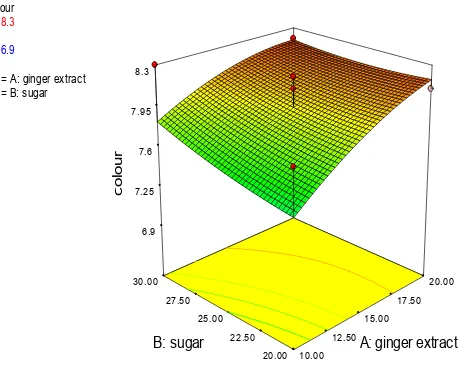
[image:3.595.70.535.336.498.2]For the optimization of the variables, the responses colour, flavour, texture, mouth feel and overall acceptability were selected. From the ANOVA result in Table 2 there was significant difference found for each variable of sensory attributes at p<0.05. All these responses have been shown to create direct effect on the quality of bread (Puranik et al., 2013). Interaction between sugar and ginger extract showed positive (P < 0.05) effect on the flavour as we increase the concentration of ginger extract (Fig. 2). Interaction between sugar and ginger extract to colour had significant negative effect on colour (P < 0.05) (Fig. 3). The interactive effect of ginger to sugar showed positive effect on texture of bread (Fig. 4). On increasing the amount of ginger extract and sugar, mouth feel increases (Fig.5). Interaction between sugar and ginger extract showed positive (P < 0.05) effect on the overall acceptability of optimized bread (Fig 6). The overall effect of ginger extract and sugar was maximum on all sensory
Table 1. Effect of variables on the sensory attributes of developed ginger bread
Variables Sensory Responses
Ginger exract (ml) Sugar(g) Colour Texture Flavour Mouth feel Overall Acceptability
10.00 20.00 10.00 20.00 7.93 22.07 15.00 15.00 15.00 15.00 15.00 15.00 15.00
20.00 20.00 30.00 30.00 25.00 25.00 17.93 32.07 25.00 25.00 25.00 25.00 25.00
7.9 8.1 8.3 8.2 6.9 8.3 7.1 7.9 8.2 7.6 7.8 8.1 8.2
7.4 8.3 5.3 8.3 8.1 8.4 8.3 5.9 7.8 6.7 7.6 8.3 7.8
7.3 8.3 5.2 8.3 8.1 8.3 7.9 5.4 7.6 6.6 7.5 8.4 7.7
7.5 8.2 5.4 8.1 8.2 8.3 8.5 5.8 7.9 6.9 7.5 8.1 7.9
7.6 8.2 5.5 8.2 8.2 8.4 7.4 5.7 7.9 6.8 7.6 8.2 7.7
[image:3.595.103.500.531.619.2]Control 7.2 7.9 8.5 8.4 8.6
Table 2. ANOVA results for value added bread
Source Color Texture Flavour Mouthfeel Overall acceptability
Model SS 0.69 8.46 10.04 8.03 8.48
Model DF 5 5 5 5 5
Mean MS 0.14 1.69 2.01 1.61 1.70
Pure Error 0.29 1.37 1.65 0.91 1.09
Mean 7.95 7.48 7.38 7.45 7.49
F cal. 0.90 4.08 4.00 4.91 5.29
F tab. 0.5289 0.0470 0.0493 0.0301 0.025
R square 0.3918 0.7444 0.7406 0.7781 0.7906
Table 3. Nutritional composition of Control and Optimized value added bread
Bread sample Moisture
(%)
Energy (kcal)
Protein (gm/100g)
CHO (gm/100g)
Fat (gm/100g)
Ash (gm/100g)
Ca (mg/100g)
Fe (mg/100g)
Fibre (gm/100)
Control N 34.5±0.28 258±0.57 6.4±0.05 56.49± 0.04 0.58±0.00 1.47±0.23 12.1±0.05 2.5±0.05 0.2±0.03
Optimised A 23.5±0.23 304±2.30 7.6±0.11 66±0.04 1.0±0.23 1.9±0.42 23±0.57 3.0±0.04 2.0±0.05
Table 3. Nutritional composition of Control and Optimized value added bread
Bread sample Moisture
(%)
Energy (kcal)
Protein (gm/100g)
CHO (gm/100g)
Fat (gm/100g)
Ash (gm/100g)
Ca (mg/100g)
Fe (mg/100g)
Fibre (gm/100)
Control N 34.5±0.28 258±0.57 6.4±0.05 56.49± 0.04 0.58±0.00 1.47±0.23 12.1±0.05 2.5±0.05 0.2±0.03
[image:3.595.52.553.656.699.2] [image:3.595.46.556.734.777.2]responses followed by control. To consider all the responses simultaneously for optimization, the RSM was used to compromise optimum conditions and it was found that the sensory scores were 7.1, 8.3, 7.9, 8.5 & 7.4 for colour, texture, flavor, mouth feel and overall acceptability corresponding to optimum conditions (Table 1).
[image:4.595.309.549.67.253.2]Bread having composition 17.93 g sugar, & 15 ml ginger extract per 100 g bread was found optimum. Triplicate samples were prepared using the optimum conditions and were evaluated for all the responses. Corresponding values for color, texture, flavor, mouth feel and overall acceptability were 7.1, 8.3, 7.9, 8.5 & 7.4 respectively which were comparatively higher than the predicted value (Table 2). Therefore, bread having composition 17.93 g sugar, 15 ml ginger extract per 100 g of bread was found optimum and the said formulation was recommended for value added bread.
Fig. 2. Response surface and counter plots showing effects of variable on the flavor of value added bread
[image:4.595.46.278.282.475.2]Fig. 3. Response surface and counter plots showing effects of variable on the colour of value added bread
Fig. 4. Response surface and counter plots showing effects of variable on the texture of value added bread
[image:4.595.312.547.328.516.2]Fig. 5. Response surface and counter plots showing effects of variable on the mouth feel of value added bread
Fig. 6. Response surface and counter plots showing effects of variable on the overall acceptability of value added bread
Design-Expert® Softw are
flavour 8.4
5.2
X1 = A: ginger extract X2 = B: sugar
10.00 12.50
15.00 17.50
20.00
20.00 22.50 25.00 27.50 30.00
5.2 6.025 6.85 7.675 8.5
f
la
v
o
u
r
A: ginger extract B: sugar
Design-Expert® Softw are
colour 8.3
6.9
X1 = A: ginger extract X2 = B: sugar
10.00 12.50
15.00 17.50
20.00
20.00 22.50 25.00 27.50 30.00
6.9 7.25 7.6 7.95 8.3
c
o
lo
u
r
A: ginger extract B: sugar
Design-Expert® Softw are
texture
8.4
5.3
X1 = A: ginger extract X2 = B: sugar
10.00 12.50
15.00 17.50
20.00
20.00 22.50 25.00 27.50 30.00
5.2 6.025 6.85 7.675 8.5
te
x
tu
re
A: ginger extract B: sugar
Design-Expert® Softw are
mouthfeel
8.3
5.4
X1 = A: ginger extract X2 = B: sugar
10.00 12.50
15.00 17.50
20.00
20.00 22.50 25.00 27.50 30.00
5.4 6.15 6.9 7.65 8.4
m
o
u
th
fe
e
l
A: ginger extract B: sugar
Design-Expert® Softw are overall acceptability
8.4
5.5
X1 = A: ginger extract X2 = B: sugar
10.00 12.50
15.00 17.50
20.00
20.00 22.50 25.00 27.50 30.00
5.5 6.25 7 7.75 8.5
o
v
e
ra
ll
a
c
c
e
p
ta
b
ili
ty
[image:4.595.47.276.554.739.2] [image:4.595.311.551.581.753.2]
(a)
[image:5.595.50.279.48.618.2](b)
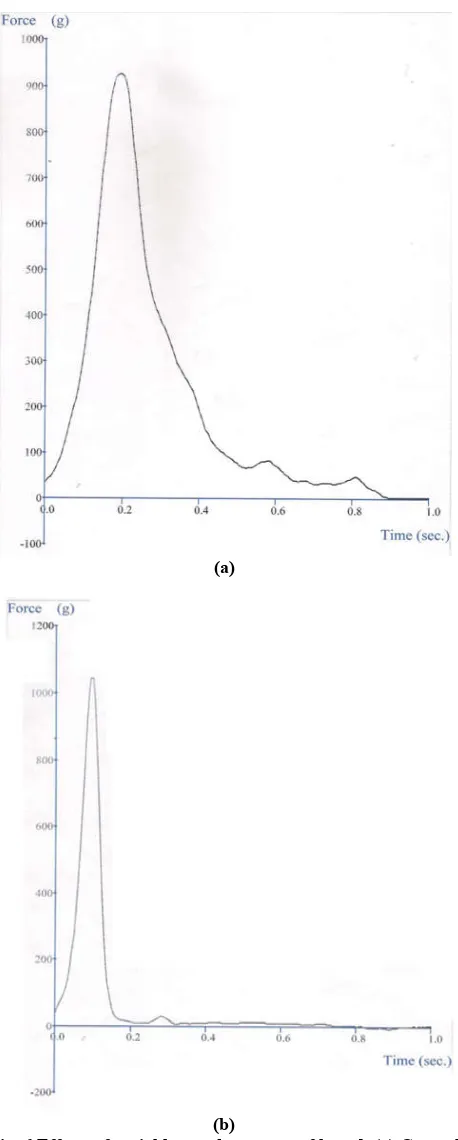
Fig. 6 Effects of variables on the texture of bread: (a) Control bread and (b) Optimized bread
Texture analysis of Optimized Bread
From the results of texture analysis, the hardness of control bread and optimized bread was found to be comparatively near to each other i.e. 915 g and 1015 g respectively (Fig. 6). This result can be correlated with the acceptable sensory scores of control and optimized bread (texture score of 7.9 & 8.3 respectively).
Nutritional Evaluation of Optimized Bread
The nutritional composition of optimized bread regarding moisture, ash, crude fat, crude protein, crude fiber,
carbohydrate and mineral contents are presented in (Table 3). The nutritive value of ginger extract incorporated bread was significantly higher than that of control. By incorporation of ginger extract, the ash content was increased from 1.47% to 2.94%. The optimized bread was found to be superior in terms of minerals, calcium, iron and fibre, 23.6, 3.0mg/100g and 2% respectively as compared to control bread (12.1 & 2.5 mg/100g and 0.2%). The moisture content was decreased from 39.5% to 23.5% which may be also helpful for the improvement of shelf-life of optimized bread. Since, the bread was a good source of calcium, iron and fibre (Table 3), hence it can be recommended for consumption for children and old age people.
Evaluation of antioxidant activity
Antioxidant activity in terms of total phenol content and DPPH % radical scavenging activity was found to be 310.54mgGAE / 100g and 93.2% respectively, for ginger extract incorporated optimized bread which was higher than control bread (212.65mg GAE / 100g & 90.1%) (Table 4). The addition of ginger extract, gave an excellent antioxidant effect on the bread compared with control. The same results were obtained in study in which, in bread, addition of purified extracts of marjoram, mint and basil is reported to have an excellent antioxidant effect compared with the effect of BHA (Bassiouny et al., 1990). The higher efficiency of the ginger extract could be due to the stability of this natural antioxidant during baking. Results of sensory evaluation reveal that the ginger extract at concentrations of 15% may be used in place of synthetic antioxidants in bread. Addition of natural antioxidants can increase shelf-life of food products containing fats and oils. In addition, natural antioxidants are safe and impart health benefits to the consumer.
Conclusion
Acknowledgment
The authors are thankful to the Centre of Food Technology, University of Allahabad, Allahabad for providing necessary facilities for the research work.
REFERENCES
A.O.A.C. (Association of Official Agricultural Chemists). 2005. Official Methods of Analysis. 18th edn. Washington, DC. Association of Official Agricultural Chemists. AOAC., 1997. Officials Methods of Analysis of Association of
Analytic Chemists. AOAC, Washington, DC., USA.
Badreldin, H. et al. 2008. “Some phytochemical,
pharmacological and toxicological properties of ginger (Zingiber officinale Roscoe)” A review of recent research, Food and Chemical Toxicology, 46; 409–420.
Bassiouny, S. S., Hassanien, F. R., Razik Ali, F., & El-Kayati, S. M. 1990. “Efficiency of antioxidants from natural sources in bakery products”, Food Chemistry, 37, 297–305.
Bhattarai S, et al. 2001. “The stability of gingerol and shagaol
in aqueous solution”, Journal Pharma Science
90(10):1658-1664.
Chrubasik S, pittler MH, et al. 2005. Zingibaris rhizome: A comprehensive review on the ginger. Phyto medicine, 12(9):684-701.
De - Ancos B, Sgroppo S, Plaza L. and Cano MP. 2002. “Possible nutritional and health-related value promotion in orange juice preserved by high-pressure treatment”. Journal of the Science of Food and Agriculture, 82: 790– 796.
Francisco C. et al. 2008. “Alterations in behavior and memory induced by the essential oil of Zingiber officinale Roscoe (ginger) in mice are cholinergic-dependent”, Journal of Medicinal Plant Research, Vol.2(7), pp. 163-170.
Girdhari Lal, G.S. Siddappa, G.L. Tandon, 2010. Chutneys, Sauces and Pickles, Preservation of Fruits and Vegetables, ICAR Publication, New Delhi, pp. 235-269.
Mugwiza, Q. 2009. “Optimization of processing parameters for cloudy passion fruit juice processing using pectolytic and
amylolytic enzyme”, Pakistan Journal of Nutrition,
8;1806-1813.
Murray, J.M., C.M. Delahunty, I.A. Baxter, 2001. Descriptive sensory analysis: past, present, future, Food Research International journal, 34; 471-641.
Nazni, P. and Gracia, J. 2014. “Optimization of Fibre Rich Barnyard Millet Bran Cookies Using Response Surface Methodology”, International Journal of Agriculture and Food Science, 4, 100-105.
Philip John Kanu, H.M. Zhou, Jestina Baby Kanu, K.X. Zhu, K.R. Zhu, H.F. Qian, 2007. “The use of response surface
methodology in predicting sesame (Sesamum indicum)
protein extractability with water and the analysis of the protein extracted for it amino acid profile”, Biotechnology, 6; 447-455.
Sai Manohar, R. and Haridas Rao, P. 1999. “Effect of emulsifiers, fat level and type on the rheological characteristics of bread dough and quality of bread”, Journal of Science of Food and Agriculture, 79, 1223– 1231.
Sharma, G.K., Padmashri, A. And Bawa, A.S. 2003. Baked Products-A global Scenario.Proc Food Industry, 14-24. Singleton VL, Orthofer R and Lamuela-Raventos RM. 2005.
Analysis of total phenols and other oxidation substrates and antioxidants by means of Folin–Ciocalteu.
Siva kumar, P.S., S.H. Panda, R.C. Ray, S.K. Naskar, L.K. Bharathi, 2010. “Consumer acceptance of lactic acid fermented pickle”, Journal Sensory Studies. 25;706-719. Thomson M, Al Qattan KK, Al Sawan SM, et al. 2002. “The
use of ginger (Zingiber officinale Rosc.) as a potential anti-inflammatory and antithrombotic agent”, Prostaglandins Leukotriences Essential Fatty Acids, 67(6):475-478. Vinita Puranik, D. K. Chauhan and Vandana Mishra, 2013.
Development of herbal functional RTS beverage, International Journal of Biotechnology Research, Vol. 1(3), pp. 028-037.
Wang CC, Chen LG, Lee LT, et al. 2003. “Effects of 6-gingerol, an antioxidant from ginger, on inducing apoptosis in human leukemic HL-60 cells In Vivo”, Cytotechnology 17(6):641-645.