Homology Curve Complex
Ningthoujam Jiban Singh1*, Himadri Kumar Mukerjee2
1Department of Mathematics, Assam University, Silchar, India
2Department of Mathematics, North-Eastern Hill University, NEHU Campus, Shillong, India
Email: {njiban, himadrinehu}@gmail.com
Received October 22, 2011; revised November 1, 2011; accepted November 12,2011
ABSTRACT
A homological analogue of curve complex of a closed connected orientable surface is developed and studied. The dis-tance in this complex is shown to be quite computable and an algorithm given (Theorem 3.5). As an application of this complex it is shown that for a closed orientable 3-manifold, and any of its Heegaard splittings, one can give an algo-rithm to decide whether the manifold contains a 2-sided, non-separating, closed incompressible surface (Theorem 1.1).
Keywords: Homology Curve Complex; Heegaard Splittings; Incompressible Surface
1. Introduction
Jaco and Oertel ([1]) gave an algorithm to decide if a 3-manifold is a Haken manifold. Their algorithm is an offshoot of an algorithm given by Haken himself. Haken has developed in 1960’s ([2]) an algorithm to decide if a fundamental normal surface of a given presentation of a compact irreducible 3-manifold is injective. Any normal surface can be constructed from these fundamental nor- mal surfaces and if the input is a normal surface then by successive application of the above algorithm one can check if the normal surface is injective. But one does not know for how many normal surfaces (finite or infinite) this algorithm has to be run. Jaco and Oertel ([1]) pro-duced a finite collection of constructible normal surfaces (test surfaces) only on which this algorithm has to be run. Results of similar flavour has been found by Jaco, Let-scher, and Rubinstein [3] and many others.
We, on the other hand, give here an algorithm whose input is any Heegaard splitting of the given manifold. We develop a homological version of curve complex, which we call “homology curve complex”.
The term homology curve complex used in this paper is inspired by the term used in the set of open problems posed by Joan Birman in the arXiv preprint [4], page no. 8, line 12, but is different from what she meant there. This term has also been used recently by Ingrid Irmer in his arXiv preprint [5] with a different meaning.
We prove that for surfaces of genus greater than one, this complex is connected (3.3), hence a notion of dis-tance between vertices, which we call “H-disdis-tance” can be defined. We give an algorithm which returns H-dis-
tance of two given vertices, theorem (3.5). Using this complex we define an analogue of the Hempel distance of a Heegaard splitting of a 3-manifold. This distance is then used to decide if the manifold contains a closed, two-sided incompressible surface or not, a homological analogue of Johnson and Patel ([6], lemma 4), which also extends to genus 2 in our case. Finally an algorithm is given which takes as its input a Heegaard splitting of a given closed connected orientable 3-manifold and decides if this distance is zero or not in polynomial time.
Every closed connected orientable 3-dimensional mani- fold M admits a Heegaard splitting, i.e., a decomposition into two orientable handlebodies V and V′ which meet along their boundary. This common boundary is called a Heegaard surface. Alternately, we may view M as ob- tained from the two handlebodies by identifying their boundaries under a homeomorphism f : ∂V→∂V′. Hee- gaard splittings are a convenient way to define a 3- manifold, but a priori it is difficult to get structural in-formation about the manifold from them. It is in this light the following result assumes importance.
Theorem
(Theorem 4.1) Given a closed, connected, orientable 3- manifold Mand a Heegaard splitting M V gV
of genus g > 1, there is an algorithm, which runs in poly- nomial time, to decide whether M contains a nonsepa- rating,2-sided, closed incompressible surface.
In Section 2 we give a brief recollection of complex of curves and some related concepts. We introduce in Sec-tion 3 an analogue of curve complex, “homology curve complex”, associated with the surface and a notion of distance, “H-distance”, and prove several results de-*The first author acknowledges CSIR, India, for financial supports under
scribing their properties including a result giving an al-gorithm to compute the H-distance between a pair of ver- tices: see lemma (3.2), lemma (3.3), theorem (3.5), pro- position (3.6), proposition (3.7). Section 4 starts with the introduction of the notion of an analogue of the Hempel distance of a Heegaard splitting followed by a recollec-tion of complete meridian systems and some results re-lated to these. Finally, we complete the proof of theorem (1.1) giving an algorithm which takes as its input a Hee- gaard splitting of the given 3-manifold and decide in po- lynomial time if the manifold contains a nonseparating, 2-sided, closed, incompressible surface.
2. Preliminaries
For standard 3-manifold terminologies, we refer the reader to Jaco [7]. The curve complex C( ) for a compact, con- nected, closed, orientable surface is the abstract sim- plicial complex whose vertices are isotopy classes of essential, simple closed curves in and whose sim- plices correspond to sets of distinct isotopy classes which are represented by pairwise disjoint circles (simple closed curves) in . If C( ) is connected we can define an integer valued distance d(x, y) between a pair of vertices x, y as the number of edges in the shortest edge path be-tween them. Given a handlebody V and a homeomor-phism f: ∂V, the handlebody set (or a disk complex)
is the set of (isotopy classes of) circles in
that bound properly embedded essential discs in V. The genus g boundary set g is the set of non-separating circles in such that each bounds a properly embedded, 2-sided, incompressible, genus g surface in V and the boundary set is the union
=∪g 0g. The Hempel distance, denoted by d(V, V′), of the Heegaard splitting (V, V′; g) as defined in Hempel [8] is given by d(V, V′) = inf{d(x, y): x is a vertex of , y is a vertex of }.
The boundary distance as defined in Johnson and Patel [6] is given by
,
d d .
3. Homology Curve Complex
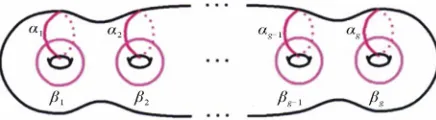
Let g denote a closed, connected and oriented surface of genus g > 1. It is well-known that H1(g; ) has the standard bilinear intersection form ,, which is sym-plectic (i.e., x, x = 0, x H1(g;) and the form establishes a self-duality on H1(g;) (i.e. an isomor-phism H1(g; ) → Hom H1(g; ), )), see for example Johnson [9]. For x, yH1(g; ), the integer x, y is called the algebraic intersection number between x and y. A basis of H1(g; )) (which is a free - module of rank 2g) is called canonical or symplectic if it is of the form {a1, ···, ag, b1, ···, bg} with ai, aj = bi,bj = 0, and ai, bj = ij (Kronecker delta), i, j {1, 2, ···, g}. It is well-known that H1(g; ) has the standard
canonical basis (see Figure 1).
A nontrivial element x H1(g;) is said to be primitive (relative to the canonical basis) if its coordi-nates are relatively prime.
3.1. Definition
We define the homology curve complex of the surface g
, denoted by HC(g), to be an abstract simplicial complex whose vertices are the primitive elements of H1(g;) and a collection {c1, ···, cm} of m distinct
vertices form an (m − 1)-simplex if the algebraic inter- section numbers ci, cj = 0, i, j {1, ···, m}. In the following, we shall represent a vertex of HC(g) by its coordinates relative to the standard canonical (ordered) basis B.
3.2. Lemma
For g > 1, if x, yare distinct vertices of HC(g), then there is a vertex zof HC(
g) such that x, z = 0 = y, z.
Proof. The standard intersection form , on H1(g; ) induces a module homomorphism f: H1(
g ; ) → × defined by t (t, x, t, y). Since is a PID, ker(f) and im(f) are free submodules of the free -modules H1(g;) and × respectively and the sequence 0 → ker(f) →H1(
g
; ) → im(f) → 0 is split-exact. So, H1(
g
; ) = ker(f) im(f). Since di (ker(f)) = H1(
m
dim g; ) − (im(f)) ≥ 2g− 2 ≥ 2, we get a
nontrivial element zH1(
dim
g
;) satisfying x, z = 0 = y, z and so by dividing each of the co-ordinates of z by their gcd, if necessary, we can always take z to be a primitive element.
3.3. Lemma
For g > 1, HC(g) is an infinite dimensional, connected abstract simplicial complex and if the integer valued distance dH(x, y) between a pair of vertices x, y is the number of edges in the shortest edge path between them, then dH is explicitly given by
1, if 0, if and ,; 0; 2, otherwise= . , H x y x
d x y y x y
Proof.It is easy to see that m , the set Am = {(1, x, 0, ···, 0) 2g: 1 ≤x ≤ m, x } of vertices of
[image:2.595.313.531.658.718.2]HC(g) forms an (m− 1)-simplex in HC(g). There-
HC(g) is infinite dimensional. To see that HC(g) is connected, let x, y be distinct vertices of HC(g).
If x, y = 0, then they can be joined by an edge by definition; otherwise by lemma (3.2), there is a vertex z such that x can be joined to z by an edge and then z can be joined to y by another edge.
Notice that a circle α on g is separating if and only if its homology class is zero. There is a characterization of the vertex set of HC(g).
3.4. Lemma
(Meyerson [10]) A nontrivial element ofH1(g; ) can be represented by a non-separating circle on g if and only if it is primitive relative to the standard canonical (ordered) basis of H1(g; ) .
3.5. Theorem
For g > 1, there is an explicit algorithm which takes as input g, a canonical ordered basis B = {a1, ···, ag,
b1, ···, bg} for the homology H1(g; ), a pair of verti-ces α, β of HC(g) and returns the distance between them.
Proof. By part (f) of Theorem 1 in [11], there is an al-gorithm to compute the algebraic intersection number α, β and also the co-ordinates of α and β relative to the basis B in polynomial time. If α = β then by lemma 3.3 dH(α, β) = 0. If αβ by lemma 3.3 again, dH(α, β) = 1 if and only if the algebraic intersection number between α and β = 0. If neither of these hold, then by lemma 3.3 again dH(α, β) = 2.
3.6. Proposition
With the same notations as above, every simplicial auto- morphism : HC(g) → HC(g) induces an isometry on the metric space (HC0(
g
), dH), where HC0(
g ) de- notes the set of vertices of HC(g).
Proof.Let x, y be vertices of HC(g) with dH(x, y) = k, where k = 0, 1, or 2. For k = 0, 1, the result follows from the fact that a simplicial automorphism maps m- simplices to m-simplices and in particular if x y and x, y = 0, thereby dH(x, y) = 1, then x, y form an edge. So, λ(x) λ(y) will also form an edge, so λ(x), λ(y) = 0 thereby dH(λ(x), λ(y)) = 1. If k = 2, i.e. if x, y 0, by lemma (3.2) there is a vertex z of HC(g) such that x, z = 0 = y, z. So, λ(x), λ(z) = 0 = λ(y), λ(z). This gives, by triangle inequality, dH(λ(x), λ(y)) ≤ 2. However, dH(λ(x), λ(y)) < 2 implies that dH(λ(x), λ(y)) = 0 or 1. This implies that λ(x), λ(y) = 0 and so x, y = 0, which is a contradiction. So, dH(λ(x), λ(y)) = 2.
3.7. Proposition
Let k {0, 1, 2}. For g > 1, the set {(x, y) HC0(
g ) ×
HC0(
g)|dH(x, y) = k} is infinite.
Proof. For k = 0, 1, the result follows from lemma (3.3). For k = 2, there are vertices a, b in the vertex set of HC(g) with algebraic intersection number 1, which also have respective representative circles with geometric intersection number 1. Consider the positive Dehn twist Ta. Now, n , a (b), b = b + na, ba, b = na, ba, b + b, b = n and so by definition,
Tn
n a
dH(T (b), b) = 2, whenever n 0. This proves the result.
4. Applications
As an application of the concepts developed in the pre-vious sections we shall present a complexity measure for Heegaard splitting using the homology curve complex and prove.
4.1. Theorem
(Theorem 1.1) Given a closed, connected, orientable 3- manifold Mand a Heegaard splitting M V gV of genus g > 1, there is an algorithm, which runs in polyno- mial time, to decide whether M contains a non-sepa-rating,2-sided, closed incompressible surface.
Before giving the proof we need to introduce some more notations and definitions:
4.2. Definition
For a Heegaard splitting (V, V′; g), let D (resp. D′) denote the set of vertices in HC(g), each represented by a circle whose homology class is nontrivial in g, but trivial in V (resp. V′). Then, we define the H-distance, denoted by dH(V, V′), for the splitting (V, V′; g) to be the inf{dH(x, y): xD, yD′}.
As immediate consequence of lemma (3.3), we have the following.
4.3. Lemma
For (g > 1), the H-distance of the Heegaard splitting g
M V V takes only the finite values 0,1 or 2.
4.4. Remark
For any Heegaard splitting M V gV of genus 3 or greater, Johnson and Patel [6] showed, using complex of curves (different from homology curve complex), an analogous result that distance d(g) is equal to 0, 1 or 2.
4.5. Definition
A complete meridian system (or simply cms) for a han-dlebody V is a set L = {D1, ···, Dg} of pairwise disjoint
boundaries of the discs of a cms for V form a meridian system for the surface ∂V.
Given a cms L = {D1, ···, Dg} for a handlebody V, let α
be a simple arc on the boundary ∂V connecting ∂Di and ∂Dj (i j) with int (α) disjoint from L. Let N denote a regular neighbourhood of ∂Di ∪∂Dj ∪α in g. Then, ∂N has three components, one is a copy of ∂Di, one is a copy of ∂Dj and the other one is called a band sum of ∂Di and ∂Dj along α on ∂V which gives arise to a compress-ing disc Dij in V (after slight pushing the interior of the disc inside V) with boundary ∂Dij being the band sum. Denote L′ = {D1, ···, Di−1, Dij, Di+1, ···, Dg}. We say that
L′ is obtained from L by an elementary slide (and Dij is also called a disc slide). If a cms L′ on V is obtained from a cms L on V via a finite number of elementary slides and isotopies, we say that L and L′ are equivalent and denoted by L L′. We also say that L slides to L′. The following fact about cmss of discs on a handlebody V is well- known (see for example [12]), which tells us how two cmss of discs for a handlebdy are related.
4.6. Proposition
Assume that Lis a cms of discs for a handlebody Vand L slides to L′, then L′ is also a cms of discs for V. Con-versely, any two cmss of discs for Vare equivalent.
4.7. Remark
It is well-known that if D is a non-separating properly embedded compressing disc for a genus g handlebody V, then {D} can be extended algorithmically to a cms of discs for V in g many steps.
Proof of the theorem (4.1). We will begin with the following characterization of a closed connected orien- table 3-manifold which is an extension of Johnson-Patel ([6], lemma 4) to the setting of homology curve complex.
4.8. Theorem
Let Mbe a closed connected orientable 3-manifold with a Heegaard splitting (V, V′; g) of genus g > 1. Then for any pair of cmss L = {D1, ···, Dg}, L′ = {D1, ···,Dg} for the respective handlebodies V and V′, the following statements are equivalent:
1) Mcontains a non-separating, two-sided, closed in-compressible surface;
2) H1(M) is infinite;
3) The matrix A = (aij), where aij is the algebraic in-tersection number of Di and Dj, is singular;
4) d(g
) = 0; 5) dH(V, V′) = 0.
Proof. 1 2 is a classical result (see Jaco [7], or Johnson-Patel [6]). 2 3 4 is due to Johnson- Patel ([6], lemma 4). By definition D is a quotient of
, consisting of homology classes of elements of ,
so d(g) = 0 implies dH(V, V′) = 0, or 4 5. Now we prove that 5 1. If dH(V, V′) = 0 then there exists x D∩D′ HC(
g
). Pick two disjoint simple closed curves and ′ on g, each of which represents x. Then,
and ′ bound two-sided, non-separating properly em-bedded compact surfaces FV and F′V′ respectively. Since and ′ are homologous in g, they cobound a compact subsurface S of g. The union F∪S∪F′ is a two-sided, non-separating closed surface embedded in M. By compressing repeatedly, if necessary, we eventu-ally find a closed, non-separating, two-sided incompre- ssible surface in M.
We are ready to complete the proof of theorem (4.1). Proof. (Completion of proof of theorem (4.1))
By theorem (4.8), existence of a non-separating, two- sided, closed incompressible surface in M is reduced to examining if dH(V, V′) = dH(D, D′) = d(g) = 0, which
in turn reduced to examining if the matrix A = (aij) is singular, where aijis the algebraic intersection number of Di and ∂Dj. One can compute the entries aij of the matrix A in polynomial time (see for example [11] theorem 1 (f)) and the non-singularity of a matrix can be determined in polynomial time (see for example section 2.3 of [13]). This completes the proof of the theorem (4.1).
4.9. Problem
It will be interesting to characterize those closed ori-entable 3-manifolds which possess Heegaard splittings having H-distance 1 and/or 2.
5. Acknowledgements
We acknowledge Prof. Joan Birman for her useful com-ments on an earlier version of the draft of our paper. We also acknowledge the anonymous referees for their useful comments.
REFERENCES
[1] W. Jaco and U. Oertel, “An Algorithm to Decide If a 3- Manifold Is a Haken Manifold,” Topology, Vol. 23, No. 2, 1984, pp. 195-209. doi:10.1016/0040-9383(84)90039-9 [2] W. Haken, “Theorie der Normalflachen,” Acta Mathe-
matica, Vol. 105, No. 3-4, 1961, pp. 245-375. doi:10.1007/BF02559591
[3] W. Jaco, D. Letscher and J. H. Rubinstein, “Algorithms for Essential Surfaces in 3-Manifolds,” Contemporary Mathematics, Vol. 314, 2002, pp. 107-124.
doi:10.1090/conm/314/05426
[5] I. Irmer, “Geometry of the Homology Curve Complex,” arXiv.org, 2011. http://arxiv.org/abs/1107.3547
[6] J. Johnson and T. Patel, “Generalized Handlebody Sets and Non-Haken 3-Manifolds,” Pacific Journal of Mathe-matics, Vol. 235, No. 1, 2005, pp. 35-41.
[7] W. Jaco, “Lectures on Three-Manifold Topology,” CBMS Regional Conference Series in Mathematics, American Mathematical Society, Providence, 1980.
[8] J. Hempel, “3-Manifolds as Viewed from the Curve Com-plex,” Topology, Vol. 40, No. 3, 2001, pp. 631-657. doi:10.1016/S0040-9383(00)00033-1
[9] D. Johnson, “An Abelian Quotient of the Mapping Class Group Ig,” Mathematische Annalen, Vol. 249, No. 3, 1980, pp. 225-242. doi:10.1007/BF01363897
[10] M. D. Meyerson, “Representing Homology Classes of
Closed Orientable Surfaces,” Proceedings of AMS, Vol. 61, No. 1, 1976, pp. 181-182.
[11] M. Schaefer, E. Sedgwick and D. Stefankovic, “Algori- thms for Normal Curves and Surfaces,” Lecture Notes in Computer Science, Springer, 2002, New York, pp. 370- 380.
[12] F. C. Lei, “Complete Systems of Surfaces in 3-Mani- folds,”Mathematical Proceedings of the Cambridge Phi- losophical Society, Vol. 122, No. 1, 1997, pp. 185-191. doi:10.1017/S0305004196001545